
TL;DR
-
Gemini 3.8 Flash is GA (
gemini-3.8-flash, Sep 2 2026) — current workhorse for agentic and coding workloads, ~1.05M-class context, natively multimodal. Introductory API price $0.75/$3.75 per 1M tokens through 2026-12-31, then $1.50/$7.50 (same intro rates as 3.7 Flash). Use it as the starting production tier for speed, agents, and volume — not as a permanent org-wide law. 3.7 Flash remains supported for efficiency-first workloads. Gemini 3.8 Flash Cyber is Fairwind-only, not a public API SKU. Gemini 4 Argon (announced Sep 30 2026) is also Fairwind-only. Google has not published an Argon API id, so do not pin it. Announced launch price is $2/$10 per 1M tokens, then $4/$20 after an introductory period whose end date is not published. Cached input is 95% off. Max output is 1M tokens. -
Gemini 3.5 Pro is rolling out; when Pro is not GA for your project, escalate hard reasoning to Gemini 3.1 Pro (or the current Pro-class ID in docs). Be honest about availability — check Google model docs before committing.
-
Two surfaces: Gemini API (AI Studio / API keys) and Vertex AI (GCP IAM, VPC, enterprise controls). Grounding with Google Search reduces stale parametric answers for public facts. Gemini 3.5 Transcribe (preview, Aug 26 2026) is a speech-to-text sibling (
gemini-3.5-transcribe/-live), not a new Flash/Pro generation. Gemini 3.8 Live (gemini-3.8-live/gemini-3.8-live-extended-thinking, Sep 15 2026) is a Live API speech-to-speech SKU for voice agents — pin those IDs separately; they are not a Flash chat default. Live Avatar (Sep 24 2026) adds lip-synced video to 3.8 Live in Gemini Enterprise. Gemini 3.8 Flash TTS and Flash-Lite TTS (Sep 23 2026) are speech-generation models on the Gemini API and AI Studio; confirm model IDs in Google docs before pinning. -
Route: Flash for speed/agents/volume; Pro-class for hard reasoning and heavy long multimodal. Pin versioned IDs; verify pricing live.
-
History only: Gemini 1.x → 1.5 → 2.x → 3.x → 3.5 Flash → 3.6 Flash → 3.7 Flash → 3.8 Flash. Do not start new systems on retired 1.5/2.x IDs without a migration plan.
Quick Decision Guide
| If you want to... | Read |
|---|---|
| Route OpenAI GPT tiers | GPT Models |
| Use Anthropic Claude | Claude Models |
| Use Google Gemini | Gemini Models |
| Self-host open weights | Llama · Mistral · DeepSeek |
| Reduce model cost | Cost Optimization |
| Compare on your own tasks | Evaluation |
Who this guide is for
- Best for: AI engineers · ML engineers · backend engineers · architects
- Difficulty: Intermediate
- Estimated time: 55 min
Learning Path
Large Language Models → Prompt Engineering → Gemini Models → Function Calling → Cost Optimization → Evaluation
On this page
- Why This Matters
- The Problem Gemini Models Solve
- How We Got Here
- What Is the Gemini Model Family?
- How Gemini Models Work
- Architecture
- Step-by-Step Flow
- Real Production Example
- Design Decisions
- Comparisons
- Common Mistakes
- Where It Breaks Down
- When NOT to Default to Gemini
- Running in Production
- Production Checklist
- Related Guides
- Interview Questions
- Key Takeaways
- FAQs
- References
- Further Reading
Why This Matters
Google positions Gemini as the AI layer across Search, Workspace, Android, Cloud, and DeepMind research. For teams already on Google Cloud, Gemini is often the path of least resistance: unified billing, IAM, VPC-SC, and regional controls on Vertex AI.
Rapid naming (1.5 → 2.x → 3.5) and dual entry points (AI Studio vs Vertex) create misconfiguration risk. Understanding the Flash vs Pro-class split, multimodal context, and grounding options prevents surprise bills and silent quality regressions when aliases move.
If you evaluate providers, Gemini deserves a serious bake-off for multimodal workloads, GCP-native data planes, and Flash-priced high volume — measured against GPT and Claude on your golden set. Treat model enablement as an ops concern: a design doc that assumes Gemini 3.5 Pro while the project only has Flash and 3.1 Pro will fail at the worst time — launch week. Keep role→ID maps and availability checks in the same place you store rate-limit runbooks.
Engineering Insight
Most production failures trace back to weak routing and evaluation, not to picking the "wrong" provider. Choose tiers by workload and eval-gate every change.
The Problem Gemini Models Solve
Multimodal AI historically meant brittle pipelines: OCR for PDFs, a vision model for images, speech-to-text for audio, then an LLM to synthesize. Latency compounded; failure modes multiplied.
Gemini was designed as a natively multimodal foundation model — text, code, images, audio, and video in one context. That simplifies:
- Document and chart understanding without a separate vision microservice for many cases
- Video / long media analysis inside a large context window (~1.05M class on current Flash — verify)
- GCP data workflows — BigQuery, GCS, and Vertex agents under one identity plane
- Volume economics — Flash tiers for high-QPS classify/extract/agent steps
Procurement also simplifies for GCP-standardized orgs: one vendor review, one invoice path. The tradeoff is ecosystem maturity vs OpenAI in some third-party tools, and the need to track which Pro ID is actually GA for your region/project. Reliability still requires grounding, schemas, and evaluation — see large language models.
How We Got Here
Diagram: Gemini family evolution
timeline
    title From Gemini 1.x to 3.8 Flash
    2023-2024 : Gemini 1.x / 1.5
              : Native multimodal + long context
    2024-2025 : Gemini 2.x
              : Faster Flash + stronger Pro / thinking
    2025-2026 : Gemini 3.x / 3.5
              : 3.6 then 3.7 Flash GA
              : 3.8 Flash GA (Sep 2026)
              : 3.8 Live voice SKUs (Sep 2026)
              : Flash TTS + Live Avatar (Sep 2026)
              : Pro-class rolling out / 3.1 Pro escalate
Long multimodal context arrived early; production practice settled on Flash for volume/agents and Pro-class for hard reasoning.
| Era | Representative IDs | Engineering lesson |
|---|---|---|
| 1.5 | gemini-1.5-pro, gemini-1.5-flash |
Million-token multimodal demos |
| 2.x | gemini-2.0-flash, gemini-2.5-pro |
Thinking modes; sharper coding |
| 3.6 | gemini-3.6-flash |
Prior Flash GA (Jul 2026) |
| 3.7 | gemini-3.7-flash |
Prior Flash workhorse (Aug 2026) |
| 3.8 | gemini-3.8-flash, Live IDs, TTS, Pro partner-testing |
Flash for chat; Live for voice; TTS for speech out; verify Pro |
| 4 Argon | no public API id | Announced Sep 30 2026; Fairwind only — not a pin |
Keep 1.x/2.x in migration history. New builds should pin gemini-3.8-flash and the currently available Pro-class ID from Google docs. Do not pin Gemini 4 Argon; Google has not published an API id. 3.7 Flash remains supported when you need the previous efficiency profile.
What Is the Gemini Model Family?
Gemini is Google DeepMind's family of large multimodal models. Unlike text-first models that bolted on vision later, Gemini's stack targets heterogeneous inputs from the start.
| Tier | Typical ID | Role |
|---|---|---|
| Flash | gemini-3.8-flash |
Speed, agents, coding, high volume — primary GA workhorse |
| Pro-class | gemini-3.5-pro (when GA) or gemini-3.1-pro |
Hard reasoning / long multimodal escalation |
| Lite / other | Flash-Lite variants (when offered) | Ultra-cheap classify/route — verify current catalog |
| Transcribe | gemini-3.5-transcribe, -live (preview) |
Speech-to-text (recorded + streaming); not a chat model |
| Live | gemini-3.8-live, gemini-3.8-live-extended-thinking |
Real-time voice agents (Live API); not a Flash/Pro chat default |
| Cyber | gemini-3.8-flash Cyber (Fairwind only) |
Trusted-defender vuln discovery/patching — not public API |
| Argon | none published | Gemini 4, announced 2026-09-30, Fairwind only — not a public pin |
Access paths:
- Google AI Studio / Gemini API — API keys, fast prototyping
- Vertex AI — enterprise GCP, SLAs, CMEK, VPC-SC
- Consumer surfaces — Gemini app, Workspace (different product constraints)
Note
Availability of Gemini 3.5 Pro varies by account and region. If Pro is not GA for you, escalate hard work to Gemini 3.1 Pro (or the documented successor) and re-check monthly. Never assume a blog post ID is live in your project.
How Gemini Models Work
Multimodal encoding. Text, images, audio, and video map into a shared token space; cross-modal attention runs inside one context window. That design is why Gemini often wins bake-offs on PDF-with-charts, UI screenshots, and short video understanding without a separate OCR/vision microservice. It is not magic: huge media packs still dominate token bills and latency, and middle-of-context attention can degrade — measure recall on long multimodal golden sets the same way you would for long text.
Autoregressive generation. Output tokens stream like other LLMs. Thinking / reasoning modes on supported models spend extra internal tokens for harder problems — bill and latency rise. Treat thinking as a per-route dial analogous to Claude effort or GPT Sol reasoning modes: on for hard planning, off for FAQ classify.
Context caching (Vertex / supported APIs). Cache large prefixes (docs, videos) and reuse across requests at reduced cost — critical for repeated corpus queries. Layout matters: static corpus first, user query last. A cache miss on every turn because you prepend a timestamp defeats the feature.
Grounding. Connect Gemini to Google Search or enterprise datastores so answers cite fresher public or private evidence — reducing parametric drift for current events. Grounding is not a full substitute for application-level claim verification. Search snippets can be incomplete or mis-cited; for regulated answers, validate spans and refuse when evidence is weak — see hallucinations and evaluation.
Function calling. Tool declarations follow patterns familiar from function calling; combine with structured outputs for parsers. On Vertex, pair tools with IAM-scoped service accounts so the model cannot reach data your product identity should not see.
API vs Vertex semantics. Prototypes on AI Studio often use API keys and looser networking. Production on Vertex should redo auth, logging, and data-residency reviews — do not copy a Studio notebook into a public Cloud Run service with a long-lived key.
The Transformer backbone remains attention + feed-forward with residuals:
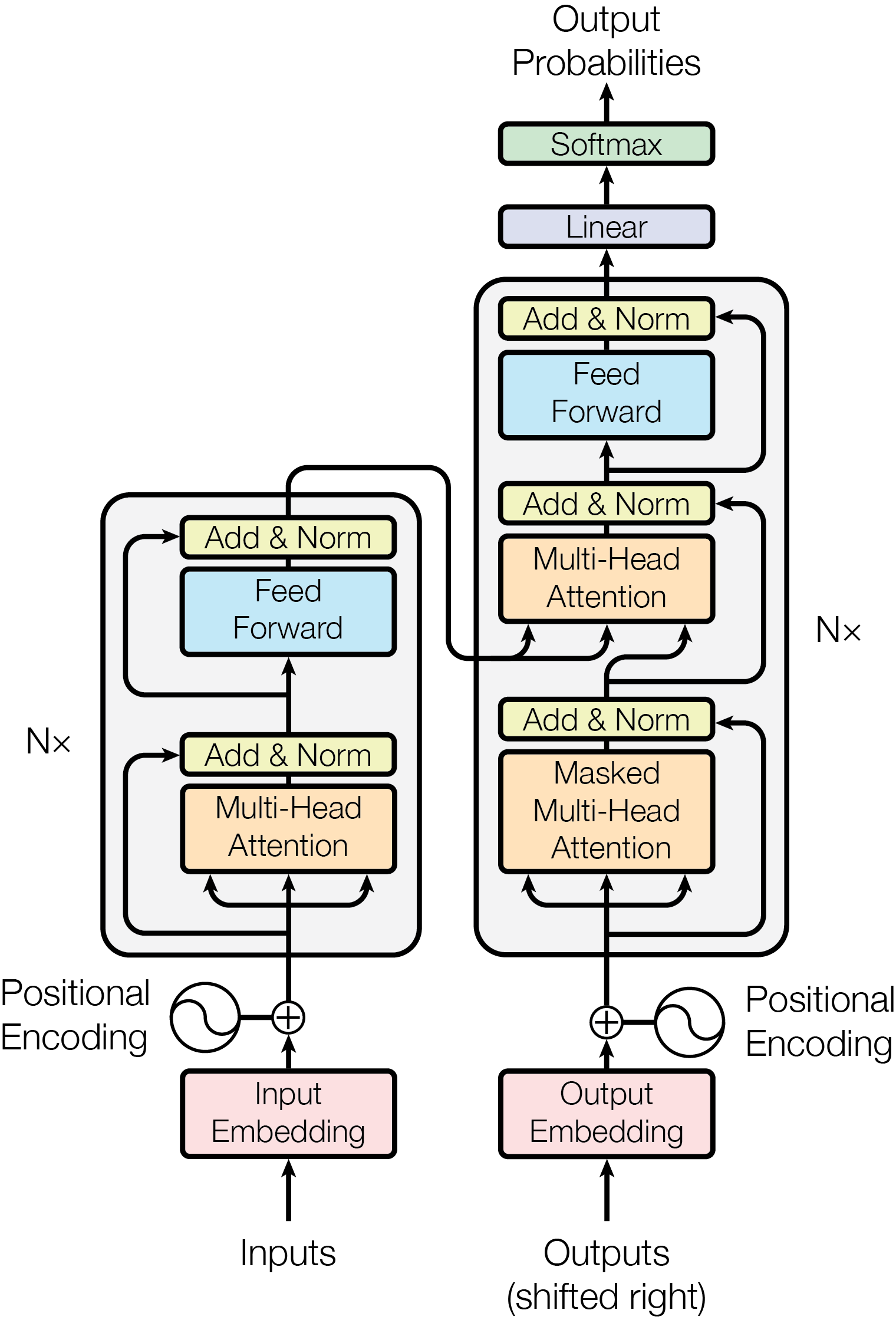
Source: Google Research
Architecture
Diagram: Gemini production architecture
flowchart TB
    subgraph Entry [Entry points]
        Studio[Gemini API / AI Studio]
        Vertex[Vertex AI]
    end
    subgraph Models [Model tiers]
        F[gemini-3.8-flash]
        P[Pro-class: 3.5 Pro or 3.1 Pro]
    end
    subgraph Controls [Controls]
        Ground[Search / datastore grounding]
        Cache[Context cache]
        Tools[Function calling]
        Schema[Structured outputs]
        Eval[Eval + Cloud Monitoring]
    end
    Studio --> F
    Vertex --> F
    Studio --> P
    Vertex --> P
    F --> Tools
    P --> Ground
    Tools --> Schema
    Ground --> Cache --> Eval
Pick API vs Vertex for controls; pick Flash vs Pro-class for difficulty; ground and cache where corpora repeat.
| Component | Responsibility |
|---|---|
| Surface | Gemini API for speed-to-proto; Vertex for enterprise controls |
| Router | Flash vs Pro-class by complexity and stakes |
| Grounding | Search/enterprise for factual public/private facts |
| Cache | Large static multimodal prefixes |
| Pinned ID | Exact version string in env; log on every span |
Lineup snapshot (September 2026)
| Model | Status | Best for | Context (approx.) |
|---|---|---|---|
gemini-3.8-flash |
GA | Agents, coding, volume, multimodal | ~1.05M — verify |
gemini-3.7-flash |
GA (supported) | Efficiency-first / prior pin | ~1.05M — verify |
gemini-3.5-pro |
Rolling out | Hard reasoning / long multimodal | Verify when GA |
gemini-3.1-pro |
Escalation when 3.5 Pro unavailable | Hard reasoning stand-in | Verify docs |
Pricing: Google publishes Flash/Pro rates that change with promotions and regions. Verify on the current Gemini API / Vertex pricing pages before budgeting. Cost levers match peers: route Flash-first, cache, Batch/offline where offered, compress context — cost optimization.
Step-by-Step Flow
Diagram: Flash-first request with Pro escalation
sequenceDiagram
    participant U as User
    participant App as App / Vertex endpoint
    participant Rt as Router
    participant G as Gemini
    participant Gr as Grounding / Tools
    U->>App: Multimodal or text request
    App->>Rt: Score difficulty + modality needs
    Rt-->>App: flash | pro-class
    App->>G: Contents + tools + optional ground
    alt tool or grounding
        G->>Gr: Search / function call
        Gr-->>G: Evidence / result
    end
    G-->>App: Streamed candidates
    App-->>U: Validated response
Start on Flash; escalate to Pro-class only when eval or confidence requires it.
- Choose surface — Gemini API vs Vertex (IAM, VPC, CMEK needs).
- Profile modality — text-only vs image/PDF/video; size the context pack.
- Start on
gemini-3.8-flashfor agents, coding assistants, and volume. - Define Pro escalation —
gemini-3.5-proif GA; elsegemini-3.1-pro(verify). - Enable grounding for public-fact or enterprise-datastore paths.
- Add function calling + schemas for actions and parsers.
- Turn on context caching for repeated corpora.
- Instrument and eval — model ID, tokens, grounding citations, latency, cost — evaluation.
| Workload | Start | Escalate |
|---|---|---|
| High-QPS classify / extract | 3.8 Flash | Pro-class if quality fails |
| Agentic tool loops | 3.8 Flash | Pro-class on hard planning |
| Coding assistant | 3.8 Flash | Pro-class for hardest refactors |
| Long video / heavy multimodal reason | Flash pack | Pro-class |
| Current-events Q&A | Flash + Search grounding | Human / verifier |
Real Production Example
GCP support assistant: Flash classifies and answers with optional Search grounding; Pro-class handles flagged complex policy reasoning. IDs come from environment so you can swap when 3.5 Pro becomes GA.
from __future__ import annotations

import os
from google import genai
from google.genai import types

client = genai.Client(api_key=os.environ["GEMINI_API_KEY"])

FLASH = os.environ.get("GEMINI_FLASH_MODEL", "gemini-3.8-flash")
# Prefer 3.5 Pro when your project has GA access; else 3.1 Pro.
PRO = os.environ.get("GEMINI_PRO_MODEL", "gemini-3.1-pro")


def classify_complexity(text: str) -> str:
    resp = client.models.generate_content(
        model=FLASH,
        contents=(
            "Classify complexity as simple or complex. One word only.\n\n"
            + text
        ),
        config=types.GenerateContentConfig(temperature=0),
    )
    return (resp.text or "simple").strip().lower()


def answer(text: str, *, use_grounding: bool = True) -> str:
    complexity = classify_complexity(text)
    model = PRO if complexity.startswith("complex") else FLASH
    tools = []
    if use_grounding:
        tools.append(types.Tool(google_search=types.GoogleSearch()))
    resp = client.models.generate_content(
        model=model,
        contents=text,
        config=types.GenerateContentConfig(
            temperature=0.2,
            tools=tools or None,
        ),
    )
    return resp.text or ""


print(answer("What changed in our publicly documented API rate limits this month?"))
On Vertex, swap the client to Vertex auth and keep the same Flash/Pro routing. Prefer datastore grounding for private corpora instead of Search.
Design Decisions
Choose Gemini when:
- Multimodal (esp. video/PDF-heavy) inputs are first-class
- You are standardized on GCP / Vertex controls
- Search or enterprise grounding fits the product
- Flash wins your cost/latency bake-off for agents and volume
Prefer another family when:
- OpenAI tooling / Azure OpenAI is already the spine and OpenAI's current flagship GPT models win evals → GPT
- Long-context careful coding + MCP IDE hosts favor Anthropic → Claude
- You must self-host open weights → Llama / Mistral
Availability engineering is part of Gemini design in mid-2026: keep a config map from logical roles (flash, pro) to concrete IDs, and allow ops to flip pro from gemini-3.1-pro to gemini-3.5-pro without a code freeze. Document the flip in the same runbook as rate-limit raises. Treat "Pro rolling out" as an operational fact, not a footnote.
Common patterns
| Pattern | Practice |
|---|---|
| Flash-first agents | Tool loops on 3.8 Flash; Pro for final hard synthesis |
| Grounded factual | Search or datastore on; verify citations in app code |
| Vertex enterprise | Private networking + IAM; same model IDs when available |
| Cache the corpus | Video/doc prefixes cached across sessions |
| Availability shim | Config maps 3.5 Pro → 3.1 Pro until GA |
| Modality budgets | Cap frames/resolution before tokenization |
Diagram: Flash vs Pro-class
flowchart TD
    Q[Request] --> M{Heavy multimodal hard reason?}
    M -->|Yes| P[Pro-class 3.5 or 3.1]
    M -->|No| A{Agent / code / volume?}
    A -->|Yes| F[gemini-3.8-flash]
    A -->|No| F2[Flash + optional grounding]
    F --> E{Eval fail / low confidence?}
    F2 --> E
    E -->|Yes| P
    E -->|No| Out[Deliver]
Flash carries agents and volume; Pro-class is an escalation, not the permanent default.
For Workspace-adjacent products, clarify whether user traffic hits consumer Gemini surfaces or your Vertex project — data handling and retention differ. Product marketing saying "powered by Gemini" is not an architecture diagram.
Comparisons
| Dimension | Gemini | GPT | Claude | Llama |
|---|---|---|---|---|
| Current workhorses | 3.8 Flash; Pro-class escalate | OpenAI current flagship / volume tiers | Anthropic current flagship / volume tiers | Size-dependent |
| Multimodal | Native strong | Strong (tier-dependent) | Strong vision; less video-centric | Varies |
| Grounding | Search + Vertex datastores | Tools / browsing variants | Tools / MCP | DIY |
| Enterprise plane | Vertex AI | Azure OpenAI | Anthropic / AWS beds | Self-host |
| Context (approx.) | ~1.05M Flash — verify | Large — verify | Large — verify | Often smaller |
| Volume economics | Flash-first | OpenAI volume tier | Anthropic volume tier | GPU CapEx |
| Gemini tier | Prefer for | Avoid as permanent default for |
|---|---|---|
| 3.8 Flash | Agents, coding, volume, most multimodal | Hardest proofs if eval fails |
| Pro-class | Hard reasoning / heavy multimodal | Every FAQ request |
Include at least one multimodal slice and one pure-text slice in every provider comparison. Gemini can win video/PDF tasks while losing a text-only coding pack — shipping "Gemini everywhere" because of one win is how permanent-default mistakes start.
Common Mistakes
- Assuming 3.5 Pro is GA everywhere — check project access; keep a 3.1 Pro fallback ID.
- Flash ignored for agents — many agent loops belong on Flash; Pro is escalation.
- Grounding without citation checks — Search snippets can still be misread; verify spans.
- Mixing AI Studio prototypes into Vertex prod without IAM review — different trust boundaries.
- Unpinned model strings — aliases move; pin and eval.
- Megacontext without cache — repeated video/doc prompts without caching waste budget.
- Skipping peer bake-offs — Gemini is not automatically best for pure text coding or every RAG chat.
Where It Breaks Down
- Pro availability lag — roadmap ≠ your project's enabled models.
- Ecosystem gaps — some third-party SDKs still optimize for OpenAI shapes first.
- Grounding overtrust — grounded ≠ verified; add application checks for high stakes.
- Latency on huge multimodal packs — stream; truncate; cache.
- Policy / regional limits — some modalities or grounds restricted by region.
- Knowledge cutoff without grounding/RAG — same class of failure as other LLMs.
- Quota fragmentation — AI Studio and Vertex quotas differ; a Studio prototype that "worked" can 429 in Vertex under real traffic.
- Citation UX debt — Search grounding returns metadata you must render and validate, or users cannot audit answers.
When NOT to Default to Gemini
Do not set Gemini (or Pro-class) as the permanent org default when:
- GPT or Claude win your measured quality/latency/cost frontier
- You are not on GCP and Vertex benefits do not matter — pick the winner of the bake-off
- Almost all traffic is text FAQ and another volume tier is cheaper at equal quality
- Pro IDs you planned are not enabled — do not ship architecture on vapor availability
- You lack token/cost attribution — instrument first
Warning
A permanent single Gemini model ID for all traffic is an anti-pattern. Route Flash vs Pro-class by capability, latency, and cost; verify GA; pin versions.
Running in Production
Best Practice
Default interactive and agent traffic to
gemini-3.8-flash, escalate to a verified Pro-class ID, prefer Vertex for enterprise controls, and eval-gate every ID change.
| Dimension | Guidance |
|---|---|
| Scaling | Stateless clients; Vertex quotas; separate Batch/offline pools |
| Cost | Flash-first, context cache, truncate media, attribute $ — cost optimization |
| Latency | Flash + streaming; Pro async for hard jobs |
| Security | Vertex IAM/VPC-SC; no browser-held keys; sanitize tool args |
| Observability | Model ID, modality sizes, grounding metadata, tokens, TTFT |
| Evaluation | Multimodal + text golden sets; CI on upgrades — evaluation |
| Reliability | Retry/backoff; fallback to GPT/Claude twin route |
Multimodal traffic needs explicit size budgets: cap frames, downsample images, and reject oversized uploads before they hit the model. Log input modality breakdown (text tokens vs media tokens estimate) so cost spikes from video are visible. Keep a monthly calendar item to re-check whether gemini-3.5-pro is GA for your org — architecture docs that assume Pro while traffic silently stays on Flash (or the reverse) create confusing incident timelines.
Continue Learning
- Next guide: GPT Models
- Then: Claude Models
Production Checklist
- Model ID pinned per environment (Flash vs Pro-class)
- Pro-class availability verified; fallback documented if not GA
- Vertex AI vs Gemini API surface decision recorded
- Media size budgets and modality metrics configured
- Grounding enabled on factual paths with citation handling
- Function calling and structured outputs on parsed paths
- Context caching configured for repeated corpora
- Token, cost, and modality metrics attributed per route
- Golden-set gates for text and multimodal upgrades
- Cross-provider fallback plan load-tested
- Rollback strategy for ID or tier changes documented
Related Guides
Prerequisites
Core Concepts
Implementation
Optimization
Advanced Topics
Diagram: Gemini learning path
flowchart LR
    LLM[LLMs] --> GM[Gemini models]
    GM --> FC[Function calling]
    FC --> SO[Structured outputs]
    SO --> CO[Cost opt]
    CO --> EV[Evaluation]
    GM --> GPT[GPT]
    GM --> CL[Claude]
Learn Flash/Pro routing, then tools and cost controls; compare peers on multimodal and text suites.
Interview Questions
-
How do you choose Flash vs Pro-class?
Flash for speed, agents, coding, volume; Pro-class when Flash fails hard-reasoning or heavy multimodal evals. Never permanent Pro for all traffic. -
What if Gemini 3.5 Pro is not GA?
Escalate to Gemini 3.1 Pro (or current documented Pro) and track enablement — do not block the product on an unreleased ID. -
Gemini API vs Vertex?
API for prototypes; Vertex for IAM, VPC, CMEK, enterprise SLAs. -
What does Search grounding buy you?
Fresher public evidence and citations — still verify claims in the app for high stakes. -
Why is Gemini strong for multimodal?
Native multi-input training/stack reduces glue between OCR/vision/ASR and the LLM for many workloads. -
Gemini vs Claude for coding?
Bake off 3.8 Flash / Pro-class vs Anthropic's current flagship Claude tiers on your repo — no permanent winner by brand. -
How do you control cost?
Flash-first routing, context cache, media truncation, offline batching — cost optimization. -
Why pin model IDs?
Reproducible evals; Google renames and retires versions on announced schedules.
Key Takeaways
- Gemini 3.8 Flash is the GA workhorse for agents, coding, and volume; 3.7 Flash remains supported; Pro-class is escalation. Gemini 4 Argon (2026-09-30) is Fairwind-only and has no public API id.
- Speech out uses Gemini 3.8 Flash TTS / Flash-Lite TTS. Real-time voice uses 3.8 Live. Live Avatar is the Gemini Enterprise video feature on Live. None of those replace
gemini-3.8-flash. - Be honest about 3.5 Pro rollout — use 3.1 Pro when needed and verify access.
- Vertex vs Gemini API is a controls decision; grounding and caching are cost/quality levers.
- Historical 1.x/2.x IDs belong in migration history.
- Never treat one Gemini ID as the permanent org-wide default.
FAQs
Is Gemini 3.8 Flash production-ready?
Yes — it is GA for agentic/coding/volume-style workloads. Still pin IDs and run your eval suite. 3.7 Flash remains supported if you need the previous efficiency profile.
When do I use Gemini 3.8 Live?
When you are building real-time voice agents on the Live API. Pin gemini-3.8-live for low-latency dialogue and gemini-3.8-live-extended-thinking for multi-step spoken workflows. Do not use Live IDs as a Flash/Pro chat default. Google lists audio at about $0.005/min input and $0.018/min output — verify current pricing. Live Avatar (Sep 24 2026) adds lip-synced video on 3.8 Live in Gemini Enterprise; custom avatars are allowlisted. The announcement did not publish a separate API id or price.
When do I use Gemini 3.8 Flash TTS?
When you need generated speech rather than a live conversation: voice design and line-level direction on Flash TTS, or high-volume speech on Flash-Lite TTS (Sep 23 2026). Both are on the Gemini API and Google AI Studio. Flash-Lite enterprise API is described as coming soon. Confirm model IDs in Google docs before pinning. Do not send chat or agent traffic to a TTS id.
When do I use Pro-class?
When Flash fails hard reasoning or heavy multimodal tasks on your golden set, or when stakes demand maximum capability plus verification.
Is Gemini 3.5 Pro available?
It is rolling out. If not enabled for you, use Gemini 3.1 Pro (verify current docs) and monitor GA. Gemini 4 Argon is not that Pro-class pin: it was announced 2026-09-30 for Fairwind only, and Google has not published an API id.
Is Gemini 4 Argon available on the API?
No. As of 2026-10-01 it is rolling out to trusted cyber defenders through the Fairwind Program, not to developers, enterprises, or consumers. Google has not published a model id. Announced launch price is $2 input / $10 output per 1M tokens, then $4 / $20 after an introductory period whose end date is not published. Cached input is 95% off the input price. Max output is 1M tokens. Keep pinning gemini-3.8-flash and the currently available Pro-class id.
How large is the context window?
~1.05M-token class on current Flash-tier docs — verify per model and API.
Should I use Vertex or the Gemini API?
Vertex for enterprise GCP controls; Gemini API for lightweight/API-key apps. Many orgs prototype on API and productionize on Vertex.
Does grounding eliminate hallucinations?
No. It reduces stale public-fact errors; intrinsic misreads and bad tool use remain. Add verification for high stakes.
Gemini vs GPT for tools?
Both support function calling. Choose based on eval quality, latency, cost, and whether Vertex or Azure is your enterprise plane.
Can I self-host Gemini?
No for the frontier Gemini API models. For self-host, use open-weight families (Llama, Mistral, Gemma where licensed for your use).
References
- Introducing Gemini 3.8 Flash and 3.8 Flash Cyber
- Introducing Gemini 3.8 Live and 3.8 Live Extended Thinking
- Gemini 3.8 Live (API docs)
- Gemini 3.8 Flash TTS and Flash-Lite TTS
- Introducing Gemini 3.8 Live with Live Avatar
- Google Fairwind Program
- Introducing Gemini 3.7 Flash
- Introducing Gemini 3.5 Transcribe
- Google AI Gemini API Docs
- Gemini Models
- Vertex AI Generative AI
- Attention Is All You Need (Vaswani et al., 2017)
- OpenAI API Documentation
- Anthropic Documentation