
TL;DR
-
Mistral AI builds both open-weight and commercial models - known for parameter efficiency and the Mixtral mixture-of-experts (MoE) architecture.
-
Mixtral 8x7B activates only 2 of 8 experts per token - delivering ~70B-quality output with ~13B active parameters and lower inference cost.
-
Mistral Large 3 is the current generally available flagship line, Codestral specializes in code, Mistral Small 4 targets efficient hybrid instruct/reasoning/code workloads, and Ministral 3 provides smaller deployable models. IDs change—verify the official model catalog.
-
Mistral Large 4 is in public preview (2026-10-06) as
mistral-large-4: a natively multimodal MoE with 1T total and 49B active parameters and a 1M-token context window. Mistral says open weights will follow by the end of October; the weights license has not been published yet. Treat it as a preview until GA, and keep Large 3 pinned for production. -
Mixtral remains Apache 2.0 for self-host — as of 2026-08-16 it is not listed on Mistral serverless API pricing. Use vLLM/TGI or a third-party host; do not assume La Plateforme.
-
Regional Endpoints are GA (2026-08-11) — pin inference to Europe or the US. Priority Tier is in public preview with an uptime SLA.
-
Firefox Smart Window (beta, 2026-09-16) — Mozilla’s AI browsing assistant is powered by Mistral models in France and North America (UK/Germany expected later). Conversations are not saved on Mozilla servers by default; Mistral agrees to zero data retention. This is a consumer distribution partnership, not a new Large SKU.
-
Open models (Mistral 7B, Mixtral, Mistral Nemo) are Apache 2.0 licensed - fewer restrictions than Llama for commercial use.
-
Mistral is not always better than Llama - Llama has a larger ecosystem and more fine-tunes; Mistral wins on efficiency and European data sovereignty options.
Quick Decision Guide
| If you want to... | Read |
|---|---|
| Route OpenAI GPT tiers | GPT Models |
| Use Anthropic Claude | Claude Models |
| Use Google Gemini | Gemini Models |
| Self-host open weights | Llama · Mistral · DeepSeek |
| Adapt an open model | Fine-tuning · LoRA · QLoRA |
| Reduce model cost | Cost Optimization |
Who this guide is for
- Best for: AI engineers · ML engineers · platform/infra engineers · architects
- Difficulty: Intermediate
- Estimated time: 55 min
Learning Path
Large Language Models → Transformers → Mistral Models → Fine-tuning → LoRA → Cost Optimization
On this page
- Why This Matters
- The Problem Mistral Models Solve
- How We Got Here
- What Is the Mistral Model Family?
- How Mistral Models Work
- Architecture
- Step-by-Step Flow
- Real Production Example
- Design Decisions
- Comparisons
- Common Mistakes
- Where It Breaks Down
- When NOT to Use Mistral
- Running in Production
- Production Checklist
- Related Guides
- Interview Questions
- FAQs
- References
- Further Reading
Why This Matters
Mistral AI emerged as the leading European AI lab, challenging the assumption that open-weight models must trail closed APIs by a wide margin. Their models consistently punch above their weight class - Mistral 7B outperformed Llama 2 13B on release, and Mixtral 8x7B matched Llama 2 70B at a fraction of the inference cost.
For engineers, Mistral offers a compelling middle path: Apache 2.0 open models for self-hosting, plus a commercial API (La Plateforme) for managed inference. The MoE architecture is increasingly influential - Grok, DeepSeek, and others adopted similar designs.
Understanding Mistral's tier structure and MoE mechanics helps you make informed decisions about model routing, GPU sizing, and when efficiency matters more than raw parameter count.
Engineering Insight
Efficiency and deployment flexibility, not headline benchmark wins, are why teams reach for Mistral. Decide by workload economics and residency — then verify quality against frontier tiers on your own eval.
The Problem Mistral Models Solve
Dense transformer models scale quality with parameters - but inference cost scales linearly too. Running a 70B model requires 70B worth of compute on every token, even when most of that capacity is redundant for simple queries.
Mistral addresses this with two strategies:
-
Parameter efficiency - Smaller dense models (7B, Nemo 12B) that outperform larger competitors through better training data and architecture choices.
-
Mixture of Experts (MoE) - Multiple specialized "expert" networks where only a subset activates per token. Mixtral 8x7B has 47B total parameters but activates ~13B per token.
For production systems, this means:
-
Lower latency - fewer active parameters per forward pass.
-
Higher throughput - more tokens/sec on the same GPU.
-
Cost efficiency - better quality-per-dollar for inference-heavy workloads.
Mistral also offers Regional Endpoints (GA 2026-08-11) so managed inference can run in Europe or the US — relevant for GDPR-conscious deployments that want managed inference with an explicit processing region.
How We Got Here
Mistral AI began with Mistral 7B, a small dense model that made grouped-query and sliding-window attention practical reference points for efficient serving. Mixtral 8x7B then made sparse mixture-of-experts architecture accessible under Apache 2.0: a router activates two of eight feed-forward experts per token. Mixtral 8x22B scaled the same idea, while Mistral Nemo expanded the compact dense line with long context.
Those releases remain useful history and installed baselines, but they are not the complete 2026 recommendation. The current catalog is split by deployment and workload. Mistral Large 3 is the current generally available flagship family, with Mistral Large 4 in public preview since 2026-10-06; Mistral Medium 3.5 targets agentic and coding work; Mistral Small 4 unifies instruct, reasoning, and coding in a lower-cost tier; Ministral 3 offers 3B, 8B, and 14B-class options; and Codestral remains the code specialist. Mistral publishes dated IDs and deprecation dates, so aliases such as mistral-large-latest are convenient for experiments but risky for reproducible production.
Diagram: Evolution of Mistral's model portfolio
timeline
    title From compact dense models to a tiered portfolio
    2023 : Mistral 7B
         : Mixtral 8x7B
    2024 : Mixtral 8x22B
         : Mistral Nemo
         : First Codestral and Large generations
    2025 : Updated Codestral
         : Ministral evolution
    2026 : Mistral Large 3
         : Medium 3.5, Small 4, Ministral 3
         : Large 4 public preview (Oct)
Earlier Mixtral models explain Mistral's efficiency reputation, while current deployments should begin from the supported 2026 catalog.
This evolution creates an important governance requirement: “Mistral” is not one license. Some historical open models use Apache 2.0; downloadable or commercial models may use other Mistral terms. Verify the license attached to the exact checkpoint and version rather than inheriting assumptions from Mixtral.
What Is the Mistral Model Family?
Mistral AI, founded in Paris in 2023, produces both open-weight models (released on Hugging Face) and commercial models (API-only via La Plateforme).
Open-Weight Models
| Model | Parameters | Active Params | License | Notes |
|---|---|---|---|---|
| Mistral 7B v0.3 | 7B | 7B | Apache 2.0 | Efficient baseline |
| Mixtral 8x7B | 47B | ~13B | Apache 2.0 | MoE; self-host (not on Mistral serverless pricing as of 2026-08-16) |
| Mixtral 8x22B | 141B | ~39B | Apache 2.0 | Larger MoE; same self-host path |
| Mistral Nemo 12B | 12B | 12B | Apache 2.0 | 128K context, co-built with NVIDIA |
| Codestral | 22B | 22B | Mistral license | Code-specialized |
Commercial API Models
| Model | Role | Notes |
|---|---|---|
| Mistral Small 4 | Fast hybrid tier | Instruct, reasoning, and coding; documented ID mistral-small-2603 |
| Mistral Medium 3.5 | Agentic/coding tier | Multimodal model between Small and Large |
| Mistral Large 3 | Commercial flagship | Current high-capability line; pin the dated ID |
| Mistral Large 4 | Preview flagship | mistral-large-4; public preview, 1T/49B-active MoE, 1M context |
| Codestral | Code specialist | Completion, infilling, and code workflows; verify current version |
| Mistral Embed | Embeddings | For RAG pipelines |
| Pixtral | Vision | Multimodal image + text |
Mistral's commercial lineup and model IDs change frequently (new Small/Large versions, renamed tiers). Always confirm the current model IDs and capabilities in the Mistral docs before wiring them into production.
How Mistral Models Work
Dense Models (Mistral 7B, Nemo)
Standard decoder-only transformer. Mistral's architectural choices that improve efficiency:
-
Grouped-query attention (GQA) - reduces KV-cache memory, enabling longer contexts and higher batch sizes.
-
Sliding window attention - attends to a local window for most layers, reducing compute on long sequences.
-
Byte-fallback BPE tokenizer - handles rare characters without UNK tokens.
Mixture of Experts (Mixtral)
Mixtral replaces some feedforward layers with MoE layers:
The original Transformer uses stacked encoder and decoder blocks. Each block combines multi-head self-attention with position-wise feed-forward layers, residual connections, and layer normalization.
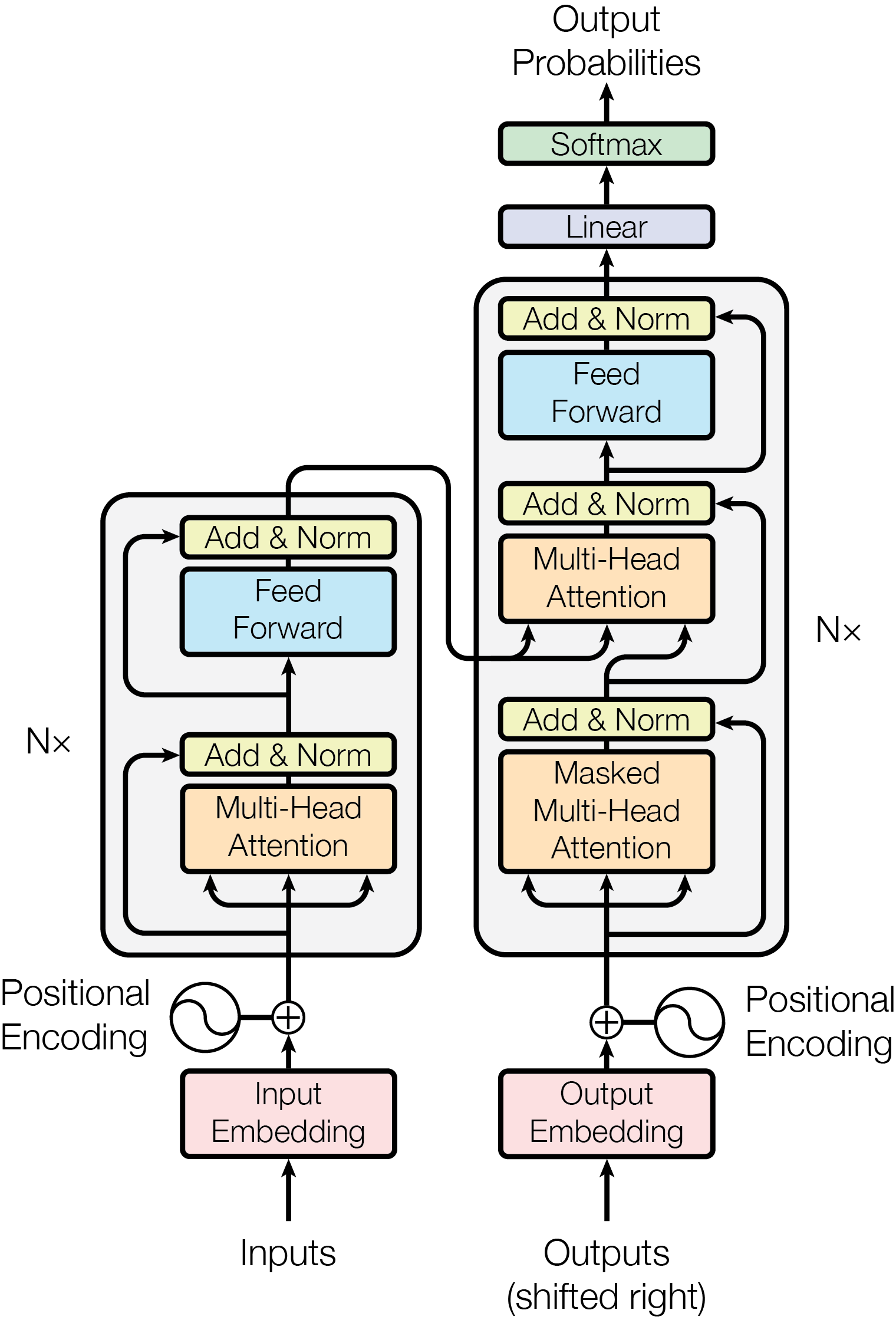
Source: Google Research
For each token:
- A router computes scores for all 8 experts.
- The top-2 experts are selected and activated.
- Expert outputs are weighted and summed.
- Only ~13B of 47B parameters are used per token.
Implications for deployment:
- All expert weights must be loaded in memory (47B total) even though only 13B are active.
- VRAM requirements are closer to 47B than 13B - but compute per token is ~13B-equivalent.
- vLLM and TGI support MoE models with expert parallelism across GPUs.
Architecture: Model Tiers and Capabilities
Production architecture should make region, license, and task class first-class routing inputs. A request approved for La Plateforme can use managed Mistral tiers on Regional Endpoints (EU or US). A restricted workload can target self-hosted Ministral, Nemo, or Mixtral where its exact license permits — Mixtral is an open-weight path, not a current Mistral serverless SKU. Hard agent tasks should have an evaluated escalation path rather than being forced through one vendor.
Diagram: European hybrid Mistral architecture
flowchart LR
    U[User request] --> G[EU model gateway]
    G --> P{Data policy}
    P -->|On-prem only| O[Open model pool]
    P -->|Managed EU allowed| LP[La Plateforme]
    G --> T{Task class}
    T -->|Code| C[Codestral]
    T -->|General| M[Mistral tier]
    T -->|Small/edge| N[Ministral]
    O --> E[Evaluation gate]
    C --> E
    M --> E
    N --> E
    E -->|Hard agent gap| F[Closed frontier API]
    E --> R[Response]
Residency decides eligible endpoints; workload and measured quality decide the model within that boundary.
Open Model Comparison
| Model | MMLU | HumanEval | Context | VRAM (4-bit) | Best For |
|---|---|---|---|---|---|
| Mistral 7B | ~62% | ~38% | 32K | ~4 GB | Edge, simple tasks |
| Mixtral 8x7B | ~70% | ~45% | 32K | ~26 GB | Production sweet spot |
| Mixtral 8x22B | ~77% | ~55% | 64K | ~80 GB | High quality open |
| Nemo 12B | ~68% | ~42% | 128K | ~7 GB | Long context, efficient |
Benchmark scores are approximate and vary by evaluation setup. Always test on your tasks.
Mistral vs Llama vs DeepSeek (Open Models)
| Dimension | Mixtral 8x7B | Llama 3.3 70B | DeepSeek V3 |
|---|---|---|---|
| Active params/token | ~13B | 70B | MoE (~37B active) |
| VRAM (4-bit) | ~26 GB | ~40 GB | ~40 GB+ |
| Inference speed | Faster | Slower | Comparable |
| Quality (general) | Good | Strong | Strong |
| Ecosystem / fine-tunes | Moderate | Largest | Growing |
| License | Apache 2.0 | Llama license | DeepSeek license |
API Pricing (La Plateforme, Approximate)
| Model | Input $/1M | Output $/1M | Notes |
|---|---|---|---|
| Mistral Small 4 | ~$0.15 | ~$0.60 | Efficient hybrid tier |
| Mistral Medium 3.5 | ~$1.50 | ~$7.50 | Agentic and coding tier |
| Mistral Large 3 | ~$0.50 | ~$1.50 | mistral-large-latest |
| Codestral | Varies by version | Varies by version | Code generation |
All prices are approximate August 16, 2026 snapshots from Mistral API pricing. Batch, marketplace, Regional Endpoints, caching, and dedicated deployment prices differ. Verify before committing.
Step-by-Step Flow: Choosing and Deploying Mistral
1. Open vs API decision
| Need | Path |
|---|---|
| Data sovereignty, high volume | Self-host open models |
| Quick start, managed infra | La Plateforme API |
| Code generation | Codestral (API or self-host) |
2. Select model
Simple tasks, edge         → Mistral 7B or Nemo 12B
Production (self-hosted)   → Mixtral 8x7B
Maximum open quality       → Mixtral 8x22B
Code                       → Codestral
Managed API                → Mistral Large
3. Deploy with vLLM (MoE-aware)
python -m vllm.entrypoints.openai.api_server \
  --model mistralai/Mixtral-8x7B-Instruct-v0.1 \
  --tensor-parallel-size 2 \
  --max-model-len 32768
Mixtral typically needs 2 GPUs for comfortable serving due to total weight size.
4. Or use Ollama for local dev
ollama pull mixtral:8x7b
ollama run mixtral:8x7b
5. Evaluate against Llama 70B
On your tasks, Mixtral 8x7B may match Llama 70B at lower inference cost. Measure before committing.
6. Monitor MoE expert utilization
In production MoE deployments, uneven routing - where certain experts receive disproportionate traffic - causes latency spikes and GPU hot spots. vLLM exposes expert utilization metrics. If imbalance exceeds 2:1 across experts, investigate input distribution or consider expert parallelism across additional GPUs.
Hybrid routing pattern
Many teams deploy Mistral in a tiered architecture: Ministral or a proven Nemo baseline handles classification, a larger open checkpoint handles bounded generation, and the current Mistral Large endpoint handles escalation when confidence is low. A separate GPT, Claude, or Gemini route covers tasks where independent evaluation shows a material agent-reliability advantage.
def select_mistral_model(task_type: str, confidence: float) -> str:
    if task_type in ("classify", "extract", "route"):
        return "ministral-3-8b"  # example self-hosted tier; pin exact ID
    if confidence < 0.7:
        return "mistral-large-latest"  # API escalation
    return "mixtral-8x7b"  # self-hosted default
Diagram: Mistral request and escalation sequence
sequenceDiagram
    participant App
    participant Gateway
    participant Local as Self-hosted Mistral
    participant API as La Plateforme
    participant Eval
    App->>Gateway: request + residency class
    Gateway->>Local: bounded first attempt
    Local-->>Gateway: answer + metrics
    Gateway->>Eval: score output
    alt needs stronger Mistral tier
        Gateway->>API: pinned Large/Medium model
        API-->>Gateway: escalated answer
    else accepted
        Eval-->>Gateway: pass
    end
    Gateway-->>App: response + trace ID
A pinned managed tier is an escalation option, while an evaluation gate prevents silent quality regressions.
Real Production Example
Mistral API with function calling:
from mistralai import Mistral
import os

client = Mistral(api_key=os.environ["MISTRAL_API_KEY"])

tools = [
    {
        "type": "function",
        "function": {
            "name": "get_weather",
            "description": "Get current weather for a city",
            "parameters": {
                "type": "object",
                "properties": {
                    "city": {"type": "string"},
                },
                "required": ["city"],
            },
        },
    }
]

response = client.chat.complete(
    model="mistral-large-latest",
    messages=[
        {"role": "user", "content": "What's the weather in Paris?"}
    ],
    tools=tools,
    tool_choice="auto",
)

# Process tool_calls from response.choices[0].message
Self-hosted Mixtral via OpenAI-compatible endpoint:
from openai import OpenAI

client = OpenAI(
    base_url="http://localhost:8000/v1",
    api_key="not-needed",
)

response = client.chat.completions.create(
    model="mistralai/Mixtral-8x7B-Instruct-v0.1",
    messages=[
        {"role": "system", "content": "You are a concise technical assistant."},
        {"role": "user", "content": "Explain MoE in 3 sentences."},
    ],
    temperature=0.2,
    max_tokens=200,
)
print(response.choices[0].message.content)
Embeddings for RAG:
embeddings = client.embeddings.create(
    model="mistral-embed",
    inputs=["Mistral AI builds efficient language models"],
)
Design Decisions: When to Pick Mistral
Choose Mistral when:
-
Inference efficiency matters - MoE gives better tokens/sec per dollar than dense 70B models.
-
Apache 2.0 licensing is important - fewer restrictions than Llama license.
-
European data residency - Regional Endpoints (GA) pin La Plateforme inference to Europe or the US.
-
Code generation - Codestral is competitive and cost-effective.
-
GPU-constrained deployment - Mixtral 8x7B quality on ~26GB VRAM beats dense 70B on ~40GB.
Choose Llama when:
-
You need the largest fine-tune ecosystem and community support.
-
128K context is required (Llama 3.1+; Mixtral default is 32K).
-
Meta's backing and regular releases matter for your roadmap.
Choose API models (GPT/Claude) when:
-
You need frontier quality without GPU ops.
-
Reliable tool use for complex agents.
Comparisons
Mistral's strongest decision variables are deployment flexibility, European operations, and efficiency. Absolute capability on the hardest agentic work should be measured against current closed tiers, where Mistral generally trails at the frontier even if it wins cost, control, or latency routes.
| Workload | Mistral candidate | Comparison set | Decision |
|---|---|---|---|
| EU-hosted enterprise generation | Mistral Large 3 | OpenAI balanced tier, Anthropic flagship | Compare contracts, residency, quality, and latency |
| Code completion/infilling | Codestral | Anthropic flagship, OpenAI balanced / frontier | Use repository-level acceptance tests |
| Edge/private classification | Ministral 3 | Llama small tiers, OpenAI volume tier | Locality and throughput may dominate |
| High-volume bounded generation | Small 4 or self-hosted open model | Anthropic volume tier, OpenAI volume tier | Compare cost per accepted response |
| Hard multimodal agent | Large/Medium candidate | Google Flash-class, Anthropic frontier, OpenAI frontier | Route to the highest evaluated reliability |
Approximate list prices change frequently. Verify current Mistral, OpenAI, Anthropic, and Google pages before budgeting — special context bands, cache, batch, region, and tools often dominate the headline rate.
| Dimension | Mistral open model | La Plateforme | Frontier closed API |
|---|---|---|---|
| Weight access | Yes for selected models | No for commercial endpoints | No |
| Residency | Your chosen infrastructure | European options | Provider and region dependent |
| Customization | LoRA/QLoRA where license permits | Provider features | Provider features |
| Ops burden | High | Low | Low |
| Reproducibility | Pin weights and stack | Pin dated model ID | Pin snapshot where available |
| Hard-agent ceiling | Usually lower | Evaluate current flagship | Often higher, model dependent |
Common Mistakes
-
Assuming MoE means less VRAM. All expert weights must be loaded. Mixtral 8x7B needs ~26GB quantized, not ~8GB.
-
Ignoring 32K context limit on Mixtral. For long documents, use Nemo 12B (128K) or Llama 3.1.
-
Not using vLLM for MoE. Standard inference without MoE-aware batching wastes GPU capacity.
-
Comparing total params to active params. Mixtral is 47B total, ~13B active - compare fairly in benchmarks.
-
Skipping Codestral for code tasks. General models work, but Codestral is optimized for code generation.
Where It Breaks Down
-
Context length - Mixtral's 32K default trails Llama and Claude for long-document workloads.
-
Frontier quality - Mistral Large is good but does not consistently beat frontier closed APIs (OpenAI's and Anthropic's current flagship models) on hard reasoning.
-
MoE serving complexity - expert parallelism, load balancing across experts, and multi-GPU coordination add ops overhead.
-
Smaller ecosystem - fewer fine-tunes and community tools than Llama.
-
Tool use reliability - open Mistral models trail closed APIs on function calling without fine-tuning.
-
License mix - some models are Apache 2.0, Codestral has a separate license. Check before commercial use.
When NOT to Use Mistral
Do not choose Mistral only because the company is European or an older Mixtral checkpoint is Apache 2.0. Residency depends on the actual endpoint and contract; license terms depend on the exact model. “EU company,” “EU processing,” “EU-only storage,” and “self-hosted in the EU” are different claims.
Mistral is not the right permanent primary route when:
- The application needs maximum reliability on long-horizon agents, computer use, or difficult tool recovery and OpenAI's, Anthropic's, or Google's current flagship tiers win representative evals.
- Your team cannot run GPU infrastructure and the managed endpoint does not satisfy the required SLA, region, or feature set.
- A sparse MoE model fits the compute budget but not accelerator memory. Active parameter count does not determine the total weight footprint.
- You depend on an unpinned
latestalias and cannot tolerate behavior changes. Use dated IDs, record deprecation dates, and run regression gates before migration. - The model's specific license does not permit the intended commercial use, redistribution, or fine-tuning arrangement.
- Your volume is too low to amortize self-hosting, or too bursty to provision without substantial idle capacity.
Use workload-based routing instead of declaring Mistral—or a closed provider—the universal default. A compact Ministral model can own private classification, Codestral can own measured coding routes, and a frontier closed tier can own hard agents. Revisit ownership whenever models, prices, or workloads change.
Running in Production
Best Practice
✅ Best Practices - Instrument every stage, version embedding models, enforce access control at retrieval time, and evaluate on a fixed golden set before shipping changes.
| Dimension | Consideration |
|---|---|
| Scaling | vLLM with tensor parallelism for Mixtral. Expert parallelism for 8x22B. API path scales automatically via La Plateforme. |
| Cost | Self-hosting and per-query estimates are approximate and utilization-dependent. Include replicas, idle time, engineers, retries, and evaluation; verify current API prices. |
| Latency | Mixtral 8x7B: 40–100 tokens/sec (2× A100). Faster than Llama 70B on same hardware. API: 1–3s typical. |
| Security | Self-host for full control. La Plateforme offers EU data residency. |
| Observability | Self-hosted: custom logging. API: Mistral dashboard. Use LangSmith/Helicone for either. |
| Evaluation | MoE models behave differently than dense - re-evaluate when switching from Llama. |
| Reliability | MoE load imbalance can cause latency spikes. Monitor per-expert utilization. |
Ecosystem
-
API: La Plateforme (Mistral AI), available on Azure AI, AWS Bedrock.
-
Inference: vLLM, TGI, Ollama, llama.cpp (GGUF).
-
Fine-tuning: Hugging Face PEFT, Axolotl, Unsloth.
-
Frameworks: LangChain, LlamaIndex - native Mistral support.
-
Embeddings:
mistral-embedfor RAG pipelines.
Continue Learning
- Next guide: Llama Models
- Then: DeepSeek Models
Production Checklist
- License verified for intended commercial use and redistribution
- Deployment region / EU residency requirements confirmed
- API vs self-host decision documented with owners
- Dated model ID pinned (no floating
*-latestin production) - Codestral / Small / Large routing policy defined by workload
- Context-length limits validated against document workloads
- Latency and cost benchmarks completed on representative traffic
- Golden-set evaluation completed before ID or serving changes
- MoE / serving metrics monitored (including expert imbalance if self-hosted)
- Cross-provider fallback path documented and tested
- Rollback strategy for API ID or self-hosted checkpoint documented
Related Guides
Prerequisites
- Large Language Models — Dense and sparse transformer fundamentals.
- Transformers — Architecture foundation.
Core Concepts
- Llama Models — Primary open-weight alternative.
- DeepSeek Models — MoE competitor with strong reasoning.
Implementation
- Fine-tuning — Adapting Mistral to your domain.
- LoRA — Parameter-efficient adaptation of eligible open checkpoints.
Optimization
- Cost Optimization — MoE efficiency strategies.
Advanced Topics
- Evaluation — Compare quality, reliability, latency, and cost.
Diagram: Learning path for Mistral deployment
flowchart LR
    LLM[LLM basics] --> M[Mistral models]
    M --> Eval[Evaluation]
    Eval --> Route[Model routing]
    M --> FT[Fine-tuning]
    FT --> LoRA[LoRA]
    Route --> Cost[Cost opt]
Build architectural and evaluation literacy before optimizing adapters, routing, and spend.
Interview Questions
Why does Mixtral reduce compute without proportionally reducing VRAM?
Top-k routing activates only a subset of experts for a token, so arithmetic work tracks active parameters. The server still needs all expert weights available, so memory tracks total parameters much more closely.
How would you choose between Codestral and a general model?
Build repository-representative tests for completion acceptance, infill correctness, compile rate, tests passed, secure-code violations, latency, and cost. Codestral should own the route only where specialization improves those metrics.
What does European data residency require beyond choosing Mistral?
Confirm the serving region, storage and log locations, subprocessors, support-access path, retention, backups, contractual safeguards, and failover region. Provider headquarters alone do not establish residency.
Why pin a dated model ID?
An alias may move to a newer version without a deploy event in your system. Pinning makes behavior reproducible and lets teams evaluate a successor before traffic migration.
When is a smaller model preferable?
For bounded tasks where it meets the acceptance threshold at lower latency, memory, and cost. Classification, extraction, routing, and templated transformations often do not need the most capable tier.
FAQs
What is Mixtral?
Mixtral 8x7B is a mixture-of-experts model with 8 feedforward experts per layer. For each token, a router selects the top 2 experts. Total: 47B parameters, ~13B active per token.
Is Mixtral better than Llama 70B?
Mixtral 8x7B matches Llama 2 70B on many benchmarks at lower inference cost. Llama 3.3 70B generally edges ahead on quality. Mixtral wins on speed and efficiency; Llama wins on ecosystem and context length.
What license do Mistral open models use?
Mistral 7B, Mixtral, and Nemo are Apache 2.0 - permissive for commercial use. Codestral has a separate Mistral AI license with different terms.
How much VRAM does Mixtral need?
~26GB for 4-bit quantized 8x7B. ~80GB for 8x22B. Plan for 2 GPUs for comfortable production serving.
Should I use Mistral API or self-host?
Self-host when volume is high and data must stay on-premise. Use La Plateforme API for quick starts and when GPU ops is not your core competency.
What is Codestral?
Codestral is Mistral's code-specialized line for completion, infilling, and instruction-based programming tasks. Sizes, IDs, availability, and license terms have changed across versions, so use the current catalog rather than assuming the original 22B release describes today's endpoint.
How does Mistral compare to the frontier closed models?
Mistral Large is competitive on many tasks but generally trails frontier closed APIs (OpenAI's and Anthropic's current flagship models) on complex reasoning, tool use, and multimodal. Benchmark on your workloads - the gap varies, and Mistral's commercial tier IDs change, so verify which version you are testing.
What is Mistral Nemo?
A 12B model co-developed with NVIDIA. 128K context, strong quality for its size. Good balance of efficiency and long-context capability.
Can I fine-tune Mixtral?
Yes, with LoRA/QLoRA via Hugging Face PEFT, Axolotl, or Unsloth. MoE fine-tuning is more complex than dense models - target expert layers carefully.
Is Mistral good for European GDPR deployments?
Mistral AI is a French company offering EU-hosted API options via Regional Endpoints. Self-hosting open models on EU infrastructure provides maximum control. Firefox Smart Window (beta) is a Mozilla consumer surface with ZDR — it does not change La Plateforme residency or Mixtral self-host terms.
What inference engine should I use for Mixtral?
vLLM is the production standard for MoE models. Ollama for local development. Ensure your version supports MoE architectures.
How does MoE affect batching?
MoE models batch tokens that may activate different experts. vLLM handles expert routing efficiently, but load imbalance across experts can cause latency variance.
References
- Mistral Model Overview
- Introducing Mistral Large 4
- Mistral changelog
- Mistral × Mozilla: Firefox Smart Window
- Mistral Model Selection Guide
- Mistral Pricing
- Mistral Deployment Documentation
- Hugging Face Transformers Documentation
- LangChain Documentation
- OpenAI API Documentation
Further Reading
Summary
- Mistral excels at parameter efficiency - MoE delivers 70B-quality at 13B inference cost.
- Mixtral 8x7B is the open-weight sweet spot for self-hosted production.
- Apache 2.0 licensing is simpler than Llama for most commercial use cases.
- MoE requires all weights in memory - VRAM needs are higher than active params suggest.
- Compare against Llama 70B and API models on your tasks before committing.
- Codestral for code; Nemo 12B for long context; Mistral Large for managed API quality.