
TL;DR
- Attention replaced recurrent state as the primary path between tokens. An RNN must carry information through every intermediate timestep; self-attention gives any position a short, direct route to every allowed position and lets training process positions in parallel.
- Query, key, and value have different jobs. A query expresses what the current position needs, keys describe what positions can match, and values carry the information mixed into the result. They are learned projections, not literal words or fixed semantic labels.
- Scaled dot-product attention computes
softmax(QKᵀ / √dₖ)V. Scaling keeps logits in a range where softmax remains trainable. Masks remove padding or disallowed future positions before normalization. - Multi-head attention performs several narrower retrievals. Heads use separate projections, their outputs are concatenated, and an output projection mixes them. Individual heads may specialize, overlap, or become redundant; they are not guaranteed human-readable modules.
- Training and autoregressive inference exercise attention differently. Training can evaluate all sequence positions in parallel under a causal mask. During decoding, a model emits one token at a time and normally stores prior keys and values in a KV cache.
- Long context has several costs. Dense prefill attention has quadratic score interactions in sequence length, while decode reads an ever-growing KV cache. Optimized kernels reduce memory traffic; MQA and GQA reduce cache size; neither makes context free.
- A large context window is a model capability, not an application architecture. Chunking and RAG reduce what enters the prompt. They do not change the model's internal attention algorithm, but they can improve relevance, latency, cost, and access control.
- Attention weights are not a reliable explanation of model reasoning. They are intermediate routing coefficients affected by every layer, head, residual stream, and nonlinear block. Evaluate observable behavior instead of treating one heatmap as causal proof.
On this page
- Why This Matters
- The Problem Attention Solves
- How We Got Here
- What Is Attention?
- How Attention Works
- Architecture
- Step-by-Step Flow
- Real Production Example
- Design Decisions
- Comparisons
- Common Mistakes
- Where It Breaks Down
- When NOT to Use Attention
- Running in Production
- Related Guides
- Interview Questions
- Key Takeaways
- FAQs
- References
- Further Reading
Why This Matters
Attention is the operation that allows a transformer to make a token representation depend on surrounding tokens. It is central to how large language models connect a pronoun to an earlier noun, use a definition supplied in a prompt, continue a code pattern, or combine evidence distributed across a document.
For model engineers, attention determines tensor shapes, memory use, numerical behavior, kernel selection, parallelism, and inference cache design. For application engineers, its consequences appear as context limits, time-to-first-token, per-token latency, lost-in-the-middle behavior, prompt sensitivity, and the need to select context rather than append every available document.
The boundary matters. A model may be capable of attending across 100,000 tokens, yet an application can still fail because it retrieved the wrong evidence, exceeded latency targets, mixed untrusted instructions with trusted policy, or supplied so much competing material that relevant facts were not used. Conversely, an application can serve a corpus much larger than the model window by retrieving a small authorized subset for each request.
Attention therefore belongs in two design conversations:
- Model capability: architecture, masks, positional representation, head layout, attention kernel, training distribution, and maximum supported sequence.
- Application engineering: chunking, retrieval, prompt assembly, token budgets, caching, evaluation, security boundaries, and graceful degradation.
Confusing these layers leads to bad fixes. RAG cannot alter a model's learned attention patterns; it can place better evidence inside the available context. FlashAttention does not make the mathematical interaction sparse; it computes exact attention with less high-bandwidth-memory traffic. A longer advertised context does not prove uniform recall at every position.
The Problem Attention Solves
A sequence model must let one position use information from another. In “The service that owns the retry queues is unavailable,” the representation at “is” should preserve the relationship to “service,” not be dominated by the nearer plural noun “queues.” Machine translation adds a harder case: while producing each target token, the decoder needs different parts of the source sentence.
Recurrent neural networks process positions in order:
[ ht = f(x_t, h{t-1}) ]
Information from position 1 reaches position 100 only after passing through 99 state transitions. LSTMs and GRUs improve gradient flow, but the path remains sequential. This creates two constraints:
- Long dependency path: distant information must survive repeated transformations through a fixed-width hidden state.
- Limited parallelism: timestep (t) depends on (t-1), so training cannot compute all sequence positions simultaneously within a layer.
Convolutions parallelize positions, but a fixed kernel initially sees only a local neighborhood. Stacking layers or using dilation expands the receptive field, though distant positions still require multiple hops and the connectivity pattern is fixed in advance.
Attention replaces a fixed or recurrent routing path with content-dependent routing. A query at one position scores keys at every allowed position, then receives a weighted mixture of their values. In one attention layer, the graph distance between two unmasked positions is one edge. During training, the score matrix for all positions can be computed with batched matrix multiplication.
Attention does not solve every sequence problem. It needs positional information because a set of vectors alone does not encode order. Dense self-attention creates (n \times n) score interactions. Learned compatibility can also select irrelevant or adversarial context. The mechanism solves access and parallel routing; it does not guarantee correct retrieval, reasoning, truth, or policy compliance.
How We Got Here
Early encoder-decoder translation systems compressed an entire source sentence into the encoder's final hidden state. That fixed-size bottleneck degraded as sentences grew. Bahdanau, Cho, and Bengio introduced an alignment mechanism that allowed the decoder to compute a weighted combination of encoder states for each output step. Luong and colleagues developed related global and local attention formulations.
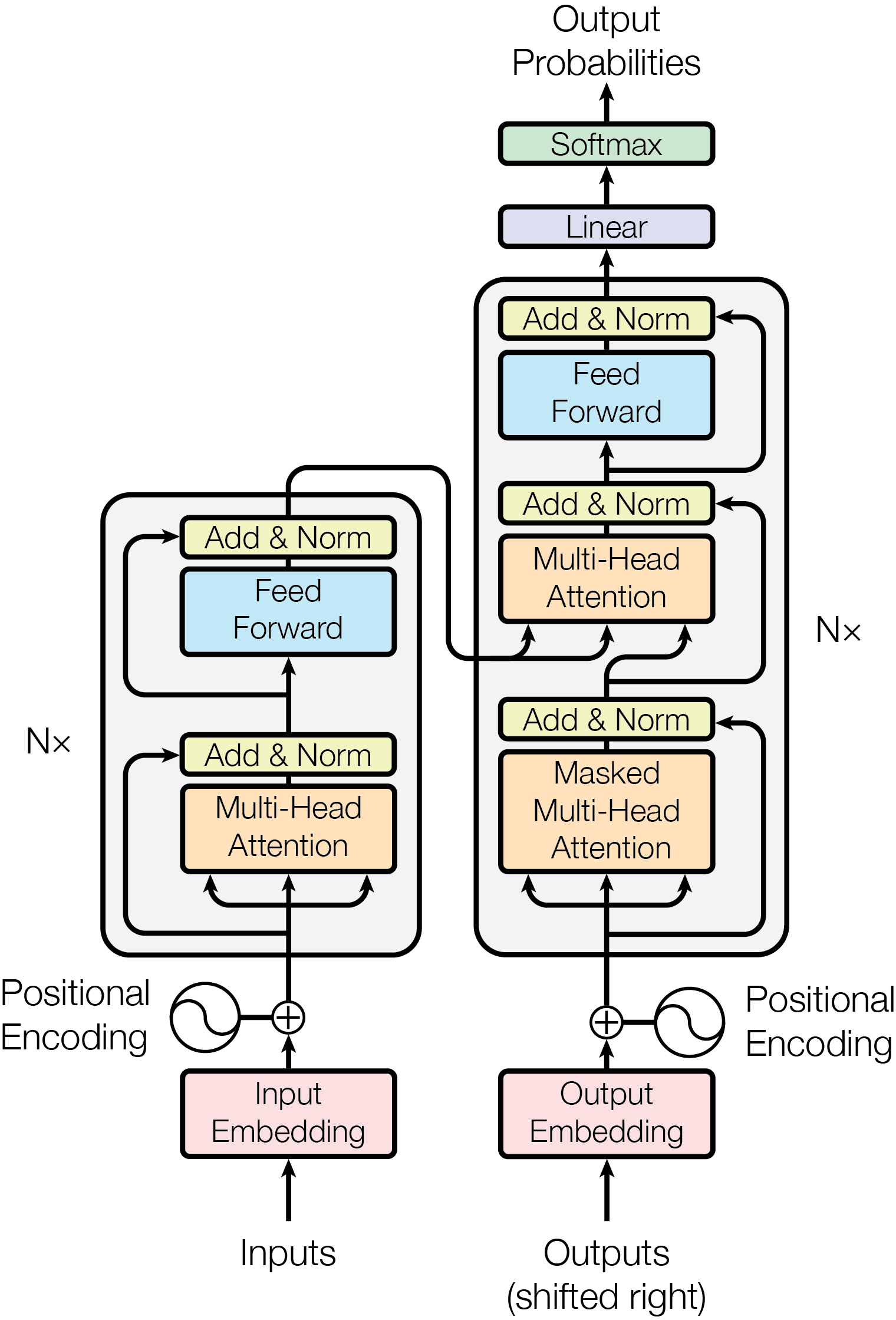
The Transformer removed recurrence from the main sequence-processing path. Vaswani and colleagues used self-attention within encoder and decoder stacks, cross-attention between them, positional encodings, residual connections, and feed-forward networks. Because positions within a training sequence could be processed concurrently, the architecture mapped well to accelerators and scaled to larger datasets.
Later systems adapted the design. Encoder-only models use bidirectional attention for representation learning. Decoder-only models use causal self-attention for next-token generation. Efficient kernels such as FlashAttention preserve exact dense-attention results while reducing memory movement. Multi-query attention (MQA) and grouped-query attention (GQA) reduce the number of key/value heads and therefore KV-cache memory. Local, block-sparse, and hybrid patterns trade global connectivity for lower cost.
Diagram: Evolution from recurrence to efficient attention
timeline
    title Sequence modeling and attention
    1980s-1990s : Recurrent networks carry sequential state
    1997 : LSTM improves long-range gradient flow
    2014 : Neural translation aligns decoder to encoder states
    2017 : Transformer uses self-attention without recurrence
    2020 : Dense attention kernels become IO-aware
    2020s : MQA, GQA, local, sparse, and hybrid designs scale inference
Attention evolved from a decoder alignment mechanism into the primary routing operation of transformer models, followed by systems work to control its memory and compute costs.
What Is Attention?
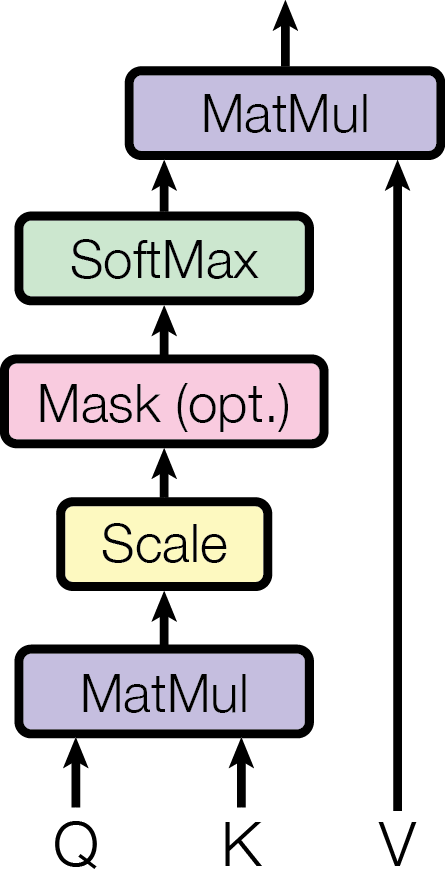
Attention is a differentiable retrieval operation. Given queries (Q), keys (K), and values (V), it returns a weighted mixture of values for each query:
[ \operatorname{Attention}(Q,K,V) = \operatorname{softmax}\left(\frac{QK^\top}{\sqrt{d_k}} + M\right)V ]
Here (d_k) is the key dimension and (M) is an optional additive mask containing zero for permitted pairs and a very negative value for prohibited pairs.
Q/K/V intuition before the math
Consider a database analogy:
- Query: what information does this position need?
- Key: what kind of match can this position offer?
- Value: what information should be returned if it matches?
The analogy is intentionally limited. Attention does not perform symbolic equality, return one exact record, or store a durable database. Queries, keys, and values are dense vectors learned jointly with the rest of the network. The softmax normally returns a mixture of many values.
For self-attention, all three projections begin from the same sequence representation (X):
[ Q=XW_Q,\quad K=XW_K,\quad V=XW_V ]
The projections separate matching from content transfer. A feature useful for deciding whether two positions relate need not be the same feature copied into the output. In cross-attention, queries come from one sequence—often decoder states—while keys and values come from another, such as encoder outputs.
Self-attention, cross-attention, and causal attention
Self-attention uses one sequence as the source of queries, keys, and values. Bidirectional encoders generally permit every non-padding position to attend to every other position.
Causal self-attention applies a lower-triangular mask. Position (t) may use positions (0) through (t), but not future positions. This preserves the autoregressive objective during teacher-forced training.
Cross-attention uses queries from one representation and key/value vectors from another. Encoder-decoder translation and many multimodal architectures use it to connect streams.
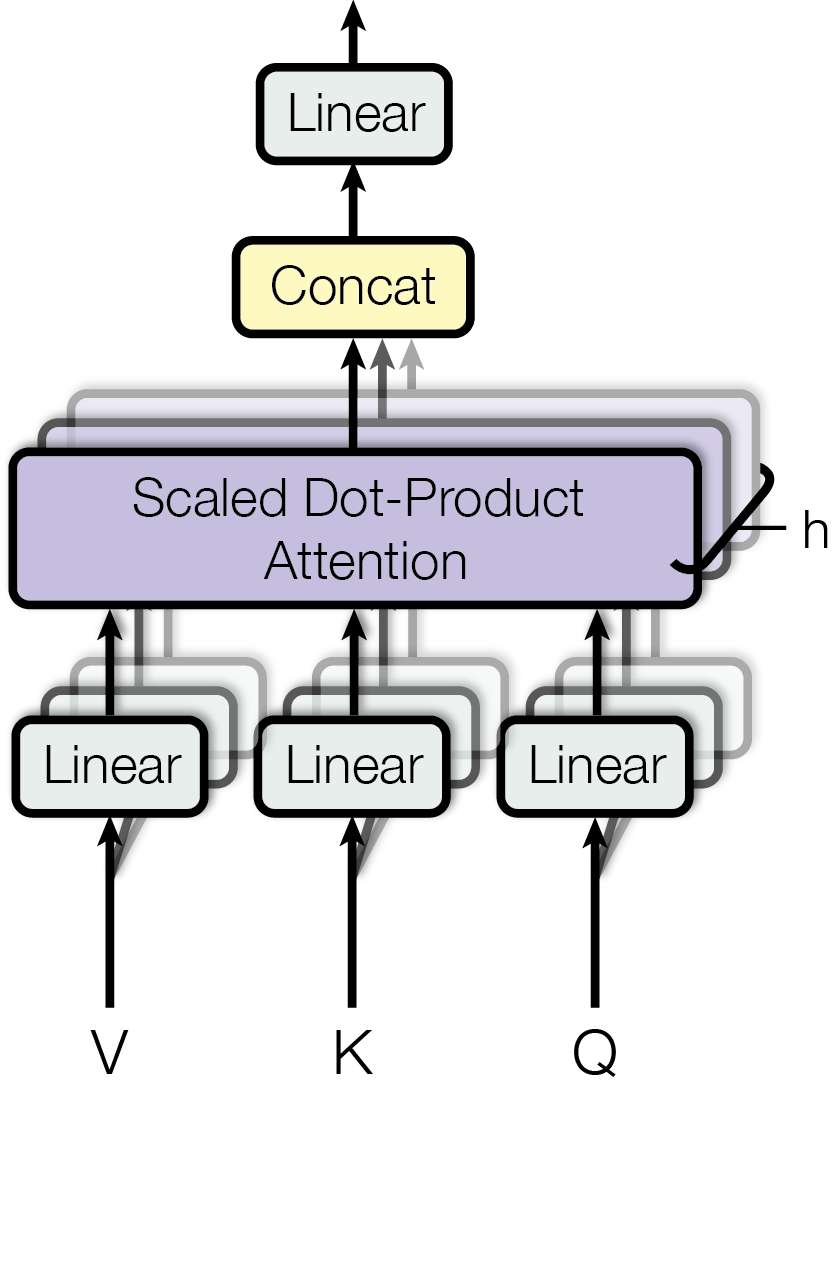
Multi-head attention
A single attention map produces one distribution per query. Multi-head attention uses (h) learned projection sets:
[ \text{head}_i=\operatorname{Attention}(XW^Q_i,XW^K_i,XW^V_i) ]
[ \operatorname{MHA}(X)=\operatorname{Concat}(\text{head}_1,\ldots,\text{head}_h)W_O ]
Heads provide multiple representation subspaces and routing patterns at the same layer. Some analyses find heads associated with positional, syntactic, copying, or delimiter behavior, but specialization is empirical rather than guaranteed. The output projection and residual stream combine head outputs, so interpreting an isolated head as a complete reasoning step is unsafe.
Source: Attention Is All You Need, Figure 2 (Vaswani et al.)
Source: Attention Is All You Need, Figure 2 (Vaswani et al.)
How Attention Works
Assume a batch of hidden states (X) with shape [batch, sequence, model_width]. A transformer block first projects (X) into queries, keys, and values. Implementations often compute one fused linear projection and reshape it into heads rather than run three visibly separate operations.
For one head:
- Compute the matrix of query-key dot products. With (n) query positions and (m) key positions, scores have shape
[n, m]. - Divide scores by (\sqrt{d_k}). If query and key components have roughly unit variance, the unscaled dot-product variance grows with dimension. Large logits push softmax toward saturation and reduce useful gradients.
- Add masks before softmax. A causal mask prohibits future keys; a padding mask prohibits padded input; some architectures add local or block constraints.
- Normalize each query row with softmax. Allowed key weights sum to one.
- Multiply the probabilities by values. The output at each query is a weighted sum with value width (d_v).
- Combine heads, project to model width, and pass through residual and normalization structure according to the block design.
Numerically stable kernels subtract a row maximum before exponentiation or use a fused online-softmax algorithm. A fully masked row must be handled deliberately because softmax over all negative infinity is undefined. Production libraries also choose accumulation precision and kernel paths based on dtype, device, mask, dropout, and sequence dimensions.
Position and order
Without positional information, self-attention is permutation equivariant: permuting input rows permutes outputs but does not tell the mechanism which token came first. Transformers therefore add or apply positional representations. The original Transformer added sinusoidal or learned position vectors. Many decoder models use rotary position embeddings (RoPE), while other designs use relative biases or alternatives.
Position handling affects extrapolation and long-context behavior. Increasing a server's accepted token limit is insufficient if the model was not trained or adapted to use those positions. RoPE scaling and similar modifications involve quality trade-offs and require evaluation across both short and long sequences.
Architecture
The following view separates the tensor path inside a decoder block from inference infrastructure around it.
Diagram: Decoder attention architecture
flowchart TB
    T[Token IDs] --> E[Embeddings plus position]
    E --> N1[Pre-attention norm]
    N1 --> P[Q K V projections]
    P --> A[Masked multi-head attention]
    A --> O[Output projection]
    O --> R1[Residual add]
    E --> R1
    R1 --> N2[Pre-FFN norm]
    N2 --> F[Feed-forward network]
    F --> R2[Residual add]
    R1 --> R2
    R2 --> L[Next transformer layer]
    P -. keys and values .-> C[(KV cache)]
    C -. decode reuse .-> A
A decoder layer uses attention to mix positions, an FFN to transform each position, residual paths to preserve state, and a KV cache to avoid reprojecting prior tokens during generation.
Source: Attention Is All You Need, Figure 1 (Vaswani et al.)
| Architecture | Query source | Key/value source | Typical mask | Primary use |
|---|---|---|---|---|
| Encoder self-attention | Encoder sequence | Same sequence | Padding only | Classification, embedding, understanding |
| Decoder self-attention | Decoder sequence | Same sequence | Causal plus padding | Autoregressive generation |
| Encoder-decoder cross-attention | Decoder states | Encoder states | Source padding | Translation and conditional generation |
| Multimodal cross-attention | Text or latent stream | Image/audio features | Architecture-specific | Connecting modalities |
Step-by-Step Flow
The lifecycle differs between training, prompt prefill, and token decoding.
Training
- The data pipeline tokenizes many sequences and forms batches.
- The model computes embeddings and positional representations.
- Each layer projects Q, K, and V for every position in parallel.
- Causal masks prevent target leakage in autoregressive models.
- Attention and subsequent block operations produce logits for every training position.
- Loss compares shifted next-token targets with logits.
- Backpropagation updates Q/K/V projections and all other trainable weights.
Teacher forcing makes every target prefix available in one forward computation, subject to masking. The model does not run a production-style one-token decode loop during ordinary autoregressive training.
Prefill and decode
At inference, the server first processes the prompt in a prefill phase. It computes attention for prompt positions and stores each layer's keys and values. It then enters decode. For each generated token, the model computes the new position's query, key, and value; appends the new key/value to cache; attends the query over cached keys; emits logits; selects a token; and repeats.
Diagram: Prefill and cached autoregressive decode
sequenceDiagram
    participant App
    participant Tok as Tokenizer
    participant Model
    participant Cache as KV cache
    App->>Tok: Prompt messages
    Tok->>Model: Prompt token IDs
    Model->>Model: Parallel prefill attention
    Model->>Cache: Store K and V per layer
    loop Until stop condition
        Model->>Cache: Read prior K and V
        Model->>Model: Attend with new query
        Model-->>Tok: Next token ID
        Model->>Cache: Append new K and V
        Tok-->>App: Stream decoded text
    end
Prefill handles the prompt as a sequence; decode serially emits new tokens while reusing prior key/value projections.
The KV cache removes repeated projection and representation work for prior tokens, but it does not make decoding constant-cost. Each new query still reads keys and values for the retained sequence. Cache memory scales approximately with layers, retained tokens, key/value heads, and head dimension. MQA uses one shared key/value head; GQA uses fewer key/value groups than query heads; both reduce cache traffic relative to standard multi-head attention.
Real Production Example
The following PyTorch implementation makes scaled dot-product attention inspectable while retaining engineering checks that short demonstrations often omit. It supports batched multi-head tensors, boolean masks, stable softmax, dropout during training, and shape validation. For production model execution, prefer the framework's fused scaled_dot_product_attention, which can dispatch to optimized kernels.
from __future__ import annotations

import math
import torch
from torch import Tensor


def inspectable_attention(
    query: Tensor,                 # [batch, heads, q_len, head_dim]
    key: Tensor,                   # [batch, kv_heads, kv_len, head_dim]
    value: Tensor,                 # [batch, kv_heads, kv_len, value_dim]
    allowed: Tensor | None = None, # broadcastable; True means allowed
    dropout_p: float = 0.0,
    training: bool = False,
) -> tuple[Tensor, Tensor]:
    if query.ndim != 4 or key.ndim != 4 or value.ndim != 4:
        raise ValueError("query, key, and value must be rank-4 tensors")
    if query.shape[-1] != key.shape[-1]:
        raise ValueError("query and key head dimensions must match")
    if key.shape[-2] != value.shape[-2]:
        raise ValueError("key and value sequence lengths must match")
    if key.shape[1] != query.shape[1]:
        raise ValueError("expand grouped/shared KV heads before this function")
    if allowed is not None:
        allowed = allowed.to(device=query.device, dtype=torch.bool)
        target = (*query.shape[:-1], key.shape[-2])
        try:
            torch.broadcast_shapes(allowed.shape, target)
        except RuntimeError as exc:
            raise ValueError(f"mask {allowed.shape} cannot broadcast to {target}") from exc
        if (~allowed).all(dim=-1).any():
            raise ValueError("every query row must allow at least one key")

    # Accumulate logits and probabilities in fp32 for an inspectable path.
    logits = torch.matmul(
        query.float(), key.float().transpose(-2, -1)
    ) / math.sqrt(query.shape[-1])

    if allowed is not None:
        logits = logits.masked_fill(~allowed, float("-inf"))

    weights = torch.softmax(logits, dim=-1)
    if dropout_p:
        weights_for_output = torch.dropout(
            weights, dropout_p, train=training
        )
    else:
        weights_for_output = weights

    output = torch.matmul(weights_for_output, value.float())
    return output.to(value.dtype), weights


# Small causal verification: four positions, two heads.
torch.manual_seed(7)
q = torch.randn(1, 2, 4, 8, dtype=torch.float16)
k = torch.randn(1, 2, 4, 8, dtype=torch.float16)
v = torch.randn(1, 2, 4, 8, dtype=torch.float16)
causal = torch.ones(4, 4, dtype=torch.bool).tril()[None, None, :, :]

manual_output, weights = inspectable_attention(q, k, v, allowed=causal)
fused_output = torch.nn.functional.scaled_dot_product_attention(
    q, k, v, attn_mask=causal, dropout_p=0.0
)

torch.testing.assert_close(manual_output, fused_output, atol=2e-3, rtol=2e-3)
assert torch.count_nonzero(weights.masked_select(~causal)) == 0
print(weights[0, 0])  # Diagnostic only; do not log this for every request.
This comparison tests semantics, not performance. The manual path materializes the score matrix and converts intermediates to FP32. The fused path may use FlashAttention or another optimized backend based on hardware and input constraints. Kernel selection, mask support, and numerical tolerances vary by framework and release, so benchmark the actual deployment shape rather than extrapolating from a four-token sample.
The application implication is equally important. Suppose a support assistant has 40,000 documentation chunks but a 32,000-token model window. Increasing attention capacity does not establish which chunks are relevant or authorized. The service should authenticate the caller, filter retrieval by tenant and permissions, retrieve a small candidate set, rerank it, enforce a token budget, and attach source identifiers. The model's attention then operates over selected evidence.
That split is deliberate:
- Model layer: attends over the supplied token sequence.
- Retrieval layer: decides which external evidence enters that sequence.
- Policy layer: decides which evidence the caller may access.
- Evaluation layer: measures whether answers use supported evidence.
Chunking and RAG are application mitigations for bounded and imperfect context use. They do not “fix attention,” and they introduce retrieval failure modes such as bad segmentation, missed candidates, stale indexes, and authorization errors.
Design Decisions
Head organization
Standard multi-head attention gives every query head its own K/V head, maximizing projection flexibility but producing a large KV cache. MQA shares one K/V head across query heads. GQA chooses an intermediate number of K/V groups. For high-throughput generation, cache bandwidth often makes GQA or MQA attractive; the model must be trained or adapted for that architecture.
Global, local, or sparse connectivity
Dense global attention permits every allowed pair and is straightforward, but prefill interactions grow quadratically. Sliding-window attention limits each token to nearby keys, reducing work to roughly (O(nw)) for window width (w). Sparse and block patterns add selected long-range connections. Hybrid architectures may alternate local and global layers. The trade-off is task-dependent: source code, document synthesis, and retrieval across distant sections may need global paths.
Exact kernel versus approximate architecture
FlashAttention is an exact, IO-aware implementation of dense attention. It tiles computation and avoids writing the full score and probability matrices to high-bandwidth memory. Sparse or linear-attention architectures change which interactions are computed or approximate the operation. They should not be grouped under one claim of “reducing attention complexity.”
Context window versus selected context
A model window is an upper bound on representable request length, not a target prompt size. Send the smallest context that preserves answer quality. Retrieval is useful when the source corpus is large, changes frequently, has access controls, or needs citations. A full-context approach may be simpler for short, stable documents when exhaustive cross-document relationships matter and latency remains acceptable.
Positional strategy
Absolute embeddings, relative biases, RoPE, and long-context scaling differ in training behavior and extrapolation. Application teams consuming an API usually cannot change this choice. They should test effective recall at realistic lengths and avoid assuming that a nominal window extension preserves short-context quality or reliable use at the boundary.
When should I study this deeply?
| Dig into attention when | You can stay higher-level when |
|---|---|
| Debugging long-context cost or KV-cache behavior | You only call hosted LLM APIs |
| Choosing architectures or efficient attention variants | Product work is prompts, RAG, and evals |
| Interpreting latency vs context length tradeoffs | You need application patterns, not model internals |
| Implementing or optimizing inference stacks | Context windows and tokens cover your needs |
Comparisons
| Property | Recurrence | Convolution | Dense self-attention |
|---|---|---|---|
| Within-layer training parallelism | Sequential across positions | Parallel | Parallel |
| Long-range path length | (O(n)) | Depends on depth/dilation | (O(1)) in one layer |
| Routing pattern | Compressed recurrent state | Fixed local kernels | Content-dependent |
| Sequence interaction cost | Roughly linear per layer | Roughly linear in kernel width | Quadratic score pairs |
| Native order signal | Sequential update | Kernel position | Requires positional mechanism |
| Streaming state | Hidden state | Recent receptive field | KV cache or recomputation |
| Variant | Attention connectivity | Main benefit | Main cost or limitation |
|---|---|---|---|
| MHA | All query heads have distinct K/V heads | Maximum per-head flexibility | Largest KV cache among these head layouts |
| GQA | Query heads share K/V within groups | Lower cache memory and bandwidth | Less K/V diversity |
| MQA | All query heads share K/V | Smallest K/V cache | Strongest sharing constraint |
| Sliding window | Nearby keys only | Lower long-sequence cost | Distant facts need other paths |
| Block sparse | Selected blocks or global tokens | Structured cost reduction | Pattern and kernel complexity |
| FlashAttention | Same dense mathematical result | Lower memory traffic, often faster | Dense interaction count remains quadratic |
| Long-context technique | Changes model attention? | Application-level effect |
|---|---|---|
| Chunking | No | Creates retrieval/index units and controls prompt assembly |
| RAG | No | Selects a small evidence subset from a larger corpus |
| Prompt compression | No | Reduces supplied tokens, potentially losing details |
| Sliding-window architecture | Yes | Restricts direct token connectivity |
| GQA/MQA | Yes | Reduces key/value cache heads |
| Optimized attention kernel | No mathematical change | Improves execution efficiency |
Common Mistakes
- Explaining Q, K, and V as fixed meanings. They are learned projections at every layer and head. “Question, label, content” is intuition, not an ontology enforced by the model.
- Claiming attention weights explain the answer. A heatmap shows one intermediate routing distribution. Residual paths, value vectors, later layers, FFNs, and output projection can change the result. Behavioral interventions are stronger evidence than visualization alone.
- Saying FlashAttention removes quadratic compute. It avoids materializing large intermediates in GPU memory and improves IO efficiency. Exact dense attention still considers quadratic query-key pairs during prefill.
- Using an incorrect causal mask convention. Some APIs accept booleans where
Truemeans allowed; others useTrueto mean masked. Add a test that verifies future weights are zero and compare against a trusted implementation. - Treating KV cache as persistent memory. It is request-local numerical state for previously processed tokens. It does not store durable user facts and should be released or isolated with the request/session lifecycle.
- Assuming all context positions are used equally. Effective recall depends on the model, task, position, distractors, formatting, and training distribution. Test beginning, middle, and end positions with realistic evidence.
- Appending all retrieved chunks. More context can increase latency and introduce contradictions or prompt injection. Retrieve, rerank, deduplicate, authorize, and fit a measured budget.
- Changing only the server token limit. The model's positional mechanism, training, cache allocation, and kernels must support the length. A transport-level setting cannot create learned long-context capability.
- Logging full prompts or attention tensors by default. They are large and may expose private data. Prefer aggregate length, latency, cache, and evaluation metrics with controlled sampling.
Where It Breaks Down
Dense attention's prefill score interactions scale as (O(n^2)). Doubling sequence length creates four times as many query-key pairs for a full self-attention pass. Optimized kernels can avoid storing the full matrix and improve wall-clock performance, but arithmetic and data movement remain substantial.
Decode has a different profile. With KV caching, the model does not recompute all prior K/V projections, but each new query attends over the retained cache. Per-token attention work and cache reads grow with sequence length. Under many concurrent requests, KV-cache capacity can limit batch size and throughput.
Quality also degrades before hard capacity limits:
- Lost in the middle: models may use information near prompt boundaries more reliably than equally relevant middle content.
- Distractor interference: irrelevant or contradictory passages compete with useful evidence.
- Position extrapolation: behavior beyond trained lengths may deteriorate despite technically accepted inputs.
- Softmax concentration: strongly matched keys can dominate a head, while useful evidence may be distributed.
- Finite representation: weighted mixtures can blur distinct values, and later layers must recover the needed computation.
- Adversarial context: untrusted text can contain instructions that influence the same model routing used for legitimate evidence.
Attention also lacks durable state. Once a request ends, the normal forward-pass context and KV cache do not update model weights or create an authorized memory record. Cross-session memory requires an external data model, retention policy, retrieval process, and user controls.
When NOT to Use Attention
Do not reach for a transformer merely because input is sequential.
- Use a deterministic parser for a stable grammar where correctness and clear errors matter more than fuzzy interpretation.
- Use SQL, search indexes, or key-value lookup for exact retrieval and filtering over structured records.
- Use a streaming state machine or compact recurrent model when memory is severely constrained and only bounded recent state matters.
- Use convolutional or domain-specific architectures when locality is strong and global pairwise interaction adds little value.
- Avoid putting a whole corpus in context when retrieval can select a smaller, authorized subset.
- Avoid an LLM for access control, arithmetic, transaction validation, or other rules that can be enforced deterministically.
Running in Production
Production attention work is mostly capacity planning, runtime selection, evaluation, and context governance.
Capacity and latency
Track prompt tokens, generated tokens, batch size, prefill time, time to first token, inter-token latency, cache bytes, cache utilization, and eviction or preemption. Separate prefill and decode metrics because they respond differently to long prompts and concurrency. Benchmark representative sequence distributions; averages hide tail requests that exhaust cache capacity.
Use optimized kernels supported by the framework and hardware, but verify fallback behavior. An unsupported mask, dtype, head dimension, or dropout setting can select a slower kernel. Quantizing model weights does not automatically quantize the KV cache. If the runtime supports cache quantization, evaluate quality and bandwidth effects independently.
Continuous batching improves accelerator utilization by combining active requests, but variable sequence lengths and cache allocation can fragment capacity. Prefix caching can reuse shared prompt prefixes when the runtime and privacy model permit it. Never share cached state across security boundaries without explicit isolation guarantees.
Context assembly
Establish a token budget with reserved output capacity. Partition it among system policy, user input, conversation state, retrieved evidence, and tool definitions. Reject or summarize overflow using documented rules; silent truncation can remove the system instruction or the evidence required to answer.
For RAG, chunk documents along semantic or structural boundaries, retain source and authorization metadata, retrieve more candidates than will be sent, rerank, deduplicate, and pack the final context. Keep trusted instructions distinct from untrusted document content. Retrieved text remains data even when it contains imperative language.
Evaluation
Build a fixed suite that varies:
- relevant-fact position near the beginning, middle, and end;
- prompt and retrieved-context length;
- number and similarity of distractors;
- contradictory evidence and recency;
- multilingual text, code, tables, and long identifiers;
- repeated facts with different access permissions;
- model, runtime, kernel, quantization, and prompt versions.
Measure task accuracy, citation support, refusal correctness, latency, token use, and cost per successful task. A context-window benchmark that only asks for a unique passkey tests retrieval under artificial conditions; production evaluation should match actual synthesis and ambiguity.
Security and privacy
Attention is not a security boundary. System instructions and user-controlled text are processed by the same model. Enforce authorization before retrieval, validate tool calls outside the model, minimize exposed data, redact logs, and use output controls appropriate to the domain. Prompt injection defenses should assume the model may follow malicious instructions and limit the consequences through deterministic policy.
Best Practice
Treat every increase in context length as a deployment change. Re-run quality, position-sensitivity, latency, throughput, cache-capacity, and cost evaluations before rollout.
Related Guides
- Transformers: how attention, FFNs, residual paths, normalization, and positional representations form complete model blocks.
- Large Language Models: how transformer attention contributes to pretraining and autoregressive generation within a production AI stack.
- Tokens: why attention sequence length is measured in model-specific tokens rather than words or characters.
- Context Windows: how prompt, generated output, positional support, and serving limits share a finite budget.
- Generative AI: where attention-based language models fit among generative modeling approaches and applications.
- RAG: how retrieval selects external evidence before the model attends over it.
- Embeddings: how vector representations support model input and retrieval, while serving different roles.
- Prompt Engineering: how instruction and evidence layout influence observable model behavior.
Interview Questions
1. Why did attention replace recurrence in large language models?
It shortened the path between distant positions and allowed all training positions in a layer to be computed in parallel. That improved accelerator utilization and long-range access. It did not remove autoregressive serial decoding or eliminate sequence-length costs.
2. Why are queries, keys, and values separate projections?
Matching and information transfer are different functions. Query-key features determine compatibility, while values carry the representation mixed into the output. Separate learned projections let each head optimize those roles independently.
3. Why divide attention logits by (\sqrt{d_k})?
Under common assumptions, dot-product variance grows with key dimension. Scaling controls logit magnitude, reduces premature softmax saturation, and preserves useful gradients.
4. What does a causal mask do during training?
It prevents position (t) from using keys at positions after (t), preserving next-token prediction even though all training positions are evaluated in parallel.
5. How does a KV cache change inference?
It stores prior keys and values for every layer so decoding does not recompute them for the entire prefix. Each new token still computes new Q/K/V and attends its query over retained cached keys and values.
6. Compare MHA, GQA, and MQA.
MHA has one K/V head per query head. GQA shares K/V within groups of query heads. MQA shares one K/V head across all query heads. Sharing reduces cache memory and bandwidth but constrains K/V diversity.
7. Does FlashAttention make attention linear?
No. It computes exact dense attention using tiling and an online softmax to reduce high-bandwidth-memory reads and writes. Dense prefill still has quadratic pair interactions.
8. Why can a model with a long context window miss supplied facts?
Capacity does not imply uniform use. Position, distractors, task complexity, training distribution, positional representation, and competing instructions affect effective recall.
9. How do chunking and RAG relate to attention?
They are application-level context-selection techniques. They reduce and improve the evidence placed in the model window; they do not modify internal attention unless the model architecture itself changes.
10. Why are attention weights insufficient as explanations?
They omit value content, residual contributions, FFNs, later layers, and output transformations. Similar outputs can arise from different attention patterns, and high weight does not prove causal importance.
Key Takeaways
- Attention is learned, differentiable routing: query-key compatibility determines how value information is mixed.
- Self-attention creates direct content-dependent paths between allowed positions and enables parallel training computation.
- Multi-head attention provides multiple learned subspaces; GQA and MQA trade K/V diversity for lower inference-cache cost.
- Training computes masked positions in parallel; generation remains sequential and relies on a KV cache.
- Dense prefill has quadratic interactions, while long decode sequences increase cache reads and per-token work.
- Optimized kernels improve execution but do not change exact dense-attention complexity.
- Context-window size is a capacity limit, not a promise of uniform recall.
- Chunking, retrieval, reranking, and token budgeting are application controls around model capability.
- Attention weights are diagnostics, not faithful explanations or security controls.
FAQs
What is the difference between attention and self-attention?
Attention is the general query-key-value operation. Self-attention derives queries, keys, and values from the same sequence. Cross-attention derives queries from one stream and keys/values from another.
Is attention the same as model memory?
No. Attention accesses representations inside the current forward context. A KV cache preserves request-local inference state. Durable memory requires an external store, retention policy, authorization, and retrieval.
Why is attention quadratic?
Dense self-attention forms a compatibility score for each query-key pair. With (n) positions, there are (n^2) pairs during full-sequence prefill. Local or sparse patterns reduce the pairs by restricting connectivity.
Does a longer context window always improve answers?
No. It increases capacity and may help tasks requiring more evidence, but can also increase latency, cost, distractors, and position sensitivity. Evaluate the task across realistic lengths.
Should an application always use RAG for long documents?
No. Full context may be simpler when documents fit comfortably and exhaustive relationships matter. RAG is preferable when the corpus exceeds the window, changes frequently, requires access filtering, or benefits from citations—but retrieval quality must be evaluated.
How should I test long-context behavior?
Use representative tasks with relevant evidence at varied positions, lengths, and distractor levels. Measure answer support, not just exact string retrieval, and record latency, cache use, and cost.
References
- Bahdanau, Cho, and Bengio: Neural Machine Translation by Jointly Learning to Align and Translate
- Luong, Pham, and Manning: Effective Approaches to Attention-based Neural Machine Translation
- Vaswani et al.: Attention Is All You Need
- Dao et al.: FlashAttention—Fast and Memory-Efficient Exact Attention with IO-Awareness
- Shazeer: Fast Transformer Decoding—One Write-Head is All You Need
- Ainslie et al.: GQA—Training Generalized Multi-Query Transformer Models from Multi-Head Checkpoints
- PyTorch: Scaled Dot Product Attention