
TL;DR
- A transformer processes sequences with self-attention — every position can attend to every other position in parallel. That design replaced RNNs for large-scale language modeling.
- Modern chat LLMs are decoder-only transformers (Llama, Mistral, GPT-style APIs): causal attention plus stacked blocks that predict the next token.
- Each block is multi-head attention + a feed-forward network, with residuals and normalization. Most parameters live in the FFN, not in the attention score computation itself.
- Positional encodings (today usually RoPE) inject order because attention alone treats inputs as a set.
- Production cost is dominated by prefill vs decode and KV cache: attention is (O(N^2)) in sequence length; serving systems batch, cache keys/values, and parallelize across GPUs.
- You rarely implement a transformer from scratch — you choose models, context limits, quantization, and serving stacks that expose those architectural constraints.
Quick Decision Guide
| If you want to... | Read |
|---|---|
| Understand transformers | Transformers |
| Learn the attention math | Attention Mechanism |
| See how LLMs use this | Large Language Models |
| Manage context cost | Context Windows |
| Adapt a model cheaply | PEFT · LoRA |
| Train with limited VRAM | QLoRA |
Who this guide is for
- Best for: AI engineers · ML engineers · backend engineers · architects
- Difficulty: Intermediate
- Estimated time: 55 min
Learning Path
Embeddings → Attention Mechanism → Transformers → Large Language Models → Context Windows → Prompt Engineering → Fine-tuning
On this page
- Why This Matters
- The Problem Transformers Solve
- How We Got Here
- What Is a Transformer?
- How Transformers Work
- Architecture
- Step-by-Step Flow
- Real Production Example
- Design Decisions
- Comparisons
- Common Mistakes
- Where It Breaks Down
- When NOT to Obsess Over Transformer Internals
- Running in Production
- Production Checklist
- Related Guides
- Interview Questions
- Key Takeaways
- FAQs
- References
- Further Reading
Why This Matters
Every production LLM you call — whether a hosted API or an open checkpoint such as Llama 3.x / Llama 4-class models or Mistral — is a transformer (or a close variant such as Mixture-of-Experts transformers). Embedding models, rerankers, and many vision backbones use the same family. The architecture determines hard product limits: context windows, time-to-first-token, tokens-per-second, GPU memory for the KV cache, and why fine-tuning changes behavior without changing the block layout.
Understanding transformers is not about reimplementing multi-head attention. It is about making correct engineering decisions: why longer prompts cost more, why generation latency scales with output length, why "lost in the middle" appears, why KV cache sizing dominates serving capacity, and why RAG and tools exist when parametric memory is insufficient. See large language models for the training/inference product view and attention mechanism for the math of queries, keys, and values.
Engineering Insight
Longer context windows increase cost and latency — attention is (O(N^2)) and the KV cache grows with sequence length. More context is not automatically better.
The Problem Transformers Solve
Before 2017, sequence modeling at scale leaned on recurrent networks (RNNs, LSTMs, GRUs). Those designs process tokens in order. Three structural problems blocked industrial language modeling:
- Sequential training. A 512-token sequence requires 512 dependent steps. GPU throughput collapses because most cores wait.
- Long-range degradation. Signals from early tokens dilute through many recurrent updates. Distant dependencies are hard to learn.
- Fixed-state bottleneck. An LSTM compresses history into a fixed hidden vector. Detail is lost as sequences grow.
Self-attention removes the sequential dependency for training: every token can form a direct connection to every other token in one parallel matmul-heavy step. Depth comes from stacking blocks, not from unrolling time. That change unlocked the scaling regime that produced modern LLMs.
| Constraint | RNN / LSTM | Transformer |
|---|---|---|
| Parallelism over sequence | Poor | Excellent (training / prefill) |
| Path length for long-range links | Linear in distance | Constant (one attention hop) |
| Dominant memory at long context | Hidden state size | Attention + KV cache (~(N^2) / (N \times L \times d)) |
| Generation | Still sequential | Still sequential (decode), but trained in parallel |
How We Got Here
Diagram: From recurrence to modern decoder-only LLMs
timeline
    title Sequence modeling → production LLMs
    2014-2016 : Seq2seq RNNs + attention
              : Attention as an add-on
    2017 : Attention Is All You Need
         : Full transformer encoder-decoder
    2018-2019 : BERT vs GPT split
              : Bidirectional vs causal
    2020-2022 : Scale + decoder-only wins
              : GPT-3, scaling laws
    2023-2026 : Open families + long context
              : Llama, Mistral, RoPE, MoE, KV serving
The industry converged on decoder-only transformers for generation; encoders remain common for embeddings and classification.
| Era | Dominant idea | Production consequence |
|---|---|---|
| RNN + soft attention | Attention helps the decoder look at encoder states | Still sequential training limits |
| Original transformer | Drop recurrence; stack attention + FFN | Parallel training at scale |
| BERT / GPT split | Bidirectional MLM vs causal LM | Two product lines: understand vs generate |
| LLM era | Decoder-only + huge data/compute | Chat APIs, open weights, PEFT adaptation |
| Serving era | KV cache, continuous batching, FlashAttention | Throughput and memory engineering |
Kaplan / Chinchilla-style scaling laws (high level): for a fixed compute budget, model size and data volume trade off; under-training a huge model wastes parameters. Practitioners treat this as planning guidance — pick a size you can train or license, then invest in data quality, evaluation, and serving — not as a guarantee that "bigger always wins" on your task.
What Is a Transformer?
A transformer is a neural architecture introduced by Vaswani et al. (2017) in Attention Is All You Need. It builds representations by alternating:
- Multi-head self-attention — mixes information across positions
- Position-wise feed-forward networks — transforms each position independently
- Residual connections and normalization — stabilize deep stacks
The original paper used an encoder–decoder for machine translation. Three families matter in production:
| Family | Attention pattern | Typical use |
|---|---|---|
| Encoder-only | Bidirectional | Embeddings, classification (BERT-style) |
| Decoder-only | Causal (left-to-right) | Chat / code / agents (Llama, Mistral, GPT-style) |
| Encoder–decoder | Encode bidirectionally; decode with cross-attention | Translation, some summarization (T5/BART lineage) |
As an application engineer shipping generation, you almost always consume decoder-only models. Encoder-only stacks still power many embedding pipelines.
How Transformers Work
Inside a block
Each block roughly does:
- Normalize (pre-norm in most modern LLMs)
- Multi-head self-attention with residuals
- Normalize
- Feed-forward (often SwiGLU-style MLP in Llama/Mistral families)
- Residual add
Multi-head self-attention projects hidden states into queries, keys, and values. Attention weights decide how much each position reads from others. Multiple heads learn different relationship patterns in parallel. Full math lives in attention mechanism.
Feed-forward layers hold most parameters (~two-thirds in many GPT-style layouts). Capacity for "knowledge" and non-linear transforms concentrates here; attention routes information.
Residuals (x + sublayer(x)) keep gradients usable across dozens or hundreds of layers.
Autoregressive generation
Decoder-only models generate one token at a time: sample (yt) from (p(y_t \mid y{<t}, x)), append it, repeat. Prefill processes the prompt in parallel; decode is inherently serial per sequence (though batching and speculative decoding mitigate wall-clock cost).
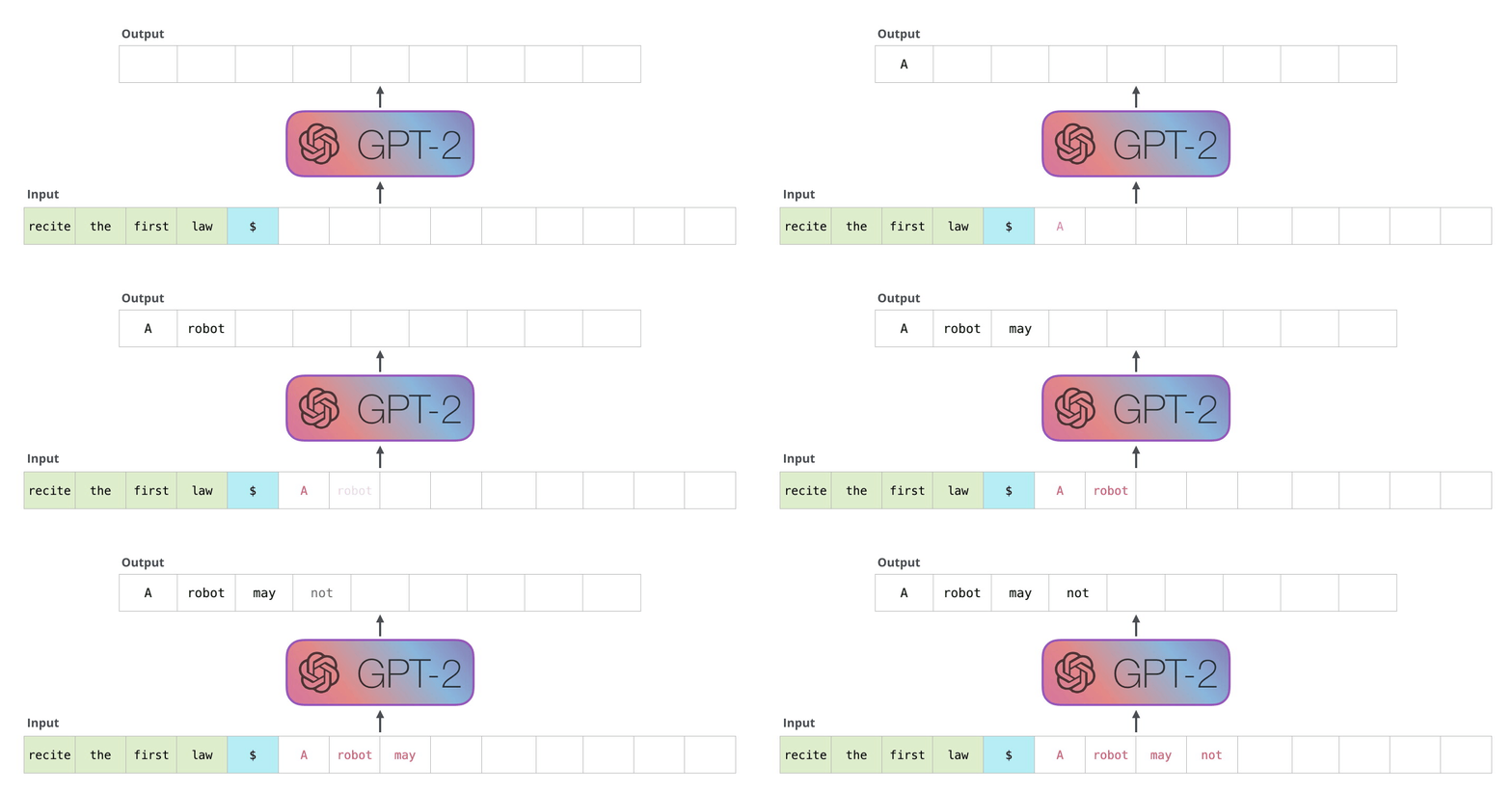
Source: Jay Alammar — Illustrated GPT-2
Positional encodings
Without positions, attention is permutation-invariant. Early transformers added sinusoidal or learned absolute embeddings. Most modern open LLMs use RoPE (Rotary Position Embeddings): rotate query/key pairs by an angle that depends on position so relative distance is encoded geometrically. RoPE also underpins many long-context extension schemes (frequency scaling / NTK-aware adjustments) used when models move from 4K–8K training contexts toward 128K+ serving contexts — with quality caveats that require evaluation, not slogans.
# Conceptual RoPE sketch (not a drop-in kernel)
import torch

def apply_rope_pair(x_even: torch.Tensor, x_odd: torch.Tensor, position: int, theta: float = 10000.0):
    dim = x_even.shape[-1]
    freqs = 1.0 / (theta ** (torch.arange(0, dim).float() / dim))
    angles = position * freqs
    cos, sin = angles.cos(), angles.sin()
    return x_even * cos - x_odd * sin, x_even * sin + x_odd * cos
Architecture
Diagram: Decoder-only stack used by modern LLMs
flowchart TB
  subgraph input [Input]
    T[Tokens]
    E[Embedding + RoPE]
  end
  subgraph block [Repeated N times]
    A[Causal multi-head attention]
    F[Feed-forward / MLP]
  end
  subgraph out [Output]
    L[LM head → logits]
    S[Sample next token]
  end
  T --> E --> A --> F
  F -->|stack| A
  F --> L --> S
  S -->|append| T
Causal attention prevents attending to future tokens; the LM head maps the final hidden state to vocabulary logits.
Variant comparison
| Variant | Examples (illustrative) | Strength |
|---|---|---|
| Dense decoder-only | Llama 3.x / 4-class dense, Mistral dense | Predictable latency, broad tooling |
| MoE decoder-only | Mixtral-style, large MoE APIs | More capacity per active FLOP; routing complexity |
| Encoder-only | BERT-lineage embedders | Bidirectional context for retrieval features |
| Encoder–decoder | T5-lineage | Explicit seq2seq; less common for chat |
Scale intuition (order-of-magnitude)
| Class | Layers (typical) | Hidden size (typical) | Role |
|---|---|---|---|
| ~7–8B open instruct | ~32 | ~4096 | Local / cheap serving, strong with PEFT |
| ~70B open instruct | ~80 | ~8192 | Higher quality; heavier KV + weights |
| Frontier APIs | Proprietary | Proprietary | Capability ceiling; black-box serving |
Exact layer counts change by release. Treat vendor cards and Hugging Face model configs as source of truth for a checkpoint.
Serving-shaped architecture
At inference time the "architecture" you operate includes:
- Weights — static parameters (possibly quantized)
- Activations — transient per forward
- KV cache — per-layer keys/values for tokens already seen (grows with context × layers × heads × dim)
- Scheduler — continuous batching, paged attention (vLLM), tensor/pipeline parallel
Step-by-Step Flow
Diagram: Prefill vs decode for one request
sequenceDiagram
  participant C as Client
  participant S as Inference server
  participant G as GPU kernels
  C->>S: Prompt tokens
  S->>G: Prefill (parallel over prompt)
  G-->>S: Logits + initial KV cache
  loop Until stop / max tokens
    S->>G: Decode 1 token (use KV cache)
    G-->>S: Next token + append KV
    S-->>C: Stream token (optional)
  end
Prefill is compute-heavy and parallelizable; decode is memory-bandwidth heavy and serial per sequence.
- Tokenize text with the model tokenizer (tokens).
- Embed token IDs; apply RoPE (or equivalent) inside attention.
- Prefill the prompt through all blocks; materialize KV cache.
- Project final hidden state through the LM head → logits.
- Decode with temperature / top-p / constraints; append token.
- Repeat decode until EOS, stop string, or max length.
- Detokenize for the client; retain KV only as long as the session policy allows.
Real Production Example
You configure serving, not hand-written attention. Example: vLLM-style deployment for an open instruct model (Llama 3.1 8B Instruct shown; swap IDs for your approved checkpoint):
from vllm import LLM, SamplingParams

llm = LLM(
    model="meta-llama/Llama-3.1-8B-Instruct",
    tensor_parallel_size=1,
    max_model_len=8192,
    gpu_memory_utilization=0.90,
    dtype="bfloat16",
    enforce_eager=False,
)

sampling = SamplingParams(
    temperature=0.2,
    max_tokens=1024,
    top_p=0.95,
)

outputs = llm.generate(
    ["Explain causal attention vs bidirectional attention in two paragraphs."],
    sampling,
)
print(outputs[0].outputs[0].text)
Map knobs to architecture:
| Knob | Architectural meaning |
|---|---|
max_model_len |
Positional / trained context ceiling + memory budget |
gpu_memory_utilization |
Room left for KV cache and batching |
tensor_parallel_size |
Split large matrices across GPUs |
dtype / quant |
Weight precision vs quality / VRAM |
| Continuous batching | Hide decode latency across users |
For adaptation rather than serving, the same architecture is frozen or lightly updated via PEFT / LoRA / QLoRA without redesigning blocks.
Design Decisions
| Decision | Options | Guidance |
|---|---|---|
| Family | Decoder-only vs encoder–decoder vs encoder-only | Generation → decoder-only; embeddings → encoder-only |
| Size | 8B vs 70B+ vs API frontier | Fit latency/cost first; measure task quality |
| Density | Dense vs MoE | MoE for capacity/cost; watch tail latency and routing |
| Context | 8K vs 128K+ | Longer ≠ always better; retrieval often beats stuffing |
| Precision | BF16 vs INT8/INT4 | Quantize after task eval; separate train vs serve precision |
| Serving | API vs vLLM/TGI/TensorRT-LLM | Privacy, steady load, and customization drive self-host |
| Adaptation | Prompt / RAG / fine-tuning | Architecture stays fixed; change context or adapters |
Common patterns
- Chat template + stop tokens aligned with training
- RAG to extend effective knowledge without growing weights
- Speculative decoding / Medusa-style heads for decode speedups (engine-dependent)
- Prefix caching when many requests share a system prompt
Comparisons
| Dimension | RNN/LSTM | Transformer (decoder-only LLM) |
|---|---|---|
| Train parallelism | Weak | Strong |
| Long-range modeling | Hard | Direct attention paths |
| Inference generation | Sequential | Sequential decode + KV cache |
| Ecosystem (2026) | Niche / legacy | Default for LLMs |
| Dimension | Encoder-only | Decoder-only | Encoder–decoder |
|---|---|---|---|
| Mask | Bidirectional | Causal | Mixed + cross-attn |
| Best fit | Embeddings, NLU | Chat, agents, code | Classic seq2seq |
| Chat fine-tunes | Rare | Standard (PEFT) | Less common |
| Serving concern | Why transformers force it |
|---|---|
| KV cache RAM | Stores per-token K/V across layers |
| (O(N^2)) attention | Long context taxes compute/memory |
| Batching | Needed to utilize GPUs during decode |
| FlashAttention-class kernels | Avoid materializing full attention matrices |
Common Mistakes
- Confusing the architecture with the Hugging Face
transformerslibrary. The library loads models; the architecture is the network design. - Assuming chat needs an encoder–decoder. Production chat is almost always decoder-only.
- Ignoring KV cache when sizing GPUs. Long context × concurrency OOMs even when weights fit.
- Expecting bidirectional "understanding" from causal models. Future tokens are invisible during generation; prompt order matters.
- Equating prefill cost with decode cost. One long answer is many full-stack forwards.
- Treating context extension as free. RoPE scaling can degrade retrieval/reasoning — evaluate.
- Blaming "the transformer" for factual errors. Fluency ≠ truth; see hallucinations and grounding.
- Changing chat templates between train and serve after fine-tuning adapters.
Where It Breaks Down
Quadratic attention. Doubling sequence length roughly quadruples dense attention cost. Streaming, retrieval, hierarchical memory, and sparse/linear attention variants exist, but most production LLMs still pay a steep long-context bill.
Statelessness. The network has no durable memory outside the context you pass (and any external store). Multi-turn products must resend or cache history deliberately.
Error compounding. Teacher-forced training differs from autoregressive freerunning; mistakes in early tokens pollute later attention.
Capability ceiling. Adapters and prompts cannot invent abilities absent from the base model’s scale and training mix. Pick a stronger base before heroic fine-tunes.
Multimodal and MoE complexity. Shared transformer ideas remain, but routing, vision encoders, and tool loops add failure modes outside the vanilla stack.
When NOT to Obsess Over Transformer Internals
Skip deep architecture work when:
- you only call a hosted API and your bottleneck is evaluation, prompts, or retrieval;
- a smaller specialized classifier or rules engine meets the contract;
- the problem is factual freshness — use tools/RAG, not a different attention variant;
- you lack measurement — architecture debates without golden sets waste time.
You still need enough transformer literacy to set context limits, interpret latency profiles, and review serving configs. You do not need to re-derive attention softmax to ship.
Running in Production
Important
Capacity planning is usually KV-cache and decode bandwidth, not "can the weights load."
| Dimension | Practice |
|---|---|
| Latency | Track TTFT (prefill) and inter-token latency (decode) separately |
| Throughput | Continuous batching; watch queue depth and preemptible long jobs |
| Memory | Model weights + KV × concurrent sequences × context |
| Reliability | Hard caps on max_tokens and context; backpressure |
| Quality | Task evals beat perplexity; slice by length and language |
| Security | Prompt injection exploits the lack of instruction/data separation in attention — defend in the app |
| Adaptation | Version base revision + tokenizer + optional LoRA adapter as one artifact |
Batching and the KV cache in practice
Continuous batching packs decode steps from many users into the same GPU kernels so expensive matrix multiplies stay saturated while each sequence still advances one token at a time. Paged attention (as popularized by vLLM) allocates KV cache in blocks so fragmentation does not strand memory when requests finish at different lengths. Operators should alert on KV fragmentation, preempted long generations, and cache hit rate for shared system prefixes.
Tensor parallelism shards large matmuls across GPUs for models that do not fit on one device; pipeline parallelism stages layers across devices at the cost of bubble time. Choose based on model size and interconnect — do not enable both “because more parallelism sounds faster” without a benchmark on your traffic mix.
Quantization (INT8/INT4/FP8) reduces weight memory and can raise concurrency, but it changes numerics. Treat quantized weights as a new artifact: rerun task and safety evals. Training-time schemes such as QLoRA are not the same decision as inference quantization after a merge.
What application engineers should log
For each request, retain model ID/revision, tokenizer revision, max context used, prompt token count, completion token count, TTFT, and whether an adapter was active. Those fields turn “the model got worse” into a bisectable incident. Architectural literacy without telemetry still leaves you debugging anecdotes.
Diagram: Decision tree for using transformer knowledge in a product
flowchart TD
  A[Need generation quality?] -->|No| B[Classifier / embeddings / rules]
  A -->|Yes| C[Hosted API OK?]
  C -->|Yes| D[Prompt + eval + RAG/tools]
  C -->|No| E[Self-host open LLM]
  E --> F{VRAM tight?}
  F -->|Yes| G[Quantize + smaller model]
  F -->|No| H[BF16/FP8 serve]
  D --> I{Stable behavior gap?}
  I -->|Yes| J[Fine-tune via PEFT]
  I -->|No| K[Keep prompt/RAG]
Architecture literacy informs serving and adaptation; it does not replace evaluation.
Continue Learning
- Next guide: Attention Mechanism
- Then: Large Language Models
Production Checklist
- Context window selected and enforced with hard caps
- KV cache sized for peak concurrent sequences × context
- Batching strategy tested (continuous batching / paged attention)
- Throughput and TTFT / inter-token latency benchmarked
- Quantization evaluated as a separate artifact (task + safety evals)
- Model revision and tokenizer revision logged per request
-
max_tokensand context backpressure configured - Tensor / pipeline parallelism choice validated on traffic mix
- Adapter (if any) versioned with base as one artifact
- Queue depth and KV fragmentation alerts configured
- Rollback path for model / quant / serving config documented
Related Guides
Prerequisites
Core Concepts
- Attention Mechanism — Q/K/V and multi-head detail
- Large Language Models — training vs inference product view
- Context Windows
Implementation
- Fine-Tuning · PEFT · LoRA
Optimization
Advanced Topics
Diagram: Learning path around transformers
flowchart LR
    T[Tokens] --> LLM[LLMs]
    LLM --> TR[Transformers]
    TR --> AT[Attention]
    TR --> CW[Context windows]
    LLM --> FT[Fine-tuning]
    FT --> PF[PEFT]
    PF --> LR[LoRA]
    LR --> QL[QLoRA]
Read architecture first, then adaptation methods that freeze most transformer weights.
Interview Questions
Why did transformers replace RNNs for large-scale LM?
Parallel training over the sequence, direct long-range paths via attention, and better hardware utilization. Generation remains sequential, but training throughput unlocked scale.
What is the difference between BERT-style and GPT-style transformers?
BERT-style encoders use bidirectional masks for understanding/embeddings. GPT-style decoders use causal masks for next-token generation. Most chat LLMs are decoder-only.
Where do most parameters sit in a decoder-only LLM?
Typically in the feed-forward / MLP matrices, not in the attention score function itself. Attention projections still matter and are common LoRA targets.
What is the KV cache and why does it matter?
Cached key/value tensors from prior tokens so decode does not recompute them. Memory scales with layers × heads × dimension × sequence length × batch, often dominating serving VRAM.
How does RoPE differ from absolute positional embeddings?
RoPE encodes position by rotating Q/K, emphasizing relative offsets and enabling many long-context extension methods. Absolute embeddings add a position vector to each token embedding.
Prefill vs decode — which dominates latency?
Short answers: often prefill (TTFT). Long answers: decode dominates wall clock because each token is a serial step. Optimize them differently.
Do scaling laws mean you should always train the biggest model?
No. They describe compute–data–size trade-offs. Under-trained large models waste budget; for products, evaluate quality per dollar and per millisecond on your task.
Key Takeaways
- Transformers mix tokens with parallel self-attention and per-position MLPs; they are the substrate of modern LLMs.
- Decoder-only causal stacks dominate generation; encoders remain central for embeddings.
- Positional schemes (RoPE) and KV caching are as operationally important as "knowing attention exists."
- Production pain is memory, batching, and long context — not implementing softmax.
- Adaptation (PEFT, LoRA, QLoRA) changes weights or adapters, not the block diagram.
FAQs
Do I need to implement a transformer to use LLMs?
No. You need enough literacy to reason about context, latency, memory, and adaptation. Libraries and engines implement the kernels.
Why is generation slower than embedding a document?
Embeddings are typically one forward pass (encoder). Autoregressive generation runs a forward per output token (decode), plus growing KV state.
What is FlashAttention?
A family of IO-aware attention kernels that avoid materializing full (N \times N) matrices in HBM, cutting memory and often speeding training/inference.
How do MoE transformers change the picture?
Experts activate sparsely so total parameters can exceed dense compute per token. Serving must handle expert placement and load balance; latency variance can increase.
Can I change layer count at inference?
No. Depth and width are fixed by the checkpoint. Choose another model or distill/quantize; do not expect runtime architecture morphing.
How do vision transformers relate?
Same attention + FFN pattern on patch tokens. Multimodal systems couple vision encoders with text decoders; product failures often sit at the interface, not in "attention itself."
Why do open models still matter if APIs are stronger?
Privacy, cost at volume, customization via fine-tuning, and offline control. Architecture knowledge transfers across both.
References
- Vaswani et al., Attention Is All You Need (2017)
- Hugging Face Transformers documentation
- vLLM documentation