
TL;DR
- PEFT means training a small fraction of parameters (adapters, low-rank updates, soft prompts) while freezing the base transformer.
- Hugging Face PEFT is the standard library that unifies configs, save/load, and merging across methods — most teams mean "LoRA via PEFT" in day-to-day speech.
- LoRA is the default for quality, ecosystem support, and merge-to-zero-overhead serving. QLoRA is LoRA on a 4-bit frozen base for memory-constrained training.
- Prefix / prompt tuning and classic bottleneck adapters still matter for extreme parameter frugality or research, but lose to LoRA for most production SFT.
- Decision order: prompting → RAG/tools for knowledge → fine-tuning with PEFT for stable behavior → full FT only with measured need → RLHF/DPO for preference alignment.
- Adapters are small artifacts (tens to hundreds of MB) that enable multi-tenant serving on one base checkpoint when you keep them unmerged.
Quick Decision Guide
| If you want to... | Read |
|---|---|
| See all adapter methods | PEFT |
| Use low-rank adapters | LoRA |
| Train with limited VRAM | QLoRA |
| Do full fine-tuning | Fine-tuning |
| Change model knowledge instead | RAG |
| Understand the base architecture | Transformers |
Who this guide is for
- Best for: AI engineers · ML engineers · applied research engineers
- Difficulty: Intermediate
- Estimated time: 55 min
Learning Path
Transformers → Large Language Models → Fine-tuning → PEFT → LoRA → QLoRA
On this page
- Why This Matters
- The Problem PEFT Solves
- How We Got Here
- What Is PEFT?
- How PEFT Works
- Architecture
- Step-by-Step Flow
- Real Production Example
- Design Decisions
- Comparisons
- Common Mistakes
- Where It Breaks Down
- When NOT to Use PEFT
- Running in Production
- Production Checklist
- Related Guides
- Interview Questions
- Key Takeaways
- FAQs
- References
- Further Reading
Why This Matters
Full fine-tuning of an 8B–70B open model duplicates optimizer state, checkpoints, and often entire serving stacks per task. PEFT cuts trainable parameters to roughly 0.01–1%, shrinks artifacts, reduces forgetting pressure on the frozen base, and lets one Llama or Mistral checkpoint host many task adapters.
If you use Hugging Face Transformers + TRL in 2026, you are almost certainly touching PEFT whenever you train LoRA or QLoRA. Treating PEFT as a decision hub — which method, when to prefer RAG, when to merge — prevents cargo-cult configs and wasted GPU hours. Deep dives: LoRA, QLoRA, parent fine-tuning.
Platform teams also feel PEFT in procurement. Instead of budgeting eight GPUs per experimental task, they budget shared base capacity plus overnight adapter jobs. That changes roadmap conversations: product managers can request a “tone adapter” without implying a new model SKU. The risk shifts from hardware scarcity to governance — who may train, what data is legal, and how adapters are reviewed before they touch customers.
Engineering Insight
Fine-tuning changes behavior; RAG changes knowledge. Reach for PEFT adapters only when prompting and retrieval leave a stable behavior gap.
The Problem PEFT Solves
Adaptation at LLM scale fails for operational reasons as often as for modeling reasons:
| Pain | Full fine-tuning symptom | PEFT response |
|---|---|---|
| GPU memory | Adam states ≈ 2× params in FP32-equivalent pressure | Train tiny modules; optionally 4-bit base (QLoRA) |
| Storage / blast radius | Full copy per task | Adapter files + shared base |
| Multi-task serving | N model deployments | N adapters, one base (unmerged) |
| Catastrophic forgetting | Large updates on small data | Frozen base preserves general skills |
| Experiment velocity | Slow iteration | Small searchable hyperparameter space (rank, targets) |
PEFT does not solve missing labels, bad eval hygiene, or the desire to store a live product catalog in weights. Those remain data and architecture problems.
How We Got Here
Diagram: Evolution of efficient adaptation
timeline
    title From full FT to PEFT libraries
    2018-2019 : Full fine-tune BERT/GPT
              : One checkpoint per task
    2019 : Houlsby adapters
         : Bottleneck modules
    2021 : Prefix / prompt tuning
         : Soft prompts
    2021 : LoRA
         : Low-rank ΔW = BA
    2023 : QLoRA
         : 4-bit base + LoRA
    2023-2026 : HF PEFT + TRL default
              : SFT, DPO, multi-adapter serve
Methods proliferated; Hugging Face PEFT became the integration layer production teams standardize on.
Adapter layers (Houlsby), prefix tuning (Li & Liang), prompt tuning (Lester et al.), LoRA (Hu et al.), IA³, and AdaLoRA each optimized a different corner of the parameter–quality–latency space. Bitsandbytes + QLoRA then made 65B/70B-class SFT feasible on single large GPUs. Preference optimization (RLHF, DPO) typically rides the same PEFT stack so alignment fits in memory.
What Is PEFT?
Parameter-efficient fine-tuning is the family of methods that adapt a pretrained model by updating a small parameter subset. PEFT (capitalized) also names Hugging Face’s library that implements those methods behind one API:
from peft import get_peft_model, LoraConfig

config = LoraConfig(
    r=16,
    lora_alpha=32,
    target_modules=["q_proj", "k_proj", "v_proj", "o_proj"],
    task_type="CAUSAL_LM",
)
model = get_peft_model(base_model, config)
model.print_trainable_parameters()
Method map
| Method | What trains | Inference note | Deep dive |
|---|---|---|---|
| LoRA | Low-rank matrices on linear layers | Mergeable → zero extra latency | LoRA |
| QLoRA | Same as LoRA; base stored 4-bit while training | Train-time memory win | QLoRA |
| Bottleneck adapters | Down/up projections inserted in blocks | Extra depth; rarely merged simply | This hub |
| Prefix tuning | Virtual KV prefixes per layer | Extra context / KV | This hub |
| Prompt tuning | Soft tokens in input embedding space | Tiny; limited capacity | This hub |
| IA³ | Scaling vectors on activations | Very few params | Niche |
| AdaLoRA | LoRA with adaptive rank budget | More moving parts | When rank unclear |
How PEFT Works
Lifecycle is method-agnostic:
- Load base causal LM (BF16/FP16, or 4-bit for QLoRA).
- Build a method
*Config. get_peft_modelfreezes base weights and injects trainable modules.- Train with Transformers
Traineror TRLSFTTrainer/DPOTrainer. - Save adapter-only artifacts (
adapter_config.json+ weights). - Evaluate vs prompt baseline; merge or hot-swap for serve.
What “parameter-efficient” actually buys
Efficiency shows up in three budgets. Optimizer memory scales with trainable parameters, so shrinking that set is the largest training win. Checkpoint I/O shrinks from tens of gigabytes to megabytes, which speeds experiment tracking and multi-region copies. Serving fan-out improves when many tasks share one resident base — especially important for open transformers checkpoints hosted on your GPUs rather than per-task API fine-tunes.
Efficiency does not automatically mean better sample efficiency. A rank-8 LoRA can still overfit 50 near-duplicate tickets. Data diversity, loss masking, and held-out slices dominate outcomes once the method is “LoRA-shaped.” Likewise, PEFT does not reduce inference FLOPs unless you merge (removing extra matmuls) or distill later. Unmerged prefix tuning can increase decode cost via longer effective KV sequences.
Library boundaries you will hit
PEFT assumes a Transformers PreTrainedModel (or compatible) surface for module injection. Custom research architectures need manual target_modules strings that match named_modules(). Some serving engines accept PEFT adapters natively; others only accept merged safetensors. Plan the export path before you invest in a training run: if production vLLM build lacks multi-LoRA, your “flexible adapters” story collapses to merge-or-nothing at release time.
my_adapter/
├── adapter_config.json
└── adapter_model.safetensors   # tens–hundreds of MB, not full model
from peft import PeftModel

base = AutoModelForCausalLM.from_pretrained("meta-llama/Llama-3.1-8B-Instruct")
model = PeftModel.from_pretrained(base, "./my_adapter")
merged = model.merge_and_unload()  # LoRA path
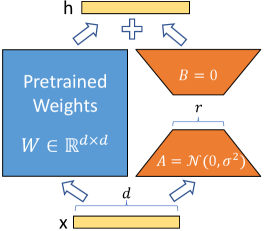
Source: Microsoft Research — LoRA paper
Architecture
Diagram: PEFT in the training/serving stack
flowchart TB
  subgraph train [Training]
    B[Base LLM weights]
    C[PEFT config]
    A[Trainable adapters]
    T[TRL / Trainer]
    B --> C --> A --> T
  end
  subgraph artifacts [Artifacts]
    AD[Adapter checkpoint]
    CF[adapter_config.json]
  end
  subgraph serve [Serving]
    B2[Shared base]
    M[Merged weights]
    X[Multi-adapter router]
  end
  T --> AD
  T --> CF
  AD --> M
  AD --> X
  B2 --> M
  B2 --> X
One base revision pins many adapters; merging collapses to a single dense checkpoint for simple deploys.
| Layer | Component | Role |
|---|---|---|
| Config | LoraConfig, PrefixTuningConfig, … |
Method + hyperparameters |
| Wrapper | PeftModel |
Freeze, inject, save/load |
| Quant | bitsandbytes + prepare_model_for_kbit_training |
QLoRA path |
| Train | TRL / Transformers | SFT, DPO, reward loops |
| Serve | vLLM / TGI / LoRAX / S-LoRA | Merged or multi-adapter |
Step-by-Step Flow
Diagram: Choosing an adaptation path
flowchart TD
  S[Behavior or knowledge gap?] -->|Knowledge / fresh facts| R[RAG or tools]
  S -->|Stable behavior| P[Strong prompt baseline]
  P -->|Passes gates| Done[Ship prompt]
  P -->|Fails gates| F{GPU memory?}
  F -->|Comfortable| L[LoRA BF16/FP16]
  F -->|Tight| Q[QLoRA 4-bit]
  L --> E[Eval vs baseline]
  Q --> E
  E -->|PEFT ceiling| Full[Consider full FT]
  E -->|OK| Dep[Merge or multi-adapter deploy]
PEFT sits after prompting and beside RAG — not as a knowledge database.
- Confirm the gap is behavioral (fine-tuning boundaries).
- Freeze an eval set and prompt baseline.
- Pick LoRA unless VRAM forces QLoRA.
- Set
target_modules, rank, alpha; print trainable %. - Train 1–3 epochs; early-stop on eval.
- Save adapter; record base revision + tokenizer + chat template.
- Compare merged vs unmerged numerically on smoke prompts.
- Canary deploy; keep rollback adapter/base pair.
Real Production Example
Multi-tenant support platform: one Llama-3.1-8B-Instruct base, three LoRA adapters (triage classifier, tone-constrained reply, JSON extractor). Prefix tuning was trialed for summarization storage size; LoRA won on quality.
from transformers import AutoModelForCausalLM, AutoTokenizer, TrainingArguments
from peft import LoraConfig, get_peft_model, PeftModel
from trl import SFTTrainer
import torch

MODEL_ID = "meta-llama/Llama-3.1-8B-Instruct"

base = AutoModelForCausalLM.from_pretrained(
    MODEL_ID, torch_dtype=torch.bfloat16, device_map="auto"
)
tokenizer = AutoTokenizer.from_pretrained(MODEL_ID)

def train_lora(name: str, dataset, r: int = 16):
    model = get_peft_model(
        base,
        LoraConfig(
            r=r,
            lora_alpha=2 * r,
            target_modules=["q_proj", "k_proj", "v_proj", "o_proj"],
            lora_dropout=0.05,
            task_type="CAUSAL_LM",
        ),
    )
    args = TrainingArguments(
        output_dir=f"./adapters/{name}",
        num_train_epochs=2,
        per_device_train_batch_size=4,
        learning_rate=2e-4,
        bf16=True,
        eval_strategy="epoch",
    )
    SFTTrainer(
        model=model,
        args=args,
        train_dataset=dataset["train"],
        eval_dataset=dataset["test"],
        processing_class=tokenizer,
    ).train()
    model.save_pretrained(f"./adapters/{name}")

# Serving sketch: switch adapters on one base
runtime = PeftModel.from_pretrained(base, "./adapters/triage", adapter_name="triage")
runtime.load_adapter("./adapters/reply", adapter_name="reply")
runtime.set_adapter("triage")
| Method (same triage task) | Accuracy | Trainable | Adapter size | Train time |
|---|---|---|---|---|
| LoRA r=16 | 96.8% | ~42M | ~170 MB | 2.1 h |
| Prefix (20 tokens) | 94.2% | ~1.6M | ~6 MB | 0.8 h |
| Prompt tuning | 91.5% | ~0.16M | ~0.6 MB | 0.3 h |
| Full FT | 97.1% | ~8B | ~16 GB | 8.4 h |
LoRA recovered ~99.7% of full-FT accuracy at a fraction of cost; production standardized on LoRA + optional QLoRA for 70B experiments.
Design Decisions
| Decision | Prefer | When |
|---|---|---|
| Method | LoRA | Default SFT / most DPO |
| Memory mode | QLoRA | Single-GPU 34B–70B class |
| Deploy shape | Merge | One adapter, max simplicity |
| Deploy shape | Unmerged multi-adapter | Tenant/task routing |
| Rank | r=16 | Start; sweep 8/32 with data size |
| Targets | Attention projections | Classification; add MLP for generation |
| Alignment | PEFT + DPO/RLHF | Preference data available |
When to use each method
| Method | Use when | Avoid when |
|---|---|---|
| LoRA | Almost always for open SFT | You proved PEFT ceiling with ablations |
| QLoRA | VRAM bound | Ample multi-GPU and you need max step speed |
| Prefix tuning | Huge adapter counts, tiny storage | You need merge-only serving |
| Prompt tuning | Ultra-fast probes | Complex generation behavior |
| AdaLoRA | Rank allocation unclear after sweeps | Simple r=16 already good |
| Full FT | Large data + measured PEFT gap | First experiment |
Comparisons
| Approach | Changes | Best for | Update story |
|---|---|---|---|
| Prompting | Context only | Fast iteration | Edit text |
| RAG / tools | Retrieved evidence | Fresh/private facts | Index / API |
| PEFT (LoRA) | Small weights | Stable style/format/tools | Retrain adapter |
| Full FT | All weights | Large shift / small models | Full redeploy |
| RLHF/DPO | Policy via prefs | Helpfulness/safety tone | Preference pipeline |
| PEFT method | Trainable % (order) | Mergeable | Typical production role |
|---|---|---|---|
| LoRA | 0.1–1% | Yes | Default |
| QLoRA | LoRA-sized | Adapter yes; 4-bit is train-time | Memory-limited train |
| Prefix | ≪1% | No | Niche multi-adapter |
| Prompt tuning | ≪0.1% | No | Probes |
| Bottleneck adapters | 0.5–8% | Awkward | Legacy / research |
Common Mistakes
- Using PEFT to "upload the wiki." Use RAG; adapters memorize poorly and stale.
- Skipping
print_trainable_parameters(). 100% trainable means the wrap failed. - Saving full checkpoints by accident. Verify adapter directory sizes.
- Mismatched base revision. Llama 3.1 adapters on a different 3.0/4 checkpoint → garbage.
- Prompt tuning for deep behavior change. Capacity is too small.
- Ignoring inference overhead of non-LoRA methods. Prefix tokens tax KV cache forever.
- No prompt baseline. You cannot claim PEFT helped.
- Mixing methods on one model casually. One method per adapter unless you know the composition semantics.
- Forgetting
task_type="CAUSAL_LM". Silent misconfig risk. - Treating QLoRA as faster. It is smaller VRAM, often slower steps.
Where It Breaks Down
PEFT approximates full updates. If the base model lacks language coverage or reasoning skill, adapters cannot invent it. Non-Transformers ecosystems need custom injection. Composing many LoRAs can interfere — test mixtures. Very unusual architectures may need manual target_modules. Preference optimization still needs good preference data; PEFT only shrinks the optimizer footprint.
Another failure mode is process debt. Because adapters are cheap to train, organizations spawn dozens without owners. Six months later nobody knows which adapter is canonical for “billing reply,” eval sets disagree, and a merge conflict becomes a production incident. Cheap training without lifecycle policy recreates the same chaos full fine-tuning caused with heavier files.
Finally, PEFT cannot enforce deterministic contracts. Schema validation, authorization checks, and citation verification remain application responsibilities. An adapter that “usually” emits valid JSON still needs constrained decoding or parsers for hard guarantees — see structured outputs and guardrails.
When NOT to Use PEFT
Do not reach for PEFT when:
- a prompt (and maybe few-shot) already clears quality/latency gates;
- facts must be attributable and fresh — use RAG/tools;
- you have no held-out eval or data rights;
- the serving stack cannot load adapters and you refuse to merge/evaluate;
- hardware lacks CUDA for QLoRA and even LoRA will not fit — pick a smaller base first;
- the organization cannot version adapters or roll them back safely.
Prefer prompting → retrieval → PEFT → full FT, with fine-tuning as the behavioral layer. A useful heuristic: if you cannot name the metric that would make you delete the adapter, you are not ready to train it.
Running in Production
| Dimension | Practice |
|---|---|
| Versioning | Bundle base revision, tokenizer, chat template, PEFT version, adapter hash |
| Routing | Explicit adapter ID in traces; no silent fallback |
| Latency | Merged LoRA ≈ base; cold adapter load costs hundreds of ms |
| Eval | Per-adapter golden sets + cross-talk tests when switching |
| Security | Adapters memorize; scan training data; isolate tenants |
| Rollback | Keep prior adapter + config immutable |
| Alignment | Run DPO/RLHF on PEFT when prefs exist — same ops model |
Important
Default production path: LoRA → evaluate → merge → serve. Use dynamic multi-adapter only when product requirements justify the operational complexity.
Operating multi-adapter fleets
Once more than one adapter is live, treat the base model like a shared library and each adapter like a deployable microservice binary. Require a change ticket that lists dataset hash, training config, eval report, and intended traffic percentage. Canary by adapter ID — not by “the new model” — because several adapters may share one process.
Watch for silent cross-talk: a request routed to adapter A after adapter B was active should not retain B’s bias. Engines differ in whether set_adapter fully isolates state; write an integration test that alternates adapters on fixed prompts and asserts expected outputs. For high QPS, prefer engines with native multi-LoRA batching rather than loading adapters per request on the critical path.
Storage hygiene matters. Adapters are small enough that teams accidentally keep dozens of undated folders. Enforce naming task__baseRevision__r16__yyyyMMdd and garbage-collect unreferenced artifacts after the rollback window. Encrypt adapter stores if training data was sensitive; a 100MB file can still contain memorized secrets.
PEFT inside preference and tool-use pipelines
Supervised PEFT is only the first adapter you may ship. Preference optimization with DPO or RLHF often continues from an SFT adapter (or trains a new LoRA on top of the same base). Keep the lineage explicit: SFT adapter → preference adapter → optional merge. Tool-calling conventions are a frequent PEFT target: if your agent must emit a strict function-call grammar, adapters can reduce retries, but structured outputs and server-side validation remain mandatory.
Cost accounting should separate training GPU hours, adapter storage, and incremental inference cost. Merged LoRA usually has negligible inference premium versus the base; unmerged multi-adapter serving may trade a few percent throughput for operational flexibility. Revisit that trade whenever traffic concentrates on a single adapter — merging that winner can reclaim capacity.
Continue Learning
Production Checklist
- Adapter strategy selected (LoRA / QLoRA / other PEFT method)
- LoRA vs QLoRA evaluated against VRAM and quality gates
- Prompt / retrieval baseline frozen before adapter training
- Base revision, tokenizer, and PEFT library versions pinned
- Adapter artifacts versioned with hash and training config
- Explicit adapter ID required in traces (no silent fallback)
- Per-adapter golden-set evaluation completed
- Cross-talk test passed when switching adapters
- Rollback prior adapter retained and immutable
- Multi-adapter naming and garbage-collection policy enforced
- Merge-then-serve vs dynamic multi-LoRA decision documented
Related Guides
Prerequisites
- Fine-Tuning — when to adapt at all
Core Concepts
Implementation
Optimization
Advanced Topics
Diagram: PEFT family graph
flowchart LR
    FT[Fine-tuning] --> PEFT[PEFT hub]
    PEFT --> LoRA[LoRA]
    PEFT --> QLoRA[QLoRA]
    LoRA --> QLoRA
    PEFT --> RLHF[RLHF]
    PEFT --> DPO[DPO]
    FT --> LLM[LLMs]
    LLM --> TR[Transformers]
Interview Questions
PEFT vs LoRA — are they the same?
PEFT is the family (and HF library). LoRA is the dominant method inside it. Colloquially people say PEFT to mean LoRA.
When is QLoRA preferable to LoRA?
When frozen base weights in BF16/FP16 do not fit, but you can accept dequant overhead and bitsandbytes/CUDA constraints. Quality is usually close; step time often worse.
Why merge LoRA adapters?
Merged weights remove extra matmuls and simplify engines that lack multi-adapter routing. Re-evaluate after merge and after any post-quantization.
How do PEFT and RAG divide responsibility?
RAG supplies evidence at request time. PEFT changes parametric behavior (format, tone, tool habits). Using PEFT for changing facts creates stale, uncitable memory.
What must be pinned for reproducible loads?
Base model revision, tokenizer/chat template, adapter config (rank, alpha, targets), and library versions.
Can DPO use PEFT?
Yes — wrapping the policy with LoRA is standard to fit preference optimization in memory.
Key Takeaways
- PEFT freezes the base LLM and trains small modules; HF PEFT is the integration standard.
- Start with LoRA; use QLoRA for VRAM; treat other methods as special cases.
- Decide against prompting and RAG before training.
- Operate adapters as versioned artifacts with eval gates and rollback.
- Link the family: fine-tuning → PEFT → LoRA / QLoRA → DPO / RLHF.
- If an adapter cannot beat a strong prompt baseline on a frozen eval set, delete it — PEFT is optional complexity, not a badge of seriousness.
FAQs
Which PEFT method should I use in 2026?
LoRA for nearly all open-weight SFT. QLoRA when the base model otherwise OOMs. Everything else needs a specific constraint.
How small are adapters?
Often 10–500 MB depending on rank, targets, and model width — versus tens of GB for full copies.
Does PEFT work with Unsloth / Axolotl / LLaMA-Factory?
Yes; most wrap the same LoRA/QLoRA ideas and emit PEFT-compatible adapters. Still evaluate the exported artifact.
Can I serve multiple adapters in vLLM?
Support evolves by version — check current multi-LoRA docs. LoRAX/S-LoRA exist specifically for multi-adapter batching. Merging remains the simplest path.
Is AdaLoRA worth it?
Only after fixed-rank LoRA sweeps fail. Complexity cost is real.
Does PEFT reduce hallucinations?
Not reliably. It can teach abstention format, but grounding still needs retrieval/tools (hallucinations).
References
- Hugging Face PEFT documentation
- Hu et al., LoRA (2021)
- Dettmers et al., QLoRA (2023)
- Houlsby et al., Parameter-Efficient Transfer Learning (2019)