Stifel CEO on Anthropic, Integrating AI and Fed Policy
Stifel CEO and Chairman Ron Kruszewski discusses the firm’s new partnership with Anthropic, announced at Stifel’s 2026 Blueprint Conference in Las Vegas. The tools are intended to help advisers organize work, improve productivity and communicate with clients, not replace human judgment. Speaking on "Bloomberg The Close," Kruszewski also comments on Federal Reserve monetary policy and the state of the market. (Source: Bloomberg)
The office of Nvidia’s Jensen Huang has an unusual setup: The chief executive officer sits at an enormous oval desk facing his lieutenants, with room for more employees in stadium seating behind them. The arrangement — created as part of Nvidia’s headquarters in Santa Clara, California — is purpose-built to suit how Huang runs the company. Though it’s not uncommon to see cultlike tech CEOs who obsess over details, Huang is in a class of his own. He has led the business since its very beginning 33 years ago, the longest such run in Silicon Valley. And even as Nvidia grew into one of the world’s most powerful companies — with a stock return of more than 700,000% — there’s still no one designated to potentially replace him. Ian King, Bloomberg News US Semiconductor reporter discusses the latest. (Source: Bloomberg)
Anthropic launches IPO roadshow with $64B fundraising goal
Anthropic PBC today kicked off the roadshow for its upcoming initial public offering. An IPO roadshow is a series of promotional events aimed at persuading institutional investors to buy shares. Anthropic plans to sell 825 million units of common stock for $70 to $78 per share, which works out to $64.35 billion at the top […] The post Anthropic launches IPO roadshow with $64B fundraising goal appeared first on SiliconANGLE.
OpenAI Acquires Odessia, An AI Travel Agent Startup Founded By Sonder Founder Francis Davidson
OpenAI has acquired Odessia, an AI travel planning and booking startup, and brought its founder Francis Davidson in-house to work on travel. Davidson... The post OpenAI Acquires Odessia, An AI Travel Agent Startup Founded By Sonder Founder Francis Davidson appeared first on OfficeChai.
OpenAI acquires Odessia, travel startup created by Sonder founder
OpenAI has not yet said what its plans are for the future of travel. But Sonder founder Francis Davidson is a well-known figure in the travel industry.
OpenAI, Anthropic face new oversight as New York’s AI safety law takes effect
New York is preparing to enforce its sweeping AI safety law, requiring major developers like OpenAI and Anthropic to register, disclose safety practices, and report critical incidents or face fines.
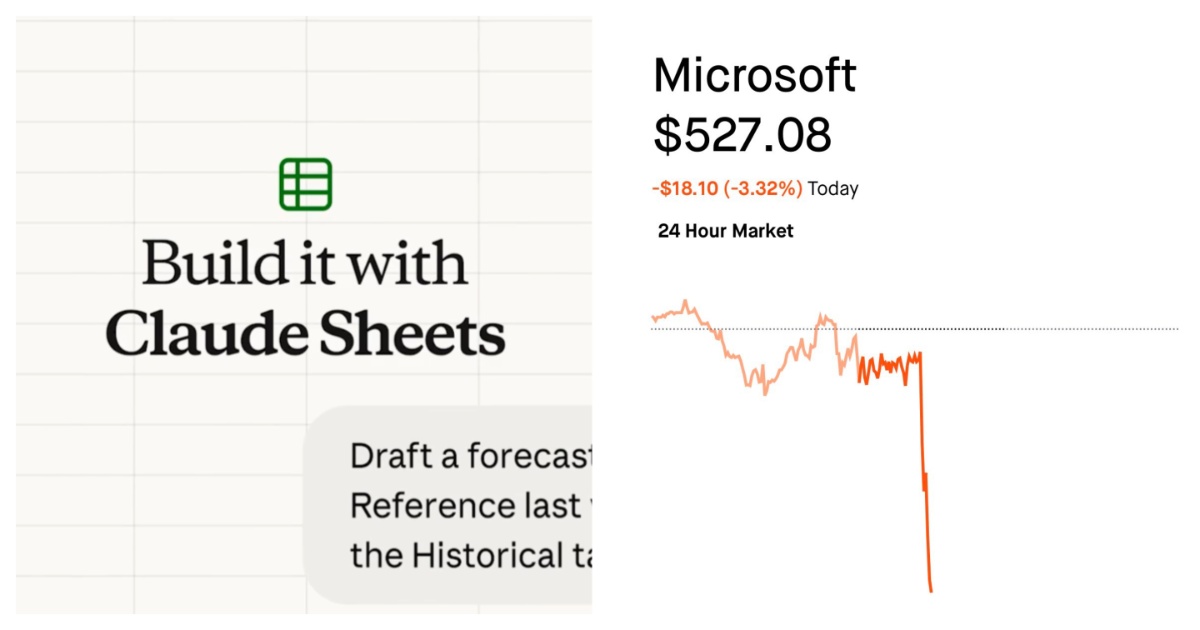
Microsoft Stock Drops 3% After Anthropic Announces Claude Sheets And Claude Data
Microsoft’s stock took a sudden hit on Tuesday, falling as much as 3% intraday after Anthropic unveiled a new suite of workplace tools... The post Microsoft Stock Drops 3% After Anthropic Announces Claude Sheets And Claude Data appeared first on OfficeChai.
OpenAI turns ChatGPT into a business directory with AI agents that handle customer questions
OpenAI is opening up ChatGPT as a business platform: through a new Business Hub, companies can claim their profile, add product data, and track how users interact with them. "Business Agents" let eligible US e-commerce providers talk to customers directly inside ChatGPT. The article OpenAI turns ChatGPT into a business directory with AI agents that handle customer questions appeared first on The Decoder.
Anthropic wants Claude to be the front end for your entire enterprise app stack
Anthropic is expanding Claude’s ability to work directly inside enterprise applications; it can now open full software interfaces, retrieve information, The post Anthropic wants Claude to be the front end for your entire enterprise app stack appeared first on The New Stack.
All 7 Anthropic founders will each cash out about $250M in IPO
Each of the seven co-founders plans to sell exactly the same number of shares in the IPO, which would bring each of them about $250 million in cash at the midpoint of the price range while leaving the group in control of the company.
Anthropic turns Claude into a full workspace with Plugins, spreadsheets, whiteboards, and soon Meeting notes
Anthropic is expanding Claude with Sheets, Whiteboards, and Interactive Connectors, letting partners like Adobe and Atlassian embed their apps directly inside Claude. Anthropic says Claude Meetings, which can join calls and take notes, is coming soon. Step by step, Anthropic is turning Claude into a central work platform for teams that brings many other apps together in one place. The article Anthropic turns Claude into a full workspace with Plugins, spreadsheets, whiteboards, and soon Meeting notes appeared first on The Decoder.
Nvidia Board Members Tap Wachtell’s Kim for Huang Probe
Nvidia Corp.’s independent board members tapped a former top federal prosecutor to help probe Chief Executive Officer Jensen Huang’s relationship with a suspected Chinese spy.
Google’s Gemini Targets Health Care’s Data Problem
Google Cloud is launching Gemini for Health Care, an AI platform designed to connect fragmented information across hospitals, insurers and other health systems while reducing administrative work. Aashima Gupta, Global Leader of Healthcare at Google Cloud, discusses how Gemini can connect medical records, clinical guidelines and business systems, and how Google is building privacy, security and HIPAA compliance into the platform. She joins Riley Griffin on "Bloomberg Tech." (Source: Bloomberg)
Washington Weighs Nvidia Fallout as China Concerns Grow
The controversy surrounding Nvidia CEO Jensen Huang is raising broader national security questions in Washington, from the potential exposure of sensitive information to concerns over the company’s dealings in China. Foundation for American Innovation senior fellow Ryan Fedasiuk discusses the questions he believes an independent investigation should examine and why the episode could add momentum to bipartisan efforts to tighten controls on the flow of advanced US chips to China. He joins Riley Griffin on "Bloomberg Tech." (Source: Bloomberg)
Anthropic Targets $1.4T Valuation in Blockbuster IPO
Anthropic is seeking a $1.4 trillion fully diluted valuation as it prepares to become the first frontier AI lab to go public, testing investor appetite after a sharp selloff in AI stocks. Bloomberg’s Bailey Lipschultz and Rachel Metz break down demand for the offering, the enormous growth Wall Street is modeling to justify the valuation, and Anthropic’s latest Mythos and Fable models. They join Riley Griffin on "Bloomberg Tech." (Source: Bloomberg)
Anthropic’s $1.4 Trillion IPO Bet Tests AI Appetite
Bloomberg’s Riley Griffin breaks down Anthropic's big goal of seeking a $1.4 trillion valuation in an IPO that could raise more money than SpaceX's blockbuster debut. Plus, Nvidia shares are down for a second straight day following the scandal surrounding CEO Jensen Huang's affair with an alleged Chinese spy; and SoftBank reports a $7 billion net loss in the second quarter, its first loss in nearly two years. (Source: Bloomberg)
Nvidia's model GR00T 2 watches humans on video, then imagines itself as the robot
Nvidia's new AI model GR00T 2 is designed to teach robots new tasks without laborious teleoperation. Instead, the system transfers human hand movements from videos to robotic arms, trained on about 400,000 hours of video footage. Success rates still vary widely, though, ranging from 10 to 80 percent depending on the task. The article Nvidia's model GR00T 2 watches humans on video, then imagines itself as the robot appeared first on The Decoder.
Nvidia Scandal Underscores Growing Espionage Risks for AI Firms
Nvidia Corp. Chief Executive Officer Jensen Huang’s affair with an alleged Chinese spy has underscored how Beijing and other nations are increasingly turning to corporate espionage to gain an edge in the global artificial intelligence race.
Gemini 4 Carbon arrives just in time to feel like yesterday's news in the fastest model cycle yet
Google is making Gemini 4 Carbon generally available after a two-week testing phase. The model ranks first in several benchmarks, in some cases ahead of Anthropic's new Fable 5.2, at less than half the per-task cost. Google is also previewing coordinated agent teams through the "/swarm" feature, which split up complex tasks in real time. The article Gemini 4 Carbon arrives just in time to feel like yesterday's news in the fastest model cycle yet appeared first on The Decoder.
Get a jump start on the US trading day with Dani Burger on "Bloomberg Open Interest." Inflation comes in hot, strengthening the case for a December rate hike. Anthropic tests investor appetite with a potential $1.4 trillion valuation, while Nvidia faces fresh scrutiny around Jensen Huang. White House CEA Chair Chris Phelan and Carlyle’s Jason Thomas break down the Fed outlook and AI risk. And Bucks President Josh Glessing on building a franchise beyond Giannis. (Source: Bloomberg)
Anthropic launches Claude Meetings to turn workplace discussions into plans and tasks
As participants talk, Claude can draft the plan being discussed, map out a timeline on a whiteboard, answer questions in the meeting chat, and access connected work apps to retrieve information, such as last year's figures.
Anthropic Targets $1.4 Trillion Valuation in Blockbuster IPO
Anthropic PBC is seeking a valuation of about $1.4 trillion in its initial public offering, in a bid to make history as the first frontier artificial intelligence lab to go public. Bloomberg's Bailey Lipschultz joins to discuss. (Source: Bloomberg)
Google DeepMind's Gemini Robotics 2.5 scores 96 percent sorting metal parts in a Mercedes-Benz assembly pilot
Google Deepmind introduced Gemini Robotics 2.5, a new control model for robots, and tested it with Apptronik on active Mercedes-Benz production lines in Hungary and Germany. The humanoid robot Apollo 2 sorted metal parts there with a reported success rate of 96 percent. The article Google DeepMind's Gemini Robotics 2.5 scores 96 percent sorting metal parts in a Mercedes-Benz assembly pilot appeared first on The Decoder.
Inside the Gemini factory: Accelerating partner solutions
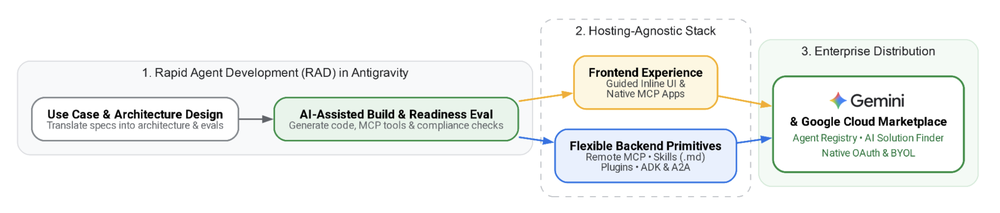
With the new unified Gemini experience, enterprises can bring third-party partner capabilities directly in Gemini through standardized connectors (spanning Model Context Protocol (MCP), Agent-to-Agent (A2A) runtimes, and REST APIs), alongside emerging declarative skills and plugins. For independent software vendors (ISVs), this unified architecture unlocks a powerful opportunity to embed domain-specialized intelligence, regulated workflows, and live systems of record directly into enterprises' daily workflows. Yet turning a compelling use case into an enterprise-ready integration often stalls in engineering friction, from choosing the right extensibility primitive and wiring authentication to orchestrating multi-step tool execution and rendering inline interactive experiences. To eliminate these bottlenecks, Google Cloud launched the Gemini factory—an intensive co-innovation initiative designed to help enterprise software partners go from a blank whiteboard to agentic solutions listed on Google Cloud Marketplace in record time. Through hands-on workshops in global technology hubs—including San Francisco, New York City, Sunnyvale, London, Paris, Tel Aviv, and Tokyo—Google Cloud specialists work side-by-side with partner teams to ideate, architect, and build the next generation of enterprise AI solutions with Gemini. Specifically, the Gemini factory helps partners: Choose the right agentic architecture across MCP connectors, skills, plugins, and autonomous agents. Go from an initial use case to a production integration in days rather than months. Accelerate customer activation with funding incentives and go-to-market (GTM) support. Let’s dive in and see how we make all of that a reality. Choosing the right architecture: agents, MCPs, skills, and plugins In previous iterations of enterprise AI, third-party integrations often operated as isolated top-level agents, forcing employees to leave their workflow. When software providers arrive at the Gemini factory, they evaluate how their capabilities plug into Gemini across four complementary architectural primitives rather than competing extremes: Model Context Protocol (MCP) connectors: The foundational data and tool pipe for exposing external APIs, search, and CRUD operations to Gemini as callable tools registered in Agent Registry in Gemini platform. Declarative Skills (.md): Open Markdown configurations stored in Skills Registry that equip Gemini with domain-specific instructions, operational guardrails, and repeatable multi-step workflows across connectors. Plugins: The composite packaging and governance primitive in Gemini and Google Cloud Marketplace that bundles one or more Connectors and Skills into a single turnkey solution for IT administrators to govern and Gemini users to invoke. AI agents (A2A): For enterprise ISVs whose value lies in proprietary algorithms, regulated workflows, or strict compliance rules, standalone A2A agents run in an isolated partner environment while plugging into Gemini as callable connectors—keeping intellectual property protected, guaranteeing deterministic execution sequences, and maintaining tamper-proof audit trails. Rather than forcing developers into a single mold, Gemini unifies all four primitives into a coherent enterprise fabric—passing shared session context into partner connectors and chaining outputs across the enterprise ecosystem. Technical velocity: From use case to production Once the right architectural pattern is defined, the Gemini factory compresses months of integration work into a streamlined, AI-assisted engineering pipeline that brings partner development teams and Google Cloud experts together side-by-side. Accelerated Partner Development Pipeline This execution velocity is powered by three core capabilities in Gemini platform: Antigravity & AI-assisted builder workflows: Rather than writing boilerplate from scratch, developers build and govern solutions in Antigravity, an AI-first development environment. Using pre-built Rapid Agent Development (RAD) skills and AI-assisted workflows, partner teams rapidly translate use-case specifications into working architectures, scaffold remote MCP connectors or agent runtimes, author declarative .md skills, and run automated pre-ingestion validation harnesses. Flexible backend primitives (MCP, skills, plugins, and ADK): For most integrations, teams expose platform APIs via a hosting-agnostic Remote MCP Connector (on Cloud Run or their existing cloud) and layer on declarative Skills (.md) bundled into a turnkey Plugin. When a use case requires closed-IP models or strict deterministic execution, partners use the Google Agent Development Kit (ADK) and the A2A protocol to expose their runtime as a callable connector in Agent Registry. Inline adaptive experiences (native MCP apps): Instead of redirecting users to fragmented external portals or maintaining complex custom UIs, Gemini keeps users in the flow of work. Through native MCP apps and guided inline components, partner integrations dynamically stream rich, context-aware visual canvases directly in Gemini while chaining outputs across Google Workspace and other enterprise connectors. From working prototype to marketplace distribution The Gemini factory is structured as an end-to-end commercial runway, not just a hackathon: Stage Program pillar Partner benefit 1. Build Seed credits Offset upfront costs: Upfront scoped credits to offset build and porting costs, consumption-based performance credits as partners scale, and scoped engineering support to accelerate development. 2. Launch Cloud marketplace Enable discoverability: Publish directly to Google Cloud Marketplace with streamlined billing, procurement, and enterprise integration to gain direct visibility across global enterprise and mid-market accounts. 3. Scale Co-marketing & GTM Amplify market demand: Access custom co-marketing and launch assets, social promotion, PR kits, launch spotlight campaigns, and Google-funded campaign packages for top-performing partners. Enterprise deployment architecture: Regardless of whether a partner builds a Skill, Plugin, MCP server, or A2A agent, the architecture is designed to keep customer onboarding frictionless and partner IP secure. Gemini users access the partner integration in Gemini using native OAuth, Dynamic Client Registration (DCR), and streamlined Bring Your Own License (BYOL) flows, while the partner maintains backend security, data sources, and proprietary tooling within their own project perimeter. Built-in discoverability: Partner solutions are published directly to Google Cloud Marketplace and featured in AI Solution Finder, giving enterprise customers a central place to discover validated MCP connectors, plugins, and agents today—and making it simple for IT administrators to configure and govern them in Gemini. Comprehensive incentives & go-to-market: Google Cloud supports verified partners through every growth stage. Qualified solutions unlock Seed Credits upon Marketplace publishing and performance credits to offset operational inference costs, paired with GTM assets and sales enablement to turn engineering milestones into a net-new pipeline. Featured partners: proven speed to impact Recent Gemini factory (previously referred to as the Agent Factory) cohorts have already brought a wave of industry-specific agents to life. Here is how nine software partners took complex enterprise challenges and deployed production-grade solutions built with Gemini in days: Aily Labs Aily Decision Intelligence Agent The Aily Decision Intelligence Agent unifies 360° enterprise performance metrics to deliver predictive business diagnostics and actionable strategic recommendations. Built for executive decision-makers, it interrogates complex operational and financial datasets to forecast performance trends, identify supply disruptions, and guide strategic resource allocation through an intuitive, mobile-first interface. “Our mission is to bring real-time, AI-powered decision intelligence to every business executive. The Agent Factory workshop was an incredible catalyst; it enabled our team to wire up complex predictive reasoning models into the Gemini Enterprise runtime, activating Aily Super Agent in record time; orchestrating thousands of specialized agents, connecting insights across multiple business domains, and presenting them through a single, intuitive interface for the user. Having side-by-side engineering support helped us prove out high-impact executive scenarios and accelerate our roadmap toward a verified listing on Google Cloud Marketplace.” — Reynaldo Espana, VP of Engineering, Aily Labs FlowX Capital Markets Document Reconciliation Agent FlowX's Capital Markets Document Reconciliation Agent streamlines high-stakes financial operations, including institutional document extraction, multi-party reconciliation, and loan pack completeness audits. Leveraging specialized document intelligence and Kubernetes-backed agent runtimes, it cross-checks disparate contracts, regulatory filings, and credit documentation to flag discrepancies in real time, drastically reducing cycle times for back-office operations. “In capital markets and lending, precision, auditability, and data security are non-negotiable. What impressed us most about the Agent Factory was how rapidly we could implement complex business validation rules and multi-source document ingestion without compromising on enterprise compliance. Transitioning from raw use cases to a functional prototype in a single workshop demonstrated the sheer execution velocity possible on Gemini.” — Serban Chiricescu, Founder & Chief Technology Officer, FlowX.AI Klarvant Digital Governance Analyst Agent The Analyst Agent by Klarvant provides outside-in discovery and analysis of an enterprise’s external namespace: post-quantum readiness, certificate and TLS hygiene, email security, supply-chain risk, and external exposure. It tracks post-quantum migration endpoint by endpoint, matches supplier and dependency events to the points where they touch the estate, and answers plain-language questions with audit-ready evidence and custom dashboards built on request. “What Gemini does exceptionally well is reason over complex technical evidence and explain it in plain language. That is exactly what governance needs. A board member or even a CISO does not want a list of ciphers; they want to know whether the company is ready and what to do next. With the Agent Factory, Gemini became the bridge between our intelligence and the people accountable for it.” — Endre Fehn, Chief Technology Officer, Klarvant NextLM AI Prospecting Agent The NextLM AI Prospecting Agent brings tenant-native prospect intelligence into Gemini. Powered by the Savant model family, it ranks the B2B accounts and buyers most likely to convert using behavioral data across 300M+ companies, 370M+ professionals, and 1.3B+ tracked news articles. Each customer gets an isolated model that is further trained on its own closed-won and closed-lost data, so prioritization reflects what actually wins for that business. Built to work alongside other agents in Gemini, it hands ranked accounts and buyer context to research, outreach, and CRM connectors, turning “who should we pursue and why now” into action across the workflow. “Building autonomous B2B sales agents requires blending live external market signals with deep enterprise CRM context. The Agent Factory eliminated the typical development friction—our engineers used the RAD framework to go from an initial architecture diagram to an active, working prospecting agent in under 24 hours. The hands-on co-engineering with Google Cloud gave us the confidence and tooling to bring a production-ready solution straight into the Gemini Enterprise ecosystem.” — Chris Anzalone, Founder & CEO, NextLM Optimizely Mark Marketing Calendar Deck Builder Agent Optimizely Mark Marketing Calendar Deck Builder Agent converts cross-functional marketing strategies, campaign timelines, and experimentation roadmaps into executive-ready slide decks and visual briefs. Grounded in campaign performance metrics and content repository data, it enables marketing leaders to generate unified omnichannel schedules, align global teams, and track milestone delivery in seconds. “Marketing teams spend countless hours manually consolidating disjointed campaign plans and roadmaps into presentations for leadership. The Agent Factory allowed us to harness Gemini and Vertex AI Vector Search to turn that manual chore into an autonomous, one-click experience. In just one intensive day, our team built an agent that unlocks immediate productivity gains for enterprise marketers and seamlessly plugs into our broader Mark platform.” — Kevin Li, SVP Product, Optimizely Ping Identity PingID Device Management Agent Employees manage their own MFA devices just by asking. When someone gets a new phone, the agent displays a live PingID pairing QR code with real-time status directly in Gemini, rendered with A2UI. Employees can also list, rename, set a default, or remove devices without opening a portal or filing a help desk ticket. That replaces a help desk call, and the over-the-phone identity check that social engineering attacks exploit, with a short conversation. “Every new phone and every last day at work is an identity event, and too many of them still turn into help desk tickets. Working side by side with Google Cloud in the Agent Factory, we built agents that let employees manage their own MFA devices and let admins resolve identity requests in one conversation. With ADK, A2A, and A2UI, those experiences run natively in Gemini, and every action stays scoped to the user, confirmed by a person, and accountable.” — Loren Russon, SVP, Product & Technology, Ping Identity Sinch Sinch RCS Messaging Agent The Sinch RCS Messaging Agent enables enterprises to create and manage RCS business agents, draft interactive messaging campaigns directly from natural-language prompts, execute rich RCS broadcasts, and monitor delivery reports, built with Gemini and Sinch's carrier infrastructure. “Collaborating with the Agent Factory team dramatically accelerated our timeline from prototype to a verified listing on Google Cloud Marketplace. Leveraging their structured environment and pre-built RAD skills, our engineering team was able to rapidly assemble, secure, and validate a complete lifecycle agent for RCS, covering enterprise authentication, RCS agent provisioning, prompt-based campaign drafting, and real-time delivery reporting. We walked away with a production-ready solution that harnesses Google Cloud’s ecosystem to help businesses deliver richer, more interactive conversational experiences at scale.” — Antoine Sein, Senior Engineering Manager, Developer Experience & Agent Experience, Sinch THG Ingenuity Shopping Assistant Insights Agent Shopping Assistant Insights converts shopper conversations into actionable commercial insights and plain-business answers grounded in BigQuery analytics. It tracks shopper demand, assistant performance, and customer friction while maintaining strict data privacy. Designed for commercial leaders, it highlights opportunities to stock, promote, or fix based on real user interactions. “Our AI Shopping Assistant captures a depth of shopper intent that traditional search bars can't. The Agent Factory helped us turn this insight into valuable action points for brands and retailers. We leveraged Gemini to rapidly build a Shopping Insights Agent that turns raw consumer data into actionable business strategy. The collaborative environment accelerated our development, giving us a deeper understanding of the Agent Marketplace while delivering a live, functional agent that provides immediate value to our customers.” — Jo Drake, CTO, THG Ingenuity Xiatech Xfuze Order Intake Agent The Xfuze Order Intake Agent automates multichannel commerce order processing, exception triage, and inventory reconciliation across disparate enterprise systems. Powered by Xiatech’s Xfuze integration platform and BigQuery analytics, it continuously identifies supply chain anomalies, resolves fulfillment errors, and provides commercial operators with conversational visibility into real-time order-to-cash health. “Connecting disparate legacy systems, e-commerce storefronts, and ERPs is a major hurdle for retail and supply chain leaders. At the Agent Factory, we leveraged the Antigravity IDE and RAD developer skills to build an agent that unifies these complex data streams effortlessly. The speed of execution was remarkable, in 24 hours, we built a first of its kind agentic application (multiple agents in one) that delivers instant operational transparency and tangible cost savings to our clients.” — Jonathan Summerfield, Founder & Chief Executive Officer, Xiatech The road ahead The transition to the agentic era requires more than standalone applications—it demands an open, interoperable enterprise ecosystem. Through the Gemini factory, Google Cloud is bringing together technical velocity and commercial scale so partners can meet enterprises wherever they work: End-to-end co-engineering: Rapid architecture design, AI-assisted development, and automated readiness testing in Antigravity alongside Google Cloud partner engineers. Full-spectrum extensibility: Flexible blueprints in Gemini across deterministic A2A agents, standardized MCP connectors, declarative skills, and turnkey plugins. Marketplace discovery and scale: Streamlined publishing to Google Cloud Marketplace, backed by seed credits, performance incentives, and joint go-to-market support. By collapsing the journey from initial whiteboard concept to a verified Google Cloud Marketplace listing into a matter of days, the Gemini factory is helping partners bring the next generation of enterprise AI solutions to market faster than ever—and this is just the beginning. Explore partner-built agents, MCP connectors, skills, and plugins in the Google Cloud Marketplace and AI Solution Finder, or connect with your Google Cloud Partner team to start building in the Gemini factory.
BigQuery measures is now GA: Unifying BI metrics and knowledge graphs for AI accuracy
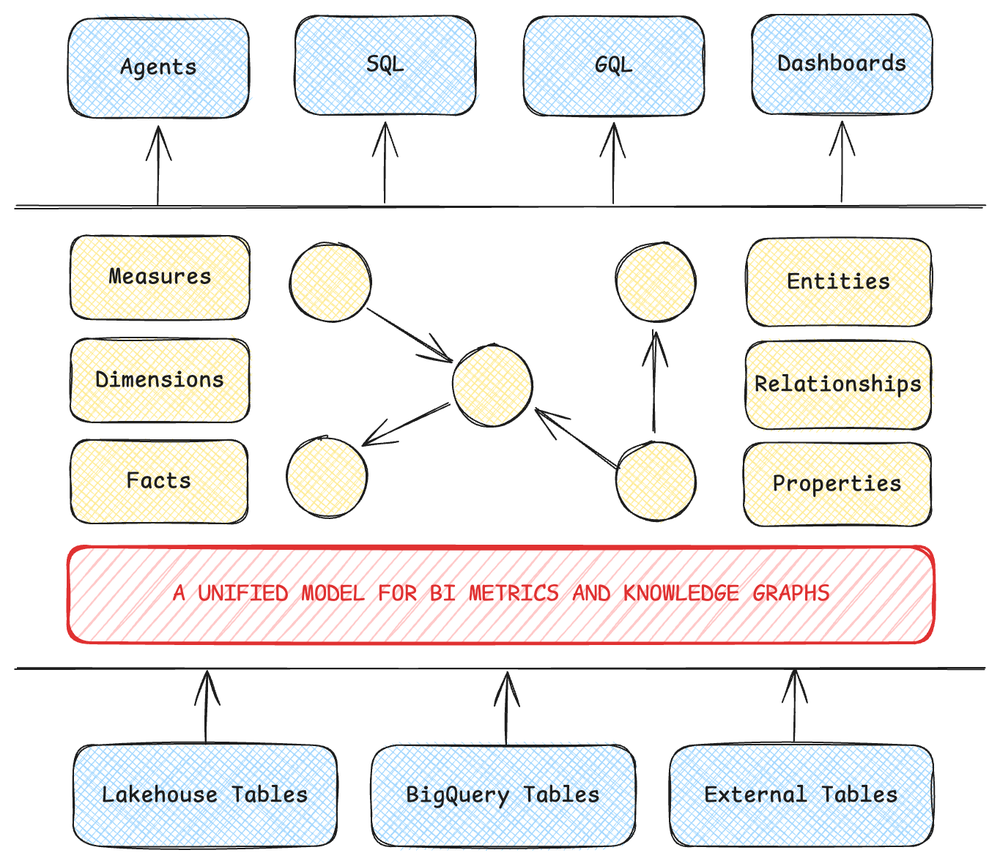
To answer a complex business question, an AI agent must understand two things: what happened, and why. The what is a governed metric, like revenue at risk; the why is the network of relationships that produced it. Because metric definitions, a.k.a. measures, traditionally live in business intelligence (BI) platforms while relationships live in knowledge graphs, an AI agent only ever sees half the picture. It guesses the rest, leading to confident but sometimes wrong answers. To solve this hallucination problem, we introduced measures in BigQuery, which are now generally available. Historically, organizations needing both BI and knowledge graphs had to run two siloed technology stacks: one to calculate reliable metrics, the other to map out entity relationships. Bridging them entailed brittle data pipelines and runtime reconciliation by analysts and AI agents, who held the connections in their heads or in sprawling prompts. This patchwork approach wasn't just slow and expensive — it’s where data governance broke down, as every analyst and prompt may define joins and metrics differently. Figure 1: A unified model for defining BI metrics and knowledge graphs in one place, for powering AI agents, SQL, GQL and dashboards. To replace manual reconciliation, you need a single model that understands both the structure of your business and the math that measures it. BigQuery measures builds directly on BigQuery Graph to deliver that unified foundation. By defining measures directly on the graph entities they describe, your BI dashboards and AI agents don't just get a number they can trust — they get the relational context behind it. Finally, they can reliably answer both the what and the why. "With BigQuery measures, we can now deliver self-documenting data products. Defining measures natively in BigQuery ensures Looker Dashboards, Conversational Agents and our Data team queries operate on identical logic, guaranteeing metric alignment across leadership and significantly reducing data team maintenance overhead." - Amanda Reelick, Head of Data Enablement, Woolworths NZ One model to answer both the what and the why Let's walk through an example. Suppose your retail bank's risk analytics team spots a sudden spike in transaction activity in the Prague district. You need to know whether this represents healthy customer growth or concentrated risk exposure. Answering requires two pieces of evidence: how much money actually moved (the what), and which specific accounts it flowed through (the why). At most banks, getting that answer takes two teams, two tools, and two numbers that are rarely reconciled. With BigQuery, your underlying data is already in place — whether in native tables or in a borderless Lakehouse. With a single schema, you can define a semantic model directly over your existing transaction, account, and district tables — with no data movement and no secondary system: code_block <ListValue: [StructValue([('code', '-- Entities, relationships, and measures, declared in one model\r\nCREATE OR REPLACE PROPERTY GRAPH retail_banking.BankingGraph\r\n NODE TABLES (\r\n retail_banking.trans AS Trans\r\n KEY (trans_id)\r\n PROPERTIES (\r\n trans_id, account_id, amount,\r\n MEASURE(SUM(amount)) AS total_trans_amount\r\n ),\r\n retail_banking.account AS Account\r\n KEY (account_id)\r\n PROPERTIES (\r\n account_id, district_id, stmt_frq,\r\n MEASURE(COUNT(account_id)) AS account_count\r\n ),\r\n retail_banking.district AS District\r\n KEY (district_id)\r\n PROPERTIES (district_id, city, state)\r\n )\r\n EDGE TABLES (\r\n retail_banking.trans AS POSTED_TO\r\n KEY (trans_id)\r\n SOURCE KEY (trans_id) REFERENCES Trans (trans_id)\r\n DESTINATION KEY (account_id) REFERENCES Account (account_id)\r\n NO PROPERTIES,\r\n retail_banking.account AS LOCATED_IN\r\n KEY (account_id)\r\n SOURCE KEY (account_id) REFERENCES Account (account_id)\r\n DESTINATION KEY (district_id) REFERENCES District (district_id)\r\n NO PROPERTIES\r\n );'), ('language', ''), ('caption', <wagtail.rich_text.RichText object at 0x7fee2a9710d0>)])]> To determine whether the Prague spike reflects broad growth or concentrated exposure, your team checks whether the transaction volume is spread across many accounts or driven by just a few. Using GRAPH_EXPAND, you flatten the graph and roll up both measures with the AGG() function: code_block <ListValue: [StructValue([('code', '-- Volume by city, and the accounts behind it, each counted once\r\nSELECT\r\n District_city,\r\n AGG(Trans_total_trans_amount) AS total_volume,\r\n AGG(Account_account_count) AS accounts_involved\r\nFROM GRAPH_EXPAND("retail_banking.BankingGraph")\r\nGROUP BY District_city;'), ('language', ''), ('caption', <wagtail.rich_text.RichText object at 0x7fee2a9706d0>)])]> You can ensure accurate reporting by using measures that have been “grain-locked” — where a fixed level of granularity has been assigned to how facts and dimensions are modeled. Because a single account can have thousands of transactions, joining the two tables can duplicate account rows. A standard SQL COUNT(account_id) would overcount those accounts, leaving your risk and finance teams with conflicting numbers. BigQuery measures preserve the native grain of each entity, counting every account only once regardless of how the tables are joined. The second half of the investigation is about connectivity: Which accounts are driving the Prague activity? You can answer that with a traversal in GQL (the ISO-standard Graph Query Language) over the exact same model: code_block <ListValue: [StructValue([('code', "-- Which accounts moved money in Prague\r\nGRAPH retail_banking.BankingGraph\r\nMATCH (:Trans)-[:POSTED_TO]->(a:Account)-[:LOCATED_IN]->(d:District)\r\nWHERE d.city = 'Prague'\r\nRETURN DISTINCT a.account_id"), ('language', ''), ('caption', <wagtail.rich_text.RichText object at 0x7fee2a2f2150>)])]> Neither query requires a separate system, and both evaluate against the same governed definitions. New features in BigQuery measures While the preview introduced grain-locked measures tightly integrated with BigQuery Graph, real-world production analytics demand more than basic sums — and enterprise AI agents need programmatic ways to discover and interpret those metrics. The GA of BigQuery measures focuses on two key areas: richer modeling and visualization for complex business logic, and native semantic discovery for the agentic ecosystem. Richer modeling, querying and BI visualization To enable more expressive and flexible measure definitions, MEASURE() supports both composite expressions and derived measures; this capability is GA. Rather than repeating conditional logic across queries, you can define baseline aggregates once and compose them into higher-order calculations on the same table using AGG(). BigQuery validates these formula dependencies at schema compilation time to catch circular references or invalid aggregations early. Downstream dashboards and AI agents can then query complex ratios and net metrics at any dimensionality with consistent accuracy. For example, on your Trans node, you can define settled volume alongside total volume, and then derive unsettled volume and unsettled percentage directly from those building blocks: code_block <ListValue: [StructValue([('code', '-- Compose custom calculations, conditional expressions, and derived ratios\r\nPROPERTIES (\r\n trans_id, account_id, amount, fee, is_settled,\r\n MEASURE(SUM(amount)) AS total_trans_amount,\r\n MEASURE(SUM(CASE WHEN is_settled = TRUE THEN amount ELSE 0.0 END))\r\n AS settled_volume,\r\n MEASURE(AVG(CASE WHEN amount > 10000 THEN amount ELSE NULL END))\r\n AS avg_large_trans,\r\n -- Derived: written in terms of the measures above\r\n MEASURE(AGG(total_trans_amount) - AGG(settled_volume)) AS unsettled_volume,\r\n MEASURE(\r\n SAFE_DIVIDE(AGG(total_trans_amount) - AGG(settled_volume),\r\n NULLIF(AGG(total_trans_amount), 0)) * 100.0\r\n ) AS unsettled_pct\r\n)'), ('language', ''), ('caption', <wagtail.rich_text.RichText object at 0x7fee2a2f2e50>)])]> Query across multiple fact tables Enterprise data models routinely span multiple business processes. Joining separate fact tables that share a common dimension — such as transactions and credit cards linked to the same bank account — traditionally causes a "chasm trap," where cross-fact multiplication inflates both metrics. The new start_node argument in GRAPH_EXPAND solves this by isolating each fact table into its own expansion tree. BigQuery evaluates each measure at its native grain before joining the results on the shared entity: code_block <ListValue: [StructValue([('code', '-- Transactions and cards per account, each evaluated at its own root grain\r\nSELECT\r\n ET.Account_account_id,\r\n AGG(ET.Trans_settled_volume) AS settled_volume,\r\n AGG(EC.Card_card_count) AS total_cards_issued\r\nFROM\r\n GRAPH_EXPAND("retail_banking.BankingGraph", start_node => "Trans") AS ET\r\nLEFT JOIN\r\n GRAPH_EXPAND("retail_banking.BankingGraph", start_node => "Card") AS EC\r\nON ET.Account_account_id = EC.Account_account_id\r\nGROUP BY ET.Account_account_id;'), ('language', ''), ('caption', <wagtail.rich_text.RichText object at 0x7fee2a6f6190>)])]> By expanding each fact table from its own root (Trans and Card), each branch maintains its exact grain — even for accounts with transactions but no issued cards. Visualize in Data Studio With the updated BigQuery connector in Data Studio, you can now connect directly to BigQuery graphs and build interactive visualizations powered by native measures. Data Studio honors the aggregation logic defined in your graph model, keeping complex calculations consistent across charts while preventing accidental client-side re-aggregations. Built for the agentic era Attach business meaning to your measures In a large enterprise schema, it’s nice to be able to attach business meaning to your measures, as multiple metrics often share similar names. In our banking model alone, total_trans_amount, settled_volume, and unsettled_volume could all casually be called "volume" by a business user. That ambiguity can trip up both analysts building reports and AI agents translating natural-language prompts into SQL. With the GA, you can embed rich semantic metadata directly into each measure definition using the OPTIONS clause, including plain-language description strings, domain synonyms, and custom key-value extensions: code_block <ListValue: [StructValue([('code', "-- Business meaning and governance metadata travel with the metric\r\nMEASURE(SUM(CASE WHEN is_settled = TRUE THEN amount ELSE 0.0 END)) \r\n AS settled_volume\r\n OPTIONS (\r\n description = 'Transaction value that settled. Excludes fees.',\r\n synonyms = ['settled amount', 'cleared volume'],\r\n extensions = [('unit', 'USD'),\r\n ('owner', 'finance-analytics'),\r\n ('reporting_tier', 'executive')]\r\n )"), ('language', ''), ('caption', <wagtail.rich_text.RichText object at 0x7fee48864150>)])]> Because this business context lives inside the schema alongside the SQL formula, your semantic definitions travel wherever the metric is queried. Make measures discoverable to humans and AI agents BigQuery directly integrates with Knowledge Catalog to create a unified discovery and consumption loop for both people and machines: Enterprise-wide context discovery in Knowledge Catalog: BigQuery Graph and measures metadata is automatically ingested and searchable in Knowledge Catalog as a native resource alongside tables, views, and routines. Data stewards, analysts, and AI agents can search across the catalog using business synonyms or descriptions, inspect governance tags, and view the underlying measure’s SQL definitions (such as SUM(CASE WHEN is_settled = TRUE...)) to verify how each metric is calculated before using it. In Knowledge Catalog, you can also enrich graph metadata with business glossaries and stewardship context, uniting asset discovery, business meaning, and mathematical measures in a single pane so users and agents can work from the same context. Runtime schema introspection in BigQuery: Calling BQ.SHOW_GRAPH_EXPAND_SCHEMA returns an expanded graph's schema as JSON without scanning underlying tables, flagging metrics with "is_measure": true alongside their descriptions and synonyms. Passing flatten_results => FALSE preserves your entity hierarchy as nested ROW (STRUCT) types, letting agents inspect the relational tree and query paths like Account.District.city directly. Connect across your data and AI ecosystem Finally, BigQuery measures integrates across the Google Cloud data and AI stack so you can author, reuse, and query semantics in the tools you already use: Author with AI: Use the graph skills in Data Agent Kit to scaffold, author, and validate BigQuery measure definitions using natural-language prompts in your preferred AI coding environment. Reuse existing LookML models: If you already model business metrics in Looker, you can model once using LookML-based derived analytic models to compile Explores, joins, and measures directly into native BigQuery Graph models. Query with natural language: Unified graph and measure definitions are supported out-of-the-box in Conversational Analytics, enabling business users and AI agents to ask complex questions against governed metrics in plain natural language. Get started with BigQuery measures The primary advantage of this unified model is that you can build from the foundation you already have. If you already run a BI semantic layer, take a governed metric and define it directly on the entity it describes; if your foundation is a knowledge graph, attach a unified measure to your most frequent traversal. Whichever side you start from, you are building a single source of truth for both your BI dashboards and your AI agents. To see unified semantics in action, watch the BigQuery measures introduction video, or dive into the BigQuery measures documentation and BigQuery Graph overview. When you are ready to build hands-on, try our step-by-step codelabs for music streaming analytics.
Don't just flag it, fix it: How to run CodeMender in your pull requests
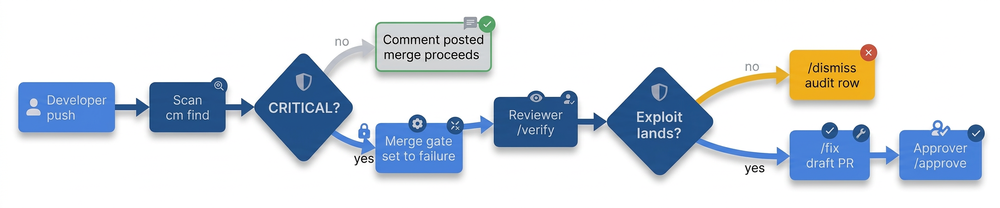
As many developers use agentic tools to create more code faster than ever before, the code has gotten more complex and they’re taking longer to find and fix software flaws. Helping to address that pressure is a key concern at Google. We know that software development velocity is increasing, as much as 2x for some teams, and the average developer fix time for software flaws expanded from approximately 59 days a decade ago to more than 170 days in 2025, according to the Mandiant M-Trends 2026 Report. CodeMender: AI powered vulnerability fixes right in GitHub PRs To help you secure more code, more quickly, we’ve built CodeMender, our autonomous code-security agent that can find and fix software flaws at machine speed. We also know that developer tools only succeed if they fit into existing routines. That’s why CodeMender, part of our AI Threat Defense platform, brings automated code fixes directly into the developer workflow. Today, we’re sharing this reference architecture that wires automated CodeMender remediation straight into Git pull requests via Google Cloud Run. What the developer sees Everything happens in the timeline. The scan posts one comment, a table of findings, each finding with an ID, and the two things you can type next. Figure 1: A pull request triggers the scan on Cloud Run. Findings, exploit traces, and proposed patches all come back to the same timeline. Reply /verify 612424da and the exploit attempt comes back in the thread, folded into a collapsible View Exploit Steps & Response Trace block so it doesn't bury the conversation. Reply /fix 612424da and the patch arrives the same way, behind Preview Proposed Code Diff, with a draft pull request already open /approve there. Both commands take all in place of an ID. Figure 2: The initial scan comment provides a table of findings and the actionable slash commands, keeping the developer entirely within the pull request timeline. Nothing asks the developer to leave the pull request or learn a console. Ship evidence, not just a severity CodeMender cm find runs return a confidence score on the vulnerability finding during the code analysis. If the confidence score is below 100%, you can use cm verify to have CodeMender build and simulate an exploit in a sandbox to determine if the vulnerability is actually exploitable. The simulation results can change the severity. Because the verification sandbox is ephemeral, the pipeline automatically streams these artifacts to Google Cloud Storage to preserve an audit trail for compliance and security operations reviews. Figure 3: The /verify command returns a trace of the sandboxed exploit attempt, giving reviewers actionable evidence rather than abstract alerts. Engineer for failure modes in your verification pipeline. If your harness only searches for a successful exploit string, then any test failure — such as a crashed mock server or an execution timeout — can cause the pipeline to fail open and mistakenly label a real vulnerability as safe. Ensure your parser separates true negative results from test crashes. If an exploit fails to complete cleanly, flag the status as inconclusive rather than giving it a clean bill of health. Propose the patch, preview the diff When an exploit proves a finding is real, the next step isn't a ticket, it's a patch: cm fix a1b2c3d4 instructs CodeMender to author one. Figure 4: The /fix command returns a unified code diff, giving reviewers meaningful context to evaluate the patch. If the diff looks good, applying it takes one step. The developer replies /approve. The agent commits the patch to the branch, pushes it, and sets a commit status security/codemender-gate to green. Branch protection is what turns that status into a merge block; without it, the gate is advisory. No stored keys between GitHub and Cloud Run None of this happens until GitHub and Google Cloud trust each other. This agent needs write access to your source code, precisely the credential you don't want sitting in a secret store waiting to leak. GitHub Actions can mint a short-lived OIDC token instead, and Google can be configured to accept it, so nothing long-lived exists to steal. Nearly all the security here rests on one line: code_block <ListValue: [StructValue([('code', 'resource "google_iam_workload_identity_pool_provider" "github" {\r\n workload_identity_pool_provider_id = "github-provider"\r\n\r\n oidc {\r\n issuer_uri = "https://token.actions.githubusercontent.com"\r\n }\r\n\r\n attribute_mapping = {\r\n "google.subject" = "assertion.sub"\r\n "attribute.repository_id" = "assertion.repository_id"\r\n }\r\n\r\n # Without this, any repository on GitHub can exchange a token against your pool\r\n attribute_condition = "assertion.repository_id == \'123456789\'"\r\n}'), ('language', ''), ('caption', <wagtail.rich_text.RichText object at 0x7fee2b763350>)])]> Every GitHub Actions workflow shares that issuer URL, so validating the issuer alone buys you nothing. The condition is the part doing the work. Note what it matches on. assertion.repository would also work here, but it matches a name and names get renamed, or claimed by someone else once you release them. repository_id and repository_owner_id are immutable, which is why Google recommends mapping those instead. Give the exploit somewhere safe to run Verification runs attack code that nobody reviewed, written on demand, pointed at a mock target, doing what the vulnerability class implies. As recent headlines have reminded everyone, the last thing you want is an autonomous agent deciding the fastest way to complete a task is to break out of its container and port-scan your internal network. Before you can trust the verdict, you have to answer two important questions: Where does that code execute, and what can it reach while it does? The answer is to run it as a Cloud Run job. Every Cloud Run instance is sandboxed, and jobs always run in the second-generation execution environment, a microVM with full Linux compatibility. The execution starts, does one thing, and exits. Figure 5: The exploit runs in an instance that holds nothing and lives for one finding. Only the verdict leaves. Then empty the room. Give the job a service account of its own and grant it nothing beyond the API that writes the exploit. It needs no registry access, because Cloud Run imports the container image when you deploy rather than pulling it at the instance start. Skip the Compute Engine default account, which may carry roles/editor depending on your organization policy. Take the network away too: Direct VPC egress into a subnet with no route out means code that can't call anywhere can't exfiltrate what it finds or fetch a second stage. Run one job per finding. The execution ends, the instance goes with it, and the verdict is the only thing that outlives either. Cloud Run sandboxes or agent sandboxes close the last gap. In the instance, process execution is isolated from the parent workload, its environment variables, its secrets, and the Google Cloud metadata server, so the credential the platform hands out by default is out of reach as well. It's built for agents running code they just wrote. Get started today You can build an autonomous GitOps security agent today. Start with the reference implementation at codemender-gitops.