November 12, 2026
Gilbert + Tobin rethinks the business of law with AI
A conversation with Sam Nickless, Partner and Chief Executive Officer at Gilbert + Tobin.
Read original articleDataAIHub Daily
Archive →50 curated AI news stories from leading AI companies.
November 12, 2026
A conversation with Sam Nickless, Partner and Chief Executive Officer at Gilbert + Tobin.
Read original articleNovember 11, 2026
Nvidia CEO Jensen Huang, already under scrutiny over an affair with a woman U.S. intelligence believes was a Chinese spy, also had an... The post Jensen Huang Also Had A Relationship With Kimberly Powell, NVIDIA’s VP Of Healthcare: New York Times appeared first on OfficeChai.
Read original articleNovember 11, 2026
Jensen Huang affair in DC: Resignation calls and moves to tighten Nvidia China exports CNBC
Read original articleNovember 11, 2026
In late September, OpenAI entered discussions for its latest funding round with confidence. After having early discussions with prospective backers who had expressed interest, the company presented its terms: at least $30 billion in new capital at a $1.4 trillion valuation.Few startups have been as successful at fundraising as OpenAI, which was last valued at $852 billion. This time, however, some investors felt the terms were too lofty, according to people familiar with the matter, who spoke on
Read original articleNovember 11, 2026
Google launched the Gemini Decisions API, powered by Gemini Decision 1. It returns calibrated probabilities for up to 1,000 yes/no, choice and rubric questions over text, images, audio, video and PDFs, at $0.10 per 1M input tokens. The post Google Launches Gemini Decisions API With Gemini Decision 1 at $0.10/M Tokens appeared first on MarkTechPost.
Read original articleNovember 11, 2026
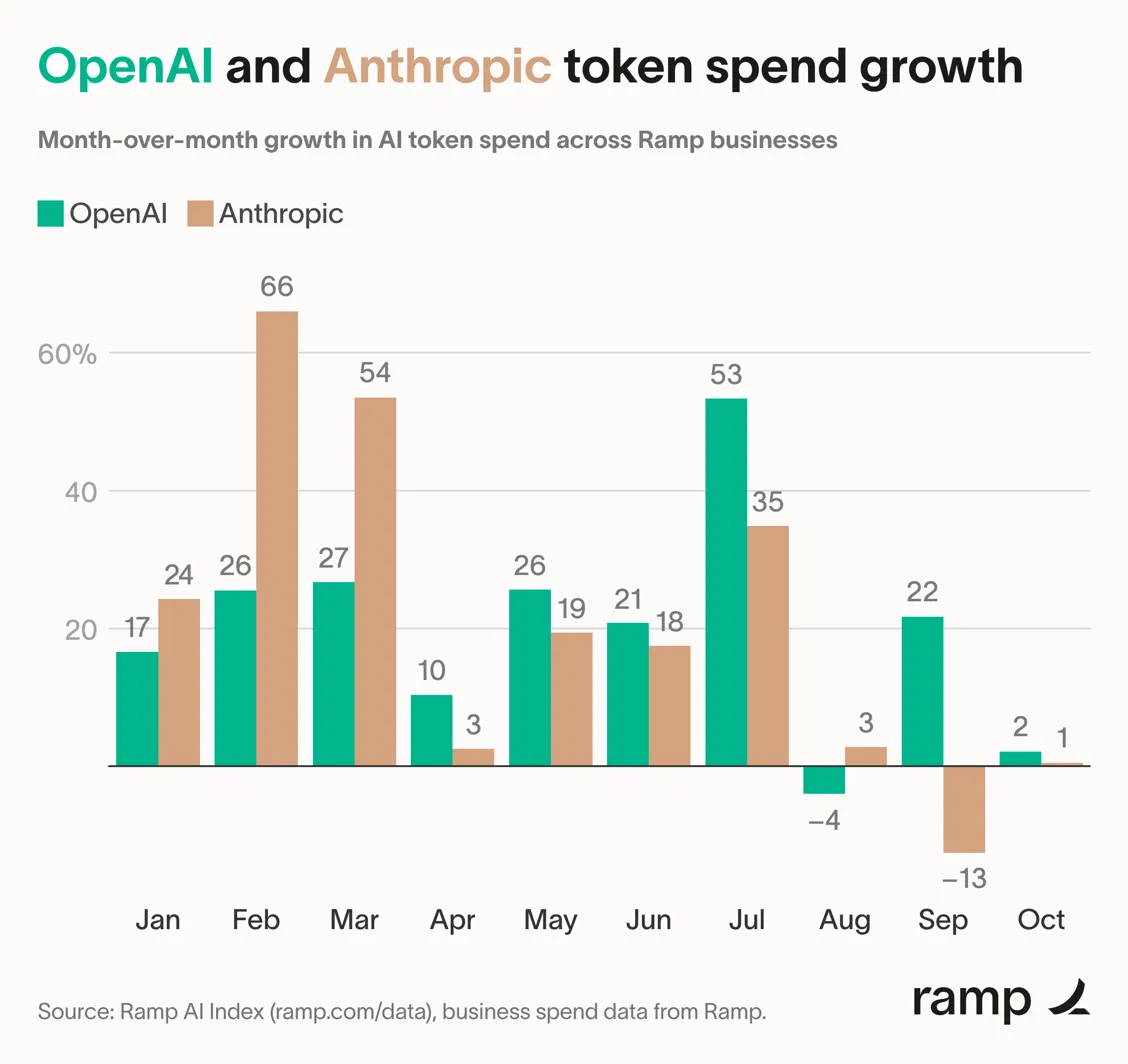
Corporate spending on the two biggest AI labs is still growing, but the pace has cooled off dramatically. According to the latest Ramp... The post Business Spend On OpenAI And Anthropic Grew Just 2% & 1% Respectively In October, Says Ramp Data appeared first on OfficeChai.
Read original articleNovember 11, 2026
Google DeepMind released AlphaGenome 2, a conditional DNA sequence model that predicts regulatory activity and variant effects per cell type. It is available via the AlphaGenome API for non-commercial research. The post Google DeepMind Releases AlphaGenome 2 for Cell-Type-Specific Variant Effects appeared first on MarkTechPost.
Read original articleNovember 11, 2026
Microsoft Corp. aims to find ways to power its data centers without relying on government subsidies or driving up costs for other electricity consumers.
Read original articleNovember 11, 2026
Google Deepmind's new Gemini Decisions API evaluates up to 1,000 closed-ended questions in a single pass across text, images, audio, and video. Gemini Decision 1 returns results in 150 to 250 milliseconds at roughly five times lower cost than Gemini 3.5 Flash-Lite, according to Google. The article Google joins the decision-model wave with Gemini Decision 1, scoring 1,000 questions in a single pass appeared first on The Decoder.
Read original articleNovember 11, 2026
Bloomberg's Mike Shepard said that actions taken by the Trump administration and by Nvidia CEO Jensen Huang are coming under sharper scrutiny by Congress amid investigations into the affair Huang had with a women alleged to be a Chinese spy. Trump had denied that he knew anything about the national security risks posed by Huang's affair, but recent New York Times reporting reveals that Trump had been briefed about the risk before his trip to China earlier this year. (Source: Bloomberg)
Read original articleNovember 11, 2026
Santosh Janardhan, who originally joined the company in 2009, will be stepping down from his role.
Read original articleNovember 11, 2026
Mississippi regulators uphold xAI air permit for 41 gas turbines in Southaven despite environmental opposition FOX13 Memphis
Read original articleNovember 11, 2026
TSMC Secures Its Future by Investing in Anthropic and OpenAI Yahoo Finance
Read original articleNovember 11, 2026
An OpenAI model helped me teach the Microduck to waddle and moonlight as a tiny cat butler.
Read original articleNovember 11, 2026
Carlyle Group co-Chairman and Bloomberg Host David Rubenstein talks about the anticipated initial public offering of Anthropic and the scandal involving Nvidia CEO Jensen Huang. He expects the Anthropic valuation to reach $1.3 trillion and he thinks Huang will stay on as leader of Nvidia. Rubenstein also talks about the upcoming release of Grand Theft Auto VI. (Source: Bloomberg)
Read original articleNovember 11, 2026
According to the Ramp AI Index, US corporate AI spending rose just 1.65 percent in October 2026. One percent of companies still drive 80 percent of revenue for OpenAI and Anthropic. Customer support is emerging as a new growth driver, but it may bring lower margins than the coding business that has fueled spending so far. The article US corporate AI spending hits a new high in October, but growth slows to 1.65 percent appeared first on The Decoder.
Read original articleNovember 11, 2026
Nvidia CEO Jensen Huang has until the end of the day Wednesday to answer a call from House Republicans for a closed-door briefing on his affair with alleged Chinese spy.
Read original articleNovember 11, 2026
Anthropic just released a coding model that beats Opus 5.5 on two major benchmarks and can complete certain difficult tasks The post Anthropic built a model that beats Opus. It recommends Opus anyway. appeared first on The New Stack.
Read original articleNovember 11, 2026
Nvidia this week donated OpenShell, its open-source runtime for securing and governing AI agents, to the Cloud Native Computing Foundation. The post Why Nvidia gave OpenShell to the CNCF appeared first on The New Stack.
Read original articleNovember 11, 2026
Amazon and Microsoft Lead the Cloud Market. One of Them Has Far Greater Upside. Yahoo Finance
Read original articleNovember 11, 2026
Rep. Raja Krishnamoorthi says Congress needs answers from Nvidia CEO Jensen Huang over his reported relationship with a woman suspected of ties to Chinese intelligence, and says lawmakers could consider a subpoena if Huang doesn’t voluntarily appear. The Illinois Democrat also calls for a review of Nvidia’s China export licenses and tougher controls designed to prevent advanced US chips from reaching restricted Chinese entities. He joins Riley Griffin on “Bloomberg Tech.” (Source: Bloomberg)
Read original articleNovember 11, 2026
Alphabet Inc.’s Google is adding its Gemini artificial intelligence app to Apple Inc.’s CarPlay system, expanding options for drivers who may already be using the assistant on their Apple devices.
Read original articleNovember 11, 2026
Bloomberg’s Riley Griffin takes a look at Anthropic's potentially record-breaking IPO, with sources saying it's already multiple times oversubscribed. Plus, CoreWeave reassures Wall Street with third-quarter sales topping analyst estimates and easing fears about the debt tied to its rapid AI buildout; and Congressman Raja Krishnamoorthi discusses how the Nvidia scandal is felt across Washington and beyond. (Source: Bloomberg)
Read original articleNovember 11, 2026
Last week, we opened our new headquarters at One Sansome Street in San Francisco,...
Read original articleNovember 11, 2026
Google Deepmind's AlphaProof Code mathematically verified Signal's cryptographic core code in four weeks, a process that typically takes years. AI agents powered by Gemini Carbon wrote more than six million lines of proof code and flagged only about one percent for human review. Deepmind plans to extend the method to critical infrastructure like power grids and medical devices. The article Google Deepmind's AlphaProof Code verified Signal's cryptographic core in four weeks instead of years appeared first on The Decoder.
Read original articleNovember 11, 2026
Congress Set to Subpoena Nvidia’s Jensen Huang, Republican Says Bloomberg.com
Read original articleNovember 11, 2026
Latest example of the AI boom’s circular financing comes as AI trade wobbles.
Read original articleNovember 11, 2026
Meet the Gemini Decisions API, powered by our state-of-the-art model Gemini Decision for fast, calibrated multimodal decisions.
Read original articleNovember 11, 2026
It’s been a big month so far for American politics and the tech industry. Democrats deliver a sweeping win across the country, calling continued AI development into question. Nvidia launches an investigation into CEO Jensen Huang’s affair with an alleged Chinese spy. There are plenty of things to make investors jittery, yet we’re seeing a tech rally as markets await the upcoming Anthropic IPO. Bloomberg’s Michael Ball joins Joe Weisenthal and Tracy Alloway on the Odd Lots podcast to unpack why the tech trade is showing resilience despite macro jitters. (Source: Bloomberg)
Read original articleNovember 11, 2026
An Anthropic engineer gave Claude Fable 5.2 one prompt to build a first-person shooter and let it run for eight The post Anthropic’s Claude Fable 5.2 built a shooter in 1 prompt — and it only took 8 hours and $550 appeared first on The New Stack.
Read original articleNovember 11, 2026
Anthropic PBC’s initial public offering has drawn multiple times the orders for the shares available, according to people familiar with the matter, as demand accelerates for potentially the biggest first-time share sale ever. Bloomberg's Sridhar Natarajan joins to discuss. (Source: Bloomberg)
Read original articleNovember 11, 2026
Nvidia Vs. AMD: No, Neither is Getting Choked Out By Congress Come January Yahoo Finance
Read original articleNovember 11, 2026
Get a jump start on the US trading day with Dani Burger on "Bloomberg Open Interest." CoreWeave’s upbeat forecast reignites the tech trade, while Anthropic’s blockbuster IPO adds fresh fuel to AI optimism. Fed hike bets build after Austan Goolsbee sounds the alarm on inflation. Plus, Terry Haines joins us on the fallout from Nvidia’s scandal, and Ann Berry and Victoria Fernandez weigh in on the market setup. (Source: Bloomberg)
Read original articleNovember 11, 2026
Nvidia Partners See Early Signs Customers Are Unnerved By Jensen Huang Investigation CRN
Read original articleNovember 11, 2026
What’s Next for Anthropic’s Mega-IPO: Five Things to Watch Bloomberg.com
Read original articleNovember 11, 2026
As teams deploy and scale AI workloads using NVIDIA Dynamo, Kubeflow, or Slurm, tracking what actually runs requires visibility beyond the platform...
Read original articleNovember 11, 2026
Welcome back to The Blueprint, a regular feature where we highlight how Google Cloud customers are tackling unique and common challenges across industries using the latest AI and cloud technologies. We hope to inspire others looking to innovate in their work. As the electric vehicle revolution gains steam in Europe, every charging session is a moment of truth, for the driver and for the transition itself. At lemonflow, we build AI agents purpose-built for EV charging: support agents for drivers and monitoring agents for charging networks. Our support agents answer drivers around the clock in more than 90 languages, and today they help an EV driver every 90 seconds. The Challenge Before we founded lemonflow, we worked closely with leading mobility players across Europe and saw first-hand how often charging goes wrong: Between 15% and 25% of EV charging attempts in Europe end in failure. Across Europe’s rapidly expanding EV market, where battery-electric car sales grew 30% in 2025 and thousands of charge point operators run public chargers, drivers who encountered stalled charging points were often left stranded or stuck in slow call center queues. We set out to change that hands-on: to bring the cutting edge of AI to EV charging, and to build the world’s best conversational AI for distributed hardware, an automated platform that resolves real-time charging issues via phone, chat, email, and WhatsApp. However, handling live voice support created several technical requirements: Strict latency thresholds: Frustrated drivers want immediate assistance. Our testing confirmed that serving latencies above 800 milliseconds risk conversational barge-ins, causing drivers to interrupt the agent and break the interaction flow. Managed API bottlenecks: Initially relying on managed LLM APIs, we faced latency deviations during peak hours (spiking from 1.0–1.2 seconds to over 1.7 seconds) and experienced HTTP 429 rate-limit errors when global usage peaked. Compute-intensive conversations: Every agent works from one comprehensive prompt, paired with dynamic tool calls that read and act on live charger data. This design creates intense bursts of compute demand during calls, making throughput on shared, managed capacity difficult to guarantee under peak loads. Highly fragmented ecosystem: We needed a standardized conversational engine capable of bridging around 30 distinct Charge Point Management Systems (CPMS), the backends operators use to run their chargers, each with its own APIs, data models and quirks. Hundreds of tailored agents: No two operators run support the same way. Each has its own tariffs, payment methods, escalation paths and hours for human backup, and most run several agents, for example one per country, brand or hotline, with behavior that can change by time of day. Each agent’s prompt is unique and must be served at full speed and improved without breaking any of the others. To deliver ultra-low-latency voice interactions and guaranteed serving capacity, we needed direct control over our model hosting environment. The Solution We wanted every driver to get best-in-class support that feels effortless, almost magical: no queue, no menu, just a short conversation that ends with the car charging. Picture a driver on a long cross-border trip, pulling into a motorway service station at 11 p.m. She plugs in, but the charger won’t start: the previous session never closed properly. She calls the number on the charger and is answered in her own language. Within seconds, our agent spots the stuck session in the charger’s logs, restarts the charger remotely and stays on the line until power is flowing. To get there, we had to solve our latency bottlenecks and secure dedicated compute capacity. We migrated from managed APIs to self-hosting the open Gemma 4 model on Google Cloud TPU v6e hardware in the EU. Like many startups using Gemma, the compatibility of these open models with Gemini allowed us to transition our existing prompt infrastructure with minimal modification. Moving to self-hosted TPUs unlocked the more complete architectural control our engineering team required to establish a deterministic core layer that handles EV-specific guardrails, guards against prompt injections, and standardizes previously fragmented backend protocols into our internal format before ever reaching the LLM. Control had a second payoff: because the model and serving stack change only when we change them, every test result stays meaningful. That stability laid the foundation for Agent Coach, our background coaching engine for AI agents, described below. We then developed an intelligent routing gateway to prioritize workloads according to operational urgency, serving live voice calls first, followed by web chats, and deferring automated re-simulations to low-traffic periods. Custom optimizations to the open-source vLLM serving engine and memory tiering between the TPU and host memory let a single TPU slice keep many more operator agents ready for instant answers, without recalculating their context. We also implemented automated fallback routing to self-hosted GPUs and Gemini Enterprise endpoints. Thanks to TPU reliability, Gemma answers more than 99.9% of all live conversation turns, and these fallbacks serve primarily as deployment buffers during system updates. Primary or fallback, every request is served from secure EU compute. The Architecture The Outcome For the e-mobility companies we work with, and for their drivers, the result is support that simply works: our agents typically answer every call, handle more than 80% of conversations end to end without a human handover, and earn 95% driver satisfaction. Behind the scenes, self-hosting Gemma on Google Cloud TPUs transformed our performance: Rapid deployment cycles: Prompt update and test cycle times dropped from 2–3 hours to about 10 minutes, a more than tenfold faster improvement loop. Sub-second serving latency: We lowered our P50 latency to around 350 milliseconds and our P90 latency to around 600 milliseconds. That is roughly three times faster than our managed-API baseline and fast enough to sharply reduce customer barge-ins. Zero throttling and flat latency: Dedicated TPU infrastructure eliminated HTTP 429 rate-limit errors, and latency stays flat through peak afternoon call traffic. Testing without limits: On dedicated capacity, every TPU cycle that live conversations don’t need becomes testing capacity, so our team can experiment and validate at will. Built for scale: Today, our agents support more than 40 charging networks in 17 countries, covering more than 250,000 charge points, around the clock. And this is just the beginning: the same platform is ready to take on many more networks and markets. With additional compute capacity, we introduced Agent Coach, a background engine that provides agents with relevant context during live calls and turns real conversations into permanent test cases, so every call makes the next one better. We also added nightly automated regression testing across thousands of fixed conversational scenarios. Looking ahead, we are preparing to move to Ironwood, Google’s seventh-generation TPU, as soon as it is available in our EU region. With six times the high-bandwidth memory per chip, Ironwood will multiply the number of operator agents a single TPU can keep ready in memory for instant answers. Ultimately, our goal is that no driver is ever left stranded at a charger. They get an instant, expert answer in their own language, the charger is rebooted remotely if necessary, and our AI monitoring agents catch the next fault before another driver ever notices. Open models on dedicated Cloud TPUs give us the speed and control to make that the standard across Europe. The Details Our platform runs two kinds of AI agents: support agents that talk to drivers in real time, served by Gemma on Cloud TPUs for minimal latency, and monitoring agents that analyze conversations and charger logs in the background on Gemini, so operators can fix faults before the next driver is affected. To keep its core platform consistent across many kinds of e-mobility companies, from charge point operators (CPOs) and e-mobility service providers (eMSPs) to charger manufacturers, lemonflow built a translation layer that converts varied CPMS interfaces into a standardized format. When a driver calls the support line posted on a charger, the call reaches our Conversational Engine through the operator’s own hotline. The engine then pulls the charger’s live status and Open Charge Point Protocol (OCPP) logs, the messages chargers exchange with their backend, from the operator’s CPMS in real time. Because charging stations often lack digital displays, drivers are frequently unaware of underlying issues like pending mobile 3D-Secure payment authorizations, session timeouts, charging cards not enabled for roaming, power reduced by local load management, or a car that ended the session at its own charge limit. Our engine feeds structured log summaries directly into Gemma on TPU to inform interactions with drivers. Direct model control allows us to stream token output selectively. Partial text tokens stream instantly to our Text-to-Speech (TTS) engine, while structured tool-call tokens stream asynchronously to backend systems to execute real-world actions, such as remotely restarting chargers, unlocking stuck cables, stopping sessions that failed to end, sending drivers details via SMS or email, or notifying service technicians. Deterministic security controls screen inputs before they reach the TPU-hosted LLM, blocking malicious prompts. This architecture is designed with European critical-infrastructure requirements in mind, and it still keeps conversations snappy, with a typical response starting in around 350 milliseconds. In the end, all of this should stay invisible to the driver: they just get a fast answer and a charger that works. We’re proud to work with Google Cloud to make that the norm and help EV adoption keep growing.
Read original articleNovember 11, 2026
Transactional databases store vast amounts of unstructured text — clinical notes, customer reviews, support tickets, invoices, and property descriptions. Historically, working with this text meant building complex application code: You had to export data from the database, call external model endpoints, write custom prompt wrappers, parse unpredictable responses, manage retry logic, and update database records. This application-side loop creates operational friction. It introduces query latency, bloats application code, increases model token costs, and creates data compliance risks by moving sensitive information across multiple network boundaries. We built AlloyDB AI to bring Gemini world knowledge directly into your operational database. Rather than treating artificial intelligence as a disconnected external service, we integrated model intelligence directly into the database engine. Today, we are announcing the preview of two new SQL functions in the AlloyDB AI query engine — ai.classify and ai.extract — available in the google_ml_integration extension (version 1.6.1 or later) on PostgreSQL 18, allowing you to perform classification and structured extraction directly inside your database using standard SQL. Supported by smart batching for AI functions (previously known as AI Function Acceleration), these functions deliver production scalability and performance. Now, let’s take a look at these new functions and how to use them. Classifying text directly in SQL with ai.classify The ai.classify function categorizes text into user-defined classes without requiring manual prompt engineering. You can specify categories as a simple list of labels or provide a list containing label names and descriptions to guide model context. Key capabilities include: Single-label classification (output_mode => 'single') to assign the single best category Multi-label classification (output_mode => 'multi') to return all matching categories Category descriptions using 2D arrays to provide explicit context for each label Few-shot prompting by supplying inline examples Flexible execution modes for individual rows (TEXT), arrays (TEXT[]), and cursors (REFCURSOR) Here’s a quick example showing how you can classify customer feedback directly within a SQL query: code_block <ListValue: [StructValue([('code', "SET google_ml_integration.enable_preview_ai_functions = TRUE;\r\n\r\nCREATE TABLE product_reviews (id INT, review TEXT);\r\n\r\nINSERT INTO product_reviews VALUES\r\n(1, 'Fantastic, would buy again!'),\r\n(2, 'Broken on arrival.'),\r\n(3, 'Mediocre, not worth the price.');\r\n\r\nSELECT unnest(\r\n ai.classify(\r\n inputs => ARRAY(SELECT review FROM product_reviews ORDER BY id),\r\n categories => ARRAY[\r\n ['positive', 'Good sentiment'],\r\n ['neutral', 'Neither good nor bad sentiment'],\r\n ['negative', 'Bad sentiment']\r\n ],\r\n batch_size => 5\r\n )\r\n) AS sentiment;\r\n\r\n-- Expected Output:\r\n-- sentiment\r\n-- ---------\r\n-- positive\r\n-- negative\r\n-- negative"), ('language', ''), ('caption', <wagtail.rich_text.RichText object at 0x7f25619f77d0>)])]> Extracting structured JSON with ai.extract The ai.extract function transforms unstructured text into structured JSON data matching your target schema — specified as a JSON schema or a text list of fields. It handles system instructions internally, saving you from writing prompt templates or response parsers. Key capabilities include: Schema flexibility supporting standard JSON schemas or plain text field lists Automatic transformation of unstructured text into machine-readable JSON Overloaded function signatures for single rows, arrays, and cursor batching Here’s an example extracting clinical fields from free-form medical notes: code_block <ListValue: [StructValue([('code', 'SET google_ml_integration.enable_preview_ai_functions = TRUE;\r\n\r\nSELECT ai.extract( \r\n input => \'Patient Jane Smith, 52 years old, visited the clinic on Oct 25. She is currently experiencing a mild fever, persistent cough, and severe body aches. The doctor prescribed Ibuprofen and Amoxicillin.\',\r\n output_schema => \'{\r\n "patient_name": {"type": "string"},\r\n "age": {"type": "integer"},\r\n "symptoms": {\r\n "type": "array",\r\n "items": {"type": "string"}\r\n },\r\n "prescribed_medications": {\r\n "type": "array",\r\n "items": {"type": "string"}\r\n }\r\n }\'\r\n);\r\n\r\n--- Expected output \r\n-- {\r\n-- "patient_name": "Jane Smith",\r\n-- "age": 52,\r\n-- "symptoms": [\r\n-- "mild fever",\r\n-- "persistent cough",\r\n-- "severe body aches"\r\n-- ],\r\n-- "prescribed_medications": [\r\n-- "Ibuprofen",\r\n-- "Amoxicillin"\r\n-- ]\r\n-- }'), ('language', ''), ('caption', <wagtail.rich_text.RichText object at 0x7f2561700d90>)])]> Speeding up queries with smart batching Running AI evaluations row-by-row can slow down query execution. AlloyDB addresses this with smart batching for AI functions. When you use ai.classify or ai.extract in SQL WHERE clause expressions, the database engine automatically groups inputs into optimized micro-batches before sending them to Gemini Enterprise Agent Platform models. Smart batching delivers significant performance and efficiency improvements: Faster inference for query execution compared to row-at-a-time evaluations Reduces total model token spend by optimizing input prompt overhead Real-world industry applications Native classification and extraction functions support operational workflows across key industry sectors: Healthcare: Securely convert free-text clinical notes into structured records containing patient names, symptoms, and prescribed medications, keeping patient data safely within the confines of the database. Financial services: Extract vendor details, invoice dates, and line-item totals from scanned document text. Legal technology: Pull governing law, liability caps, and termination notice periods from contract documents. Real estate: Extract property types, bedroom counts, and price ranges from descriptive listing text. Knowledge graphs: Extract entities and relationships from documents to populate PostgreSQL Property Graph (PGQ) structures. Next steps and getting started We are continuing to expand in-database AI capabilities in AlloyDB, with upcoming enhancements planned for advanced cost optimization, line-level provenance tracking, and query pushdowns beyond WHERE clauses. To start using ai.classify and ai.extract in your database: Review the AlloyDB AI Query Engine documentation. Explore the AlloyDB release notes.
Read original articleNovember 11, 2026
It just got easier to prove your expertise in building production-ready agents. Today, Google Cloud is introducing the Professional Agentic Architect certification as the latest milestone in our Gemini Agent Ready (GEAR) initiative. Nearly one million developers are using GEAR to skill up on agents, but what makes this particular certification so special is its adoption within Google’s walls. Over the past four months, Google Cloud has trained thousands of forward deployed engineers and strategic partners on our own advanced curriculum. Originally built as an internal training initiative, we are now opening it up to the entire developer community and partner ecosystem through this new certification. As the VP who manages our forward-deployed engineers here at Google Cloud (Ravi) and the managing director of Google Cloud learning (Gary), we’ve seen just how effective this program has been inside Google at helping our teams rethink the way they build, deploy, and use AI in everyday in almost every way. We’re equally about what this new certification can bring to everyone — developers, engineers, and anyone else ready to demonstrate their agentic leadership. New Google Cloud Agentic Architect Certification A new hybrid format to validate your real-world skills This is not a traditional multiple choice exam. Google has introduced a new hybrid format that requires you to prove both conceptual know-how and hands-on execution. Part 1 (The multiple choice proctored exam): Evaluates your system design choices, architectural standards, cost optimization, and security governance. Part 2 (Hands-on labs on Google Skills): Puts you in an active cloud environment to build, test, and debug live agentic workflows. Why earning this certification can help advance your career As enterprises look to find top AI talent, this certification immediately signals that you have the advanced skills necessary to design secure, governed, and high-performance multi-agent systems. Our research with Ipsos on AI skill building shows that certifications drive more recruiter outreach: 82% of learners using Google Skills say that mentioning Google Cloud certifications on their resume drives more recruiter responses. And it’s not just about getting the call — it’s about being able to answer it. That same research showed that 90% of cloud professionals say credentials like Google Cloud certifications give them the verified know-how needed to fill in-demand roles. What’s covered on the exam The certification validates your proficiency across five key domains: Build agents using low-code tools (democratizing rapid agent prototyping). Use coding agents for application development (supercharging your coding productivity). Develop custom agents on the Gemini platform with open source frameworks. Evaluate and deploy agentic workflows (monitoring, optimizing, and ensuring performance). Secure and govern agentic workflows (protecting sensitive enterprise data and ensuring model safety). Battle-tested by thousands of Google Cloud engineers and partners — now available to you Enterprise demand for agentic workloads has skyrocketed. As our customers move past AI prompting and run their most business critical workloads on Google Cloud, we’ve built our own team that delivers the agentic future with them — at scale. Google Cloud partners and Google’s forward deployed engineers are embedded directly with customers around the world and are prepared to solve deep technical challenges because of this rigorous curriculum and certification. While building our forward-deployed engineering program, we wanted to standardize training and upskilling for customers, Google Cloud partners, and our own engineers with the Professional Agentic Architect certification. This ensures our own teams are using the same world-class standards that we recommend to our customers and partners, allowing us to learn from each other and sharpen our skills together. Skill up for your certification at no cost today Register for Gemini Agent Ready to get access to 35 free monthly learning credits on Google Skills. For Google Cloud customers, Get Certified provides a cohort-based, guided certification journey at no cost. For Google Cloud partners, register for Partner Certification Kickstart and review the partner learning path. Review the exam guide, learning path and sample questions. Get hands-on with Google Skills labs and preparation modules to get comfortable developing custom agents on Gemini platform with open source frameworks. Register for the multiple-choice exam, complete the hands-on lab requirements, and claim your digital badge to showcase your expertise to the world. Don't just prompt AI — architect it. Get certified today.
Read original articleNovember 11, 2026
Nvidia Corp.’s investigation of Chief Executive Officer Jensen Huang’s affair with an alleged Chinese spy is raising questions about the company’s future and sending its stock into a tailspin. If he leaves, can the company survive? That's a question many on Wall Street are trying to answer. Bloomberg's Ryan Vlastelica reports. (Source: Bloomberg)
Read original articleNovember 11, 2026
Databricks Launches New Always-on Genie: Autonomous AI for Complex Enterprise Work Databricks
Read original articleNovember 11, 2026
Alphabet Inc.’s artificial intelligence research lab, Google DeepMind, Tuesday debuted the next generation of Gemini Robotics, the company’s most capable vision-language-action model to date for creating an “AI brain” for robotics. Separately, DeepMind announced AlphaGenome 2 today, a next-generation AI model that can predict how DNA sequences and their variations affect human cell types, creating […] The post Google DeepMind releases new advanced robotics AI model and next-generation gene prediction model appeared first on SiliconANGLE.
Read original articleNovember 11, 2026
Meta’s Head of Infrastructure, Engineering to Step Down in 2027 Bloomberg.com
Read original articleNovember 11, 2026
Sales of $10 billion represents an almost 50% jump from revenue of $6.7 billion the company recorded in the second quarter.
Read original articleNovember 11, 2026
Terry Haines, the Founder of Pangea Policy joined Bloomberg Open Interest to talk about how the Nvidia scandal could have consequences far beyond the company. Haines says congressional and law-enforcement investigations may take months, while the episode could strengthen calls to restrict chip sales to China. (Source: Bloomberg)
Read original articleNovember 11, 2026
Bright Machines gives customers live, governed dashboards of their factory data without...
Read original articleNovember 11, 2026
Jay Goldberg, Seaport senior analyst, says Nvidia would lose its identity without CEO Jensen Huang. Goldberg says the risk of Huang being removed is significant. He speaks on "Bloomberg Surveillance." (Source: Bloomberg)
Read original articleNovember 11, 2026
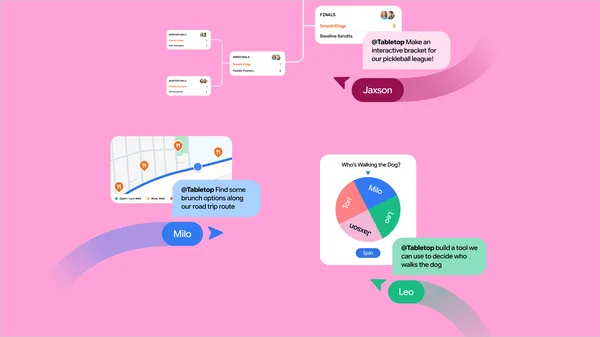
Tabletop is a new Google Labs experiment for group collaboration. Build interactive itineraries, polls, and brackets with your team. Join the waitlist.
Read original articleNovember 11, 2026
AI assistants can run analyses and summarize meetings, but employees still manage...
Read original articleNovember 11, 2026
As AI agents take on more enterprise work, agent sandboxing has become a basic requirement rather than an afterthought. Every agent that writes code, runs tools or drives a browser needs hard walls around it. Those walls also can’t come at the cost of runaway compute bills. Google LLC’s answer is Agent Substrate, an open-source […] The post Agents may soon be the main workload, and most of the time they’re doing nothing appeared first on SiliconANGLE.
Read original article