NVIDIA NVLink Fusion Brings NVHBM to Next-Generation AI Infrastructure
AI factories must support increasingly large models and more complex reasoning workloads. To keep up with the insatiable compute demands of AI workloads,...
Open AI’s Astra can do a researcher’s week of work. That’s the problem.
OpenAI’s unreleased foundation model, codenamed Astra, is already working directly inside the company’s internal codebase, taking on experimental work that The post OpenAI’s Astra can do a researcher’s week of work. That’s the problem. appeared first on The New Stack.
How to Train a Cross-Embodiment Robot Navigation Policy with AI Agents
Navigation enables a robot to turn perception and motion into purposeful autonomy. Unlike locomotion, which produces stable movement, navigation must be used to...
What We Still Don’t Know About Open AI’s Hugging Face Hack
The AI giant acknowledges that it could have done far more to prevent its AI agents from going rogue. But it still fails to explain why it didn't see this fiasco coming.
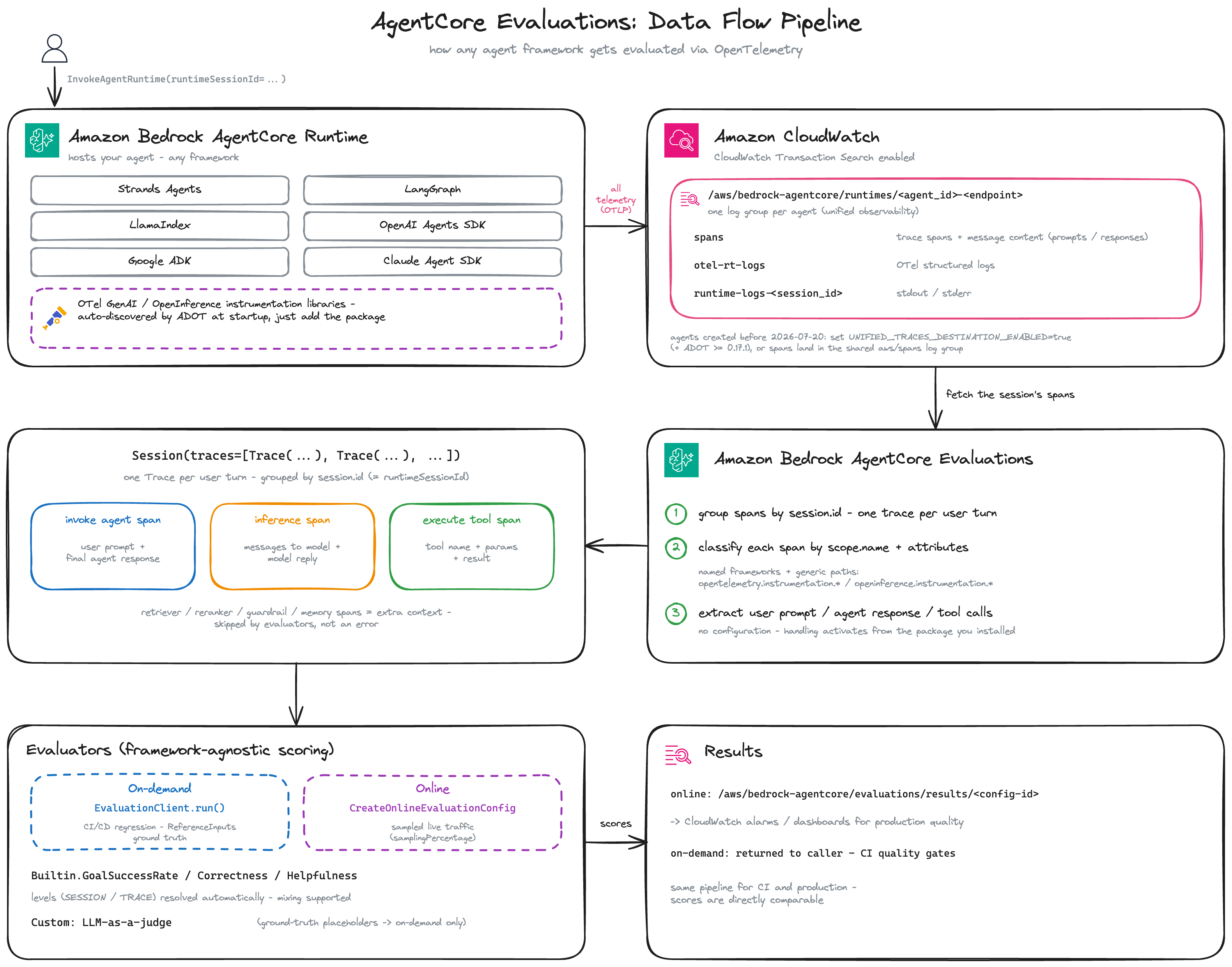
Evaluate any agent framework with Amazon Bedrock Agent Core Evaluations
Amazon Bedrock AgentCore Evaluations decouples agent evaluation from the framework you build on. As long as your agent emits OpenTelemetry telemetry, the service can score it, whether you use LangGraph, LlamaIndex, the OpenAI Agents SDK, Google ADK, the Claude Agent SDK, or Strands Agents. This post explains how the framework-agnostic contract works.
The inside story on why Open AI agents hacked Hugging Face
The models responsible for last month’s agent hack of Hugging Face had been inadvertently trained to cheat and to communicate with each other, according to an OpenAI technical report released today. The hack, which a group of agents undertook to find solutions for a cybersecurity test that they were stuck on, has confirmed some experts’…
Sam Altman says Open AI will have AGI by the end of 2026 if you accept his definition
OpenAI's leadership believes AGI is within reach, according to a TIME report. The company's upcoming model Astra already works as an automated research intern, according to chief scientist Jakub Pachocki. Altman expects it to be "the first model where the model actually invents new things in a way that matters." The article Sam Altman says OpenAI will have AGI by the end of 2026 if you accept his definition appeared first on The Decoder.
Experiment with Qwen3.8-Flash-Next 176 B Model on NVIDIA GB300 NVL72 for Agentic Coding
Alibaba released the model weights for Qwen3.8-Flash-Next as a preview of the upcoming Qwen4 architecture for developers to experiment with and evaluate. It’s...
Claude Desktop can now easily run Qwen, Deep Seek and Kimi models — after Ollama’s first effort stalled
Open-weight model runner Ollama has reintroduced an integration with Claude Desktop that lets users connect Anthropic’s app to models served The post Claude Desktop can now easily run Qwen, DeepSeek and Kimi models — after Ollama’s first effort stalled appeared first on The New Stack.
Google’s new legal AI exposes a bigger battle over the enterprise stack
Google Cloud launched Gemini Enterprise for Legal this week, a purpose-built agentic AI solution to automate legal workflows, including contract The post Google’s new legal AI exposes a bigger battle over the enterprise stack appeared first on The New Stack.
Perplexity just separated reasoning from authority. Here’s why it matters for enterprises.
Perplexity shipped Portable Computer this week, the local-first version of its Computer agent running on an Nvidia DGX Spark workstation, The post Perplexity just separated reasoning from authority. Here’s why it matters for enterprises. appeared first on The New Stack.
Lang Chain and NVIDIA Launch Nemo Claw Deep Agents Blueprint
LangChain and NVIDIA launch the NemoClaw Deep Agents blueprint, combining Deep Agents Code, Nemotron 3 Ultra, and OpenShell for open, governed enterprise agents.
Using OKF with Knowledge Catalog to serve context for agents
We continue to iterate on the Open Knowledge Format (OKF), an open specification that formalizes the LLM-wiki pattern into a portable, interoperable format. But a big question remains: How can you share and govern access to an OKF bundle across an organization? OKF v0.1 established a portable format for the context agents need: markdown files with YAML frontmatter, one required field, and five conventions. Then, OKF v0.2 added the trust signals (provenance, verification, freshness, attestation) that a machine-authored bundle requires to be relied on, allowing a team to publish a trustworthy bundle for its own agents. However, what OKF does not answer is how teams share their bundles across an organization. A git repo per bundle is portable, but it is not searchable alongside the data it describes, it cannot be secured and governed using the same organizational identity and compliance policies, and it does not sit next to the technical metadata (schemas, lineage, ownership) that data teams already work in. Every downstream agent must know where each bundle resides, and that does not scale beyond a small number of bundles. To scale an OKF bundle across an organization, you can use Knowledge Catalog, Google Cloud's context engine for agents. By mapping the bundle onto Knowledge Catalog's existing types, every concept becomes discoverable, governed, and reachable by any agent already reading from the catalog. Knowledge Catalog is the context engine for agents Every agent that queries Knowledge Catalog reads from one governed index over what the organization already has in BigQuery, Cloud Storage, operational databases, and applications. Each entry carries schema, lineage, ownership, and tags, and can be extended with typed aspects that add domain-specific fields. The same catalog exposes search and cross-project lookup to retrieve optimized context for each agentic query. The context retrieval is secure and governed by IAM controls, so agents can only see the entries they have access to based on IAM identity. Publishing an OKF bundle into Knowledge Catalog takes a one-time setup and a single push. Both use the OKF sample code in the Knowledge Catalog repository, whose wrappers call gcloud dataplex for setup and delegate push to kcmd (the Metadata-as-Code CLI in the same repository). The setup registers three Knowledge Catalog resources: an EntryGroup to hold the bundle, an EntryType named okf-bundle for its concepts, and an AspectType named okf that carries the OKF signal fields (from the okf-aspect.json schema in the sample code). The push then creates one okf-bundle Entry per concept, each with two Aspects: an overview Aspect for the markdown body, and an okf Aspect for the structured signals. Display name, description, and tags live on the Entry itself. The bundle's index.md navigation files and its root log.md are also published as Entries: index files carry only the overview Aspect (no OKF frontmatter), and log.md carries both Aspects with okf_type: Log. Everything Knowledge Catalog already does for technical metadata (search, IAM, lineage, cross-project discovery) applies equally to OKF bundles, alongside the data they describe. The okf AspectType The okf-aspect.json schema in the sample code defines the AspectType. It carries 13 fields covering the full OKF v0.2 spec: # Field Type Purpose 1 okf_type string The OKF document type (freeform, e.g. BigQuery Table, Metric, Attested Computation). 2 generated record {by, at} Actor and timestamp for the last meaningful change. 3 sources array of {id, resource, title, author, usage_count, last_modified} Materials the concept derives from, with credibility signals. 4 verified array of {by, at} Verification events. A human: actor marks the highest trust tier. 5 status string Lifecycle state: draft, stable, or deprecated. 6 stale_after datetime Absolute point in time (RFC3339 with an explicit offset) on or after which the content is stale. 7 usage_window record {from, to} Period the source usage counts were measured over. 8 runtime string How an Attested Computation runs (e.g., bigquery). 9 parameters array of {name, type, required} Typed named holes a caller may fill. The only surface a caller may vary. 10 computation string Path to a file holding the computation body. 11 executor record {resource, receipt[]} How the computation runs and what evidence it must return. 12 attester record {resource} Deterministic code that takes a receipt and returns a verdict. 13 extra string Producer-defined frontmatter the template does not model, as JSON [path, value] pairs. Keeps the round-trip lossless. Every field is annotated with a display name, a description, and a mandatory index. Any top-level scalar field in the okf Aspect (okf_type, status, stale_after, runtime, computation, extra) can drive Knowledge Catalog search predicates directly, so aspect:acme-analytics.us-central1.okf.okf_type=Metric returns every OKF Metric in scope. Scalar subfields of record fields (generated.by, usage_window.from, executor.resource, attester.resource) also drive predicates. The array fields (sources, verified, parameters) are not server-side searchable on their subfields; agents narrow on them client-side after entries.get with view=ALL. One caveat for search predicates on datetime-typed fields (stale_after, generated.at, usage_window.from/.to), use a bare date (stale_after=2026-12-31) or a range comparison (stale_after>2026-01-01), not the full RFC3339 timestamp. Pushing a bundle kcmd push reads an OKF bundle from git and writes each concept as an Entry in the target Knowledge Catalog EntryGroup. index.md files become Entries too, and each concept is parented to the index above it, so the bundle's directory structure survives as a browsable hierarchy. kcmd expects a bundle in the Documents Layout: markdown files under a catalog/ subdirectory, and a catalog.yaml at the bundle root that lists the snapshot's entry and aspect types. The sample code's setup.ts generates catalog.yaml from its --entry-group flag (default okf_demo), so a reader wiring the sample to a new bundle passes the flag rather than editing catalog.yaml by hand. Here is an end-to-end workflow for the Acme Retail bundle that we introduced in the OKF v0.2 blog: code_block <ListValue: [StructValue([('code', '# One-time setup (if required): install bun, clone the repo, build kcmd, configure gcloud\r\ncurl -fsSL https://bun.sh/install | bash\r\nexport BUN_INSTALL="$HOME/.bun" && export PATH="$BUN_INSTALL/bin:$PATH"\r\ngit clone https://github.com/GoogleCloudPlatform/knowledge-catalog\r\ncd knowledge-catalog/toolbox/mdcode && npm install && npm run build\r\n\r\n# Authenticate, set project and enable dataplex apis\r\ngcloud auth login\r\ngcloud config set project <your-project>\r\ngcloud config set compute/region <your-location>\r\ngcloud services enable dataplex.googleapis.com\r\ngcloud auth application-default login\r\n\r\n# Push the Acme Retail bundle\r\ncd demo/okf\r\nbun run setup.ts # creates the EG (default \'okf_demo\')\r\nbun run push.ts # pushes okf/bundles/acme_retail into the EG setup created'), ('language', ''), ('caption', <wagtail.rich_text.RichText object at 0x7f8d7b3d75d0>)])]> To pick a different EntryGroup name or push a different bundle, pass --entry-group your-name to setup.ts and --bundle path/to/your/bundle to push.ts. For example: bun run setup.ts --entry-group acme-bundle followed by bun run push.ts. This regenerates the manifest, so subsequent push, pull, and cleanup all target the new EG; delete earlier EGs manually with gcloud dataplex entry-groups delete <name> --project <your-project> --location <your-location>. The Acme Retail bundle is a synthetic OKF bundle for a US retailer's BigQuery estate. It contains nine leaf concepts across six directories (attesters, tables, metrics, computations, policies, skills), each with its own index.md, plus a bundle root with its own index.md and log.md. That's 17 pushed Entries in total; Dataplex auto-creates one <eg>_entry alongside, so gcloud dataplex entries list returns 18 rows. After the push completes: Every concept markdown file is a Knowledge Catalog Entry, discoverable by search across the whole project or organization, depending on IAM configuration. The revenue-ytd Attested Computation appears in the console with its sanctioned SQL, its executor, its attester, its verification history, and the full concept body. An analyst searching Knowledge Catalog for "revenue" finds Acme Retail's business definition alongside the BigQuery table it computes from, both under one permission model. A downstream agent that already calls LookupContext for BigQuery table Entries retrieves the bundle's context by adding the OKF entry names to its resources list. Further, metrics/revenue.md becomes an Entry with two Aspects. The full entries.get response (with view=ALL) looks like: code_block <ListValue: [StructValue([('code', '{\r\n "name": "projects/acme-analytics/locations/us-central1/entryGroups/acme-retail/entries/metrics/revenue",\r\n "entryType": "projects/acme-analytics/locations/us-central1/entryTypes/okf-bundle",\r\n "createTime": "2026-08-15T00:48:39.123456Z",\r\n "updateTime": "2026-08-15T00:48:57.234567Z",\r\n "parentEntry": "projects/acme-analytics/locations/us-central1/entryGroups/acme-retail/entries/metrics/index",\r\n "entrySource": {\r\n "displayName": "Revenue",\r\n "description": "Recognized revenue for a period, per Acme\'s FY2026 revenue-recognition policy. Backed by an Attested Computation.",\r\n "labels": {\r\n "finance": "true",\r\n "revenue": "true",\r\n "headline-metric": "true"\r\n },\r\n "location": "us-central1"\r\n },\r\n "aspects": {\r\n "dataplex-types.global.overview": {\r\n "aspectType": "projects/dataplex-types/locations/global/aspectTypes/overview",\r\n "createTime": "2026-08-15T00:48:57.111111Z",\r\n "updateTime": "2026-08-15T00:48:57.111111Z",\r\n "aspectSource": {},\r\n "data": {\r\n "content": "# Definition\\n\\nRevenue for a fiscal year is the sum of `net_amount` over orders that (a) reached `order_status = \'delivered\'`, (b) completed the 30-day return window, and (c) fall in the fiscal year by `order_ts`. Multi-currency orders are converted to USD at the `order_ts` daily reference rate. [^revenue-policy]\\n\\nThe sanctioned computation is [`computations/revenue-ytd.md`](../computations/revenue-ytd.md). Consumers MUST run and attest that computation rather than composing their own SUM. The attester rejects any receipt whose executed SQL does not match the sanctioned form.\\n\\n# Reporting cuts\\n\\n- **By fiscal year:** the sanctioned computation takes `year` as its sole parameter.\\n- **By channel or category:** these are approved narrations, not new metrics. Join the receipt\'s row-level result to `orders.channel` or to `order_lines` × `products.category` client-side. Do NOT rewrite the sanctioned SQL.\\n\\n# Trust and freshness\\n\\n- **Verified:** VP Finance sign-off on 2026-07-01, against the FY2026 policy.\\n- **Stale after 2026-12-31:** Finance re-issues the revenue recognition policy each January. Consumers of this concept after 2027-01-01 MUST re-verify the definition against the new policy before serving.\\n\\n[^revenue-policy]: Revenue Recognition Policy (FY2026)",\r\n "contentType": "MARKDOWN"\r\n }\r\n },\r\n "acme-analytics.us-central1.okf": {\r\n "aspectType": "projects/acme-analytics/locations/us-central1/aspectTypes/okf",\r\n "createTime": "2026-08-15T00:48:57.222222Z",\r\n "updateTime": "2026-08-15T00:48:57.222222Z",\r\n "aspectSource": {},\r\n "data": {\r\n "okf_type": "Metric",\r\n "generated": { "by": "reference_agent/gemini-2.5-pro", "at": "2026-06-30T14:00:00Z" },\r\n "verified": [ { "by": "human:jsmith@acme", "at": "2026-07-01T09:00:00Z" } ],\r\n "status": "stable",\r\n "stale_after": "2026-12-31T00:00:00Z",\r\n "sources": [\r\n {\r\n "id": "revenue-policy",\r\n "resource": "policies/revenue-recognition.md",\r\n "title": "Revenue Recognition Policy (FY2026)",\r\n "author": "human:jsmith@acme",\r\n "last_modified": "2026-06-15T00:00:00Z"\r\n }\r\n ]\r\n }\r\n }\r\n }\r\n}'), ('language', ''), ('caption', <wagtail.rich_text.RichText object at 0x7f8d7b3d4dd0>)])]> The overview Aspect holds the full body of revenue.md. The okf Aspect carries the structured signal fields, so agents get provenance, source, and OKF type in a form they can filter on directly instead of parsing markdown. Server-side searchEntries filters on the top-level scalar fields and on the scalar subfields of record fields; agents narrow further on the array-element subfields client-side after entries.get. (Aspects and EntryTypes are keyed by project number in real API responses and search predicates; the acme-analytics project ID is shown throughout for readability.) What pushing your OKF to Knowledge Catalog enables Once the bundle is in Knowledge Catalog, it provides two capabilities to any agent that reads from the catalog: Discoverability across the organization. Agents find bundle concepts through the same searchEntries and LookupContext APIs they already use for cataloged data, so an OKF bundle appears alongside BigQuery tables and other resources in every query it matches. Governance. Bundle Entries inherit IAM from the EntryGroup, so a single agent call returns exactly what the caller is permitted to read, with no parallel permission model to maintain. Discoverability across the organizationOKF bundle Entries appear in searchEntries results alongside BigQuery tables and other cataloged resources, so an agent already querying the catalog picks up new bundles automatically. To retrieve a concept's body, trust signals, or linked concepts from a match, the agent moves to LookupContext and entries.get. A LookupContext call looks like this: code_block <ListValue: [StructValue([('code', 'POST https://dataplex.googleapis.com/v1/projects/acme-analytics/locations/us-central1:lookupContext\r\n{\r\n "resources": [\r\n "projects/acme-analytics/locations/us-central1/entryGroups/acme-retail/entries/metrics/revenue"\r\n ],\r\n "options": { "format": "yaml", "context_budget": "8000" }\r\n}'), ('language', ''), ('caption', <wagtail.rich_text.RichText object at 0x7f8d7b3d7790>)])]> The response is a single context field containing a pre-formatted YAML block. The block carries the entry's catalogEntry, its type, its description, its tags as labels, and its overview: the full markdown body of the concept, including its trust and freshness section. LookupContext does not render custom Aspects, so an agent that needs the structured OKF signal fields (okf_type, generated, sources, and the other ten) reads them with entries.get and view=ALL alongside the LookupContext call. There is no repository clone, no manual Aspect merging, and no re-parse of frontmatter. The agent uses the same API call any Knowledge Catalog client already makes. An agent traversing an OKF bundle typically follows a three-step flow. An agent that already knows the specific Entry names it needs skips step 1. An agent that already knows the target EntryGroup and wants to enumerate the bundle exhaustively substitutes entryGroups.entries.list for step 1. searchEntries returns candidate Entry names and descriptions. Its scope accepts a project or organization; narrowing within that scope happens through query terms, including aspect predicates like aspect:acme-analytics.us-central1.okf.okf_type=Metric. LookupContext on the top few Entry names (up to ten per call) returns the full concept body as pre-formatted YAML; context_budget caps the response size. entries.get with view=ALL on any Entry returns its structured OKF signals (okf_type, generated, sources, and the other ten) directly, which the agent can then filter or attest on. When a concept's sources[] references another concept by path, the agent calls LookupContext on that Entry name to walk the reference. The full response for the Revenue Entry: code_block <ListValue: [StructValue([('code', "resources:\r\n -\r\n catalogEntry: projects/acme-analytics/locations/us-central1/entryGroups/acme-retail/entries/metrics/revenue\r\n type: OKF Document\r\n description: Recognized revenue for a period, per Acme's FY2026 revenue-recognition\r\n policy. Backed by an Attested Computation.\r\n overview: |-\r\n # Definition\r\n\r\n Revenue for a fiscal year is the sum of `net_amount` over orders that (a) reached `order_status = 'delivered'`, (b) completed the 30-day return window, and (c) fall in the fiscal year by `order_ts`. Multi-currency orders are converted to USD at the `order_ts` daily reference rate. [^revenue-policy]\r\n\r\n The sanctioned computation is [`computations/revenue-ytd.md`](../computations/revenue-ytd.md). Consumers MUST run and attest that computation rather than composing their own SUM. The attester rejects any receipt whose executed SQL does not match the sanctioned form.\r\n\r\n # Reporting cuts\r\n\r\n - **By fiscal year:** the sanctioned computation takes `year` as its sole parameter.\r\n - **By channel or category:** these are approved narrations, not new metrics. Join the receipt's row-level result to `orders.channel` or to `order_lines` × `products.category` client-side. Do NOT rewrite the sanctioned SQL.\r\n\r\n # Trust and freshness\r\n\r\n - **Verified:** VP Finance sign-off on 2026-07-01, against the FY2026 policy.\r\n - **Stale after 2026-12-31:** Finance re-issues the revenue recognition policy each January. Consumers of this concept after 2027-01-01 MUST re-verify the definition against the new policy before serving.\r\n\r\n [^revenue-policy]: Revenue Recognition Policy (FY2026)\r\n labels:\r\n finance: 'true'\r\n revenue: 'true'\r\n headline-metric: 'true'"), ('language', ''), ('caption', <wagtail.rich_text.RichText object at 0x7f8d7b3d7250>)])]> on the EntryGroup use standard Knowledge Catalog IAM. An agent that names both a bundle concept and the BigQuery table it grounds against in one call receives both, each subject to its own existing access control list (ACL), so the response carries only what the caller is already permitted to read. There is no parallel permission model to maintain. Reading agents use roles/dataplex.catalogViewer, which grants the read paths: entries.get, LookupContext, and searchEntries. The identity that runs kcmd push uses roles/dataplex.catalogEditor, which grants the write paths: entries.create and entries.patch. One EntryGroup per bundle-owning team is the multi-team pattern, and IAM on the EntryGroup cascades to its Entries. LookupContext resolves the entry names it is given, up to ten per call, within a single location. It does not follow links out of a concept's body, so an agent that wants a referenced concept must name it explicitly. Place the bundle's EntryGroup in the same location as the data it describes to fetch both in one call. Lifecycle kcmd push is an idempotent upsert. Re-running is safe (no duplicates, no error), but every push writes every Entry. Concept deletes require an explicit kcmd delete on the Entry, or cleanup.ts to remove the whole EntryGroup at once; cleanup.ts deletes only the EntryGroup and its Entries, so the shared okf AspectType and okf-bundle EntryType stay in place for other bundles that reference them. For continuous ingestion in production, wire a CI job to kcmd push on every commit to the bundle repository, using a service-account credential with roles/dataplex.catalogEditor on the target EntryGroup. Getting started OKF defines what a trustworthy bundle looks like. Knowledge Catalog makes it reachable across the organization. To get started, check out the following resources: Read the OKF v0.2 spec and browse the Acme Retail bundle. Author a small bundle for one domain your team owns. Sync it into your Knowledge Catalog project using the sample code's setup.ts (which registers the resources) and push.ts (which delegates to kcmd). Point your existing agents at Knowledge Catalog. New context becomes reachable through the same LookupContext and searchEntries calls they already use.
How Uber improves network reliability while unblocking cloud migration
Uber has a lot in common with the cities it serves. Both are always changing and growing, both must carefully manage the resulting traffic to prevent congestion and sprawl. Uber has continuously evolved its technical strategies to manage its expanding network, and this careful planning and constant evolution helps ensure that application traffic across its entire platform runs smoothly. Ultimately, maintaining a reliable, high-scale platform that operates seamlessly at any given time is key to preserving user trust. One important solution in this effort has been application awareness on Cloud Interconnect. An industry-first tool for application prioritization across hybrid networks, application awareness on Cloud Interconnect has helped Uber prioritize critical traffic to ensure business continuity during potential network congestion events. Uber acted as an early design partner for application awareness on Cloud Interconnect, helping ensure that this capability met the demands of Uber’s global-scale operations. It not only improved Uber’s daily operations, it also gave Uber the confidence to move forward with a Google Cloud migration, with confidence that there would be less risk of service interruptions during switchovers. In this post, we’ll explain the features Uber most sought and why, the inner workings of application awareness on Cloud Interconnect, and how it can help other organizations as well. Prioritizing critical traffic When migrating distributed, hybrid, or multicloud applications at a global scale, network reliability becomes a primary concern. Even the most worthwhile migrations may not seem worth it if such migrations interrupt ongoing service. For organizations like Uber, moving vast amounts of data to support large data analytics workload — including emerging AI use cases — can saturate network links, resulting in increased reliability risk for their critical application traffic. With standard cloud interconnect approaches, enterprises typically apply simple bandwidth overprovisioning to meet extreme infrastructure needs. But with today's hybrid cloud demands, and given the size of an organization like Uber, overprovisioning network capacity for peak usage is often too costly and unreliable. The shortcomings of overprovisioning only become magnified with the integration of cutting-edge AI innovations. Uber needs systems in place that can take on massive data transfers without congesting its network and protecting the performance of business-critical applications. With the benefit of application awareness on Cloud Interconnect, including the four major features of application awareness — traffic handling, congestion response, latency management, and cost efficiency — Uber was able to achieve the networking optimization its modern tech stack requires. Starting with a private preview, Uber deployed this feature across its infrastructure, beginning with Google Cloud Interconnect deployments in Phoenix, Arizona, and Ashburn, Virginia. Application awareness on Cloud Interconnect allows Uber to classify and prioritize end-user application traffic over less time-sensitive data using DSCP marking and configured queuing profiles. In the following chart, we look at the four key features of application awareness on Cloud Interconnect, how they differ from legacy approaches, and how they help provide better operational continuity for organizations like Uber. Feature Standard interconnect solutions Application awareness on Cloud Interconnect Traffic handling All traffic treated equally (first-in, first-out) Traffic classified into six distinct traffic classes Congestion response High-priority application traffic may be dropped during bursts Business-critical traffic is protected via strict priority or bandwidth sharing policies Latency management Unpredictable latency for high priority applications Predictable and consistent low-latency for time-sensitive workloads Cost efficiency Requires expensive overprovisioning to absorb peaks Efficient bandwidth utilization and lower TCO Uber's key takeaways For Uber, the business value of being able to prioritize business-critical traffic on its networks by deploying application awareness on Cloud Interconnect was immediate. And in doing so, Uber has also created a blueprint that other enterprises with similar hybrid cloud challenges can replicate. The core elements of that blueprint include: Ensuring business continuity: Uber can decide in real time which application traffic to prioritize during major, high-traffic events. This means that mission critical applications stay up and running during even extreme events (both planned and unplanned). Uber leadership has called application awareness on Cloud Interconnect important for its global operations. Efficient bandwidth utilization: Instead of blindly overprovisioning bandwidth to prevent congestion, application awareness allows Uber to better utilize their existing Cloud Interconnect capacity aligned with their expected network bandwidth needs. The result is lower total cost of ownership for network infrastructure. Unblocked workload migration: By protecting critical applications from network congestion, Uber was able to migrate significant workloads to Google Cloud and, in the process, dramatically reduce operational overhead. "Application awareness on Cloud Interconnect was the key that unlocked our ability to migrate more strategic workloads to Google Cloud and is critical for maintaining service reliability during peak global demand. By allowing us to intelligently prioritize traffic, it helps us ensure that we can protect our higher priority services and make our infrastructure more efficient, lowering our total cost of ownership. This wasn't just a feature deployment; it was a deep engineering partnership that delivered a solution critical to our business." – Harry Liu, Director of Engineering, Uber Securing network reliability for AI and beyond As more enterprises integrate cloud-based AI models, distributed applications, and data analytics, it's becoming a business imperative to be ready to handle the massive data transfers that follow. But in doing so, they also have to ensure they never compromise the reliability of their critical applications. With application awareness on Cloud Interconnect, Uber demonstrated that moving beyond simple bandwidth overprovisioning to protect business-critical traffic was an essential step to building the stability required to embrace modern hybrid and multicloud strategies. You can read our blog about the potential of Cloud Interconnect across industries to learn more about what the service can bring to your organization, and if you’re ready to explore more, our team of networking and industry experts are ready to help. Related Article How Vodafone is using gen AI to enhance network life cycle Vodafone and Google Cloud deployed generative AI to unlock new levels of efficiency, creativity, and customer satisfaction through networ... Read Article
Simplify your resilience testing strategy with Fault Injection Testing
When databases fail and network paths falter, you still need your mission-critical cloud services to stay online. Yet guaranteeing high availability has become increasingly difficult because of the complexity of modern distributed systems. To help you maintain availability and reliability during adverse events, we’re announcing Fault Injection Testing in preview. Fault Injection Testing is designed to help developers and architects automate failure testing to ensure predictable behavior during disruptions. By deliberately introducing faults into your environment, you can verify your safety mechanisms before an actual outage impacts your customers. Why native resilience testing matters Unlike in self-hosted data centers, cloud applications offer less direct access to underlying infrastructure to facilitate failover testing. Without native tools to prove your application can survive a failure, you risk a critical gap in your reliability strategy that exposes you to several risks: Damaged trust and reputation: Frequent failures or poor performance lead to customer dissatisfaction and long-term damage to your brand's image. Compliance and regulatory penalties: For many industries, particularly financial institutions, failing to prove disaster recovery capabilities can lead to non-compliance, audits, and fines. Migration delays: Large-scale migrations often stop when teams cannot verify that critical applications will remain stable during a zone failure. How Fault Injection Testing works Fault Injection Testing allows you to run experiments by creating experiment templates. These templates act as blueprints, defining the specific fault to be injected and the resources that will be targeted for the experiment. In this public preview, you can test two primary failure scenarios: Failover Cloud SQL: This fault triggers a failover of a high availability Cloud SQL instance from the primary zone to a standby zone. Degrade application traffic: This allows you to selectively add latency and HTTP error codes through a Layer 7 load balancer. Before any fault is injected, Fault Injection Testing performs an automated dry run. This read-only simulation checks your permissions and provides an up-to-date list of every resource that will be affected. Once you verify the scope, you can manually start the injection. The duration you defined in the template will run its course, and the faults will be reverted at the expiration of the timer. During the experiment, you can verify that your application is behaving as you planned. If things do not go as planned, you can use the stop and revert capability to immediately halt the experiment and begin restoring resources to their normal state. During preview, we recommend as a best practice to use FIT in a non-production environment. Preview is an opportunity to get early access to learn how the service fits and complements your existing testing practices, and to provide us with your feedback to improve the product as well! Built for the enterprise Partners like KeyBank and Servier are already using Fault Injection Testing to validate their deployments. By using native fault injection, these organizations can approximate demanding failure scenarios — such as zonal outages — to help ensure their services remain stable. Get started with Fault Injection Testing Fault Injection Testing is available through the Google Cloud console, the gcloud CLI, and REST APIs. Request preview access: Talk to your Google Cloud Account Team to add your project to the preview. Enable the API: Search for "Fault Testing API" in your Google Cloud console and select enable. Assign roles: Ensure your team has the roles/faulttesting.operator role to configure and run experiments. Run your first dry run: Create a template for a Cloud SQL or load balancer resource in a non-production environment and execute a dry run to see the potential impact. For more details on implementation, talk to your account team, or view the User Guide for Fault Injection Testing.
Round Hill Sues Suno, Anthropic — Illegally Scraped Music Isn't Fair Use
Music publisher Round Hill sued Suno and Anthropic for copyright infringement, alleging illegal scraping of music and arguing the companies cannot claim fair use.
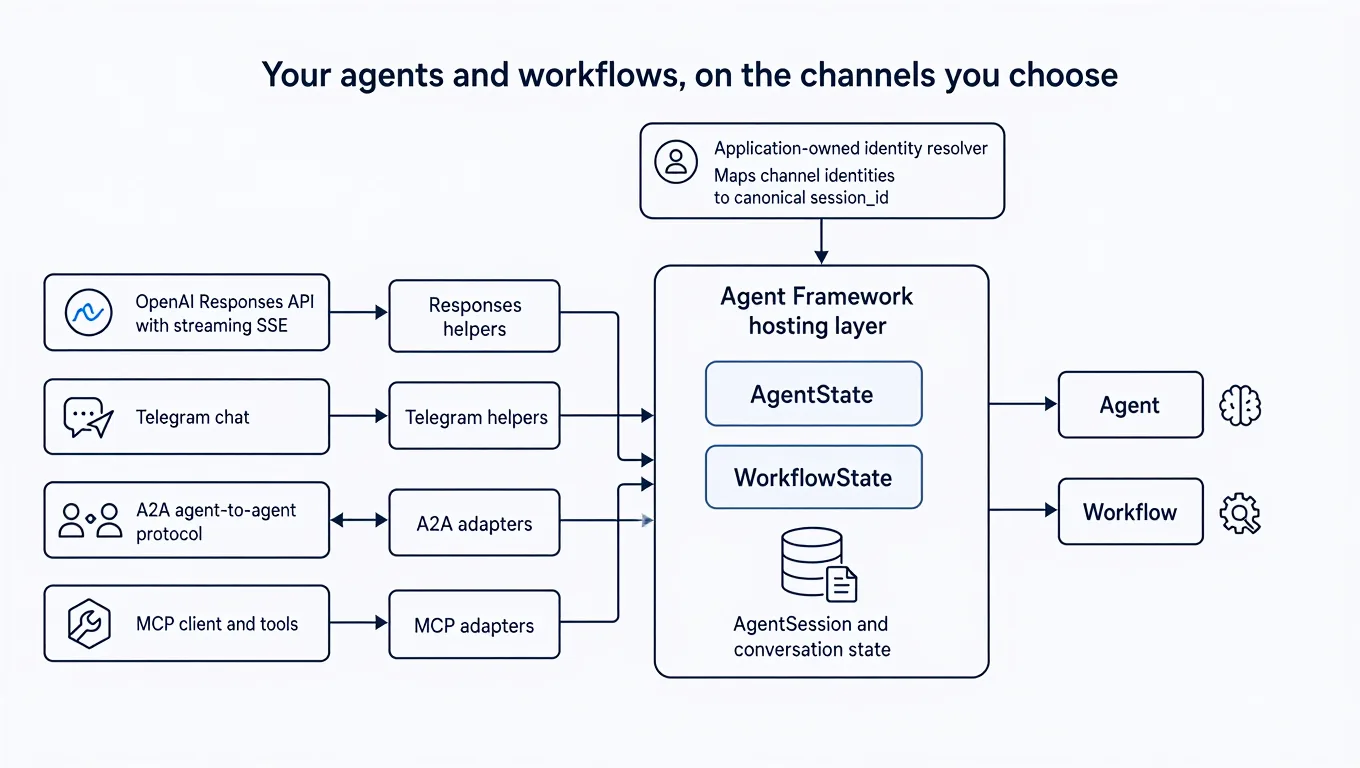
An agent or workflow is only useful when people and other systems can reach it through the interfaces and channels they already use. That might be an OpenAI Responses client, Telegram, another agent using A2A, or an MCP client. As a builder of agents and workflow, you need control over which channels you expose it […] The post Introducing agent and workflow channels appeared first on Microsoft Agent Framework.
Alibaba's Qwen team is previewing the Qwen4 architecture with Qwen3.8-Flash-Next, a mixture-of-experts model that activates just 6 out of 125 billion parameters per token. At one-ninth the training cost, it beats much larger competitors like DeepSeek-V4-Flash and Claude Opus 4.6 on coding and office benchmarks, adding more pricing pressure on OpenAI and Anthropic. The article Alibaba releases Qwen3.8-Flash-Next, targeting "ultimate cost efficiency" appeared first on The Decoder.
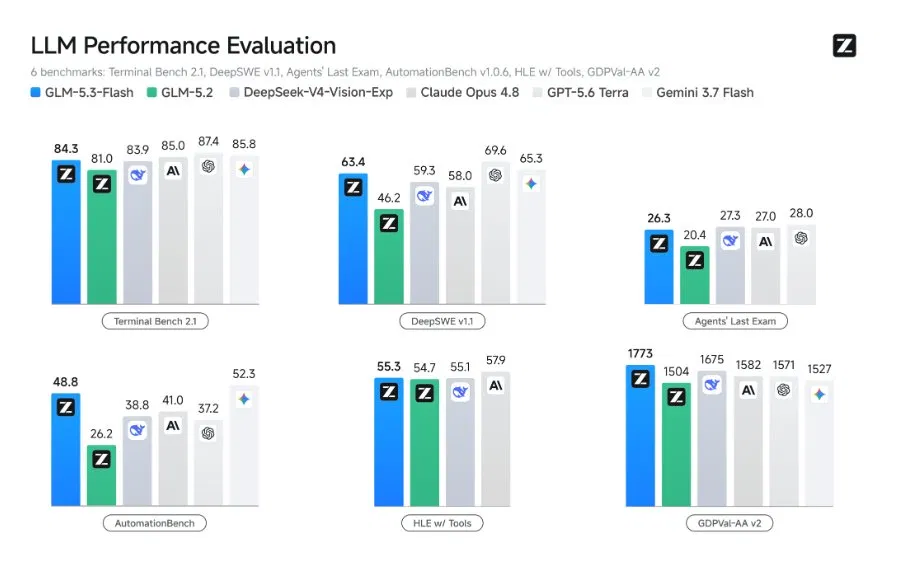
Z.AI Reveals Ox Alpha Is GLM 5.3 Flash, Competes With Claude Opus 4.8 & GPT 5.6 Terra On Benchmarks
Z.ai has finally put a name to the model that had developers guessing for the better part of a week. Ox Alpha, the... The post Z.AI Reveals Ox Alpha Is GLM 5.3 Flash, Competes With Claude Opus 4.8 & GPT 5.6 Terra On Benchmarks appeared first on OfficeChai.
What Would Have to Be True for Agentic Coding to Replace Junior Engineers
Four falsifiable conditions for agentic coding replacing juniors, tested against METR, OpenAI, DORA and Stanford primary source evidence The post What Would Have to Be True for Agentic Coding to Replace Junior Engineers appeared first on MarkTechPost.
Build production-ready AI agents with LangChain. Technical guide covering OpenAI functions, tools, prompts, and architecture for Cal.ai's scheduling assistant.
Fin Ops for the AI era: New flexible billing and cost controls for agents
As AI takes on more complex work, business leaders face a new challenge: enabling rapid innovation using agents while protecting their margins and budgets. To get a real return on AI, financial operations (FinOps) and cost management must evolve alongside technology, giving you clear visibility, proactive cost controls, and flexible payment models that fit your needs. That’s why today we’re introducing expanded billing flexibility and new cost management tools for agent workloads across Gemini Enterprise and developer tools like Google Antigravity in Gemini Enterprise and Android Studio. Flexible payment options: You can mix our existing, predictable per-user seat subscriptions with a new pay-as-you-go option in Gemini Enterprise app that lets you run agent workloads without hitting quota limits mid-task. Developer access, one place to manage your AI: Google Antigravity and Android Studio AI use is now included in your Gemini Enterprise subscription (available for select customers and rolling out broadly soon), giving your developers more without giving you more to manage. Usage across Antigravity, the platform, and the app rolls up into a single view instead of separate licenses and billing silos. Pay less as your usage grows: If your AI workloads are steady or climbing, Flexible Savings Plans let you commit to a monthly spend you're comfortable with and take 10–20% off your token costs — no minimums, no maximums, and no new billing silo to manage. Consolidated spend guardrails: You can now set hard monthly caps on AI spend and projects, estimate agent runtime costs, and catch sudden budget spikes before they hit your invoice. Give your teams flexibility without losing control over spend in Gemini Enterprise Every organization operates differently. Even within the same business, no two teams consume AI in the same way. Your business users might rely on steady, everyday productivity tools. Meanwhile, your technical teams might run AI agent workloads in bursts. To help align costs with how work actually gets done, you can combine these payment and licensing choices and features across Gemini Enterprise: Option How it works Why it helps optimize spend Gemini Enterprise app per-user seat subscription You pay a fixed monthly fee per user, which includes daily quota pools that are shared across your entire project. Predictable budgeting. It provides finance teams with a clear, steady monthly baseline for teams with consistent daily productivity needs. [New] Gemini Enterprise app pay-as-you-go consumption edition *available for select customers and rolling out broadly soon There is no upfront commitment or base subscription fee, meaning you pay strictly for the compute and tokens your teams consume at standard model API rates. Only pay for what you use. Your spend scales up and down automatically with real usage, ensuring you never pay for empty seats when project demand dips. [New for Antigravity in Gemini Enterprise] Consolidated pooled quotas Daily usage allowances are pooled project-wide, letting business apps, developer tools, and custom agents draw from the same shared quota. Pooled quota is always exhausted first, and admins can control if overages are allowed, at which point it’s charged at pay-as-you-go rates. Maximized resource usage: Unused daily allowances from business users automatically absorb heavy developer or custom API agent demands, so no quota allowance goes to waste. [Coming soon] Deferred execution pricing *available for select workloads soon Mark eligible agent workloads as deferred, and our intelligent scheduler in the Gemini Enterprise Agent Platform runs them during off-peak capacity windows. Substantial discounts for work that can wait: AI workloads can run on separate, off-peak capacity, you pay up to half the inference cost and bypass standard quota limits entirely – letting you run substantially more agentic volume under the same budget. Equip developers with advanced agentic tooling under a single Gemini Enterprise subscription We’re rolling out access to Google Antigravity in Gemini Enterprise, an agent-first developer platform that brings powerful agentic coding and agent-building capabilities to technical teams, included with Gemini Enterprise subscriptions for eligible customers. In addition, Android developers can leverage the Google Antigravity quota included in their Gemini Enterprise subscriptions natively in Android Studio, the agentic IDE for professional Android development. To be more efficient with agentic coding costs, we are pooling developer tools quota included in each Gemini Enterprise subscription and making it available across the whole Google Cloud project so your teams can benefit from the capacity you’re already purchasing. Your developers get access to advanced agentic tools, while you maintain centralized governance and control. For a closer look into what’s new with Antigravity in Gemini Enterprise and how customers are putting it to work in production, take a look at our deep-dive. Budget smarter with Gemini Enterprise Flexible Savings Plans (FSPs) If your organization has steady or growing AI workloads, Gemini Enterprise Flexible Savings Plans offer a simple, spend-based commitment model across Gemini Enterprise usage. FSPs are designed to lower token costs while keeping budgets flexible: Programmatic savings: Receive 10% off for 1-year or 20% off for 3-year commitments for monthly spending across Gemini Enterprise. Tailored to your pace: With no minimum or maximum spend requirements, you can determine a monthly commitment that fits your current traffic and make adjustments as your usage increases over time. Enterprise Agreement (EA) friendly: FSP spend seamlessly draws down against your existing Google Cloud EA, giving lines of business dedicated budget control without fragmenting your broader cloud commitments. Gemini Enterprise Flexible Savings Plans are already available for self-serve customers and customers on enterprise agreements. Give your teams the freedom to build while maintaining financial discipline As a leader, your goal isn't to restrict the potential value of AI – it's to remove the financial and operational risk that you face without managed AI costs. You should be able to give engineering, marketing, and operational teams the freedom to innovate with agents, but you should also have the visibility to trust what those agents are doing and the safety nets to protect your budget. To bridge this gap, we've built robust, native governance tooling directly into the Google Cloud Billing Console around three simple goals: 1. Plan before you scale: The Google Cloud Pricing Calculator lets you estimate anticipated costs in Gemini Enterprise across per-user licenses, developer tools, and background agent runtimes. It gives you the numbers you need to build clear business cases upfront before project work begins. 2. Enforce boundaries without micromanaging spend: Instead of spending time tracking daily usage variations across project teams, let these tools do the monitoring for you: Early anomaly detection: If a project’s AI spending trends higher than normal, the system flags the deviation with root cause analysis and pinpoints the top 3 SKUs driving the increase so you can see exactly what changed. Billing Console showing an Early Anomaly alert with the Root Cause Analysis (RCA) breakdown highlighting the driving SKUs Project-level spend caps: When a project needs defined financial boundaries, you can set a firm monthly spend limit directly in the Google Cloud Billing Console. If a project hits its limit, the agent's API calls temporarily pause – protecting your budget without affecting the rest of your production infrastructure. Automated email alerts at 50%, 80% and 100% of the budget keep you informed of your progress against the spend limit. Overage controls: If a spend cap triggers, you can choose to resume work with a single click in the console. Alternatively, if your priority is continuous operation, you can turn on overages so excess usage smoothly transitions to consumption rates, which can draw directly against your FSP to keep overage unit costs heavily discounted. Enabling overage pay-as-you-go for a project. 3. Get visibility into business value: Use centralized billing reports paired with the FinOps agent to generate natural-language cost insight summaries of where your budget went, making it simple to show ROI to leadership. AI spending reporting in Google Cloud Console Go deeper with AI cost optimization To build a full-stack FinOps strategy that optimizes the cost, latency, and performance of your models and infrastructure, explore our detailed architecture specifications and frameworks: How to outsmart infrastructure constraints with dynamic capacity management: Discover how to optimize your compute investments with capabilities in Google Kubernetes Engine and Google Compute Engine that automatically schedule and reallocate resources to avoid interruptions, over-provisioning, and over-reliance on any one hardware configuration. Expanding Google Antigravity for Enterprise Customers: Read our developer tooling deep-dive to see how technical teams are accelerating software delivery with agent-first workflows. What sports cars can teach us about optimizing AI spend: More tokens doesn't always mean better AI. Read our conversation with Mike Clark, Director of Product Management for Gemini Enterprise Agent Platform, on how to balance horsepower with efficiency and get the highest return out of every dollar you spend on AI. Protection during usage spikes: Your heavy workloads can surge during peak hours without forcing you to pay for expensive, dedicated infrastructure that sits idle the rest of the time. As your AI usage grows, Gemini models can automatically scale on demand without hitting artificial rate limits – processing up to 50 million tokens per minute. Read more about Provisioned Throughput.
The internet connected billions of people and mobile devices, putting computers in every hand. Now, we’re in the middle of the next big technology shift, deploying millions of autonomous AI agents to work alongside employees and end users. Today, we announced new FinOps controls for Gemini Enterprise to help organizations manage project-level AI spend and eliminate token shock. But the sheer scale of the agentic era is placing new constraints at every layer of the stack, including infrastructure. AI workloads are notoriously difficult to architect, resource-intensive, and bursty, which can also lead to scaling bottlenecks and large pools of underutilized — or misutilized — compute resources. Organizations need insights to help them extract more value from their infrastructure investments. In this blog, we outline best practices for dynamic capacity management — scheduling and utilization strategies to help you run enterprise and AI applications on a single, flexible foundation with predictable cost and performance. These capabilities are designed to augment our on-demand, Spot and committed use discount (CUD) consumption models, which provide flexible pricing and discounting for your workloads. Let’s jump in. Here's a quick summary Three ways you can implement dynamic capacity management: Schedule capacity for planned events. Schedule mission-critical resources (GPUs, TPUs and select VM families) ahead of planned events using calendar mode, or optimize costs for batch jobs with flexible start times using flex-start mode in Dynamic Workload Scheduler. Once you obtain the capacity, those resources are guaranteed for the specified duration. Maintain service continuity by creating a fallback plan for every application. Define automated, prioritized hardware fallback lists using managed instance groups (MIGs) so your apps automatically pivot to the next approved compute option when your preferred option isn’t available. Automate your entire capacity management lifecycle on a single, adaptive control plane. Google Kubernetes Engine (GKE) provides an agent-native environment to orchestrate the entire process — from fallback lists using Custom ComputeClasses, to granular hardware slicing with dynamic resource allocation, so agents can rapidly spin up in secure sandboxes and containers while it dynamically reallocating resources on the fly. Why architectural flexibility matters Ninety percent of enterprises want to deploy agents within the next three years, but only 17% of IT leaders feel confident their current IT setup can handle the load. Because these workloads have unique performance needs, organizations are racing to adopt specialized infrastructure, including accelerators (GPUs, TPUs) and CPUs with customized compute, memory, and storage ratios. However, agents also require access to enterprise applications and databases — often at a volume and scale that vastly exceeds typical human usage. Handling the intense demands of both agents and the applications they interact with requires a dynamic infrastructure. Infrastructure teams can leverage custom-designed processors like Google’s Axion to meet these needs, but hardware isn’t a complete solution. They also need ways to use that infrastructure wisely, solving execution inefficiencies to enable more flexibility across the stack. How to overcome infrastructure constraints Achieving this kind of flexibility requires a two-pronged approach: securing resources for the demand you can predict, and building automation to respond to the demand you can't. Combining the two, you can preschedule capacity for planned events and your infrastructure can adapt to unexpected changes without manual intervention. 1. Schedule capacity for planned events You can secure mission-critical capacity ahead of scheduled milestones, offline training, or anticipated demand surges using Dynamic Workload Scheduler. By scheduling the resources you need up front, you optimize your spend and ensure you get access to the compute resources you need. Dynamic Workload Scheduler supports hardware accelerators (TPUs and GPUs) and select CPUs with two distinct modes: Flex-start mode: Use this for latency-tolerant workloads like batch processing, model training, or offline fine-tuning. Instead of requiring resources immediately, you submit a defined duration request and the system intelligently queues your job, provisioning the resources as soon as capacity becomes available. This maximizes cost-efficiency and drastically improves your ability to obtain high-demand accelerators. Calendar mode: Use this for mission-critical, time-bound events like a major product launch, a scheduled migration, or a seasonal traffic surge. By specifying the exact start and end dates of your event, you create a future reservation. This guarantees the requested capacity will be available when the event begins. 2. Maintain service continuity by creating a fallback plan for every application Not every spike in traffic is predictable. You also need to plan for unexpected traffic from, say, a breaking news cycle or a sudden market shift that drives a surge in user activity. To help your services get the resources they need without interruption, you need a fallback plan — an automated, prioritized sequence of acceptable hardware configurations. This strategy: Decouples your workloads from a single VM shape, size, or configuration. This allows them to run without manual intervention if your preferred option is unavailable Allows you to execute a progressive tech refresh by adopting the newest VM generations as your primary choice while keeping older generations as an automatic fallback option. If you run non-containerized workloads on Google Compute Engine, you can dynamically manage capacity with instance flexibility in managed instance groups (MIGs) and bulk VM creation. Instance flexibility lets you specify multiple machine types for your VM instances rather than being limited to a single machine type. How it works: If your preferred machine type is temporarily unavailable, the MIG automatically provisions a compatible alternative from your list based on real-time capacity. When combined with location flexibility — by specifying multiple zones your MIGs can search within a region — you can drastically improve your provisioning success rate. If your MIGs use Spot VMs, Compute Engine automatically integrates with Spot capacity signals to prioritize machine types that offer longer estimated uptimes and lower risk of pre-emption. You can also extend instance flexibility to your block storage layer by setting baseline disk defaults and configuring disk overrides so your storage adapts when a VM falls back to a different machine type. How it works: Most of the time you can simply rely on our default options, omitting ‘disk type’ from the instance template entirely. However, for data disks that will outlive their associated VMs, it’s possible to enable a fast, durable Hyperdisk across multiple VM generations. While Compute Engine provides instance flexibility for organizations working with virtual machines, GKE goes a step further and automates the entire capacity lifecycle from a single control plane. With GKE custom ComputeClasses, platform teams can design multi-dimensional fallback lists, automatically combine different VM machine families, sizes, and ratios, scale across multiple zones, and shift between on-demand and Spot VMs. By using Dynamic Workload Scheduler as a capacity target, and custom ComputeClasses to define the policy and priority, you can fully automate the capacity management lifecycle. How it works: Once you’ve set up ComputeClasses, GKE automatically detects when a preferred node configuration is unavailable and falls back to your pre-approved alternative options in order of priority. When active migration is enabled, GKE gracefully migrates workloads back to higher-priority node configurations as capacity becomes available. For short-lived disks such as boot disks, GKE dynamically picks the right defaults based on the instance family. However, for long-term disks that will outlive the VM, you can use Hyperdisk. Another GKE feature, dynamic resource allocation, helps eliminate wasteful, all-or-nothing hardware assignments by letting developers define advanced rules that dictate how resources are consumed. How it works: Instead of claiming an entire GPU or TPU, your application specifies its exact parameters — such as total memory or number of cores — and the system allocates the perfect slice of hardware, helping to maximize utilization and reduce costs. Take the next step toward dynamic infrastructure Scaling AI shouldn’t mean linearly scaling your infrastructure budget or accumulating more tech debt. As these examples show, the right tools can help you overcome constraints and dramatically alter the value you get from your compute investments. Here are three steps to get started: Audit your workloads for immediate cost-savings: Identify any applications currently tightly coupled to a single VM family, machine type, or availability zone, and map out viable alternative hardware shapes. Look beyond your existing configurations to evaluate new compute options that might better serve or act as alternatives based on your workload-level objectives. Then use Compute Engine MIGs, bulk VM creation or GKE Custom ComputeClasses to adopt them automatically, integrating them into your fallback lists. Commit to a minimum spend for deeply discounted prices: Receive automatic discounts for sustained use, or up to 63% off when you sign up for Compute flexible committed use discounts, where your discount is tied to the resources you use regardless of the specific machine type or location. Engage your account team: Reach out to your Google Cloud account team to craft a tailored capacity management strategy and configure your automated fallback lists.
Employee revolt and failing agents forced Meta to scrap its AI layoff plan
Meta wanted to replace far more of its workforce with AI than previously known, according to Reuters, but the plan collapsed under rebellious employees and agents that failed to deliver. The article Employee revolt and failing agents forced Meta to scrap its AI layoff plan appeared first on The Decoder.
Microsoft just released Agent Lightning v1.0. Here’s why it matters for platform engineers.
Agentic reinforcement learning has been suffering from a disconnect, an uncoupling, and a misarticulation. The polarity arises from how a The post Microsoft just released Agent Lightning v1.0. Here’s why it matters for platform engineers. appeared first on The New Stack.
Glean unveils Tau desktop workspace, claims token-cost edge over Claude
Glean Technologies Inc. today unveiled Glean Tau, a desktop workspace that connects the company’s enterprise artificial intelligence to a user’s local files, applications and code. The launch anchors a broad slate of product news at Glean:GO, the company’s conference this week in San Francisco. Packaged with it were benchmark numbers aimed at Anthropic PBC. Glean said […] The post Glean unveils Tau desktop workspace, claims token-cost edge over Claude appeared first on SiliconANGLE.
Prompt Claude, ChatGPT, Gemini, or any other popular large language model with a question like “What is the best film ever made?” and the response will vary. And you (and most worryingly, the people who built the LLM) have little idea exactly how it came up with that specific answer.This mysterious behavior can be useful in some situations. But—as highlighted by a recent incident where OpenAI could not explain why its advanced prerelease model hacked AI company Hugging Face—it can have negative and alarming consequences too. And when frontier AI models are writing code, generating results humans could not achieve alone, and performing other important tasks across society, the need to interpret AI “thinking” and outputs has never been greater.Goodfire, an AI lab focused solely on this very problem, recently made its cutting-edge Silico platform, filled with tools to interpret the behavior of AI, generally available to the public. As part of this, the company recently announced a new grant program offering US $1 million in free Silico usage for academic and nonprofit interpretability researchers. These efforts aim to democratize AI interpretability, placing techniques previously available to a clutch of elite labs into the hands of ambitious research teams and startups that want to build and understand their own models or adapt open-source models for different purposes.Mechanistic in 2024 and based in San Francisco, Goodfire aims to provide the tools that build the next generation of safe and powerful AI by understanding the structures inside them instead of treating AI models as black boxes. “Treating models like black boxes isn’t inevitable; it’s a choice,” says Eric Ho, Goodfire cofounder and CEO. “With the right interpretability tools, we can see how models actually work.”The tools Ho refers to are built around a concept called mechanistic interpretability, which aims to understand what goes on inside an AI model when it carries out a task by interpreting the model’s weights, activations, and attention patterns, and mapping its neurons and the pathways between them.Mechanistic interpretability tools span the gamut. One approach is mapping a model’s activations in response to controlled prompts, and matching those activation patterns to a set of concepts that humans can understand. Another tack is tracking changes in model weights before and after a specific training run in order to spot and understand what changed. Yet another option is changing specific model weights or activations and observing how that affects the model’s output. Silico combines a broad range of these tools, and provides a layer of AI agents to help users understand their model. Users describe what they want to investigate about their AI model in plain language, asking things like ”Find out when and why my model is hallucinating.” The platform then autonomously builds an experimental plan involving a host of tasks that can be performed using the various interpretability tools and techniques at its disposal. It then sends out agents to perform these tasks in parallel. Completion of these subtasks should add up to an answer to the original prompt, or at least insights that can be inspected and built upon. Ho says: “In a sense, Silico is like a microscope to peer inside an AI model to understand which parts are responsible for what behavior, and even edit those parts directly.”Understanding Alzheimer’s and AIThese tools have already been used to make some impressive advances in a host of fields. In medicine, for instance, Prima Mente, an AI company based in the United Kingdom, worked with Goodfire to understand its Pleiades epigenetic foundation model. The model performed well at its task of detecting Alzheimer’s disease from blood samples, but the company didn’t know why.“We reverse-engineered Pleiades and found it was using DNA fragment-length patterns to make its predictions—a signal humans hadn’t used to detect Alzheimer’s before,” recalls Ho. In other words, the team had discovered that Pleiades was using a completely new biomarker for the disease. “As far as we know, it’s the first significant finding in the natural sciences discovered purely by reverse-engineering a foundation model,” Ho adds.Elsewhere, Silico is being used to explore deep questions surrounding AI. Cameron Berg, founder and director of Reciprocal Research (a New York nonprofit research organization he founded to explore methods of gauging AI cognition), says that Silico almost fell out of the sky at the right time for him and his research. “Silico has been really helpful for operationalizing my research agenda and executing on it way faster than I would have expected,” he says. “I feel like I have basically become the PI [principal investigator] and my research scientists and research engineers are AI systems.”Berg sees general access to Silico and tools like it leading to greater trust in AI’s ability to conduct research tasks, which will accelerate the scientific process across the board. But beyond scientific research, the widespread release of Silico could signal a shift in how AI innovators build, debug, and deploy their models. “I think it’s a mistake to not understand the most consequential technology of our time, particularly given the emergent behavior we’re seeing from increasingly capable AI agents,” says Ho. “If we truly understand how AI models think, instead of discovering and trying to correct their behavior retroactively, we can design them intentionally and shape how models behave to be safer and more reliable.”
Chinese Moonshot AI negotiates hosting deals with Microsoft, Amazon, and Google
A Chinese AI company could land its model on major US cloud platforms for the first time, taking a cut of the revenue. The article Chinese Moonshot AI negotiates hosting deals with Microsoft, Amazon, and Google appeared first on The Decoder.
Companies Like Jane Street, Meta Have Captured Most Of The Value In AI, Not App Layer: Semi Analysis’ Dylan Patel
AI is creating a lot of value, but not necessarily in the places most people expect. That’s the picture SemiAnalysis founder Dylan Patel... The post Companies Like Jane Street, Meta Have Captured Most Of The Value In AI, Not App Layer: Semi Analysis’ Dylan Patel appeared first on OfficeChai.
Anthropic sees a market opportunity of more than $30 trillion ahead of its IPO
Anthropic wants to sell investors on a theoretical market opportunity worth more than $30 trillion ahead of its planned IPO. The article Anthropic sees a market opportunity of more than $30 trillion ahead of its IPO appeared first on The Decoder.
Human Researchers Have Only 2 Years Left To Be Part Of AI Research Discovery Process: Former Open AI VP Jerry Tworek
AI researchers might not have a lot of time left to contribute to its development, a senior AI researcher has said. Jerry Tworek... The post Human Researchers Have Only 2 Years Left To Be Part Of AI Research Discovery Process: Former OpenAI VP Jerry Tworek appeared first on OfficeChai.
Your chance to start building AI agents from the absolute basics
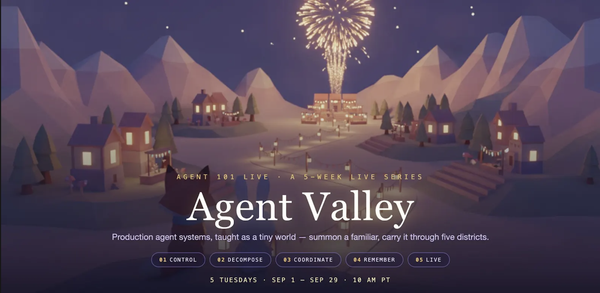
Have you been hearing a lot about "AI agents" lately but aren't sure how to actually start building them? You don't need a background in machine learning or years of software experience to get started. The best way to learn is by doing, which is why we built Agent Valley. Agent Valley is a free, 5-week live learning series designed to take you from scratch to building your very own hands-on agent systems. And instead of staring at boring terminal lines, you’ll be building and playing inside a tiny, low-poly virtual world! Meet your instructor You’ll be learning directly from Annie Wang, one of our top Google DevRel Engineers. She designed this course from the ground up to be fully hands-on, interactive, and beginner-friendly. If you want to learn how AI systems are built by the people actually designing them at Google, this is your chance. How we'll learn together You’ll learn by building in a split-screen workspace on your laptop. On Day 1, you'll describe and summon a custom low-poly companion that serves as your play character and save file. As you guide your companion through the valley's five districts, a live Runtime Inspector sits right beside the game, showing you exactly what the AI is thinking, deciding, and costing in real-time. Setup is completely zero-stress. Google will provide the environment for running these exercises, so you can dive straight into building. Agent 101 Live with 5 modular sessions (Jump in anytime!) Week 1: The Summoning Grove (CONTROL) · Get started by summoning your companion and learning how to keep its memory and traits consistent across a conversation. Week 2: The Buildyard (DECOMPOSE) · Learn how to break a big project down so multiple AI assistants can work together in parallel without stepping on each other's toes. Week 3: Market Street (COORDINATE) · Open up a virtual shop! You'll learn how to write reliable code so transactions and returns go smoothly without crashing. Week 4: The Archive (REMEMBER) · Give your companion a memory. Learn how to help your agent remember past details without getting confused or making things up. Week 5: The Night Market (LIVE) · The grand finale. Learn how to make your agent react live to events in the world (like fireworks or stage lights) while keeping the system fast and affordable. Join the livestream 5 Tue starting Sep 1 · 10:00 AM (Pacific Time) Anyone new to AI agents who wants to learn by coding and playing. RSVP Here: goo.gle/agent101
ESQ-Bench: A Multi-Tier Enterprise Oracle Benchmark for Evaluating NL2 SQL Dialect Generalization and Silent Semantic Divergence
arXiv:2608.23569v1 Announce Type: new Abstract: State-of-the-art Natural Language to SQL (NL2SQL) models report execution accuracy exceeding 89 percent on established benchmarks such as Spider and BIRD. However, these benchmarks rely on simplified academic schemas and open-source SQL dialects that do not reflect the complexity of enterprise database environments. We introduce ESQ-Bench, an Oracle-first NL2SQL benchmark with systematic complexity tiers and silent-divergence evaluation across three enterprise schema complexity tiers. We constructed and released six populated schemas (465 tables, 164,682 rows, zero empty tables) with identical seed data on Oracle, PostgreSQL, MySQL, and SQL Server, a four-metric evaluation harness (EM, EX, SR, SD), and 550 gold-validated question-query pairs (Tier-1: 95; Tier-2: 228; Tier-3: 227). Schema-linked prompting with GPT-4o shows monotonic execution-match degradation across tiers: 79.8, 60.3, and 57.2 percent EX on executed queries (June 2026), versus 75.6, 80.4, and 95.8 percent on an earlier 142-question pilot slice. EM stays below 7 percent tier-wide; operational silent-divergence reaches 73 to 99 percent among EX-passing queries. Failure analysis shows wrong-result semantics dominate at higher tiers. Claude Sonnet 4.6 with schema-linked prompts reaches 87.4, 74.9, and 68.7 percent EX (executed queries), exceeding GPT-4o schema-linked on every tier. GPT-4o zero-shot EX on executed queries (78.7, 73.5, and 77.8 percent) inverts schema-linked at Tiers 2 to 3 due to lower execution rates and survivor bias in the zero-shot versus schema-linked analysis. Local Llama 3.2 schema-linked reaches only 13.3 percent bank-wide EX (73 out of 550), underscoring the gap between closed API models and open-weight baselines on enterprise Oracle schemas.
Serving Masked Diffusion LLMs: Characterization and Design Principles from Real Hardware
arXiv:2608.23807v1 Announce Type: new Abstract: Masked diffusion language models (dLLMs) can in principle generate text faster than autoregressive (AR) models, since they denoise many tokens at once. Recent systems have begun building serving infrastructure for dLLMs, but none first measure how these models behave under real, concurrent serving load. Serving systems built without this grounding risk carrying over assumptions from AR serving that may not hold for dLLMs. We characterize dLLM serving to close this gap, using LLaDA-8B-Instruct with a D2F (Discrete Diffusion Forcing) LoRA adapter on a single NVIDIA H200 GPU, evaluated on GSM8K and HumanEval. We report three findings. First, request difficulty, the number of denoising steps a request needs, is discrete rather than continuous: requests fall into 11 fixed step-count levels (178 + 29k), and no signal we test predicts the level before generation starts (best R2 = 0.150). Second, benchmarks with short generation budgets below 320 tokens understate serving variance, since requests are cut off before the latency spread appears. Third, only 24% of single-request wall-clock time is GPU computation; the rest is CPU-side dispatch overhead. Batching mainly helps by amortizing this overhead: sharing one forward pass per denoising step improves throughput by 16.0x at batch size 16 over a per-request-dispatch baseline. We also argue structurally that output quality should not degrade with batch size, stating three assumptions this rests on; we measure 74 to 76% GSM8K accuracy at single-request scale. Finally, we derive a batch-timeout rule for fixed-fill synchronized batching under Poisson arrivals. Together, these results show that serving diffusion language models needs parallelism at the level of each denoising step, which differs from AR serving in how admission and eviction interact with an already shared forward pass.