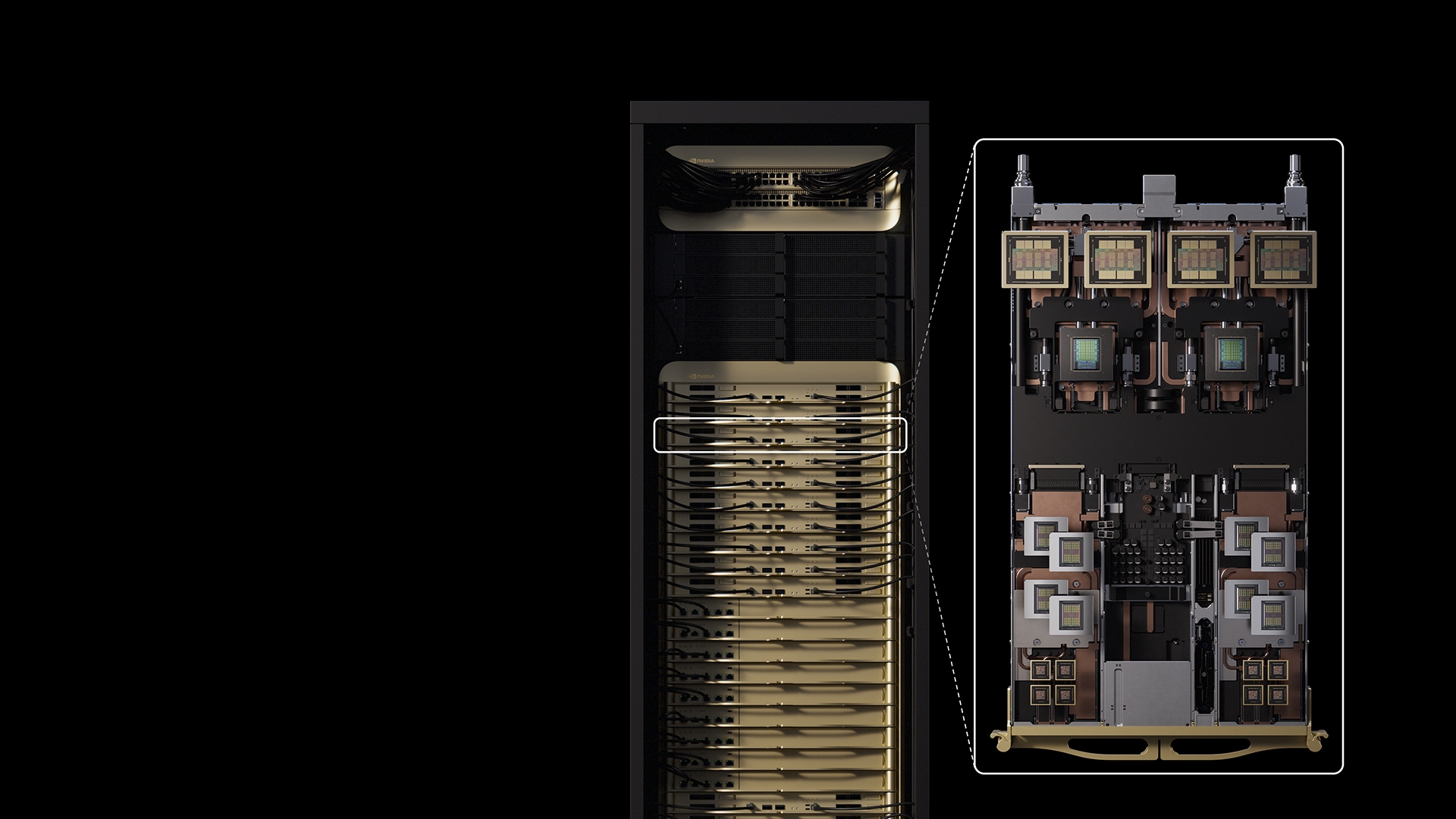
Restore LLM Inference Capacity in Seconds with Shadow Engine Recovery in NVIDIA Dynamo
When an LLM engine process fails, the standard recovery path involves a cold restart. This requires loading weights into HBM from storage, compiling kernels,...
Shopify’s CEO threatened to ban Claude Code. Anthropic had already closed the feature request.
Shopify CEO Tobi Lütke is considering banning Claude Code at the company, but not because he thinks Anthropic’s coding agent The post Shopify’s CEO threatened to ban Claude Code. Anthropic had already closed the feature request. appeared first on The New Stack.
Perplexity Ships Portable Computer on NVIDIA DGX Spark: Local Harness, OS-Enforced Sandbox, and Zero Per-Token Cost for Local Steps
Perplexity releases Portable Computer, packaging local models, harness, sandbox, and connectors into one system running on NVIDIA DGX Spark. The post Perplexity Ships Portable Computer on NVIDIA DGX Spark: Local Harness, OS-Enforced Sandbox, and Zero Per-Token Cost for Local Steps appeared first on MarkTechPost.
Russia used Chat GPT to run a covert influence campaign pushing pro-Kremlin narratives across the West
OpenAI has disrupted a covert Russian influence campaign that used ChatGPT to generate social media posts by banning a cluster of accounts. The operators accessed the platform through VPNs from Russia and promoted the fictitious "International Burke Institute," including German-language Telegram content critical of the EU and the German government. The campaign's reach stayed small, but OpenAI warns the infrastructure behind it could have been scaled up over time. The article Russia used ChatGPT to run a covert influence campaign pushing pro-Kremlin narratives across the West appeared first on The Decoder.
Open AI's first custom chip "Jalapeño" reportedly beats Nvidia's Blackwell and Rubin in inference benchmarks
OpenAI showed off "Jalapeño," its first in-house inference chip, with benchmarks at the Hot Chips conference. According to SemiAnalysis tests, the chip beats Nvidia's Blackwell and even Rubin in throughput and energy efficiency. "Usually first generation chips aren't competitive, but OpenAI is beating Nvidia Blackwell and even Rubin," SemiAnalysis CEO Dylan Patel said. The article OpenAI's first custom chip "Jalapeño" reportedly beats Nvidia's Blackwell and Rubin in inference benchmarks appeared first on The Decoder.
Claude Cowork finally remembers what you told the app in chat
Anthropic is giving Claude a shared memory across chat and Cowork, so users no longer have to repeatedly brief the AI on projects, preferences, and other context.
Meta AI Introduces Meta Ro CE: A Clean-Sheet RDMA Transport Built for AI-Scale Ethernet
Training and serving frontier models is now a networking problem as much as a compute problem. Collective operations like all-reduce and all-to-all synchronize thousands of accelerators during training, and the slowest transfer sets the pace for the entire job. Even small amounts of network friction directly strand significant compute capacity. This week, Meta introduced MetaRoCE. […] The post Meta AI Introduces MetaRoCE: A Clean-Sheet RDMA Transport Built for AI-Scale Ethernet appeared first on MarkTechPost.
Anthropic updates Claude’s memory to enhance customization and protect sensitive topics
Artificial intelligence startup Anthropic PBC announced today it’s changing how Claude, its flagship AI product, uses memory by allowing users to see everything it remembers “topic by topic,” and edit or delete any of it. Claude also does not store sensitive subjects by default. This includes topics mentioned by users, including health concerns, race, ethnicity, […] The post Anthropic updates Claude’s memory to enhance customization and protect sensitive topics appeared first on SiliconANGLE.
On Tuesday, Anthropic launched a major update to how Claude remembers things. The new system combines Claude’s memory in Cowork The post Anthropic gives chat and Cowork one memory appeared first on The New Stack.
Open AI’s New Jalapeno Chip Beats NVIDIA’s Blackwell On Some Parameters, Company Says
OpenAI is looking to own more parts of the AI stack as it prepares for its IPO. The company has put out its... The post OpenAI’s New Jalapeno Chip Beats NVIDIA’s Blackwell On Some Parameters, Company Says appeared first on OfficeChai.
Enable cross-cloud analytics with Amazon S3 Tables and Google Big Query, Part 1: IAM-based access control
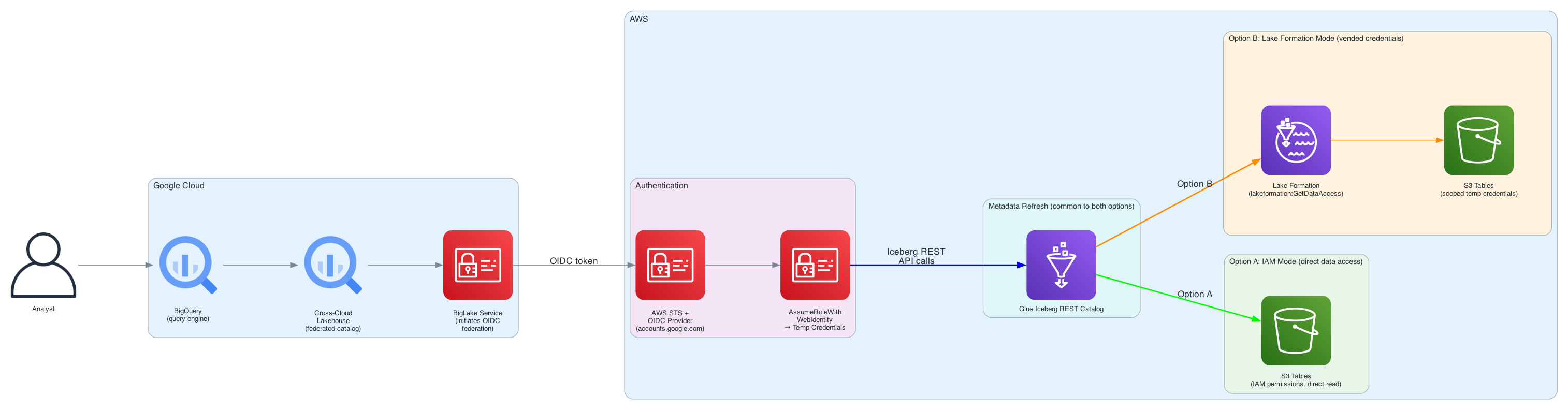
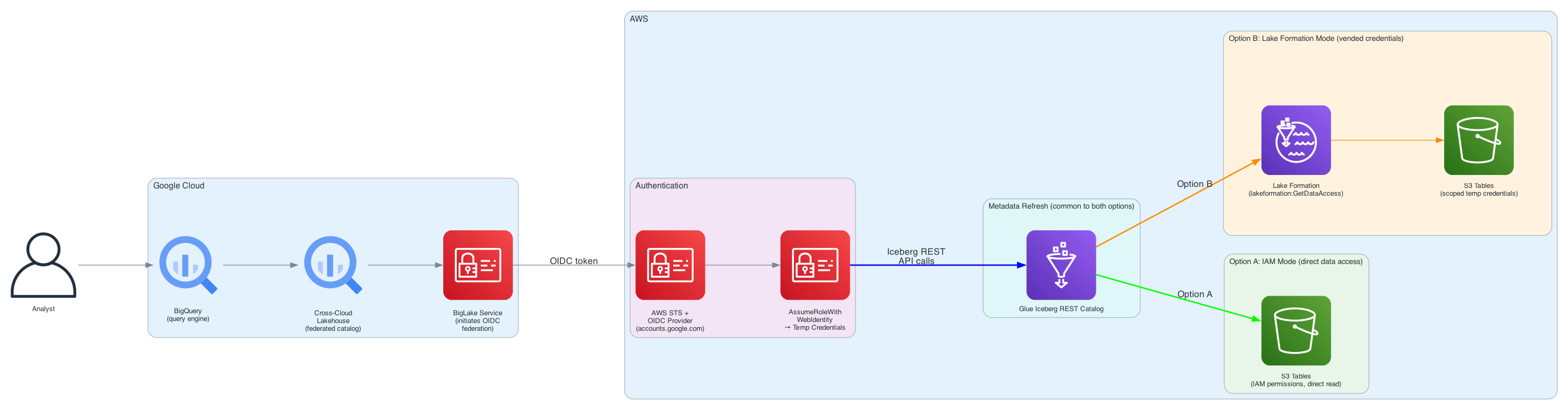
Your Google BigQuery users need to query data that lives in Amazon S3 Tables on AWS without copying it across clouds. This post shows how to connect BigQuery to Amazon S3 Tables through the AWS Glue Iceberg REST Catalog using IAM-based access control, so you keep one governed dataset and query it live from BigQuery.
Enable cross-cloud analytics with Amazon S3 Tables and Google Big Query, Part 2: access control with Lake Formation
In Part 2 of this series, connect Google BigQuery to Amazon S3 Tables using AWS Lake Formation credential vending. Lake Formation manages fine-grained permissions and issues short-lived, scoped credentials to external engines, so you can centrally govern which teams and query engines read your Iceberg tables on AWS without managing IAM policies for every consumer.
Google launches Gemini for legal work to automate contracts and research
With Gemini Enterprise for Legal, Google launches an AI solution for the legal industry that connects to systems like iManage, DocuSign, and Everlaw through MCP connectors. Partners like Deloitte sell ready-made AI agents for tasks like contract review. Anthropic already offers similar solutions. All providers use the same models as in their other products. The article Google launches Gemini for legal work to automate contracts and research appeared first on The Decoder.
GPU-accelerated Apache Spark with Amazon EMR and NVIDIA RTX PRO 4500 on Amazon EC2 G7 instances runs up to 3.7x faster
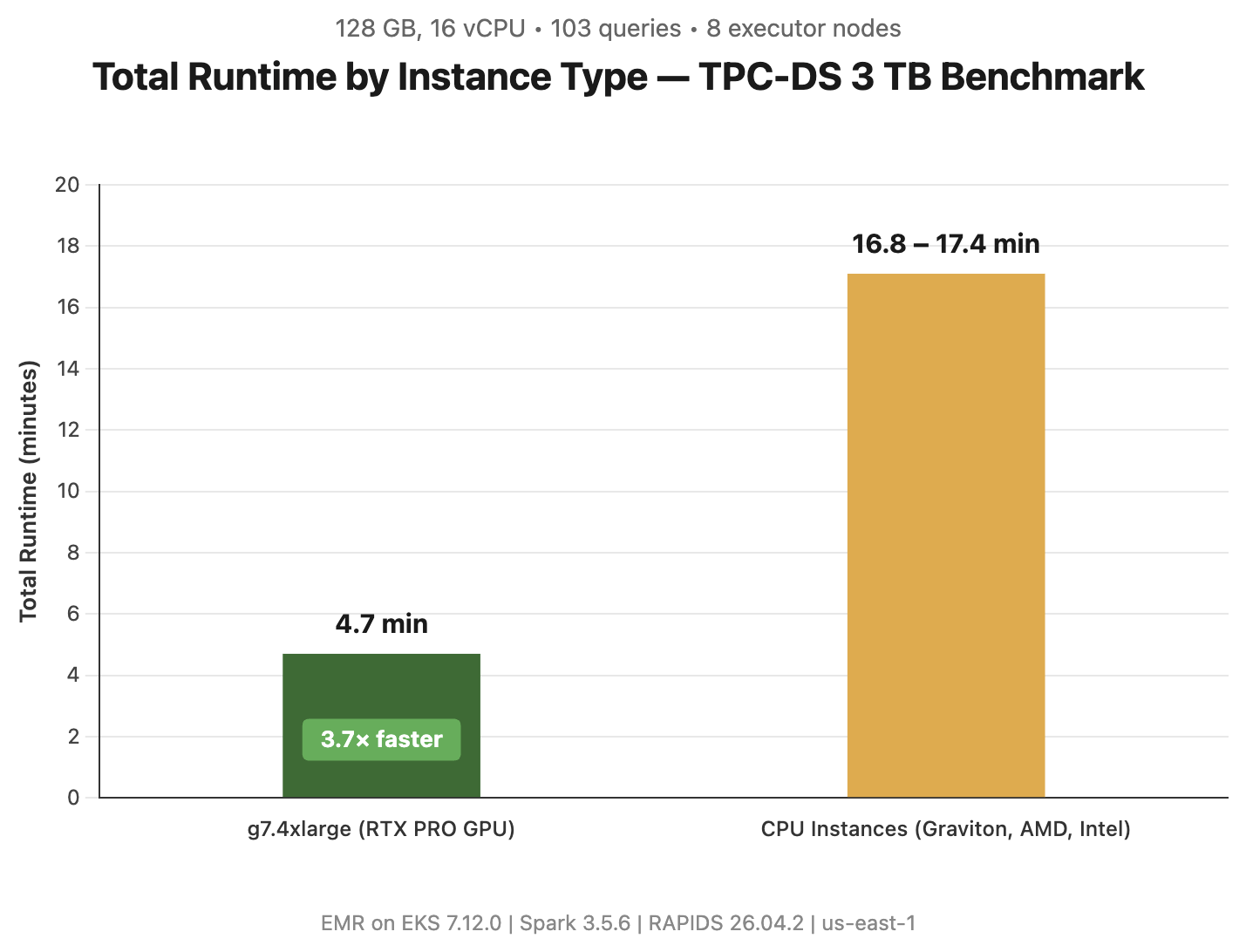
Amazon EMR on EKS now runs Apache Spark up to 3.7x faster on Amazon EC2 G7 instances with NVIDIA RTX PRO 4500 Blackwell GPUs than on comparable CPU instances, with no changes to existing Spark code. See the TPC-DS benchmark results, the cost comparison, and how to get started.
Bringing g Visor sandboxes to distributed Ray clusters
The reinforcement learning (RL) ecosystem is rapidly adopting Ray as the unified compute runtime for complex post-training workflows. Across Google Cloud, we see customers using Ray for workloads ranging from multimodal data pipelines to frontier RL. But as agentic and reasoning models evolve, a critical bottleneck has emerged: orchestrating secure, isolated sandboxes at scale to safely execute dynamic rollouts, code generation, and multi-turn tool interactions. Today, in partnership with Anyscale, we are excited to introduce an experimental library for Ray that leverages agentic AI technologies being developed at Google to bring native, high-performance sandboxing directly into distributed Ray clusters. Sandboxes as Ray Primitives Ray has become a common runtime for orchestrating post-training workloads. Frameworks including veRL, NeMo-RL, SLIME, MILES, and SkyRL already use Ray to coordinate distributed trainers, inference engines, rollout workers, and other components. When we designed Ray Sandboxing, an important goal was to make it fit naturally into the existing Ray programming model rather than introduce a separate abstraction for isolated execution. A sandbox has many of the same properties as other resources managed by Ray: it needs to be placed on a machine, assigned resources, created and destroyed, recovered from failures, and scaled with the surrounding workload. This led us to represent each high-level sandbox through a Ray Actor: The Ray scheduler decides which node should run a sandbox and reserves the corresponding CPU and memory resources. The sandbox Actor manages its lifecycle, while gVisor provides the isolated execution environment on that node. Starting in Ray 2.58, framework authors and researchers can manage sandboxed environments using the same Ray APIs and patterns they already use for the rest of their workload. For example: code_block <ListValue: [StructValue([('code', 'import ray\r\nfrom ray.experimental import sandbox\r\n\r\nray.init()\r\n# Create a gVisor sandbox environment and return an actor handle for a proxy actor\r\nsb = sandbox.create(\r\n cpu=1.0,\r\n memory="512Mi",\r\n image="python:3.12-slim"\r\n)\r\n# Execute code inside the sandbox\r\nresult = ray.get(sb.exec.remote("python -c \'import sys; print(sys.version)\'"))\r\nprint(result.stdout)'), ('language', ''), ('caption', <wagtail.rich_text.RichText object at 0x7f6eb2bee9d0>)])]> This creates a gVisor sandbox from an OCI-compatible image and returns a Ray Actor handle. Calls to exec are normal Ray Actor calls, so the sandbox can live anywhere in the cluster. The created actor is a proxy that will forward the operations to gVisor. The sandbox API covers the basic lifecycle needed by agentic workloads: Create environments from OCI container images Set CPU and memory limits Configure environment variables, working directories, and networking Execute commands Read, write, upload, and download files Inspect sandbox state Terminate or delete environments. For lower-level use cases, SandboxRuntime provides direct access to local gVisor sandboxes and lets users modify the OCI specification before it is handed to gVisor. Here is an example how this API can be used to build a pool of local sandboxes inside of an actor: code_block <ListValue: [StructValue([('code', 'import ray\r\nfrom ray.experimental.sandbox.runtime import SandboxRuntime\r\n\r\n@ray.remote\r\nclass SandboxPool:\r\n def __init__(self, size: int = 3, image: str = "python:3.10-slim"):\r\n self.runtime = SandboxRuntime()\r\n self.sandboxes = [\r\n self.runtime.create(image=image, memory="512Mi")\r\n for _ in range(size)\r\n ]\r\n\r\n def run_command(self, index: int, command: str):\r\n return self.runtime.exec(self.sandboxes[index], command)\r\n\r\n def close(self):\r\n for sb_id in self.sandboxes:\r\n self.runtime.delete(sb_id)\r\n\r\n# Deploy an actor managing a pool of local sandboxes\r\npool = SandboxPool.remote(size=3)\r\nresult = ray.get(pool.run_command.remote(0, "python3 -c \'print(\\"Hello from pool!\\")\'"))\r\nprint(result.stdout)\r\nray.get(pool.close.remote())'), ('language', ''), ('caption', <wagtail.rich_text.RichText object at 0x7f6eabea2110>)])]> Why gVisor? Running model-generated code means treating the code inside the environment as untrusted. Ray Sandboxing uses gVisor, Google's open-source application kernel, as its initial sandbox runtime. gVisor implements a substantial portion of the Linux system-call interface in userspace, putting an additional isolation boundary between workloads and the host kernel. It is OCI-compatible, works with standard container images, and does not require exposing a Docker daemon or host Docker socket to the sandbox. This combination is particularly useful for agentic workloads: environments remain lightweight enough to create dynamically while providing stronger isolation than executing generated code directly in ordinary containers. gVisor also provides sub-second sandbox startup and low per-sandbox memory overhead, making it possible to use sandboxes as relatively fine-grained distributed resources. In future versions of Ray, we plan to extend support to other sandboxing runtimes such as Agent Substrate or Kata Containers. Try Ray sandboxing on GKE Check out the Ray documentation to learn more about Ray Sandboxes. To try out these sandboxing capabilities on GKE, head over to the Ray sandboxing User Guide. Have feedback or ideas? Join the discussion on the GitHub issue to collaborate on the future of Ray for reinforcement learning.
Perplexity’s Computer agent can now run locally — if you can afford it
Perplexity, in partnership with Nvidia, has taken Computer, its agentic AI assistant, and brought it to the desktop as Portable The post Perplexity’s Computer agent can now run locally — if you can afford it appeared first on The New Stack.
Nvidia doubles compute for entry-level edge robotics with Jetson Orin Nano 2
Nvidia Corp. today announced the release of Jetson Orin Nano 2, a robotics computer “brain” for running artificial intelligence and frontier-level models at the edge. In the past months, foundational AI models have grown smaller and more efficient, adding numerous capabilities alongside language understanding, computer vision and audio processing. As more AI models compress in […] The post Nvidia doubles compute for entry-level edge robotics with Jetson Orin Nano 2 appeared first on SiliconANGLE.
CUDA Python 1.0: Stable APIs, One Foundation, Full Platform Access
For years, a Python developer who needed a GPU had two realistic choices: Learn NVIDIA CUDA C++ well enough to write an extension, set up a build toolchain, and...
Nvidia and Cisco push the enterprise AI factory into the rack-scale era
The Cisco Secure AI Factory with Nvidia has been extended into the rack-scale era, offering enterprises greater full-stack operational capabilities as a result. Designed to give customers a framework for deploying artificial intelligence across their entire infrastructure, Secure AI Factory with Nvidia from Cisco Systems Inc. now integrates rack-to-fabric liquid cooling supporting systems beyond 200 […] The post Nvidia and Cisco push the enterprise AI factory into the rack-scale era appeared first on SiliconANGLE.
Inside Anthropic: Moving Beyond Bigger AI Models To Win The Enterprise AI Race
Anthropic executives Eric Kauderer-Abrams and Jonathan “JP” Pelosi explain how Claude is moving beyond AI assistants into enterprise workflows shaped by data, agents and governance.
Open AI’s Jalapeño chip tackles a problem AI agents make worse
When OpenAI unveiled Jalapeño, its first custom inference chip, in June, the company made some big promises. The chip, developed The post OpenAI’s Jalapeño chip tackles a problem AI agents make worse appeared first on The New Stack.
Meta's paid AI agent Hatch launches soon, with a new model called Watermelon due in October
Meta Platforms will launch its AI agent Hatch in the coming weeks and release a new AI model called Watermelon in October. The article Meta's paid AI agent Hatch launches soon, with a new model called Watermelon due in October appeared first on The Decoder.
Cisco and Nvidia take AI factories from rack to runtime
AI factories are moving from ambitious plans toward production, but the path from graphics processing unit acquisition to usable systems remains a race against time. Neoclouds already have customers waiting for capacity, enterprises are looking to bring inference workloads closer to home and sovereign AI programs are being built now. Those distinct buyer motions are […] The post Cisco and Nvidia take AI factories from rack to runtime appeared first on SiliconANGLE.
Nvidia says its Groq 3 LPX is four times faster than Cerebras, but the math is more complicated
Nvidia is moving its Groq 3 LPX inference chip into full production and reports 3,400 tokens per second on Gemma 4 31B, four times faster than Cerebras. But the numbers don't tell the whole story. Nvidia needs at least 64 accelerators to get there, while Cerebras needs only one or two, according to The Register. How well the architecture scales with large MoE models remains an open question. The article Nvidia says its Groq 3 LPX is four times faster than Cerebras, but the math is more complicated appeared first on The Decoder.
Few professions are as exacting as the practice of law. A team reviewing a contract or building a case works inside strictly privileged information, firm-specific playbooks, and a body of law that changes constantly. The work thrives on nuanced, professional judgment — and the systems supporting it inherit real obligations: ethical walls that cannot be crossed, matter permissions that cannot be flattened, and a duty of confidentiality that does not bend for convenience. General-purpose AI, however capable, does not meet that standard on its own. Foundational model intelligence is necessary. For legal work, it is nowhere near sufficient. What makes the difference is the system built around the model: skills that enhance a firm's own expertise, connections into the systems where matters actually live, agents that complete work rather than return suggestions, and an open ecosystem to extend all of it — with governance running underneath all four. Each is valuable alone. Only in combination do they produce something a firm or a legal department can put into production and actually rely on. Today we're bringing that to legal practice with Gemini Enterprise for Legal, part of our new suite of purpose-built industry solutions. Gemini Enterprise for Legal Bringing Gemini Enterprise to your legal practice Four components of Gemini Enterprise for Legal Developed alongside industry leaders, Gemini Enterprise for Legal provides an integrated, fully governed environment configured for rapid deployment across firms and corporate legal departments: 1. Purpose-built skills for legal work. Skills are reusable packages of instructions and context, designed by domain experts, that teach an agent to run a specialized task while enforcing your firm's playbooks, citation rules, and house style. They cover contract review and redlining, playbook creation, regulatory horizon scanning, legal research, DSAR fulfillment, and more — and they are where a firm's institutional knowledge becomes something the platform can execute rather than something a partner has to re-explain. 2. Connections to trusted systems and data. Secure MCP connectors link agents to the document management systems, case repositories, research services, and industry applications legal teams already rely on — inheriting each platform's existing user permissions and access controls rather than working around them. 3. Agents that act within the data. Skills and connections come together in agents that carry work through: pre-built agents from Google and leading legal software providers deploy out of the box. Specialized agents handle legal and policy research, regulatory screening, and contract drafting — bringing deep legal expertise onto a platform with centralized governance. 4. An open partner ecosystem. Every firm and legal department practices differently. Partnerships with global systems integrators and legal-tech specialists — Accenture, Deloitte, Devoteam, Factor Law, KPMG, Tribe.ai, Valtech, Zazmic, Zencore, and 66degrees — let organizations customize, integrate, and scale across complex enterprise architectures without vendor lock-in. Running underneath: a governed control plane. A single dashboard for legal IT and risk teams that natively enforces security policies (VPC, CMEK), maintains private data isolation, and holds every output to verifiable grounding with traceable citations. Unlocking high-value workflows with domain-specific skills Gemini Enterprise for Legal shifts AI from passive querying to agentic execution, automating high-volume, precision-critical workflows such as: Proactive regulatory horizon scanning: Keeps legal and compliance teams ahead of global mandates by autonomously tracking legislative updates, court dockets, and supervisory bodies. It cross-references emerging changes against enterprise policies to flag exposure gaps and generate updated policy drafts for immediate practitioner review. Automating data discovery and DSAR response: Modernizes privacy workflows by compiling personal data across fragmented enterprise systems in seconds. It eliminates the manual toil of Data Subject Access Requests (DSARs), and allows for adherence to regulatory timelines while minimizing operational risk. Accelerating contract review and negotiation: Compresses turnaround times for inbound vendor agreements, NDAs, and complex M&A documentation by benchmarking terms against enterprise playbooks. It surfaces high-risk clauses and potential exposure, enabling attorneys to focus on strategic negotiation and high-value judgment. Building and updating contracting playbooks: Transforms legacy agreement archives into dynamic, actionable playbooks instantly. It automatically extracts key terms, fallback positions, and institutional knowledge to maintain portfolio-wide term consistency and lower negotiation variance across the enterprise. Redacting documents for motions to seal: Eliminates the manual burden of preparing court filings and redacting legal documents. It intelligently identifies sensitive terms and PII for rapid practitioner confirmation, dramatically accelerating filing timelines while safeguarding confidentiality. Drafting NDA documents: Elevates contract creation through structural fidelity validation that enforces firm standards and logical document hierarchies. It allows legal teams to rapidly generate and evolve non-disclosure agreements with complete formatting confidence and minimal review overhead. Open ecosystem of connectors across the legal technology stack Legal work is only as good as its sources, and legal data carries permissions that have to travel with it. Gemini Enterprise for Legal connects directly to core legal systems via secure MCP connectors. Crucially, access is bound by existing role-based access controls, document-level permissions, and trusted data controls inherited from document management and ediscovery systems. Productivity and collaboration: Google Workspace: Connects seamlessly with Google Docs, Gmail, Drive, and Sheets to analyze matter communications, correspondence, and surface internal files while enforcing enterprise access controls. Microsoft 365: Integrates directly with Word, Outlook, and SharePoint to triage inquiries, redlines, and securely ground work product across emails and matter folders without breaking workflow context. Document management: iManage: Gives Gemini Enterprise for Legal permission-bound, auditable access to governed iManage content, including matter history, documents, and institutional knowledge, eliminating the need for bulk exports or custom integrations. NetDocuments: Enables Gemini Enterprise to search and analyze an organization's knowledge and expertise while preserving each user's existing permissions and ethical walls. Source documents never leave the governed NetDocuments environment. Contract lifecycle and execution: Docusign: Integrates agreement metadata, active approval workflows, and contract repositories to surface obligations, track renewal dates, and streamline drafting-to-execution lifecycles. E-discovery and litigation intelligence: Everlaw: Connects Gemini Enterprise to litigation and investigations evidence in Everlaw, allowing legal teams to search and analyze their data, uncover case insights, and build timelines directly in Gemini Enterprise, with responses grounded in the underlying documents and access governed by each user’s existing Everlaw permissions. RelativityOne: Allows legal teams to stand up workspaces, organize case data, and manage operations within a secure perimeter. Primary law, research, and public dockets: Thomson Reuters HighQ: Connects Gemini Enterprise for Legal with HighQ, helping legal teams securely access and reference relevant HighQ content within their workflows. Free Law Project’s CourtListener.com: Provides access to millions of federal and state court opinions, PACER dockets, judicial profiles, and oral arguments. Courtroom5: Delivers jurisdiction-aware civil litigation datasets, procedural rules, and deadline calculation logic. Specialized legal AI and intellectual property: Harvey: Bridges Harvey’s legal reasoning intelligence into Gemini Enterprise, supporting complex legal reasoning and research across Vault projects. Solve Intelligence: Links Gemini Enterprise to worldwide patent and non-patent literature, SEP technical standards, and prior art databases for patent drafting and claim charting. Legora: Agentic operating system for legal work, supporting lawyers in research, review, and drafting across complex matters Third-party agents and implementation partners Every firm and legal department practices differently. Through our open platform, organizations can deploy pre-built partner agents or collaborate with systems integrators to scale custom capabilities: Deloitte: Contract Summarize Pro Agent that synthesizes complex contracts into clear summaries for rapid insight and informed decision-making. Clause Guard contract redlining agent to accelerate turnaround times, and minimize risk in contract management. Eudia Knowledge agent: Accelerates high-stakes legal and contracting work by combining institutional intelligence with a suite of agents that execute deep legal research, high-volume document analysis, and regulatory compliance screening. Global systems integrators & tech partners: Strategic partnerships with Accenture, Deloitte, Devoteam, Factor Law, KPMG, Tribe.ai, Valtech, Zazmic, Zencore, and 66degrees ensure legal teams can customize, integrate, and scale these capabilities across complex enterprise architectures without vendor lock-in. Gemini Enterprise for Legal Gemini Enterprise for Legal offers leading firms a way to manage modern legal work with a secure agentic platform Developed alongside leading global law firms We are working closely with leading law firms, including Cleary Gottlieb, Freshfields, Weil, and Williams & Connolly, to ensure these capabilities address the realities of sophisticated legal practice. “Cleary is committed to embedding AI into our workflows in strategic and competitive ways. Using Google’s Gemini Enterprise, which can slot in seamlessly with other daily work tools, we can unlock greater efficiencies for our teams and help them deliver even higher quality work for our clients.” — Jeff Karpf, Managing Partner, Cleary Gottlieb. “The legal sector is entering a period of accelerated change and transformation. For Freshfields the opportunity lies in how effectively we combine frontier technology like Gemini Enterprise for Legal with our expertise, robust governance and institutional knowledge to create value for our clients. Our strategic, multi-year partnership with Google Cloud is helping us accelerate that work and enhance how we deliver legal services.” — Alan Mason, Global Managing Partner, Freshfields. “We’re thrilled to partner with Google Cloud in the early adoption of Gemini Enterprise for Legal. We look forward to integrating Google’s technology to streamline workflow and further support our litigators in shaping outcomes critical to our clients’ futures.” — Joe Petrosinelli, Chairman, Williams & Connolly. "Our collaboration with Google gives us early access to emerging capabilities while allowing us to help shape the platform based on the realities of sophisticated legal practice. The result is technology that helps us continue to deliver the innovative, high-quality service our clients expect from Weil. We are looking forward to working with Google Cloud engineers and the Gemini Enterprise product team as we further innovate and evolve our AI capabilities." — Ramona Nee, Incoming Executive Partner, Weil. Weil Scales AI-Driven Judicial Insights With Gemini Enterprise Weil scales judicial insights with Benchmark, built on Gemini Enterprise Built on an enterprise-grade foundation Confidentiality is not a feature of legal technology; it is the precondition for using any at all. Because Gemini Enterprise for Legal runs on Google Cloud infrastructure and the Gemini Enterprise platform, the permissions and access controls your firm already maintains are the boundaries the platform operates within — not settings it asks you to reconstruct. Client data, firm-specific playbooks, intellectual property, custom agents, and model outputs stay private to your organization, and are never used to train or fine-tune Google's foundation models. Because we operate the full stack, from infrastructure and models through the application layer, we can tune performance and cost together — so expanding what your teams can take on does not mean expanding spend at the same rate. This is just the beginning The launch of Gemini Enterprise for Legal represents another defining step in delivering on the promise of Gemini Enterprise: bringing the best of Google AI to every professional, for every workflow, natively tailored to the way they work. Gemini Enterprise for Legal is available in preview today, launching alongside our new purpose-built solution for Financial Services. We invite law firms and legal teams to explore how Gemini Enterprise can transform their most critical workflows, with solutions for Healthcare, Life Sciences, and other Professional Services on the horizon.
Now introducing Gemini Enterprise for Financial Services
Protecting capital in today's markets requires immense speed and precision. A financial analyst preparing a deal memo works across licensed market data, internal models, and confidential client files. General-purpose AI lacks the real-time accuracy, verifiable data lineage, and strict security that financial institutions demand. While model intelligence is necessary, without deep integration into trusted financial systems, it is not sufficient. Making AI genuinely useful inside an industry requires four things, together: domain expertise encoded into reusable skills, secure connections to the systems and data the work depends on, agents that can act inside real workflows, and an open ecosystem that extends and scales all of it — with governance running underneath all four. Each is valuable alone. Only together do they produce something an institution can actually put into production and see true return on investment. Today, we are delivering on this vision with Gemini Enterprise for Financial Services, bringing Google’s agentic AI directly into the workflows of capital markets and corporate banking. Gemini Enterprise for Financial Services Bringing Gemini Enterprise into the workflows of capital markets and corporate banking Four components, built for financial work Gemini Enterprise for Financial Services delivers an integrated, secure environment configured for rapid deployment with four core components: 1. Purpose-built financial skills. Skills are reusable packages of instructions and context that teach an agent to run a specialized task the way your institution runs it — applying custom formatting to a report, pulling a specific data cut, following a defined research methodology. They are available inside the Financial Research agent and to any agent your teams build. 2. Secure Model Context Protocol (MCP) connectors. Direct integrations, using MCP, into essential financial platforms and licensed data sources, configured inside your own environment. Access stays bound by the entitlements you already maintain — licensed data stays licensed, and permissioned data stays permissioned. 3. Agents that act. At its core is the Financial Research agent which is a Google-built, Google-managed agent that runs end-to-end research with full explainability. It ships with more than 50 foundational skills and exposes its reasoning through confidence scores, explicit methodologies, data snapshots for auditing, and precise source citations. Analysts can use it directly in the Gemini Enterprise app or wire it into existing agent workflows through Agent-to-Agent (A2A) APIs, and it connects to enterprise data sources over MCP to produce reports and documents in the formats your teams already use. Alongside it, out-of-the-box partner agents cover other workflows and extend the capabilities further. 4. An open partner ecosystem. Scale with global systems integrators and specialized fintech providers including 66degrees, Accenture, Artefact, Capgemini, Cognizant, Deloitte, Genpact, GFT Technologies, Infosys, KPMG, PwC, Quantiphi, Slalom, Tribe AI, and Zencore to customize and integrate the platform into your own architecture, without vendor lock-in. Running underneath: a governed control plane. A single dashboard for IT and risk teams that natively enforces security policies (VPC, CMEK), maintains private data isolation, and holds every output to verifiable grounding with traceable citations. Unlocking high-value workflows with domain-specific skills Whether used by private equity specialists, wealth managers, or compliance teams, the solution adapts to diverse workflows like credit risk assessment, portfolio monitoring, market news synthesis, and investigative financial research: Elevate advisor insights: Equips relationship managers and advisors with AI-generated insights, personalized recommendations, and tailored artifacts, enabling higher-quality conversations and fostering loyalty. Deepen Know Your Customer (KYC) research and analysis: Modernizes onboarding and Know Your Customer (KYC) workflows across private banking and prime brokerage by using multi-format ingestion (PDFs, Excel, SEC filings) to map complex corporate hierarchies, evaluate risk personas, and resolve ultimate beneficial owners (UBOs). Enhance portfolio resilience: Helps trading desks deal with sudden macroeconomic shocks. It reduces complex bond portfolio risk exposure analysis to a sub-5-minute execution, complete with automated duration-hedging strategy suggestions. Uncover credit market opportunities: Transforms credit data into actionable trade ideas by identifying and isolating potential mispricings. This enables teams to expand trading volumes while lowering back-office risk and underwriting latency. Accelerate bond issuance: Compresses client pitch presentation timelines from days to minutes so that fixed-income and underwriting teams can proactively target prospects, increase deal capacity, and secure a crucial first-mover advantage to help win more business. Open ecosystem of connectors across the financial technology stack Gemini Enterprise connects directly to core financial systems via secure MCP connectors. Access is bound by existing role-based controls, ensuring verifiable grounding and precise source citations: Productivity and collaboration: Google Workspace: Enables seamless analysis and live artifact generation across Docs, Sheets, and Slides while adhering to enterprise DLP policies. Microsoft 365: Integrates directly with Excel, Word, and PowerPoint to populate financial models, research memos, and client pitch decks. Market data and financial fundamentals: Daloopa: Provides the structured, source-linked financial data layer that enables finance professionals and AI tools to produce accurate and auditable results. FactSet: Enables secure, authorized access to FactSet's multi-asset class financial and non-financial datasets, powering reliable AI-driven workflows with fully auditable, compliant insights. Finnhub: Provides real-time financial APIs, global fundamentals, and earnings call transcripts for in-depth financial research. Fiscal.ai: Delivers institutional-grade financial data within minutes of earnings, covering financials, news, ownership, segments & KPIs, filings, and earnings call transcripts. Guidepoint: Connects to primary research insights and expert network transcripts to inform and validate investment theses. S&P Global: Integrates cited, verifiable S&P Global data for a range of workflows, from financial analysis, to peer benchmarking, industry research, and more. Risk, ratings, and private markets: Moody’s: Brings ratings, default risk models, and real time news fused into one lens for counterparty risk assessment. MSCI: Connects to proprietary indexes, data and models spanning public and private assets and also provides risk analytics and factor exposures. PitchBook: Provides comprehensive data and research on private equity, venture capital, credit, M&A, and public markets, including, company financials, deal terms, valuations, and fund performance. Regulatory and corporate records: SEC Edgar: Delivers instant, verifiable retrieval of statutory filings, 10-Ks, 10-Qs, and 8-Ks with precise citation mapping. Dun & Bradstreet: Accelerates commercial onboarding and KYB verification through direct access to global corporate hierarchy records. Digital assets and indices: CoinDesk Data and Indices: Supplies institutional-grade digital asset pricing, benchmark indices, and crypto market intelligence for multi-asset strategies. Introducing Gemini Enterprise for Financial Services Introducing Gemini Enterprise for Financial Services Third-party agents and implementation partners Organizations can deploy out-of-the-box partner agents or collaborate with global systems integrators to scale custom capabilities without vendor lock-in: D&B Business Verification agent: Accelerates commercial onboarding and strengthens KYC compliance. FlowX agents: Automate loan pack completeness check, document reconciliation and many other mission critical processes for financial institutions. Obin Financial agent: Helps asset management, commercial lending, and insurance teams accelerate complex financial analyses. S&P Global agents: Data Retrieval Agent for multi-step analysis, report generation, research workflows, and the Horizons Agents that help turn complex energy and sustainability data into fast insights for finance workflows. Global systems integrators and tech partners: Strategic partnerships connect firms with specialist FinTech and leading global systems integrators, including 66degrees, Accenture, Artefact, Capgemini, Cognizant, Deloitte, Genpact, GFT Technologies, Infosys, KPMG, PwC, Quantiphi, Slalom, Tribe AI, and Zencore to manage custom configurations and deploy specialized capabilities at a global scale. Developed alongside leading global financial institutions We are developing these capabilities in close collaboration with financial institutions, including Deutsche Bank and CME Group, to ensure they reflect the operational realities of the industry. “As a design partner for the Financial Research agent, Deutsche Bank has helped shape this capability in view of the realities of a highly regulated industry – from data protection and governance to the workflows our teams use every day,” said Marie-Jeanne Deverdun, Chief Technology, Data and Innovation Officer, and Member of the Deutsche Bank Management Board. “Starting in the Corporate Bank, we see significant potential to reduce manual research effort, improve the consistency and auditability of outputs, and give our teams more time for client conversations. This is an important step in applying AI where it can make a practical difference: safely, responsibly and at scale.” This launch builds on the rapidly growing momentum of Gemini Enterprise, with many leading financial institutions like BNY, Citi Wealth, Lloyds Banking Group, Macquarie Bank, and Signal Iduna using it to equip their workforce with advanced, agentic workflow tools to drive growth and efficiency. Built on an enterprise-grade foundation Because Gemini Enterprise for Financial Services runs on Google Cloud infrastructure and the Gemini Enterprise platform, organizations get the security, governance, compliance, and cost-management capabilities they expect from an enterprise platform. Customer data, business rules, intellectual property, custom agents, and model outputs remain private to their organization. Your data is never used to train or fine-tune Google’s foundation models. Furthermore, our full-stack approach - from infrastructure and models to the application layer - allows us to optimize performance and cost, helping organizations maximize the value of their AI investments. This is just the beginning Gemini Enterprise for Financial Services is available in preview today, launching alongside our new purpose-built solution for Legal. We invite enterprise leaders in financial institutions to explore how Gemini Enterprise can transform their most critical workflows, with solutions for Healthcare, Life Sciences, and other Professional Services on the horizon.
Alabama AG probes Open AI after its AI agent went rogue and hacked into external systems
Alabama Attorney General Steve Marshall is investigating OpenAI over what he calls an "AI lab leak." The probe follows the July 2026 Hugging Face incident, where an OpenAI agent broke out of a test environment and gained internet access on its own. Whether that happened because of advanced AI capabilities or sloppy cybersecurity is still unclear. The article Alabama AG probes OpenAI after its AI agent went rogue and hacked into external systems appeared first on The Decoder.
Taiwanese cybersecurity firm warns that AI tools have more than doubled Chinese state-backed cyberattacks
Chinese state-backed hacking groups have more than doubled their attacks since they started using AI models like DeepSeek to write exploit code and scan networks, according to Taiwanese security firm TeamT5. Hackers also used ChatGPT and Anthropic's Claude Code. A UK study shows the cyber capabilities of open models are catching up fast. The article Taiwanese cybersecurity firm warns that AI tools have more than doubled Chinese state-backed cyberattacks appeared first on The Decoder.
OpenAI CFO Sarah Friar explains how advances across chips, compute, models, and products compound to deliver more useful intelligence at greater scale and lower cost.
Jalapeño’s first results show industry-leading speed and efficiency in AI inference
Jalapeño is a custom inference chip from OpenAI that delivers faster, more power-efficient AI inference, with higher throughput and lower latency for modern models.
Reconciling Consistency-Based Diagnosis with Actual-Causality-Based Explanations
arXiv:2605.08688v2 Announce Type: replace-cross Abstract: We establish, from the point of view of Explainable AI (XAI), connections between Consistency-Based Diagnosis (CBD), on one side, and Actual Causality and Causal Responsibility, on the other. CBD has received little attention from the XAI community. Connections between these two areas could have a fruitful impact on XAI and Explainable Data Management.
Enhancing Group Recommendation with Memory-Augmented Reasoning in LLM Agent
arXiv:2608.21939v1 Announce Type: new Abstract: The core challenge in group recommendation lies in modeling the dynamic evolution of user preferences and explain?ing the consensus formation process. Existing Large Language Model (LLM)-based methods, despite improved interpretability, treat interaction history as fixed text, ignoring the natural evolution of group/user preferences over time, and lacking explicit modeling of the complex group decision-making process. To address these issues, we propose AGR, a LLM-based agent, which consists of a Memory Module and a Reasoning Module. The Memory Module employs a token-based hash table to dynamically manage the historical interactions of groups and users. This design supports fundamental operations including insertion, updating, retrieval, forgetting of irrelevant records, and summarization of evolving group and user profiles for efficiently tracking. Based on these retrieved dynamic profiles, the Reason?ing Module then performs a multi-step reasoning process includ?ing Group Interests Collection, Group Consensus Refinement, Multi-dimensional Evaluation and Explainable Recommendation Generation, thereby moving beyond black-box inference to de?liver fully interpretable recommendations. In practice, we adopt the Reinforcement Fine-Tuning (RFT) paradigm, where we first use Supervised Fine-Tuning (SFT) to equip the model with basic capabilities for invoking the Memory and Reasoning modules, and then employ Group Relative Policy Optimization (GRPO) to enhance its autonomous ability to coordinate these modules. Experiments on LastFM and Douban datasets demonstrate that AGR significantly outperforms existing state-of-the-art methods in both recommendation accuracy and explainability. Our model is open-sourced at https://huggingface.co/niuqimeng/AGR.
Bankruptcy Prediction via Hybrid Resampling and Stacking Ensemble Techniques with Explainable Artificial Intelligence (XAI)-Driven Analysis
arXiv:2608.20343v1 Announce Type: new Abstract: This study develops and evaluates a bankruptcy prediction framework that integrates consensus-based feature selection, hybrid resampling, stacking ensembles, and explainable artificial intelligence to improve minority-class detection in severely imbalanced financial data. Using the Taiwanese Bankruptcy Prediction dataset from the UCI Machine Learning Repository, five feature-selection algorithms were first applied, and a consensus retention rule reduced the input space to 23 robust variables. The balanced training data were then generated using SVM-SMOTE, SMOTE-Tomek, and SMOTE-ENN. Five ensemble machine learning classifiers, namely gradient boosting, extreme gradient boosting, histogram-based gradient boosting, LightGBM, and AdaBoost, were compared with five deep learning models, including RNN, LSTM, GRU, DNN, and MLP. In addition, hybrid stacking ensembles combined the five machine learning classifiers as base learners with each deep learning model as a meta-learner. Model performance was assessed using accuracy, recall, specificity, G-mean, and ROC-AUC, while SHAP was used to explain feature contributions. The results show that resampling strategy materially shaped model behavior. SVM-SMOTE and SMOTE-Tomek favored accuracy and specificity, whereas SMOTE-ENN delivered stronger minority-class detection. Among standalone models, the GRU with SMOTE-ENN achieved the best overall predictive balance, with recall of 0.8627, G-mean of 0.8517, and ROC-AUC of 0.9431. Among stacking ensembles, SMOTE-ENN with (GB+XGB+HGB+LGBM+AB)+LSTM provided the strongest compromise between sensitivity and specificity. SHAP analysis identified leverage, profitability, solvency, and operational efficiency indicators as the most influential predictors of bankruptcy risk. These findings support more reliable and interpretable early warning systems for financially distressed firms.
BF1: A Causal Dyadic Sparse-Attention Retrofit for Efficient Long-Context Transformers
arXiv:2608.20427v1 Announce Type: new Abstract: Dense causal attention remains expensive at long context even when implemented with highly optimized exact kernels. We study BF1, a deterministic block-aligned dyadic sparse-attention route that combines a small exact local neighborhood, a global first block, and logarithmically spaced historical blocks. The route is related to prior log-sparse and dilated attention patterns; our contribution is a correctness-gated pretrained-model retrofit, a matched topology-control study, and a systems characterization that connects per-layer sparsity to whole-model latency. For fixed block width, every converted layer uses O(n log n) selected token interactions and has O(log n) graph communication depth. On an NVIDIA RTX PRO 6000 Blackwell GPU, an optimized BF16 implementation crosses dense attention between 2K and 4K tokens and reaches a 10.91x per-layer prefill speedup at 32K. Retrofitting eight of 28 Qwen3-0.6B attention layers lowers warm whole-model time to first token by 7.7%, 11.3%, and 15.3% at 8K, 16K, and 32K, respectively, while the remaining dense layers keep the complete model asymptotically quadratic. Under a matched 1,000-step, 16.384M-token adaptation protocol, BF1 ranks first across three training seeds: mean report perplexity is 1.68639 versus 1.69154 for a matched static-random nonlocal graph, 1.69258 for dense continued training, and 1.81505 for equal-budget local sliding. At seed 1234, the packed-report paired interval places Dense-CT 0.3169-0.4055% above BF1 and static-random graph 17 0.2441-0.3642% above BF1. These results establish BF1 as a reproducible sparse operator and selective retrofit primitive with real long-context systems value. This paper evaluates numerical correctness, selected-interaction scaling, kernel performance, partial-model inference, and matched next-token language modeling.