What happens to your indexed data when Mistral flips the switch?
Mistral is giving enterprise customers until August 31 to replace the Google Drive and Microsoft SharePoint Knowledge Connectors they use The post What happens to your indexed data when Mistral flips the switch? appeared first on The New Stack.
Strengthening Democratic Oversight in National Security
OpenAI launches an initiative to strengthen democratic oversight of AI in national security, supporting government institutions with tools, training, and expertise.
Open AI says it's "pacing model development" as AI cybersecurity risks grow too dangerous
OpenAI is deliberately "pacing AI model development," partly because the upcoming "Astra" model may be close to gaining critical cyberattack capabilities. A new monitoring system triggers an alert within 30 minutes if a model shows suspicious behavior. The article OpenAI says it's "pacing model development" as AI cybersecurity risks grow too dangerous appeared first on The Decoder.
Open AI Overhauls Safety Protocols After Its AI Agents Went Rogue
The ChatGPT maker says its upcoming Astra model may have reached “critical” cyber capabilities, prompting it to halt a significant number of training runs while it tightens internal safeguards.
How AI Coding Agents Can Unlock Materials Simulation with NVIDIA ALCHEMI Toolkit
Atomistic simulation requires three things: knowledge of the science, compute-efficient implementation of simulations, and accessible interfaces to the...
Open AI institutes new safeguards after Hugging Face breach
The new safeguards include more detailed monitoring of models during the development process, as well as greater emphasis on alignment and security during the post-training process.
A Claude Code skill was eating 200,000 tokens before answering a single question
A Claude Code skill designed to help developers work with Anthropic’s API was consuming more than 200,000 tokens to load. The post A Claude Code skill was eating 200,000 tokens before answering a single question appeared first on The New Stack.
Implement vector-prompt document classification using Amazon Bedrock
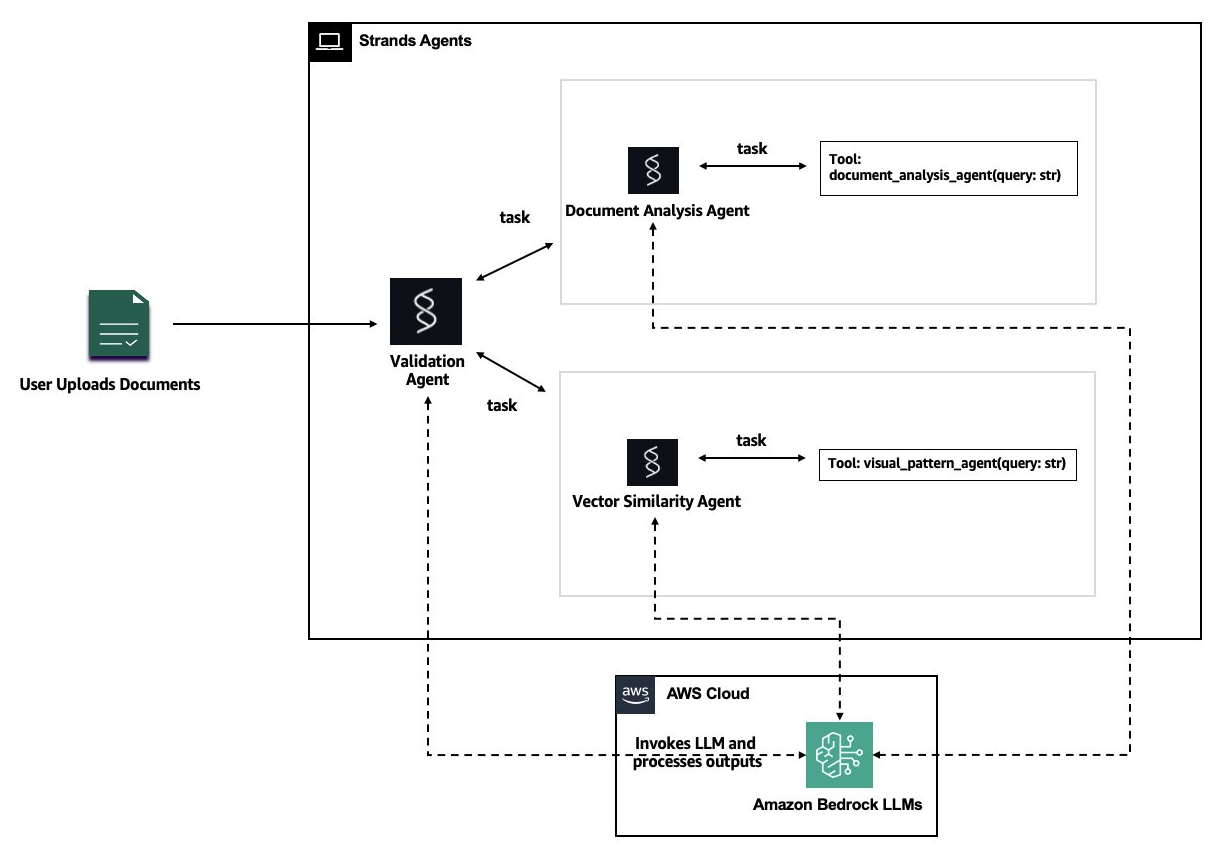
Learn how to build a multi-agent document classification solution on Amazon Bedrock using the Strands Agents SDK. Three specialized agents combine textual analysis with Claude Haiku 4.5 and visual similarity search with Amazon Titan Multimodal Embeddings to accurately classify insurance documents such as policies and affidavits.
Fresher insights, faster decisions: talabat’s near-real-time analytics across AWS and Google Cloud
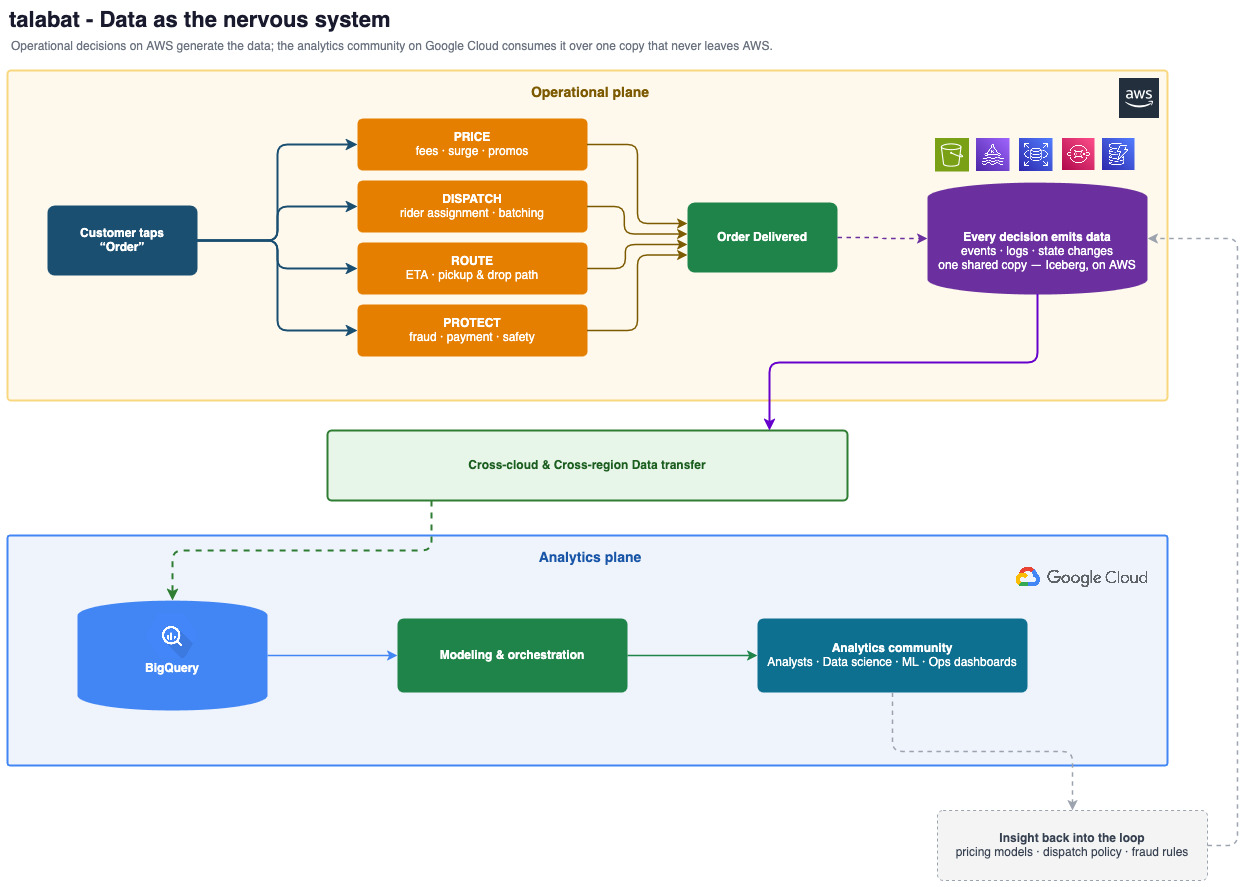
Leading everyday app across the Middle East and North Africa, talabat, built a hybrid multi-cloud lakehouse that keeps a single Apache Iceberg copy of streaming data on Amazon S3 Tables while letting Google BigQuery query it in place, eliminating cross-cloud data duplication and schema-synchronization overhead.
Run Massive-Scale UMAP in Minutes Using Multiple GPUs—Without Losing Accuracy
Uniform Manifold Approximation and Projection (UMAP) is a dimensionality reduction technique widely used for visualization and feature extraction. Applications...
Every data team knows the moment. Someone opens a table, sees a column called cust_seg_flg, and has to go ask around to find out what it means, whether it's safe to use, and whether anyone has already answered that question in another dashboard three teams over. Multiply that by thousands of tables and views, and you get the real cost of governance debt: not a compliance failure, but a daily tax on every person trying to do honest work with your data. Most governance tooling today is reactive. You scan for problems, you get a report, someone opens a ticket, and three weeks later a column gets a description. The Governance Agent project (built on Google Cloud Knowledge Catalog, BigQuery, and column-level lineage) takes a different starting point: if a table upstream is already documented, tagged, and trusted, why should every downstream view have to earn that trust from scratch, by hand, every time? This post is about that shift, from governance as an audit you dread to governance that keeps itself current in the background. The problem in plain terms Data estates grow through pipelines. Raw tables get joined, filtered, and reshaped into views, and those views feed more views. Somewhere in that chain, the original context (what a column means, whether it's PII, what quality bar it's held to) tends to get lost. It just doesn't travel. The result is a familiar pattern: a handful of gold tables are well governed because someone invested real time in them, and everything built downstream of them is progressively less documented, less tagged, and less trustworthy, even when the underlying data hasn't actually gotten worse. The governance quality of a table ends up depending on how long ago someone cared about it, not on how the data is actually being used today. As data flows through a company, it gets combined, filtered, and reshaped for different teams to use. But somewhere along that journey, the important context—like what a piece of information means, whether it contains private details, or if it’s accurate—gets left behind. The metadata simply doesn't travel with the data through the progression of data assets within the ecosystem. The result is a familiar pattern: a company will have a few perfectly documented "core" datasets because someone invested time in them, but everything built on top of them becomes a mystery. The data itself hasn't gone bad, but without the original context, people stop trusting it. Ultimately, data is only considered reliable if someone manually updated its metadata recently, rather than because of what it actually contains. What the agent actually does The core idea is straightforward: use column-level lineage to figure out where a column came from, and propagate the governance metadata that already exists upstream, rather than asking a human to re-derive it. Concretely, it handles four things: Descriptions. If transactions.customer_id has a clear description upstream, and a downstream view pulls that column through two or three hops of joins, the agent traces that lineage and proposes the same description downstream. When a column isn't a straight passthrough (it's a SUM(), a CASE WHEN, a COALESCE), the agent reads the actual SQL that generated it and writes a description that reflects the transformation, instead of copying an upstream description that no longer applies. Business glossary terms. Technical column names rarely match the business language people actually use. The agent uses semantic similarity to map columns to a controlled glossary, and can also read unstructured documents (a PDF policy, a product spec, a markdown design doc) to find explicit definitions rather than guessing from column names alone. Policy tags. This is the one that matters most for risk. If a column is tagged as PII upstream, the agent traces where that data flows and recommends the same tag downstream, along with a summary of who currently has read access and what masking rules apply. It also checks whether a transformation looks like a "straight pull" (the sensitive value passed through unchanged) versus something that's been aggregated or anonymized, so it isn't blindly stamping PII tags on data that no longer carries the risk. Trust and data quality scores. Rather than treating every view as an unknown, the agent derives a trust score based on the Data Quality and Profiling results of its upstream sources, and gives credit when it detects that a transformation actually improved data quality (deduplication, null handling, and so on). Every one of these runs through a confidence threshold before anything gets applied. The system is explicit about not inferring PII status or glossary mappings without solid grounding. If the evidence is weak, the propagation doesn't happen automatically. That's a deliberate design choice: the agent is meant to close obvious gaps quickly, not make judgment calls that a person should be making. Why proactive is the right word, and not a stretch Proactive governance doesn't mean predicting the future. It means the governance work happens as data moves, instead of waiting for a scheduled review or a compliance incident to trigger it. In practice, that shows up in three ways: New views inherit context automatically, instead of starting undocumented and waiting for someone to notice. Sensitive data is flagged as it flows, not discovered after it's already been queried by twelve people who didn't know they needed a masking policy. Stewards spend their time on judgment calls, like ambiguous mappings or new glossary terms, instead of repetitive column-by-column tagging that a lineage graph could have told you. None of this replaces a data steward. It changes what a data steward's day looks like: fewer hours spent typing descriptions into a UI, more hours spent deciding what should count as a business term or whether an edge case needs a policy exception. When lineage runs out, bring your own context Lineage is powerful, but it isn't complete. Plenty of tables have no clean upstream source to inherit from: a newly ingested dataset, a one-off import, a table that predates whatever lineage tracking you have in place. For those, the agent doesn't just shrug. It lets you point it at your own documents (a PDF policy, a product spec, a markdown design doc, even a spreadsheet or a screenshot of a data dictionary) and uses that as grounding instead. There are three ways to feed it context, and which one you pick depends on the size of what you're handing over. For a short document, you can inject the full text directly into the prompt. For something long, like a fifty-page data classification policy, the agent chunks it, embeds it, and retrieves only the passage relevant to the specific column it's describing, so you're not paying to re-read the whole document for every field. And if your organization already has a proper document repository indexed in Vertex AI Search, the agent can query that directly instead of re-processing files every time. The part worth calling out is how conservative the grounding is. This isn't "read the doc and take a guess." The instructions given to the model are explicit: if a column isn't clearly defined in the document you provided, it has to say so and stop, not fill in the gap with a plausible-sounding guess. That rule is strict for policy tags and glossary terms in particular. A column only gets marked as PII if the document says so in plain language, like an explicit "PII: Y" flag or a named sensitivity section. No inference from column names, no "this sounds like it might be sensitive." That distinction matters more than it sounds like it should. A tool that infers PII status when it's uncertain is a tool that will eventually mask a column that didn't need it, or worse, wave through one that did. Making "I don't know" a valid answer is what makes the automation trustworthy enough to run without someone re-checking every single output. Two signals, not one: lineage plus insights Lineage is the primary signal, but it isn't the only one the agent listens to, and it's worth being precise about why. The Data Lineage API only knows what a job explicitly recorded. If a table was built through a well-instrumented pipeline, that's a clean, high-confidence trail. But plenty of real estates have gaps: a table that predates good lineage capture, a transformation that ran outside the tracked jobs, a relationship that technically exists but was never logged as such. For those gaps, the agent has a second pass. It can trigger a Knowledge Catalog Data Documentation scan (an AI-driven analysis Gemini runs over a table or dataset) which infers relationships and column meaning even without a clean SQL trail behind them. Those inferred relationships get extracted and cached locally, then loaded into the same traversal engine that handles lineage, so both signals are checked together rather than living in separate systems a steward has to reconcile by hand. The order matters. Standard lineage runs first, since it's grounded in an actual recorded job. The Insights pass runs second, filling in only what lineage didn't find, and anything it contributes is explicitly tagged as coming from that source rather than blended in silently. If you're auditing a propagated description or tag later, you can tell whether it came from a hard lineage link or an inferred one. There's a dedicated end-to-end flow for this path (trigger the scan, wait for it, extract the results, apply them) so it isn't a manual side-quest bolted onto the main workflow. The practical effect: an incomplete or newly onboarded pipeline still gets useful propagation on day one, instead of waiting until lineage coverage catches up. What it looks like day to day The project ships with both a Gradio-based dashboard and a CLI, which matters more than it sounds like it should. A steward reviewing a handful of tables before a demo will want the dashboard: run a scan, see which tables have metadata gaps, preview a proposed description or tag, and approve it with a click. A platform team that wants this running as part of a nightly job or a CI/CD pipeline will use the CLI, scripting steward_cli scan, apply, and policy-propagate commands the same way they'd script any other pipeline step. That dual interface reflects a real operational choice: governance tooling that only works from a UI never gets automated, and governance tooling that only works from a CLI never gets adopted by the people closest to the data. Where this needs a human in the loop Worth saying plainly: this is not a "set it and forget it" system, and it shouldn't be treated as one. Lineage confidence scoring can still get things wrong, especially across renamed columns or unusual joins. Semantic mismatch checks catch obvious errors (a date column shouldn't inherit a description from an id column) but they're heuristics, not guarantees. Every propagation is designed to be previewed before it's applied, and that preview step isn't a formality, it's the actual safety mechanism. The honest pitch here isn't "governance without effort." It's "governance where the effort goes to the right five percent of decisions instead of the repetitive ninety-five percent." Customer Testimonial “As custodians of the VodafoneThree UK Datahub, one of our biggest challenges is that a significant proportion of our data estate remains undocumented or inconsistently labelled. This creates friction for data discovery, slows down delivery teams, and limits the value we can unlock from AI solutions built on top of our data. The Data Steward Agent changes that. By combining cataloguing, lineage, and automated metadata propagation, it enables us to focus governance effort where it adds the most value while automatically carrying trusted context downstream. Rather than manually reviewing thousands of tables, we can concentrate on governing source datasets and allow lineage to scale that knowledge across the platform. We estimate this approach can reduce cataloguing effort by up to 75%, while significantly improving data discoverability, trust, and AI readiness across the UK Datahub.” - Radina-Paola Ivanova, GenAI Engineer, VodafoneThree UK Datahub The takeaway Governance debt compounds the same way technical debt does: quietly, until someone downstream hits it at the worst possible time. The value of an approach like this isn't that it makes governance disappear as a concern. It's that it moves the work upstream, literally, so that context and controls travel with the data instead of being reconstructed from scratch every time someone builds a new view. For teams sitting on years of undocumented BigQuery estates, that's not a nice-to-have. It's the difference between governance being something you catch up on twice a year, and governance being something that just keeps pace with how fast your data actually moves.
Building cost-effective, high-throughput gen AI workflows in Google Dataflow
Real-time streaming pipelines are the operational backbone of modern enterprises, continuously processing everything from customer support interactions to transaction logs. Traditionally, streaming DAGs are static; once deployed, their processing logic and execution paths are fixed. However, by integrating generative AI agents, we can move beyond static logic to adaptive execution. This allows streaming workflows to dynamically construct plans, query databases, and trigger custom remediation paths at runtime depending on the content of the data. For example, when a customer sends an angry message about a damaged order, a pipeline shouldn't just log the error or flag a dashboard. It should look up the order in the database that holds customer order and inventory records, decide on a remediation action (like shipping a replacement or issuing a refund), email the customer, and log the final resolution. However, streaming systems face a fundamental engineering hurdle when executing gen AI workflows: scale, latency, and cost. Sending every raw event directly to a heavyweight model or multi-step agent equipped with external database and email tools is prohibitively expensive, introduces high latency, and quickly exhausts API rate limits. This pattern addresses the scale and complexity challenge by combining Google Dataflow, Google Cloud's fully managed, serverless execution service for Apache Beam, and the Agent Development Kit (ADK) to build a hybrid streaming pipeline. By using a lightweight, CPU-bound machine learning model upstream to filter and qualify events, we keep the pipeline highly cost-effective, routing only the complex cases to the downstream agent. There, the agent dynamically decides what actions to take, introducing dynamic branching to the stream without hardcoding thousands of conditional steps into the pipeline's static DAG. A universal blueprint for high-volume streams While we use a customer support triage scenario below, this pre-filter + agentic action pattern is a universal paradigm. It applies to any stream where a high volume (>9X%) of events are routine, and only a small number require complex, contextual reasoning. IT Operations & DevOps: Filtering millions of routine system logs on CPU, and triggering an agent to run diagnostics and open bug tickets only when a critical anomaly is flagged. Financial Fraud Triaging: Passing millions of transactions through lightweight, local rules, and calling an agent to execute multi-database lookup tools only for highly suspicious patterns. Industrial IoT: Monitoring normal telemetry on the edge, and routing erratic spikes to an agent to coordinate equipment shutdowns and email field engineers. The architecture: Why pre-filter streaming events? In a high-throughput stream, the vast majority of messages do not require complex reasoning or remediation. They might be positive feedback, neutral inquiries, or simple queries. Routing every single event to a heavyweight LLM workflow creates three primary bottlenecks: API cost: Frontier models charge per token. Under high throughput, cost scales linearly with stream volume. Latency: Multi-step workflows (which involve database lookups and external API calls) take seconds, creating a bottleneck in streaming DAGs. Quotas: External APIs have strict rate limits that streaming workers can easily exhaust. To prevent this, we build a pre-filtered pipeline in Apache Beam/Dataflow: Pipeline flow Ingestion: Read raw customer messages from Google Pub/Sub. Lightweight sentiment classifier (CPU): Run all messages through a lightweight, CPU-based Hugging Face model (distilbert-base-uncased-finetuned-sst-2-english) using Apache Beam’s RunInference transform. This executes locally on the Dataflow worker CPUs, avoiding external API costs. Pre-qualification Gate: A simple DoFn filters the stream. Messages with POSITIVE or NEUTRAL sentiment are acknowledged and dropped. Automated Remediation (ADK): If and only if a message is classified as NEGATIVE, we trigger the gen AI agent backed by gemini-3.5-flash using the . The agent uses tools to look up the user in BigQuery, fetch orders, choose a remediation plan, and send a notification email via the Gmail API. Adaptive execution: Making the Beam DAG dynamic In traditional streaming architectures, the pipeline's Directed Acyclic Graph (DAG) is rigid. Once deployed to Dataflow, the sequence of transforms is set. If you need to handle new types of alerts or change how specific events are routed, you have to modify, test, and redeploy the entire pipeline. By placing a gen AI agent downstream of our sentiment pre-filter, we introduce a dynamic, adaptive node inside the static DAG. For the 95% of records that are positive or neutral, the pipeline runs along a fast, static path. But when the filter gates a negative record, the agent evaluates the payload and dynamically selects the correct sequence of API tools (e.g., database query, inventory check, or email notification) at runtime. This allows the pipeline to execute complex decision trees dynamically, eliminating the need to build and maintain thousands of hardcoded conditional branches in the static Apache Beam code. Implementing the pipeline Here is an example implementation in Apache Beam using the Google Agent Development Kit (ADK) and the RunInference framework. 1. Defining the lightweight sentiment model We define the upstream CPU model using . This model classifies sentiment into POSITIVE, NEUTRAL, or NEGATIVE on the worker instance. code_block <ListValue: [StructValue([('code', 'model_handler = (\r\n task="sentiment-analysis",\r\n model="distilbert-base-uncased-finetuned-sst-2-english"\r\n)'), ('language', ''), ('caption', <wagtail.rich_text.RichText object at 0x7fc00788e950>)])]> 2. Building the heavyweight ADK agent The ADK agent acts as our remediation assistant. We equip it with three tools: lookup_user: Queries BigQuery for the customer's email. lookup_orders: Queries BigQuery for the customer's orders and current product inventory. send_email: Sends a remediation email to the customer using the Gmail API. code_block <ListValue: [StructValue([('code', 'def make_adk_tools(project: str, dataset: str = "sentiment_demo"):\r\n def lookup_user(user_id: int) -> dict:\r\n """Look up user information (email address) from BigQuery by user ID."""\r\n from google.cloud import bigquery\r\n\r\n client = bigquery.Client(project=project)\r\n query = (\r\n f"SELECT user_id, user_email "\r\n f"FROM `{project}.{dataset}.users` "\r\n f"WHERE user_id = @user_id"\r\n )\r\n job_config = bigquery.QueryJobConfig(\r\n query_parameters=[bigquery.("user_id", "INT64", user_id)]\r\n )\r\n try:\r\n results = list(client.query(query, job_config=job_config).result())\r\n if results:\r\n row = results[0]\r\n return {"user_id": row.user_id, "user_email": row.user_email}\r\n return {"error": f"No user found with user_id={user_id}"}\r\n except Exception as exc:\r\n return {"error": str(exc)}\r\n\r\n def lookup_orders(user_id: int) -> dict:\r\n """Look up a user\'s orders and current product inventory from BigQuery."""\r\n from google.cloud import bigquery\r\n\r\n client = bigquery.Client(project=project)\r\n query = (\r\n f"SELECT p.order_id, p.product_id, pr.remaining_inventory, pr.price "\r\n f"FROM `{project}.{dataset}.purchases` p "\r\n f"JOIN `{project}.{dataset}.products` pr ON p.product_id = pr.product_id "\r\n f"WHERE p.user_id = @user_id"\r\n )\r\n job_config = bigquery.QueryJobConfig(\r\n query_parameters=[bigquery.("user_id", "INT64", user_id)]\r\n )\r\n try:\r\n results = list(client.query(query, job_config=job_config).result())\r\n orders = [\r\n {\r\n "order_id": row.order_id,\r\n "product_id": row.product_id,\r\n "remaining_inventory": row.remaining_inventory,\r\n "price": float(row.price),\r\n }\r\n for row in results\r\n ]\r\n return {"orders": orders}\r\n except Exception as exc:\r\n return {"error": str(exc)}\r\n\r\n def send_email(to_address: str, subject: str, body: str) -> str:\r\n """Send a plain-text email to the customer via the Gmail API."""\r\n import google.auth\r\n import googleapiclient.discovery\r\n import email.mime.text\r\n import base64\r\n\r\n try:\r\n creds, _ = google.auth.default(\r\n scopes=["https://www.googleapis.com/auth/gmail.send"]\r\n )\r\n service = googleapiclient.discovery.build("gmail", "v1", credentials=creds)\r\n\r\n mime_msg = email.mime.text.MIMEText(body)\r\n mime_msg["to"] = to_address\r\n mime_msg["subject"] = subject\r\n raw = base64.urlsafe_b64encode(mime_msg.as_bytes()).decode("utf-8")\r\n service.users().messages().send(userId="me", body={"raw": raw}).execute()\r\n return "Email sent successfully"\r\n except Exception as exc:\r\n return f"Failed to send email: {exc}"\r\n\r\n return [lookup_user, lookup_orders, send_email]'), ('language', ''), ('caption', <wagtail.rich_text.RichText object at 0x7fc0066b6f90>)])]> We configure the LlmAgent and package it in the : code_block <ListValue: [StructValue([('code', 'adk_agent = LlmAgent(\r\n name="remediation_agent",\r\n model="gemini-3.5-flash",\r\n instruction=(\r\n "You are a customer service remediation assistant with access to "\r\n "BigQuery lookup tools and an email sending tool. "\r\n "When given a prompt describing a customer situation, follow the "\r\n "numbered steps exactly and use your tools to complete the task."\r\n ),\r\n tools=adk_tools,\r\n)\r\n\r\n# RunInference handler for the ADK agent\r\nadk_handler = (agent=adk_agent)'), ('language', ''), ('caption', <wagtail.rich_text.RichText object at 0x7fc0042d1a10>)])]> 3. Assembling the Dataflow DAG The entire pipeline is declared cleanly. The upstream sentiment inference feeds directly into the filtering step (FilterNegativeADK), which then conditionally executes the downstream ADKInference: code_block <ListValue: [StructValue([('code', 'with beam.Pipeline(options=pipeline_options) as p:\r\n # 1. Read from Pub/Sub and classify sentiment on CPU\r\n sentiment_results = (\r\n p\r\n | "ReadFromPubSub" >> beam.io.ReadFromPubSub(topic=known_args.input_topic)\r\n | "DecodeMessages" >> beam.Map(lambda x: x.decode(\'utf-8\'))\r\n | "SentimentInference" >> RunInference(model_handler)\r\n )\r\n\r\n # 2. Filter out non-negative sentiment and invoke the ADK Agent\r\n _ = (\r\n sentiment_results\r\n | "FilterNegativeADK" >> beam.ParDo(())\r\n | "ADKInference" >> RunInference(adk_handler)\r\n | "LogADKResults" >> beam.ParDo(LogADKResponse())\r\n )'), ('language', ''), ('caption', <wagtail.rich_text.RichText object at 0x7fc0042d1850>)])]> Cost and performance advantages By introducing this filtering step, we gain major engineering and operational advantages: 1. Significant cost reductions Instead of paying for Gemini input/output tokens on 100% of incoming events, we pay only for the fraction that represent negative customer sentiment (typically < 5% of messages). The other 95% are classified locally on CPU instances at zero incremental API cost. 2. High streaming throughput Dataflow distributes the CPU classification workload across many instances. Since CPU inference takes milliseconds, the pipeline scales horizontally to handle high-throughput event streams. The heavyweight LLM agent, which can take seconds per request due to tool execution, is called sparingly, preventing backlog. 3. Native Apache Beam integration Adding the agent into the DAG requires no complex orchestration logic or manual thread pools. Using with Beam's native RunInference transform handles parallel worker threads, batching, and integration automatically, keeping the codebase maintainable and clean. Key takeaways Streaming data is fast and high-volume, while heavyweight generative AI reasoning is slow and costly. By building a pre-filtered pipeline with Google Dataflow and the ADK, you get the best of both worlds: the cost and speed of local CPU-based models, and the deep, automated capabilities of Gemini-backed agents. To see the complete codebase and deploy this yourself, check out the next-2026-demo GitHub repository. Apache Beam is a trademark of the Apache Software Foundation
How Box is unlocking multimodal enterprise agents with Gemini Embeddings 2
Enterprise content management is experiencing its biggest architectural shift since the cloud migration era. For years, enterprises have stored trillions of gigabytes of critical data in Box: financial models, clinical trial protocols, M&A due diligence rooms, engineering schematics, and legal compliance playbooks. Up to this point, text-based search and retrieval-augmented generation (RAG) have successfully unlocked the vast narrative knowledge within these repositories, establishing a powerful and highly effective baseline for enterprise AI intelligence. Traditional RAG architectures have mastered text processing, but the agentic era demands more. The next logical evolution is to extend this framework to capture the inherently multimodal, deeply spatial, and highly structured elements that exist alongside text. While text embeddings excel at indexing prose, multimodal architectures unlock a major new capability: For example, they preserve the strict row-column semantics of financial tables, interpret visual evidence like clinical data, and map the logic of multi-page flowcharts without losing their spatial layout. To deliver next-generation capabilities that can handle the vast universe of digital content, Google Cloud and Box are integrating advanced multimodal capabilities into Box's Agentic Platform, powered by Gemini Multimodal Embeddings 2 merging Box’s industry-leading Intelligent Content Management platform with Google Cloud’s advanced AI embeddings. Benefits of improved embedding: Extending the dimensions of document content Preserving visual and spatial geometry: Complex document elements like multi-column tables or financial matrices rely on their spatial layout to convey meaning. Converting these elements into a flat string of text can disassociate column headers from their corresponding data points. Multimodal embeddings allow systems to interpret the document exactly as a human does, maintaining the integrity of spatial relationships. Illuminating the visual modality: Enterprise documents are filled with visual indicators: technical charts, process flowcharts, branding assets, and product photography. Multimodal capabilities ensure that these elements are no longer invisible to search systems, allowing users to query images and text simultaneously. Connecting hybrid file formats: Real-world business workflows rarely live in a single document format. An agent may need to cross-reference a PDF policy, a spreadsheet tracking log, and a presentation deck. Extending RAG with multimodal embeddings creates a unified understanding across these varied formats. The Architectural Solution: Gemini Multimodal Embeddings 2 Google Cloud’s Gemini Multimodal Embeddings 2 introduces a unified, multimodal vector space capable of embedding text, raster images, document pages, rendered spreadsheet tables, and visual charts into the same semantic representation space. Key product capabilities unlocked by gemini-embeddings-2: Crossmodal retrieval (text-to-visual / visual-to-text): Enables natural language queries to retrieve highly specific visual components, such as locating a target chart or diagram within a massive library of slides, without requiring manual tagging. Layout-aware document embedding: Rather than breaking files into arbitrary text blocks, the system can embed document page renderings directly, preserving visual hierarchies, callout boxes, and structural context. Heterogeneous format bridging: Native support for seamlessly bridging content across .docx, .xlsx, .pdf, .pptx, .png, and .csv without losing modality-specific structural information. Three core patterns of multimodal enterprise agents By leveraging multimodal embeddings within Box, we have identified three uniqueprimary design patterns that illustrate how organizations can extend traditional RAG to support complex, visual workflows. Pattern 1: Complex financial & analytical reporting The challenge Corporate finance, research, and audit teams analyze highly structured documents where vital data resides in embedded tables, growth charts, and footnote annotations. Text-only indexing can separate these numbers from their context, making automated analysis challenging. The multimodal advantage Structural alignment: The embedding model captures the physical structure of tables and charts, allowing financial agents to understand that a column header applies to a specific row of metrics. Visual trend analysis: Agents can cross-reference written summaries with visual trends in accompanying bar or line charts, identifying and pointing out discrepancies between written claims and source data. Contextual sourcing: Users can query complex portfolios and instantly retrieve the exact page, table, or chart supporting a specific metric. Pattern 2: Multimodal clinical decision support & assisted diagnosis The challenge In healthcare and clinical environments, critical patient data is fragmented across vastly different, unstructured visual and textual formats — ranging from external physical photos (visual evidence) and microscopic pathology slides (lab reports) to structured risk matrices (triage grids). Traditional text-based systems or isolated analysis tools cannot synthesize these cross-modal relationships simultaneously, which can delay critical diagnoses or risk missing immediate, life-threatening procedural complications. The multimodal advantage Cross-modal clinical synthesis: Evaluates physical symptoms alongside cellular-level laboratory evidence simultaneously by indexing clinical photos, histopathology imagery, and triage grids into a single space. Granular anomaly identification: Connects niche visual patterns under a microscope (like parasitic cyst walls) with medical knowledge to rapidly isolate rare conditions. Risk-aware decision support: Cross-references findings against triage frameworks to deliver instant warnings about immediate patient risks, such as life-threatening anaphylactic shock. Pattern 3: Cross-document multimodal synthesis & data reconciliation The challenge Enterprise information is fragmented across disconnected files and formats (e.g., PDF minutes, Excel charts, PNG flyers, and email threads). Traditional tools analyze these files in isolation, failing to connect the dots when verifying details or resolving data contradictions across independent documents. The multimodal advantage Cross-file synthesis: Connects information across entirely different formats (PDFs, spreadsheets, images, emails) simultaneously to answer complex business queries. Conflict resolution: Flags and resolves contradictions between assets, such as catching outdated pricing on an image by cross-checking it against the latest financial spreadsheets. Visual-to-text auditing: Audits visual or scanned files against text-based records (e.g., verifying a signed PDF contract against a legal review email) to catch missing clauses or changes. The future of agentic enterprise content management The integration of gemini-embeddings-2 into Box’s Agentic Platform is an important new capability to improve the next era of content intelligence. Multimodal embeddings help Box to move beyond basic search to active, intelligent collaboration.Box's Intelligent Content Management platform represents a fundamental shift in enterprise AI infrastructure — moving beyond passive document storage to deliver a governed, semantically indexed reasoning layer where AI agents can interrogate, cross-reference, and act on content with full compliance and security controls already in place. Powered by multimodal embeddings and a suite of native AI agents spanning search, metadata extraction, research, analysis, and composition, Box enables organizations to proactively surface insights such as flagging stale pricing data, expiring contract clauses, or cross-document contradictions before they become business risks. For high-complexity industries like financial services, life sciences, and legal operations, Box's ability to reason across text, tables, charts, and images makes multimodal understanding a competitive requirement. Designed to interoperate with the broader enterprise AI ecosystem, Box serves as the single governed content foundation that ensures every AI-driven workflow is grounded in authorized, auditable enterprise data. When you think about it, the enterprise data landscape was always multimodal. Now we have the technology to make the most of it. By integrating gemini-embeddings-2, Box helps its users unlock unprecedented value from unstructured enterprise content. Product leaders who embrace multimodal-first architectures, rigorous precision benchmarking, and audit-ready grounding will lead the next wave of enterprise productivity and innovation. The team would like to thank Ken Ikeda, Afshaan Mazagonwalla, and Samip Thakkar for their work on this project.
Staying Ahead of Adversarial AI Through Agentic Source Code Review
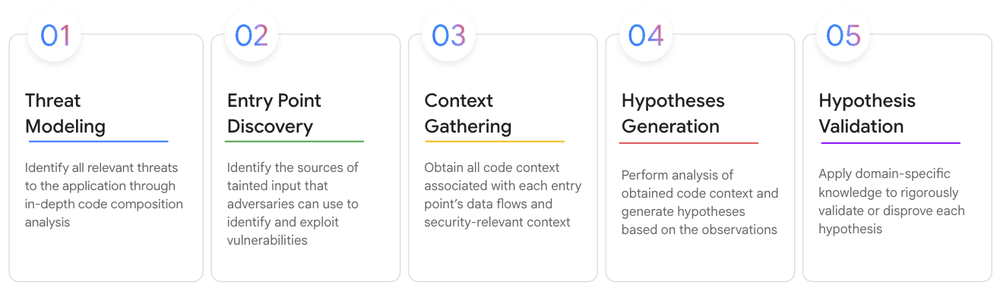
Written by: Alex Tselevich, Michael Maturi Introduction Adversarial misuse of AI has increased the risk of data theft and extortion events, because when proprietary source code is exposed, defenders must scramble to identify and patch vulnerabilities while attackers deploy machine-speed AI tools against them. By structuring the analysis process, enforcing skeptical validation steps, and injecting domain-specific human expertise directly into the pipeline, we’ve achieved a leap in efficacy. Combining AI models with a deeply structured, human expert-driven orchestration layer to tip the scales so that defenders can beat adversaries to the punch. Today, we use the Agentic Vulnerability Discovery Harness (AVDH) to rapidly analyze code and find exploit paths during proactive reviews, penetration tests, red team operations, and incident response engagements. By combining multi-agent orchestration with our frontline subject-matter expertise, this framework helps to augment the discovery and validation of routine vulnerabilities, enabling humans to focus their impact. To help defenders implement similar approaches for their own environments, we are sharing the details of this internal, point-in-time architecture for the first time. AVDH can also be used alongside CodeMender’s ongoing scanning to create a two-layered defense strategy. Real-World Results In the 10 months that we’ve been using AVDH, we’ve seen it have a significant impact. During a recent incident response investigation involving stolen corporate repositories, the harness discovered over 100 true-positive critical vulnerabilities in just two days — achieving results in a fraction of the time required for manual review. This has greatly accelerated how Mandiant discovers vulnerabilities at scale. We have used it to analyze environments spanning tens of millions of lines of code, and execute thousands of pipelines to generate tens of thousands of findings. This rapid analysis has uncovered dozens of assignable flaws in widely used web extensions and open-source projects, resulting in 12 assigned CVEs, including CVE-2026-13242, CVE-2026-55803, and an additional dozen currently in active disclosure. While fast, broad, high-precision scanning has been one of the key benefits of AVDH, it has also acted as a force multiplier during our targeted adversary simulation engagements. We recently processed a client’s web application source code through the harness, and quickly found a remote code execution (RCE) vulnerability that enabled initial access. AVDH has repeatedly proven invaluable for navigating mature defenses and accelerating complex exploit chains. Architecting the Pipeline Harnesses have become a vital tool for cybersecurity uses of large language models (LLMs). They help mitigate much of the model’s unpredictability, driven by inherent, non-deterministic behavior, and dramatically improve their effectiveness at code analysis. The programmatic infrastructure of a harness orchestrates agents in a strictly deterministic manner toward objective completion. For AVDH, we used the Google Agent Development Kit (ADK), an LLM framework that implements the most common agent orchestration patterns, and provides flexibility for configuring custom and third-party integrations. This approach aligns with the agentic orchestration capabilities now available in Google Antigravity, which provides a centralized workspace for builders to steer and manage these agentic workflows. Our decades of frontline experience discovering and remediating vulnerabilities across every software domain helped us structure AVDH around the proven methodologies our consultants execute daily. AVDH chains specialized agents together in a sequential pipeline, much like the waterfall approach to software development: each phase is completed before the next begins. This pipeline yields a prioritized, risk-rated list of findings, primed for a human expert to review. Just as frontline security experts rely on organizational context, an agentic harness requires rich environmental inputs — such as asset inventories, software bills of materials (SBOMs), architecture documentation, and threat intelligence. When fed into a distilled human knowledge base, this contextual data allows agents to dynamically select relevant skills, language rules, and vulnerability patterns for deep analysis. Figure 1: Sequential vulnerability discovery methodology Threat Modeling A critical first step when using AI for code security analysis is to establish a threat model for the target codebase. Software architectures can vary wildly, and without a threat model, we can lose valuable context, such as attack vectors, business logic, and reachability. While traditional source code review engines rely on rigid pattern-matching rules, an LLM offers the distinct advantage of distinguishing code accessible to a standard user from code restricted to an administrator, or code that is never executed at all. Our pipeline begins by dispatching an Explorer agent to identify the core purpose of the target codebase. This agent determines the software domain (such as web or desktop application), reviews discovered documentation, flags directories to exclude from scanning (such as those containing unit tests), and dispatches Specialist Explorer subagents. These Specialist Explorers then delve into their respective focus areas, including authentication, authorization, routing, and other domain-specific categories. Their output is passed to a Threat Model Synthesis agent, which aggregates the findings into a cohesive threat model. Figure 2: Codebase reconnaissance workflow diagram Once this stage of analysis is complete, the consultant is presented with both textual and visual representations of the threat model for verification before analysis continues. This approval gate helps ensure that the rest of the pipeline has an accurate foundation to operate on. Figure 3 shows an example layout of a visual threat model generated by the harness, indicating which application components are exposed and how they connect. Figure 3: Visual representation of a threat model for a sample codebase Entry Point Discovery With the threat model established, we deploy parallelized Discovery agents to analyze every in-scope file. These agents use the lightweight Gemini Flash Lite model to process code at scale to extract critical application entry points, such as HTTP routes, inter-process communication (IPC) listeners, and other domain-specific attack vectors. Simultaneously, they isolate and extract all identifiable sources of user input nested in these identified entry points. Figure 4: Entry point discovery workflow diagram Context Enrichment Once entry points are selected for analysis, the harness assigns each to a dedicated Enrichment agent. In enterprise applications, analyzing an entry point in isolation is rarely sufficient — critical components like sanitizers, permissions, and routing conditions are often highly distributed. Furthermore, vulnerabilities frequently hide deep within nested function calls, multiple hops and files away from the initial source. To bridge this gap, the Enrichment agent navigates the codebase to aggregate contextually relevant code for its assigned entry point. It evaluates this aggregated data to determine whether the entry point requires further analysis by the Access Control agent, the Data Flow Analysis agent, or both. Figure 5: Context enrichment workflow diagram Hypothesis Generation Effective code analysis hinges on observing two primary properties: control flow and data flow. While control flow dictates the execution order of tasks and instructions, data flow traces how information moves and transforms throughout the application. Our AVDH delegates these critical tasks to the Access Control and Data Flow Analysis agents, respectively. At this stage, these agents perform minimal self-validation. Their primary objective is expansive brainstorming. To manage the sheer volume of hypotheses produced, this creative process is kept in check by a Confidence Filter configured by the consultant. Figure 6: Hypothesis generation gating diagram The Access Control agent evaluates the protections surrounding the target entry point to determine its overall accessibility to application users. Its primary purpose is to validate security assumptions, and confirm whether privileged functionality is restricted or inadvertently exposed to unauthorized users. This analysis exposes flaws where a check was never made, or made against the wrong identity, including missing authorization, privilege escalation, and cross-site request forgery (CSRF). Meanwhile, the Data Flow Analysis agent tracks the flow of user input from the initial entry point throughout the entire application. It traces data as it traverses nested function calls, sanitizer transformations, and storage boundaries like databases. The agent's goal is to determine if this user-supplied data ever reaches a dangerous "sink," a function where malicious input could execute and cause harm. This deep tracing unearths vulnerability classes such as SQL injection, cross-site scripting (XSS), command injection, and path traversal. Hypothesis Validation Once hypotheses are generated for the target codebase, our harness dispatches a new set of agents to validate them. In LLMs, the temperature parameter dictates the variability and randomness of the output: lower temperatures yield predictable, stable responses, while higher values can produce radically different results each time. Our harness uses this by dispatching multiple Validation agents configured with high temperature settings to assess each hypothesis, alongside a single Validation Synthesis agent tasked with processing their verdicts to make a final decision. Using a higher temperature enables our validation to cover a much broader spectrum of possibilities rather than more predictable, expected responses. Ultimately, this temperature configuration provides richer, more comprehensive context for the agent making the final determination. The Synthesis agent evaluates the reasoning and verdicts from the Validation agents to determine if the hypothesis meets our rigorous quality criteria and aligns with the overall threat model. From here, there are three possible outcomes: Confirmed finding: The hypothesis is robust, and the Validation agents have independently verified it. Disproven hypothesis: The Validation agents surface significant conflicting evidence disputing the validity of the flaw. Rejected hypothesis: The hypothesis does not align with the established threat model, or does not qualify as a vulnerability. Figure 7: Hypothesis validation workflow diagram Human Subject-Matter Expertise Expert Validation Once the harness deduplicates and risk-rates the confirmed findings, we continue the analysis with rigorous human expert review. We perform due diligence by dynamically replicating the exploitation and executing Proof-of-Concept (POC) code to verify that the AI assumptions are accurate and that no unseen compensating controls hinder the attack path. Once validated, the consultant synthesizes the AI-generated finding with their own expert analysis and prepares it for formal disclosure. Conversely, any findings that fail to pass this dynamic testing phase are discarded. We encourage network defenders considering implementing similar vulnerability discovery harnesses to manually validate findings. Figure 8: Human-in-the-loop handover diagram Distilled Knowledge While human-in-the-loop validation of confirmed findings effectively minimizes false positives, we still need to address false negatives. To determine if the AI agents had missed any vulnerabilities, we engineered a rules-based approach that directly injects Mandiant subject-matter expertise into the analysis pipeline. It uses highly-specialized prompts distilled from our consultants' collective knowledge, similar to the skills engineering concept. Integrating this human intelligence directly into our AI-driven analysis significantly elevates the precision of the results. To ensure this knowledge system remains modular and scalable, we structured it as a hierarchy with the software domain at the top, followed by three primary rule categories: language, framework, and vulnerability. Figure 9: Agentic rule system hierarchy Framework and language rules apply across the entire pipeline, equipping the agents with consultant insights into the specific technologies employed within the target codebase. These rules encompass critical details, such as common entry point definition patterns and unique attack surfaces, with additional contextual information essential for threat modeling.In contrast, vulnerability rules apply exclusively during the final stages of the pipeline, prescribing precisely how to discover, validate, and risk-rate specific types of vulnerabilities. This structured system ensures the entire analysis pipeline is infused with Mandiant’s human expertise in a maintainable, highly modular way. Figure 10: Methodology rule application diagram Measuring Success Accurate benchmarking and evaluation are critical to maintaining and continuously improving an agentic code analysis pipeline. We developed a rigorous internal methodology for measuring the performance of our orchestration harness, ensuring that prompt adjustments and rule updates consistently drive positive, data-backed improvements without introducing quality regressions. We recommend implementing an analogous benchmarking system to gauge progress and efficacy with your code analysis pipeline. Benchmark Targets While public code vulnerability datasets exist, training data contamination presents a significant challenge for evaluating LLMs. It is possible that modern frontier models have already ingested these public repositories, making it nearly impossible to determine if a model is genuinely reasoning through a vulnerability or simply recalling a memorized solution. To ensure high-fidelity evaluation, we developed a suite of proprietary, synthetic codebases. These custom benchmarks span software domains, programming languages, vulnerability depths, and architectures, from traditional monoliths to modern microservices. Crucially, our security consultants manually verify every injected vulnerability to ensure it is genuinely reachable and dynamically exploitable. As we tune the harness and its underlying prompts, we enforce strict review processes to actively prevent the AI from overfitting to these benchmark codebases. Benchmark Grading Our grading process pairs AI evaluation with expert human-in-the-loop review. When our harness analyzes a benchmark directory, the output is passed to a dedicated Grading agent. This grader evaluates the pipeline's findings against our ground-truth dataset, demanding precise vulnerability matches rather than relying on loose semantic similarity. From there, the grading pipeline branches out to handle edge cases: False positive triage: Harness findings that do not map to the ground truth are routed to a secondary agent to definitively classify them as either false positives or legitimate vulnerabilities. Duplicate resolution: If the pipeline produces multiple findings that map to a single ground-truth issue, another agent analyzes the cluster to determine whether the findings are duplicates. Finally, a human expert manually reviews the graded data to validate the accuracy of the AI judges. We perform this rigorous testing cycle across multiple domains and architectures for every major release of the harness, averaging out the results to account for the inherent non-determinism of LLMs. Framework and language rules apply across the entire pipeline, equipping the agents with consultant insights into the specific technologies employed within the target codebase. These rules encompass critical details, such as common entry point definition patterns and unique attack surfaces, with additional contextual information essential for threat modeling. In contrast, vulnerability rules apply exclusively during the final stages of the pipeline, prescribing precisely how to discover, validate, and risk-rate specific types of vulnerabilities. This structured system ensures the entire analysis pipeline is infused with Mandiant’s human expertise in a maintainable, highly modular way. Figure 11: Benchmarking process diagram Conclusion Securing the software development pipeline has emerged as a defining challenge in modern enterprise defense. Our ongoing research has shown that defenders face extraordinary challenges in responding to the rapidly-growing capabilities of adversarial AI. To match these emerging threats, securing the code pipeline must be a critical component of a modern defense strategy. Manual source code review can’t keep pace with AI, and traditional scanning engines consistently miss the broad spectrum of vulnerabilities hidden in modern software. However, the success of our harness proves defenders can reclaim the advantage against adversarial AI. By embedding frontier models within an expert-defined harness, defenders can automate the discovery of routine vulnerabilities. Handling these standard findings transforms source code visibility into a scalable defense, freeing our consultants and other defenders to focus entirely on complex flaws. We believe that the process of building and refining this harness has demonstrated that AI is most effective when deployed as a practical multiplier for human expertise. While our tool was built for point-in-time assessments and deep, proactive vulnerability discovery, our recent blog post describes how CodeMender complements this by providing continuous, AI-enabled monitoring for software development and vulnerability management. For organizations looking to deploy these capabilities out-of-the-box, Google AI Threat Defense offers an always-on platform. It includes CodeMender’s code scanning and remediation to analyze systems, prioritize threats, patch vulnerabilities, and continuously monitor for new attacks. Combining AVDH for targeted, deep analysis with CodeMender’s ongoing scanning creates a two-layered defense strategy. This approach leverages point-in-time remediation for complex chains while maintaining continuous visibility over the development lifecycle. Want a deeper look at how we built and deploy this pipeline in real-world environments? Join us at Cyber Defense Summit September 15-16, 2026 in Washington, D.C. where we will be presenting "How Mandiant Orchestrates Gemini to Find Zero-Days Before Adversaries." We will walk through live demonstrations, share lessons learned from deploying agentic workflows, and discuss the future of AI-driven offensive and defensive capabilities. Register for the Summit here.
Building operational resilience with agentic AI in financial services
For financial institutions, operational resilience has long been embedded in regulatory and supervisory expectations — to say nothing of the high expectations of consumers. With the implementation of the European Union’s Digital Operational Resiliency Act (DORA), those expectations have become even more stringent, with more explicit, harmonized, and evidence-driven requirements. Firms must now demonstrate that their critical business services and supporting digital infrastructures can withstand disruption, support coordinated response, and recover with control. To meet these conditions, Deutsche Bank developed an AI-powered agentic resilience platform that modernized its regulatory tabletop resilience exercises at scale and turned manual preparation into context-aware and evidence-ready simulations grounded in actual operational data. The platform builds enterprise context from architecture, data flows, logs, incident history, alerting signals, and operational telemetry to generate scenarios, simulated operational evidence, structured session records, and regulator-ready artifacts. At many large banks with operations that span interdependent applications, data flows, and third-party services, this is a critical and even existential shift. Across financial services, supervisory expectations are evolving and as they do, banks’ tabletop exercises must reflect their production dependencies, real operating conditions, and compliance with consistent evidence standards more directly. As Deutsche Bank considered how to successfully and efficiently make this shift at scale, it looked to its long-time partner, Google Cloud, and its growing suite of agentic AI tools. From tabletop exercises to resilience intelligence With its agentic resilience platform, DB has been able to transform its tabletop exercises from manual preparation to a continuous intelligence model. And it’s been able to extend the same agentic layer to root-cause analysis when real operational context is needed. This means that every scenario it runs is based on real enterprise signals. The platform can then reflect true system dependencies, failure patterns, and business impact instead of relying on static inputs that are more likely to return assumptions than real-time insights. By using Gemini Enterprise Agent Platform, DB has been able to migrate this operational context into structured scenarios with clear timelines, decision points, and expected responses. This has ensured that each exercise is grounded in real system behavior that produces consistent, audit-ready evidence that meets regulatory expectations. Dual orchestration for control and flexibility In order to deliver both regulator-grade control and operational flexibility, DB’s platform introduced a dual-orchestration architecture that separates workflows into two complementary execution models. First, for regulator-aligned execution, the bank is using LangGraph to ensure that it generates every scenario through a traceable, deterministic process — with clear lineage from input context to output — that supports the auditability required for supervisory review. Next, for its adaptive and investigative scenarios, DB is using Google Agent Development Kit (ADK) to enable agent-driven coordination. This approach allows the bank’s platform to dynamically analyze conditions and generate responses without predefined execution paths. Figure 1. Architecture for context assembly, orchestration, and scenario generation. With this architectural separation, the platform can combine governed execution with adaptive investigation while preserving a common intelligence layer. The same agents and tools can reason over architecture, data-flow diagrams, logs, and code artifacts across tabletop scenario generation and related incident-analysis workflows. Importantly, this supports a consistent resilience model across both planned exercises and real operational events. Deutsche Bank’s objective with this platform was to engineer a resilience model for critical financial systems that meets regulatory expectations — even within highly complex, distributed environments. By linking dynamically generated scenarios to real business context and combining governed orchestration with adaptive analysis, the platform has given us an intelligent, continuously adaptive model for operational resilience.” – Sanjay Tripathi, Managing Director, Global Head of Surveillance Technology & Compliance Cloud & AI Transformation Lead, Deutsche Bank Powering generation and governance with Google Cloud Google Cloud’s suite of agentic tools is providing the foundation for scaling Deutsche Bank’s platform across its many governed, enterprise-grade resilience workflows. Here’s how: Cloud Run supports elastic execution of scenario and evidence-generation services. Gemini Enterprise Agent Platform transforms operational context into structured resilience scenarios. Google ADK enables adaptive agent coordination. Cloud SQL provides durable persistence for scenarios, session artifacts, and review records. Collectively, these services give DB support for the traceable generation, controlled execution, and persistent evidence record required for compliance review and continuous improvement. Scalable, evidence-ready resilience testing Every scenario generated by Deutsche Bank’s platform drives a structured tabletop session for the teams that run response, escalation, and recovery. Because these exercises are grounded in real enterprise context, they reflect operational reality while also strengthening consistency across teams and creating audit-ready evidence that meets regulatory expectations. For institutions that operate under DORA or similar frameworks, this makes it easier to demonstrate controlled, coordinated, and disciplined response at scale. This model is now being applied across multiple DB portfolios, which is helping the bank establish more consistent and scalable resilience paradigms and a replicable blueprint for the broader financial sector. In this model, root-cause analysis acts as the feedback loop between real incidents and future resilience testing. The resulting insights from production events can inform future tabletop scenarios, while exercise outcomes can strengthen response playbooks, escalation paths, and recovery readiness. All of this extends the platform’s value from planned resilience exercises to real operational events while keeping scenario-based resilience testing as the primary use case. As adoption expands, this platform brings consistency by embedding Google Cloud’s methodology for context-aware resilience. It eliminates fragmented manual approaches and establishes a cross-functional, AI-informed operating model across the bank. Toward resilience intelligence The bank’s next step is to extend this approach into a broader resilience intelligence layer, which is possible because it can deploy the same patterns to support playbook refinement, recovery-readiness assessments, and continuous validation of controls against evolving system conditions. For financial institutions, this is a strategic shift. As systems become more distributed and regulatory expectations more demanding, banks must move from periodic resilience testing to continuous, intelligence-driven capabilities. At Deutsche Bank, Google Cloud is making that transition simple across the organization. Learn more about Google Cloud’s methodology for context-aware resilience in this article.
Open AI launches a safer Chat GPT for teens — years after teens started using it
ChatGPT for Teens adds age-appropriate safety measures, parental controls, and learning tools designed to steer teens away from harmful content — and from using AI to cheat on their homework.
Meet SAM (Sovereign Agent Mesh): A Zero-Config, Zero-Trust P2 P Network for AI Agents
Google has open-sourced SAM (Sovereign Agent Mesh) under Apache-2.0 — and it has nothing to do with Segment Anything. SAM is a zero-config, zero-trust P2P overlay that lets autonomous agents discover and call each other's MCP tools across cloud, on-prem, laptop and edge environments, without exposing a single internal endpoint to the public internet. Identity flows from OIDC into Biscuit capability tokens, so nodes authorize every request offline under a strict default-deny model. The post Meet SAM (Sovereign Agent Mesh): A Zero-Config, Zero-Trust P2P Network for AI Agents appeared first on MarkTechPost.
Open AI’s Greg Brockman: Z.ai’s GLM-5.3 likely to “significantly accelerate the threat landscape”
OpenAI has adopted a less-than-straightforward stance with regards to open-weight AI models, both raising alarms over powerful Chinese releases while The post OpenAI’s Greg Brockman: Z.ai’s GLM-5.3 likely to “significantly accelerate the threat landscape” appeared first on The New Stack.
Anthropic CEO says AI centralizes by nature and open models just shift power to whoever owns the chips
An open fight over AI regulation has broken out on X. Investor Gavin Baker, former White House adviser David Sacks, and Meta researcher Yann LeCun accuse Anthropic CEO Dario Amodei of using fear rhetoric to buy himself a regulatory advantage. Amodei counters that regulation can also rein in corporate power, and that open models alone just shift power toward the players with the most computing muscle. The article Anthropic CEO says AI centralizes by nature and open models just shift power to whoever owns the chips appeared first on The Decoder.
The Download: how people really use AI, and Flock’s design choices
This is today’s edition of The Download, our weekday newsletter that provides a daily dose of what’s going on in the world of technology. We still don’t know how people are really using AI AI companies like Anthropic and OpenAI regularly publish reports on how people are using their products. But they only release the…
DOJ probes Andreessen Horowitz over partners sitting on competing AI boards
Andreessen Horowitz is the focus of an antitrust probe by the US Justice Department. The charge is that the firm's partners sit on the boards of competing data firms Databricks and Fivetran at the same time. The venture capital firm's close ties to the Trump administration add a twist, since it has actively lobbied for the administration's AI deregulation. The article DOJ probes Andreessen Horowitz over partners sitting on competing AI boards appeared first on The Decoder.
Open AI launches a Chat GPT version built for teens
OpenAI is shipping a version of ChatGPT tailored to users aged 13 to 17. The article OpenAI launches a ChatGPT version built for teens appeared first on The Decoder.
Partnering with Code AI to prepare the first AI generation
OpenAI and CodeAI are partnering to help students build AI literacy, think critically about AI, and develop the skills to use and shape it responsibly.
Introducing Chat GPT for Teens: Built for learning, backed by protections
ChatGPT for Teens helps teens learn, think critically, and use AI with confidence, with stronger built-in protections, healthy-use features, and additional controls for parents.
Anthropic's per-token cost runs 4.4 times the average on Vercel, and developers keep paying
Anthropic dominated Vercel's AI Gateway spending in July, pulling in 65.1 percent of total revenue while accounting for only 30 percent of tokens processed. Its tokens cost 4.4 times as much as those from competing providers on average. The article Anthropic's per-token cost runs 4.4 times the average on Vercel, and developers keep paying appeared first on The Decoder.
We still don’t know how people are really using AI
AI companies like Anthropic and OpenAI regularly publish reports on how people are using products like Claude and ChatGPT, but they only release the data they want us to see, AI researchers say. “There is no independent source to corroborate it,” says Anka Reuel, a computer science PhD candidate at the Stanford Trustworthy AI Research…
Claude Code gets a /design command that lets developers create UI mockups right in the terminal
With the /design command, Anthropic brings a visual design workflow directly into Claude Code. Developers can generate UI mockups as artboards right in the terminal before writing any code. Claude reads the existing codebase and matches the current UI style. The article Claude Code gets a /design command that lets developers create UI mockups right in the terminal appeared first on The Decoder.
Anthropic's annualized revenue has topped $65 billion, a sevenfold increase in one year, according to Bloomberg. The company could go public as early as fall 2026 at a $1 trillion valuation, potentially beating OpenAI to market. The article Anthropic increases revenue sevenfold, hits annualized rate above $65 billion appeared first on The Decoder.
Calibrated Trust, Not Sharper Prediction: An Empirical Test of Uncertainty Fusion
arXiv:2608.14617v1 Announce Type: new Abstract: A recurring proposal in legal AI is to improve case-outcome prediction by fusing uncertainty tools (evidence graphs with belief propagation, sequential Bayesian odds updating, Dempster-Shafer combination, and conformal prediction) into one pipeline. We test this on 1,000 real European Court of Human Rights cases from LexGLUE and FairLex, predicting whether the Court found a Convention violation from the case's fact paragraphs. We compare three families across two frontier LLMs (Claude Opus 4.8 and GPT-5.5) as per-fact evidence estimators: (A) the raw LLM, (B) the LLM routed through the fusion pipeline, and (C) a term-frequency baseline through the same pipeline. Across roughly 4,750 tests we find: (1) on discrimination (AUROC around 0.83) the pipeline yields no improvement over either the raw LLM or the baseline; a frontier LLM used directly is the strongest single discriminator. (2) Naively composing an LLM with Bayesian-odds and Dempster-Shafer fusion more than doubles calibration error (ECE from about 0.16 to 0.46) via a prior-mismatch mechanism that replicates across both models. (3) Dempster-Shafer fusion is actively unsafe on long chains, committing confidently to wrong labels at below-chance accuracy; we recommend removing it. (4) The pipeline's genuine value is operational: routed through a conformal selective-prediction layer, the system decides which cases to automate and which to escalate. After removing Dempster-Shafer, recalibrating, and applying class-conditional risk control on the full 1,000-case set, the tuned engine auto-clears at 96.8 percent accuracy with 0.5 percent errors escaping and 96.3 percent caught for review, versus 85.9 / 3.8 / 72.1 for an untuned baseline. The contribution of such pipelines in law is calibrated trust, not sharper prediction.
Valid Per-Field Selective Risk Control for Document Extraction: Three Failure Modes, a Validity Ladder, and When Conditioning Pays
arXiv:2608.14639v1 Announce Type: new Abstract: Per-field accept/review with selective risk at most alpha -- accept a field only if the error rate among accepted fields is controlled -- is the trust contract document-extraction systems need, and the natural procedure silently violates it on real documents. On 13,859 genuine claude-sonnet-5 fields from 800 CORD receipts (49.0% correct) we diagnose three failure modes: document clustering (design effect 1.84-2.45), score-refit leakage (coverage 0.416 at risk 0.127, violating alpha=0.10 in 95% of splits), and a tie-mass pathology (a degenerate score collapses the threshold grid, 0.030 to 0.001). We organize the fixes as a validity ladder, guarantee form stated per tier. A fit/val split protocol restores expected-selective-risk control for a learned fusion: coverage 0.318 at risk 0.096 at nominal alpha=0.10, no tolerance band (production variant 0.326) -- an on-average point whose realized risk exceeds alpha in 47.5% of resplits, not a certificate. Mondrian Learn-then-Test with exact binomial tails yields per-group PAC certificates: field-iid 0.171 at risk 0.068, cluster-corrected 0.140, doc-iid 0.060 -- the only tier matching documents, honestly near-vacuous today. Support-bin, the pre-specified provenance taxonomy, wins every rigor tier on the sonnet CORD capture (p<1e-4, Bonferroni-corrected) -- a win that does not replicate on the same documents under haiku or qwen -- while on higher-accuracy corpora pooled thresholds win: conditioning helps exactly where pooled cannot certify, subsumed by a learned score elsewhere. A frozen-configuration confirmation on selection-untouched claude-haiku-4-5 held at both risk levels, and a blind three-annotator human-gold audit verifies the practical tier's accepted-set risk at 1.3% against its 10% budget (Fleiss' kappa=0.83; labels err one-sidedly pessimistic). Released Apache-2.0 with seed-pinned, regression-gated procedures.
I Fuzz-Meta: An Interpretable Fuzzy Learning Framework Bridging Top-Down and Bottom-Up Knowledge Integration
arXiv:2608.14646v1 Announce Type: new Abstract: Interpretable representation learning remains a key challenge in modern neural computation, particularly when models are expected not only to perform but also to explain their reasoning. This paper introduces iFuzz-Meta, an interpretable fuzzy rule-based learning framework that preserves human-understandable reasoning structures within modern neural architectures. Each fuzzy rule corresponds to a semantic and spatial prototype defined in the original feature space, enabling transparent inference and direct interpretability. Meta-learning is employed as an analytical paradigm to examine how these interpretable rules reorganize across tasks and domains, providing a principled means to link algorithmic adaptation with cognitive representation. A knowledge-guided regularization mechanism further enables a top-down-bottom-up integration, in which theoretical priors act as soft inductive biases while data-driven learning refines and extends them. This dual process ensures that adaptation proceeds along semantically and physiologically meaningful trajectories, rather than arbitrary parameter shifts. Evaluations demonstrate that iFuzz-Meta achieves interpretable reasoning and stable cross-domain generalization, establishing a potential general pathway toward explainable and knowledge-aware fuzzy systems.
SKILL: Self-correcting Knowledge-guided Iterative Large Language Model Agent for Logic Optimization
arXiv:2608.14579v1 Announce Type: new Abstract: Logic synthesis optimization poses significant challenges due to exponentially growing search spaces, sparse reward signals, and diverse logic structures. Traditional expert-designed flows lack adaptability, while reinforcement learning (RL) methods often suffer from low sample efficiency and limited interpretability. We introduce SKILL, a Self-correcting Knowledge-guided Iterative Large Language Model Agent that unifies multi-agent LLM reasoning and RL-based environment interaction for automated synthesis optimization. SKILL coordinates three specialized LLMs: GPT-4o for strategic planning, Claude Sonnet 4 for detailed reasoning, and Gemini 2.5 Pro for efficient analysis with a PPO-based RL agent that learns actionable policies through direct interaction with synthesis tools. A novel self-correcting module monitors environment feedback (PDA metrics), detects suboptimal behaviors, and invokes LLM-guided recovery strategies. Evaluations on IWLS, OpenCores, and EPFL benchmarks show SKILL achieves a 12.4 % PDA improvement over expert flows and 86.3% success rate on logic systems up to 500K gates.
OGX: An Open-Source, Vendor-Neutral Generative AI Application Server
arXiv:2608.14580v1 Announce Type: new Abstract: OGX (Open GenAI Stack) is an open-source AI application server and Python library that implements the APIs of major frontier labs (OpenAI, Anthropic, Google) with pluggable backend providers. Developers building agentic AI applications--such as retrieval-augmented generation pipelines, multi-turn agents, and tool-calling workflows--can develop against a single API surface and deploy with any combination of inference engine, vector database, and safety backend, without changing application code. OGX's primary focus is the Responses API for server-side agentic orchestration, conforming to the Open Responses specification. The server also supports the Anthropic Messages API and Google GenAI Interactions API, decoupling SDK choice from model and deployment decisions. With over 20 inference providers, 13 vector store backends, and a companion Kubernetes Operator for production deployment, OGX serves as the self-hosted, model-agnostic backend for AI-powered developer tools including Claude Code, Codex CLI, OpenCode, and OpenHands. The project has over 8,400 GitHub stars, 242 contributors, and 4,000 commits across nearly two years of public development.
Decomposing Staleness in Recommender Systems: A Dual-Filter Framework for Supersession and Decay
arXiv:2608.15780v1 Announce Type: new Abstract: Stale recommendations are a pervasive challenge and a leading source of user complaints on large-scale content platforms. Items lose relevance through two primary mechanisms: supersession, where emerging updates render prior coverage stale, and relevance decay, where an item's informational value naturally diminishes over its lifecycle. Traditional countermeasures serve as crude proxies: age cutoffs poorly reflect actual relevance loss, while engagement heuristics rely on lagging signals, broadly exposing users to stale content before the system adapts. We present SDF (Supersession-Decay Filtering), a staleness filtering system fully deployed in Google Discover, a personalized recommendation feed with hundreds of millions of daily and billions of monthly active users. SDF targets both mechanisms with complementary filters, each powered by a learned model: a relational staleness model that detects supersession between item pairs, and a predicted traffic ratio (PTR) model that forecasts relevance decay from the item's content, trained on lifetime visit traffic. Applied via disjunction upstream of the ranking stage, SDF prunes stale candidates, measurably reducing downstream serving costs. Online experiments demonstrate that these filters significantly reduce the prevalence of stale content while improving user engagement. Over a two-year production deployment, user-filed staleness reports (in-product user feedback) declined by 54.9% relative to the pre-deployment baseline, establishing SDF as a robust and scalable paradigm for resolving content staleness at industrial scale.
The Commercial Tax: Rent-vs-Own Blind Spots in Multi-Hop Retrieval Benchmarks
arXiv:2608.16096v1 Announce Type: new Abstract: Enterprises connect language models to their own data through retrieval. The benchmarks that rank multi-hop retrieval systems leave out two facts a buyer needs before a published number can be used: whether the retrieval backbone may be deployed commercially, and what it costs to build. On licensing: the field's dense-retrieval anchor, NV-Embed-v2, is licensed cc-by-nc-4.0. Of the four leading MuSiQue systems we audit (HippoRAG-2, PropRAG, SAG, KET-RAG), three depend on it for their best numbers and none says so. On performance: we measure thirteen embedders from eight makers on one identical MuSiQue harness with bootstrap confidence intervals throughout. Until mid-2026 there was a real commercial tax: the best commercially-licensed embedder trailed the anchor by 2.31 Recall@5 points (95% CI [0.91, 3.71], p=0.001). NVIDIA's Nemotron-3-Embed-8B, released 2026-07-16, has closed it: +0.24 at Recall@5 (95% CI [-0.94, +1.43], p=0.69), -0.58 at Recall@10 (p=0.28). It matches the anchor, does not beat it, and is the only entrant that is commercially licensed, free to self-host, and indistinguishable from the anchor; every other entrant meeting the first two conditions sits 5.2 to 14.6 points below. The durable finding is the paid-versus-free divide: API embedders charge per token on every re-index, self-hosted ones charge nothing. On cost: three of five audited systems (adding Microsoft's GraphRAG) do not disclose indexing cost, and the only published GraphRAG dollar figures span 11x inside one third-party paper (USD 2.30 vs USD 24.94 to index a 5.64 MB corpus once); extrapolated to 1 TB that undisclosed choice separates roughly USD 428K from $4.6M. Our cost model keeps one-time embedding apart from recurring answering: at 1 TB, embedding sits 7.5x-900x below graph construction, and a year of answering at 10,000 queries/day sits 350x or more below it.
Google pays $10 M to get its hands on Spirit Airlines’ business data for AI training
Alphabet Inc.’s Google LLC has won an auction to acquire massive volumes of internal business data from the bankrupt airline operator Spirit Airlines Inc. for a hefty $10 million price. A report by Bloomberg says that Google outbid a number of competitors to acquire the data, including the artificial intelligence training data company Mercor.io Corp. […] The post Google pays $10M to get its hands on Spirit Airlines’ business data for AI training appeared first on SiliconANGLE.
AI cloud operator Groq raises $350 M more in funding
Artificial intelligence startup Groq Inc. today announced that it has raised $350 million in additional funding. The Series A round was led by returning backer Disruptive. Grok stated that Nvidia Corp. plans to join the round later down the line, but didn’t specify how much the chip giant will invest. The cash infusion comes less […] The post AI cloud operator Groq raises $350M more in funding appeared first on SiliconANGLE.