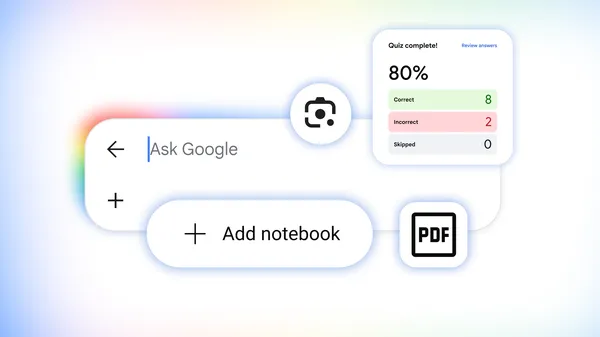
Google packs Search and Gemini with new AI study tools
The launch of the new study features marks Google's latest effort to make Gemini the AI assistant that students turn to when learning and studying, as it continues to compete with companies like OpenAI.
OpenAI reaffirms Zero Data Retention for eligible API customers and previews Private Safety Processing for advanced AI safety without compromising data privacy.
Ers say Open AI revoked their access to limited cyber program
The idea behind OpenAI's Trusted Access for Cyber program is to give trusted defenders better models so they can report bugs and vulnerabilities to companies, with the aim of getting flaws patched faster.
Open AI fixes Codex bug that deleted real user files without permission
OpenAI patched Codex after GPT-5.6 Sol started deleting real user files on its own. A cleanup command meant for temporary folders was wiping home directories instead. Codex now verifies deletion targets first, and full-access mode can no longer be triggered by accident. The article OpenAI fixes Codex bug that deleted real user files without permission appeared first on The Decoder.
Building Federated Multimodal AI Workflows with NVIDIA FLARE
Modern vision-language models (VLMs) can support tasks such as visual question answering, captioning, and image-text reasoning. In practice, however, the data...
Coders Say They Already Found Workarounds to Claude’s Invisible Watermarks
Anthropic announced last week it would include invisible watermarks in AI-generated content to comply with new EU rules. Within hours, overrides were being touted online.
Post-Train NVIDIA Cosmos 3 Edge for On-Device Robot Control
Robots need policies that can adapt to their sensors, environments, and tasks while running on onboard computing hardware. World models offer a foundation for...
Evaluating AI Agent Skill Performance with NVIDIA Skill Evaluator
AI agents are only as effective as the context they receive. Even with capable models and well-documented NVIDIA libraries, agents can spend extra steps finding...
How to modernize Apache Hive using Google Cloud’s Lakehouse runtime catalog
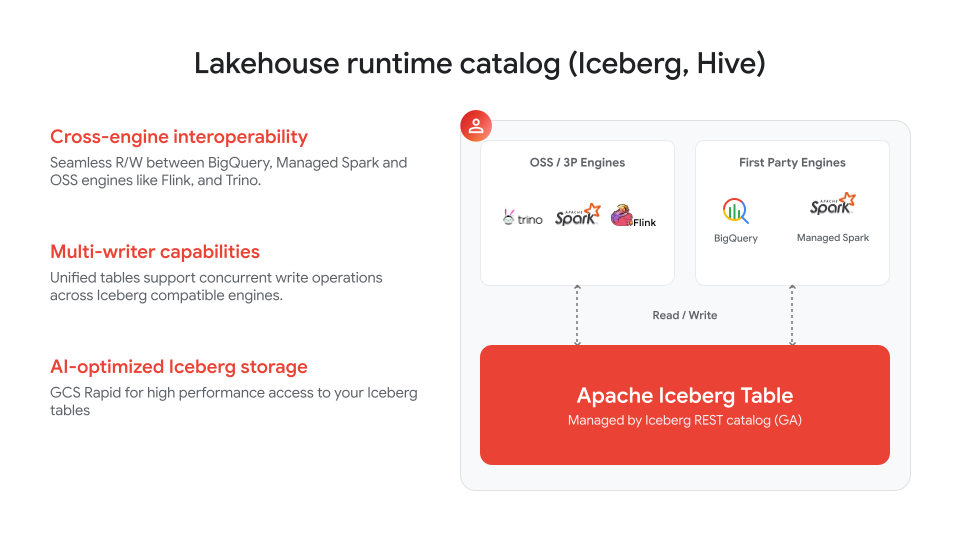
For over a decade, the Apache Hive Metastore (HMS) has served as the de facto metadata authority for big data analytics. Whether it was deployed on Hadoop clusters, self-managed Compute Engine VMs backed by MySQL or PostgreSQL, HMS provided the central schema registry that let Apache Spark, Presto, and Hive query raw .parquet and .orc files. However, as enterprise data architectures scale to petabytes and span multiple query engines (such as Google Cloud Managed Service for Apache Spark, BigQuery, and Trino), legacy Hive Metastores often become critical operational bottlenecks. In this blog, we explore why legacy metastores struggle in modern cloud environments at agent scale, and show you how the serverless Google Cloud Lakehouse runtime catalog that we introduced last year can help: Built on the open Apache Iceberg REST catalog specification, it is a runnable, zero-data-copy migration solution to help you transition your production Hive tables in minutes. The challenges of legacy Hive Metastores When speaking with data engineers and infrastructure leads running production analytics at scale, three core pain points consistently emerge with standalone Hive Metastores: Architectural and scaling HMS deployments rely on relational database backends (such as MySQL or Postgres) to track table schemas, partitions, and storage locations. As data lakes grow to hundreds of thousands of partitioned tables, partition pruning and bulk listing operations lead to key performance bottlenecks on the relational database. A complex Spark job requesting partition metadata can spike metastore CPU to 100%, causing cluster-wide query delays or out-of-memory (OOM) failures. Siloed identity and security governanceLegacy metastores were designed around perimeter-based Hadoop security models. Enforcing modern granular data governance — such as table-level access control lists (ACLs) — across both Apache Spark compute jobs and enterprise SQL engines like BigQuery requires maintaining fragmented, duplicated security policies across two distinct control planes. Operational overhead and total cost of ownership (TCO)Managing high-availability MySQL/Postgres instances, patching HMS daemons, tuning JDBC connection pools, and paying for idle instance-based metastore servers creates unnecessary operational toil for data platform teams, whose time is better spent building high-leverage data products for agents. The solution: Lakehouse runtime catalog To solve these architectural bottlenecks without forcing data engineers to rewrite petabytes of existing storage payloads, we built the Lakehouse runtime catalog with support for Iceberg Rest Catalog and Hive Catalog. The Lakehouse runtime catalog is a fully serverless, highly available, and unified metadata registry designed from the ground up to support both legacy Hive/Parquet tables and modern open table formats like Apache Iceberg. By natively implementing the Apache Iceberg REST Catalog specification, the Lakehouse runtime catalog decouples metadata discovery from compute engines. This decoupling of the catalog and compute engines ensures multiple Iceberg compatible engines can access the same data in a zero copy fashion thereby reducing the need for customers to maintain multiple copies of the data and enables them to take their workloads to production sooner. This approach offers a number of architectural benefits: Multi-engine interoperability: Once registered, tables are immediately discoverable and queryable across Google Cloud Managed Spark, BigQuery, and open-source engines via standard REST interfaces. Open APIs: Supports Iceberg Rest Catalog and Hive Catalog which enables different teams to use their preferred analytics tools on a single, unified dataset. Zero-data copy: Table definitions point directly to your existing data in Google Cloud Storage. You do not move, rewrite, or duplicate your underlying data. AI-powered governance, security and trusted context: The Lakehouse runtime catalog integrates directly with Knowledge Catalog and Cloud IAM, allowing you to define trusted context for your agents and table-level security that apply consistently across all compute engines. Further it supports key authorization mechanisms, such as credential vending. This means you can access your tables without needing direct access to the files in the underlying Cloud Storage bucket. Enterprise-readiness, scale and reduced TCO: Backed by Google’s planet-scale infrastructure and Spanner, enabling your metadata to scale with your data. Support for Cloud Storage dual-region and multi-region buckets enables failover use cases. It also provides reduced TCO due to serverless and no-ops environments, and scalability for any workload size. Zero-copy migration from legacy Hive Metastore in action To demonstrate how smooth cutover is in practice, we have provided a capability that lets you modernize your legacy self-managed Hive Metastore to the Google Cloud Lakehouse. This capability connects directly to your legacy Hive Metastore, extracts external table definitions and partition maps, and registers them cleanly into the serverless Lakehouse catalog and then start using the data in Google Managed Spark, BigQuery and Conversational Analytics agents with Gemini. Modernize to the Lakehouse and immediately tap your data in key agentic journeys Ready to modernize your data architecture? Modernizing from a legacy Hive Metastore to Google Cloud’s Lakehouse minimizes data silos across analytics engines and agents, unifies multi-engine governance, provides trusted context to your agents and slashes operational TCO. In other words, it helps prepare your modern cloud environments to operate at agent scale. Get started and migrate your Apache Hive Metastore tables to Google Cloud today, and get ready for the agentic era. Learn more about Google Cloud Lakehouse here.
Serverless Apache Spark on Google Cloud: Architecture Choices & AI Troubleshooting
In modern enterprise data engineering, Apache Spark remains a cornerstone framework for processing massive datasets at scale. However, managing infrastructure such as provisioning clusters, tuning YARN configurations, and avoiding costs for idle hardware often detracts from what matters most: building resilient data pipelines. Google Cloud addresses this operational overhead via its Managed Service for Apache Spark, offering flexible deployment modes of serverless and managed clusters tailored to specific operational needs. This technical guide walks through the architectural decision matrix for deploying Spark on Google Cloud, details resource and cost optimization techniques, and demonstrates how to apply built-in Gemini Cloud Assist to rapidly troubleshoot and resolve serverless batch pipeline failures. While there is benefit to reading these three parts in a sequence, each one can be read independently and add value to how you approach Spark development on Google Cloud. Part 1: Choosing your Apache Spark deployment model When launching Spark workloads on Managed Service for Apache Spark, the first major decision point is evaluating whether to construct traditional managed clusters or transition to a zero-management, serverless infrastructure footprint. Decision #1: Managed clusters vs. serverless *Created using Nano Banana 2 in Gemini Enterprise Agent Platform Choosing between traditional Managed Spark clusters and serverless depends on ecosystem requirements, infrastructure control needs, and financial utilization patterns: Workload frequency, latency sensitive workloads & financial fit: For continuous, highly predictable, 24/7 streaming or batch processing pipelines where cluster nodes maintain constant high utilization baselines (80%+) or when the workflow’s accumulated startup time risk meeting SLA target, a permanently running, finely tuned traditional cluster, with custom YARN autoscaling rules, can sometimes be more cost-predictable. Conversely, for intermittent, bursty, ad-hoc, or orchestrator-triggered pipelines, Managed Spark serverless is highly optimal, eliminating operational management, requiring less planning time and ensuring you don’t pay for idle compute time. Ecosystem & component requirements: Managed Spark serverless is strictly optimized for Apache Spark 3.x+ codebases. If your processing pipeline relies on other ecosystem components such as Apache Flink, Presto/Trino, Hive LLAP, or Apache HBase, or if you are locked into a legacy Spark 2.x codebase, you must use Managed Spark clusters. Infrastructure customization needs: Managed Spark serverless abstracts away the underlying virtual machine (VM) layer. If your workload mandates deep OS-level hardware tuning, custom OS initialization actions, root SSH access to instances, specific local SSD configurations, or custom machine shapes, a traditional cluster is required. Note that serverless does support custom Docker container images for bundling specific application-level libraries. Decision #2: Serverless interactive sessions vs. serverless batches *Created using Nano Banana 2 in Gemini Enterprise Agent Platform Once you select the serverless deployment mode, you must choose the appropriate execution model based on your development stage and operational requirements. Managed Service for Apache Spark provides two options for running serverless workloads: Serverless interactive sessions Interactive sessions are great for iterative and exploratory use cases. You write blocks of code, inspect intermediate DataFrames, modify variables, and generate visualizations with your dataset held warm in-memory. Primary interface: Designed for human-in-the-loop interaction. Developers execute code cell-by-cell using their IDE of choice, such as Colab, Gemini Enterprise Agent Platform Workbench, Antigravity, Jupyter notebooks, etc. Idle cost profile: Compute resources remain active to support immediate execution during developer thinking time, which can incur some idle compute charges if sessions are left inactive. Serverless batches Batches are useful when you know what you want to run, and need automated, non-interactive execution. The engine runs fully completed, packaged PySpark scripts (.py) or Java/Scala application files (.jar) from start to finish without manual human intervention. Primary interface: Managed by automated orchestrators, such as Managed Service for Apache Airflow, Cloud Scheduler, or CI/CD pipelines. Idle cost profile: Billed strictly for the duration of the run. Compute resources are provisioned on-demand, run the script, and immediately shut down upon completion to prevent idle costs. The development-to-production lifecycle These execution options are designed to work together as a natural pipeline lifecycle. During the initial development phase, you open a serverless interactive session within your notebook interface to explore datasets, clean schemas, and prototype transformations. Once your logic is validated and the transformations are finalized, you package the code into a Python script and schedule it as a serverless batch job orchestrated by Managed Service for Apache Airflow for production execution. This transition minimizes ongoing development costs while maintaining operational reliability. Part 2: Advanced performance tuning and DCU cost optimization While serverless Managed Spark eliminates the operational overhead of cluster maintenance, running production enterprise-grade pipelines on default settings can result in performance bottlenecks or budget waste. Resource allocation must be explicitly declared during submission using runtime configuration properties to maintain an efficient Data Compute Unit (DCU) burn rate. Google recently introduced history-based autotuning. In the context of serverless, this capability automatically applies optimizations based on best practices and historical execution. It does this by grouping recurring batch workloads into what Google calls cohorts. The autotuner analyzes the telemetry and statistics from previous runs under that same cohort name to figure out where the bottlenecks are. Customizing driver and executor shapes By default, serverless batches allocate generic specifications (4 cores and 16,000MB RAM). This can cause critical efficiency issues depending on the nature of the application: The Memory-Bound job: Pipelines processing highly uncompressed data volumes may hit Out-Of-Memory (OOM) errors and crash. To counter this, increase heap sizing independently using spark.driver.memory and spark.executor.memory. The Compute-Bound Job: Processing-intensive jobs running mathematical modeling or heavy tokenization might saturate CPUs while leaving expensive RAM sitting idle. Fine-tune processing concurrency per instance by explicitly adjusting spark.driver.cores and spark.executor.cores. Remember that by default increasing cores, automatically provisions a proportionate baseline of memory to match the vCPU-to-RAM ratio. This is why overriding the values for both cores and memory is critical Controlling autoscaling boundaries Managed Spark serverless dynamically scales up and down the number of active executors based on backlogged tasks. However, unconstrained scaling can lead to budget overruns if a rogue code loop or unoptimized cartesian join is introduced. As a defensive guardrail, always declare an explicit upper limit using spark.dynamicAllocation.maxExecutors. This acts as your budget deadman-switch. By capping this at a reasonable ceiling, you guarantee that even if the code behaves sub-optimally, the job will never scale past a fixed infrastructure footprint. High priority (SLA-driven): Set maxExecutors to a higher ceiling to allow resource bursting and minimize overall runtime duration. Low priority (nightly batch): Set maxExecutors to a low, tight ceiling. The workload will run longer but will consume a predictable, flat, cost-efficient stream of DCUs. Managing shuffle storage efficiency When execution involves wide transformations like groupBy(), join(), or distinct(), data must be redistributed across the network, generating intermediate disk writes known as shuffle storage. Spark defaults to a static setting of 200 partitions (spark.sql.shuffle.partitions). If you are processing a massive, multi-gigabyte dataset, 200 partitions means each individual chunk will be too large. When a partition's size exceeds available executor RAM (e.g., a 1GB partition trying to process inside 0.5GB of assigned heap space), data spills onto disk. This slows execution and incurs additional billing fees for premium or standard shuffle storage blocks. A helpful rule of thumb: Dynamically scale your partition parameters based on total data size so that each partition handles roughly 100MB to 200MB of data in memory. This may require a few iterations before the optimal results are achieved. The above properties are the main tunable properties. Additional Serverless runtime configuration properties can be found in this link Part 3: Operational diagnosis with Gemini Cloud Assist When automated data pipelines fail in production, data engineers are traditionally forced to spend hours sifting through verbose, disjointed log files across drivers and executors. Managed Service for Apache Spark addresses this friction by natively integrating Gemini Cloud Assist into the Google Cloud console, allowing engineers to diagnose and resolve failures using natural language. To illustrate this operational shift, we examine the typical troubleshooting lifecycle for a failed PySpark ETL pipeline that reads customer transaction data from a Google Cloud Storage (GCS) bucket, applies transformations, and encounters unexpected runtime errors. Stage 1: Diagnosing missing execution parameters During the initial execution attempt of a new pipeline, the batch job status switches from pending to running, and ultimately ends in a failed state with a generic exit message: Application failed with exit code 1. Rather than manually querying Cloud Logging or navigating through multiple sections of the console, the engineer can locate the error log and select the ‘Investigate log’ option. This action opens a native conversation pane where Gemini Cloud Assist automatically analyzes the driver telemetry and system logs. In this scenario, the assistant explains in plain English that the PySpark script failed because required runtime arguments (such as the source GCS bucket path) were omitted during submission. It instantly identifies the exact lines in the script expecting these arguments, eliminating the need to read through the stack trace. Stage 2: Resolving schema and data type anomalies Once the missing arguments are resolved and the job is re-submitted, the pipeline runs but encounters a secondary data anomaly. In high-volume ingest pipelines, upstream source files frequently contain corrupted records or formatting inconsistencies. Upon the second failure, the engineer again prompts Gemini Cloud Assist to investigate the logs. The assistant identifies a TypeError and pinpoints the exact DataFrame transformation causing the crash: a division operation (df['amount'] / df['transaction_id']) that failed because the schema auto-inferred the columns as strings. Additionally, the assistant scans the underlying GCS file data to identify the root cause: non-numeric anomalies (such as text strings within numerical cells) in the source dataset. Stage 3: Generating and deploying verified code fixes Rather than manually rewriting the PySpark logic to cast schema types and catch null values, the engineer can prompt Gemini Cloud Assist directly to generate a resilient solution: User Prompt: "Suggest how to rewrite the code to divide the amount by quantity instead of transaction_id. In addition, add logic to skip invalid records without failing the process." The assistant generates the corrected PySpark code block, using resilient casting and null-handling functions (such as coalesce and try_cast). By implementing this corrected script, the orchestration pipeline can filter out bad source records smoothly without crashing the entire batch run. The subsequent execution completes successfully, preserving data freshness SLAs. Unlock serverless Apache Spark: Benefits and next steps Managing data processing pipelines should not require a deep specialization in infrastructure configuration. By pairing the hands-off scale of serverless batches with explicit resource tuning — such as dynamic allocation caps and calculated shuffle sizing — data teams can maintain strict control over performance and cost profiles. When failures do occur, integrating Gemini Cloud Assist directly into your logging workflows transforms complex troubleshooting from a manual log-sifting exercise into a rapid, automated cycle. To start putting these architectures into practice, you can explore the Managed Service for Apache Spark documentation and execute a serverless batch directly in the Google Cloud console. For a deep architectural analysis of these concepts, get instant access to A practitioner’s guide to Apache Spark® in the agentic era. This guide includes step-by-step workflows, Codelabs, and runnable PySpark and Terraform templates directly from our GitHub repository. If you are new to Google Cloud, you can test these blueprints on serverless and managed clusters at zero cost by signing up for a free trial with $300 in credits.
The CEO of This Nvidia-Backed Artificial Intelligence (AI) Chip Company Just Bought $10 Million of His Own Stock. Here's What He's Seeing That Retail Investors Won't Want to Miss. - The Globe and Mail
The CEO of This Nvidia-Backed Artificial Intelligence (AI) Chip Company Just Bought $10 Million of His Own Stock. Here's What He's Seeing That Retail Investors Won't Want to Miss. The Globe and Mail
Venture Beat names Rob Strechay as its first Lead Analyst, expanding its enterprise AI research push
Rob Strechay, until recently managing director and principal analyst at theCUBE Research, has joined VentureBeat as our first Lead Analyst and a founding analyst of VentureBeat Research. His arrival is the next step in a deliberate move at VentureBeat toward deeper specialization: analysis built for the technical decision-makers — the directors, VPs, CIOs, and CTOs — who are evaluating, buying, and deploying enterprise AI.The enterprise AI stack is being rewritten in real time, and the decision-makers I talk with are starved for objective, defendable data. Rob Strechay has the mix of technical rigor and operating experience needed to dissect the architecture behind the next phase of enterprise AI deployment.The questions enterprise technology leaders are asking have changed. As organizations move past experimentation with generative AI toward production deployment, they want to know how to orchestrate multi-vendor environments, where the security gaps in their agentic pipelines sit, and how to fix the utilization problems draining their infrastructure budgets. Answering those questions requires more depth than news coverage alone provides, and that is the gap this research offering is built to fill.An analyst who has sat on every side of the tableStrechay brings nearly three decades of experience as a practitioner, product executive, and industry analyst. Before becoming an analyst, he was an executive at numerous startups, including Zerto; he joined Amazon Web Services to help build a new analytics service; and he held executive roles across enterprise infrastructure. He later served as a senior analyst at Enterprise Strategy Group and most recently as managing director and principal analyst at theCUBE Research and SiliconANGLE, where he hosted executive interviews and analyzed the evolution of cloud, data, and AI infrastructure.Strechay will initially focus his coverage on cloud infrastructure, advanced data infrastructure, platform engineering and DevOps orchestration and observability, and the intersection points where AI and enterprise security collide.Already at work: GPU utilization and the VB Pulse surveysStrechay has already been contributing to VentureBeat's research. In May he published an analysis of enterprise GPU utilization, examining the compute waste sitting inside enterprise AI infrastructure, and he provided a substantive review of our AI Infrastructure & Compute survey before it went into the field.His infrastructure-level focus complements the research engine VentureBeat has built around its monthly VB Pulse surveys, which track five areas of enterprise AI adoption: agentic orchestration, agent reliability and evals, agentic security and identity, AI infrastructure and compute, and context layers, including retrieval-augmented generation (RAG). Our June report on agentic orchestration, drawn from a survey of 145 enterprises, found that two-thirds of those enterprises had hedged their AI model strategy rather than committing to a single provider — a posture whose value the June outage of Anthropic's Claude models made plain.VB In Conversation: The first vehicleA core vehicle for this expanded research footprint will be a deepening of VentureBeat's existing VB In Conversation video interview series, which Strechay will host. Rather than high-level industry overviews, the series will bring architectural blueprints, actual deployment barriers, and back-end infrastructure realities to light through in-depth technical interviews with the architects and product leaders behind leading enterprise AI systems — an unvarnished look at which tools perform under production-grade pressure."VentureBeat has built an audience of enterprise builders and technology buyers that any analyst would want to serve," Strechay said. "My goal is to use deep empirical metrics and VentureBeat's proprietary tracking data to help enterprise buyers and the people building for them make sound platform and infrastructure decisions during the most disruptive transition enterprise technology has seen."The expanded VB In Conversation series will appear on VentureBeat and on VentureBeat's YouTube channel, alongside Rob's written analysis on the site. Enterprise practitioners who want to take part in our monthly VB Pulse surveys, or arrange an analyst briefing with Rob, can reach the research team here.
China lets Nvidia's H200 chips trickle onto the mainland to help its AI firms keep pace with the US
China is letting small batches of Nvidia's H200 chips onto the mainland to help domestic AI firms in the race with the US. The article China lets Nvidia's H200 chips trickle onto the mainland to help its AI firms keep pace with the US appeared first on The Decoder.
Anthropic says any lab can now let a language model agent run the whole protein design stack
Anthropic had its Claude models design small proteins on their own that dock onto target structures in the body, a key step in early drug development. The hit rate reached up to 35 percent, far above the industry average of 10 to 15 percent. Claude only steered existing specialized tools, and an independent review is still pending. The article Anthropic says any lab can now let a language model agent run the whole protein design stack appeared first on The Decoder.
Anthropic passes Open AI on revenue for the first time
Anthropic has passed OpenAI on revenue for the first time in the AI race. The article Anthropic passes OpenAI on revenue for the first time appeared first on The Decoder.
An open source rival to Claude Managed Agents just launched
AI infrastructure platform company TrueFoundry has launched its open-source agent harness, TrueForge. The technology, announced Wednesday, is directly billed as The post An open source rival to Claude Managed Agents just launched appeared first on The New Stack.
An industrial-scale distillation of models, or subtle benchmaxxing: What developers really think of GLM-5.3
Chinese frontier model outfit Z.ai released GLM-5.3 on Friday, a model hewn from the same codebase as its predecessor GLM-5.2, The post An industrial-scale distillation of models, or subtle benchmaxxing: What developers really think of GLM-5.3 appeared first on The New Stack.
TCMIIES: A Browser-Based LLM-Powered Intelligent Information Extraction System for Academic Literature
arXiv:2605.07507v2 Announce Type: replace-cross Abstract: The rapid growth of academic publications has created a need for tools that extract structured knowledge from unstructured scientific texts. Although large language models (LLMs) can perform natural language understanding and information extraction, existing solutions often require specialized infrastructure, programming expertise, or fine-tuned domain-specific models, which limits their accessibility for researchers in specialized fields. This paper describes TCMIIES (Traditional Chinese Medicine Information Intelligent Extraction System), a browser-based, zero-installation platform that uses commercial LLM APIs to perform structured information extraction from academic literature. The system employs a schema-guided prompting framework with automatic system prompt generation, allowing researchers to define custom extraction schemas through a graphical interface without programming. TCMIIES features a pure front-end architecture that processes all information locally in the browser, supports five major LLM providers (DeepSeek, OpenAI, Qwen, Zhipu AI, and custom OpenAI-compatible endpoints), implements concurrent batch processing with automatic retry mechanisms, and provides intelligent field mapping for Chinese academic databases including CNKI and Wanfang. Evaluation across multiple extraction scenarios in Traditional Chinese Medicine research shows structured output compliance rates exceeding 94\% and extraction accuracy approaching but below expert-level agreement ($\kappa=0.82$ as reference). The system offers a flexible, privacy-preserving, and cost-effective solution for domain researchers who need to process literature at scale.
Succinct Structure Representations for Efficient Query Optimization
arXiv:2603.15465v2 Announce Type: replace Abstract: Structural decomposition methods offer powerful theoretical guarantees for join evaluation, yet they are rarely used in real-world query optimizers. A major reason is the difficulty of combining cost-based plan search and structure-based evaluation. In this work, we bridge this gap by introducing meta-decompositions for acyclic queries, a novel representation that succinctly represents all possible join trees and enables their efficient enumeration. Meta-decompositions can be constructed in polynomial time and have sizes linear in the query size. We design an efficient polynomial-time cost-based optimizer based directly on the meta-decomposition, without the need to explicitly enumerate all possible join trees. We characterize plans found by this approach using a novel notion of width, which effectively implies the theoretical worst-case asymptotic bounds of intermediate result sizes and running time of any query plan. Experimental results demonstrate that, in practice, the plans in our class are consistently comparable to---even in many cases better than---the optimal ones found by the state-of-the-art dynamic programming approach, especially on large and complex queries, while our planning process runs by orders of magnitude faster, comparable to the time taken by common heuristic methods.
Gx P-Agent: Process-DAG Topology for Reliable Clinical Trial Programming with LLM Agents
arXiv:2608.16890v1 Announce Type: new Abstract: Clinical trial programming -- transforming study protocols into analysis-ready datasets under CDISC standards -- is a bottleneck in regulatory submissions, yet LLM-based code generation fails catastrophically on this task: across 11 single-shot attempts with five frontier models, none produces a valid subject-level analysis dataset. We introduce GxP-Agent, a multi-agent system that encodes regulatory process ordering as a directed acyclic graph (DAG), decomposing monolithic dataset generation into 15 domain-specific nodes executed by worker agents with pharmaverse skill context, validation gates, and conditional retry. On CDISC-Bench, a new execution-based benchmark built from the FDA pilot submission CDISCPilot01 (254 subjects, 49 ground-truth ADSL variables), GxP-Agent with Claude Sonnet 4.6 achieves 100% structural match (49/49 variables, 254 correct records) across three independent runs, compared to 59.2% for the best retrieval-augmented baseline and 0% for all single-agent and flat multi-agent approaches. The DAG topology also enables weaker models: GPT-4.1 achieves 59.2% mean structural match under the same DAG, where it scores 0% under every other architecture. The approach generalizes to ADAE (adverse events; 9-node branching DAG, 55 variables, 1,191 records), achieving 100% structural match on the first attempt. These results demonstrate that encoding domain process knowledge as graph topology -- rather than relying on LLM reasoning alone -- is a key enabler for reliable, GxP-compliant clinical trial programming.
Kernel Arc: A Multi-Agent Framework for GPU Kernel Optimization
arXiv:2608.17071v1 Announce Type: new Abstract: We present KernelArc, a multi-agent framework for autonomous GPU kernel optimization across heterogeneous workloads. Strategy-specialized agents run in parallel and coordinate through conclusions-only shared memory, a deterministic benchmark guard, and read-only cross-agent state with plateau-triggered drafting. We evaluate \kernelarc{} on NVIDIA H100 and B200 GPUs using category-representative SOL-ExecBench workloads. The resulting implementations span custom BF16 GEMM, static cuBLASLt Expert-API configuration tables, fused mixture-of-experts backward, shape-gated decoder-layer fusion, native NVFP4 grouped-query attention, and paged prefill attention. At the public SOL-ExecBench leaderboard snapshot recorded on July~30, 2026, these submissions ranked first on representative L1, L2, Quantization, and FlashInfer tasks. The trajectories support the paper's central motivation: shared multi-agent search can broaden exploration and reach stronger incumbents within a fixed candidate budget, while the value of individual coordination features depends on the kernel and optimization stage.
Open AI’s junior version of Chat GPT with guardrails has launched
OpenAI Group PBC today announced it’s rolling out a stricter version of its ChatGPT chatbot created for younger users. The announcement of “ChatGPT for Teens” follows scrutiny over how generative artificial intelligence, whether the products of OpenAI or other AI firms, can be misused by younger users. OpenAI itself is currently fighting a number of […] The post OpenAI’s junior version of ChatGPT with guardrails has launched appeared first on SiliconANGLE.
Open AI falls further behind Anthropic, with disappointing revenue growth and mounting losses
OpenAI Group PBC is falling further behind its rival Anthropic PBC, if its latest financials are any indication. The artificial intelligence model maker told investors that its revenue rose 18% on a sequential basis, from the first to the second quarter, but it also grew its net loss. The numbers are likely to be hugely […] The post OpenAI falls further behind Anthropic, with disappointing revenue growth and mounting losses appeared first on SiliconANGLE.
Cybersecurity concerns prompt Open AI to pause some AI training runs
OpenAI Group PBC recently paused some of its artificial intelligence training workloads over concerns that they could cause cybersecurity issues. The ChatGPT developer disclosed the move in a blog post published today. According to the company, the pause is part of a broader initiative designed to improve its cybersecurity guardrails. The project will also see […] The post Cybersecurity concerns prompt OpenAI to pause some AI training runs appeared first on SiliconANGLE.
Google partners with the aviation industry to prevent climate-warming contrails with AI
Google LLC today revealed it’s partnering with the U.K. government and the country’s aviation industry on a new initiative called Operation Blue Skies that aims to use artificial intelligence insights to reduce the impact of climate-warming contrails across an entire oceanic airspace. Contrails are the white clouds that sometimes form behind airplanes at cruising altitudes. […] The post Google partners with the aviation industry to prevent climate-warming contrails with AI appeared first on SiliconANGLE.
NVIDIA Releases Tensor RT Model Connect in Public Preview: Hugging Face Checkpoint to Native C++ Inference in Two Commands
NVIDIA has released TensorRT Model Connect (TRTMC) in public preview, an Apache-2.0 project that takes a supported Hugging Face or local checkpoint to end-to-end TensorRT inference in two commands, with no intermediate ONNX export. The build emits a versioned .bundle artifact that runs through native C++ task APIs, so inference executes without PyTorch in the runtime path. NVIDIA's July 29, 2026 GB300 snapshot covers 105 release profiles across 76 model families. The post NVIDIA Releases TensorRT Model Connect in Public Preview: Hugging Face Checkpoint to Native C++ Inference in Two Commands appeared first on MarkTechPost.