Claude can now delete your production voice agent from a chat window
Developers can now ask Claude to inspect a production voice agent, revise its system prompt, change the voice entirely, or The post Claude can now delete your production voice agent from a chat window appeared first on The New Stack.
Anthropic defined the standards inside Agent Plugins. So why isn’t it helping govern the format?
Earlier this month, Vercel released Agent Plugins 1.0.0 with core maintainers from AWS, Cursor, Microsoft, and OpenAI. Google announced the The post Anthropic defined the standards inside Agent Plugins. So why isn’t it helping govern the format? appeared first on The New Stack.
Developing Nemotron 3.5 Lightning NVFP4 with QAD Using NVIDIA Model Optimizer
Teams customize their models to hit their targets for latency, speed, memory, and compute. With the open NVIDIA Nemotron family of models, developers can find...
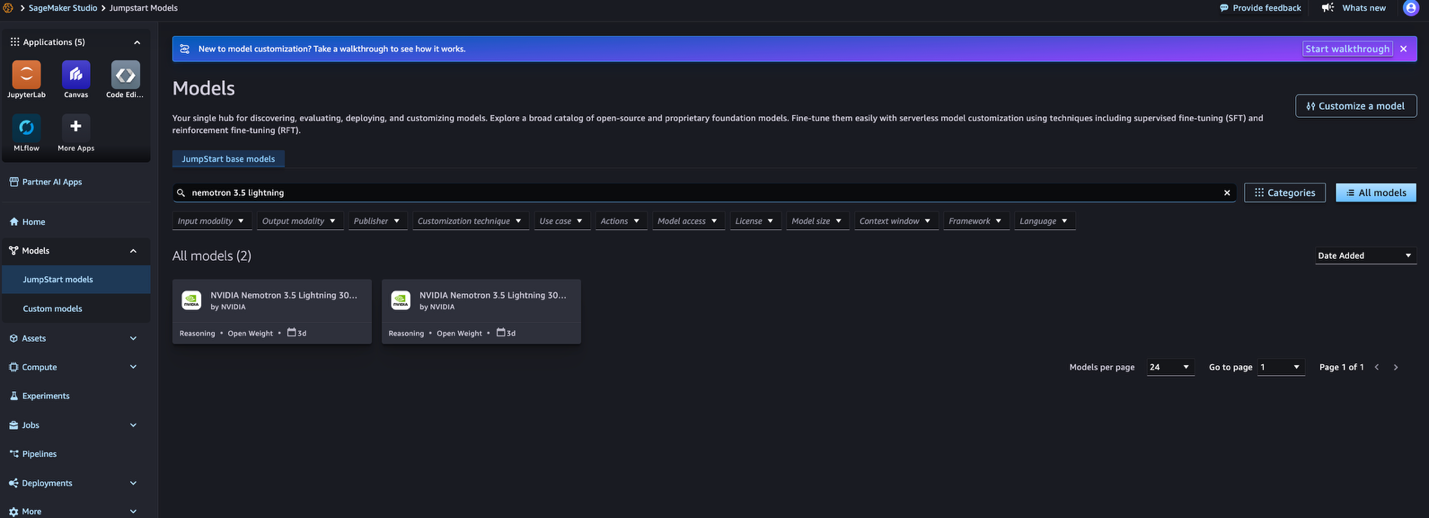
NVIDIA Nemotron 3.5 Lightning now available in Amazon Sage Maker Jump Start
NVIDIA Nemotron 3.5 Lightning, an open model built for high-volume agentic workloads, is now available in Amazon SageMaker JumpStart. This post shows how to deploy the 30B Mixture-of-Experts model (3B active), which delivers up to 4x higher throughput and up to 30% faster task completion for always-on agents.
On the CUBE Pod: AI bubble debate heats up and neocloud earnings challenge doubters
The debate over whether we are in an artificial intelligence bubble took a new turn this week. Despite the ballooning AI spending, Dave Vellante (pictured, right), chief analyst for theCUBE Research, contends that any bursting point may be far off. Now that Nvidia Corp. Chief Executive Jensen Huang, has committed $500 billion to establish independent […] The post On theCUBE Pod: AI bubble debate heats up and neocloud earnings challenge doubters appeared first on SiliconANGLE.
“Open weights are nowhere near a sufficient solution”: Dario Amodei fires back on AI power
The independence developers gain from open weights comes with a hard infrastructure ceiling, according to Anthropic CEO Dario Amodei. “AI The post “Open weights are nowhere near a sufficient solution”: Dario Amodei fires back on AI power appeared first on The New Stack.
Groq raises $350 M to fuel its pivot from AI chips to neocloud
Groq raised $350 million at a $3.5 billion valuation as the former AI chipmaker pivots to a neocloud business and expands its Nvidia-powered data center footprint.
Open AI signs record Ohio data center lease with Nvidia backing up to $105 billion
OpenAI has signed a 20-year lease for an 8-gigawatt data center in Ohio. Nvidia is guaranteeing up to $105 billion for the residual value of the facilities and becomes the exclusive chip supplier. According to the Wall Street Journal, nine tech companies now hold around $3 trillion in AI commitments that don't appear on any balance sheet. The article OpenAI signs record Ohio data center lease with Nvidia backing up to $105 billion appeared first on The Decoder.
The impact of AI on software development has been both profound and ever-evolving. Last year, I wrote about AMD’s plans to use AI not just for generating new lines of code, but also for other steps in the software development lifecycle (SDLC), such as triaging problems, debugging code, and testing the software. At the time, we were hoping for a 25 percent productivity boost from AI use over the course of two or three years.But with each new release, the capabilities of Large Language Models (LLMs) improve dramatically—accelerating software development, increasing the quality of AI-generated code, and fundamentally reshaping how software is engineered. Now, just one year later, we have surpassed our productivity target, achieving a 30 percent overall productivity boost through AI. On top of that, we are rethinking not only how we use AI within the SDLC, but the structure of the SDLC itself.We believe that the biggest AI revolution in software engineering is still ahead. So far, we have largely been teaching AI how we perform tasks and asking it to mimic existing workflows. In many ways, this constrains AI to human patterns of thinking. The next transformation will come from collaborative swarms of AI agents capable of discovering solutions independently.Agents of todayAMD began developing AI systems for code generation, testing automation, bug analysis, and code review in 2024. At the time, our objective was to achieve 25 percent AI-generated production code by 2027 while gradually automating larger portions of the SDLC.Measuring productivity is inherently challenging, but from the outset we have consistently tracked one objective metric: the percentage of source code generated by AI. Importantly, we count only code that passes all reviews and testing and is ultimately included in the final product. While AI-generated code is certainly not the only contributor to productivity gains, it is one of the few metrics that can be measured objectively and consistently.By this metric, we have crossed the 20 percent mark at the beginning of this year and are now progressing toward 50 percent across entire codebase. In some software components, more than 80 percent of the code is now generated using AI.Agentic AI has enabled us to include AI in every step of the lifecycle: For code analysis and triage, agents are trained to analyze problem reports, identify and group similar requests, and highlight which code snippets are likely to need modification. For debugging and code generation, agents are directed to analyze a bug request and implement required code changes. For testing, the agents generate unit tests, and if those are passed, identify necessary integration and product-level tests. And finally, for the approval and release stage, agents prepare architecture summary, code change review and full test results for engineers’ review and approval and if approved, integrate the changes into the next release.Agents of tomorrowToday, engineers create AI agents in their own image: they teach AI what they know about the system, how they would fix an issue, and how they would implement a change. This is already a major technological advancement. Engineers can create multiple “AI versions” of themselves, allowing these agents to work in parallel, scaling their expertise far beyond the limits of individual productivity. The limitation, however, is that these AI agents are still constrained by human thinking and human-defined approaches. AMDWe believe the next major transformation in software engineering will occur when collaborative AI agent swarms can independently identify and develop solutions, guided by humans on what to solve rather than constrained by human assumptions about how the job should be done. Instead of providing detailed instructions on how to solve a problem, engineers will define the issue, the desired outcome and the quality, performance, and system constraints allowing AI agents to determine the optimal path to a solution.A swarm of AI agents will then work in parallel to generate, evaluate, and refine multiple solution approaches. These agents will automatically validate correctness, measure performance, test trade-offs, and compare alternative implementations against defined success criteria. Finally, AI agents will prepare ranked solution options, along with validation results and performance metrics, for engineer review and approval. The agents won’t be enhancing each step of the SDLC—they will be rewriting the SLDC themselves.To get to this point, we need to change how agents are trained. Today, improvement occurs one engineer and one agent at a time: an engineer reviews the output, refines the prompt, and repeats the process. To scale beyond this model, agents must continuously learn from one another, reuse successful strategies, and improve collaboratively across projects and teams.We are already moving in this direction by using multi-agent workflows extensively through agentic harnesses, such as Codex and Claude Code, while simultaneously developing our own internal multi-agent systems to support the next generation of AI-driven software engineering.A good example is our AI-driven effort to resolve issues in our Radeon Software eXperience (RSX). RSX is a user interface component that allows users to configure and monitor graphics driver behavior. In October 2025, we began using AI agents to automatically debug and fix reported RSX issues. Out-of-the-box AI tools delivered limited results, resolving only 6% of issues. The percentage of software issues fixed automatically by AI agents in AMD’s Radeon Software eXperience (RSX) has been growing steadily, reaching 75 percent in June 2026. As we analyzed failures and identified ways to improve, we built a learning loop—initially a largely manual process—to understand where the agents were falling short and how to improve them. Rather than retraining the underlying models, we refined the objectives given to the agents, allowing them to iteratively explore multiple approaches, evaluate the results against defined success criteria, and converge on better solutions. At the same time, advances in models and agent runtimes further increased effectiveness. Together, these improvements significantly increased our resolution rate from 6 percent to more than 75 percent of RSX issues resolved by agentic loop.To make agents and agent swarms truly productive, we need a continuous learning loop that feeds errors and human interventions back into future agent workflows. The opportunity is to engineer this loop around clear, measurable goals. Each cycle captures new insights, making the entire AI engineering workflow smarter and more effective. Over time, this self-reinforcing loop—not just the underlying model—will become a key driver of AI progress.The evolving role of human engineersAt AMD, we view AI as a means of increasing productivity, improving quality, and enabling employees to focus on higher-value work. Our goal is to empower our workforce with AI, not to reduce headcount.To support this transformation, we are investing heavily in AI education and training across the company. The way we work is evolving rapidly, and we want every AMD employee to be prepared to leverage AI confidently, responsibly, and effectively.As AI agents continue to improve, engineers will spend less time manually implementing solutions, focusing more on defining specifications, validating outcomes, and making the strategic decisions that drive innovation.
Anthropic watermarks Claude's output, but critics question the tradeoffs
Anthropic's text watermarking for Claude is supposed to make AI-generated content detectable. But critics doubt that word choice stays unaffected, and lawyers are facing new transparency headaches. The article Anthropic watermarks Claude's output, but critics question the tradeoffs appeared first on The Decoder.
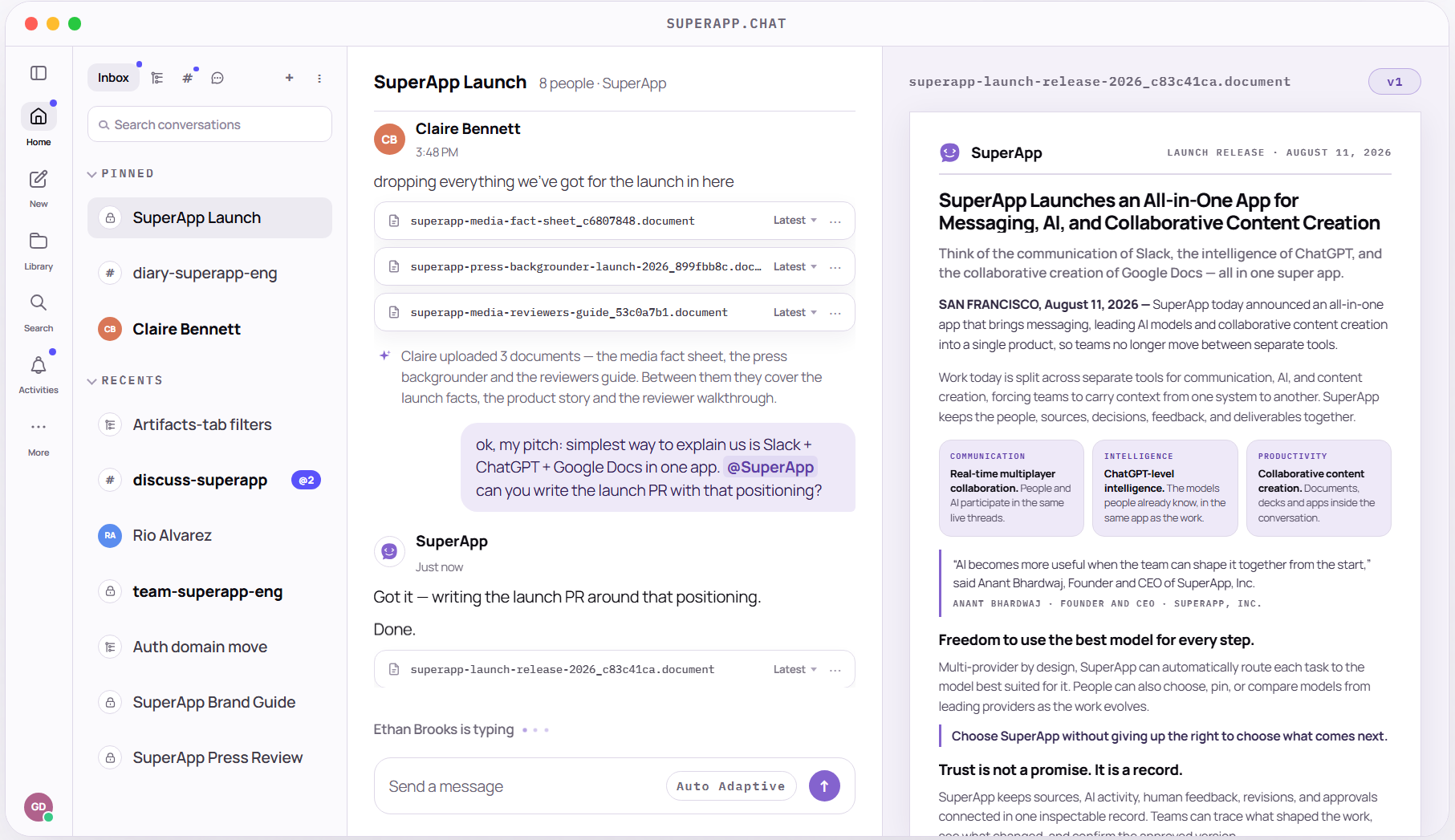
Super App launches a shared space with AI models for teams to collaborate on work
SuperApp Inc., formerly Instabase Inc., today announced the launch of its flagship product of the same name and its transition from Instabase to the new name. The new platform provides teams with a Slack-like communication interface on the web, iOS, Android and Windows, with a document library similar to Google Docs and deep access to […] The post SuperApp launches a shared space with AI models for teams to collaborate on work appeared first on SiliconANGLE.
Do AI chatbots find what experts would? Effects of model, user role, and sample size on study retrieval for medical questions
arXiv:2608.13786v1 Announce Type: new Abstract: Large language model (LLM) chatbots are increasingly used to answer clinical questions with citations to relevant clinical studies. Prior research has largely focused on citation fabrication, leaving a gap in evaluating the quality of retrieved studies and the factors driving their selection. In this study, we evaluated three general-purpose LLM chatbots: Claude Sonnet 5, Gemini 3.1 Pro, and ChatGPT GPT-5.5. We prompted the models with clinical questions adapted from 20 review questions in Issues 6 and 7 of the 2026 Cochrane Database of Systematic Reviews, simulating patient, clinician, and evidence-synthesis researcher roles. Each chatbot was queried under each user role with four independent repetitions, yielding 720 responses. Each chatbot was asked to support its answers with primary clinical citations, which we benchmarked against the included and excluded study sets of the Cochrane reviews. On average, a chatbot response retrieved 39.2% $\pm$ 29.8% of Cochrane included studies, while citing 5.0% $\pm$ 9.4% of excluded studies. Recall of Cochrane included studies varied significantly by model and user role. ChatGPT achieved higher recall than Claude or Gemini (63.1% $\pm$ 29.5% vs. 37.0% $\pm$ 23.8% vs. 17.3% $\pm$ 13.1%; $p=2.0\times10^{-5}$). The researcher role yielded higher recall than the clinician or patient roles (42.8% $\pm$ 30.8% vs. 38.6% $\pm$ 28.9% vs. 36.1% $\pm$ 29.3%; $p=2.0\times10^{-5}$). Controlling for publication year, citations per year, and open-access status, sample size was the only independently significant predictor of retrieval (odds ratio 1.80 per 1-unit increase in log sample size, 95% CI 1.37-2.36, $p=2.34\times10^{-5}$). These findings suggest that while LLM chatbots can retrieve some studies identified by expert reviewers, their performance varies by model and user role, and they exhibit a bias toward clinical trials with larger sample sizes.
Agentic Transaction: Towards ACID-Compliant Agent Systems
arXiv:2608.13900v1 Announce Type: new Abstract: Large language model (LLM) agents are evolving from conversational assistants into autonomous systems that execute long-horizon tasks through reasoning, tool use, code generation, and workspace manipulation. As agents increasingly operate over persistent environments and multi-step workflows, they face challenges analogous to those addressed by transactional database systems: reliable execution, consistent outcomes, safe concurrency, and durable state management. We introduce the concept of an agentic transaction and propose an ACID-compliant agent system framework that reinterprets the classical ACID properties for agent execution through four semantic guarantees: Semantic Atomicity, Semantic Consistency, Semantic Isolation, and Semantic Durability. Together, these properties provide a principled foundation for building reliable agent systems despite model uncertainty and dynamic execution environments. To instantiate this framework, we develop an ACID-compliant data agent that realizes these guarantees through transactional exploration-execution-validation cycles, transactional skill hubs, confidence divergence-based validation, semantic dependency-aware isolation, and transaction-aware semantic state management. Experimental results on widely used benchmarks show that our system achieves a 10.6% improvement over state-of-the-art agents, including Claude Code. This work opens a broader research agenda on extending transactional principles and system architectures toward building trustworthy, scalable, and self-evolving AI agent systems.
From BERT to Frontier Agents: Eight Years of Language-Model Progress, the Collapse of the Capability-Cost Curve, and the Rise of Task-Targeted Models
arXiv:2608.13675v1 Announce Type: new Abstract: Between October 2018 and July 2026 AI models progressed from simple systems like BERT to massive agents that solve complex math and write software. The ability to resolve real coding issues improved by nearly six times per year since late 2024. During this time costs dropped sharply with OpenAIs budget model GPT 5 point 6 Luna matching flagship capabilities for just one to six dollars per million tokens beating older versions at a fraction of the price. Top performance is now split across specialized models as Claude Opus 5 leads in frontend coding Claude Fable 5 excels at repository level coding and GPT 5 point 6 Sol dominates terminal tasks. In a grade school math test using the Qwen 2 point 5 model basic methods solved 58 of 100 problems while advanced sampling solved up to 79. A confidence ranking tool correctly identified 47 right answers in its top 50 choices proving highly useful for sorting tasks with all research materials made fully public.
OpenAI funds 14 independent projects exploring new AI policy ideas to expand economic opportunity and strengthen societal resilience in the Intelligence Age.