All the questions Nvidia should answer on Tuesday — but probably won’t
Nvidia interim CEO and long-time CFO Colette Kress is about to have one of the biggest days of her career on Tuesday when the company reports its third quarter results. Given the turmoil Nvidia is in, there are a number of questions that Nvidia should answer.
Nvidia Short Sellers Reap $24 Billion as Stock Extends Slide
Nvidia Corp.’s tumble in the wake of the scandal that led to former Chief Executive Officer Jensen Huang’s ouster has fueled tens of billions of dollars in gains for short sellers.
Security patches are supposed to protect you. Google found AI agents turning them into exploits.
Google’s Threat Intelligence Group says attackers are using autonomous AI agents to reverse-engineer security patches, generate exploits, and attempt to The post Security patches are supposed to protect you. Google found AI agents turning them into exploits. appeared first on The New Stack.
Analyze Anthropic usage, spend, and access with AWS Glue, Amazon S3 Tables, and AWS Quick
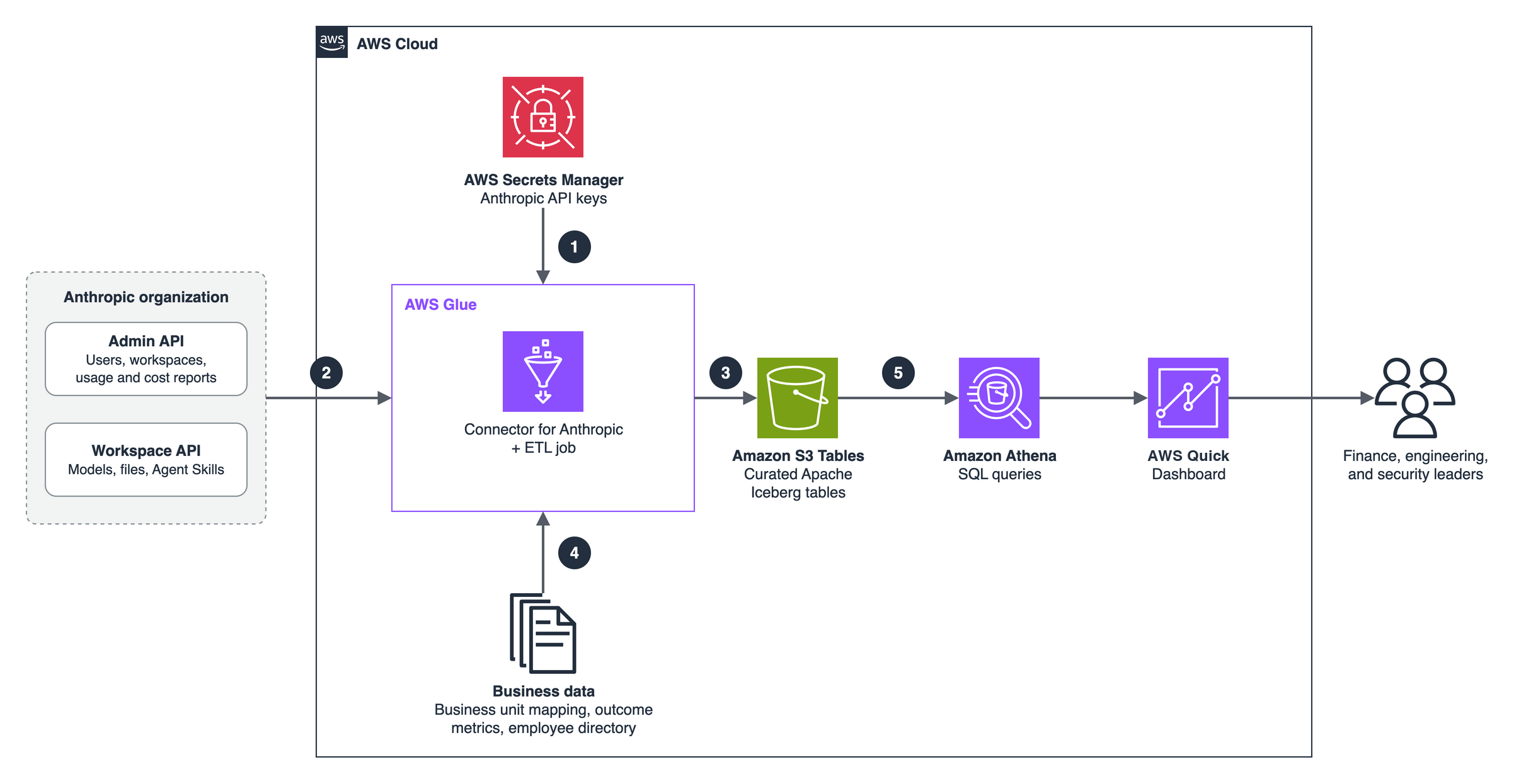
The new AWS Glue connector for Anthropic reads Claude usage, cost, and API key data into AWS without custom code. This post shows how to land it in Amazon S3 Tables as Apache Iceberg tables, join it with your business data, query it with Amazon Athena, and visualize AI spend and governance in AWS Quick.
Google warns that fully automated cyberattacks have arrived and will get worse fast
Google's Threat Intelligence Group has for the first time caught attackers finding and exploiting security vulnerabilities with no human involvement at all. An AI framework called "exploit_agent," found on an exposed server, automatically compared code before and after patches, built exploits, and ran them on its own. The article Google warns that fully automated cyberattacks have arrived and will get worse fast appeared first on The Decoder.
Nvidia is about to report earnings without Jensen Huang at the helm of the chipmaker. Colette Kress, the interim CEO will lead the call and certainly face questions about what direction she is taking the company in and how she will handle political and litigation risks. Bloomberg's Ed Ludlow reports. (Source: Bloomberg)
OpenAI's GPT-6 Astra tackles the Standard Model's toughest math problem on a lattice
OpenAI physicist Nathaniel Craig used GPT-6 Astra to tackle a problem that had stumped particle physicists for over 25 years. The AI model took Craig's strategy for defining the full Standard Model on a computational lattice and turned it into a working proof. Craig says a lot of work remains before realistic simulations are possible. The article OpenAI's GPT-6 Astra tackles the Standard Model's toughest math problem on a lattice appeared first on The Decoder.
Putin-Xi Meeting Unlikely to Bring Substantive Results for Trump, Says Jane Harman
Jane Harman, a former ranking Democrat on the House Intelligence Committee, talked about the potential national security risks from the Nvidia scandal, Trump’s upcoming meetings in Asia and the Senate Democratic leadership battle. Harman said that potential meetings between President Trump, Xi Jinping and Putin in China are unlikely to provide any substantive results other than a 'good photo op.' On the fight for Senate leadership between Chuck Schumer and Chris Van Hollen, Harman said that no matter the leader, Democrats should take seriously voters' calls for change. (Source: Bloomberg)
Tusk: Jensen Huang Should Not Return as Nvidia CEO
Tusk Ventures co-founder Bradley Tusk says Congress should examine the relationships between Nvidia’s former leadership and the Trump administration as questions remain over China, chip exports and national security. He discusses why he believes Jensen Huang should not return as CEO, what tighter US export controls could mean for Nvidia and the broader startup ecosystem, and why Silicon Valley’s reliance on high-profile founders and CEOs deserves more scrutiny as Anthropic prepares to go public. He joins Ed Ludlow on "Bloomberg Tech." (Source: Bloomberg)
Nvidia Fallout Adds New Tension to US-China AI Race
The US-China technology rivalry is in focus as President Trump travels to China for talks with Xi Jinping, with AI chips, export controls and rare earths among the key issues shaping the relationship. Krach Institute for Tech Diplomacy CEO Michelle Giuda discusses why Nvidia remains critical to US technological leadership and the importance of tightening chip export controls. She joins Ed Ludlow on "Bloomberg Tech." (Source: Bloomberg)
I/O Fund CEO and lead tech analyst Beth Kindig says her long-term Nvidia bull case remains intact despite Jensen Huang’s departure, arguing the company could still reach a $20 trillion market value by 2030. She discusses why surging AI compute demand, Nvidia’s potential expansion into recurring software revenue and its lowest valuation multiple in years could support the stock - while AMD emerges as a more formidable competitor in rack-scale AI systems. She joins Ed Ludlow on "Bloomberg Tech." (Source: Bloomberg)
Nvidia’s Defining Week: CEO Search, Earnings and China
Bloomberg’s Ed Ludlow breaks down Nvidia's defining week as the chip giant searches for a new CEO while earnings loom. Plus, President Trump is set to meet with Xi and Putin in China, as AI chips, trade and the Nvidia fallout loom over the summit. And Anthropic prepares for a record-breaking IPO this week. (Source: Bloomberg)
Up till now the world has turned a blind eye to cronyism in the tech world. But it doesn’t have to anymore, and that’s why any efforts to restore Jensen Huang at Nvidia must be rejected, Bloomberg Opinion columnist Parmy Olson says. (Source: Bloomberg)
Sam Altman on Nvidia without Jensen Huang: the industry will be ‘fine’
OpenAI CEO Sam Altman acknowledged the special role Nvidia CEO Jensen Huang has played in the AI boom, but ultimately thinks the industry will be “fine” without him at the helm.
Altman Says AI Industry ‘Will Be Fine’ After Huang’s Ouster
OpenAI’s Sam Altman said he believes the artificial intelligence industry will weather the uncertainty prompted by the ousting of Nvidia Corp. Chief Executive Officer Jensen Huang last week.
Get a jump start on the US trading day with Dani Burger on "Bloomberg Open Interest." Two major tests for the AI trade: Nvidia faces life after Jensen Huang, while Anthropic’s blockbuster IPO reshapes Wall Street’s deal pipeline. Bank of America Brian Moynihan shares his thoughts on how the mega IPO is impacting the landscape. Plus, We talk to Anthropic founding investor Anjney Midha about why the US is falling behind when it comes to the AI buildout. (Source: Bloomberg)
OpenAI will embed safety research ers to investigate AI subversion
OpenAI will embed six Apollo Research evaluators to investigate whether its AI models engage in subversive behavior, but restrictions on access and disclosure raise questions about their independence.
AI Companies Develop Decision Models to Avoid Hallucinations
On 15 September, a startup called TypeSafe AI released a new AI model called Jev. The company’s broad, disruptive claims about Jev that turned heads: The company claimed that Jev, which it calls a “System One model” is cheaper, faster, and can’t hallucinate.TypeSafe AI’s marketing is an obvious shot across the bow of other AI companies and their large language models (LLMs), which, despite their capabilities in math and coding, are infamous for their cost and tendency to “hallucinate” factually incorrect replies. And the startup has certainly attracted both attention and investment. The company recently raised $870 million in funding at a valuation of $7.5 billion.But the most impressive metric of Jev’s success is arguably the many imitators it’s already spawned. Cloudflare, Amazon, OpenAI, and Microsoft quickly released “decision models” that imitate Jev’s capabilities. Start-ups, academic researchers, and independent enthusiasts have released dozens more.“I have to give Jev credit,” says Matt Mastracci, an independent developer who has trained and released several decision models including Djev, which Cloudflare cited as an inspiration for its own decision models. “It really brought decision models to the forefront. In six or seven weeks, we’ve seen dozens of models come out.”Jev’s Latency and Compute AdvantagesMost AI researchers would call Jev a decision model or decider model. TypeSafe AI’s branding of Jev as a System One model refers to a theory of cognition popularized by psychologist Daniel Kahneman in his book Thinking, Fast and Slow. In the book, Kahneman draws a line between fast, instinctive thought (System One) and slower, deliberate thought (System Two).TypeSafe AI argues that modern LLMs offer the second, but are too slow to provide the first. The company claims that Jev can provide end-to-end response latency between 70 and 500 milliseconds. By comparison, LLMs typically require at least several seconds, to provide a response, and more complicated tasks (like coding software from scratch) can take several hours.Independent testing backs up TypeSafe AI’s claims. A pre-print co-authored by Ramayya Krishnan, a professor of information systems at Carnegie Mellon University, along with several colleagues, found that Jev delivered a median latency of 150 milliseconds across several benchmarks designed to gauge decision accuracy, including RewardBench and JudgeBench. OpenAI’s most capable model at the time, GPT-6 Astra, delivered a median latency of 1.89 seconds.A faster reply is often a cheaper reply, because it requires less compute time, and that’s reflected in TypeSafe AI’s pricing. The startup charges US $0.042 per million input tokens and output tokens are free. By contrast, for GPT-6 Astra, ChatGPT charges $10 per million input tokens and $50 per million output tokens. Even GPT-6 Luna, a variant of GPT-6 designed for fast, inexpensive inference, costs $0.10 per million input tokens and $0.50 per million output tokens.Mastracci says that lower latency and costs open opportunities to tackle tasks LLMs currently can’t handle.“You can think of content moderation, such as moderating a fire hose of social media posts, or an extremely busy chat room.” Michelle Chen, a group product manager at Cloudflare (which has released its own decision models, including Clef and Claric), is also bullish on what decision models can accomplish. “You can probably offload 80 percent of your typical LLM tasks to a System One model that is going to be so much faster and so much cheaper.”TypeSafe AI has offered few details about how Jev achieves its speed, but Jev’s open-weights imitators provide more transparency.For example, take Cloudflare’s Clef, an open-weights decision model which is free to download on Hugging Face. “With an LLM, when you’re generating an output token, it looks at all the previous tokens, and predicts the next output token,” explains Chen. This occurs in sequence, token after token, until an end token is reached. “Our decision models don’t do that. They just do a single forward pass, to generate one read of all the inputs, and then generate one output. That’s why it’s a lot faster.”How Decision Models Generalize TasksDecision models based on an LLM, such as Clef (which is based on Alibaba’s Qwen LLM), still contain the neurons and transformer-based model architecture of an LLM. They still input and output tokens. However, the portions of the model that turn these tokens into text have been changed to constrain the output. “Jev can only answer questions with a predefined, structured answer format,” says Zhongyu Wei, a professor at Fudan University who is also a co-author of a study that benchmarks decision models and introduces an open-weight alternative, SII-Decision. “We give it a question and options such as A, B and C, and it must choose from those options, returning probabilities alongside its choice.”In one sense, decision models are a return to classifiers, a type of model that, as the name implies, learn to sort data into classes. They’re used in a wide range of tasks, including spam filters and face detection. “These kinds of models are not new,” says Chen. “It’s almost like a rebranding.”But decision models offer a key upgrade over prior classifiers: generalization.Mastracci explains that classifiers were traditionally created through domain-specific training. Decision models, though, retain the general intelligence of an LLM, and that makes them applicable to many situations. “You can pick it up off the shelf, you point it at your problem, and it works,” says Mastracci.Cloudflare is putting this advantage into practice. Before decision models, teams looking to use a classifier model had to “get a lot of data, stand up a machine learning team, and fine-tune” a model for the task, Chen says. Decision models eliminate this requirement, so one decision model can be used in many domains. Examples include flagging spam pull requests in Cloudflare’s GitHub documentation repository, catching spam and phishing emails, spotting phishing domains, detecting prompt-injection attacks on LLMs, and reading emails about internet backbone outages to judge whether they’ll affect Cloudflare’s services. Decision models are well suited for quick judgements on data like emails, messages, or documents.Source: TypeSafe AIDo Decision Models Really Stop Hallucinations?In programming, “type-safe” languages are designed so that operations mixing incompatible kinds of data—adding a number to a string, say—are rejected before the program runs rather than producing a bad result later. Decision models are similar in that they prevent the model from generating an unexpected reply. TypeSafe AI’s name makes the connection between type-safe programming and decision models part of the company’s marketing, and it builds on that to make a startling claim: Jev will never hallucinate.This is, strictly speaking, true. LLMs hallucinate because they calculate probabilities for tokens repeatedly across a huge vocabulary of possibilities and output many tokens. This leaves room for less probable tokens to lead a response astray, or for the model to deliver tokens that are probable based on the model’s training, but not correct in the context of the reply. Decision models, by contrast, only calculate probabilities among the pre-determined possibilities, and the most probable is chosen. This eliminates hallucination.However, Carnegie Mellon’s Krishnan cautions that “eliminating hallucinations in the output does not eliminate errors in decision-making.” He and his co-authors tested Jev by asking it to determine if answers to questions were correct. Jev performed well when the judgment could be easily reached by reading the prompt, but performance dropped off when the judgment required math or involved a logic puzzle.Wei and his co-authors report similar results in their own research. They found the best decision models can slightly beat the accuracy of LLMs when asked questions about document understanding, and score close to LLMs when asked questions related to tool use (such as choosing the correct software tool to call to perform a user’s task). However, decision models fall behind when asked questions in domains that require topic expertise, including medicine, finance, and law.“I think reasoning is a key factor,” says Wei. Reasoning allows an LLM to work though its response before it provides a final answer to the user. However, Wei adds that reasoning alone doesn’t explain the domain gaps in all cases, as some LLMs performed well even without reasoning. Wei says the methods used to train decision models can also be a factor, and used decision-specific training for SII-Decision.Yet decision models and LLMs don’t have to be competitors. Krishnan and his colleagues also tested passing Jev’s low-confidence answers to GPT-6 for additional consideration. The combination of models slightly beat the accuracy of GPT-6 alone, and did so at 41 percent of the cost. Wei thinks this “hybrid architecture” will become common. “The decision model can call an LLM to give a more detailed explanation. And an LLM can call a decision model for a quick judgment. I think that’s very flexible.”
Beyond the compute bottleneck: Maximizing the ROI of AI accelerators with purpose-built storage
There’s a lot more to AI infrastructure than just buying accelerators. Indeed, the infrastructure mandate for enterprise AI has shifted from acquiring accelerators to keeping them fully utilized. Next to these expensive accelerators, storage accounts for only a small sliver of total AI spend. However, having the wrong storage in place can put the rest of your committed compute capital at risk. To optimize your accelerators’ TCO, you need to keep them fully occupied. Very often, the challenge here is data I/O. If accelerators sit waiting to read or write data, you’re wasting money. Across the industry, insufficient storage throughput has become a primary impediment to AI success, starving models of the data they need. And the problem is only going to get worse. Gartner predicts enterprises will deploy over 150,000 agents in the next few years, so the I/O bottleneck and the challenge of orchestrating storage for agentic fleets will only compound. Organizations are eager to move their AI initiatives forward, but preventing idle compute requires a purpose-built approach to data I/O. With the demands of AI, standard enterprise storage — even a system optimized for fast analytics — will inevitably suffer from bottlenecks that leave compute resources twiddling their proverbial thumbs. AI is not a monolithic workload The most common architectural misstep we see is treating AI as a single, general-purpose workload. In reality, the physical movement of data transforms across the AI lifecycle, creating distinct I/O profiles based on how models consume and generate information: In model training, clusters read datasets at high throughput, but pause regularly to write checkpoints to record their state in event of a failure. When thousands of GPUs attempt to save this data in a single, simultaneous burst, standard storage architectures stall. That’s especially true of traditional cloud storage, which is engineered for durability. Writing checkpoints triggers thousands of administrative database transactions to safely record the files, bogging down the system, choking the network, and freezing the entire GPU cluster until the save is complete. Furthermore, saving the data is only one of the problems: If a server fails, slow storage turns a routine checkpoint recovery into a multi-hour delay, leaving expensive accelerators sitting completely idle. Inference, conversely, is real-time and latency-sensitive. As AI services scale to meet user demand, inference clusters constantly load and unload petabyte-scale model repositories quickly. In this case, a slow storage system can leave GPUs in a “cold start” as they wait for data. Also, many models now process context windows that exceed 100,000 tokens, filling up accelerator memory. Without a high-speed external cache to offload this context, when a user asks the next question, the accelerator must recalculate previous inputs, wasting compute on redundant operations. Industry-leading performance across object and file storage To solve these I/O challenges and keep expensive accelerators busy, organizations need compute, networking, and storage to be deeply integrated. As industry analysts have noted, enterprise customers gain a unique performance advantage because Google Cloud runs on the exact same storage foundation as Google's own consumer products. This foundation is built on Colossus—the planet-scale distributed file system powering Google Search, YouTube, and Gemini. Because this shared infrastructure supports billions of users daily, its reliability is continuously proven against the extreme traffic and hardware demands of Google's global consumer services. As a result, today, nine out of the world’s ten leading AI frontier model labs run on Google Cloud infrastructure because we deliver the throughput and performance they require to innovate. In fact, we spent the last two years co-designing our storage architecture directly with these frontier labs as well as with Google's own foundation model teams. For large-scale training on object storage, our architecture ensures workloads don’t have to wait on data, and successfully absorbs peak bandwidth demands. For real-time inference, enterprise platform companies like Salesforce AI Research leverage our architecture to serve complex agentic inference workloads with up to 40% fewer GPUs. We deliver these outcomes through two distinct, purpose-built storage solutions: Cloud Storage Rapid: For organizations that have standardized on cloud-native object storage, Cloud Storage Rapid provides Colossus scale and performance directly to accelerators, so they can use the data stored on object storage in their AI workflows. This eliminates the need to migrate data into separate, specialized storage silos to achieve the performance that AI workloads require. A single Rapid bucket pushes the boundaries of object storage, delivering up to 15 TB/s of throughput and 20 million queries per second with sub-millisecond latency. This makes it a strong fit for streaming large training datasets and recovering checkpoints without bottlenecking the network. For bursty workloads such as model loading across multiple locations, Rapid Cache acts as a read accelerator that co-locates active data directly with TPU and GPU clusters. With no code changes, Rapid Cache delivers up to 2.5 TB/s of aggregate read throughput, taking idle cold-start times from hours to minutes. Google Cloud Managed Lustre: For demanding AI and HPC workloads that need a parallel file system, there’s Google Cloud Managed Lustre. Built in partnership with DDN, Managed Lustre provides up to 10 TB/s of throughput per instance, absorbing the intense read-write bursts of synchronous checkpointing and reinforcement learning, so that your expensive accelerators remain fully saturated.To help organizations scale their workloads without breaking budgets, Managed Lustre’s new Dynamic Tier delivers more Lustre for less by consolidating hot and cold data into a single namespace, eliminating traditional caching performance cliffs. Finally, Managed Lustre Cloud Storage Mirror reduces the downtime and operational friction inherent in manual data transfers. Instead of you having to write custom scripts that leave expensive compute clusters waiting on files, it automatically synchronizes datasets in the background so they are ready before training begins. Proven in production at scale This purpose-built storage foundation is already powering customers’ most demanding AI workloads, helping them extract maximum return on investment from their compute resources. Thinking Machines Lab utilizes Cloud Storage Rapid Cache to stabilize read throughput peaks above 1.8 TB/s and achieve an 89% cache hit ratio, completely eradicating rate-limiting surge errors across their multi-region architecture. Shopify deployed 50+ unique Rapid Caches across their worldwide footprint, achieving over 2 TB/s peak throughput and up to a 90% latency reduction from their baseline to meet the data demands of their growing compute scale. Salesforce AI Research uses Managed Lustre as a high-throughput, low-latency external cache to keep their GPUs fully saturated, driving substantial performance gains for LLM inference over previous hardware generations. Atlassian adopted Managed Lustre on Google Kubernetes Engine (GKE) to turn preemption interruptions into quick five-minute restores, delivering nearly 5x higher throughput and boosting their GPU utilization by 70% compared to NVMe-based systems. Harmonic relies on Managed Lustre to train mathematical reasoning models, eliminating 50% of experiment interruptions, cutting startup times in half, and increasing data retrieval speeds by 15x. The path forward When advising AI Infrastructure teams designing their stack today, our guidance is straightforward. First, evaluate your token economics rather than just legacy storage metrics. If your chips are waiting on data, optimizing storage is a cost-effective and efficient remedy. Second, avoid creating separate copies of data for every new workload; keep your primary data in a unified foundation and move it to the right tier as needed. Finally, while AI performance grabs the headlines, you can’t create your AI strategy on infrastructure built for a different era. At the same time, AI infrastructure needs enterprise-grade reliability, built-in security, and automated cost discipline for optimized TCO. The future of enterprise AI belongs to organizations that can turn their data into action. Google Cloud enables you to match the speed of your storage to the speed of your compute, so that you maximize your compute investments.