Ads in Chatbots Have Arrived. Here’s What’s Working—and What’s Not
As Anthropic maintains its vow to keep ads out of Claude, the rest of the AI chatbot industry is racing to win over advertisers without antagonizing users.
Nvidia Plunges 9% as AI Selloff Wipes Out $2.3 Trillion | Closing Bell
Comprehensive cross-platform coverage of the U.S. market close on Bloomberg Television, Bloomberg Radio, and YouTube with Romaine Bostick, Kailey Leinz, Carol Massar and Tim Stenovec. (Source: Bloomberg)
OpenAIs GPT-6 Cyber can both break into systems and propose how to fix them
With GPT-6 Cyber, OpenAI is introducing an AI model built to find security vulnerabilities in software, develop exploits, and suggest patches. According to OpenAI, it has already found 81 previously unknown vulnerabilities in Firefox and developed 948 working exploits in the Linux kernel, significantly more than its predecessor. The article OpenAIs GPT-6 Cyber can both break into systems and propose how to fix them appeared first on The Decoder.
OpenAI Sued Over Claim ChatGPT Drafted Lethal Poisoning Plan
James Gates says he started to suspect his wife was trying to poison him after he found a handwritten note with a list of substances and dosage plans, some of which were labeled “lethal.”
Meta says US users can now video chat with their Muse AI avatar
Meta's AI agent can now take calls as a customizable animated avatar, ahead of the launch of a Tamagotchi-like wearable designed to bring Muse to life.
Meta warns that election backlash against data centers could make AI expansion harder
Meta warns that growing political opposition to data centers could threaten future AI investments, as communities push back against massive infrastructure projects.
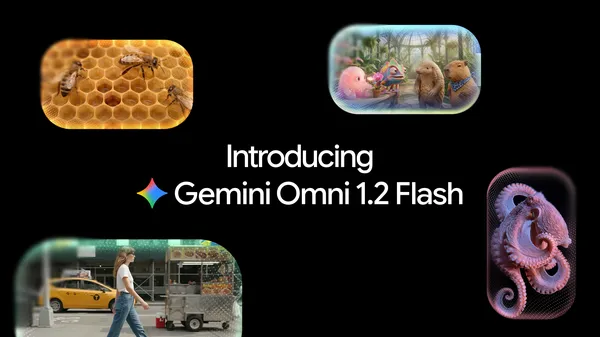
Google's Gemini Omni 1.2 Flash stretches AI video clips to 15 seconds and cuts pricing by 30 percent
Google Deepmind is making Gemini Omni 1.2 Flash generally available. The video-generation model now creates clips up to 15 seconds long, can be edited step by step via conversation, and costs just $0.07 per second at 720p, 30 percent less than its predecessor. Users who draft in low resolution and upscale only the final result can save even more. The article Google's Gemini Omni 1.2 Flash stretches AI video clips to 15 seconds and cuts pricing by 30 percent appeared first on The Decoder.
Google Plans to Spend $17 Billion on Wyoming Data Center
Alphabet Inc.’s Google will spend $17 billion to build a data center in Wyoming, formally putting a price tag on the proposal two days after voters across the US delivered a broad rebuke to the development of such massive projects for artificial intelligence work.
OpenAI’s new GPT-6 Cyber is better at hacking and better at staying in its lane
OpenAI on Thursday launched GPT-6 Cyber, the latest release in its series of cybersecurity-focused models. The company ranks GPT-6 Cyber’s ability The post OpenAI’s new GPT-6 Cyber is better at hacking and better at staying in its lane appeared first on The New Stack.
OpenAI president Greg Brockman says company could be IPO ready in 2027
Speaking at a Wall Street Journal tech conference on Wednesday, the executive touted how the company had been gaining ground in the enterprise market, where rival Anthropic had already successfully made inroads.
Anthropic, Plaid Collaborate on AI Consumer Finance Guidance
Anthropic PBC is tapping the fintech Plaid and its vast network of consumer finance information to bring more tailored financial guidance to users of its Claude artificial intelligence model.
Get a jump start on the US trading day with Dani Burger on "Bloomberg Open Interest." The tech rout accelerates as the midterm fallout slams chipmakers and Nvidia tumbles. Plus, Forrester founder, chairman and CEO George Colony on AI’s next phase, why custom chips could challenge Nvidia, and why the biggest value may be shifting to software. (Source: Bloomberg)
Siri AI's Biggest Upgrade Yet + John Ternus's First Apple Earnings Call
Apple is finally bringing some of Siri's most ambitious AI capabilities to the iPhone. In this episode of Power On, Bloomberg's Mark Gurman and Vlad Savov break down the major changes coming with iOS 27.3, including Siri's new ability to control apps, carry out complex tasks and coordinate actions across multiple applications. They discuss how these improvements compare with AI agents from OpenAI and Meta, and why Apple still has a long way to go. Plus, Mark and Vlad analyze John Ternus's first earnings call as Apple's CEO, the company's strong iPhone sales, concerns about slowing growth and profit margins, and why more price increases could be coming. They also examine Apple's AI rollout in China and the privacy implications of new always-listening Apple Watch features. Have a question for Mark? Email us at poweron@bloomberg.net or join the Power On Discord Subscribe to the Power On Newsletter at https://www.bloomberg.com/poweron (Source: Bloomberg)
Configure, Certify, and Operate Kubernetes GPU Clusters with NVIDIA DSX OS
One underperforming GPU can slow an entire distributed training job. The node may pass basic health checks and show normal utilization, leaving operators to...
Building an agent skill optimizer with AlphaEvolve, Harbor and Gemini 4 Argon
Every day, more and more people are using coding agents like Google Antigravity and OpenCode to complete software engineering tasks. But those tools need instructions to operate and their output is only as good as the inputs they get. By utilizing agent skills that direct the agents through building, testing, and deploying code, developers have a powerful way to automate their workflows. But most skills are written manually, so it’s hard to know which instructions are effective without assessing their output. To measure the effectiveness of our skills, we ran OpenCode with Gemini 3.8 Flash on tasks from Terminal-Bench 2.0, a public benchmark. The results were inconclusive: with our baseline skill, the agent passed about two-thirds of its attempts, but the outcome was about the same even without the skill. We needed better results. To achieve them, we turned to AlphaEvolve, which optimizes skills the way it optimizes code: Gemini proposes a new version, an evaluator scores it, and the search retains the higher-scoring version. And with Harbor, that evaluator can be a real coding agent working on real tasks. We saw improvements of 5% with just a few iterations with alphaevolve This is how you can build the same loop: Treat the skill as the program: AlphaEvolve can rewrite your skill's text. Let the agent judge: Harbor runs the agent with the skill on real tasks. Make the score trustworthy: Compare each version to the baseline skill and run them both at the same time. Check the winner on unseen tasks: Save some tasks the search never sees for your final check. Treat the skill as the program AlphaEvolve is designed to advance the code between two markers in a seed program. Skills are SKILL.md files with names, descriptions, and markdown instructions, so we put their text between the markers and let Gemini rewrite them: code_block <ListValue: [StructValue([('code', 'def build_skill() -> tuple[str, str]:\r\n """Return the evolvable (description, body) pair for the skill."""\r\n # EVOLVE-BLOCK-START\r\n description = (\r\n "Solve engineering tasks in a Linux terminal: building and compiling "\r\n "software, fixing broken repositories and configuration, ..."\r\n )\r\n body = r"""# Terminal task solver\r\nYou are working in a Linux container. The task has a specific, checkable end\r\nstate, and an automated test suite will decide whether you achieved it. ...\r\n"""\r\n # EVOLVE-BLOCK-END\r\n return description, body'), ('language', ''), ('caption', <wagtail.rich_text.RichText object at 0x7fabd6f0e190>)])]> AlphaEvolve operates in Google Cloud and doesn’t run your code. Its feedback is the scores and notes your evaluator sends back about what "better" means. Image 1. AlphaEvolve proposes a skill, Harbor runs the agent with it next to the baseline skill, and the score and notes go back to AlphaEvolve. Let the agent judge Harbor runs agents on benchmark tasks, with each trial in its own container. We ran it on Google Kubernetes Engine (GKE) with one pod per trial, and a single search ran thousands of agent trials. For each candidate, the evaluator returns a score for passes and failures, as well as short notes on tasks that failed or timed-out. AlphaEvolve then sends those notes to Gemini for the next version. Make the score trustworthy Agent scores can be noisy. In one of our early runs on the same benchmark, our model’s latency explained much of the variance in candidate scores. With each candidate running next to the baseline skill on the same tasks at the same time, their scores are the difference. Check the winner on unseen tasks The best skills read differently than the baseline, which is a careful checklist: read first, reproduce the failure, and work in small verified steps. AlphaEvolve's version is a protocol built around the time limit: code_block <ListValue: [StructValue([('code', '## 2. Ship a Working Baseline to the Target Path Early\r\n(...)\r\n- Having a valid artifact on disk protects you from timeouts: if you refine or\r\n golf code (`gpt2.c`, `eigen.py`, `my_warrior.red`), keep the last passing\r\n version written to the target path at all times.\r\n\r\n\r\n(...)\r\n\r\n\r\n## 5. Hard Stop When Green\r\nThe moment `eval.py`, the test suite, or your acceptance check passes and the\r\nrequired files exist with exact formatting (...): **STOP IMMEDIATELY**. (...)'), ('language', ''), ('caption', <wagtail.rich_text.RichText object at 0x7fabd6d32450>)])]> What we learned AlphaEvolve focused on the most common failure: running out of time. About a third of the search's trials hit their time limit, as reported in the evaluator's notes, and AlphaEvolve's best skill is built around that limit. We also found that running the search is harder than building the loop. After about 10 hours, the search scored no new candidate; our latency check held back every evaluation while model responses were slow, and full agent logs filled the controller's disk. It’s important to plan for slow model windows and for log storage before a long search. In addition, skills paid off when they added what the agent lacks, as advised by the Agent Skills best practices. Our baseline skill made no measurable difference, while the skill holding the answers added 33 points on the dev tasks. Our hypothesis: today's models and coding agents are already tuned for coding work, so general advice has little left to add. If so, the room is in specifics, which a search can find: AlphaEvolve's best skill is built around the agent's most common failure, running out of time. What's next We’re testing AlphaEvolve on enterprise agent harnesses — system prompt, policy instructions, and tools — where the agent lacks business rules that a search can add. In one small study on customer service test cases for a fictional bank, AlphaEvolve found and fixed a wrong policy rule we had planted, and carried the fix over to cases it never saw. Other small studies were mixed, and we’ll share our final results when we’ve completed the full study. Get started AlphaEvolve on Google Cloud: the GitHub repository. Benchmark and harness: Terminal-Bench 2.0 and Harbor. Agent skills: the format at agentskills.io and the opencode skills docs. Thanks for reading! Tell us what your own tests show on LinkedIn or X.
Semantic aggregation over millions of rows in BigQuery with AI.AGG
For more than a decade, BigQuery has helped set standards for structured data aggregation, calculating financial sums, counting active users, and computing historical averages at a petabyte scale in seconds. But as modern enterprises become inundated with unstructured data — application logs, customer service transcripts, product imagery, and diagnostic reports — a critical gap has emerged. Historically, relational SQL engines have lacked the native ability to aggregate, synthesize, and extract overarching semantic themes from millions of rows of text and multimodal data. While BigQuery recently introduced powerful row-level AI functions (like AI.GENERATE and AI.CLASSIFY), analyzing massive datasets holistically presents a unique architectural challenge: the large language model (LLM) context window. Even with advanced foundation models like Gemini, you cannot pass millions of rows into a single prompt without triggering severe truncation or hard execution failures. Traditionally, solving this required data engineering teams to construct complex external map-reduce pipelines, manage rate-limiting backoffs, and recursively stitch chunked summaries together. Today, we are thrilled to deep-dive into AI.AGG — currently in preview — a fully managed, multi-level semantic aggregation function natively embedded within BigQuery GoogleSQL. By conceptualizing semantic aggregation as a distributed map-reduce problem, AI.AGG enables data teams to run natural-language instructions over millions of rows of data using a single SQL query. Here is a look under the hood at how it works, transformative enterprise use cases, and best practices for deploying it in production. Turning petabytes of data into semantic insights natively in BigQuery. Multi-level batching architecture AI.AGG abstracts the immense engineering complexity of chunking and parallel execution. When you execute an AI.AGG query, the BigQuery engine automatically orchestrates a sequence natively within the database: Row-level validation: The engine helps verify no single row exceeds the maximum context window (dropping or returning an error on payloads >10 MiB). Context-safe batching: The engine dynamically groups input rows into smaller batches that safely fit within the token limits of your chosen Gemini endpoint. Parallel inference: Your natural-language SQL prompt is applied to each batch in parallel, generating intermediate semantic summaries via Vertex AI. Recursive synthesis: Finally, the system batches these intermediate outputs together and passes them back to the LLM with the exact same instruction. This reduction repeats recursively until a single, final aggregated string is produced per SQL GROUP BY clause. Because AI.AGG requires deep reasoning to synthesize concepts across disparate batches, it relies entirely on full-weight LLMs for every stage of its pipeline — differentiating it from row-level functions like AI.CLASSIFY, which can leverage distilled CPU proxy models. Built for the multimodal enterprise AI.AGG natively supports both text and multimodal inputs. By leveraging BigQuery Object Tables and the OBJ.GET_ACCESS_URL function, analytics teams can aggregate visual insights across thousands of images stored directly in Cloud Storage with no data movement or transcoding required. Data engineering pro-tip: The NULL exclusivity rule When evaluating multiple columns, users often pass a STRUCT into the function. However, if even a single field within that composite structure evaluates to NULL, the entire row is treated as NULL and silently discarded. Always explicitly wrap nullable fields with IFNULL() (e.g., IFNULL(description, 'No data provided')) to help verify your data safely enters the pipeline. Transformative enterprise use cases The true analytical power of AI.AGG emerges when combined with standard SQL GROUP BY operations. 1. Diagnostic analysis of high-volume system logs System logs generated by globally distributed microservices often hide subtle degradations (like memory thrashing or systemic clock drift) that never throw explicit fatal errors. Using AI.AGG, DevOps teams can group millions of logs by system component and generate targeted, human-readable diagnostic summaries. Prompting Tip: Instruct the model to explicitly describe the "normal operation" of the component before hunting for anomalies. This helps suppress the LLM's tendency to hallucinate errors on completely healthy logs. 2. Building the "agentic data cloud" AI.AGG isn't just an analytical reporting tool; it’s a dynamic orchestration engine. Imagine acquiring a massive repository of legacy support tickets with no clear categorization. You can deploy AI.AGG to read the raw text, synthesize a definitive list of categories, and output them as a strict JSON array. By unpacking this array via JSON_VALUE_ARRAY and feeding those dynamic labels directly into row-level classifiers like AI.CLASSIFY, you can orchestrate an end-to-end, autonomous data labeling pipeline natively in SQL — reducing the need for external Python scripts. Prompt engineering is data engineering When integrating generative models into highly deterministic SQL pipelines, standard conversational prompts will often fail. Prompting for programmatic SQL outputs is a strict engineering discipline: Explicit output contracts: Treat the prompt as an API contract. Append commands like: "Return exactly one valid JSON array of strings. Do not include markdown code blocks or conversational text." Contextual delimiters: Use string concatenation with explicit labels (e.g., '- Description: ') to anchor the LLM and prevent it from conflating fields across dense batches. Failure state design: Explicitly instruct the model to return strict null values for missing information rather than guessing, preventing schema hallucinations downstream. Few-shot anchoring: Provide a literal example of your expected structure within the prompt to heavily ground the model's attention mechanism. Governance, cost management, and guardrails Transitioning semantic workloads to production requires operational oversight. Because of the recursive batching architecture, the total tokens sent to Gemini will be greater than the token count of your source data. To mitigate costs, mandate strict WHERE and LIMIT pre-filtering. Furthermore, for workflows cross-referencing massive, static datasets, BigQuery supports Gemini Context Caching, which can reduce input token costs and execution latency. Use the AI.COUNT_TOKENS utility to estimate query costs prior to execution. Administrators can operate knowing AI.AGG works strictly within BigQuery's governance framework, supporting VPC Service Controls (VPC-SC) to prevent data exfiltration. Furthermore, if a transient error occurs during a batch process, the function degrades gracefully — skipping the rejected rows rather than crashing the entire query. Preview guardrails to keep in mind: The final output string per SQL group is strictly capped at 10,000 tokens per group. Ask the model for concise output Individual payload rows must not exceed 10 MiB. When processing multimodal arrays, limit image assets to fewer than 10 images per row to avoid silent skipping. For optimal stability, we recommend processing a maximum of 20 million rows and outputting a maximum of 1,000 distinct SQL groups per query. Putting AI.AGG into practice To help you get started, here are examples of how AI.AGG is used to synthesize insights alongside traditional SQL metrics. Macro-level topic discovery Summarize what specific top authors talk about, turning thousands of their comments into a concise narrative code_block <ListValue: [StructValue([('code', "WITH top_commenters AS (\r\n SELECT\r\n `by` AS author,\r\n `text`\r\n FROM `bigquery-public-data.hacker_news.full`\r\n WHERE `type` = 'comment'\r\n AND `by` IN ('dang', 'patio11', 'tptacek')\r\n LIMIT 5000\r\n)\r\nSELECT\r\n author,\r\n AI.AGG(\r\n `text`,\r\n 'These are comments written by this user on a tech forum. Tell me what topics this user talks about the most and what their general tone is. Keep it concise.'\r\n ) AS author_persona\r\nFROM top_commenters\r\nGROUP BY author;"), ('language', ''), ('caption', <wagtail.rich_text.RichText object at 0x7fabd78c4ad0>)])]> Autonomous diagnostic reporting for DevOps (log analysis) Instead of counting standard HTTP error codes, use AI.AGG to read thousands of raw stack traces and log messages, grouping them by the microservice name to find the qualitative root cause of systemic failures. code_block <ListValue: [StructValue([('code', "SELECT \r\n service_name,\r\n COUNT(*) AS total_errors,\r\n AI.AGG(\r\n STRUCT(error_code, log_message, stack_trace), \r\n 'Analyze these error logs and stack traces. Provide a concise, two-sentence summary of the primary root cause or pattern causing failures in this service.'\r\n ) AS diagnostic_summary \r\nFROM `my_project.ops_logs.application_errors` \r\nWHERE severity = 'CRITICAL' AND timestamp >= TIMESTAMP_SUB(CURRENT_TIMESTAMP(), INTERVAL 24 HOUR)\r\nGROUP BY service_name \r\nORDER BY total_errors DESC;"), ('language', ''), ('caption', <wagtail.rich_text.RichText object at 0x7fabd7dfd010>)])]> The next era of the data warehouse With AI.AGG, Google Cloud is democratizing access to semantic analysis at petabyte scale. By marrying the deterministic grouping power of BigQuery’s relational engine with the macroscopic reasoning capabilities of Vertex AI Gemini, we are transforming the enterprise data warehouse from a passive repository of historical metrics into an active, semantic runtime capable of deep, holistic intelligence. Ready to unlock the semantic value of your enterprise data? Head over to the Google Cloud console, explore the BigQuery documentation, and run your first semantic aggregation today.
Gemini Omni 1.2 Flash: Fast, cost-effective, and reliable video generation and editing now generally available
Today, Gemini Omni 1.2 Flash is generally available on Google Cloud. Built for the everyday videos businesses make in volume — like product videos, virtual try-ons, and ads — this model is fast, cost-effective, and follows your image, video and audio references more closely than before. Business users can create with it in Gemini for business and Google Vids, and developers can build with it via API. Here's what's new: A lower price: $0.07 per second of 720p video, 30% less than Gemini Omni 1.1 Flash, with similar savings at other resolutions. Longer clips: Generate and edit videos of up to 15 seconds, up from 10s. More consistent results: stronger adherence to image and video references keeps products, characters, and brand details consistent from shot to shot. Faster drafts, in higher resolution: create drafts at 360p or 720p, then upscale the best creations to 1080p or 4K. More natural speech: You can generate scenes with more fluid, natural-sounding dialogue, clearer lip-sync, and distinct multi-speaker conditioning. Editing in conversation: refine the same clip, such as swapping a product, changing lighting, or changing camera angle, instead of starting over. Note: Audio references are gated behind allowlisting. Gemini Omni 1.2 Flash is ready for production Gemini Omni 1.2 Flash is production-ready and backed by Google Cloud’s enterprise-grade infrastructure and security, offering Provisioned Throughput. Outputs carry an imperceptible SynthID watermark. Video creation inside the tools people already use Design and creative platforms are building Gemini Omni 1.2 Flash directly into their products, so their users can create and edit videos where they already work. Here’s how customers are already using Gemini Omni 1.2 Flash: “At Artlist, we’re focused on giving creators the control and flexibility to bring their ideas to life. Gemini Omni 1.2 Flash brings exciting capabilities in reference-based generation, video extension, and creative consistency, helping our customers move from experimentation to professional content production at scale.” – Roee Peled, CPTO, Artlist. Artlist uses Gemini 1.2 Omni Flash to bring creative ideas to life Artlist uses Gemini 1.2 Omni Flash to bring creative ideas to life “Creative teams need models that they can rely on consistently. Gemini Omni 1.2 Flash edits exactly what you ask for, a colorway or a background, and leaves the product untouched, even from detailed images and finished video. Its video-to-video takes footage into entirely new styles.” – Andrew Taco Zhang, Product Marketing Manager, FLORA. FLORA uses Gemini Omni 1.2 Flash to create new styles FLORA uses Gemini Omni 1.2 Flash to create new styles “We ran Gemini Omni 1.2 Flash through our evals at invideo. Honestly, it's really good. It sticks to the prompt, and the physics and sound feel real. If you need fast video at scale, it's one of the best we've tested. And 15 seconds means a full scene in one go.” – Shivam Rastogi, VP of Engineering, invideo. invideo uses Gemini Omni 1.2 Flash to create full scenes in one prompt invideo uses Gemini Omni 1.2 Flash to create full scenes in one prompt “We’re really impressed by how fast and accurate this new model is. The outputs retain an amazing level of detail, and the model does a great job of making only the changes we ask for while keeping everything else consistent. We’re excited to use it for character and scene replacements, as well as other creative workflows.” – Numan Khan, Creative Specialist, Krea. Krea uses Gemini Omni 1.2 Flash for their creative workflows, from character to scene replacements Krea uses Gemini Omni 1.2 Flash for their creative workflows, from character to scene replacements "Gemini Omni 1.2 fits the way our teams work. Draft mode lets us iterate concepts in minutes, then render in 4K for TV-ready AI dramas. Text stays crisp across frames, characters look and sound real, and the speed keeps production moving. Now that it is generally available, we can bring this quality to over 100M Picsart creators." – Narek Hayrapetyan, Head of Product and Partnerships, Picsart. Picsart uses Gemini 1.2 Flash to iterate concepts in minutes Picsart uses Gemini 1.2 Flash to iterate concepts in minutes Runway empowers creatives with advanced AI video tools to produce high-quality content. For organizations, Runway’s enterprise solutions deliver robust collaborative tools to scale professional production. Here is what they created with Gemini Omni 1.2 Flash. Runway uses Gemini Omni 1.2 Flash to produce and scale high-quality content Runway uses Gemini Omni 1.2 Flash to produce and scale high-quality content Product and listing videos at catalog scale Retailers and marketplaces use Gemini Omni to turn the photos they already have into short product spins, lifestyle clips, try-on videos, and video ads. “Photoroom turns product photos into video ads that sell in minutes. We chose Gemini Omni Flash to power our Video Ad Maker and Product Animator because it balances quality, speed and cost. Version 1.2 brings 15-second videos, a top user request. With general availability and SLAs, we can rely on it in production for our sellers and enterprise customers.” - Matt Rouif, CEO and Co-founder, Photoroom. Photoroom uses Gemini Omni 1.2 Flash to power their Video Ad Maker and Product Animator Photoroom uses Gemini Omni 1.2 Flash to power their Video Ad Maker and Product Animator “QuickFrame AI helps marketers and business owners create, edit, and launch professional-quality ads for CTV and social in minutes. With Gemini Omni 1.2 Flash now supporting 15-second video generations at 1080p, users can create a complete CTV ad in a single generation, making TV ad creation simpler for businesses of all sizes.” - Richard Girges, Chief Technology Officer, QuickFrame AI. QuickFrame AI uses Gemini Omni 1.2 Flash to create complete CTV ads in a single generation QuickFrame AI uses Gemini Omni 1.2 Flash to create complete CTV ads in a single generation Create in Gemini for business, Google Vids and build with the API Coming soon to Gemini, business users will be able to create a short video from a prompt or a product photo, right in the chat. In Google Vids, teams can combine generated clips with avatars, music and voiceover to create product explainers, teasers, social posts and sales pitches. Businesses can also embed the capabilities of Gemini Omni 1.2 Flash into their applications and agents via the API. Get started with Gemini Omni We'll keep improving Gemini Omni based on your feedback, so tell us what you build. For business users: Try it in Google Vids; coming soon to Gemini for business For developers: Try it in the Google Cloud console, build with the API, and see the pricing
November 2 - November 6 BigQuery observability for data agents is now generally available: Data teams can now monitor the performance, adoption, latency, and cost of BigQuery data agents and their multi-turn conversations using Google Cloud Observability. This capability provides production-grade visibility into agent execution traces, usage volume, and query behavior so organizations can scale conversational analytics with confidence. Review the BigQuery release notes. BigQuery change history and continuous queries for Apache Iceberg managed tables are now GA: BigQuery change history and continuous queries are now generally available for Lakehouse for Apache Iceberg managed tables. You can use the APPENDS table-valued function to track row additions over a specific time range and run continuous queries to read incoming data from and write output rows to Apache Iceberg managed tables. Review the BigQuery release notes. BigQuery Data Engineering Agent adds support for BigQuery AI and ML functions: The BigQuery Data Engineering Agent now supports BigQuery AI, ML, and object functions and statements directly inside generated Dataform SQLX pipelines and agent instruction files. Paired with new folder-based Git repository integration in BigQuery Studio, data engineers can build, version, and automate AI-enriched data pipelines faster. Review the BigQuery release notes. AlloyDB for PostgreSQL introduces AI-powered SQL tuning in preview: AlloyDB for PostgreSQL added the ai.tune_sql function in Public Preview. The function combines AI models with query execution plans and runtime statistics to automatically recommend query rewrites, missing indexes, vacuum operations, and database flag adjustments. Review the AlloyDB release notes. Zero-downtime embedding model upgrades in AlloyDB AI: A new technical guide demonstrates how to upgrade vector embedding models in AlloyDB AI without disrupting production traffic. Using automatic embeddings alongside ScaNN vector indexes, engineering teams can transition to newer embedding models in the background while keeping semantic search and RAG applications online. Read the blog. Shrink Cloud SQL for SQL Server storage disks with minimal downtime using Database Migration Service: A new technical guide demonstrates how to reclaim underutilized storage and reduce infrastructure costs on Cloud SQL for SQL Server instances using Database Migration Service (DMS). This workflow migrates databases to right-sized target disks with continuous replication so teams can downsize over-provisioned storage with minimal cutover downtime. Read the blog. Dataflow Streaming Engine adds latency tiers and scheduled autoscaling: Dataflow introduced new horizontal autoscaling controls for Streaming Engine jobs, allowing teams to select low, medium, or high latency tiers to tune backlog sensitivity. Engineers can also configure recurring autoscaling schedules to adjust minimum and maximum worker counts or utilization targets during predictable traffic windows. Review the Dataflow release notes. Spanner adds ON DELETE SET NULL foreign key actions across GoogleSQL and PostgreSQL: Spanner now supports the ON DELETE SET NULL referential action on foreign keys for both GoogleSQL and PostgreSQL dialects. When a referenced parent row is deleted, Spanner automatically updates the referencing child columns to NULL, simplifying schema migrations and relational integrity management. Review the Spanner release notes. October 26 - October 30 LookML metadata indexing in Knowledge Catalog is now generally available: LookML models, Explores, Views, and join logic now continuously sync into the Knowledge Catalog context graph. This integration provides turnkey grounding for Gemini Enterprise and custom AI agents with deterministic business math, paired with end-to-end lineage tracing from underlying BigQuery tables directly to individual Looker dashboard tiles. Read the announcement blog. Best Buy accelerates self-service insights with conversational analytics in BigQuery: Best Buy deployed conversational data agents directly against BigQuery to empower retail teams with multi-turn natural language exploration. The implementation reduces reliance on manual SQL and dedicated engineering queues, accelerating strategic planning and forecasting cycles while preserving enterprise governance and data protections validated against historical sales records. Explore the Best Buy customer story. Myer accelerates retail insights with BigQuery data agents and Gemini: Leading department store Myer rolled out conversational data agents in BigQuery across 50+ retail analytics projects. Powered by Gemini, the solution enables commercial and merchandising teams to analyze store performance, stock levels, and customer trends using plain English, speeding up decision-making and reducing backlog requests for data teams. Read the Myer case study. Rightmove speeds real estate analytics and predictive forecasting with Looker: The UK's top property portal unified its business analytics on Looker and BigQuery, delivering 4x faster reporting for 400+ team members and cutting meeting prep from hours to minutes. In addition, Rightmove built forecasting models that predict lead volume within 2–4.5% of actual results, while piloting Conversational Analytics in Looker. Read the Rightmove customer story. BigQuery adds AI.TRANSLATE and AI.CHUNK_DOCUMENT for in-database text and RAG pipelines: BigQuery introduced two native generative AI capabilities to simplify unstructured data workflows directly within SQL. The AI.TRANSLATE function enables multilingual translation across Neural Machine Translation and Translation LLMs, while the AI.CHUNK_DOCUMENT table-valued function partitions unstructured text into semantically coherent segments optimized for vector embeddings and RAG pipelines. Review the BigQuery release notes. AlloyDB adds in-database ai.extract and ai.classify functions to accelerate operational AI: AlloyDB for PostgreSQL introduced two new AI functions, ai.extract and ai.classify, in Public Preview, allowing developers to extract structured entities and categorize unstructured text directly inside SQL queries without external inference pipelines. These functions add to existing AlloyDB AI capabilities such as summarizing, generating, and filtering data with AI. Review the AlloyDB release notes. AlloyDB Omni Web UI is generally available for centralized hybrid database management: The AlloyDB Omni Web UI is now generally available, providing a centralized graphical interface to manage hybrid and on-premises PostgreSQL deployments. Database administrators can monitor multi-cluster topologies, inspect columnar engine metrics, diagnose slow queries with Query Insights, and verify AI model connectivity across their database fleet. Review the AlloyDB Omni release notes. Cloud Spanner adds approximate aggregate functions for high-speed analytics at scale: Cloud Spanner now supports approximate aggregate functions across both GoogleSQL and PostgreSQL dialects. Powered by HyperLogLog++ sketches, these functions generate fast statistical estimates for distinct count metrics with minimal compute overhead, accelerating analytical queries and reporting dashboards across petabyte-scale operational datasets. Review the Cloud Spanner release notes. Knowledge Catalog introduces self-learning context enrichment and Knowledge Studio (Preview): Knowledge Catalog's enrichment agent now learns from agent and user interactions and from sources such as playbooks, code repositories, and business documents to find and fix missing or outdated context, which teams can package into reusable context sets. Knowledge Studio, the new studio experience in Knowledge Catalog, lets context engineers and data stewards explore their data estate conversationally, navigate a visual context graph, and review changes before they reach users and agents. Based on internal benchmarks, grounding agents in Knowledge Catalog makes them nearly 4x more accurate, with up to 33% lower latency and using up to 75% fewer tokens. Read the launch blog. Knowledge Catalog now grounds AI agents in the semantic models you already trust (GA): Knowledge Catalog natively ingests semantic models and metric definitions from Looker LookML, BigQuery Graph, dbt MetricFlow, Snowflake Semantic Views, Databricks Metric Views, and SAP Core Schema Notation, and connects them with lineage, data quality, and access controls in a single context graph. Gemini Enterprise, BigQuery conversational analytics, and custom agents retrieve a metric's trusted formula, verified join path, and backing table in one context call, without moving data or rewriting business logic. Read the launch blog. October 19 - October 23 BigQuery introduces column aliases in GoogleSQL and cross-region table copy GAGoogleSQL in BigQuery now supports column aliases in SELECT and WHERE clauses (GA opt-in), avoiding nested subqueries and simplifying migrations from Snowflake and Teradata. Cross-region table copying is also now generally available to streamline regional data replication and disaster recovery. Review the BigQuery release notes. Conversational analytics in BigQuery expands to Canada and adds CSV/PDF analytics in BigQuery is now available in Montréal (northamerica-northeast1) and Toronto (northamerica-northeast2) to support Canadian data residency requirements. You can also now export agent responses — including text, tables, charts, and citations — directly to CSV or PDF (GA). Learn more about conversational analytics in BigQuery. AlloyDB Omni 18.4.0 is now GA with Advanced Query Insights and external KMS supportAlloyDB Omni 18.4.0 brings PostgreSQL 18.4 to self-hosted and multi-cloud environments, adding the google_insights_v2 extension for granular query execution and wait-event diagnostics. It also adds Thales CipherTrust Manager support for Transparent Data Encryption (TDE) alongside HashiCorp Vault. Explore the AlloyDB Omni release notes. Cloud SQL for PostgreSQL adds managed connection pooling and Private Service Connect defaultsCloud SQL for PostgreSQL now supports enabling built-in managed connection pooling on existing Private Service Connect (PSC) instances to scale high-concurrency workloads. PSC is also now the default private IP option for new Cloud SQL instances in new projects to simplify cross-project networking. Review Cloud SQL updates. Customer momentum: Unico prevents over $5B in fraud on Google's Agentic Data CloudDigital identity platform Unico migrated from Databricks Spark/Scala clusters to BigQuery and Spanner at the core of its data architecture. Unifying real-time transaction streams with petabyte-scale analytics enabled low-latency identity verification that has prevented over $5 billion in fraud. Read the Unico case study. Developer guide: Getting started with Looker Data AppsFollowing the debut of Looker Data Apps in preview, a new walkthrough on the Google Developer Community shares practical patterns for building prompt-driven applications inside Looker. Read the guide on the Google Developer Community. October 12 - October 16 Looker Data Apps are now in Preview to build and host interactive, agent-generated applications natively inside LookerGenerated using natural language prompts, the Antigravity CLI, or Claude Code, these interactive web applications, natively hosted inside Looker, transform business reporting into operational systems of action. Users can test scenarios, adjust parameters, and trigger workflows in downstream platforms while inheriting LookML semantic modeling, row-level security, and access controls with no runtime LLM token costs. Read the announcement blog. Build end-to-end data science pipelines with the Data Agent KitFollowing the general availability of the Data Agent Kit, a new end-to-end walkthrough demonstrates how data teams can build, test, and schedule machine learning pipelines directly from their preferred code editors. Explore the walkthrough and codelab. Manage dashboard agents as code to bring CI/CD and version control to LookML dashboardsData teams can now declare agent parameters, configurations, and prompt instructions alongside dashboard files in code. This integration enables standard developer workflows for conversational BI, including Git version control, peer review, branching, and automated CI/CD validation before agent modifications reach production end users. Read the technical guide on the Google Developer Community. Simplify AI search with native AlloyDB hybrid search and Reciprocal Rank FusionAlloyDB for PostgreSQL simplifies hybrid search architectures by combining vector similarity search and keyword BM25 retrieval within a unified database engine. Using Reciprocal Rank Fusion (RRF), developers can merge lexical scoring and semantic embeddings into a single ranked result without writing a complex SQL query. This unified approach removes the operational overhead of running and synchronizing external search engines alongside operational databases for retrieval-augmented generation (RAG) and search applications. Explore hybrid search in AlloyDB. October 5 - October 9 Data Agent Kit is now generally available to bring Google Data Cloud to any coding agentData Agent Kit provides a free collection of Model Context Protocol (MCP) tools and Google-authored agent skills that connect more than 15 Google Data Cloud services directly to coding agents across VS Code, Antigravity, Cursor, Claude Code, and Codex. This release expands support for developers and data practitioners to inspect schemas, author queries, and build end-to-end data pipelines in natural language directly from their IDE or CLI. Read the announcement blog. Spanner Omni is now generally available for deploy-anywhere, multi-model workloadsSpanner Omni brings Spanner's distributed SQL, graph, vector, and key-value capabilities to any environment, including on-premises data centers, other public clouds via Kubernetes or VMs, and local developer laptops. Organizations can build and run multi-model applications with consistent APIs and query engines across hybrid and multi-cloud footprints while seamlessly scaling to managed Spanner on Google Cloud. Read the launch blog and explore how Spanner also removed cumulative mutation limits for DML transactions. AlloyDB delivers PostgreSQL for agents and native BM25 hybrid searchWe announced PostgreSQL for agents in AlloyDB, introducing an agentic database architecture engineered for real-time data access at agent scale with workload isolation. In addition, native BM25 ranking is now in Preview for AlloyDB and Cloud SQL, allowing developers to combine keyword search and vector embeddings directly in PostgreSQL without maintaining an external search engine. For hybrid deployments, the AlloyDB Omni RPM Orchestrator is now generally available, and you can dive deeper in our new Build AI apps and agents with AlloyDB eBook. Lakehouse runtime catalog adds regional endpoints across 22 regions and GA support for flexible column namesLakehouse runtime catalog regional endpoints are now live across 22 Google Cloud regions across the Americas, Europe, Asia-Pacific, and the Middle East, supporting both the Apache Iceberg REST catalog endpoint and the Apache Hive catalog endpoint to help customers meet strict data residency and sovereignty requirements. In addition, flexible column names for Apache Iceberg tables are now generally available by default across Iceberg external tables and managed tables, enabling seamless querying of columns containing spaces, hyphens, and Unicode characters. We also announced the Preview of cross-cloud caching and connections for the borderless Lakehouse. Unlock predictive and agent-ready insights with BigQuery augmented analytics TVFs, TabFM, and identity columnsBigQuery introduced augmented analytics table-valued functions (TVFs): six built-in functions that automate metric diagnostics, trend analysis, and pattern discovery directly where your data lives and integrate as skills for AI agents. We also introduced TabFM in BigQuery to bring tabular foundation model capabilities to predictive analytics, alongside BigQuery identity columns to automatically generate sequential surrogate keys and simplify data warehouse pipelines. Dataflow adds Pause/Resume and NVIDIA RTX PRO 6000 Blackwell GPU support for large-scale AI workloadsNew Dataflow capabilities make it easier to run high-throughput streaming and batch AI pipelines at scale, including Pause/Resume job controls and support for NVIDIA RTX PRO 6000 Blackwell GPUs. And for teams running Apache Spark workloads, learn how to mitigate compute stockouts and maximize availability using flexible VMs. Unlock up to 3x higher QPS and microsecond latency with Memorystore for Valkey 9.1Memorystore for Valkey 9.1 is now available, delivering up to 3x higher queries per second (QPS) and microsecond-level caching latencies to accelerate high-throughput applications and real-time AI agent state management. Read the blog. Customer momentum across Google Data Cloud — Yahoo, PayPal, Surescripts, Airwallex, and Lucius AIOrganizations across industries are scaling their data and AI foundations on Google Data Cloud. Yahoo uses flexible VMs in Managed Service for Apache Spark to reduce provisioning failures by 85%, while PayPal migrated mission-critical analytics workloads to Managed Service for Apache Spark to scale and reduce operational overhead. On the database front, Surescripts migrated 30.5 billion annual healthcare transactions to AlloyDB with 99.998% uptime, Airwallex manages more than 5,000 databases with 99.99% availability on Cloud SQL with a team of four DBAs, and Lucius AI runs a 210,000-tender global platform on AlloyDB and MCP with 47x faster ScaNN vector search. September 7 - September 10 Pub/Sub SMTs can now AI Inference your Gemini Enterprise Agent Platform models!Pub/Sub AI Inference SMTs allow you to apply inference on an incoming stream of events using models hosted in Gemini Enterprise Agent Platform. The model’s prediction is appended to your event, making it available for downstream processing in your data warehouse (like BigQuery) or operational database (like BigTable). This feature, now generally available, can dramatically simplify or enhance anomaly detection systems you are operating. PostgreSQL Source Connector is now generally available in Managed Service for Apache Kafka!Managed Service for Apache Kafka’s PostgreSQL connector allows customers to capture changes from their PostgreSQL database and ingest them into their Kafka infrastructure with low latency. This source connector is compatible with Cloud SQL for Postgres, AlloyDB, and self-managed PostgreSQL databases. Try this along with our entire portfolio of managed connectors, including MirrorMaker 2.0, BigQuery, Cloud Storage, and Pub/Sub! E-mail kafka-hotline@google.com if you have questions or feedback! Pause-on-failure for Dataflow batch jobs is GADataflow pause-on-failure enables you to preserve the state of a batch Dataflow job before it fails. By pausing your Dataflow job, you can address issues that are external to the pipeline and resume processing without losing completed work. This helps you better manage resource costs and improve job reliability when you face temporary outages or capacity constraints. The insertAll API is now the BigQuery Storage Write API (REST)The legacy insertAll streaming API is now rebranded as the BigQuery Storage Write API (REST). By dropping the "legacy" label, developers can confidently build long-term HTTP-based streaming workflows. This stateless JSON-over-HTTPS endpoint offers a lightweight alternative to heavy gRPC libraries—ideal for serverless web apps, IoT telemetry, and AI logging. The transition is seamless for existing users, requiring zero code changes and offering 100% backward compatibility. However, the Storage Write API (gRPC) version remains the recommended standard for high-throughput, continuous pipelines. August 31 - September 4 Stateful processing is available in BigQuery continuous queries in PreviewStateful operations significantly expand what’s possible with BigQuery continuous queries. This feature allows users to leverage functions like JOINs, aggregations, and windowing functions directly in their streaming queries. Now you can calculate metrics over time (for example, a 30-minute average) to power your downstream applications and AI agents with much richer, real-time signals.Try out our feature here and share your feedback with bq-continuous-queries-feedback@google.com! Synthetic data generator tool is available for Managed Service for KafkaYou’ve launched your first Kafka cluster. Now what? The next thing to do is to produce some data to the cluster, but that involves modifying a client application somewhere or spinning up a virtual machine. The synthetic data generator tool, now generally available, can start sending mock data to your cluster in 3 clicks, and will get data streaming into your cluster in less than two minutes. The perfect utility for those moments you just want to test your cluster and new features. Try our quickstart today! Dataflow pipeline updates are faster & more flexibleDataflow pipeline updates can now stop-and-replace pipelines, a major addition to the existing in-place-update feature. The new parallel pipeline option accelerates the migration between the old & new pipeline, resulting in reduced disruption to your business. You can also set a timeout on drains that prevents runaway costs for your pipeliness in the event of stuck processing. This feature is generally available. Try it here! July 6 - July 10 New Lakehouse managed tables now in preview Lakehouse tables for Apache Iceberg are now in preview and available in the console. By using Google-managed Apache Iceberg tables in Lakehouse, you can eliminate the overhead of maintaining duplicate data pipelines and complex synchronization logic between BigQuery and open-source engines. This unified table format delivers native, multi-engine read and write interoperability, allowing you to run concurrent DML/DDL operations across diverse analytics tools on a single, shared storage layer. Built-in automated table management handles painful background optimization tasks like compaction and partition tuning, freeing up your team to focus on building rather than managing storage maintenance. June 1 - June 5 Beyond the Query: Powering AI Agents with Bigtable, Firestore & Memorystore Discover the latest advancements in Google Cloud's NoSQL Database portfolio, including Bigtable, Firestore, and Memorystore. This series is designed for a broad audience: whether you are exploring these databases for the first time or are an existing user looking to leverage the new capabilities announced at Next '26. Register here to secure your spot! Cloud Engineer's AI Toolkit Workshops: Solve data-driven challenges with BigQuery, AlloyDB, Gemini and more. Hosted by Google Cloud Labs, this highly technical event is built specifically for Platform Engineers, SREs, and cloud infrastructure teams ready to bridge the gap between AI prototypes and production-grade deployments. Look out for more locations coming soonToronto - June 25 (Data Cloud) | RSVP HereChicago - June 30 (Data Cloud) | RSVP Here Start a 10-day Bigtable free trial with a 1 node SSD cluster and up to 500GB of storage capacity. With no credit card required to start, you can easily ingest workloads and manage workloads that require low-latency, high-throughput, and predictable access. Plus, new Google Cloud customers get $300 in free credits on signup. May 11 - May 15 Managed Service for Apache Airflow has launched a wave of new features, including the general availability of Airflow 3.1, AI-powered agentic troubleshooting, a new managed Airflow MCP Server for custom agent integration, and declarative YAML-based orchestration pipelines—discover all the details in the full blog post. April 20 - April 24 Google-built ODBC Driver for BigQuery is now available in PreviewWe are excited to announce the launch of the new, Google-built ODBC driver for BigQuery. This new open-source driver provides a direct, high-performance connection for applications to BigQuery and is developed entirely in-house by Google. Download a new driver and connect your application to BigQuery. April 13 - April 17 We announced we are reintroducing Data Studio to play a significant role in the AI era, expanding from data visualizations and reports to host BigQuery conversational agents and data apps built in Colab notebooks. We announced BigQuery Graph is now available in preview, offering an easy-to-use, highly scalable graph analytics solution, empowering data professionals to model, analyze and visualize massive-scale relationships in an entirely new way. April 6 - April 10 We introduced Conversational Analytics for Looker Embedded environments, enabling users to add natural language experiences to their own custom data-driven applications, powered by Gemini. We expanded Looker’s capabilities for faster ad-hoc analysis, with the introduction of self-service Explores, enabling you to bring your own data to Looker’s semantic layer and gain instant access to insights in a governed data environment. March 23 - March 27 We showed you how you can scale your reads with Cloud SQL autoscaling read pools. This feature allows you to provision multiple read replicas that are accessible via a single read endpoint and to dynamically adjust your read capability based on real-time application needs. Our customers are leveraging the full power of Conversational Analytics and Looker to drive major business and technical breakthroughs in the AI era. Companies like Telenor, Pet Circle, Fluent Commerce, Lighthouse Intelligence, Wego, and ROLLER are turning data into insights and actions, grounded by Looker’s semantic layer. March 16 - March 20 We introduced an enhanced Gemini assistant in BigQuery Studio, transforming the agent from a code assistant into a fully context-aware analytics partner. February 23 - February 27 We introduced managed and remote MCP support for Google Cloud databases, including AlloyDB, Spanner, Cloud SQL, Bigtable and Firestore, to power the next generation of agents. This announcement extends the ability for AI models to plan, build, and solve complex problems, connecting to the database tools our customers leverage daily as the backbone of their work environment. We outlined how you can build a conversational agent in BigQuery using the Conversational Analytics API to help you build context-aware agents that can understand natural language, query your BigQuery data, and deliver answers in text, tables, and visual charts. February 16 - February 20 Our customers are leveraging the full power of Looker to drive major business and technical breakthroughs. Companies like Arrive, Audika, Carousell, Framebridge, GumGum, Intel, Overdose Digital, Ocean Network Express, Subskribe and Promevo are leveraging Looker’s newest AI-driven capabilities, including Conversational Analytics, to transform data to insights and actions, and empower their entire organization with a single source of truth, powered by Looker’s semantic layer. February 2 - February 6 Join us on March 4 for our webinar, Win Your AI Strategy with Cloud SQL Enterprise Plus, to learn how to power your generative AI workloads with 3x higher performance and 99.99% availability. Register today to discover how to build a scalable, enterprise-grade foundation for your most demanding AI applications. January 26 - January 30 We introduced Conversational Analytics in BigQuery, which allows users to analyze data using natural language. Conversational Analytics in BigQuery is an intelligent agent that generates, executes and visualizes answers grounded in your business context directly in BigQuery Studio, making data insights for data professionals more conversational. We outlined how data products have become the foundation for AI agents, providing the context needed to make autonomous agents reliable and trusted for real business use, backed by organized business logic and semantic understanding. We highlighted how you can supercharge data analytics workflows, and outlined Google Cloud’s AI agent offerings for data engineering, data science, and development tools, so you can integrate agentic workflows in your applications, empower your teams and speed discovery. January 19 - January 23 We have fundamentally reimagined Firestore with pipeline operations for Enterprise edition. Experience a powerful new engine featuring over a hundred new query features, index-less queries, new index types, and observability tooling to improve query performance. Seamlessly migrate using built-in tools and leverage Firestore’s existing differentiated serverless foundation, virtually unlimited scale, and industry-leading SLA. Join a community of 600K developers to craft expressive applications that maximize the benefits of rich queryability, real-time listen queries, robust offline caching, and cutting-edge AI-assistive coding integrations. Introducing Google Cloud SQL on MSSQLTips: We are highlighting a new technical guide published on MSSQLTips titled "Introducing Google Cloud SQL." This article serves as an essential resource for SQL Server administrators and developers exploring Google Cloud's fully managed database service. It provides a detailed overview of Cloud SQL capabilities, including high availability, security integration, and the seamless transition of on-premises SQL Server workloads to the cloud, making it an ideal resource for those planning their migration strategy. We are excited to announce the Public Preview of Microsoft Entra ID (formerly Azure Active Directory) integration with Cloud SQL for SQL Server. Designed to tackle the challenge of identity sprawl in multi-cloud environments, this integration allows organizations to govern database access using their existing Microsoft identity infrastructure. Key benefits include centralized identity management, enhanced security features like Multi-Factor Authentication (MFA), and simplified user administration through direct group mapping. This feature is available for SQL Server 2022 and supports both public and private IP configurations. January 12 - January 16 Google-built JDBC Driver for BigQuery is now available in PreviewWe are excited to announce the launch of the new, Google-built JDBC driver for BigQuery. This new open-source driver provides a direct, high-performance connection for Java applications to BigQuery and is developed entirely in-house by Google. Download a new driver and connect your Java application to BigQuery. Troubleshoot Airflow tasks instantly with Gemini Cloud Assist investigations: Cloud Composer just got smarter. We are excited to announce that Gemini Cloud Assist investigations are now available directly within Cloud Composer 3. Instead of manually sifting through raw logs, you can now simply click "Investigate" on a failed Airflow task. Gemini analyzes logs and task metadata to identify failure patterns—such as resource exhaustion or timeouts—and provides actionable recommendations driven by Gemini Cloud Assist to resolve the issue. This integration shifts the debugging experience from manual toil to automated root cause analysis, significantly reducing the time required to restore your pipelines. Learn more about AI-assisted troubleshooting. Related Article What’s new with Google Data Cloud - 2025 Recent product news and updates from our data analytics, database and business intelligence teams. Read Article
No AI agent scores above 12 percent on SemiAnalysis' new real-world work benchmark
SemiAnalysis is putting AI agents through simulated knowledge work in its new GDPx benchmark, covering everything from chip design to quant trading. No model breaks 12 percent. Claude Opus 5.5 leads narrowly over Gemini 4 Carbon. Critics point to the small number of tasks per domain and uneven testing conditions. The article No AI agent scores above 12 percent on SemiAnalysis' new real-world work benchmark appeared first on The Decoder.
Colony: AI Investment Will Continue Despite Tech Selloff
George Colony, Forrester Research Founder, Chairman & CEO says the AI boom may be entering a new phase. Custom chips could challenge Nvidia's dominance, while value shifts toward software. But the transition won't be smooth: companies must adapt to AI computing, or risk being left behind. (Source: Bloomberg)
Five Ways NVIDIA Co-Design Maximizes the Value of Every Byte in the AI Factory
In an AI factory, high bandwidth memory (HBM)is the fastest, most expensive, and most contested memory tier. Every byte spent on a redundant weight copy, an...
Meta buys AI coding startup Conductor as big tech races to lock in developers
Meta is acquiring AI coding startup Conductor, which lets developers control multiple AI coding agents at once. On the same day, OpenAI announced plans to acquire Pierre Computer, and Anthropic already bought Stainless back in May. The deals follow a pattern: AI models are becoming interchangeable, and the value is shifting to the tools built around them. The article Meta buys AI coding startup Conductor as big tech races to lock in developers appeared first on The Decoder.
AI Text Watermarking May Not Be Able to Meet the E.U.’s New Rules
The European Union now requires AI-generated text to be watermarked so that it can be identified as such. But tests on OpenAI’s new textGrain watermark, released in October and developed to comply with the new E.U. law, show that these watermarks often do not survive additional editing of the text or when it’s under 150 words. With no clear legal benchmark for how well watermarks should work, it’s uncertain whether textGrain will meet Europe’s transparency rules, which could cost the company significantly and make it difficult to detect AI-generated text as models grow more sophisticated.AI models calculate the probabilities of different possible next “tokens” (the next word or word fragment it generates) based on the text already written, then select one and repeat that process until the response is complete. After the prompt “today the weather is…,” for example, says Xiang Li, coauthor of the textGrain technical report and a postdoctoral researcher at the University of Pennsylvania, the model might weigh “warm” or “cool” as possible next words.A watermark uses a secret key to generate pseudorandom values—numbers produced by a mathematical process that influence which token the model suggests. This creates a statistical pattern in the text that a detector with the same secret key can look for, Li says. What makes textGrain different from other watermarks is that it uses entropy, a measure of how unpredictable a model’s word choices are, as a resource that can be budgeted when embedding a watermark. Developers specify how much entropy or unpredictability they want to allow, and textGrain adjusts to that target. This gives developers more control over the balance between embedding a detectable signal and preserving variation in the model’s output, Li says. “We can think of entropy as a resource, a kind of money.… In our approach, we can accurately determine how much of that resource we want to consume.”Limits of AI Watermark DetectionThe watermark is invisible to readers. But a positive result does not show how much a person contributed to a passage, and a negative result does not prove that a text was human-written.OpenAI’s false-positive rate is 1 percent, meaning the detector is designed to wrongly flag about one in 100 unwatermarked passages. In tests on psychology questions from the ELI5 database, which gathers questions and answers from the r/explainlikeimfive subreddit, the model detected watermarks in about 80 percent of 200-token text (approximately 150 words) compared to 95 percent of 400-token text (approximately 300 words). Li says this is a “basic limitation” of text-watermarking technologies and would be complicated to solve. Short passages may not contain enough watermark evidence for reliable detection, even with additional computation, he adds, while longer passages generally provide more. Editing also weakens the signal. In an evaluation of 400-token passages, replacing just 10 percent of words with synonyms reduced detection from 92 percent to 66 percent; replacing up to 25 percent cut the detection rate to 17 percent, according to OpenAI. Because the watermark depends on preceding tokens, changing one word can disrupt the signal at several positions, Li says. OpenAI says watermarking alone is not enough to determine whether content is AI-generated. TextGrain will “complement” other provenance tools, such as content credentials in the metadata and SynthID watermarks developed by Google DeepMind for images and audio outputs. OpenAI did not respond to a request for comment.E.U. AI Act Transparency ObligationsThe transparency obligations in Article 50 of the E.U. AI Act went into effect on 2 August. The law requires providers of systems generating synthetic audio, images, video, or text to mark outputs in a machine-readable format so they can be detected as artificially generated or manipulated. Technical solutions must be “effective, interoperable, robust and reliable as far as this is technically feasible,” according to the law. The E.U.’s Code of Practice offers a voluntary way for providers to show how they will be compliant. This code does not require watermarks on outputs shorter than 200 tokens. Thomas Souverain, a postdoctoral fellow on AI Ethics at the Institute of Advanced Education, in Paris, says the legislation is open to interpretation. Souverain says that the early methodology behind textGrain seems reliable and could work better than its competitors at identifying AI-generated text. OpenAI says textGrain matched or outperformed Google’s SynthID Text in its own tests, but those results have not been independently verified. Until independent researchers can test it, and while the AI Act’s criteria still lack measurable thresholds, it is too early to say whether textGrain meets legal requirements. “We only have a technical study…there hasn’t been a peer-reviewed academic article, and we don’t [yet] have access to a precise protocol [for textGrain],” Souverain says. OpenAI is working with a limited group of researchers that includes John Thickstun, an assistant professor of computer science at Cornell University, and researchers at the Kempelen Institute of Intelligent Technologies (KInIT) in Bratislava, Slovakia. Thickstun and Dominik Macko, a senior researcher at KInIT, says they had only just gained access and had not yet begun evaluating the system. Macko says his team plans to test textGrain’s “robustness” across different subject areas, languages, and text lengths.If textGrain is eventually found to not meet the E.U.’s requirements, Souverain says, OpenAI could face a fine of up to 7 percent of its annual income. Souverain also calls on OpenAI to make textGrain open-source so that researchers not on their team can “identify all the faults, paraphrases and possible translation faults” of the model by trying to break it.“I see the corporate interest, if there is a big flaw detected, a big weakness, [that] it is detected in the background,” he said. “But I would like to see an even more open phase, such as today with SynthID, [where] we have access to the methods.”
AT&T Uses Google Gemini To Tackle Security Camera Alert Overload
AT&T’s Connected Life smart home security now features Google Gemini AI, offering natural-language video search, daily Home Brief summaries, and 24/7 recording.
After midterm rout, OpenAI tries to win over communities it needs for AI expansion
OpenAI is responding to the clear vote by US voters against new data centers with voluntary commitments for future sites. The pledges only apply to facilities OpenAI operates itself, though, and a large share of its infrastructure is built by partners like Oracle. Voters rejected new data centers in 40 out of 41 local ballot measures. The article After midterm rout, OpenAI tries to win over communities it needs for AI expansion appeared first on The Decoder.
Google Preparing To Release A Flash Model Named Gemini 4 Hydrogen, X Users Say
Google is reportedly gearing up to release a new addition to its Gemini 4 family, and if the chatter on X this week... The post Google Preparing To Release A Flash Model Named Gemini 4 Hydrogen, X Users Say appeared first on OfficeChai.
Anthropic reverses course and pays for news content for the first time
Anthropic signed its first licensing deal with a news publisher just ahead of the US midterm elections. The article Anthropic reverses course and pays for news content for the first time appeared first on The Decoder.