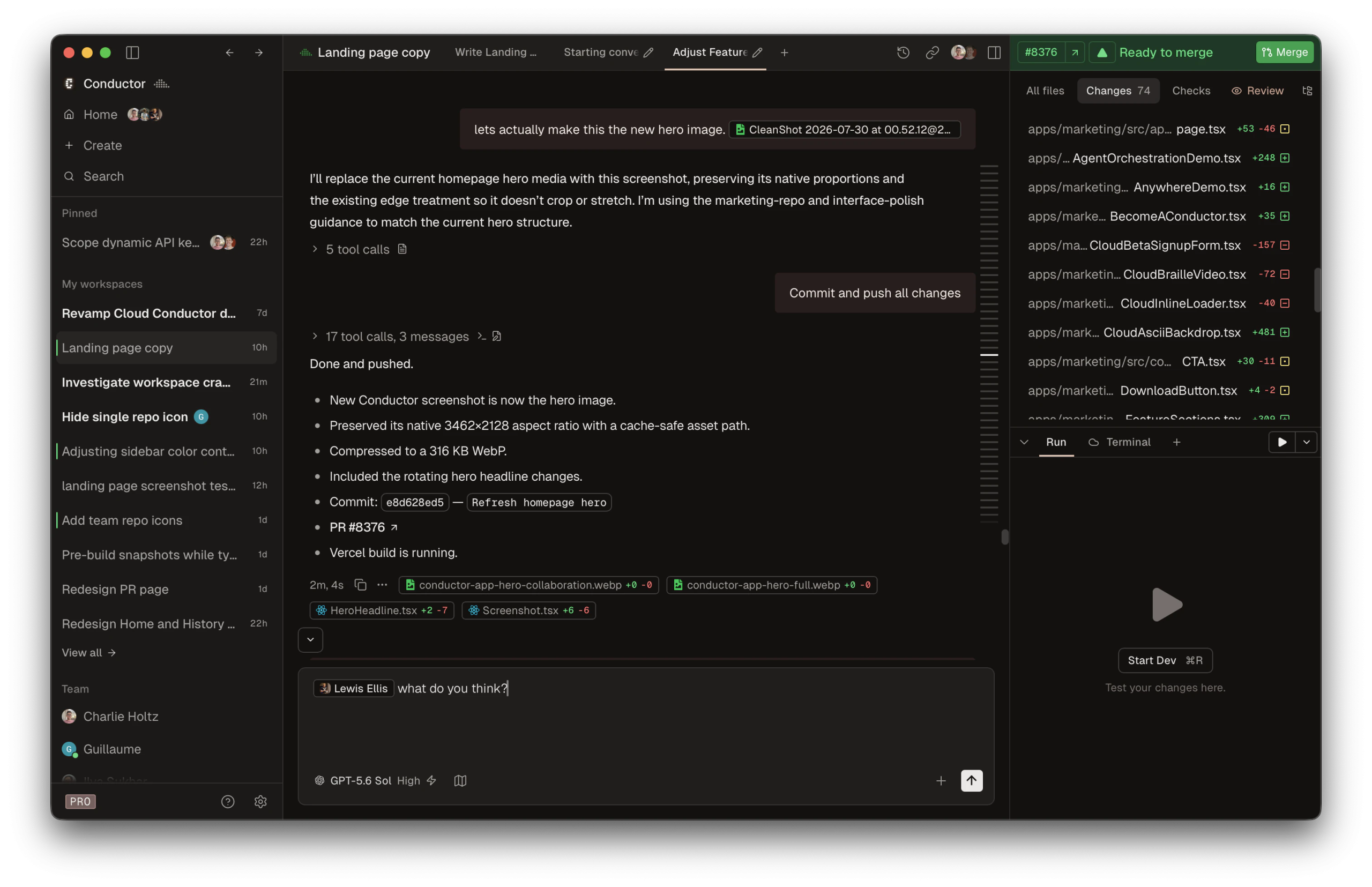
Meta acquires AI coding startup Conductor, whose app runs several coding agents at once
Meta Platforms Inc. has acquired artificial intelligence coding startup Conductor in a deal first reported today by Axios. Conductor confirmed it is joining Meta in a post on its website. Terms were not disclosed. Conductor’s software lets a developer run several coding agents at once, each in an isolated copy of the codebase, and then […] The post Meta acquires AI coding startup Conductor, whose app runs several coding agents at once appeared first on SiliconANGLE.
How NVIDIA Uses AI Agents to Streamline AI Factory Operations
As GPU clusters scale, operations span compute, network, hardware, and scheduling. Site reliability engineers (SREs) often have to examine multiple dashboards...
OpenAI is already trying to shape the 2028 election
OpenAI’s Chris Lehane wants AI to define the 2028 election, proposing a new social contract that could benefit Americans while also advancing the AI giant’s own business interests.
OpenAI to acquire developer tooling startup Pierre Computer
OpenAI Group PBC today announced plans to acquire Pierre Computer Company Inc., a low-profile developer tooling startup. The terms of the deal were not disclosed. Observers pegged it as a shot at Microsoft Corp.’s open-source software repository GitHub for the age of artificial intelligence agents. Pierre operates a cloud service that AI agents can use […] The post OpenAI to acquire developer tooling startup Pierre Computer appeared first on SiliconANGLE.
Google Is Forcing AI Overviews in Classrooms. Schools Are Searching for a Way Out
Google is tying up AI Overviews with traditional search, angering parents and educators who worry that easy, machine-generated answers are leaving kids less capable.
ChatGPT can now turn text prompts and photos into animated GIFs with OpenAI's Images 2.6 model
OpenAI is adding a GIF feature to ChatGPT. With the new Images 2.6 model, users can create animated GIFs from text prompts or photos and then adjust speed and individual frames. The model's image consistency is strong enough to keep characters recognizable across frames, making flipbook-style animation possible. According to OpenAI, users now generate more than four billion images per week. The article ChatGPT can now turn text prompts and photos into animated GIFs with OpenAI's Images 2.6 model appeared first on The Decoder.
Open source AI is booming. Hugging Face explains who profits.
Open source models are becoming more mainstream as enterprises, governments and startups alike rely on the promise of lower costs, more control, and more flexibility. But as increasingly capable models become more freely available, how do companies capture value? And with Chinese open models gaining ground, can American players keep up? On this episode of […]
Anthropic's text watermark is easy to bypass on several older Claude models
Anthropic is rolling out text watermarks to four more Claude models ahead of the EU AI Act's December deadline. But on older models like Claude Opus 4.6 and Sonnet 4.6, API users can disable the watermark by changing a single sampling parameter. Anthropic's response to the loophole? A compliance warning. The article Anthropic's text watermark is easy to bypass on several older Claude models appeared first on The Decoder.
NVIDIA CUDA 13.5 Brings NVIDIA Vera Rubin GA Support
As artificial intelligence and accelerated computing continue to push the boundaries of what's possible, the latest NVIDIA CUDA release arrives to unlock...
Building on open source AI? Hugging Face’s policy chief on the costs, risks, and trade-offs
Open source models are becoming more mainstream as enterprises, governments and startups alike rely on the promise of lower costs, more control, and more flexibility. But as increasingly capable models become more freely available, how do companies capture value? And with Chinese open models gaining ground, can American players keep up? On this episode of […]
OpenAI acquires Pierre Computer Company to make Git keep up with AI coding agents
OpenAI is buying Pierre Computer Company, the startup whose libraries already power the coding agent Codex. Combined with OpenAI's recently launched Git backend Pando, the deal shows the company is building out its infrastructure for developers and AI agents working side by side. The article OpenAI acquires Pierre Computer Company to make Git keep up with AI coding agents appeared first on The Decoder.
Oracle Deep Trust AI Brings Agent Governance To The Database
Oracle’s Deep Trust AI Architecture moves AI agent security into the database. This article looks at the announcement, how it compares with Snowflake and Databricks, and what to consider before adopting.
How NVIDIA Factory Operations Blueprint Coordinates AI Agents to Investigate Product ion Issues
A Siemens report estimates that unplanned downtime costs an average large plant in the surveyed sectors $253 million per year. Whether investigating a failed...
Helping you build and defend at machine-speed in the agentic era
As both a frontier lab and the operator of the world's most comprehensive threat intelligence network, Google occupies a unique vantage point: We see exactly how Large Language Models are engineered, and how adversaries are targeting them in the wild. Passive defense is no longer viable. Allowing rapid, ungoverned adoption of autonomous systems into traditional workflows can lead to critical security incidents. At the Google Cloud Security Summit, we are sharing updates on how we are helping organizations build securely, secure systems, and defend at machine speed in the agentic era. Building securely in the agentic era Agentic coding tools have dramatically accelerated software delivery, but human review can’t keep up with machine-speed commits and unvetted dependencies. Because autonomous agents are now part of the supply chain, blind trust can turn them into direct backdoors for attackers. Our approach to securing the development lifecycle builds native, real-time guardrails in the integrated development environment (IDE), unifies asset graphs across code and identity and access management (IAM,) and verifies models to weed out logic flaws before code merges. CodeMender: Frontier cyber with enterprise control As software-driven threats continue to escalate, our autonomous code-security agent CodeMender helps organizations find and fix code vulnerabilities at machine speed. It can eliminate manual triage bottlenecks while deeply embedding security in the software development lifecycle. CodeMender works with multiple models, including Gemini 4 Argon, that can bring state-of-the-art cybersecurity capabilities. These include identifying previously-unknown vulnerabilities, and generating tested patches before they can be exploited. Most recently, Wiz used Gemini 4 Argon along with other models to identify and help remediate core PHP vulnerabilities that affected 70% of websites. Gemini 4 Argon made a notable contribution to finding the vulnerability, developing a likely exploit path, detecting attacks, and validating the patch. Currently in preview, CodeMender delivers new capabilities for secure isolation and flexible scanning: Secure autonomous remediation: CodeMender isolates vulnerability verification and exploit simulation inside your choice of operating system-level sandbox or isolated virtual machine, and adds human-in-the-loop checks for local write and command execution helping to reduce the risks of malicious exploits and zero-day testing gone awry. Flexible scanning modes: CodeMender now allows you to scan a specific folder, entire repository, or only modified files since the last scan so you have fine grain control on how many files to scan to optimize for scanning speed and costs. Since the CodeMender preview became available in July, hundreds of customers have used CodeMender to help them find and fix vulnerabilities at machine speed. “As adversaries attack at machine speed, Google’s Fairwind Program helps us keep pace with our application security. Our early evaluation of CodeMender shows the potential to reduce vulnerability discovery time by over 95%, while keeping expert validation and remediation under human oversight,” said Ivan Fontarensky, CTO Cybersecurity Services, Thales Group. “IDC research finds that nearly 40% of enterprises add vulnerabilities faster than they can remediate them. Detection without remediation only adds to developer workloads,” said Katie Norton, research director, Cloud Security, IDC. “CodeMender solves this by pairing exploitability validation with deployable code fixes, driving the continuous, verified patching required as exploitation timelines compress.” Securing workloads everywhere When autonomous workloads transition to production, the threat landscape shifts entirely. Adversaries target your plumbing — credentials, data boundaries, and integrations that connect agents to the enterprise. Once inside, attackers exploit over-privileged credentials and unsegmented environments to move laterally across enterprise data boundaries. To eliminate these flat-trust architectures, Google Cloud delivers a unified framework of foundational security and governance controls for agents everywhere they run. Whether your agents are operating on the Gemini platform, Google Kubernetes Engine (GKE) and Cloud Run, the new Agent Compute Engine, or are coordinating across multi-cloud environments — they are bound by the same rigorous enterprise controls. To enforce our agents everywhere framework at the transaction level, we are introducing critical identity, network, and content controls: Auth Manager (Agent Identity): Centralizes credential management inside a Google-managed vault governed by IAM. Now generally available, Auth Manager automates OAuth 2.0/PKCE flows and refreshes user-delegated tokens to minimize consent fatigue and reduce credential theft. Alongside Auth Manager, Agent Identity JWT support, now in preview, issues standard OIDC tokens, allowing agents to authenticate securely across AWS, Azure, on-premises backends, and MCP servers without static, long-lived API keys. Identity-based VPC Service Controls: Reinforcing perimeter defenses against data exfiltration, VPC-SC ingress and egress rules now support IAM roles, generally available, and Workload Identity Federation for GKE, in preview, enabling security teams to enforce granular, identity-based perimeter boundaries across enterprise GKE clusters without complex, manual exceptions. Model Armor custom topic detector: This new enhancement, available in preview, enables you to enforce topic adherence for agents. You can define custom prompt-based rules to identify on-topic and off-topic interactions. Tailored for industry use cases in healthcare, insurance, and retail, it keeps your agent conversations focused, compliant, and secure. Advanced network threat protection: Building on Cloud NGFW Enterprise’ IPS capabilities, you can now protect workloads with the new Cloud NGFW advanced malware sandbox, generally available, enabled by Palo Alto Networks WildFire, streamline firewall operations using Cloud NGFW project-level resources, generally available, and automate exploit protection with Cloud Armor managed rules, available in preview, backed by Thales Imperva’s global threat intelligence that scans 1.5 trillion monthly web requests. Defending at machine-speed Attackers are integrating advanced capabilities across their operational lifecycles to achieve unprecedented scale and velocity. To defeat autonomous, multi-agent threats, we must empower defenders with agentic, intelligence-driven operations to neutralize adversaries in minutes, not days. Modern SOCs require autonomous investigation, detection, and response powered by planetary-scale infrastructure: Continuous monitoring catches live compromises at the workload layer and feeds telemetry directly into the Wiz Security Graph. Google Threat Intelligence telemetry is codified directly into the runtime logic of defensive models, triggering automated agentic threat hunts that reconstruct process trees and isolate threats in real time. Autonomous agents analyze complex alerts, run correlation queries across multi-vendor telemetry in sub-second timeframes, and present clear mitigation actions for strategic human sign-off. Of course, deploying autonomous technology is only half the battle; teams also need the right operational frameworks to wield it effectively. To help you evolve your cyber defense operations, Mandiant Transformation Services experts can modernize your operating models to maximize the benefits of these advanced technologies. By refining processes and workforce skills with frontline best practices, Mandiant enables your organization to proactively mitigate threats and ensure business continuity during a breach. Better together: Wiz and Google Cloud Delivering end-to-end defense requires extending these native platform controls into multi-cloud environments where organizations run diverse tooling. Together, Wiz and Google Cloud are combining deep autonomous application understanding, connected security context, and threat intelligence to help organizations innovate securely and stay ahead of emerging threats. Recent highlights include: Securing autonomous workloads wherever you build and run with Wiz: As organizations build and scale with Google Cloud and Gemini platform, Wiz protects autonomous applications across their entire lifecycle from code to runtime. Wiz discovers and maps autonomous applications, agents, and infrastructure, deeply analyzing the application itself, including its purpose, capabilities, and permissions, to uncover hidden risks. Combined with the context of the Wiz Security Graph, this surfaces complex attack paths and runtime threats, empowering teams to prioritize risk and innovate with confidence. Securing code at machine speed with Wiz AI SAST: Now in preview, Wiz AI Static Application Security Testing (SAST) uses agentic reasoning to understand how an application behaves and surface complex business logic flaws. Grounded in Wiz Research and powered by our proprietary Atlas harness, Wiz AI SAST correlates code weaknesses with infrastructure context on the Wiz Security Graph so teams can prioritize the risks that matter most. Exploitable attack paths can then be remediated at machine speed using our Green Agent and CodeMender. Strengthening threat defense together with Wiz plus Google Security Operations: Wiz Defend and Google Security Operations now work from a shared data model, giving security operations teams the flexibility to investigate threats in either platform. Improvements include a dedicated Wiz Content Pack in Google Security Operations, Wiz Blue Agent investigation analysis in Google Security Operations, and bi-directional syncing between the platforms for a streamlined analyst experience. Additionally, Wiz Defend now integrates with Google Threat Intelligence, bringing the latest insights and frontline intelligence directly into Wiz. Protecting under-resourced organizations with Scan for Good: A joint initiative launched by Google DeepMind and Wiz, Scan for Good brings the power of autonomous technology coupled with human security researchers to under-resourced organizations, including public services, critical infrastructure, and non-profits. In its first month, this initiative has used Argon to help more than 50 public service organizations and critical infrastructure providers find and remediate critical exposures. Turning the advantage back to the builders and defenders Securing the agentic era requires evolving operational models, enforcing secure-by-design pipelines, and taking direct action against malicious infrastructure. At Google, our responsibility extends to disrupting adversaries at the source: Tracking bad actors targeting Google Cloud environments and permanently disabling their infrastructure. Engineering specialized defensive architectures with Google DeepMind, including models trained specifically for high-stakes cybersecurity and automated code analysis. Feeding frontline threat intelligence back into model alignment and classifier training to neutralize emerging attack vectors before they materialize. By establishing native pipeline defenses, dismantling flat trust architectures, and deploying machine-speed operations, enterprises can turn the AI advantage back to defenders. Join us at the Google Cloud Security Summit to explore these capabilities and learn how to secure your organization in the agentic era.
Highlights and reflections from Google Public Sector Summit: Where mission meets moonshot
Over 2,700 government leaders, innovators, and industry partners convened across two-days at our Google Public Sector Summit in Washington D.C. where we explored the theme, “Where mission meets moonshot.” We were honored to bring together leaders who are driving impact in the agentic era and leveraging agents to help boost productivity, drive innovation, and transform how services are delivered.Let’s take a closer look at the sessions, speakers, demos, and activations throughout the event that showcased how leaders across education and government are collaborating with Google Public Sector to turn their moonshot aspirations into secure, scaled, real-world mission outcomes.Driving impact togetherIn our morning keynote, CEO of Google Public Sector, Karen Dahut unpacked the event theme and shared how organizations like NASA, NOAA, The Department of War, The Department of Energy, The State of Connecticut, The U.S. Army, Case Western Reserve University, and more are collaborating with Google to drive impact in the agentic era. Karen underscored the importance of leading boldly, building with and for your people, and scaling for impact. Thomas Kurian, CEO of Google Cloud, reinforced our commitment and shared the latest innovations across our integrated and secure stack including Gemini for government services, purpose-built for public sector missions. He also shared additional announcements including the Wiz Red, Green, and Blue agents which are now available within Wiz for Gov, Wiz’s FedRAMP Class D (High) certified environment, and how we are bringing enterprise search capabilities to Gemini on Google Distributed Cloud for air-gapped deployments.Chris Hein, Field CTO of Google Public Sector, shared a live product demonstration that showcased Google’s technology in action. Attendees had the opportunity to hear from leaders Michael P. Duffey, Under Secretary of War for Acquisition and Sustainment, and Ed Forst, Administrator for the General Services Administration, who shared how they are applying technology to transform their missions and power their moonshots. Through partnership and powerful technology, we are creating impact at scale by transforming services, strengthening security, and improving outcomes. Dedicated programming for the agentic eraDuring our Cloud Talks session, attendees heard from Elizabeth Moon, Managing Director of Customer Engineering for Google Public Sector, as she hosted a series of talks across critical pillars of public sector transformation. Presentations highlighted infrastructure for the agentic era led by Rich Sanzi, VP/GM for Accelerated Computing Systems at Google Cloud; building safely with Google’s agentic capabilities led by Michael Gerstenhaber, VP of Product Management for Gemini; and implementing proactive defense at planet-scale led by Sandra Joyce, VP of Google Threat Intelligence. Attendees also heard from dozens of customer and partner speakers during our breakout panels hosted by Google Public Sector leaders Ron Bushar, Tony Orlando, and Elizabeth Moon, as well as our lightning talks and closed-door birds of a feather discussions on topics including tokenomics, migration, and compliance. Alongside our customers and partners, we showcased how agents are transforming every facet of the public sector, from accelerating scientific breakthroughs, advancing healthcare outcomes, improving service delivery, strengthening national security, and more. Over the course of the event, we offered specialized programming and engagement opportunities for national security and defense leaders. Through our Partner Connect programming, we shared how we are scaling our impact through a thriving, highly capable partner community and introduced enhanced partner initiatives focused on fostering deeper collaboration, supercharging frontline adoption, and expanding mission delivery capabilities across our valued partner network. Hands-on innovation with Google Public SectorThe Mission Exchange served as our interactive showfloor centerpiece, bringing multi-agent coordination to life with our flagship Emergency Response Simulation, as well as live demos that showcased our full-stack innovations encompassing everything from planet-scale infrastructure to leading models and agentic platforms. We hosted 19 lightning talks in the Mission Exchange, featuring customer, partner and Google experts who shared live demos and showcased real-world mission-ready solutions. Attendees also had the opportunity to join our technical hands-on labs including “Getting Started with Gemini” and “Build Gemini Agents: From Prompt to Prototype” where they built functional mission-ready agents with Google Cloud. What’s your moonshot?I was honored to lead our closing session, “What’s your moonshot?” where we brought together visionary leaders Adam McCarthy (The White House), Laura Baker (NYS Board of Elections), and Barry J. Schindler (USPTO) to explore practical strategies for fostering a culture of courageous problem-solving and applying technology to supercharge ambition and ingenuity in entirely new ways. As we look ahead, I want to leave you with one question: “What’s your moonshot?”Answering this question will require bold leadership, ambition, and courage; it will require partnership and collaboration across teams and organizations; and technology that can help amplify capacity and potential. Leading in the agentic era means being comfortable with stepping into the unknown. It means asking and answering audacious questions, expanding the boundaries of what’s possible, and taking one small step in a bold new direction - even when - especially when it is hard.Let’s build what’s next, togetherWe believe that bold moonshots all start with a single, pragmatic first step. To help you get started, I encourage you to take advantage of a number of helpful resources and opportunities to engage:Explore our Google Public Sector Summit sessions on-demand.Learn how Gemini for government services can help transform critical workflows and advance your mission.Request a demo to see how Wiz Agents can help your agency meet today’s security demands at machine speed.Schedule a 1:1 consultation with a Google team member or reach us at geminiforgov@google.com.The agentic era will not be defined by what technology can do, but by what we choose to build with it. Let’s go build, together.
“Signing in to your company’s plugins one by one is annoying”: Anthropic’s fix puts Claude in the identity business
Anthropic is now letting businesses automatically connect employees to approved Claude plugins, saving staff from having to sign in to The post “Signing in to your company’s plugins one by one is annoying”: Anthropic’s fix puts Claude in the identity business appeared first on The New Stack.
Use NVIDIA NeMo to Turn Agent Failures into Tests and Harness Fixes
Turn production evidence into prioritized issues and custom evaluations that help you improve prompts, tools, models, memory, skills, and harness code. When you...
Introducing Compute Engine API multi-versioning: Predictable evolution without breaking product ion
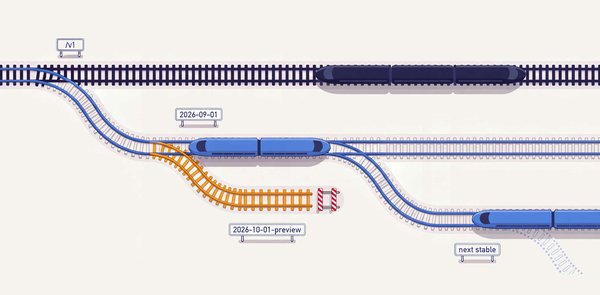
Ready to modernize your infrastructure without risking production stability? API multi-versioning for Compute Engine, now in general availability, helps you do just that. With date-based API versions, Compute Engine can now regularly deliver modern API semantics, stronger resilience defaults, and improved developer experience while preserving the rock-solid stability of the /v1 API. For more than a decade, the Google Compute Engine /v1 API has served as the foundational control plane for millions of virtual machines, Google Kubernetes Engine (GKE) clusters, and large-scale AI infrastructure. For platform teams and developers who build on Google Cloud, that single /v1 endpoint delivered an extraordinary promise: write your integration once, and trust that it will keep running year after year. Yet as cloud architectures have grown in scale and sophistication, infrastructure teams have faced a growing tension. On one hand, mission-critical production workloads require absolute API stability and strict backward compatibility. On the other hand, customers want faster access to safer security defaults, stronger regional resilience, machine-readable error models, and modern, declarative-friendly APIs, but introducing these improvements in place risks disrupting existing automation. The new versioning model helps avoid that disruption by giving you the flexibility to adopt modern semantics on your own schedule without touching your production workloads. Date-based API versions for Compute Engine Historically, Compute Engine relied on channel-based versioning (CBV) with three long-lived channels: /v1 (generally available), /beta, and /alpha. Because /v1 was a single, mutable production surface shared by every customer worldwide, any behavioral improvement–even changing a counter-intuitive default or modernizing an error format–carried the risk of breaking existing scripts or required multi-year migrations. With interface-based versioning (IBV), aligned with Google AIP-185, Compute Engine introduces immutable, date-based API snapshots alongside /v1: Stable versions (YYYY-MM-DD): Released on a predictable quarterly cadence (starting with 2026-09-01), each stable version represents a locked, point-in-time contract of all generally available Compute Engine features and behavioral defaults. Stable versions don't receive breaking changes after they're published. They have no end-of-support date today. Preview versions (YYYY-MM-DD-preview): Released on a rapid cadence (such as 2026-10-01-preview), preview versions branch from a stable parent to give developers early access to upcoming features and API designs, carrying a predictable one-year lifespan for testing and feedback. Uninterrupted /v1 support: The existing /v1 API remains fully supported and it continues to serve as the default if no date-based version is specified. Your existing applications, scripts, and integrations continue to work without modification. Primary benefits for builders 1. Stability and customer-controlled upgrades In a traditional single-version API, changing a default behavior forces a trade-off between platform progress and customer stability. But date-based multi-versioning puts upgrade timing entirely in your hands: Pin to a known contract: Direct REST callers and SDK users can lock onto a specific version identifier (such as 2026-09-01) knowing its request and response schemas are frozen. Upgrade on your schedule: When a new quarterly stable version introduces updated defaults or modified resource schemas, your team can evaluate the release notes, test in staging by changing a single version string, and roll out to production at your own pace. Consistent resource URIs: Date-based versions continue to use the /compute/v1/ base URL path. You specify the target version via the X-Goog-Api-Version HTTP header or the $apiVersion query parameter. This means that resource selfLink URIs remain uniform across tools and services. code_block <ListValue: [StructValue([('code', '# Request a specific date-based stable version using the HTTP header\r\ncurl -X GET \\\r\n "https://compute.googleapis.com/compute/v1/projects/my-project/zones/us-central1-a/instances" \\\r\n -H "Authorization: Bearer $(gcloud auth print-access-token)" \\\r\n -H "X-Goog-Api-Version: 2026-09-01"'), ('language', ''), ('caption', <wagtail.rich_text.RichText object at 0x7f4e9c515150>)])]> 2. Safer defaults, stronger resilience, and modern API standards By isolating behavioral changes to new date-based versions, Compute Engine is delivering improvements that make cloud applications more resilient, more secure, and easier to automate: Resilient global queries by default: In legacy /v1, calling AggregatedList across all zones and regions defaults to false. This means a transient issue in a single zone could cause a global list request to fail unless callers explicitly opted in. In new date-based versions, partial success is enabled by default so global fleet queries remain resilient during localized maintenance or disruptions. Actionable, machine-readable errors (AIP-193): Date-based versions adopt standardized google.rpc.ErrorInfo payloads with structured reason, domain, and contextual metadata (such as returning the list of supported_versions if an invalid version identifier is requested), eliminating brittle regex parsing of error strings. Stronger security and least-privilege hygiene: New API versions allow Compute Engine to tighten overly broad legacy IAM permission checks and introduce safer configuration defaults without disrupting legacy automation running on /v1. Cleaner, declarative-friendly API design: Multi-versioning provides a clean path to evolve complex, decade-old resource schemas toward modern Google API Improvement Proposals (AIPs). 3. Seamless adoption across client libraries, gcloud, and Terraform Whether you call the REST API directly or manage infrastructure through higher-level tools, Compute Engine API Multi-Versioning is designed to work without friction: Surface How multi-versioning works Your responsibility Client libraries (Python, Go, Java, Node.js, C#, Ruby, PHP) Each SDK release automatically binds to a specific date-based API version while preserving the /v1 package namespace (compute_v1, apiv1). Enums are represented as strings for seamless forward and backward compatibility. Upgrade your client library dependency as usual–no import path rewrites required. Use -preview SDK releases to test preview features. Google Cloud CLI (gcloud) gcloud compute targets the bundled stable API version. The new gcloud preview compute command group targets the bundled preview API version. Keep gcloud updated. Existing gcloud compute, beta, and alpha scripts continue to work as-is. Terraform (google & google-beta) The google provider targets stable date-based APIs, while google-beta targets preview APIs under the hood. Upgrade your Terraform provider version to adopt new features; no manual API version configuration needed in HCL scripts. Direct HTTP / REST Select any active version via -H "X-Goog-Api-Version: YYYY-MM-DD" or ?$apiVersion=YYYY-MM-DD, and fetch version-specific Discovery Documents. Pass the header or query parameter in your HTTP client to opt into a specific version (e.g., 2026-09-01, 2026-10-01-preview). Get started Compute Engine API multi-versioning is available today across all Google Cloud regions, with 2026-09-01 as the initial stable version and 2026-10-01-preview available for preview testing. Start exploring and adopting date-based versions in your workflows: Explore the documentation: Compute Engine API Versioning Guide Creating API Requests and Handling Responses Compute Engine REST API Reference (use the version selector to inspect 2026-09-01 and 2026-10-01-preview schemas) Try gcloud preview compute: Run gcloud components update and test upcoming preview capabilities using the new gcloud preview compute surface.
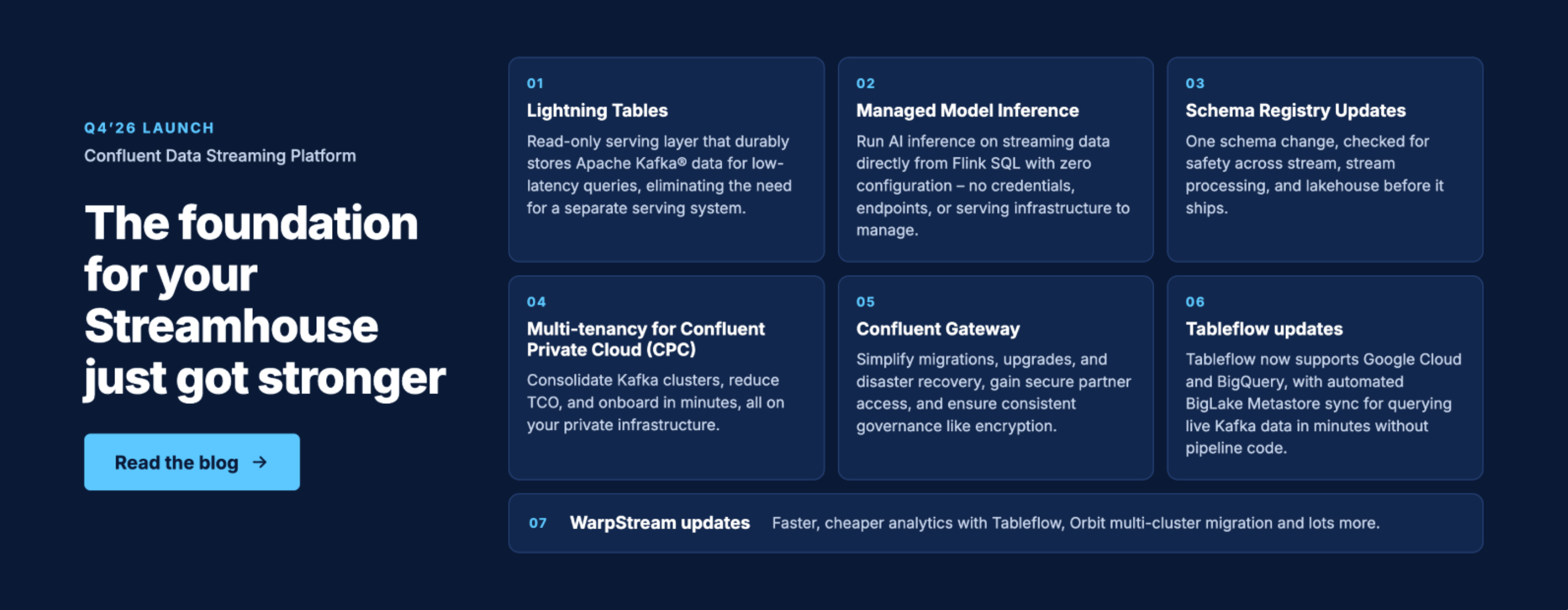
What’s New in Q4’26 Confluent Data Streaming Platform: The Most Complete, Performant, and Open Foundation for Streamhouse
Learn about Lightning Tables, Managed Model Inference, multi-tenancy for CPC, Tableflow for Google Cloud, and other Confluent Cloud, Confluent Platform, and WarpStream updates.
GPT-6 Astra sees the matrix and reprograms other AI models directly through their weights
MIT researchers show that OpenAI's GPT-6 Astra can read and deliberately rewrite the weights of other AI models without traditional training. In one experiment, Astra boosted a Qwen model's math accuracy from 7.9 to 48.1 percent by changing just 0.016 percent of its weights. The approach could fundamentally simplify AI optimization but still hits clear limits. The article GPT-6 Astra sees the matrix and reprograms other AI models directly through their weights appeared first on The Decoder.
Give your coding agent a head start with Microsoft Agent Framework skills for .NET and Python
We have added installable Microsoft Agent Framework builder skills for .NET and Python. They give coding agents Microsoft-maintained guidance for building and modifying Agent Framework applications, from choosing the right pattern to wiring tools, sessions, workflows, and hosting. These are development-time skills for your coding assistant, not runtime skills loaded by the application you ship. […] The post Give your coding agent a head start with Microsoft Agent Framework skills for .NET and Python appeared first on Microsoft Agent Framework.
Anthropic's new prototype proves which model wrote an AI response without exposing its weights
Anthropic has released FlashProve, a research prototype that uses cryptography to verify whether an AI response actually came from the claimed model. The system still has significant limitations. The article Anthropic's new prototype proves which model wrote an AI response without exposing its weights appeared first on The Decoder.
New capabilities to power agents at scale with Google's Agentic Data Cloud
Not long ago, we were entering the agentic era; today, organizations are deriving significant value from running agents in production. The opportunity to capture new revenue streams, improve efficiency, and manage risk makes reimagining operations with agents top of mind for enterprise leaders. That is why we built the Agentic Data Cloud — a System of Action designed to activate all your data by breaking down walled gardens, deliver high accuracy and trust, and operate proactively at low cost. Leading organizations such as PayPal, Siemens, Telus, Vodafone, Walmart, and more are already achieving business impact with us today. Today, we’re sharing key updates to Google’s Agentic Data Cloud. We’re empowering your agents everywhere, grounding them in your enterprise context to deliver accurate, trusted answers, and providing elevated agentic-first experiences for both practitioners and business users. Activate all your data for agents with the borderless Lakehouse Enterprise data lives everywhere — across multi-cloud environments, on-premises systems, and SaaS platforms like Confluent, SAP, Salesforce, and Workday. The borderless Lakehouse, built on the open Apache Iceberg format, lets you activate all of your data, wherever it lives, so that your agents have one governed foundation. Instead of moving data, stitching together connectors, or paying surprise variable egress fees, you get a stack tuned at every layer, from the infrastructure to the model. In fact, Apache Iceberg data under management has more than tripled over the past year. Today, we are announcing several new enhancements for the borderless Lakehouse. Gemini now works directly on your borderless Lakehouse allowing business users to use natural language to query records that live across clouds while agents ground their reasoning and drive business workflows. With cross-cloud interconnect and caching for AWS and Azure, now generally available, you can query data across clouds with a private, secure connection and zero variable egress fees. And when you query remote cloud data, Lakehouse automatically caches retrieved data blocks locally within Google Cloud. Additionally, customers can use the open Iceberg catalog federation with Databricks Unity, Snowflake Horizon, and AWS Glue as well as zero-copy integrations with SAP, Workday, and Salesforce. To deliver context for AI, the borderless Lakehouse integrates directly with Knowledge Catalog, to automatically index your distributed and unstructured data, in cloud storage, giving agents the right context to be accurate, while controlling token costs for an intelligent and sustainable agentic strategy. "By implementing the borderless Lakehouse that federates single-copy Apache Iceberg data from Amazon S3 tables to BigQuery, Delivery Hero's talabat reduced data-movement costs by approximately 40% while making streaming transactional events queryable across both clouds within minutes of production." - Harish Ramesh, Staff Data Engineer, Delivery Hero talabat To take action in the moment, agents need simultaneous access to both your historical analytical data, and real-time transactional data. That’s why today we're announcing new AlloyDB integrations with the borderless Lakehouse. With direct Iceberg access in AlloyDB, you can now directly query Iceberg tables stored in cloud storage, without any ETL pipelines or copies, and join live operational data with historical lakehouse data in a single PostgreSQL query. By combining AlloyDB's transactional capabilities with direct Iceberg table access, systems can efficiently bridge transactional and analytical data to meet rigorous demands from agents. It is fully integrated with the Lakehouse runtime catalog, allowing you to register Iceberg tables in AlloyDB alongside the rest of your tables. Everything automatically shows up in Knowledge Catalog — so your agents get the same governed context. AlloyDB direct Iceberg access is up to 7x faster on aggregation queries than Amazon’s comparable PostgreSQL-compatible service. And completing this borderless strategy, Spanner Omni, which is generally available, brings Google-grade consistency, scale, and multi-model capabilities to hybrid agentic applications across on premises, edge nodes, and multi-cloud environments. Deliver accurate, trusted answers by grounding every agent in enterprise context Agents are only as accurate as the business context they are grounded in. Knowledge Catalog is Google Cloud’s universal context engine that turns raw data into shared business context for agents to answer and act with higher accuracy, trust, and token efficiency. Today, we’re taking Knowledge Catalog to the next level by extending our AI-driven context curation capabilities with self-learning, reusable context sets, and a reimagined user experience so your context layer is built and evolved automatically with your business while keeping humans in full control of their data governance. Based on our internal benchmarks, Knowledge Catalog makes AI agents nearly 4x more accurate, with up to 33% lower latency, and using up to 75% fewer tokens. Much of an enterprise’s institutional knowledge lives outside their databases in operational playbooks, documents, and tickets, and context for agents must be curated around the questions people actually ask. With the new self-learning enrichment in Knowledge Catalog, available in preview, agents take on the heavy lifting of context curation. Knowledge Catalog learns from user intent and every human and agent interaction by continuously mining unstructured sources like Google Workspace, GitHub, Jira, Confluence, and SharePoint to close context gaps and evolve context automatically. It also packages domain knowledge into reusable Open Knowledge Format (OKF) context sets, allowing context engineers and data stewards to govern this enriched context effortlessly. For data stewards and data teams, we also introduced, a new studio experience in Knowledge Catalog, in preview, which provides a conversational user interface where you can explore context in natural language, visualize your entire data estate across cloud environments and SaaS applications, and review, audit, and approve proposed enrichment updates with full versioning and rollback. New studio experience in Knowledge Catalog showcasing conversational context exploration and an interactive graph Additionally, we announced that Knowledge Catalog is now on by default in Gemini, in preview. Every data question is now grounded in a governed business context automatically. When you connect BigQuery, AlloyDB, Cloud SQL, or Spanner, Knowledge Catalog resolves business terms, locates trusted tables, and determines join paths before generating SQL — under each user’s own access permissions. This gives organizations the confidence to deploy agents at enterprise scale because your agents draw from shared, registered context sets for consistent accuracy, lower latency, and reduced token costs. Finally, because critical business definitions cannot be left to an LLM’s guesswork, Knowledge Catalog grounds agents in trusted semantic models, now generally available, from BigQuery, Looker (LookML), Databricks, Snowflake, dbt, and SAP, without moving data. Whether an agent is calculating net revenue for finance or customer churn for operations, it applies the exact same governed formulas your business teams rely on. Knowledge Catalog also extends metadata discovery and federation to Oracle AI Database@Google Cloud, Snowflake, Databricks Unity Catalog, and third-party catalogs like Atlan and Collibra — building on the catalog investments you’ve already made so your entire data estate is universally understood by every agent. Transforming practitioner experiences with agents We are reimagining how data professionals and business teams work — elevating practitioners from individual contributors supported by co-assistants, into orchestrators of autonomous agents that drive intent-driven business outcomes. For both technical teams and everyday business users, we introduced two new purpose-built capabilities in Gemini, at the recent Gemini at Work event. For Data and ML engineers, we are extending Gemini with machine learning skills and tools that back every data scientist and data engineer with a team of agents. Engineers describe the outcome they want in plain language, and Gemini generates PySpark code, provides notebooks to edit and test it, trains models, and troubleshoots and fixes pipeline issues on its own. And for business users, anyone in your organization can generate reliable, real-time operational reports simply by asking. Gemini uses operational reporting skills integrated with BigQuery and the Knowledge Catalog to construct and save the query. Once saved, teams can run reports on demand without incurring token costs, guaranteeing consistent, verified answers every time. Now, for developers who'd rather stay in their own tools, we recently announced the general availability of the Data Agent Kit. It eliminates console hopping and ETL boilerplate by integrating Google Data Cloud tools directly into your developers' preferred IDEs and CLIs — like VS Code, Claude Code, and Antigravity. Armed with native MCP tooling, practitioners define business intent and let agents generate, tune, and test data pipelines. Engineering a data infrastructure built for agent scale As organizations scale to millions of agents collaborating across workflows, traditional database architectures break down. We’re introducing tailored infrastructure engineered specifically for agent scale. To accelerate rapid testing and prototyping, today we’re announcing AlloyDB Express, in preview. This is a new edition of AlloyDB designed for builders and coding agents who need extreme development velocity. It offers sub-2-second instant provisioning, scale-to-zero pause and resume, secure private IP connectivity, integrated observability, and a small footprint with 1–2 vCPUs and 20GB of storage. AlloyDB now provides a developer-first, PostgreSQL environment for agent development and testing. For production environments, we recently announced PostgreSQL for agents in AlloyDB, in preview, which enables thousands of collaborating AI agents to query live transactional data with complete workload isolation. With the agentic database architecture, agents achieve sub-millisecond I/O, and terabit-per-second aggregated scan throughput, supporting over 3 million queries per second. Compute scales automatically based on active reasoning sessions and scales back to zero when idle without affecting production systems. For running open-source data infrastructure, Managed Service for Apache Spark extends its price-performance advantage compared to market alternatives by over 3x through further improvements to Lightning Engine. Recent enhancements for Spark 4.0 include faster startup at no additional cost, beneficial for interactive workloads and small batch ETL jobs. In addition, the premium tier provides performance boosts by pairing upgraded hardware with software acceleration from the Lightning Engine, and this is on by default. Finally, we’ve continued to enhance BigQuery for agent scale. In the past year alone, we've made queries over 40% faster while cutting query processing cost by more than 50% through intelligent optimizations like fluid scaling and built-in workload acceleration. BigQuery Graph is now generally available, bringing petabyte-scale graph analytics directly on relational tables with zero ETL. It allows organizations to model data as nodes and edges to uncover complex, hidden relationships without moving data into a separate graph database. And today, two new models from Google Research run natively in BigQuery. The first is TimesFM 3.0, now in preview, which lets you generate forecasts directly in SQL with no custom models to train or manage and TabFM, also now in preview, which brings predictive machine learning directly into BigQuery. Get started today In addition to these announcements, we continue to enhance core performance, cost management, and operational resilience across our broader data ecosystem. Ready to transform your data estate into an active System of Action? Explore our Agentic Data Cloud page, sign up for a Data Strategy Workshop and start building your agentic enterprise, at no cost, with Google Cloud. You can also head over to our Trusted Agents, Real Outcomes digital event to catch our Agentic Data Cloud vision and the latest innovations. See the portfolio in action, learn from Yahoo’s real-world blueprint, and unpack deep-dive sessions with product leaders across Databases, Data Analytics, and BI.
AlloyDB Express: Instant, scale-to-zero PostgreSQL for developers and coding agents
Databases have struggled to keep up with the speed of AI-enabled software development. Across the engineering and platform teams we talk to, we see coding agents stalled by slow database provisioning, CI/CD test pipelines bottlenecked by complexity, and internal apps hitting a wall as they transition from sandbox to production. Until now, no PostgreSQL service in the market has combined agent-ready capabilities with uncompromised enterprise security and scale. To solve this, we are excited to announce the preview of AlloyDB Express, a new offering of AlloyDB for PostgreSQL designed specifically for developers and AI coding agents. Capable of spinning up in seconds and automatically pausing when idle, it helps bridge the gap between rapid, AI-driven development and robust enterprise infrastructure.The result is a highly secure, cost-effective database environment that accelerates how you build applications and can easily grow to production scale. Get started with the free tier and pay only for what you use. AlloyDB Express is an agent-ready database that gives you: Database creation in under two seconds: Create a ready-to-use PostgreSQL database in under two seconds using gcloud CLI, REST API, MCP, Terraform or Console. Scale-to-zero: Your database automatically pauses after 15 minutes of inactivity so you do not incur costs for compute while it is idle. When a new query arrives, it wakes up automatically in seconds. Enterprise-ready with built-in AI and security: Access enterprise AI capabilities including vector, text, and hybrid search to quickly build AI applications, all protected by built-in enterprise security guardrails. Start for free and pay only for what you use: Get started with our free monthly allowance and as you scale, pay only for what you use. One-click upgrade to production scale: When your app is ready for production, upgrade your existing database to AlloyDB in one click—keeping data, schemas, users, and connection strings intact while gaining enterprise high availability (HA), read replicas, and disaster recovery (DR). Accelerate development without compromising security AlloyDB Express combines self-service speed with built-in enterprise security. For app builders and coding agents this means you can instantly provision fully isolated PostgreSQL databases without manual setup, allowing every test and prototype to run in its own dedicated database. And for platform and security administrators you define IAM, network, and organization policies centrally once, and every AlloyDB Express database created by a developer or coding agent automatically stays within your company's security guardrails. Whether code is written by developers or AI agents, security remains enforced through built-in protection mechanisms which: Minimize exposure with safe default connections: Keep your data hidden from the public internet using public DNS endpoints that mask IP addresses and block incoming traffic until explicitly allowed. Secure internal integrations via private VPC networking: Safely connect your internal workloads using Private Service Connect (PSC) or private DNS. Enforce least privilege with granular access controls: Confidently restrict agent and user permissions utilizing Google Cloud IAM, VPC Service Controls, and native PostgreSQL roles. AlloyDB Express brings built-in AI capabilities Unlike databases that rely on external vector stores or complex setups, AlloyDB Express embeds enterprise AI tools directly into your database, so you can focus on building features. You can accelerate your AI application development, with tools like: Fast vector search (pgvector HNSW and Google’s ScaNN index): Store and search vector embeddings alongside your operational data for semantic search, recommendation engines, and agent memory (RAG) — without syncing data to a separate vector database. Direct access to Gemini models within SQL queries: Generate text or image embeddings on the fly and run semantic filtering, ranking, and summarization (ai.if, ai.rank, ai.generate) directly inside standard SELECT and INSERT statements. Natural language-to-SQL generation: Let developers and AI agents ask questions in plain English to generate, run, and refine queries in seconds using built-in AlloyDB Studio and natural language APIs. Start with the free tier and pay only for what you use AlloyDB Express offers simple intuitive pricing and scales to zero when inactive. Data stays safe, and the database wakes up instantly when a new query arrives.Here is a short summary of our pricing: Active compute: $0.115 per Compute Unit hour (CU-hr), billed by the second. Paused compute: $0.00 per hour when idle for more than 15 mins. Used storage: $0.30 per GB-month, billed only for the disk space your data actually uses. In addition, Google Cloud offers a free tier, making it easier to get started with 50 free CUs every month. For more details see the AlloyDB Express pricing. Get started today AlloyDB Express is available today in preview. Try it in the Google Cloud console or read the AlloyDB Express documentation page for more details on how to get started.
Unify operational and Lakehouse data with direct Iceberg access in AlloyDB for PostgreSQL
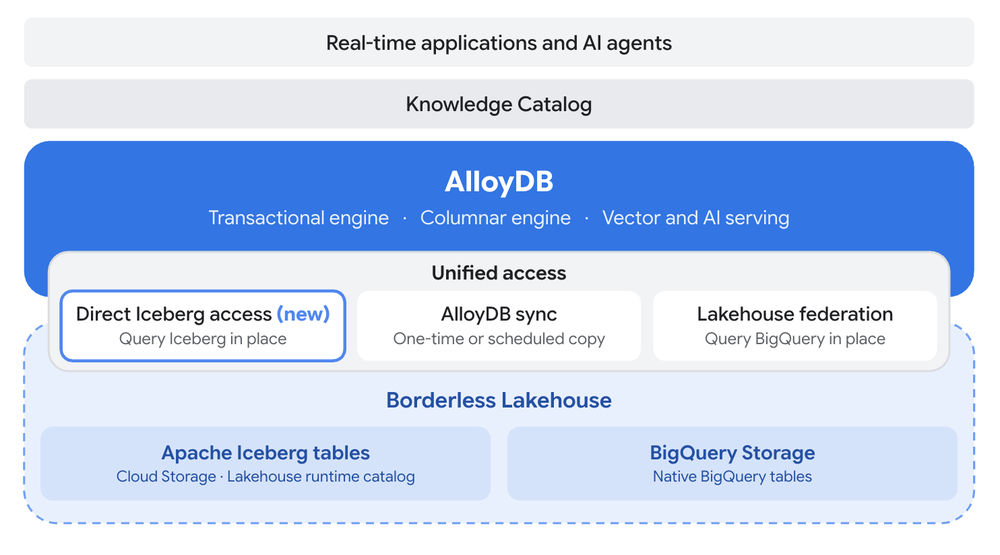
To make good business decisions, you need two kinds of data: the live state of the business from operational databases, and the historical context stored in an analytical system such as a lakehouse or a data warehouse. Traditionally, those systems have been separate, but they are now converging rapidly. That’s why today, we're announcing direct Iceberg access in AlloyDB for PostgreSQL, in preview. Now, developers can query Apache Iceberg tables stored in a cloud storage bucket directly from AlloyDB and join them with live operational data, all in a single SQL query. In addition, we’re announcing the general availability of AlloyDB sync and Lakehouse federation. Together, they give AlloyDB three ways to work with the borderless Lakehouse, which keeps one open copy of your data available to any engine. Etsy, for example, unified three petabytes with the borderless Lakehouse, joining data in place to accelerate pipeline queries by 60%. With AlloyDB, which approach to use depends on where the data lives and how your application reads it: Direct Iceberg access: Read Iceberg tables in place, accelerated by the AlloyDB columnar engine. AlloyDB sync: Serve lakehouse data from AlloyDB for your most latency-sensitive workloads, refreshed on a schedule you set. Lakehouse federation: Query native BigQuery tables in place, with BigQuery doing the processing. With this launch, apps and agents can act on operational and lakehouse data together without building or managing custom pipelines. AlloyDB and the borderless Lakehouse: Query Apache Iceberg and BigQuery data in place or sync it to AlloyDB, giving real-time applications and AI agents governed access to operational and lakehouse data together. Decisions at the moment of action With these integrations between AlloyDB and the borderless Lakehouse, historical context sits next to live transactions, so decisions can happen at the moment of action, without building or managing custom pipelines. For example: Fraud and risk: Before approving a payment, a fraud agent checks it against five years of customer transaction history in Iceberg, in addition to the last 30 days in the database. Personalization: A shopping agent joins the live cart with lifetime value and return history in the lakehouse to choose the right offer while the shopper is still on the page. Dynamic pricing: A pricing agent combines live inventory in AlloyDB with years of demand and weather history in the lakehouse to adjust prices as conditions change. Data products: A data team publishes curated tables once to Iceberg, and then dozens of applications read them in place instead of each maintaining its own copy. In each case, the history stays in the lakehouse and the decision happens in the database. Agents act on your behalf using only the tables and permissions you grant them in AlloyDB. Let’s take a deeper look at each of the three integrations. Direct Iceberg access in AlloyDB (Preview) With direct Iceberg access, AlloyDB reads Apache Iceberg tables directly from Cloud Storage, using either a bucket path or the Lakehouse runtime catalog. You register an Iceberg table once and query it like any other PostgreSQL table, including joins with live operational tables. code_block <ListValue: [StructValue([('code', "-- Register five years of transaction history stored as Iceberg\r\nCREATE TABLE transaction_history (\r\n customer_id BIGINT, category TEXT, amount NUMERIC, ts TIMESTAMPTZ)\r\nUSING iceberg\r\nWITH (uri = 'gs://my-bucket/warehouse/payments/transaction_history');\r\n\r\n\r\n-- Compare the payment in flight with the customer's history\r\nSELECT t.amount,\r\n AVG(h.amount) AS usual_spend,\r\n MAX(h.amount) AS largest_past_purchase\r\nFROM recent_transactions t -- live, in AlloyDB\r\nJOIN transaction_history h -- five years, in Iceberg\r\n ON h.customer_id = t.customer_id AND h.category = t.category\r\nWHERE t.transaction_id = 'TX-1001'\r\nGROUP BY t.amount;"), ('language', ''), ('caption', <wagtail.rich_text.RichText object at 0x7f4e9c7a8710>)])]> AlloyDB reads Iceberg tables in place and joins them with live operational data, using the same copy as the rest of your lakehouse. Iceberg support is built into AlloyDB and is accelerated by the AlloyDB columnar engine, so queries over lakehouse data are fast. They run on the same database instance as your application, without a separate reader instance to manage, and they read the latest data your team has published to the lakehouse. In our testing on a 1 TB dataset in Cloud Storage, AlloyDB direct Iceberg access is up to 7x faster on aggregation queries than Amazon's comparable PostgreSQL-compatible service, and up to 3.5x faster on aggregation queries than the open-source PostgreSQL extension. AlloyDB sync for the lowest-latency reads (GA) Not every table needs to be read in place. A retail merchant risk score, for example, is checked before every payment but only changes when the data team recomputes it overnight. Data like this, read on every request and refreshed on a schedule, is fastest as a local table in AlloyDB. The challenge is keeping that copy fresh without building and maintaining a pipeline. AlloyDB sync copies lakehouse data from BigQuery into AlloyDB, once or on a schedule, and keeps it refreshed. The copy is a local AlloyDB table, so your app reads it as fast as any other table, and you can index it, serve it from read pools, or use it with the columnar engine and vector search. You can start a sync with one click from the BigQuery console or from SQL: code_block <ListValue: [StructValue([('code', "-- Keep merchant risk scores refreshed every hour\r\nSELECT alloydb_sync.create_bq_sync_table(\r\n 'my-project.risk.merchant_risk_scores',\r\n 'merchant_risk_scores',\r\n INTERVAL '1 hour');"), ('language', ''), ('caption', <wagtail.rich_text.RichText object at 0x7f4e9c401250>)])]> Lakehouse federation (GA) For organizations with years of analytical history already in BigQuery, Lakehouse federation lets AlloyDB query native BigQuery tables in place and join them with live operational data in a single query. AlloyDB pushes filters, aggregations, and limits down to BigQuery, which does most of the processing and sends back only the results. You can also set which project is billed for these queries and restrict which roles can use them. Google Cloud customers like Loyal Guru are already pairing AlloyDB and BigQuery in this way. "AlloyDB, along with other Google Cloud products like BigQuery, provides the agility and performance needed to continually enhance our platform's capabilities and help us anticipate emerging trends rather than merely reacting." - Javi Fernández, Co-founder & CTO, Loyal Guru Choose the right approach and get started The convergence of operational and analytical systems is underway; how you choose to approach it in a Google Cloud environment depends on your use case: Direct Iceberg access: Best for historical data in Iceberg that your app joins with live data, accelerated by the AlloyDB columnar engine. Try it: Enable direct Iceberg access on a PostgreSQL 18 instance and follow: Access Iceberg data from AlloyDB. AlloyDB sync: Best for tables your app reads constantly and needs at the lowest latency. The copy is as fresh as its last refresh. Build: Pick a table in BigQuery and choose to sync to AlloyDB using the Google Cloud console or psql. Lakehouse federation: Best for history that lives in native BigQuery tables, processed by BigQuery. Start: Follow Configure AlloyDB access to real-time data in BigQuery. Read Choose how to access BigQuery data from AlloyDB to learn more.
After Microsoft’s Buyout Offer To 60,000 Employees, Google Extends Similar Buyout Offer In Several Countries
Big Tech’s AI spending spree is starting to show up in headcount decisions, and the latest company to trim its workforce voluntarily is... The post After Microsoft’s Buyout Offer To 60,000 Employees, Google Extends Similar Buyout Offer In Several Countries appeared first on OfficeChai.
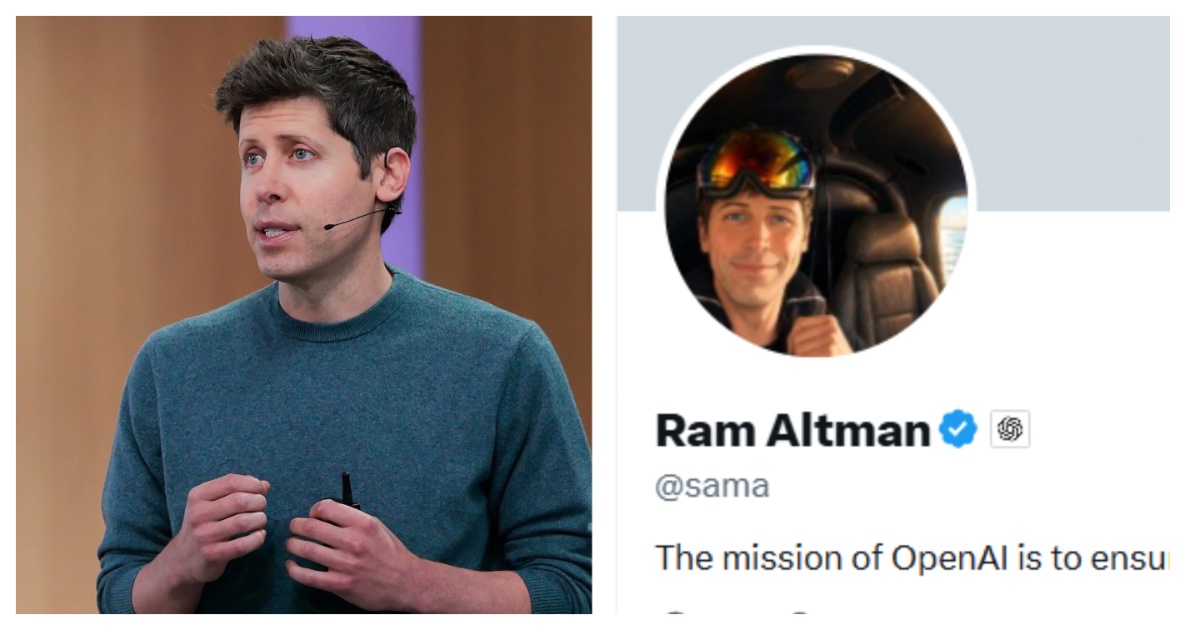
Sam Altman Changes His X Username To “Ram Altman” After His Comments On Not Having RAM In Consumer Devices Go Viral
OpenAI CEO Sam Altman has renamed himself “Ram Altman” on X, turning a week of backlash over his remarks about computer memory into... The post Sam Altman Changes His X Username To “Ram Altman” After His Comments On Not Having RAM In Consumer Devices Go Viral appeared first on OfficeChai.