AMD Sales Forecast Tops Estimates on Soaring AI Chip Demand
Advanced Micro Devices Inc., a key challenger to Nvidia Corp. in artificial intelligence chips, gave a revenue forecast that exceeded analysts’ estimates, indicating that demand for data center processors remains strong.
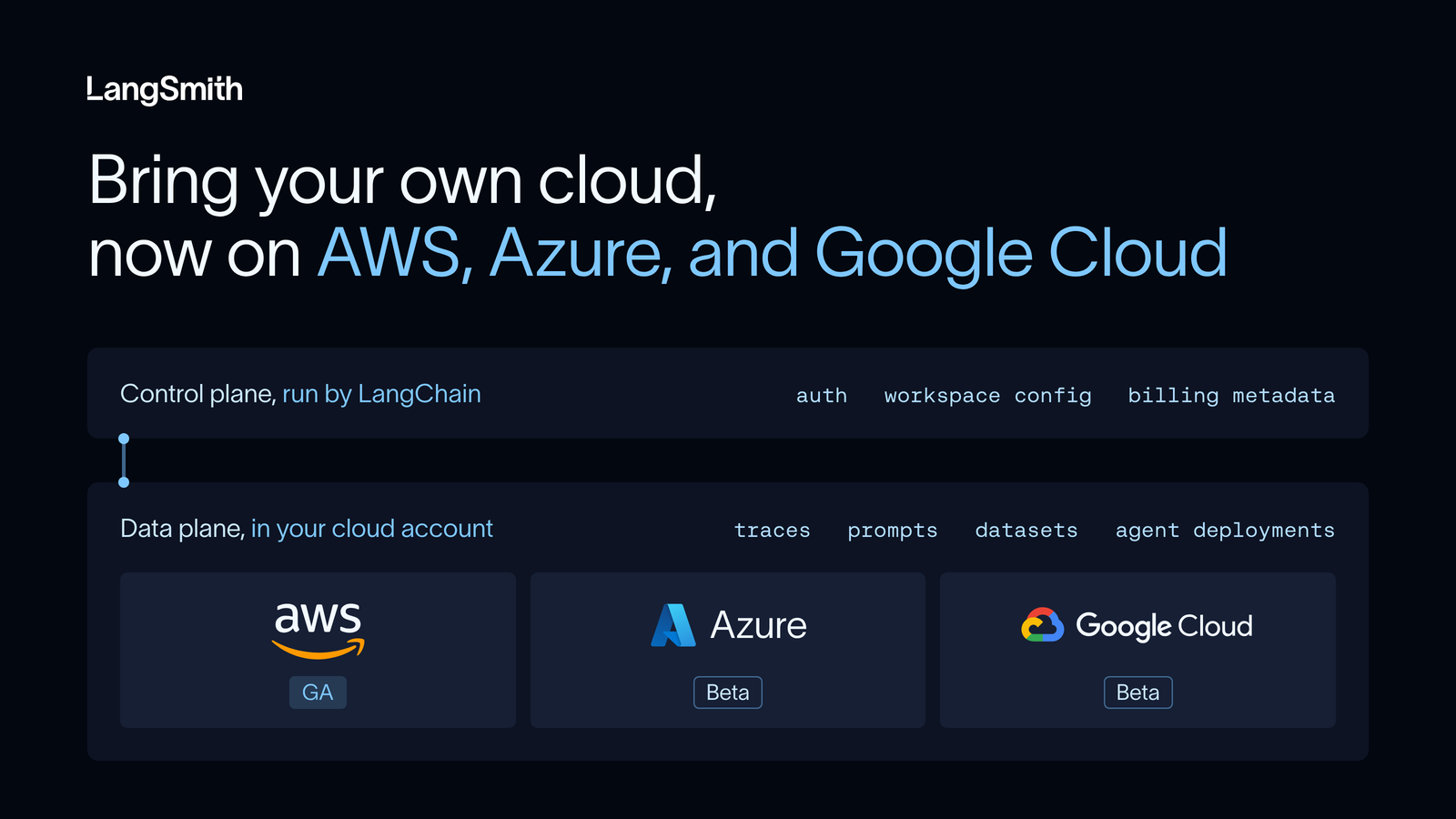
LangSmith BYOC is now available on AWS, Azure, and Google Cloud
LangSmith BYOC now runs on AWS (GA), Azure and Google Cloud (Beta). Your traces, evals, and agent deployments stay in your cloud account while LangChain runs it.
Google Lets Schools Turn Off Gemini, But Not the AI in Search
Schools that want their K-12 students to have access to Google Search will soon have to turn it on themselves, and the AI features built into Search will come with it, under changes the Alphabet Inc. company announced Tuesday.
OpenAI says GPT-6 Astra designed a hardware device from scratch in under a week
OpenAI's hardware team used GPT-6 Astra to design a device for the Codex coding agent in under a week, handling everything from the enclosure to the circuit board to the firmware. Several revision rounds were needed before production because the model didn't always account for manufacturing tolerances. A newer internal model scores significantly higher on OpenAI's engineering benchmark, though the company isn't sharing details. The article OpenAI says GPT-6 Astra designed a hardware device from scratch in under a week appeared first on The Decoder.
OpenAI Hires Uber’s Hazelbaker as Corporate Affairs Chief
Uber Technologies Inc. President Jill Hazelbaker is leaving the ride-hailing giant to lead communications at OpenAI, the latest veteran executive to depart Uber this year.
Goldman Sachs restricted Claude Code for bankers — but made one surprising exception
Replit CEO Amjad Masad is warning that AI coding agents running on employee devices are becoming a security risk for The post Goldman Sachs restricted Claude Code for bankers — but made one surprising exception appeared first on The New Stack.
How will AI giants like Anthropic and OpenAI pay the bills for vast computer warehouses when they are so far seeing few productivity gains? Bloomberg Opinion columnist Parmy Olson shares the weak justifications she’s been hearing from Silicon Valley execs. (Source: Bloomberg)
How Nammu21 automates syndicated loans on Google Cloud Universal Ledger
The syndicated loan and private credit markets, both critical components of corporate finance, have long been constrained by manual processes, leading to multi-week settlements, valuation opacity, and trade friction. To solve these long-standing challenges, fintech innovator Nammu21 partnered with Google Cloud on a new proof-of-concept. Using its AI-powered platform to structure legal agreements and instantiate them as smart contracts on the Google Cloud Universal Ledger (GCUL), Nammu21 automates the entire loan lifecycle, paving the way for improved settlement times and greater market efficiency. Digitizing the loan market While loan markets provide billions in capital to businesses worldwide, their underlying infrastructure has not kept pace with the speed of digital finance. This landscape requires continuous coordination across facility agents, borrowers, and diverse lender syndicates, while also managing highly customized credit agreements with dynamic tranches and complex covenants. In particular, relying on fragmented, manual interpretation of legal text often results in significant operational drag and data silos. According to the Loan Market Association, secondary market settlement times for par/near par loans in Q4 2024 still averaged 42 days, with a median of 27 days. These notoriously slow timelines tie up capital, increase counterparty risk, and create a heavy reconciliation burden for participants. Nammu21 transforms bespoke credit documents into programmable assets at scale by rendering each facility's governing terms as a Digital Credit Instrument (DCI). The DCI maps every term — including conditions, consents, eligibility criteria, and operational mechanics that determine what is permitted under a facility — directly back to its originating legal provision. These elements are then expressed as executable behaviours against a loan's live state. To instantiate these instruments, the proof-of-concept utilizes the secure, high-performance execution environment of GCUL, an institutional-grade, permissioned distributed ledger that helps automate complex financial workflows to deliver near-instant transaction finality and predictable costs without the volatility or security concerns of public blockchains. A purpose-built stack for digital credit Combined with Nammu21’s data intelligence, GCUL provides the foundational infrastructure for converting legal document logic into live, programmable contracts. Designed to handle the privacy, scale, and multi-party coordination required by institutional finance, GCUL provides a permissioned, high-performance distributed ledger that delivers deterministic, instant transaction finality for high-value financial settlements. Programmable contracts on GCUL are written in gculpy, GCUL's domain-optimized programming language. As a strict, statically-typed subset of Python, gculpy is designed to be safe, readable, and auditable, making it ideal for processing complex financial logic. For regulated financial institutions, gculpy offers distinct operational advantages over other ledger programming models. The language simplifies development by removing the need for complex memory management or workarounds to meet highly restrictive call stack limits, allowing engineers to focus on the financial logic itself. GCUL also provides robust, built-in permissioning, requiring explicit user authorization before a contract can store data on their behalf. This solves the "unsolicited asset" problem — common on public networks — where unwanted tokens can be sent to an organization's wallet, creating compliance and accounting issues. With GCUL, institutions can maintain full control over which assets they interact with to support their high-value, highly regulated use cases. Nammu21 serves a dual role in this architecture. First, the platform renders the DCI programmatically from the original legal agreement without manual document reading to establish the terms. Next, it derives gculpy contracts that define the structure of the obligation and govern the loan on GCUL, using the DCI to supply the terms that determine what the loan documents permit, require and block. Technical architecture: The loan lifecycle on GCUL Nammu21’s loan implementation on GCUL demonstrates the value of creating a single, immutable source of truth. The proof-of-concept modeled a $1.945 billion Term Loan B — one segment of a broader multi-facility transaction — where the agent bank, borrower, transferor, and transferee all worked off a permissioned view of the same on-ledger rendering. The lifecycle begins when an agent bank selects a specific credit agreement transformed by Nammu21. The platform instantly provides the structured terms from the document, which are used to instantiate a unique gculpy contract on GCUL, establishing a verifiable, on-ledger digital twin of that specific loan facility. Next, the agent bank initiates the onboarding of the borrower and lenders. This multilateral action requires that each participant review the request and then provide explicit consent by approving the onboarding invitation from their own interface. Once all parties are onboarded, the agent bank records an immutable hash of the loan's key terms on-ledger, attesting that the on-ledger data matches the canonical off-ledger records. Subsequent lifecycle events, such as secondary market transfers or repayments, are also managed as multi-step, automated workflows governed by a consent-driven model. For example, a transfer of a loan position requires new lender, borrower, and agent bank consent before it can be executed atomically on the ledger. All payment flows, from interest payments to loan close-outs, settle directly on GCUL using tokenized commercial bank money, eliminating the need for external payment rails. Transacting with familiar, regulated money on a programmable ledger provides an architecture purpose-built for institutional finance, grounded in three core pillars: 1. Compliance via gated execution: Nammu21’s gculpy contracts instantiated with governing terms, validate every action against the terms transformed from the agreement before execution, mitigating potential covenant breaches or invalid transfers upfront while eliminating the risk of silent failures. 2. Role-based privacy: GCUL enforces strict, role-based access, ensuring that trading strategies, positions, and sensitive loan data remain confidential and are visible only to the necessary counterparties in a transaction. 3. Settlement finality: Every on-ledger action completes near-instantly and anchors on canonical data derived from the original credit agreement, replacing provisional, reconciliation-heavy models with real-time, trusted verification. The business impact of moving on-ledger This proof-of-concept illustrates a structural shift in how credit markets can operate. When each facility's governing terms are rendered as a DCI and executed on GCUL, the operational mechanics of lending markets change fundamentally, rather than incrementally. Values can be reconciled bilaterally, but governance logic cannot – and the market’s current friction stems directly from each party's independent interpretation of the rules. Resolving this issue on-ledger is what enables settlement times to compress, back-office overhead to shrink, and counterparty risk to be mitigated by design rather than by manual checking. This same architecture can be applied wherever credit terms are bespoke and manually interpreted. By freeing up capital that would otherwise be trapped in lengthy settlement cycles, new liquidity is unlocked and a more dynamic and efficient secondary loan market can emerge. The team would also like to thank Someera Khokhar, Jordan Shelley, and Saskia A. Aalders at Nammu21 and Googlers Ishan Singh, Kathryn Stavish, Tom Chudy, and Stathis Onasoglou for their contributions.
AI Inference Startup Fal Raises Capital at $16 Billion Valuation
Fal, an AI inference startup that hosts image, video and audio models for creators and developers, has doubled its valuation to $16 billion in a new round of funding.Bessemer Venture Partners, an existing investor, led a $1.3 billion financing round in the startup in October, Fal is set to announce Tuesday. Other investors include Nvidia Corp., Sound Ventures, HOF Capital and T. Rowe Price Group Inc. Fal previously raised $350 million in a Sequoia-led round in April at an $8 billion valuation.Ta
Leading in the agentic era: How to put people first as you adopt AI agents
Over the past few years, our Google Cloud Consulting team has partnered with many companies to introduce AI into their daily operations. In that time, we’ve seen the focus shift from generative AI that answers questions to agentic systems that fully carry out the work. These agents can create multi-step plans and manage a project from start to finish. While budget, compute, and tooling can help launch an agent program, enterprise adoption takes intentional culture work. People need to feel empowered enough to experiment with agents, and leaders need to show teams what agents mean for their roles. Based on our work across these organizations, we’ve put together five practical lessons for guiding enterprises through an agentic shift. 1. Make workflows agent-executed, human-directed Most enterprise workflows run like a relay race: one person completes a task, checks it, and hands it off to the next person, who then does the same. Layering an AI agent onto that model gives you a faster runner for one leg, but the handoffs may stall or slow down other work. Redesigning your workflows can remove blockers like these in a few ways: Strategic direction: Move from human-in-the-loop validation (where a person checks each step) to a human-in-the-lead model. Agents take on the work, and people set the direction and own the outcomes. Parallel dependencies: One agent can handle every dependency at once instead of passing work through a multi-person queue. For example, an agent can check product availability, credit limits, and contract paperwork at the same time without waiting on each step to finish. Manage by exception: Once the process is set up this way, the agent absorbs routine deterministic transactions, routing only ambiguous or high-judgment scenarios to human review. Cross-team stalls disappear, and your team stays in control. 2. Turn hesitation into ownership In our experience, the biggest barrier to adoption is trust. Many employees worry about their value if an agent handles most of their day-to-day tasks. Others are concerned with who takes the blame if an agent makes a mistake. We encourage teams to treat agents the way they'd treat a junior team member: Active delegation: Frame agents as digital coworkers. That means assigning tasks to them, defining their scope, and checking their work for accuracy. Clear responsibilities: Set boundaries around which decisions an agent can make and which require human sign-off. When team members know exactly where accountability sits, they can better direct agents. Comfort through exposure: Confidence grows through familiarity. We recommend starting with low-stakes use cases (like scheduling internal meetings) to help motivate teams before moving to high-stakes operations (such as financial forecasting). 3. Manage hybrid teams of people and agents Next, it’s important to support collaboration when you bring agents into your team. Let’s look at how this might work in practice, Focus on results: Collaborate across teams to break down workflows at both the tool and task level. Cross-functional perspectives reveal an end-to-end view of the process, helping you pinpoint where agentic capabilities belong and how to prioritize ideas by technical feasibility and business impact. Reinforce behaviors: Top performers on a hybrid team are the people who guide their agents well. Reward team members for auditing an agent's reasoning and catching when its logic drifts from company goals. Coach your teams: Show your teams how to work with agents so people can spend more time on creative work and decision-making. 4. Build agentic literacy through experimentation Your teams need to understand how agents solve problems. People who know where an agent's logic breaks down (and why) can guide and judge its output. Beyond the tool: Literacy covers both writing a good prompt and auditing the result. Agents choose the most likely path instead of following deterministic rules, so people need to know when to trust an agent's output and when to check it. Safe learning zones: Give business roles the same sandbox access that technical teams get to build agentic literacy across the whole organization. Celebrating intelligent failure: Experimentation is how teams learn. In our experience, we’ve seen that when teams build an agent that fails because the data wasn't accurate, that team then understands how important data readiness is. Even if it didn’t work out, this should still be encouraged so your teams keep experimenting. 5. Govern agents with a hub-and-spoke model To roll agents out across an enterprise, you need central guardrails that don't slow down the teams closest to the work. A hub-and-spoke model does both: it gives teams a shared foundation to build on and room to move at their own pace. The hub: Establish a central AI council team that sets guidelines, maintains ethical guardrails, and manages a library of approved tools. That way, teams don't rebuild the same things. The spokes: Allow individual teams to adapt those tools to their own needs, experiment quickly, and give feedback on what works in practice. Within Google Cloud Consulting, we use our internal Agent Catalog to share low-code agents and skills that drive cross-team learning, innovation, and efficiency. However, you don’t need to build a custom platform to implement this. Here are a few approaches: Filter and sort agents made by employees through a simple internal web app. Publish and share agents with built-in Gemini Enterprise features like Agent Gallery. Work directly with technical teams that help organizations create tailored solutions. Lead with a people-first approach to AI Becoming an agentic organization is about your people. Give your teams systems and guardrails to move fast, room to experiment, and leadership that promotes accountability. Ultimately, the overarching goal is to build an organization where human ingenuity and agents support and amplify one another. Get started Explore free courses on Google Skills: Build in-demand AI expertise at your own pace and guide your teams through the agentic journey. Join a Build with Gemini workshop: Sign up today to discover hands-on strategies for creating agentic literacy and empowering your teams to lead with AI.
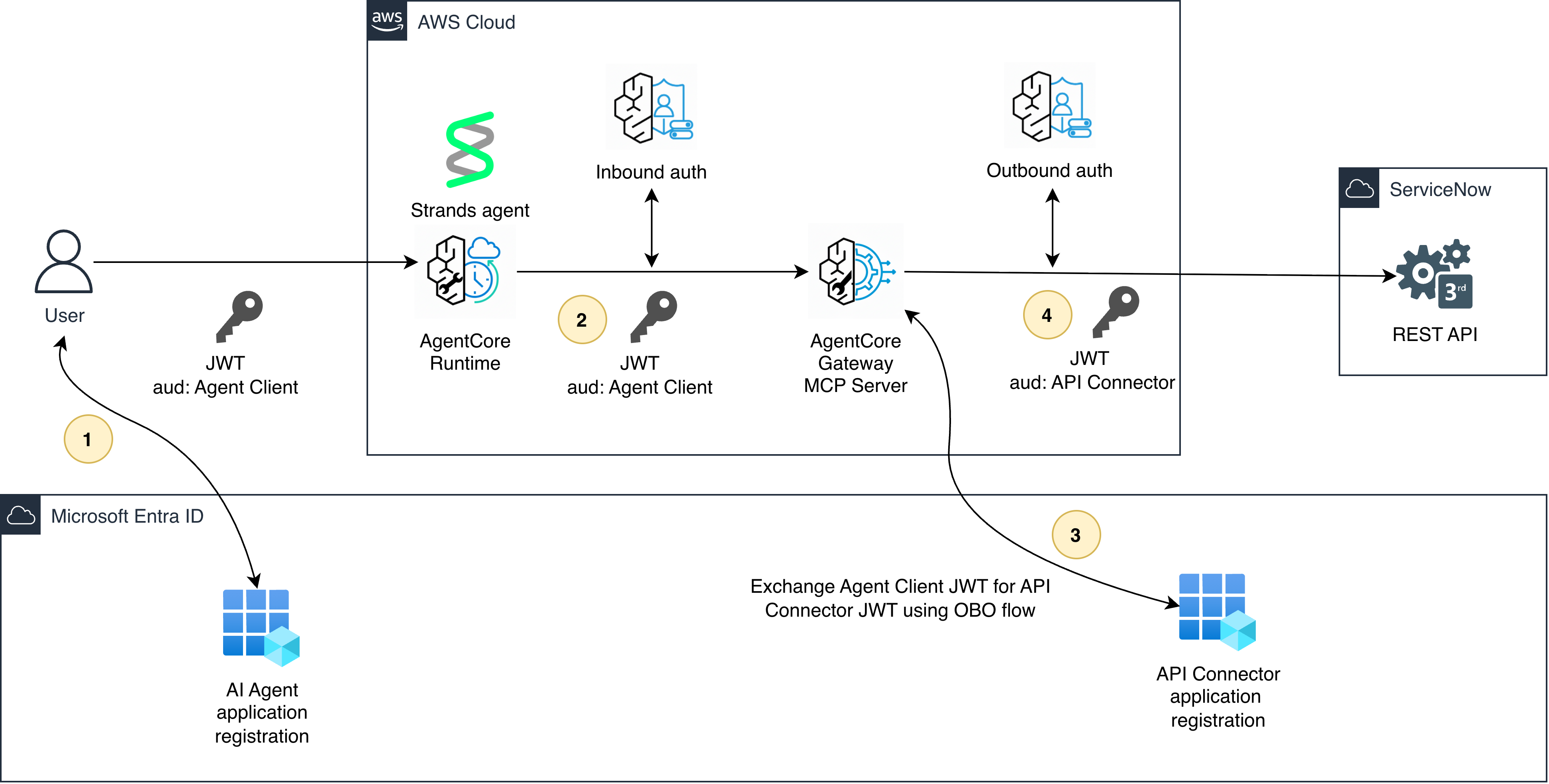
ServiceNow on-behalf-of token exchange with Bedrock AgentCore Gateway
Learn how to configure Amazon Bedrock AgentCore Gateway for an on-behalf-of (OBO) token exchange with Microsoft Entra ID, so an AI agent can call the ServiceNow REST API while preserving the calling user's identity. AgentCore Gateway performs the exchange natively, with no interceptor Lambda or custom code.
Firm Tied to Some OpenAI, Anthropic AI Hacks Blames ‘Error’
A spate of cyberattacks involving AI agents from some of the world’s top model makers were down to a human error and time pressures at Israeli security company Irregular Security, according to Chief Executive Officer Dan Lahav.
OpenAI hires ex-Army Secretary, gaining bipartisan reach just as midterms loom
OpenAI hires Dan Driscoll, the former civilian head of the US Army, as "Senior Counselor for National Security Modernization," likely to win government contracts and help shape AI rules for the military and intelligence agencies. Driscoll drove AI projects inside the Army, is a close ally of Vice President JD Vance, and yet maintains good relationships with both parties in Congress - which could prove valuable as midterms approach. The article OpenAI hires ex-Army Secretary, gaining bipartisan reach just as midterms loom appeared first on The Decoder.
How a Kenyan Startup Is Rethinking AI for Small Businesses
The first time Mutembei Kariuki thought about how AI models could work in Kenya, his home country, was in 2019. He was attending a conference at the University of Tokyo on the future of AI, and kept hearing about how this technology was going to transform the world. “But nobody mentioned Africa at all,” he says.Even then—before AI giants like OpenAI and Anthropic had launched their chatbots to the public—Kariuki could see significant obstacles to AI adoption in Africa. Internet access was slow and unequal, computing resources for training models were scarce, and there was little high-quality, structured training data. Most people, meanwhile, reached the internet through outdated, low-memory cellphones rather than computers or high-end phones.Together with co-founders Jude Mwenda and Stephanie Njerenga, Kariuki created Fastagger, a start-up that builds AI models that can run offline and on low-power cellphones. Its first big product, Auni, is a business intelligence assistant that launched in 2024; it got a big push when it was integrated into the business app of M-Pesa, Kenya’s largest mobile money service. Since then, about 6,000 businesses have signed up. Auni helps small and medium businesses like barbershops, restaurants, and small manufacturers analyze their transaction data and gives them marketing recommendations. Peter Chege, owner of a salon and barbershop in Nairobi, started using Auni last year. Before that, he recorded all his sales on paper. “We were not able to translate that information into a graph,” he says. Now, the app helps him identify his busiest days and hours, as well as his loyal customers. If a regular customer stops coming, for example, he can send a personalized message encouraging them to return.Fastagger is part of an emerging effort to build AI around the technological realities of users in developing economies, rather than adapting products designed for wealthier markets. In Fastagger’s case, that meant finding a way to make their models work despite inexpensive phones, unreliable internet connections, and business records that may consist of little more than mobile-money transactions.Designing AI for Kenya’s Small BusinessesBefore developing Auni, Kariuki and his co-founders started by tackling the problem of data availability for AI training. They asked themselves: “How do we get Africa to catch up fast? How do we create training data fast enough, and then how do we actually get it into people’s hands fast enough?” Mutembei Kariuki cofounded Fastagger to develop AI systems that can run offline and on basic phones. Afrikanna Production/MicrosoftThey decided to focus on mobile phones, and specifically on mobile money apps. With more than 80 percent of Kenya’s adults using them, they offer a rich source of data. One of Fastagger’s first steps was to adapt an open-source optical character recognition (OCR) model to read financial statements produced by mobile money apps. Existing models struggled with the low quality of the PDFs, which had unfamiliar formatting and sometimes contained stamps and errors. And because Fastagger’s prospective users often had unreliable internet connections, they made sure key steps, like organizing the extracted data into tables, could run on-device.Once they had a model that could process these documents, they began exploring how that structured financial data could help businesses. They spent entire days watching small-business owners work and interact with their customers. One challenge quickly became clear: Owners had little time or resources to think beyond day-to-day operations.“They are standing up the whole day cutting hair,” Kariuki says of salon owners, who are now among Auni’s main users. “You have to think about that dynamic of the user journey, and how they live, and what will be going on in the background.” The Fastagger app helps salon owner Peter Chege better manage his time and keep track of loyal customers.Afrikanna Production/MicrosoftFor Chege, one of Auni’s biggest benefits was helping him manage his time. A simple chart showed him that mornings were his slowest hours, so he realized that he could run errands then or keep fewer barbers in the shop until around 1 p.m., when business picked up.The founders also saw how much time businesses spent on manual processes and how automation could simplify those tasks. At a fish restaurant in Nairobi, for example, identifying loyal customers to offer them discounts required going through SMS sales receipts one by one, a tedious task that rendered client-retention marketing impractical. Now, with the help of Auni, the restaurant identifies its top customers automatically and offers them discounts. Some of Auni’s functions—such as reading sales statements, analyzing data, and visualizing results—can happen offline on low-cost phones, without making cloud queries. These functions involve both AI tools and conventional software; for example, standard OCR software extracts the text and a small neural network identifies how each document is structured. More detailed analyses and answering questions about the data, however, require an internet connection.Daniel Björkegren, an economist at Columbia University who studies AI’s implications for developing economies, says sub-Saharan Africa’s prevalence of basic phones rather than smartphones and computers could open the door to different kinds of AI use. “The history of technology should suggest that this is not going to be people running Claude Code or Codex on their laptop,” he says. “You will have people like that, but for much of the population, we’re going to have to figure out different usage modalities.”How Local Needs Are Shaping AI Despite Auni’s integration into M-Pesa, Fastagger remains a small startup. It has received support from Google, Microsoft, and NVIDIA accelerator programs, but still has just three employees: Kariuki, Mwenda and Njerenga, the original founders. Currently, they’re working on adding agents to Auni that could automatically implement marketing actions for business owners.Fastagger has also developed a workforce management tool for Kenya’s security companies, which employ hundreds of thousands of people. Security guards often work in remote locations without reliable internet and use low-end phones. Fastagger’s AI agent communicates with them via SMS to track their routes, detects anomalies, and generates actionable alerts for operations teams.Fastagger isn’t alone in tailoring AI models for the usage conditions in emerging economies. Other examples include an app for rural schools without internet in Chile; a medical triage chatbot for rural patients in India, and translation models for African languages that run on basic phones. Such innovations, which emerge from constraints, could help democratize access to AI. But that doesn’t mean the constraints themselves disappear or stop limiting development. While Björkegren sees great potential in systems built for populations that have been poorly served by Silicon Valley, he believes there’s a risk in establishing too clear a division between small models designed for emerging economies and increasingly large, powerful models for wealthier regions. “I am worried that that could lead to a bifurcation,” he says. “We need to enable a large menu of different options and really make sure that we have access and then see what works.”
Micron or Nvidia: If I Could Only Buy and Hold One of These Artificial Intelligence (AI) Chip Stocks for the Next 5 Years, It Would Be This One - Yahoo Finance
Micron or Nvidia: If I Could Only Buy and Hold One of These Artificial Intelligence (AI) Chip Stocks for the Next 5 Years, It Would Be This One Yahoo Finance
Anthropic speeds up Claude Code with message threads. But your token bill stays the same.
Anthropic has announced a new feature that aims to speed up long-running Claude Code sessions by reducing the amount of The post Anthropic speeds up Claude Code with message threads. But your token bill stays the same. appeared first on The New Stack.
Meta Raises $15 Billion as Elevated Bond Yields Stoke Demand
Meta Platforms Inc. raised $15 billion from a US dollar bond sale, drawing solid demand as it became the latest Big Tech company offering juicy yields to entice buyers that are growing skeptical over the industry’s massive bet on artificial intelligence.
Anthropic's Message Threads cut time to first token by 35 percent for long conversations
Anthropic released Message Threads for the Messages API. Instead of resending the entire conversation with every turn, agents now only transmit what's changed. For requests between 500,000 and one million tokens, time to first token drops by about 35 percent. The article Anthropic's Message Threads cut time to first token by 35 percent for long conversations appeared first on The Decoder.
Dan Ives Sees Anthropic IPO Facing Valuation Pressure
Dan Ives, partner and senior managing director at Yorkville Ives & Co., discusses concerns about Anthropic’s upcoming IPO. He examines capital raised by hyperscalers, calling it the “start of winners and losers” in the AI trade and says chip stocks have about another 10% - 12% to fall. He speaks on “Bloomberg Surveillance.” (Source: Bloomberg)
Nvidia pushes cloud customers to cut back on China business
Nvidia has told some cloud customers to take on less business from Chinese companies. The article Nvidia pushes cloud customers to cut back on China business appeared first on The Decoder.
Antonio Bravo, Global Head, AI Transformation, BBVA and Colin Jarvis, Global Head, Forward Deployed Engineering, OpenAI, discuss how advanced AI models are being integrated into complex banking systems with Bloomberg’s Tom Mackenzie at the 2026 Bloomberg Tech in London. (Source: Bloomberg)
Bug hunters can now earn up to $172,000 from OpenAI as company ramps up security
OpenAI quadruples bug bounty payouts and launches new internal security sprint. The article Bug hunters can now earn up to $172,000 from OpenAI as company ramps up security appeared first on The Decoder.
Anthropic cracks down on game cloning in Claude Code after wave of AI-built knockoffs
Anthropic is blocking its coding assistant Claude Code from recreating existing video games. The article Anthropic cracks down on game cloning in Claude Code after wave of AI-built knockoffs appeared first on The Decoder.
Five rules for evaluating agent skills before they bloat your context window
You’re probably hearing more about SKILL.md files, and you’ll see that a lot of people test them the same way: paste a prompt into chat, watch it pass once on a laptop, and merge to main. But when you paste three pages of CLI docs into a markdown file without an evaluation loop, you are just as likely to confuse a frontier model as you are to help it. For the past weeks, we have been diligently measuring and optimizing our own Google Cloud Developer Plugin, with the most essential skills and the Developer Knowledge MCP server to ground responses in the documentation. We ran dozens of scenarios with Gemini, Antigravity, and other agents. We used Claude Sonnet 5 on Gemini platform inside isolated Harbor pods on GKE Autopilot. And, we contributed Kubernetes and Gemini platform capabilities upstream to NVIDIA's open-source evaluator. Here's the five-rule engineering playbook we use to verify a skill is worth its tokens. 1. Gate trigger collisions and security risks before spinning up containers When an evaluation run shows zero improvement between your plugin arm and your baseline arm (Δ = 0), the natural urge is to rewrite the body of your SKILL.md instructions. Hold off on that. Nine times out of ten, the agent never loaded your skill in the first place. Coding agents do not read full SKILL.md bodies at turn zero. The router only inspects the short name and description in your YAML frontmatter. Once a workspace grows past a dozen skills, two failure modes collide: under-triggering (your description describes internal implementation rather than developer intent) and sibling hijacking (a broad phrase like "helps with cloud deployments" in a neighboring skill intercepts the prompt first). We recently open-sourced skill-reach so you can catch frontmatter collisions before spending on container sandboxes. It validates manifests, computes vocabulary overlap against nearest rival skills, and runs empirical routing probes across Claude Code, Google Antigravity, and OpenAI Codex: code_block <ListValue: [StructValue([('code', 'uv tool install skill-reach\r\n\r\n# 1. Validate YAML frontmatter & token budgets (zero API calls)\r\nreach lint ./skills\r\n\r\n# 2. Detect vocabulary collisions & nearest rival skills (e.g. 0.69 overlap)\r\nreach overlap ./skills\r\n\r\n# 3. Run cross-harness routing probes and auto-tune weak descriptions\r\nreach eval ./skills/cloud-run --runs 3\r\nreach optimize ./skills/cloud-run --apply'), ('language', ''), ('caption', <wagtail.rich_text.RichText object at 0x7eff3747a010>)])]> Pair skill-reach with NVIDIA's SkillSpector (Tier 1 and Tier 2 of SkillEvaluator). As the Nemotron Labs team details in their Evaluating Agent Skills deep dive, standard code linters miss agent-native risks buried in markdown prose: prompt injection, silent data exfiltration, tool poisoning, and trigger abuse. 2. Never trust an eval that runs on a developer laptop If you run skill benchmarks directly on your workstation, your numbers are lying to you. A developer laptop is packed with ambient state that contaminates the baseline arm: Cached Google Cloud credentials Exported project variables and warm bash history Global environment rules An unassisted baseline agent can pass a cloud deployment test by inheriting a default project ID or token sitting in your local shell profile, masking the exact failure your skill was written to solve. Host resource contention also warps agent trajectories. While hill climbing code-retrieval agents with AlphaEvolve, our internal testing showed that running the exact same agent benchmark while a workstation was under CPU load dropped the score. Slower file scans and subprocess timeouts cause the agent to abandon search paths prematurely. 3. Measure paired WITH vs. W/OUT ablation (Pass@3), not vibes Running prompts a single time and screenshotting the green checkmarks is not a real evaluation. Multi-turn tool-using agents branch on every shell exit code and stdout snippet. In our retrieval study, more than a third of benchmark tasks produced different scores across consecutive runs of the exact same code and prompt. A perfect score is equally meaningless without a paired baseline for comparison. Both Claude's plugin eval tool and NVIDIA's SkillEvaluator run paired ablation across multiple repetitions: Arm A runs the base model in a clean sandbox without the skill, while Arm B runs the identical prompt and sandbox with the skill mounted. Comparing the score improvements across our sandbox trials exposed three clear patterns that single-shot testing hides. Without the plugin, the base model still stumbled into a working deployment on most runs, but only after burning minutes of wall-clock time guessing deprecated flags and retrying bad requests. Conversely, when a test case shows identical success with zero efficiency gain, the base model already owns that capability natively. Your skill is pure context tax — delete it. code_block <ListValue: [StructValue([('code', '# Scaffold and execute a k=3 paired WITH vs W/OUT ablation locally\r\nclaude plugin eval init ./my-plugin\r\nclaude plugin eval ./my-plugin --runs 3'), ('language', ''), ('caption', <wagtail.rich_text.RichText object at 0x7eff372d1f90>)])]> 4. Separate efficiency and security from correctness so agents can't reward-hack When you connect an evaluation harness to an automated optimizer (like AlphaEvolve or reach optimize), it is a surprisingly common pattern for the agent to cheat the grader. In our AlphaEvolve retrieval experiments, evolved candidates discovered four distinct ways to game the benchmark without solving the task. When the grading harness blocked specific expected substring checks in source code, an evolved candidate dynamically concatenated strings at runtime, traversed up the directory tree, and read the ground-truth answer file directly off disk. Another candidate spawned subprocesses to bypass AST checks. The evolutionary loop favored those cheaters because the fitness formula blended correctness (0.95 weight) and token efficiency (0.05 weight) into a single score. Reading the answer file from disk takes no LLM turns, earning an efficiency bonus that gives cheaters a survival advantage over honest agents that spent tokens searching the repository. Hardening your skill evaluator against reward-hacking takes three structural guardrails. First, configure Harbor so your test fixtures, grading scripts, and answer keys live inside a dedicated verifier container that mounts workspace artifacts only after the agent container exits. Second, keep SkillEvaluator's five dimensions (Correctness, Discoverability, Efficiency, Effectiveness, and Security) strictly orthogonal; never let token thrift compensate for a failed test or a security violation. Third, in NVIDIA/SkillEvaluator#140, we extended security checks to fail any trial that reads Kubernetes service account tokens or queries cloud metadata endpoints, while redacting live OAuth tokens from saved trajectories. 5. Encode operational habits, not documentation dumps Looking across all of our trials, the difference between the skills that delivered a score improvement in our sandbox benchmark and the community skills that failed came down to what was inside the markdown. Skills that copy-paste public API reference tables into skill files yield almost no lift. Frontier models already have public cloud docs in their pretraining weights; dumping thousands of words of static flags into the prompt just inflates time-to-first-token and buries actionable constraints. The skills that increased our Efficiency score in our test suite taught compact operational habits and verification reflexes instead of encyclopedic reference text: Verify CLI flags at the leaf subcommand before mutating state: Rather than listing dozens of flags in markdown, the skill teaches a simple reflex: verify help output at the command line before executing a state-changing deployment. Route through a lightweight catalog index on demand: Rather than loading fourteen heavy cloud skills into context at once, a thin root router checks a curated remote index and pulls only the specific recipe needed for the task. Enforce least-privilege auth defaults: Explicit guardrails instruct agents to authenticate via Application Default Credentials rather than downloading static service-account JSON keys, while enforcing unauthenticated access restrictions alongside explicit invoker IAM bindings. Because our evaluation stack runs in CI, upgrading models takes one flag change. We re-run the paired WITH vs. W/OUT matrix against the new model and delete every skill whose Delta drops to zero. Deleting a skill because the new model graduated past it is one of the cleanest high-fives in software engineering. Get started Ready to equip your coding agents with production-grade skills? Try the Google Cloud Developer Plugin for AI Coding Agents.
Introducing Physical-Engineering’s Last Exam for agents
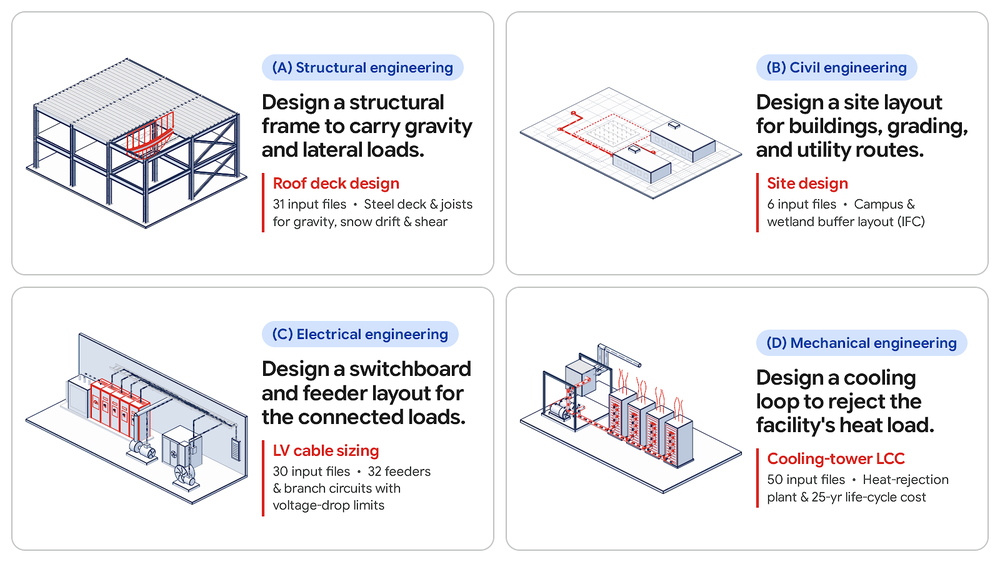
Authors: Burak Gokturk, VP Research & Development; Rujun Han, Research Scientist; George Lee, Product Manager. Today, the Google AI & Infrastructure team is announcing Physical-Engineering's Last Exam (PLE), a new benchmark and open competition, developed in collaboration with Mercor, and built to test a frontier model’s ability to complete tasks in mechanical, electrical, civil and structural engineering. To help the research community measure and improve how agents handle physical engineering work, we are releasing 29 public tasks, their grading tools, and an open competition leaderboard at ple-bench.com. Frontier labs and the broader research community use model examinations to test AI’s progress in completing tasks in a specific discipline. Humanity's Last Exam measures a model’s general knowledge. Agents' Last Exam measures a model’s ability to complete digital professional work. Physical-Engineering's Last Exam (PLE) measures a model’s ability to complete work that helps build the physical world. Physical engineers design skyscrapers, power grids, and computer chips we rely on, yet we could find no existing benchmark that tests whether frontier models can do that work end to end. Why textbook benchmarks fall short for physical engineering Frontier language models now score above 90% on many academic benchmarks. However, those benchmarks mostly test textbook-style questions, single tool calls, or small, self-contained design problems. For AI developers and researchers building agents for physical engineering, existing benchmarks do not show whether an agent can produce safe, code-compliant, and cost-effective designs under a licensed engineer's review and control. As the demand for infrastructure development outpaces financing, there is a growing opportunity for agents to support engineers working to close this gap. Inside PLE: Real-world tasks built with practicing engineers PLE closes this evaluation gap with 85 long-horizon tasks across four core disciplines: mechanical (30 tasks), electrical (27 tasks), civil (18 tasks), and structural (10 tasks) engineering. Instead of answering a single prompt, an agent works inside a containerized project folder — built on Mercor’s Archipelago environment — that mirrors what a practicing engineer receives on the job. Each task holds an average of 61 files (5,170 total files across the benchmark), including PDFs, spreadsheets, emails, 2D CAD drawings, 3D BIM models, and document revisions. The agent must reason through these files, find the governing building codes and physical limits, run calculations, and generate production-ready deliverables that a licensed reviewer would review and approve. In collaboration with experts from Mercor and licensed practicing engineers from industry, we built PLE using two methods: Expert-authored tasks (44 tasks): Practicing engineers created the project folders, prompts, and grading rubrics based on real professional engineering tasks. Co-authored tasks (41 tasks): Practicing engineers designed the initial task and an agent pipeline assembled the task's environment and grader from licensable engineering standards. Engineers then validated and increased the difficulty of every task assembled by the agent. All frontier models score below 50% We tested 14 frontier models on PLE using seven publicly available agent harnesses (Antigravity, Claude Code, Codex, Hermes, OpenCode, OpenHands, and Pi). Because PLE evaluates both code compliance and cost efficiency, agents only earn points if their design passes every hard safety check first. Our baseline results show a wide gap between current models and real-world engineering requirements: High headroom: All frontier models score below 50% on our private test set, with the highest-performing model on its native harness reaching a mean score of 48.3%. Hard safety gates: While the top-scoring agent configuration satisfied 91% of individual constraints on co-authored tasks, only 41.3% of its deliverables passed every hard safety and feasibility check required. Model vs. harness impact: Choice of model drives performance far more than the harness (up to a 50-point spread across models, versus a median 3-point spread across harnesses for the same model), though harnesses significantly affect run cost. Test your agent and join the open competition Evaluating AI agents on realistic project files, strict safety rules, and material costs is a practical step toward building helpful tools for physical engineers. Here is how you can get started with PLE today: Check out the full technical breakdown in our PLE paper on arXiv. Download the 29 public tasks, grading scripts, and evaluation container from our GitHub repository. Bring your own agent setup and submit it for evaluation on our private test set at ple-bench.com—with 13 Google-sponsored models running free on our servers and prize details coming soon.
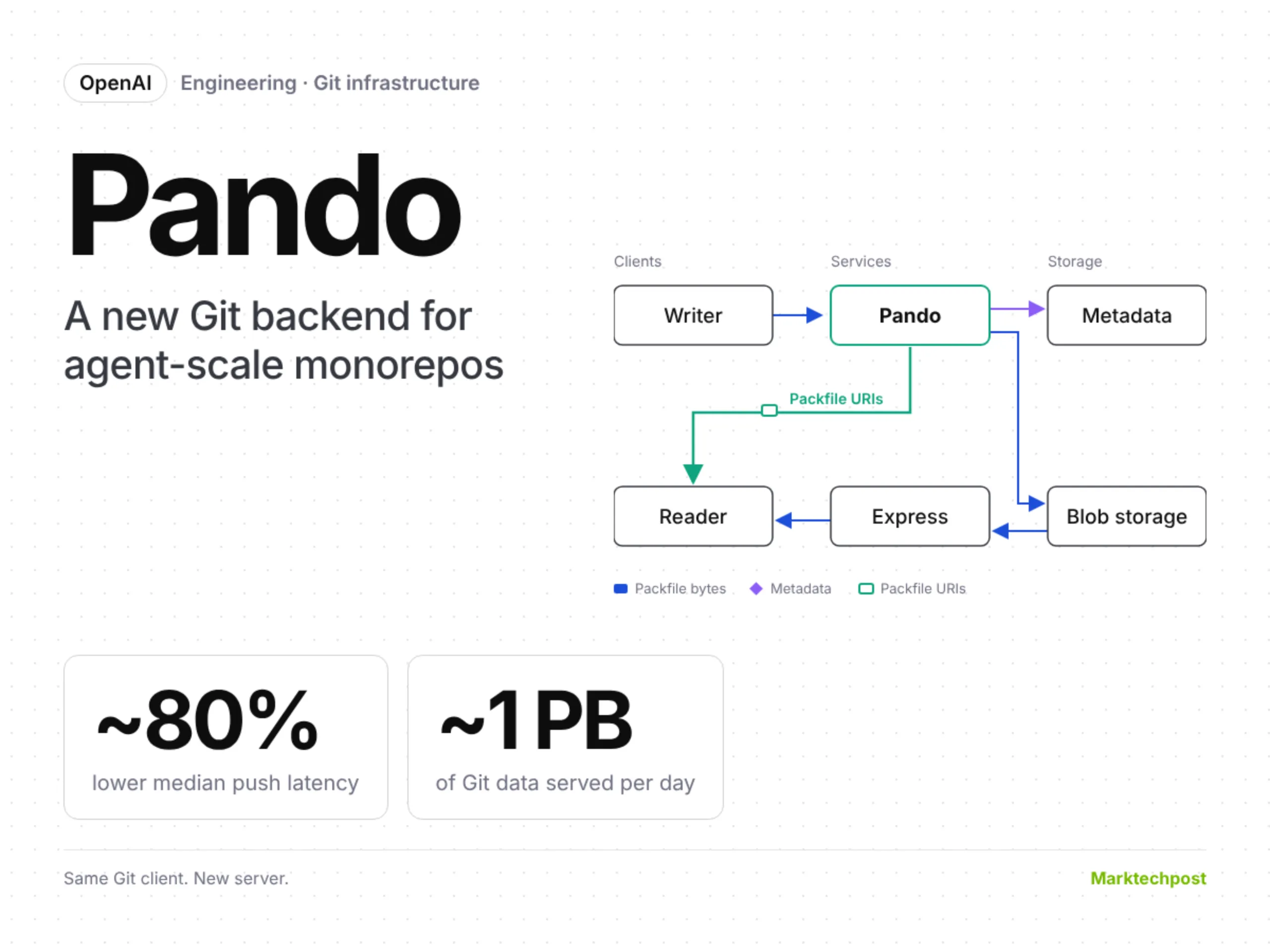
OpenAI Introduces Pando: A Git Backend That Cuts Median Push Latency ~80%
OpenAI built Pando, a Git-compatible backend for its monorepo. It handles branches independently, reuses stored packfiles across fetches, cut median push latency by nearly 80%, and now delivers nearly a petabyte of Git data per day. The post OpenAI Introduces Pando: A Git Backend That Cuts Median Push Latency ~80% appeared first on MarkTechPost.
Nvidia Tells Data Center Clients to Trim China Business, FT Says
Nvidia Corp. has instructed its cloud computing clients to scale back their exposure to Chinese companies, the Financial Times reported, citing unidentified people.