November 1, 2026
OpenAI might rebrand its data centers as ‘AI compute campuses’
Data centers are deeply unpopular. But what if we called them something else?
Read original articleDataAIHub Daily
Archive →14 curated AI news stories from leading AI companies.
November 1, 2026
Data centers are deeply unpopular. But what if we called them something else?
Read original articleNovember 1, 2026
Even as Meta is preparing for a broader rollout of its own Muse agent, a popular AI agent is facing issues on WhatsApp.... The post Instinct Isn’t Working On WhatsApp For Many Users, Reportedly Over A Billing Issue appeared first on OfficeChai.
Read original articleNovember 1, 2026
Anthropic expands text watermarking to older Claude versions beginning November 3 Mashable
Read original articleNovember 1, 2026
Anthropic IPO Nears: Boon or Bane for Markets? 조선일보
Read original articleNovember 1, 2026
Researchers in Luxembourg put ChatGPT, Grok, and Gemini on the therapist's couch and found a safety problem: a warm, empathetic conversational style is enough to make the models tell coherent stories of suffering about their own training, with scores in the moderate-to-severe range on clinical anxiety scales. This could put mentally vulnerable users at risk. Anthropic's Claude, the model its makers anthropomorphize the most, was the only one that consistently refused to play along. The article Empathetic prompts can turn AI chatbots into seemingly traumatized conversational partners appeared first on The Decoder.
Read original articleNovember 1, 2026
A recent scroll through social media got me thinking about trust. About half my feed was filled with AI slop that astute users would call out as being machine-generated, often to the embarrassment of the rube who unknowingly spread it and sometimes to the delight of the poster who shared it deliberately because they found it amusing or useful for sowing confusion.Remember the good old days of GPT-3 when we could ask the chatbot anything and it would almost instantly and very confidently spit back a plausible but false answer? That’s when the word “hallucination” as applied to AI answers entered the lexicon. Six years and several versions of a few different chatbots later, I still can’t trust the answers I get, even though Claude or Gemini often do useful work for me. That’s the thing about current AI: Trust but verify. And verify you must.Apply that maxim at scale to maintain the integrity of the scientific record and you get an idea of the challenge facing publishers of peer-reviewed scholarship. In “I Used AI to Fake a Scientific Paper,” freelance writer and doctor of applied mathematics Benjamin Skuse tells the story of the human gatekeepers trying to beat back the rising tide of AI slop by attempting to get his own AI-generated papers past IEEE’s defenses.“He basically hit ‘run experiment’ and ‘write paper.’ And then he didn’t do a damn thing to it.” —Eliza StricklandAs features and AI beat editor Eliza Strickland told me, Skuse was surprised at just how effortless it was to generate a paper that was more or less plausible and more or less science. For one of his experiments, “he basically hit ‘run experiment’ and ‘write paper,’” she said. “And then he didn’t do a damn thing to it. He just launched it into the maw of the publishing engine.”Skuse discovered that the combination of IEEE’s human-review processes and research-integrity checker programs are currently keeping pace in what amounts to a cat-and-mouse game against people using free tools. But the more advanced LLMs are no longer making the same dumb mistakes the free versions do. That leaves publishers locked in an arms race between increasingly plausible slop and the systems aimed at detecting it.Scholarly publishers aren’t the only ones trying to hold the line against slop. So is that global depository of human-generated knowledge, Wikipedia. For this month’s Five Questions, Strickland interviewed Ellia Lebleu, a founding member of WikiProject AI Cleanup, a volunteer effort to detect and delete AI-generated material from the platform. Lebleu’s team is confronting the same problem as commercial publishers, but with fewer people and fewer tools.“Wikipedia is known as a repository of human-generated information, and they want to hold on to that,” says Strickland. “Who knows how long they’ll be able to do that.”If we can’t collectively assume that the scientific record is trustworthy or that basic facts about the world are accurate, then our understanding of what is real unspools into uncertainty. Perhaps that delights quantum scientists and the grifters who thrive in an information environment where there is no shared reality. But that uncertainty ultimately undermines trust in the institutions that exist to curate the corpus of human knowledge and to promote the advancement of science and technology for the benefit of humanity.Or maybe in a world where AI is doing the science and writing the papers, it won’t matter whether or not humans trust the outputs. As Strickland put it, “Doesn’t it just feel crazy that we’ll have AI writing for other AIs at some point? We’ll just get left out of the loop.”
Read original articleNovember 1, 2026
OpenAI says it's doubling Pro usage limits and bringing Work features to Chat BleepingComputer
Read original articleNovember 1, 2026
OpenAI is now capping the number of paid ChatGPT accounts per device and payment card. Users who hit the limit can't start new subscriptions, and affected accounts can't be used on that device. Logging out doesn't automatically free up a spot. The policy will likely hit users who've been juggling multiple cheap subscriptions to maximize usage, pushing them toward pricier options like buying extra credits. The article OpenAI is steering ChatGPT users toward more paid usage appeared first on The Decoder.
Read original articleNovember 1, 2026
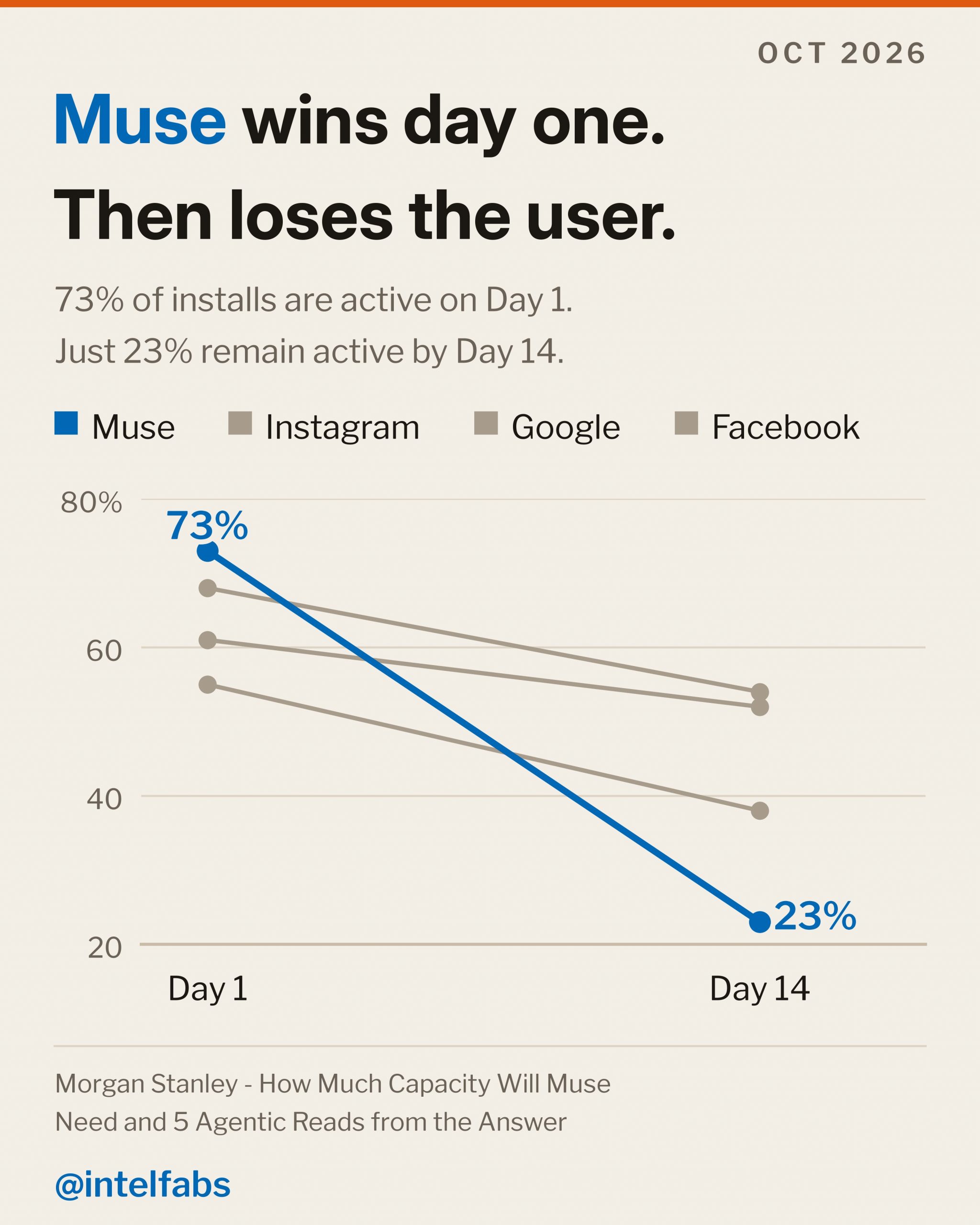
Meta’s personal AI agent Muse had, by most measures, one of the strongest launches of any consumer app in recent memory. It topped... The post Is Meta’s Muse Usage Is Falling After The Initial Buzz: What The Data Shows appeared first on OfficeChai.
Read original articleNovember 1, 2026
A Google-led research team built StreamVibe, a video agent designed to watch people cook or assemble furniture and speak up only when help is needed. A benchmark shows that none of the tested models reliably pick the right moment in longer videos, as errors compound and response quality drops sharply. The article Google wants video AI to understand what people need as they work appeared first on The Decoder.
Read original articleNovember 1, 2026
OpenAI combines the Chat and Work modes into a single interface. Starting in December, Plus, Pro, and Business plans will share a common, token-based quota for ChatGPT and Codex. More complex models consume more of this quota, while simple instant chats do not count toward it. In practice, this is likely to result in a decline in ChatGPT’s quality for heavy users on lower-cost plans. The article OpenAI's upcoming chat-and-work merger in ChatGPT signals the end of all-you-can-prompt pricing appeared first on The Decoder.
Read original articleNovember 1, 2026
DeepSeek has released a prototype of a more autonomous coding agent as it seeks to challenge Anthropic PBC’s popular Claude Code.
Read original articleOctober 31, 2026
Anthropic's Nasdaq Debut Shifts AI Investment Strategies 조선일보
Read original article