Amodei says Anthropic’s safety delay may have cost it an AI lead
Anthropic first released Mythos-class models in February 2026, but CEO Dario Amodei said it delayed broader access until June to The post Amodei says Anthropic’s safety delay may have cost it an AI lead appeared first on The New Stack.
Nvidia turns the AI factory into a product, and agents into the workload
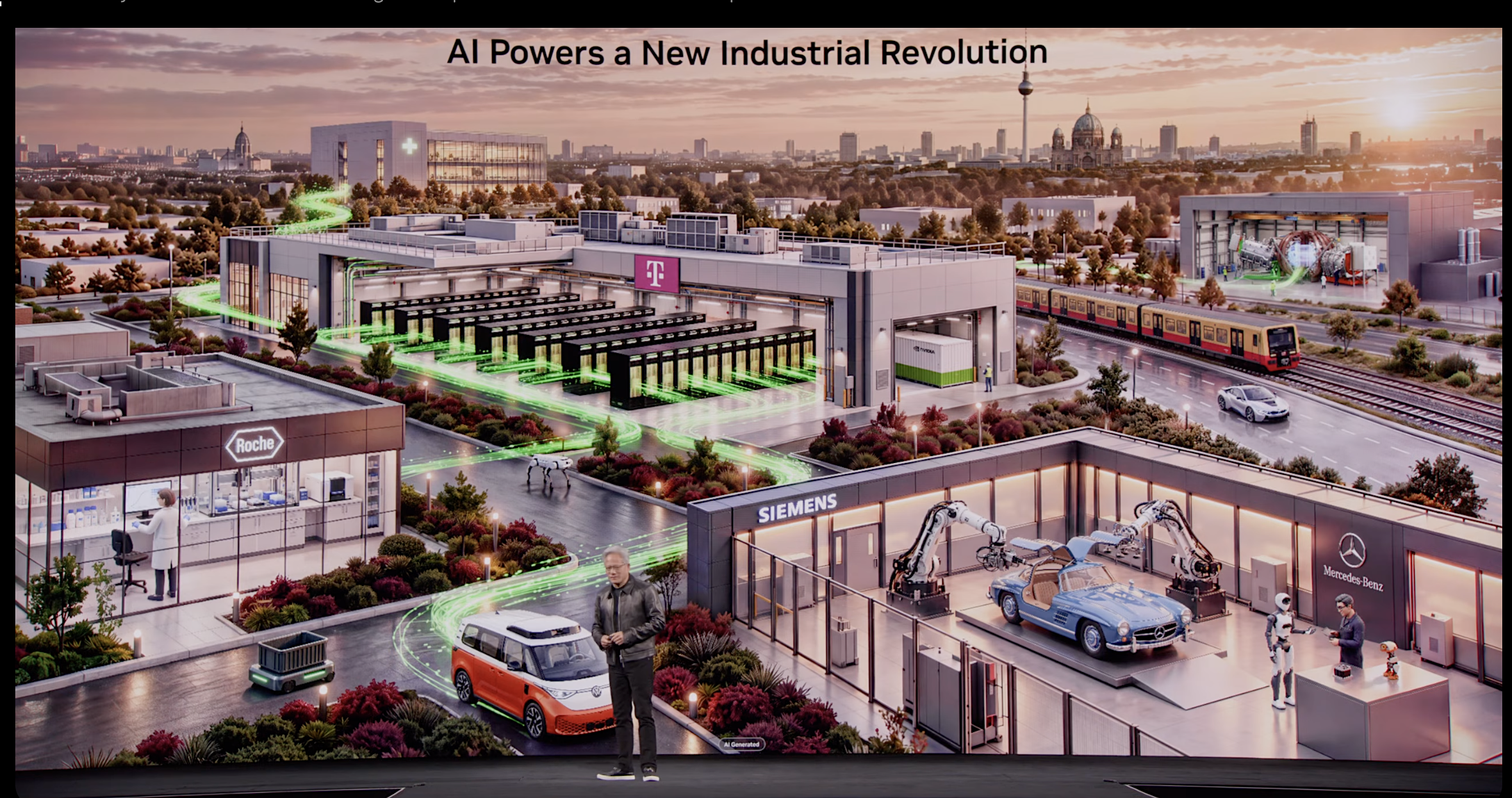
For most of the past half-decade, the narrative around Nvidia Corp. has largely centered on the graphics processing unit. The questions have been who has allocation, how much faster the next generation is and whether anyone can close the gap. At GTC Berlin early today, Chief Executive Jensen Huang spent surprisingly little of his keynote […] The post Nvidia turns the AI factory into a product, and agents into the workload appeared first on SiliconANGLE.
The Takeaways From Meta's Earnings and AI Spending Plans
Ygal Arounian, Wedbush Internet equity research managing director, reacts to Meta Platforms' third-quarter earnings and boosted capital spending outlook. He speaks on "Bloomberg The Close." (Source: Bloomberg)
Meta Boosts Bet on AI With Spending Outlook, New Stock Class
Meta Platforms Inc. boosted its capital spending outlook and announced plans for a new class of nonvoting stock, escalating its already-stratospheric bet on artificial intelligence.
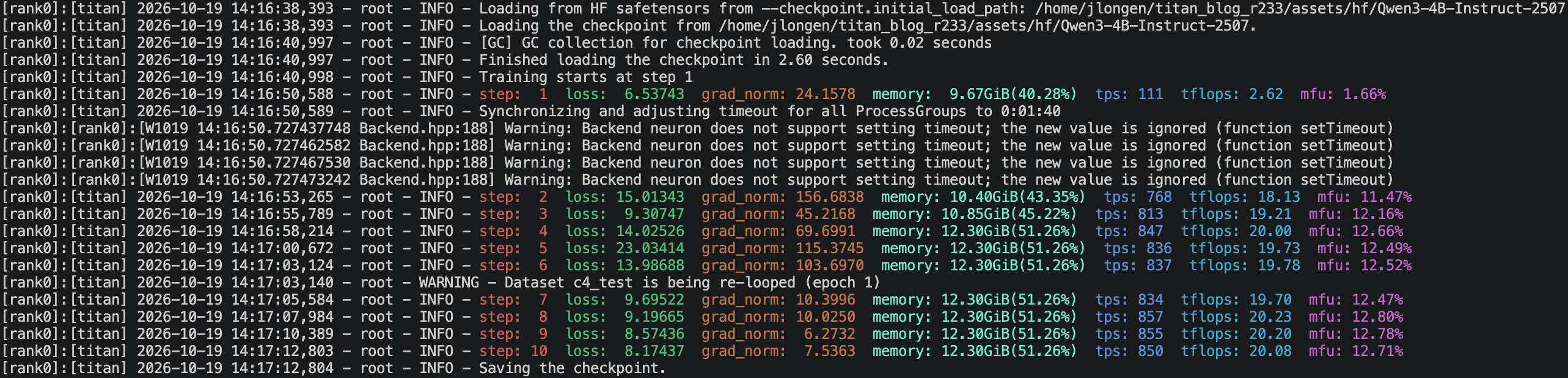
Train Qwen3 on AWS Trainium with torchtitan three ways on a single trn2.48xlarge: the Hugging Face Transformers v5 modeling backend, torchtitan's native Qwen3, and NKI mixture-of-experts kernels. The same torchrun launcher and config structure work unchanged across all three paths, including loading and saving published Hugging Face safetensors.
Open AI's GPT-5.6 Sol and Google's Gemini 4 Argon found critical PHP flaw affecting millions of websites
OpenAI's GPT-5.6 Sol discovered a critical PHP vulnerability as part of the Patch the Planet initiative that could affect millions of websites. Security firm Wiz independently found the same flaw using Google's Gemini 4 Argon. OpenAI warns that the same AI capabilities that find vulnerabilities can help attackers too. The article OpenAI's GPT-5.6 Sol and Google's Gemini 4 Argon found critical PHP flaw affecting millions of websites appeared first on The Decoder.
Nvidia-Backed Pigment Raises $250 M to Take On Microsoft
French AI company, Pigment has raised $250 million at a $2.3 billion valuation as it aims to take on the dominance of Microsoft's Excel and PowerPoint. Co-CEO Eléonore Crespo explains why backing from Nvidia is a particular validation of the startup and how it’s looking to investors in Asia to help expand into that region. Crespo joins Ed Ludlow on “Bloomberg Tech.” (Source: Bloomberg)
Space X has Blowout Quarter as Musk Floats Merger with Tesla
Bloomberg’s Ed Ludlow breaks down SpaceX's blowout quarterly results and Elon Musk's suggestion that the company combine with Tesla. Plus, Netflix looks to find its next big hit as growth at the streaming giant slows, and a report on Anthropic's draft S-1 offers some new insight and confirmation of the AI firm's financials ahead of its IPO. (Source: Bloomberg)
Google Cloud now offers Open AI models alongside Gemini and Claude, becoming the only major provider with all three
Google Cloud is the first major cloud provider to offer Gemini, Claude, and OpenAI's GPTs on a single platform. At launch, GPT-6 Astra, GPT-6.1 Sol, and GPT-6 Luna are available as a private preview for enterprise customers. The article Google Cloud now offers OpenAI models alongside Gemini and Claude, becoming the only major provider with all three appeared first on The Decoder.
Meta to Pay Historic $25 Billion in New Mexico Deception Case
Meta Platforms Inc. was ordered to pay a groundbreaking $25 billion civil penalty to the state of New Mexico in a consumer deception case spurred by the Cambridge Analytica scandal.
Deepmind founder Hassabis shortens AGI timeline from five to two to three years
Demis Hassabis keeps moving up his AGI timeline. The Nobel laureate and former Google Deepmind CEO now expects artificial general intelligence within two to three years, down from three to five years earlier this year. The article Deepmind founder Hassabis shortens AGI timeline from five to two to three years appeared first on The Decoder.
Open AI’s Models To Be Available On Google Cloud After Two Companies Strike Deal
OpenAI and Google, two of the fiercest rivals in the AI race, are now business partners. Google Cloud has announced that it is... The post OpenAI’s Models To Be Available On Google Cloud After Two Companies Strike Deal appeared first on OfficeChai.
Big Query Object Ref now GA: Build multimodal data platforms for conversational analytics entirely in SQL
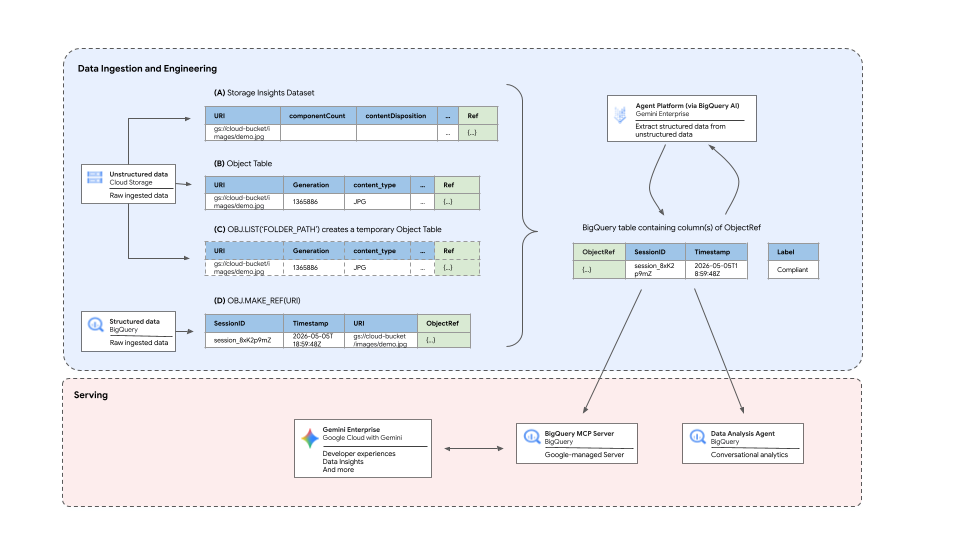
For data science, data engineering, and machine learning teams, unlocking the value of unstructured data, such as images, videos, audio, and documents, has historically meant managing siloed data pipelines for structured and unstructured data, and for analytics and AI/ML use cases. Even when files remain in Cloud Storage, running inference requires teams to orchestrate external machine learning workloads, only to face the complex, brittle challenge of stitching those structured inference outputs back into the data warehouse for analysis. This post-hoc data-stitching introduces significant operational overhead and database misalignment.ObjectRef and multimodal data analytics in BigQuery are now in General Availability (GA), establishing BigQuery as a comprehensive, multimodal agentic data platform.With ObjectRef, BigQuery natively bridges the gap between Cloud Storage and your analytical engine. You can represent unstructured data as native ObjectRef columns directly alongside your traditional relational columns. This unlocks a massive advantage over standalone model APIs by enabling you to pass multimodal, multi-column inputs directly to Gemini models in a single SQL query or natural language query using conversational analytics. ObjectRef integrations with BigQuery AI, conversational analytics in BigQuery and Gemini Enterprise enable you to easily combine Cloud Storage files with rich, structured database context, metadata, timestamps and custom agent instructions.You can now leverage BigQuery's core strengths (fully serverless compute, low total cost of ownership, and built-in at-scale inference) to build, run, and govern powerful unstructured-to-structured, unstructured-to-unstructured and fully multimodal-to-multimodal pipelines without separate compute clusters. Crucially, the extracted features and annotations can be combined directly with the unstructured object itself by storing the ObjectRef in the same row. Using this combined data directly in conversational analytics and AI agents avoids the loss of nuanced data and context that typically occurs when customers transform unstructured files into purely structured formats. Customers are already using this approach to generate embeddings for multimodal vector search, perform at-scale classification using GenAI, and execute precise data and feature extraction from vast archives of documents and media, all via standard SQL. code_block <ListValue: [StructValue([('code', 'SELECT\r\nAI.AGG(image_ref, "Summarize the major categories of pictures")\r\nFROM\r\n`bigquery-public-data.cymbal_pets.products`;'), ('language', ''), ('caption', <wagtail.rich_text.RichText object at 0x7f6a53acd110>)])]> ObjectRef brings structure to the is a built-in, predefined STRUCT data type that points to objects outside of BigQuery. code_block <ListValue: [StructValue([('code', '-- ObjectRef is a special STRUCT in BigQuery \r\nstruct {\r\n uri string,\r\n authorizer string,\r\n version string, \r\n details json { \r\n\tgcs_metadata json\r\n }\r\n }'), ('language', ''), ('caption', <wagtail.rich_text.RichText object at 0x7f6a53acf310>)])]> By storing these pointers natively in standard BigQuery tables alongside traditional columns, BigQuery treats unstructured files as first-class data citizens. Furthermore, this architecture supports independent data lifecycles: your GCS data and BigQuery tables can change independently without affecting the underlying data in the other system.This approach serves multiple data personas by offering powerful advantages:Zero-copy architecture: Keep your high-volume media files securely in Cloud Storage and query them instantly in BigQuery, respecting data gravity and avoiding costly data duplication.SQL and Python interoperability: You can query unstructured data using standard SQL or BigQuery DataFrames. Crucially, you can pass ObjectRefs into BigQuery Python UDFs, allowing you to bring open-source Python libraries, like OpenCV, directly to your data to execute custom logic without moving it.Independent lifecycles and versioning: ObjectRefs ensure reproducible inference by tracking specific GCS generation numbers. If the underlying GCS file changes, your query can still reference the exact version of the file that existed when the row was written.Unified governance: You can secure, audit, and share access to both structured columns and their related unstructured files using BigQuery's existing security policies and IAM controls.Create full-fidelity ETL with SQLSince launching ObjectRef in preview, a powerful, highly effective pattern has emerged among our users: building full-fidelity ETL pipelines entirely with SQL. Teams are leveraging BigQuery’s serverless architecture to integrate AI/ML directly into their data environments, eliminating the need for separate compute clusters to handle data movement and inference. Managing unstructured data in GCS as standard BigQuery columns allows users to apply core data engineering best practices, such as building idempotent pipelines, ensuring reproducibility, and executing seamless backfills, directly to images, video, audio, and documents.Once data is robustly prepared, teams use Gemini within BigQuery to execute full-fidelity ETL. They unlock dual-layer analytics by extracting features and annotating unstructured data while keeping the original ObjectRef anchored in the same row. The structured outputs power fast filtering, reporting and BI dashboards, while the attached unstructured objects remain available for deep, context-heavy reasoning. For example, you might extract sentiment scores and topic tags from an archive of customer call recordings to quickly flag at-risk accounts on a BI dashboard (the structured layer). Simultaneously, a conversational analytics agent evaluating escalation processes can seamlessly fall back to the original audio files to analyze the caller and customer service representative interactions, preventing the loss of critical nuance that typically occurs in unstructured-to-structured ETL pipelines.Proven use cases from industry leaders “At Snap, the safety of our community is a top priority, and we aim to limit users’ exposure to content that violates our Community Guidelines. We regularly review samples of public posts, and by leveraging ObjectRef with BigQuery AI, we transitioned from simple random sampling to post-stratification sampling. This transition improved the efficiency of our human review processes, enabling us to reinvest reclaimed capacity into new and expanded workflows that further enhance our ability to detect and address potentially harmful content.” - Carlos Ortiz, Data Scientist, Snap During the preview phase, we saw adoption across a variety of critical workloads. Customers have successfully transitioned these experimental pipelines into production, transforming unstructured data into actionable, structured insights: Content moderation: Online platforms leverage BigQuery to integrate multimedia assets with standard telemetry data in a single pipeline to fundamentally enhance their moderation and safety outcomes. Proactive threat detection: Enterprise security teams use BigQuery to analyze visual and structural web components alongside network logs, driving critical advancements in proactive threat identification. Inventory compliance: Online retailers extract text and context directly from vast image repositories to automatically flag regulatory or brand compliance issues at scale. Customer experience: Service-oriented enterprises analyze audio interactions between support agents and customers with BigQuery AI to evaluate customer sentiment and improve service delivery. New in GA We streamlined the developer experience for the General Availability release, focusing on support for a wide variety of customer use cases: Flexible authentication: In GA, we introduced End User Credentials (EUC) support for ObjectRefs. Users can now quickly query and explore unstructured data using their personal IAM identity directly for ad-hoc analysis. In preview, querying unstructured files required setting up explicit BigQuery connections for ObjectRefs. While these connections remain fully supported and are the recommended best practice for robust, service-account-driven production pipelines, we recognize they require additional setup. Unified support for your Cloud Storage metadata: We know your unstructured data’s metadata lives in various places across Google Cloud. ObjectRef now natively supports the full spectrum of these sources. Whether your metadata currently resides in BigQuery object tables, Cloud Storage insights datasets, or simply as raw string URIs within standard BigQuery tables, you can seamlessly create and manage ObjectRefs to analyze the underlying data. Array support for comparative analytics: We introduced native support for processing ObjectRefs contained within arrays. This enables entirely new classes of workloads, such as comparing multiple documents against one another, analyzing sequences of images, or batching items in a single semantic call. See it in action: End-to-end multimodal analytics To illustrate the power of these GA updates, let's look at how you can build real-world, multimodal pipelines using our streamlined SQL operators. 1. Full-fidelity ETL: Call center audio analysis Analyzing customer service calls historically required moving audio files to specialized transcription and natural language processing clusters. With ObjectRef, you can parse audio files, extract structured business intelligence and add them directly as standard relational columns. Use the GA OBJ.MAKE_REF() function to automatically detect the audio format from a raw string URI and BigQuery’s managed AI functions for well known use-cases. For example, you can use AI.CLASSIFY() to categorize customer call types. By default, BigQuery uses Optimized Mode for AI Functions to reduce the number of tokens consumed. code_block <ListValue: [StructValue([('code', 'CREATE OR REPLACE TABLE call_center.annotated_call_logs AS\r\nSELECT \r\n customer_id,\r\n call_date,\r\n OBJ.MAKE_REF(audio_uri) as ref,\r\n AI.CLASSIFY(\r\n OBJ.MAKE_REF(audio_uri), [\r\n "Lost or stolen card", \r\n "Declined card payment", \r\n "Activate my card",\r\n "Order physical card",\r\n "Cancel transfer",\r\n "Password or pin forgotten",\r\n "Virtual card not working",\r\n "Card swallowed by ATM",\r\n "Balance not updated after bank transfer",\r\n "Balance not updated after check or cash deposit",\r\n "Extra charge on statement",\r\n "Transfer fee charged"\r\n ]\r\n ) AS customer_issue_type,\r\n FROM \r\n call_center.raw_call_logs;'), ('language', ''), ('caption', <wagtail.rich_text.RichText object at 0x7f6a53ace290>)])]> This table can serve as a multimodal data source for a BigQuery conversational analytics agent. The agent translates natural language queries into SQL using BigQuery AI functions to analyze audio files when additional information is needed. 2. At-scale gen AI filtering: Product compliance Data engineers frequently need to filter massive datasets based on the contents of images or documents. Instead of running heavy generative queries and parsing text outputs, you can now use the declarative AI.IF() operator natively alongside your standard SQL in WHERE clauses. The default Optimized Mode reduces the number of tokens consumed to further optimize your workloads. code_block <ListValue: [StructValue([('code', 'SELECT \r\n product_id,\r\n seller_id,\r\nFROM \r\n ecommerce.vendor_uploads\r\nWHERE \r\n upload_date >= CURRENT_DATE() - 1 AND\r\n AI.IF(("Does this product image contain a restricted item or policy violation?", OBJ.MAKE_REF(image_uri))'), ('language', ''), ('caption', <wagtail.rich_text.RichText object at 0x7f6a53acce90>)])]> 3. Multi-object reasoning: Proactive threat detection With native array support in GA, you can now pass an array of ObjectRefs into a single Gemini call to analyze multiple files simultaneously using Gemini. This unlocks complex comparative logic directly in SQL. For example, a security team can pass a screenshot of their official login page and a screenshot of a newly discovered, suspicious webpage to Gemini simultaneously to detect phishing attempts at scale: code_block <ListValue: [StructValue([('code', 'SELECT \r\n log_id,\r\n suspect_domain,\r\n assessment.is_phishing,\r\n assessment.visual_discrepancies\r\nFROM (\r\n SELECT \r\n log_id,\r\n suspect_domain,\r\n AI.GENERATE(\r\n (\r\n "Compare these two web UI screenshots. The first is our official, trusted login page. The second is a suspected spoofed page. Identify any visual discrepancies, missing logos, or fake elements, and determine if it is a phishing attempt.", \r\n [OBJ.MAKE_REF(trusted_ui_uri),OBJ.MAKE_REF(suspect_ui_uri)]\r\n ),\r\n output_schema => \'is_phishing BOOLEAN, visual_discrepancies STRING\'\r\n ) AS assessment\r\n FROM \r\n cybersecurity.network_ui_logs\r\n);'), ('language', ''), ('caption', <wagtail.rich_text.RichText object at 0x7f6a53acfc90>)])]> Start analyzing todayBigQuery ObjectRef is now generally available on all BigQuery editions and on-demand pricing tiers.If you are currently managing complex, fragmented infrastructure just to perform machine learning inference on your Cloud Storage files, it's time to consolidate. Bring AI directly to your storage. Start leveraging your existing data engineering practices to build robust, scalable, and secure multimodal analytics pipelines directly within BigQuery.To get started with ObjectRef and multimodal analytics, check out these resources:Walk through our hands-on tutorial to generate image captions and assign product categories using synthetic data.Watch live demos from Cloud Next about unifying unstructured and structured data, and generating text with LLMs and performing vector search.Learn how to work with ObjectRef in the BigQuery documentation.
Zentei Q scales batch inference 4x with GKE Inference Gateway powered by llm-d
Today we hear from ZenteiQ, an artificial intelligence startup spun out of the Indian Institute of Science (IISc) and selected under the IndiaAI Mission to build sovereign scientific foundation models from the ground up. To pre-train models that understand physical laws, governing equations, and numerical solvers, ZenteiQ designed and built a large-scale batch synthetic data-generation pipeline that runs across multiple model families and feeds verified datasets into training runs. Google Kubernetes Engine (GKE) and GKE Inference Gateway gave ZenteiQ the inference-routing layer within its pipeline to scale aggregate inference throughput 4.07x and grow daily output from 1.47 billion to 5.97 billion generated tokens for every 1,000 accelerators. - Fisayo Feyisetan, Product Manager, Google CloudUnlike general-purpose language models trained primarily on web text and code, scientific foundation models must understand complex physical systems, mathematical governing equations, and numerical solvers across domains such as thermodynamics, computational fluid dynamics, and electromagnetics. At ZenteiQ, we are building sovereign scientific foundation models from scratch that interpret simulation outputs, evaluate equation formulations, and work through step-by-step mathematical derivations that obey physical laws.Pre-training models on large datasets of governing equations takes hundreds of billions of reasoning tokens. Alongside curated scientific literature and simulation datasets, we also rely on a batch synthetic data-generation pipeline that we independently designed and implemented to generate, evaluate, and filter candidate derivations and solver validation problems before feeding them into our MaxText pre-training jobs.Because we operate on a fixed compute allocation, every hour our accelerators spend generating and verifying training data is an hour taken away from pre-training. When data generation falls behind, multi-host accelerator clusters reserved for pre-training sit idle, waiting on datasets.When data generation slows down pre-trainingTo maximize data generation speed, our pipeline separates prompt preparation on worker pods from model serving on vLLM across multi-node accelerator pools. Each batch moves through four stages: expanding scientific seed concepts into prompt batches, generating candidate reasoning traces with generator models, scoring responses using evaluator models, and running guardrail checks with a separate model family before packaging verified datasets for pre-training.We originally ran these model pools on Kubernetes with standard ClusterIP round-robin load balancing across inference endpoints. As we scaled our pipeline to feed our 9B- and 35B-parameter model schedules, two routing bottlenecks began slowing down dataset creation.Uneven engine queues: Our upstream worker pods expand seed concepts into prompts of widely varying complexity and response length. Because standard round-robin load balancing had no visibility into vLLM engine queues, it kept sending new requests to serving pods that were already busy processing long reasoning traces, while neighboring nodes had capacity to spare.Redundant prefix computation: Prompts within a generation batch share roughly 70% to 80% of their instructional context and task specifications. Round-robin routing scattered requests with identical instructions across different serving instances, forcing each pod to recompute the same shared prompt prefix from scratch instead of reusing warm caches in accelerator memory.Together, uneven queues and redundant prefill work caused our generation throughput to swing by as much as half within a single run, stretching out dataset creation and delaying the start of scheduled pre-training runs. We needed routing that understood live vLLM queue depths and prompt caches, without pulling our researchers off model development to build and maintain a custom inference scheduler.Building on GKE Inference Gateway powered by llm-dWe already run our data preparation and MaxText pre-training jobs on GKE, which lets our team manage data generation and model training on the same Kubernetes platform. Following a recommendation from Google Cloud to address our routing bottlenecks without changing our underlying scientific methodology or pipeline design, we deployed GKE Inference Gateway, powered by the open-source llm-d distributed inference framework, in front of our vLLM accelerator pools.In our pipeline, worker pods pull scientific seed documents and domain taxonomies from Cloud Storage and expand them into batches of multi-step prompts. Those batches flow through a single GKE Inference Gateway deployment that manages traffic across all of our model families and serving nodes.Rather than maintaining isolated routing for each model tier, we route generation requests, evaluation queries, and guardrail checks across their respective model pools through the same gateway. Once candidate responses pass evaluation and guardrail checks, worker pods deduplicate and package the verified datasets for direct consumption by downstream MaxText pre-training jobs on GKE. GKE Inference Gateway routes batch generation, evaluation, and guardrail requests across multi-node accelerator pools running vLLM before verified datasets are fed into MaxText pre-training. From round-robin to load- and cache-aware routingWith GKE Inference Gateway and llm-d, routing decisions use live serving signals from our vLLM instances rather than static round-robin rotation. GKE Inference Gateway continuously monitors real-time queue depth and key-value (KV) cache utilization across our vLLM endpoints. When a serving node is busy decoding a long equation derivation, the gateway routes incoming requests to nodes with open capacity, so heavy prompts no longer pile up behind busy workers while neighboring nodes sit idle.At the same time, the gateway routes requests with matching scientific instructions to the serving node where that prefix’s KV cache is already warm in accelerator memory. Because 70% to 80% of each prompt is shared instructional context while the generated reasoning trajectories vary from request to request, combining prefix-cache locality with live queue balancing lets our pods skip repeated prefill work without overloading any single replica.Higher throughput, predictable training runsAdopting GKE Inference Gateway powered by llm-d transformed the speed and predictability of our data generation pipeline. Across our production clusters, intelligent routing delivered:4x higher fleet throughput: Aggregate throughput jumped from 16,964 to 69,114 tokens per second per 1,000 accelerators — growing daily output from 1.47 billion to nearly 6 billion generated tokens.3.5x to 5.5x gains across individual model pools: Real-time queue balancing kept serving nodes evenly loaded throughout each run, preventing the mid-run slowdowns caused by long reasoning derivations.14-percentage-point higher prefix-cache hit rate: Routing prompts with matching scientific instructions to warm caches avoided redundant prefill work before each request branched into its own derivation.For our research and infrastructure teams, the most important outcome was schedule predictability. Quadrupling daily output meant verified datasets were ready on time, so our multi-host pre-training runs started on schedule instead of waiting on data generation.What’s next for physical AI at ZenteiQAs we scale our scientific foundation models from 9B to 35B parameters and beyond, we plan to use the same GKE Inference Gateway and llm-d routing setup for post-training reinforcement learning (RL) and automated numerical solver evaluation loops. Because each turn in those multi-turn rollouts builds on the context of the turns before it, they depend even more heavily on live queue balancing and warm prefix caches.To try these capabilities on your own workloads, explore the GKE Inference Gateway documentation and check out the open-source llm-d project. You can also read how the Gemini platform team cut latency by 35% with GKE Inference Gateway.
Open AI’s GPT-5.6 Sol Helped Flag The Critical PHP Bug Flaw That’s Had The Internet Scrambling
OpenAI has confirmed that its GPT-5.6 Sol model played a role in surfacing one of the two critical PHP vulnerabilities that triggered an... The post OpenAI’s GPT-5.6 Sol Helped Flag The Critical PHP Bug Flaw That’s Had The Internet Scrambling appeared first on OfficeChai.
Red Hat and Nvidia expand their partnership to secure autonomous AI agents
Red Hat Inc. today expanded its collaboration with Nvidia Corp. to help enterprises secure autonomous artificial intelligence agents, govern access to AI models and deploy workloads on Nvidia’s upcoming Vera Rubin data center infrastructure. Announced at Nvidia’s GTC event in Berlin, the updates center on Red Hat AI Factory with Nvidia, combining agent runtime controls, […] The post Red Hat and Nvidia expand their partnership to secure autonomous AI agents appeared first on SiliconANGLE.
Jensen Huang’s Vision for Europe Runs on Plug-In Data Centers
At Nvidia’s GTC in Berlin, Huang unveiled the company’s new plug-in data center—the DSX Pod—as the key to unlocking Europe’s AI infrastructure lag. Oh, and autonomous humanoid robotics.
Inception's Mercury 3 diffusion model claims to beat GPT-6 Luna and Claude Haiku 5.5 at a fraction of the wait
Inception says Mercury 3 is the most capable diffusion language model released so far. The company claims it runs four to eight times faster than GPT-6 Luna and Claude Haiku 5.5 and beats both in eight of 12 benchmarks. There are no independent tests yet. The article Inception's Mercury 3 diffusion model claims to beat GPT-6 Luna and Claude Haiku 5.5 at a fraction of the wait appeared first on The Decoder.
Mistral and Nvidia want to speed up industrial design with physics AI
Mistral and Nvidia are teaming up to speed up engineering simulations and industrial product design with AI. The article Mistral and Nvidia want to speed up industrial design with physics AI appeared first on The Decoder.
Responding to core PHP vulnerabilities CVE-2026-109618 and CVE-2026-109619
PHP and Wiz Research disclosed today two critical vulnerabilities in the core PHP language runtime that can expose applications to unauthenticated remote code execution and memory disclosure. Wiz used a mix of models to identify and help remediate these vulnerabilities. Notably, Gemini 4 Argon made an invaluable contribution to finding the vulnerability, exploit development, attack detection, and validation of the patch. While Google Cloud itself is not vulnerable, users of PHP running on Google Cloud may be vulnerable. At Google Cloud, we understand the severity of these vulnerabilities, and are sharing guidance to help our customers take immediate action to secure their applications. Vulnerability background PHP is a widely-used, server-side scripting language that powers many websites, content management systems, and web applications. On Oct. 21, 2026, CVE.org assigned the vulnerabilities as CVE-2026-109618 and CVE-2026-109619. The official Common Vulnerability Scoring System (CVSS) base severity score for each of the PHP flaws has been determined as Critical, a severity of 9.2. Generally, this ranking means that threat actors can crash and hijack the affected system, and can easily steal, alter, and wipe its data — although mitigating circumstances can make it harder to exploit the flaw. CVE-2026-109618: Out-of-memory handling can interrupt PHP while internal request data is only partially initialized. Request cleanup may then treat the invalid data as valid. CVE-2026-109619: Request-owned internal state can survive after its backing memory has been freed. A later request handled by the same worker may use that stale state before normal initialization resets it. Vulnerable versions: All versions of PHP from 5.4 through 8.5.11 Patched in: PHP 8.5.12, 8.4.27, 8.3.36 and 8.2.35 Not patched: The PHP project is not releasing fixes for PHP 8.1 or earlier, which have reached end of life. Fix: CVE-2026-109618 (GHSA-w8hw-w9fx-j79w) and CVE-2026-109619 (GHSA-6wmf-4rv5-p3rp): Announcement: PHP has published a security advisory on these two vulnerabilities. Wiz Research has published a detailed description of the research and the coordinated disclosure process. Update PHP and redeploy your applications We urge all customers running PHP applications on Google Cloud to immediately update to PHP 8.2 or newer, and redeploy their services using a patched version. This applies specifically to applications deployed on: App Engine standard environment: Supported runtimes are patched automatically. If you are on PHP 8.1 or earlier, upgrade to PHP 8.2 or newer and redeploy. App Engine flexible environment: Redeploy your PHP runtimes using a supported runtime. If you are using a custom runtime, update your PHP dependencies to a patched version and redeploy your application. Cloud Run: If automatic base image updates are not enabled, or you deploy your own container image, rebuild with a patched version of PHP and redeploy. Google Kubernetes Engine (GKE): Update your container images with a patched version of PHP and redeploy your pods. Google Cloud Marketplace: If you run a Marketplace solution that includes PHP, such as a content management system or LAMP stack, apply the update from the solution provider or update PHP directly. Automatic patches for serverless platforms Google Cloud is rolling out updated serverless base images for all supported PHP versions on App Engine Standard, App Engine Flexible, Cloud Run, Cloud Run function, and Cloud Functions for Firebase. What this means for you: App Engine standard environment (PHP 8.2 and newer): Applications are updated automatically. No action is required. App Engine flexible environment (all PHP versions): Applications are not updated automatically. Redeploy your application as soon as possible to PHP 8.2 and newer. Cloud Run functions (PHP 8.2 and newer): Functions with automatic base image updates enabled are updated automatically. Functions without automatic base image updates enabled must be redeployed. Cloud Run (PHP 8.2 and newer): Services with automatic base image updates enabled are updated automatically. Services built without automatic base image updates must be rebuilt and redeployed to pick up the patched runtime. Important considerations: Unsupported runtimes will not be patched. The upstream PHP project is not backporting these fixes to PHP 8.1 or earlier. Applications on PHP 5.5, PHP 7.2, PHP 7.3, PHP 7.4, or PHP 8.1 remain vulnerable and must be upgraded to PHP 8.2 or newer. See the following runtime support schedules for serverless lifecycle dates: Google App Engine Standard Google App Engine Flexible Cloud Run Cloud Run functions Container images you build yourself are your responsibility. If you have deployed your own container image to Cloud Run or App Engine Flexible (such as with a custom runtime), rebuild it with a patched version of PHP and redeploy. Monitoring and auditing Use the On-Demand Scanning AP to manually scan images stored locally on your computer or remotely in Artifact Registry. Customers using Artifact Analysis will be notified of these vulnerabilities on both new and existing artifacts to identify at-risk workloads. Security Command Center customers can enable container threat detection for GKE and Cloud Run threat detection to monitor their workloads for intrusions. Patching your applications is an essential step to eliminate the vulnerability at its source and ensure the continued integrity and security of your services. We will continue to monitor the situation closely and provide further updates and guidance as necessary. For the most current information and detailed steps, please refer to the Google Cloud security bulletin.
Hackers around the world are all-in on using agentic AI to wage attacks—and manipulating tools like Anthropic’s Claude to help them carry out their crimes.
Nvidia's DSX POD could cut AI data center setup from six months to as little as 14 days
Nvidia wants AI data centers to ship fully preassembled in containers. The article Nvidia's DSX POD could cut AI data center setup from six months to as little as 14 days appeared first on The Decoder.
China protests the US Deepseek ban while blocking Chat GPT, Claude, and Gemini at home
The US has banned Deepseek from its government systems, and China is protesting sharply and demanding the ban be lifted. Yet Beijing itself blocks ChatGPT, Claude, and Gemini across its entire market. China's outrage isn't very credible, but it should be taken seriously as a political signal of possible retaliation. The article China protests the US Deepseek ban while blocking ChatGPT, Claude, and Gemini at home appeared first on The Decoder.
How Wikipedia’s Editors Keep the Online Encyclopedia Human-Written
Ellia Lebleu is a founding member of the WikiProject AI Cleanup, a volunteer effort launched in 2023 to find and remove AI-generated material from Wikipedia that breaks the website’s guidelines. When the cleanup began, AI writing was often betrayed by conspicuous clichés. Today, the project’s volunteers are developing tools to detect subtler forms of machine-generated content and debating AI’s role in the world’s most widely used encyclopedia. When did you realize Wikipedia had a problem with AI-generated material?Ellia Lebleu: It was around December 2023. A few other editors and I were chatting on Wikipedia’s Discord server, and we had all seen very strange articles with the same odd characteristics. They repeated phrases like “stands as a testament” or “rich cultural heritage.” They sometimes had conclusion sections, or sections called “Why is this important?” That was very typical of ChatGPT in 2023 and early 2024 but very odd for Wikipedia articles—and very easy to spot. Then I decided, let’s create an official project on Wikipedia so more people can deal with this.Ellia LebleuEllia Lebleu is a founding member of the WikiProject AI Cleanup. Lebleu is pursuing a Ph.D. in AI at the Inria Center of the University of Rennes, part of France’s national research institute for digital science and technology.How do editors spot AI-generated writing today?Lebleu: By 2025, the signs of AI writing were becoming subtler and more structural. For example, AI loves the “rule of three,” negative parallelisms, and other structures of speech that aren’t conclusive by themselves but become meaningful as they accumulate. We also look beyond the article. If someone writes five articles of thousands of words each in 5 minutes, there is reason to suspect AI.Does the AI problem just appear in the main text, or also in citations?Lebleu: Fake or misleading citations have become a major worry. Sometimes an AI hallucinates a citation entirely, although that’s much rarer today because of retrieval-augmented generation that allows the AI to find sources. More often, it finds a real source but gets its content completely wrong. AI citations that don’t actually support what is being written are extremely commonplace.English Wikipedia recently prohibited editors from using LLMs to generate articles. How much AI-generated content is still getting through?Lebleu: I’ve been working with [AI-detection company] Pangram to estimate the proportion of AI-generated content. I tested it on Wikipedia content from before ChatGPT and found no false positives, so its results provide a very conservative lower bound. In late 2025, it flagged perhaps 20 percent of new articles and drafts as AI-generated. In early 2026, that went down to 15 or 16 percent. But we don’t yet know whether that’s because our recent policies have had an effect or because models are getting more powerful and Pangram hasn’t had time to adapt.Is Wikipedia using AI to combat AI?Lebleu: Another editor from the project has made an AI source verifier, which goes through the sources on a page and checks whether they match the claims. Since it is itself an AI model, there is no guarantee that it will be correct every time. But if you want something that works at scale and filters out obvious cases, it’s a good first step. The Wikimedia Foundation is also working on a tool called Paste Check, which can flag text pasted directly from some AI chatbots.And we’ve seen Claude sometimes say, “I can’t write a Wikipedia article; it would go against Wikipedia’s policies.” If all major AI companies implemented that kind of prompt refusal, it wouldn’t solve the problem entirely, because there are still open-weight models that can be tweaked to avoid restrictions. But it would help with people who use commercial models and aren’t especially familiar with the technology. Can you tell if the rule prohibiting AI writing is working?Lebleu: It’s still a little early to tell. We see possible effects, such as prompt refusal and the apparent slight drop in AI-generated content. But again, we don’t yet know if that is because models are getting better or because beginners are learning the rules. The vast majority of AI-generated content is submitted by beginner editors, so we’ve made many efforts to make the rule very visible in welcome messages, editing help, and advice. What if AI becomes capable of writing truly reliable Wikipedia articles?Lebleu: That’s one of the big questions we’re facing. When the guideline was passed, it was for very practical reasons: We were flooded with AI content, we didn’t have good tools, and we needed to put a stop to it. But since then, it has taken on a more philosophical dimension. Many people have called Wikipedia “the last good place on the internet.” Being a place that was, in theory, free from AI slop has become part of Wikipedia’s identity.A lot of Wikipedia’s communication is now centered on the idea that we’re a human-written encyclopedia. Even AI companies find that interesting. It can be valuable to have a purely human-written corpus on which to [train] AI systems. The fact that Wikipedia is still that, and will remain that for at least the near future, makes it a precious resource that isn’t replicated anywhere else.But will the people who read and contribute to Wikipedia want it to become partially AI-generated if that makes it more comprehensive? We could preserve Wikipedia’s identity as a human-written corpus while also offering an AI-assisted option.Has Wikipedia reckoned with the idea of “Google Zero”—a possible future in which websites no longer get traffic from Google search?Lebleu: If everything goes through AI search and websites plummet to zero visibility, how do we expose Wikipedia and show that it can be edited and that people can still contribute? Wikipedia is frequently cited in [Google’s] AI Overviews, but users may only see an AI answer citing Wikipedia. They may not realize that Wikipedia is a living project they can edit and contribute to.The Wikimedia Foundation is working on an attribution framework that could give AI users more information about the article [being cited]: when it was last edited, how comprehensive it is, whether editors have flagged problems, and perhaps even a call to action. In the future, readers might even contribute through AI models: “The AI cited Wikipedia, but there seems to be an error. Can I make an edit request and add this other source I found?”I can see a very strong symbiotic relationship between Wikipedia and AI models in the future. I don’t see Wikipedia disappearing, but I can see it taking a very different shape. Yesterday, AI was something to clean up. Today, it’s a tool to help us with the cleanup. Tomorrow, it will be the air we breathe.A condensed version of this article appears in the November 2026 print issue as “Ellia Lebleu.”
Google Public Sector increases partner investments for frontline adoption
Partnership is at the core of Google Public Sector’s mission to empower government agencies and education institutions with transformative, mission-aligned solutions. We recognize that we can only scale our impact through a thriving, highly capable partner community.At today’s Partner Connect at Google Public Sector Summit, we are introducing enhanced partner initiatives focused on fostering deeper collaboration, supercharging frontline adoption, and expanding mission delivery capabilities across our valued partner network. These updates are centered around four pillars:Enhanced partner incentives: We will reward partners who do the heavy lifting of pre-sales technical depth, solution design, and proof-of-concept execution through newly announced incentives and discounts.Partner-Led User Success Program: We will support sustained frontline Gemini adoption led by our partners through three targeted investments.Training and enablement: Launching a new Forward Deployed Engineer (FDE) academy, a rigorous bootcamp designed to build elite, Google-trained FDEs inside partner’s practices.Pre-sales acceleration: Increasing our Pre-Sales Deal Acceleration Funds to directly co-invest in partner-led customer workshops and proofs of concept.Post-sales adoption: Expanding our investment pool to $45M in dedicated deployment and adoption funding, designed to pay for partner professional services to deploy Gemini across the entirety of the U.S. public sector for the first time—ensuring day-one operational readiness.Backing builders and powering alliances: We know specialized missions require purpose-built software and scalable infrastructure.We are launching a new ISV Agent Factory to accelerate the development of specialized public sector agents.This is on top of our ISV ATO Accelerator which provides individual ISVs up to $1M in funding from Google to offset the cost of GovRAMP, FedRAMP, and DoD Impact Level accreditations.Market-accelerating alliances: We are announcing a new Strategic Alliance with SHI to activate 400+ sellers across state, local, and education markets. At the federal level, Accenture Federal Services is announcing new Gemini Launchpads to help agencies move from agentic experimentation to mission execution, faster.In the public sector, technology is never just about deployment; it is about the mission. Together with our partners, we are ensuring that our joint public sector customers have the mission-ready capabilities they need to lead on the front lines.To operationalize these announcements, partner organizations are encouraged to engage in the programs below and access upcoming trainings:Google Public Sector Partner Enablement SeriesGoogle Public Sector Partner Specialty Badge ProgramISV ATO Accelerator