October 20, 2026
Open AI Says Its Models Can Give the Financial Sector a Coding Makeover - Gizmodo
OpenAI Says Its Models Can Give the Financial Sector a Coding Makeover Gizmodo
Read original articleDataAIHub Daily
Archive →50 curated AI news stories from leading AI companies.
October 20, 2026
OpenAI Says Its Models Can Give the Financial Sector a Coding Makeover Gizmodo
Read original articleOctober 20, 2026
OpenAI says it's adding Orchestra's team and technology to work on Rosalind, its AI model for life sciences research, and to its related Rosalind Workbench tool, a harness that aims to help researchers plan experiments and analyze results.
Read original articleOctober 20, 2026
Anthropic PBC could spend $750 billion on additional computing power in the coming years and it lost $80.7 billion in the first half of this year, according to the Wall Street Journal. The media outlet says it obtained a copy of the company's S1 filing as it prepares to go public. Romaine Bostick and Jess Menton report. (Source: Bloomberg)
Read original articleOctober 20, 2026
Meta changes AI scraping policy but won’t add language respecting robots.txt.
Read original articleOctober 20, 2026
Anthropic PBC could spend $750 billion on additional computing power in the coming years, according to a Wall Street Journal report, as the company prepares for an initial public offering.
Read original articleOctober 20, 2026
It's probably time to audit your Gemini settings.
Read original articleOctober 20, 2026
Pigment, a French AI company that competes with Microsoft’s Excel and PowerPoint, has raised $250 million in a funding round, bolstering a push by a prominent European startup to take on an American technology giant. The financing, set to be announced Tuesday, values the company at $2.3 billion. The Scaleup Europe Fund led the round, with participation from Nvidia Corp. and World Innovation Lab, a US and Japan-based fund, as well as existing institutional investors Iconiq, IVP and Meritech Capit
Read original articleOctober 20, 2026
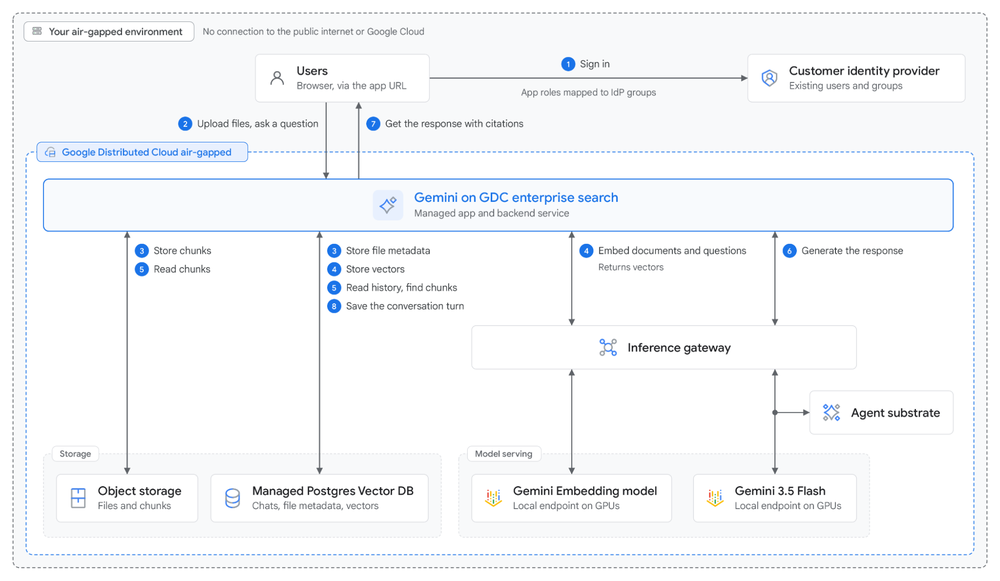
National security agencies and other sovereign and highly regulated organizations handle incredibly sensitive data such as classified reports, field manuals, and sensitive multi-modal datasets. Search and multimodal intelligence that’s available in the public cloud can help teams manage and analyze that data, but due to strict data sovereignty mandates, that data cannot leave the customer premises.The alternative has been to deploy custom agentic search inside a secure, disconnected perimeter, but until now, that meant months building and maintaining custom infrastructure — stitching together models, building speech-to-text and optical character recognition (OCR) pipelines, configuring vector databases, and managing a bespoke user interface.Today, we're excited to announce enterprise search capabilities with Gemini on Google Distributed Cloud (GDC) air-gapped accelerated by NVIDIA Blackwell Ultra to help solve the above challenges. In preview, this fully managed retrieval-augmented generation (RAG) search experience runs entirely inside your physical security perimeter, with no connection to the public internet or to Google Cloud's global infrastructure. Your teams can now upload their files into a conversation and ask Gemini to find information about it, summarize it, compare it, or translate it. Every answer cites its sources, and conversations persist between sessions.Enterprise search capabilities on GDC enable your teams to search across siloed data and unlock powerful insights. With these capabilities, you can now:Go from hundreds of pages to a cited answer: Ask questions across long manuals, reports, and policies, and see exactly which files each answer came from.Work across languages: Ask in one language and get answers grounded in documents written in another, or have Gemini translate them.Ask one question across many formats: Combine audio recordings, video clips, images, and spreadsheets with no separate transcription or OCR steps.Pick up where you left off: Conversations and files persist between sessions, so you don’t have to start from scratch on long-running work.Keep access need-to-know: Each user's chats and files are private to that user, and access follows the identity provider groups you already manage.Users can work with PDF, Microsoft Word, PowerPoint, and Excel files, plus TXT, HTML, PNG and JPEG images, WAV audio, and MP4 video. Each file can be up to 100 MB, and each chat up to 500 MB.Core architectural layers: under the hoodLet's follow a user query through each layer of the stack: signing in, ingesting files, generating the response with Gemini, and storing the session. Every step happens on the organization's air-gapped network. Identity and accessUsers sign in through their organization's identity provider. Administrators map the service's user role to identity provider groups, and only members of those groups can access the application. Each user's chats and uploaded files are private to that user.Document ingestion and embeddingWhen a user uploads a file, it goes straight to the app's object storage bucket. The backend records the file's metadata in the app's managed PostgreSQL database, which is optimized for search. The backend then splits the file into chunks, such as groups of PDF pages or tiles of an image, and writes them to the bucket. A Gemini embedding model running natively within the GDC deployment converts each chunk into a vector, which the backend stores in the app's PostgreSQL database.When the user asks a question, the state-of-the-art (SOTA) Gemini model running entirely on GDC inside the customer’s data center first rewrites the question with context from the conversation. The backend then embeds the rewritten question with the same model and searches the vector database.Model serving The backend then combines the question, the conversation history, and the best-matching data into a single multimodal prompt and sends it to a Gemini endpoint running on NVIDIA HGX B300 systems in that same GDC deployment. Gemini is natively multimodal — it accepts text, images, audio, and video as input, so it can reason across data coming from different file types in a single context, and doesn't require separate speech-to-text and OCR models. The answer then streams back to the user with citations to the source files.PersistenceLastly, the persistence layer keeps each conversation's state. Each question and answer is stored in the system’s database and uploaded files stay in object storage, so users can reopen an earlier session and pick up where they left off.Built for classified and sovereign environmentsWith Gemini and enterprise search on GDC, prompts, responses, uploaded documents, and embeddings never leave your organization's air-gapped network, and every model runs locally. Data is encrypted at rest with AES-256 disk encryption using locally managed HSM keys, and in transit with TLS using FIPS-approved algorithms. Local IAM integration with granular role-based access control (RBAC) governs access to resources. GDC air-gapped has U.S. DoD IL6 accreditation and is designed to support strict requirements in alignment with FedRAMP High security controls.Code execution: Compliance and securityTo deliver precise, deterministic answers from structured spreadsheet data (such as CSV and XLSX files), Gemini enterprise search leverages the Gemini inference stack's local code-execution engine.When handling analytical queries — such as computing the average salary across departments — Gemini dynamically generates Python code and runs it securely within Agent Substrate, an open-source execution runtime built for large-scale agent orchestration.To mitigate security risks inherent to executing LLM-generated code, Agent Substrate enforces strict network isolation and runs workloads inside gVisor sandboxes, helping ensure strong isolation boundaries without sacrificing inference performance.Bringing frontier models to the sovereign data centerYou no longer have to choose between uncompromising security and cutting-edge multimodal intelligence. Enterprise search, Gemini 3.5 Flash and databases optimized for search run together inside the GDC air-gapped perimeter with no dependency on the internet to bring the best autonomous capabilities to the sovereign cloud.Explore the GDC air-gapped documentation and contact your GDC representative to learn how you can best leverage these search capabilities in your sovereign cloud.
Read original articleOctober 20, 2026
Australian Communications Minister Anika Wells is working to form a worldwide coalition of nations to press tech giants such as Meta Platforms Inc. to reduce online harm, potentially opening a new front in a widening regulatory battle against the industry.
Read original articleOctober 20, 2026
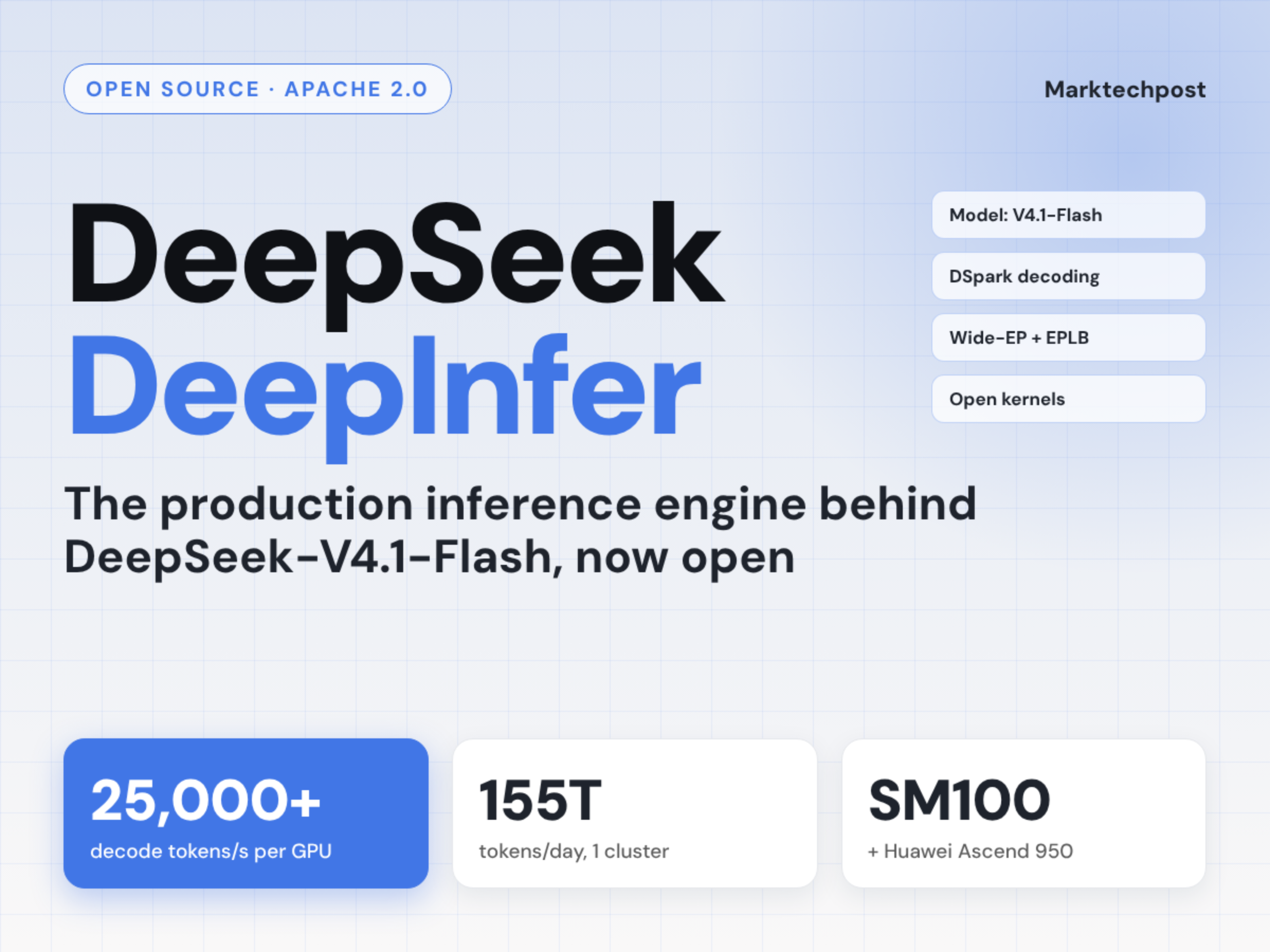
Deepseek is open-sourcing DeepInfer, the inference framework behind its fast V4.1-Flash model. The vLLM-based system cuts compute costs and energy use when running AI models. The release adds more pricing pressure on Western providers like OpenAI and Anthropic. The article Deepseek open-sources the inference engine that powers its fastest and cheapest AI model appeared first on The Decoder.
Read original articleOctober 20, 2026
Google has joined Amazon in releasing a developer tool that makes it easy for PyTorch users to move their apps off Nvidia GPUs.
Read original articleOctober 20, 2026
AI companies are quickly making moves towards the pharma and drug discovery space. On a day when Anthropic had announced that Claude had... The post OpenAI Acquires AI-Powered Drug Development Platform Orchestra Bio appeared first on OfficeChai.
Read original articleOctober 20, 2026
October 20, 2026
AI tools have made it easy to vibe code agents. Building and maintaining an enterprise...
Read original articleOctober 20, 2026
Ahead of massive IPOs, AI companies are sketching plans to share their wealth The Washington Post
Read original articleOctober 20, 2026
The former Google CEO owns about 1% stake in the leading AI lab, Bloomberg reported.
Read original articleOctober 20, 2026
Meta argues nobody “decided” to pirate books to train AI.
Read original articleOctober 20, 2026
Today we're introducing agent memory on Agent Bricks, Databricks' agent developer...
Read original articleOctober 20, 2026
Bloomberg’s Ed Ludlow breaks down why fears about the AI trade are resurfacing after South Korean data center firm Elice plunged 32% in its market debut. Plus, Anthropic is in talks with Nscale for a massive new computing deal that could be worth as much as $45 billion, and Eric Schmidt's early Anthropic bet could pay off big, with a stake worth as much as $20 billion if Anthropic hits a $2 trillion IPO valuation. (Source: Bloomberg)
Read original articleOctober 20, 2026
Former Google CEO Eric Schmidt owns around 1% of Anthropic thanks to his early investment in the startup, setting him up for one of the largest individual windfalls from the company’s imminent public market debut. Bloomberg's Natasha Mascarenhas joins Ed Ludlow on "Bloomberg Tech." (Source: Bloomberg)
Read original articleOctober 20, 2026
There has been some criticism over AI having not yet made progress on curing diseases, and Anthropic appears to have made some progress... The post Anthropic’s Claude Designed 17 Working Protein Binders Against Scorpion Venom Toxins appeared first on OfficeChai.
Read original articleOctober 20, 2026
Anthropic is in talks with Nscale for a massive new computing deal that could be worth as much as $45 billion. The deal would be for a second facility at Nscale's Monarch data center campus in West Virginia, which would deliver 460 megawatts of computing power using Nvidia's advanced Vera Rubin AI chips. Bloomberg's Bailey Lipschultz joins Ed Ludlow on "Bloomberg Tech." (Source: Bloomberg)
Read original articleOctober 20, 2026
Meta's AI companion Muse has surpassed 10 million U.S. downloads in its first 40 days, joining an exclusive group of apps that includes Threads. New data also shows Muse is retaining users at higher rates than its AI rivals.
Read original articleOctober 20, 2026
OpenAI CEO Sam Altman laid out three paths to safe AI in an internal presentation: an international watchdog modeled after the IAEA, a merger of the major labs into one entity, or a single company so powerful it could shut down everyone else's compute. He called the last option "terrible." The article Sam Altman reportedly pitched three endgames for AI safety, one involving a single firm melting everyone else's GPUs appeared first on The Decoder.
Read original articleOctober 20, 2026
Meta Platforms Inc. Chief Global Affairs Officer Joel Kaplan is leaving after spending years steering the company through its most tumultuous political moments.
Read original articleOctober 20, 2026
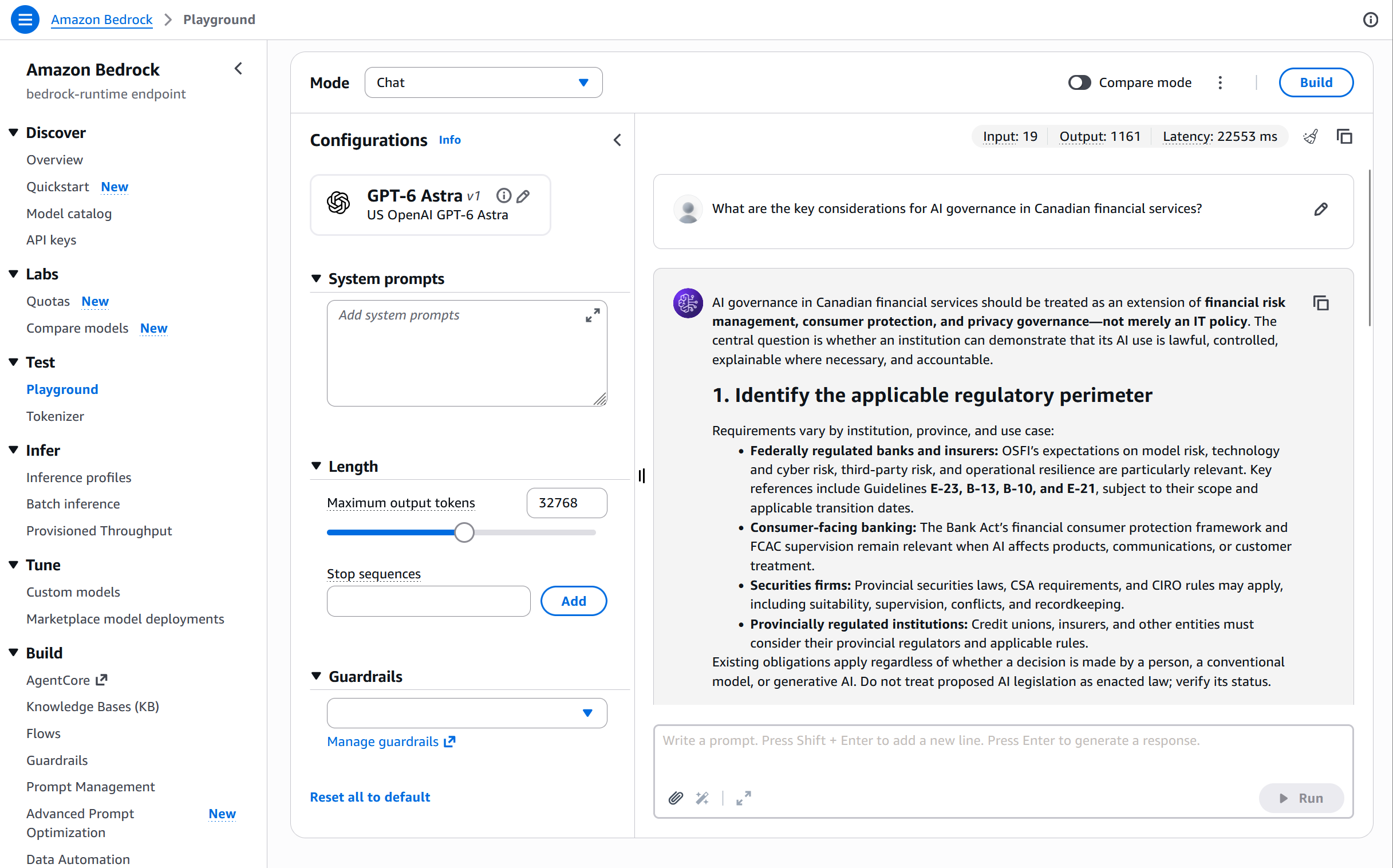
Canadian organizations can now access OpenAI GPT-5.6, GPT-6, and GPT-6.1 models on Amazon Bedrock from the Canada (Central) and Canada West (Calgary) Regions using cross-Region inference. This post covers the models and inference profiles, how to set up permissions, and how to invoke them with the Responses, Chat Completions, and Converse APIs.
Read original articleOctober 20, 2026
OpenAI improved its latest models for low-resource programming languages like COBOL, Fortran, and Visual Basic. On the new MultiLangBench, GPT-6 Astra hits an 87.4 percent test pass rate across 20 languages, up from about 38 percent for GPT-5.6 Terra. For COBOL migration specifically, GPT-6.1 Sol reaches up to 97.9 percent accuracy, a result that could matter for modernizing critical financial infrastructure. The article OpenAI says GPT-6 is much better with legacy programming languages such as COBOL and Fortran appeared first on The Decoder.
Read original articleOctober 20, 2026
October 20, 2026
Whether you are iterating on a quick bug fix or planning a complex migration, different tasks call for different models.In keeping with Google Cloud's commitment to an open ecosystem and to give developers the right model for every job, Claude Opus 5.5 and Claude Sonnet 5.5 are now available in Google Antigravity for Google Cloud customers. Claude Opus 5.5 is built for complex work while Claude Sonnet 5.5 is a faster, lower-cost complement.Once enabled by an administrator, developers can select Claude Opus 5.5 and Sonnet 5.5 directly from the model picker. Administrators can also select Google’s Gemini models, including Gemini 3.8 Flash and Gemini 4 Argon. The models apply across Antigravity 2.0, Antigravity CLI and our recently released Antigravity IDE extensions for VS Code, JetBrains IntelliJ, and Visual Studio. This lets you choose the right model for the job, under a unified enterprise billing and security boundary.In this post, we’ll share two engineering patterns for building in Antigravity using these models. To view the entire list of models supported in Antigravity across subscriptions, see our documentation here.Multi-model engineering patterns in AntigravityHaving multiple model families available inside the same agent harness unlocks practical multi-model workflows that improve code quality while controlling latency and cost.Pattern 1: Cross-model verification ("LLM-as-a-Judge") in loop and graph workflowsWhen building agentic loops or multi-step graph workflows, using the same model to both write code and review its own output can reinforce model-specific blind spots. Pairing two distinct model families, one as the implementer and another as the validator (judge), provides independent verification before moving to the next stage of a workflow.In Antigravity, you can run this pattern either interactively or via automated subagents:Plan and implement with Model A: Start in planning mode using Claude Opus 5.5 or Gemini 4 Argon to design and implement a multi-file change.Validate with Model B: Before committing or advancing the loop, switch models, or invoke a one-shot /model check in the CLI, to have a different model family critique the implementation against your test suite and requirements.Pattern 2: Pairing reasoning models with Flash subagentsComplex engineering tasks often combine a few high-reasoning decisions with dozens of high-volume, mechanical lookups (searching files, grepping logs, checking lint output, or classifying test failures). Running every lookup on a frontier model can increase both latency and spend.Antigravity's Subagent customization system (.agents/agents/*.md) lets you assign specific model tiers (inherit, flash, or pro) to specialized subagents. When your primary session is running a more powerful model.Subagents configured with model: inherit use your active session model for deep reasoning subtasks.Subagents configured with model: flash offload high-speed search, classification, and triage work to Gemini Flash models.For example, you can define a fast log-triage subagent in .agents/agents/test-triager.md: code_block <ListValue: [StructValue([('code', '---\r\nname: test-triager\r\ndescription: Runs unit tests, classifies failures, and returns a concise summary of failing assertions.\r\nmodel: flash\r\ntools:\r\n - read\r\n - edit\r\n---\r\n\r\nRun the requested test targets, classify any failures by root cause (compilation error, assertion failure, or timeout), and return a structured summary to the parent agent.'), ('language', ''), ('caption', <wagtail.rich_text.RichText object at 0x7fd6445c3390>)])]> And a cross-model code reviewer subagent in .agents/agents/gemini-judge.md: code_block <ListValue: [StructValue([('code', "---\r\nname:cross-model-judge\r\ndescription: Independent LLM-as-a-judge verifier that audits diffs and edge cases using Gemini Pro.\r\nmodel: pro\r\ntools:\r\n - read\r\n---\r\n\r\nReview the current workspace diff against the user's requirements. Check for regressions, missing edge-case tests, and security issues. Output a pass/fail verdict with specific line references."), ('language', ''), ('caption', <wagtail.rich_text.RichText object at 0x7fd644582590>)])]> With this setup, you can delegate rapid test-and-classify loops to test-triager and trigger cross-model-judge to validate the final diff, combining the strengths of each model in a single workflow.Getting startedClaude Opus 5.5 and Claude Sonnet 5.5 are available now for Google Cloud customers using Antigravity:Administrators (Gemini for business): Third-party partner models do not draw from the pooled Gemini Enterprise Standard and Plus edition monthly token quota. Instead, usage is billed on a pay-as-you-go basis through your existing Google Cloud Billing account, so overages must be enabled. Visit “Gemini Enterprise” > “Settings” > “AI developer tools” in the Google Cloud Console to configure overage billing, spend limits and authorize partner models for your organization. See Configure AI developer tools settings for step-by-step instructions.Administrators (Gemini platform): You can also enable partner models if you are using Antigravity through the API in Gemini platform. Enable Claude models in Model Garden and complete the standard Anthropic terms.Developers: Update to the latest version of Antigravity 2.0, the Antigravity CLI, or the Antigravity IDE extensions, and open the model picker (or run /model) to select the right model for your task. To learn more about enterprise governance and multi-agent configuration, visit the Google Antigravity Enterprise documentation. You can switch the active model between turns in the same conversation thread while preserving workspace state, open artifacts, and terminal context.Note: Lightweight first-party Gemini models continue to run in the background to handle high-frequency client-side coordination, such as context management and summaries. They consume first-party tokens and can incur charges.
Read original articleOctober 20, 2026
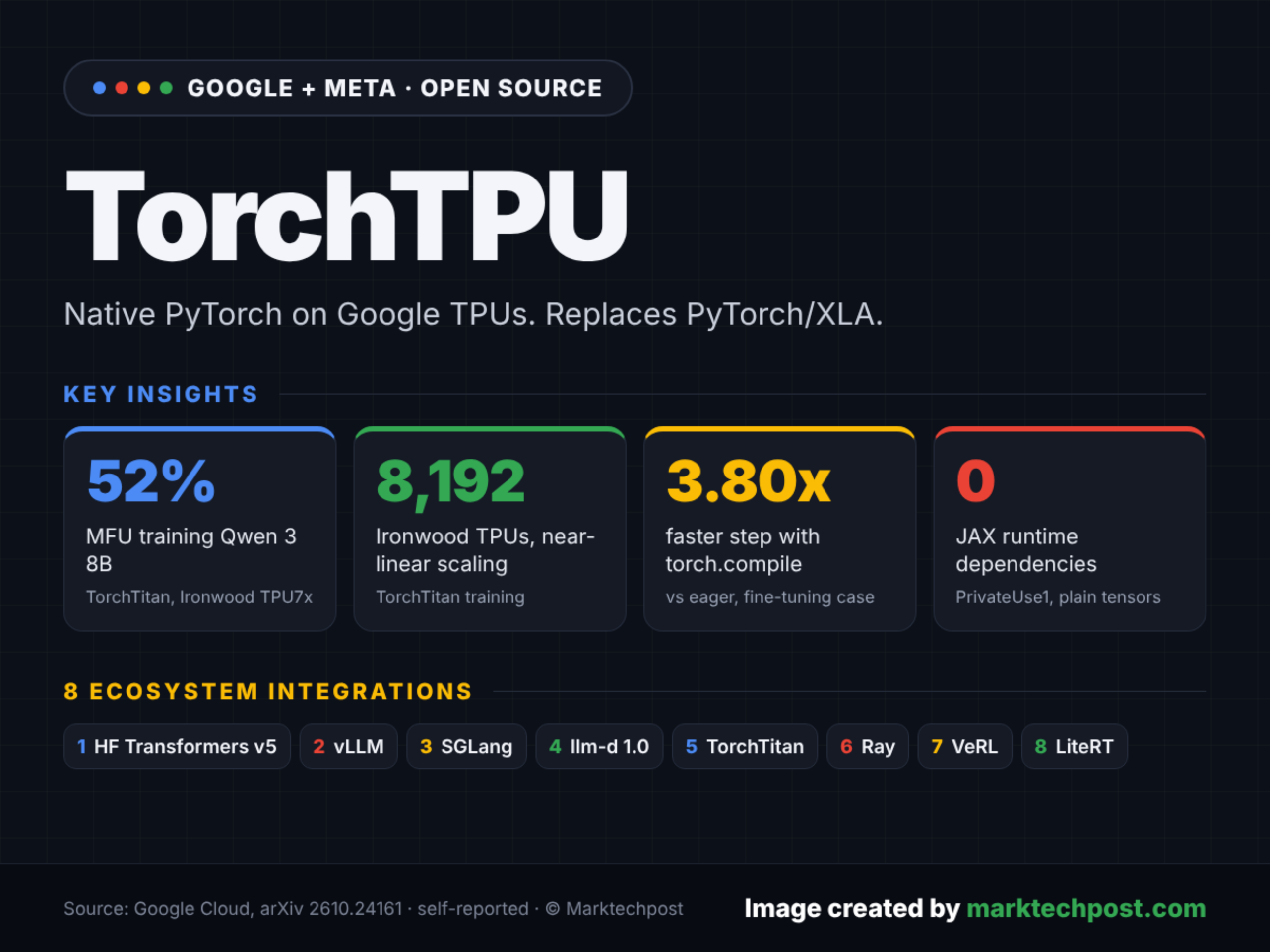
Google and Meta open-sourced TorchTPU, a native PyTorch backend for Cloud TPUs. It runs eager by default, compiles through torch.compile and XLA, and replaces PyTorch/XLA for new workloads. The post Google Open-Sources TorchTPU, a Native PyTorch Backend for Cloud TPUs appeared first on MarkTechPost.
Read original articleOctober 20, 2026
October 20, 2026
DeepSeek has open-sourced the inference engine it uses to serve its models in production, a step it said last year The post DeepSeek open-sources the inference engine behind its API. And Huawei gets equal billing with Nvidia. appeared first on The New Stack.
Read original articleOctober 20, 2026
Hamlet, an AI-powered platform that makes local government decision-making accessible...
Read original articleOctober 20, 2026
HP Moves Customer Data Platform Into Databricks, Eyes 40% Lower Costs HPCwire
Read original articleOctober 20, 2026
DeepSeek has open-sourced DeepInfer, the Apache 2.0 inference framework that serves DeepSeek-V4.1-Flash in production. It targets NVIDIA SM100 GPUs and Huawei Ascend 950 NPUs, and ships offline inference only. The post DeepSeek Open-Sources DeepInfer, the Inference Framework Behind DeepSeek-V4.1-Flash appeared first on MarkTechPost.
Read original articleOctober 20, 2026
Mark Zuckerberg once trashed Apple. Now he’s thanking its new CEO — and had to do it on Elon Musk’s X, not Threads MoneyWise.com
Read original articleOctober 20, 2026
Citrini Bets on Life Sciences After Claude AI Drug Study Bloomberg.com
Read original articleOctober 20, 2026
Every team that adopted Claude Code, Cursor, or Copilot to produce more code has the same problem: When output is The post AI’s Midas problem: When code is free, features are worthless appeared first on The New Stack.
Read original articleOctober 20, 2026
Dave McKay, president and CEO at Royal Bank of Canada, said he’s considering blocking Meta Platform Inc.’s popular artificial intelligence agent Muse from accessing the bank’s customer information. “You have to protect that consumer and then we’re liable for that as an organization,” McKay said on “Bloomberg Surveillance.” (Source: Bloomberg)
Read original articleOctober 20, 2026
Meta is suspending the sharing feature while it investigates its privacy.
Read original articleOctober 20, 2026
Apple Now Trades at Twice Nvidia’s Forward P/E Yahoo Finance
Read original articleOctober 20, 2026
Today at PyTorch Conference 2026, we announced a range of new products and integrations designed to help you run PyTorch effectively on Google Cloud or in your own infrastructure. Notably, TorchTPU, our native PyTorch stack for Google TPUs, is now available as open source on GitHub. With TorchTPU, TPUs join GPUs and CPUs as a native option for PyTorch. You can now train, serve, and deploy models on TPUs using the tools you already rely on, including vLLM, SGLang, llm-d, TorchTitan, Ray, TorchRec, Hugging Face, LiteRT. Ultimately, this provides our customers choice across a broad range of workload-optimized computing options including TPUs, GPUs, and CPUs, with a consistent, open software and operational model across the full portfolio.Run PyTorch code natively on TPUsCo-developed with the PyTorch team at Meta, TorchTPU lets you run existing PyTorch workloads on TPUs with minimal code changes, using the familiar APIs. TorchTPU lets you debug your models with eager mode, then transition to production-level performance via torch.compile to optimize TPU utilization and reduce memory overhead. By supporting standard PyTorch APIs, advanced diagnostics, and native distributed primitives out of the box, TorchTPU unlocks high performance and operational efficiency from day one. "At Meta, advancing the frontier of AI requires immense compute scale and deep hardware diversity. We cannot be constrained by a single hardware architecture. TorchTPU is a massive step forward — allowing us to co-develop hardware flexibly with the core machine learning systems team while supporting major LLM, Ads, and Recommendation systems workloads on key production use cases. It enables us to deploy our PyTorch workloads to Google TPUs, provide direct feedback to the engineering teams, and build the ecosystem flexibility everyone needs."- Jana van Greunen, Director of PyTorch Engineering, Meta We also partnered with Hugging Face so that popular open-weight models across the Hugging Face Hub run natively on TorchTPU. In Transformers v5, deploying models to TPUs is now as simple as passing device_map="tpu". The Diffusers library runs natively on TPUs with support for eager mode, torch.compile, and tensor parallelism to scale large generative models across multiple accelerators. To maintain consistent reliability, we also built dedicated CI/CD pipelines for continuous nightly testing of the Hugging Face Transformers suite on TPU infrastructure. “Hugging Face is committed to being an open, neutral platform where AI builders can choose the models, frameworks and hardware that work best for them. Hardware diversity is essential to making open-source AI accessible to everyone. Our collaboration with Google to bring native TorchTPU support to our core libraries, including Transformers, puts that commitment into practice. Together, we’re making it easier for the community to run popular models from the Hub efficiently on Google Cloud TPUs using familiar PyTorch workflows. Giving developers more choice in how and where they build helps the entire open-source ecosystem grow.” - Jeff Boudier, VP Product, Hugging Face Optimizing inferenceAs reasoning and agentic models scale, inference cost and latency become the primary bottlenecks in production. We’ve integrated TorchTPU into widely used open-source serving engines and paired them with Kubernetes-native fleet routing across TPUs and GPUs to help you optimize throughput per dollar.This foundation allows developers to scale workloads across diverse hardware while minimizing the friction of platform-specific tuning. To bring these framework-level enhancements to life in production, we have collaborated with leading open-source communities and industry partners. In the sections below, we explore how these partnerships are driving breakthrough efficiency across high-throughput serving with vLLM, structured agentic execution with SGLang, and large-scale distributed fleet orchestration with llm-d. vLLM: High-throughput serving and memory efficiency Developed in partnership with Inferact, the native PyTorch vLLM backend on TorchTPU enables developers to deploy open-weight models directly on TPUs with optimized, production-ready serving features and custom Pallas kernels. This integration supports continuous batching, quantization, and multi-chip parallelism on TPU hardware, while preserving upstream worker models, schedulers, and API servers to improve cost-performance ratios, without requiring changes to existing inference stacks. "Our mission at Inferact has always been to make high-performance inference accessible, reliable, and cost-effective across the entire AI ecosystem. We are thrilled to partner on the launch of TorchTPU and bring first-class support for vLLM to TPUs. By bridging PyTorch’s optimized TPU capabilities directly into vLLM, developers can immediately run production workloads on TPUs with the high throughput, low latency, and memory efficiency they expect from our stack." - Simon Mo, CEO and co-founder, Inferact SGLang: Accelerating agentic and structured workloads Developed in partnership with RadixArk, our native PyTorch backend for SGLang accelerates highly structured and agentic workloads on TPUs. SGLang uses RadixAttention to reuse KV cache across requests, allowing repeated prompt prefixes to skip recomputation entirely. SGLang-TorchTPU preserves upstream worker models, schedulers, and API servers, using a disaggregation transfer backend that also acts as the I/O backend for HiCache to optimize latency and throughput for complex multi-step generation. "At RadixArk, TorchTPU has supercharged our development velocity as we roll out SGLang support across diverse silicon. It’s given us a painless path to native TPU acceleration, passing massive efficiency gains and flexible compute choices directly down to our customers." - Banghua Zhu, CTO and co-founder, RadixArk llm-d for distributed LLM inference To run inference engines across large fleets, we are releasing llm-d 1.0 with Red Hat, IBM, and a community of more than 500 contributors and 25 organizations. As a Cloud Native Computing Foundation (CNCF) Sandbox project, llm-d connects two open-source communities: PyTorch, where vLLM and SGLang serve models, and Kubernetes, where distributed systems run and scale in production. The llm-d router sends each request to the replica that already holds its context, using prefix-cache-aware routing. It also splits compute-heavy prefill from memory-heavy decode. llm-d 1.0 makes that ready for production with multi-tenant flow control, router high availability, stable v1 APIs, and session-aware routing for agents. On Google Kubernetes Engine (GKE), you can have the choice of running on either GPUs or Google TPUs, with a common llm-d endpoint, and choose the hardware that fits each workload. "At Zenteiq, we use GKE Inference Gateway powered by llm-d to accelerate synthetic data generation for our sovereign Scientific Foundation Models. By leveraging load-aware and prefix-cache-aware routing, we have achieved over 4× higher aggregate inference throughput, increasing daily generated token capacity from 1.47 billion to 5.97 billion tokens per 1,000 TPU v6e accelerators. The open-source foundation of llm-d, integrated with GKE, enables us to efficiently serve multiple model families at scale without developing and maintaining a custom inference scheduler." - Prof. Sashikumaar Ganesan, Founder, Zenteiq.ai Training at scale Scaling PyTorch training across thousands of accelerators requires fault-tolerant, compile-aware distributed frameworks. We have integrated TorchTPU into the PyTorch community’s core training, reinforcement learning (RL), and orchestration frameworks. TorchTitan: Distributed high performance training at scale TorchTitan is the PyTorch-native reference implementation for scalable distributed training and features a production-grade integration with TorchTPU. By connecting to PyTorch's torch.compile and TorchTitan’s compile friendly SimpleFSDP, specialized Pallas kernels, and graph-level optimizations, developers can build and train models on TPUs with high efficiency at scale. TorchTitan provides recipes for pre-training large dense models (such as Llama 3 70B/405B, Qwen 3 8B/32B, and MuseGlimmer 30B), Mixture-of-Experts (MoE) such as Qwen 3 235B, and diffusion transformers (such as FLUX.1 12B), and has been validated running with up to 8000 Ironwood TPUs (TPU v7x). Beyond initial pre-training, TorchTitan serves as the scalable trainer inside post-training pipelines like VeRL for Group Relative Policy Optimization (GRPO) and RL alignment.To test large-scale efficiency on demanding open architectures, TorchTPU’s training paths via TorchTitan demonstrated up to 52% Model Flops Utilization (MFU) on Qwen 3 8B, showing near-linear scaling and stability across up to 8,192 Ironwood TPUs. VeRL: Scalable post-training and reinforcement learning in preview RL is a foundational technique for frontier labs that are advancing model capabilities, as well as for enterprises customizing models for domain-specific tasks. Yet, orchestrating distributed RL workloads remains one of the most complex challenges in modern AI infrastructure. Bridging that gap, VeRL has quickly become one of the most popular RL frameworks, supporting everything from verifiable math and coding rewards, to multi-turn agentic tool use at massive scale. To help expand hardware choice for this thriving community, we upstreamed a TPU backend and an end-to-end reference recipe to VeRL. Built on a disaggregated trainer-sampler architecture designed to maximize training efficiency, our GRPO reference recipe on mathematical reasoning datasets demonstrates how developers can deploy VeRL workloads on TPUs while preserving their existing, hardware-agnostic model and algorithm code. Ray: Orchestrating heterogenous compute We’ve also added native TorchTPU support to Ray, enabling you to orchestrate PyTorch data processing, training, RL, and serving across CPUs, GPUs, and TPUs within a single workflow. With a few lines of resource configuration, you can schedule each stage of a heterogeneous AI pipeline onto the accelerator best suited for the job. “At Ray Summit we talked about the PARK stack, PyTorch, AI models, Ray, and Kubernetes, because that's what teams are building production AI on today. TorchTPU embeds Google TPUs directly in that industry-standard stack. We've also worked closely with the Google team to support TPUs as a first-class accelerator in Ray. Coupled with native PyTorch support, teams can now seamlessly develop, scale, and monitor their workloads on TPUs." - Edward Oakes, Chief Architect, Anyscale Deployment flexibility and operational efficiency True portability requires standardizing deployment tools across different hardware profiles, including edge devices and cloud accelerators. LiteRT joins the PyTorch Ecosystem Many PyTorch models need to run on phones, laptops, browsers, and embedded devices. Today, LiteRT (formerly TensorFlow Lite), Google's high-performance on-device AI inference, joins the PyTorch ecosystem. With LiteRT-Torch, you convert a PyTorch model with a single litert-torch.convert() call. It builds on torch.export() and Core ATen operators, so your model code stays in PyTorch. For LLMs, LiteRT Torch exports Hugging Face Transformer models to run with LiteRT-LM. The converted models run on Android, iOS, macOS, Windows, Linux, web, and IoT devices, with hardware acceleration across CPUs (via XNNPack), GPUs (via open source ML Drift), and NPUs from major chipsets provided through a single API. TPU agent suite in early preview To expand Pytorch adoption on TPUs, we are announcing that the TPU agent suite is in preview on GitHub. Integrating through plug-ins with several coding harness-model combinations, the TPU agent suite helps automate onboarding, diagnostics, user questions, and inference performance tuning for many PyTorch models. Get started with PyTorch on Google CloudTogether, these releases reinforce our commitment to making the Google TPU software ecosystem an open, developer-friendly environment for the PyTorch community. By bringing native TPU support upstream into the PyTorch stack across TorchTPU, Hugging Face, vLLM, SGLang, llm-d, TorchTitan, VeRL, and Ray — and contributing LiteRT to the PyTorch Ecosystem — we are giving you the flexibility to build, adapt, and scale AI on your terms.Visit the Google Cloud documentation to get started running PyTorch on TPUs today.
Read original articleOctober 20, 2026
Today at the PyTorch Conference, we released llm-d 1.0, an open-source, Kubernetes-native stack for distributed LLM inference. Co-founded by Google with Red Hat, IBM and others, we worked with a community of more than 500 contributors over 25 organizations on this Cloud Native Computing Foundation (CNCF) Sandbox project, bringing together two important communities: PyTorch, where vLLM and SGLang serve models, and Kubernetes, where distributed systems run and scale in production.llm-d 1.0 arrives at a time when agents are changing the nature of inference. A year ago, most inference traffic was chat: one prompt in, one response out. Today, workloads are shifting to multi-step agents and reinforcement learning (RL) rollouts that fan out across tools, share long prefixes, and arrive in bursts. Serving them on a single machine — or behind a generic round-robin load balancer — breaks down fast. Replicas recompute the same prompts, accelerator memory fills up with duplicate state, and one bursty agent loop can stall interactive users.llm-d solves this for teams serving their own models by turning a cluster of model servers into a coordinated serving pool. During the PyTorch Conference keynote, we showed this in action with 1,000 sandboxed agents on Agent Substrate on GKE hitting a single llm-d endpoint across vLLM, SGLang, and a mixed fleet of Google Cloud TPUs and GPUs. As traffic scaled across the three stages below, cache-aware routing and tiered KV cache kept each agent's steps on the replicas holding its context, while flow control queued bursty agent loops so interactive requests stayed fast. Figure 1: Evolution of distributed inference from round-robin load balancing to cache-aware routing, tiered KV cache, and priority flow control in llm-d 1.0 What 1.0 providesllm-d already delivered prefix- and load-aware routing, KV cache offloading, prefill/decode disaggregation, wide expert parallelism and batch inference across Google Cloud TPUs and GPUs. These capabilities provide:Multi-tenant quality of service. Priority and fairness-aware routing via llm-d flow control, helping latency-sensitive requests and bursty agent workloads share a fleet to meet SLOs without starving one another.A stable foundation. v1 APIs and a hardened request path, validated on multiple clouds and accelerator types.Safer upgrades. Router high availability and zero-downtime updates, alongside DisaggregatedSet, which orchestrates prefill/decode-aware rolling updates without dropping context or disrupting active sessions.Agent-aware serving. Session-aware routing, turn-priority scheduling, and native Responses API state, helping agents reuse context across turns.Expanded TPU integration. Native PyTorch model serving with TorchTPU co-operative time-slicing to raise throughput and utilization across Google Cloud TPU fleets.The components are designed so that you can compose them into your own bespoke production environment. Keep your engine, model and cluster, and adopt only the serving components and configurations you need.llm-d under the hoodAcross the areas below, Google engineers worked with the llm-d community to connect upstream Kubernetes primitives, PyTorch serving engines, and accelerator-aware scheduling into a composable stack. Figure 2: Multi-node llm-d orchestration and single-node TorchTPU model engines on Google Kubernetes Engine and Google TPUs One endpoint, many acceleratorsAn agent fleet is not one workload. Interactive turns need low latency, background loops and reinforcement learning (RL) rollouts need high throughput, and demand swings by the minute. llm-d puts your accelerator pools behind a single endpoint, with one router, one KV cache index, and one flow-control policy in front of the whole fleet. Agents call a single API; the router picks the replica for each step and keeps a session's context on the replicas that already hold it. Adding capacity, mixing accelerator generations, or moving a model to a different pool becomes a platform change, not an agent rewrite. TorchTPU brings Google Cloud TPUs into that fleet, running PyTorch models natively inside upstream vLLM and SGLang without model rewrites. For more, see the llm-d on Google Kubernetes Engine (GKE) TPU guide.Routing that remembers contextThe llm-d router builds on Gateway API Inference, the Kubernetes project for inference-optimized routing that we launched. On GKE, GKE Inference Gateway runs the llm-d router as a managed service, simplifying installation and management and extending routing across regions. The router tracks the replicas holding each cached prefix and weighs load and predicted latency when it picks one. When accelerator memory fills up, rather than dropping it, llm-d uses vLLM’s OffloadingConnector, Mooncake, or SGLang’s HiCache to move KV cache to host memory and then to SSD or Google Cloud Managed Lustre. This setup helps prevent prefix-eviction storms under heavy, multi-turn, and long-context conversational loads across mixed TPU and GPU fleets.On an agentic coding workload on Ironwood TPU (TPU 7x), prefix-aware routing plus host memory offload cut median time-to-first-token (TTFT) by more than 85% and raised total throughput 2.4x versus a plain Kubernetes Service, as of October 2026 (source).Disaggregation that upgrades safelyPrefill is compute-heavy and decode is memory-bound, so running both on the same replicas makes each wait on the other. llm-d runs prefill, decode, and multimodal encode as separate pools, with wide expert parallelism spreading large mixture-of-experts models across nodes. In 1.0, DisaggregatedSet — built on LeaderWorkerSet, the Kubernetes API for multi-host inference that we started — manages these pools as one unit. Rolling updates move prefill and decode together on matching versions while each phase scales independently. For more, see the disaggregated serving guide.Async inference that runs alongside real-time inferenceFor latency-tolerant traffic, llm-d 1.0 introduces llm-d-async-processor, which pulls requests from queues like Google Cloud Pub/Sub or Redis and routes them alongside real-time traffic. Using queue and pool-dispatch gates, the processor checks available capacity and enforces strict priority lanes and quotas so background jobs run in slack capacity without starving interactive users.Time-slicing to put idle RL capacity to workDuring RL training, accelerators often sit idle 40% to 60% of the time during rollout generation or weight updates. llm-d now supports Google Cloud TPU and GPU time-slicing to interleave async inference into those quiet cycles, raising aggregate accelerator duty cycles from a ~40% baseline to >70% (source).Benchmarks you can trustTuning a distributed inference stack across routers, KV cache tiers, and prefill/decode pools takes repeatable measurement under realistic multi-turn load. Prism is llm-d’s open-source analysis dashboard for exploring published benchmarks across llm-d’s well-lit paths, backed by standardized llm-d-benchmark recipes and inference-perf workloads. Inspect the exact configurations behind the numbers, or upload runs from your own cluster to compare throughput, latency, and cost curves side by side.Running llm-d 1.0 on Google Cloudllm-d builds on Kubernetes components you may already run: Gateway API, LeaderWorkerSet, Dynamic Resource Allocation, Prometheus, and OpenTelemetry. Running llm-d on Google Cloud brings these pieces together with managed infrastructure:GKE Inference Gateway is the llm-d router operating in Gateway Mode, a managed GKE Gateway that handles the L7 proxy and load balancing and calls the llm-d Endpoint Picker on every request, simplifying installation and management so you don't run the proxy yourself. More importantly, GKE Inference Gateway is how you scale llm-d across clusters and regions with global failover and Model Armor safety checks.Autoscaling on inference signals. KEDA and Horizontal Pod Autoscaler (HPA) scale pools based on queue depth, saturation, and predicted latency, while Kueue enforces per-model quota on shared accelerators.Mixed accelerator node pools. Google Cloud TPU and GPU pools run behind the same llm-d endpoint, deployed with verified Helm charts.KV cache offloading across layers. Google Cloud Managed Lustre provides a shared remote tier beneath local TPU and GPU HBM and host CPU RAM so long-context workloads run without exhausting accelerator memory.In productionThis GKE llm-d stack carries production traffic, and it has been tested at fleet scale:Gemini platform (formerly Vertex AI) serves production traffic through GKE Inference Gateway, doubling its prefix cache hit rate from 35% to 70%, cutting TTFT by more than 35% for coding agents and cutting P95 TTFT by more than 50% under bursty chat traffic (source).In a published benchmark across a 17,000-node multi-region GKE deployment serving a mixture-of-experts model in the US and Europe, multi-cluster GKE Inference Gateway and the llm-d router scaled throughput 2.9x across three clusters with a 99.9% success rate and less than 1% routing overhead (source).In a published benchmark on A3 Mega cluster serving a 70B-parameter model, llm-d with multi-connector KV cache offloading to Google Cloud Managed Lustre in addition to Host CPU RAM, delivered an approximately 40% improvement in TTFT and a 30% reduction in end-to-end latency responding to 50k-token prompts compared to CPU RAM offload only, while reducing GPU-hour requirements by nearly 60% (source).Organizations running llm-d on Google Cloud are putting these same capabilities to work in different ways, for instance prefix-aware routing to raise cache hit rates, open interfaces that fit an existing service mesh, and flow control to hold latency for priority tiers when traffic spikes. “At Snap, we are integrating llm-d into our production AI infrastructure to facilitate high-performance inference at scale. By employing prefix-cache-aware routing, we have achieved prefix cache hit rates ranging up to 75-80%. We appreciate the open-source nature of llm-d, as it enables seamless integration with our Envoy-based Service Mesh." - Vinay Kola, Senior Manager, Software Engineering, Snap Inc. "At ZenteiQ, we use GKE Inference Gateway powered by llm-d to accelerate synthetic data generation for our sovereign Scientific Foundation Models. By leveraging load-aware and prefix-cache-aware routing, we have achieved over 4× higher aggregate inference throughput, increasing daily generated token capacity from 1.47 billion to 5.97 billion tokens per 1,000 TPU v6e accelerators. The open-source foundation of llm-d, integrated with GKE, enables us to efficiently serve multiple model families at scale without developing and maintaining a custom inference scheduler.” - Prof. Sashikumaar Ganesan, Founder, Zenteiq.ai “Serving frontier models across interactive applications and high-volume APIs means handling steep traffic spikes without letting bursty workloads degrade latency for priority customers. With llm-d's prefix-cache-aware routing, flow control and disaggregated serving support we can enforce strict priority bands across our commercial tiers, automatically holding or shedding lower-priority requests when pools saturate so paid traffic meets our latency SLOs. Mistral is a proud supporter of open-source software, and we will continue to contribute back to llm-d and DisaggregatedSet projects.” - Mathis Felardos, Lucas Fernandes-Martins and Nikhil Thomas, Mistral, Inference Engineers and llm-d contributors Teams serving their own models have been asking for an open stack they can take apart and adapt to their own infrastructure, with the cache-aware routing, traffic control, and upgrade controls required in production. llm-d 1.0 gives them that and a community to build with.Get startedCheck out the full demo of llm-d with TPUs at the Google Cloud booth during the PyTorch Conference.Deploy llm-d 1.0 on GKE with the verified Helm charts. See the llm-d on GKE documentation.Start with prefix-aware routing in front of your existing vLLM deployment, then add flow control, KV cache offload (SGlang, vLLM) and disaggregation.Compare results on Prism and contribute on GitHub.
Read original articleOctober 20, 2026
NVIDIA Is Finally “Too Big to Fail.” Here’s Why Meta and Google Aren’t. TIKR.com
Read original articleOctober 20, 2026
A Google Cloud outage in Europe that knocked out digital bank Revolut Ltd. and other online services for several hours on Tuesday has mostly been resolved, the US tech company said.
Read original articleOctober 20, 2026
AI devices keep running into privacy issues
Read original articleOctober 20, 2026
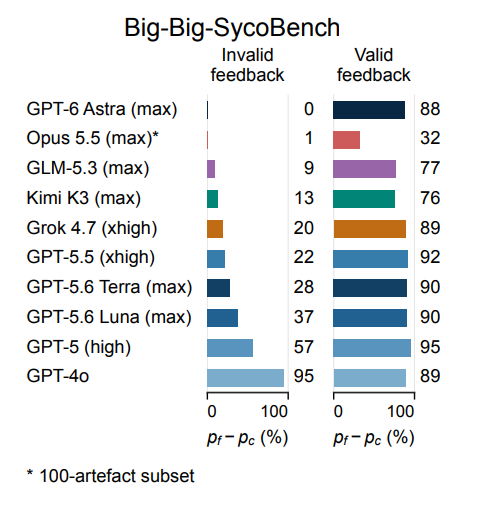
A fresh benchmark is testing AI models for sycophancy — and has produced some interesting results. A new academic benchmark has put ten... The post GPT-6 Astra Resists Invalid Feedback The Most On Big-Big Sycobench, Claude Opus 5.5 Resists Valid Feedback The Most appeared first on OfficeChai.
Read original articleOctober 20, 2026
Earlier this month at Gemini at Work, we introduced the Gemini agent: a single, universal agent for work. It answers your questions, handles your knowledge work, creates your images and media, and writes and runs code. You give it objectives, not instructions, and come back to finished work. It plans the work, uses skills and tools, connects to your systems, and has the security, administration, and governance your organization requires.Every industry runs on knowledge a general model does not have. Government work runs on statute, regulation, and agency guidance, across siloed legacy systems, under strict requirements for data sovereignty, compliance, and confidentiality. Too often that leaves civil servants on data entry and manual document review instead of the services citizens depend on.Today we're bringing the Gemini agent to public service with Gemini for government services in preview, part of our new suite of purpose-built industry solutions. It adds skills built around government work, connections to the systems agencies already run, and specialized partner agents, with governance running underneath it all. Bringing Gemini to government services Five components of Gemini for government servicesDeveloped alongside agency leaders, Gemini for government services provides an integrated, fully governed environment configured for rapid deployment across federal, state, and local agencies with five core components:Skills for government work: Skills are reusable instructions and context, written by domain experts, that teach Gemini to run a specific task. Each one applies the statute, regulation, and agency guidance that govern that task, so an agency's standard operating procedures carry into the work Gemini supports.Connectors to agency systems: Secure connectors link Gemini to the case management, ERP, HR, and collaboration systems agencies already run, along with authoritative federal data sources. Gemini queries each system in place, so no data is migrated, and access follows the identity and permission controls the agency already has.Partner agents: Skills and connectors come together in agents, including pre-built agents from public sector software providers that agencies can deploy right away. They handle tasks like FOIA discovery and batch redaction under the same central governance, with a person approving each consequential step.A governed control plane: Security and compliance teams get one place to set and enforce policy across every agent, including VPC Service Controls, CMEK, and Assured Workloads. Outputs are grounded in source documents, with citations, so reviewers can check where each answer came from.An open partner ecosystem: Every agency works under a different statute and runs a different mix of systems. System integrators and public sector ISVs help agencies customize Gemini, connect it to what they already have, and scale it without lock-in.Skills for government workflowsGemini for government services helps automate and accelerate complex government operations, including:Policy and regulatory research: Ask an operational or eligibility question and get an answer drawn from the CFR, the Federal Register, state administrative codes, and internal manuals, with page and paragraph citations. Where federal and state rules both apply, Gemini shows which one governs to empower agency decision makers.FOIA record discovery: Gemini searches SharePoint, Drive, and email archives for records responsive to a FOIA or state Sunshine Law request. It organizes them into a review set for the records officer and agency counsel, shortening discovery that often takes weeks.Redaction for public release: Gemini finds sensitive constituent data across a batch of documents, groups the findings so reviewers can clear them in passes, and proposes redactions labeled by statutory exemption. After a reviewer confirms, it produces the exemption log and audit-ready copies.Vendor bid evaluation: Gemini checks multi-volume bids against RFP requirements, FAR guidelines, minimum mandatory criteria, and evaluation rubrics, and returns scoring justifications with citations. Contracting officers get a documented basis for each award decision.Grant and program expense audits: Gemini checks invoices, receipts, purchase orders, and ledger entries against 2 CFR 200 Uniform Guidance and the terms of the award. It flags unallowable costs, missing documentation, and funding discrepancies with line-item citations, so problems surface while there's still time to fix them.Document validation at intake: Gemini classifies and validates pay stubs, W-2s, utility bills, and leases when they arrive, checks the numbers for consistency, and flags missing signatures. Defects are caught before the application enters the queue, not weeks into the case.Plain-language notices: Gemini turns policy memos and agency guidance into public notices, aligned to the Plain Writing Act of 2010, USDA-FNS standards, and Title VI language access guidance.Open ecosystem of connectors across the government technology stackGemini for government services connects directly to core agency systems via secure connectors. Access is bound by existing role-based access controls, record-level permissions, and the trusted data controls inherited from each system — and nothing is migrated to make the connection work.Federal regulatory and public data:Federal Register: Tracks legislative actions, regulations, and executive orders as they post, so state and local teams see federal changes as they land.regulations.gov: Tracks federal rulemaking dockets, public comments, and statutory agency response deadlines, keeping policy analysts ahead of incoming mandates.eCFR (Electronic Code of Federal Regulations): Grounds answers in the governing regulation, with citations down to the paragraph.Agency systems of record:Oracle E-Business Suite: Gives agents permission-bound access to procurement, payables, and ledger transactions for expense auditing and award reconciliation.Oracle PeopleSoft: Connects HR and personnel records under existing role-based controls, so workforce questions are answered from the system of record.Salesforce: Enables conversational experiences across the Missionforce portfolio, including benefits, licensing and permitting, and contact center management.ServiceNow: Automates IT, CRM, security, employee experience, and workflow records, so agents can track incidents, requests, and approval chains inside existing routing rules.Productivity and collaboration:Google Workspace: Connects with Google Docs, Gmail, Drive, and Sheets to analyze case communications and agency correspondence and surface internal files while enforcing agency access controls.Microsoft 365 and SharePoint: Integrates with Word, Outlook, and SharePoint to triage inquiries and ground responses in mail and intranet repositories without breaking workflow context.Third-party agents and implementation partnersEvery agency operates differently. Through our open platform, agencies can deploy pre-built partner agents or work with system integrators to scale custom capabilities:SZNS Solutions FOIA and public records discovery agent: Turns a plain-language request, a piece of correspondence, or a formal citizen inquiry into a scoped search across enterprise archives — bounded by custodian and date range, so a records officer narrows the set before any data moves. It exports responsive material into secure agency repositories and tracks delivery status, giving each request an auditable trail from intake to release.SZNS Solutions document redaction agent: Works inside connected repositories — SharePoint and Drive among them — finding sensitive citizen data across a batch and grouping the findings so a reviewer clears them in passes rather than page by page. Each proposed redaction carries its statutory exemption, and once the reviewer confirms, the agent exports permanently redacted, audit-ready copies back to the system of record, with the processing never leaving the agency's cloud perimeter.Systems integrators & tech partners: Strategic partnerships with Accenture Federal Services, Clutch, Dark Wolf, Daston, Deloitte, Egen, Game Plan Tech, Knexus, Onix, Resultant, SAIC, Slalom, and SZNS Solutions so agencies can customize, integrate, and scale these capabilities without vendor lock-in.Developed alongside federal, state, and local government agenciesWe are working closely with select federal and state agencies, including the State of Missouri and the U.S. Department of Health and Human Services to ensure these capabilities work in day-to-day agency operations."Our citizens expect the government to move at the speed of modern life, not the speed of paperwork. By automating routine work in our workflows, we're delivering faster, better services to Missourians." - Tim Marczewski, Director of AI and Innovation, State of Missouri Office of Administration.Built on an enterprise-grade foundationGemini for government services runs on Google Cloud's secure foundation, and can be deployed using the Assured Workloads FedRAMP High Data Boundary, enforcing U.S. data residency and personnel controls. It works within the authorities, retention rules, and approval chains your agency already has.Agency records, constituent data, institutional documents, custom agents, and model outputs stay private to your organization, and are never used to train or fine-tune Google's foundation models without your permission. Because we operate the full stack, from infrastructure and models through the application layer, we can tune performance and cost together — routing high-volume document parsing and routine records sweeps to fast, low-cost models and reserving high-reasoning models for complex policy analysis, so expanding what your teams can take on does not mean expanding spend at the same rate.This is just the beginningThe launch of Gemini for government services represents another defining step in delivering on our promise to bring the best of Gemini to every professional, for every workflow, natively tailored to the way they work.Gemini for government services is available in preview today, joining our purpose-built solutions for industries. We invite leaders at every level of government to explore how Gemini can transform their most critical workflows.
Read original articleOctober 20, 2026
Today we are bringing together mission leaders and builders from across the public sector at the Google Public Sector Summit in Washington D.C. to explore a critical intersection: Where mission meets moonshot. Through our hands-on programming, we will offer inspiration as well as pragmatic steps for turning moonshot aspirations into secure, scaled, real-world outcomes.From mapping the human genome to putting a human on the moon, public sector organizations have been at the helm of some of humanity’s most historic breakthroughs. Right now, public sector leaders are being asked to move faster than ever, amidst more complexity and uncertainty, often with fewer resources than the mission demands. To better understand these challenges and opportunities, we surveyed several hundred leaders from across the public sector with theCUBE and ECI Research. According to the findings, while 96.3% of agencies have deployed agents in some form, only 9% have achieved agency-wide adoption. The bottleneck isn’t a lack of vision or ambition—it is the systemic friction of legacy data silos and integration complexity. That is why so many organizations turn to Google; we deliver powerful technology that reduces the toil of getting started, minimizes the friction of integration, and provides the secure foundation for scale.To that end, we are excited to share several new announcements and capabilities to support your missions and moonshots in the agentic era.Introducing the Gemini agentWe recently announced the Gemini agent: your new single, universal agent for work. It can have all of your organizational context and can be used for everything from knowledge work to answering questions, and from content creation to coding, all from a single prompt box. At your direction, it can plan the work, use skills and tools, connect to your systems, and bring back something finished — inside the documents, the inbox, and the developer environments you already work in and give it permissions for. With your guidance, the agent chooses the best model for the job, employs built-in cost controls, and most importantly, reflects the security, administration, and governance controls established by your organization.Introducing Gemini for government servicesThis morning we launched Gemini for government services in private preview, a purpose-built platform engineered for the security, governance, and workflow complexity of public sector missions. Built around the core promise of delivering "less paperwork, more public service," it provides an integrated, fully governed environment configured for rapid deployment across federal, state, and local agencies. By combining pre-built partner agents, secure connectors, and deterministic skills, the platform enables civil servants to securely link Gemini directly to existing case management, ERP, and agency collaboration systems of record without migrating their agencies’ sensitive data. Civil servants are empowered to automate repetitive, high-stakes tasks—such as public records requests, document intake validation, expense auditing, and policy research—all grounded in authoritative federal regulatory sources with verifiable citations. Learn more about Gemini for government services in our blog post.Introducing Wiz agents in Wiz for GovThe Wiz Red, Green, and Blue agents are now available within Wiz for Gov, Wiz’s FedRAMP Class D (High) certified environment. The expansion of the agent trio into Wiz for Gov accelerates remediation for critical public sector priorities, including Post-Quantum Cryptography (PQC). The Green Agent can assist in driving PQC readiness through a new risk type dedicated to weak cryptography that investigates whether an asset is quantum-vulnerable and assesses potential Harvest Now, Decrypt Later (HNDL) exposure. By leveraging the cryptographic visibility from code to runtime gained through the Wiz AI-APP, the Wiz Green Agent is able to help weigh real-world external reachability against data sensitivity enabling delivery of continuously updated, PQC-resistant fixes directly into developer workflows.Wiz has also invested in several other initiatives intended to benefit the public sector. Scan for Good, a program launched jointly by Wiz and Google DeepMind, uses the Wiz Red Agent and Gemini 4 Argon, alongside Gemini 3.8 Flash Cyber, to provide no-cost security assessments designed to uncover high-risk vulnerabilities and exposures across eligible public services, critical infrastructure, and other under-resourced organizations. Wiz is also expanding capabilities for organizations navigating the new FedRAMP Vulnerability Detection and Response (VDR) and Vulnerability Evaluation and Reporting (VER) rulesets. This includes operationalizing critical FedRAMP metrics, including Potential Agency Impact (PAIN), and validating likely exploitability (LEV) and internet reachability (IRV). These enhancements will assist organizations seeking to achieve or maintain FedRAMP certification with the automated reporting and prioritized risk assessment required.Bringing enterprise search capabilities to Gemini on Google Distributed CloudFor defense, intelligence, and national security agencies operating in classified environments, the challenge is not just analyzing vast volumes of sensitive data, it is doing so without compromising perimeter security. To help turn classified information into actionable intelligence, we are bringing enterprise search capabilities to Gemini on Google Distributed Cloud for air-gapped deployments. With this new capability, users gain an intuitive conversational interface to query, synthesize, and summarize records at machine speed, completely disconnected from the public internet. This launch brings Gemini 3.5 Flash models to on-premises air-gapped deployments, expands model flexibility with open models like Gemma, and delivers massive local compute through generally available NVIDIA Blackwell B300 GPUs.Driving mission impact, togetherThrough partnership and powerful technology, organizations across the public sector are transforming how services are delivered, accelerating research and science, strengthening national security, improving healthcare delivery, and enhancing student outcomes. These organizations aren’t waiting for the future; they are actively building it right now.America.gov is offering a streamlined "front door" that simplifies access to federal services online. Google is proud to be named a technology partner in this vital initiative, leveraging Gemini to help millions of Americans access critical public resources with greater speed and ease.SUNY is tackling challenges with direct impact for communities across New York and beyond. Together, we are empowering researchers of all technical backgrounds to easily access and benefit from Google Cloud's advanced capabilities—bringing storage, high-powered computing, Gemini Enterprise, and more than 200 trusted models together into a seamless, centralized ecosystem.The Department of Energy is accelerating breakthroughs in energy dominance, discovery science, and national security through the Genesis Mission. Gemini will support the full breadth of work - from the research bench to specialized user facilities – building a secure foundation that the DOE mission can depend on.The U.S. Army is leading a sweeping modernization of its logistics infrastructure including non-tactical logistics networks, supply chain procedures, and organic industrial base sites. The Army's Strategic Capital Initiative will pair Google's secure cloud and FedEx's logistics expertise to build a more intelligent and connected supply chain network that helps reduce delivery times and ensures personnel receive the critical equipment where and when they need it.The Department of War is supercharging daily operations and workflows with Gemini, giving 3 million personnel across the department access to a secure enterprise-grade platform. With Agent Designer, GenAI.mil users are quickly able to build their own agents using natural language to help streamline repetitive, multi-step tasks such as document creation and document reviews.Case Western Reserve University is improving learning outcomes and accelerating research breakthroughs. They are leveraging Gemini for education campus-wide, transforming the experience of every scientist, staff member, and student. Tomorrow, they’re opening a new hub for discovery and innovation that leverages Google technology, and connects Google engineers with 300 university researchers across campus.Google Public Sector: Your mission partnerThe agentic era will not be defined by what technology can do, but by what we choose to build with it. So let’s meet this moment, let's re-imagine what’s possible, and let’s create impact — together.Register early for Google Public Sector Summit On-Demand to be notified when the event’s content is published.Learn how Gemini for government services can help transform critical workflows and advance your mission.Request a demo to see how the Wiz Agents can help your agency meet today’s security demands at machine speed.Catch the highlights from Google Public Sector Summit on our Linkedin page, schedule a 1:1 consultation with a Google team member or reach us at geminiforgov@google.com.
Read original articleOctober 20, 2026
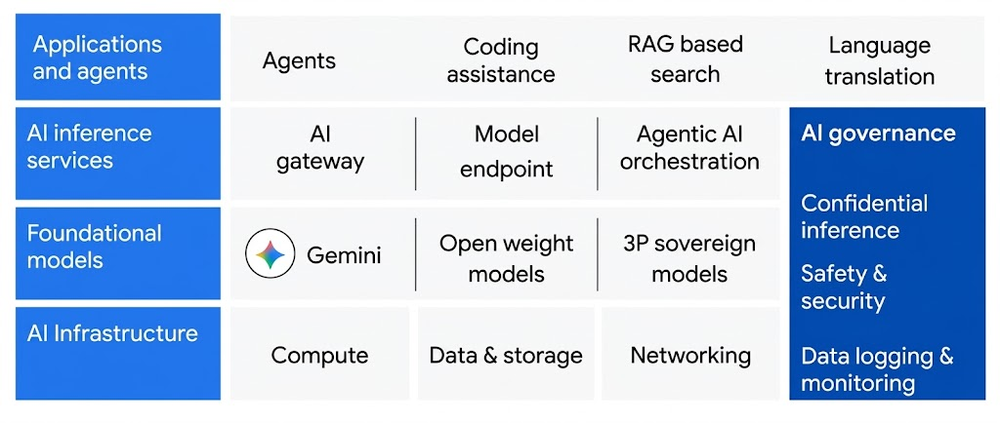
Agentic systems are quickly moving from pilots to production in the enterprise. But if your organization operates under stringent data sovereignty, defense, intelligence, or critical infrastructure mandates, sending sensitive data to a public cloud often isn’t an option — and building your own AI stack inside a disconnected perimeter can take months. Your missions demand frontier models, hardened security, and high performance, deployed directly where your most sensitive data lives.The latest innovations in Google Distributed Cloud (GDC) air-gapped represent a huge leap forward for organizations struggling with these challenges, and they no longer need to make this tradeoff. Enterprise search capabilities with Gemini, support for open weight models, turnkey ISV applications, next-generation accelerated infrastructure, and support for new partners are all now available to be directly deployed in your sovereign, air-gapped environments.Here’s a high-level look at the major capabilities launching across three pillars: Sovereign AI and enterprise search, next-generation infrastructure, and a growing ISV partner ecosystem.GDC technology stack: Infra, frontier models, data and applicationsThe GDC technology stack turns isolated infrastructure into a modern agentic innovation platform, combining foundational and open model flexibility, intuitive out-of-the-box user experiences, and high-performance data processing. Overview of GDC architecture and capabilities We are excited to bring the following innovations to GDC:Gemini on GDC enterprise search: In air-gapped environments, analysts and knowledge workers spend critical hours manually sifting through compartmentalized documents, intercepted audio, and sensor video. Agentic systems can streamline those processes, but building those capabilities often requires months of custom development. With enterprise search capabilities in Gemini on GDC (available in preview), organizations gain a turnkey conversational interface, so they can query, prompt, and summarize vast repositories of data near-instantaneously. Unlike text-only open-source alternatives, this managed architecture delivers native multi-modality support via Gemini embedding models, combining high-throughput scaling and low-latency inference performance for text, audio, and video modalities. Built-in retrieval-augmented generation (RAG) keeps indexing and interactions strictly within your sovereign perimeter, accelerating insights without compromising security.Expanded frontier and open-weight models: Google Cloud is one of the first hyperscalers to bring a frontier model like Gemini to air-gapped deployments. Now generally available on GDC air-gapped, Gemini 3.5 Flash delivers ultra-low-latency reasoning, multimodal understanding, and long-context capabilities entirely within your air-gapped boundary, allowing users to process large volumes of field intelligence, from reports to imagery and recordings, quickly. GDC also now supports leading open models like Gemma and Mistral, giving you architectural and workload choice, giving you the flexibility to match the right model to each workload on the same governed platform.Next-generation IaaS powering GDCTo run modern agentic systems and memory-intensive enterprise workloads on the same infrastructure, you need an uncompromising foundation. GDC air-gapped features a new, elevated Infrastructure-as-a-Service (IaaS) stack across compute, networking, and security, so you can run AI and traditional workloads side by side with the performance and protection they need.Next-gen high-performance agentic infrastructure: NVIDIA HGX B300 systems based on the NVIDIA Blackwell Ultra architecture are now generally available on GDC air-gapped, giving you the local compute to serve Gemini and open models — and the agents built on them — at production scale. Paired with VM networking that now supports up to 32 Gbps per VM (up from 25 Gbps), you can move data to your GPUs faster and reduce bottlenecks in your inference pipelines.Resilient, enterprise-grade networking: Fully managed Cloud DNS, now generally available on GDC, lets your platform teams manage DNS records with the same Kubernetes APIs and command line they already use — with no third-party DNS infrastructure to deploy, patch, and maintain inside the air gap. And hardware-offloaded IPsec encryption protects node-to-node traffic at up to 100 Gbps, helping you meet encryption-in-transit requirements without taking CPU away from your applications.SecOps enabled by Elastic: As agentic workloads scale, you need machine-speed security to defend your distributed environments. Through our deep integration with Elastic Security, we are modernizing threat detection and response (SIEM and EDR) on GDC air-gapped. Together, Elastic Security and GDC air-gapped provide automated case management, behavioral analytics, and agentic-driven telemetry correlation, so you can accelerate your mean time to response (MTTR).Expanding the sovereign ISV partner ecosystemYour missions depend on more than infrastructure — they run on the data platforms, developer tools, and collaboration apps your teams already know. That’s why we’re bringing more of that software to run natively on GDC, so you can adopt AI without leaving familiar tools behind. Today, we’re expanding the GDC partner marketplace with independent software vendors (ISVs) including Teradata, Solo.io, and Mattermost:Teradata extends industry-standard enterprise data analytics and warehouse intelligence to the distributed edge, so you can run complex analytical pipelines right next to local AI inference — and act on insights without moving data outside your perimeter. "Enterprises in highly regulated and air-gapped environments are eager to harness the transformative power of generative AI, but they cannot compromise on data privacy or analytical rigor. By bringing Teradata to Google Distributed Cloud, we are enabling our joint customers to run complex analytical workloads and AI inferencing right where their data resides. Together with Google Cloud, we are breaking down barriers between sovereign cloud infrastructure and enterprise-grade intelligence." - Sumeet Arora, Chief Product Officer, Teradata Solo.io brings API management, service mesh, and agentic networking — including kagent and agentgateway — to sovereign deployments, so you can securely connect and govern microservices and AI agents across isolated clusters, including which tools and other agents each agent can reach.Mattermost delivers secure collaboration and mission-critical operations workflows for defense and public sector teams, so your people can coordinate in real time entirely inside the air gap — including AI-assisted summaries and translation using models running locally on GDC.Building the future of sovereign cloudWith these capabilities, sovereignty no longer has to slow down your AI ambitions. By bringing Gemini and open-weight models, multimodal enterprise search, high-performance infrastructure, built-in security, and a growing ISV ecosystem together inside your air-gapped perimeter, GDC helps you turn your most sensitive data into actionable insights, while you maintain compliance, security, and control.Ready to get started?Read our technical deep dive on Gemini on GDC enterprise search.Explore the GDC air-gapped documentation.Contact your GDC representative to schedule a demo.
Read original article