October 19, 2026
What makes a catalog open? Unity Catalog Advances the Open Lakehouse
While almost every platform now supports open formats, what makes a catalog truly...
Read original articleDataAIHub Daily
Archive →50 curated AI news stories from leading AI companies.
October 19, 2026
While almost every platform now supports open formats, what makes a catalog truly...
Read original articleOctober 19, 2026
Former Google Chief Executive Officer Eric Schmidt owns around 1% of Anthropic PBC thanks to his early investment in the startup, according to people familiar with the matter, setting him up for one of the largest individual windfalls from the company’s imminent public market debut.
Read original articleOctober 19, 2026
Amazon SageMaker JumpStart onboarded over 100 new models from 30 providers in the first three quarters of 2026. This recap covers the model-onboarding highlights and JumpStart enhancements, including the simplified Model Hub, pre-configured deployment options, and Hugging Face deep link integration.
Read original articleOctober 19, 2026
US fears Saudi government will help ex-OpenAI engineer flee spying charges.
Read original articleOctober 19, 2026
Amazon wants to break Nvidia’s hold on PyTorch, the free toolkit used to build most AI apps, so that more developers run their apps on alternative chips like its own.
Read original articleOctober 19, 2026
A judge ordered Abdulrahman Alfozan to remain in custody, likening the Saudi government’s offer to secure the former OpenAI engineer’s release to a “blank check.”
Read original articleOctober 19, 2026
AI Is Reshaping Local Search but Small Businesses Need Google to Win Customers, Research Finds Carroll County Mirror-Democrat
Read original articleOctober 19, 2026
OpenCode is an open-source AI coding agent that's become a popular alternative to Claude Code and Cursor. But hackers got into part of its online platform and stole some users’ API keys, and the AI tools it turned to for help kept refusing to look at the malicious code.
Read original articleOctober 19, 2026
Nvidia CEO Urges German Manufacturers to Adopt AI, Saying Digital Tech Won't Replace Heavy Industry U.S. News & World Report
Read original articleOctober 19, 2026
Nscale Ltd., the AI cloud computing firm, is in talks to sell computing power to Anthropic PBC in a deal that could be worth about $45 billion, according to people familiar with the negotiations.
Read original articleOctober 19, 2026
Want to make your dumb robot smart? $3 an hour is all it costs. Or 75 cents, if you’re okay with a slightly less capable physical AI model.
Read original articleOctober 19, 2026
After drawing acquisition interest earlier this year, the Nvidia challenger raised $1.5 billion to remain independent.
Read original articleOctober 19, 2026
Anthropic is reportedly developing a model that can infer what users want from incomplete instructions. According to The Information, a The post One sentence changed Claude Code’s overreach rate from 0% to 17.1% appeared first on The New Stack.
Read original articleOctober 19, 2026
Hamilton Lane Executive Co-Chairman Erik Hirsch says much of the wealth created by the AI boom has so far accrued in the private markets, as companies stay private longer and tap increasingly deep pools of capital. With exposure to OpenAI and Anthropic through its venture and growth relationships, Hirsch discusses how investors can access private AI companies through funds, secondaries and co-investments - and why even as some of AI’s biggest names head toward IPOs, going public is no longer the default path for most technology companies. He joins Ed Ludlow on "Bloomberg Tech." (Source: Bloomberg)
Read original articleOctober 19, 2026
Anthropic plans to dedicate 5% of its shares to a public benefit fund, offering its own approach to sharing the potential wealth created by AI as concerns grow about AI-driven labor disruption. Bloomberg’s Mike Shepard discusses how the plan differs from proposals for a government-run fund - and from Elon Musk’s pledge to give every child in America a share of SpaceX - as technology leaders confront a broader question: who should benefit financially from the AI boom? He joins Ed Ludlow on "Bloomberg Tech." (Source: Bloomberg)
Read original articleOctober 19, 2026
Bloomberg’s Ed Ludlow looks at why Nscale is facing pushback to its $30 billion IPO valuation target, with some investors suggesting $16 to $19 billion instead. Plus, Anthropic plans to put 5% of its shares into a new public benefit fund to address "the public good," and a former OpenAI software engineer charged with placing a recording device in one of the company's offices is set to appear in court today. (Source: Bloomberg)
Read original articleOctober 19, 2026
Third Wheel: Microsoft’s AI Chips Are “Nowhere Close” to NVIDIA or Google per Analyst Yahoo Finance
Read original articleOctober 19, 2026
Can You Use AMD And NVIDIA GPUs In The Same PC? BGR
Read original articleOctober 19, 2026
NVIDIA CUDA Tile (cuTile) is a Python-based DSL and parallel programming model for NVIDIA GPUs that automatically leverages advanced hardware capabilities to...
Read original articleOctober 19, 2026
Get a jump start on the US trading day with Dani Burger on "Bloomberg Open Interest." Inflation fears rattle markets as Meta leads a massive earnings week. Nvidia-backed Nscale faces a valuation reality check, while Trump-Zelenskyy tensions deepen. Plus, Proofpoint’s $6.3 billion Varonis deal; we talk with Thoma Bravo’s Seth Boro. And JPMorgan’s $230 billion economic-security push with Herman Chan, plus Ed Ludlow on Anthropic’s public-good pledge. (Source: Bloomberg)
Read original articleOctober 19, 2026
Anthropic putting 5% of shares toward public benefit fund that could address AI impact on workers Fox News
Read original articleOctober 19, 2026
Ex-OpenAI engineer accused of planting bug in office was in contact with Saudi royal family, preparing to leave U.S. CBS News
Read original articleOctober 19, 2026
Imagining traditional gearheads getting their hands on software-defined vehicles is an amusing thought experiment. With their socket wrenches and air compressors at the ready, they might be confused to encounter core functions more likely to run on 1s and 0s than oil and belts. But across the auto industry these days, more and more vehicles feature prominent systems built using cloud-native development, continuous integration/continuous delivery, fast digital iteration, and plenty of AI. But there’s still a big gap to be found in many automakers’ and Tier 1 suppliers’ cloud-based development processes. On the one hand, these companies are commonly using software to develop vehicles’ digital entertainment and information screens, or other onboard high-performance computers. On the other, the dozens of microchips and control modules that make a car a car these days — such as gateways, body controllers, zone control units, sensor and actuator nodes — are still frequently hardwired to physical chips when they’re constructed, making them very difficult to update, reprogram, or expand after the vehicle drives off the factory floor. Teams have to wait for benches, samples, and rigs, and integration can easily slip to the end of the development process, where defects are most expensive to fix. This inherent inefficiency has become a leading bottleneck. After all, manufacturers can’t really claim vehicles are software-defined if most of their electronics only function when connected to physical hardware and if developers are leaning heavily on actual hardware. With Horizon, our agentic innovation platform for developing software-defined vehicles, our vision is to help manufacturers avoid these inefficiencies by working with partners like RemotiveLabs. The cockpit already runs in the cloud The Android team has invested a significant amount of time and effort over the last few years on enabling seamless development of the many digital systems in vehicles’ cockpits. Android Automotive OS (AAOS) runs inside Google’s official virtual testing environment for Android, Cuttlefish, which itself runs comfortably on Arm-based Google Cloud instances. With this approach, developers can build, boot, and test virtual versions of their infotainment stacks on the same Arm architecture that ships in vehicles. And with the recent launch of Android 17 and AAOS SDV, this capability is also extended to further domains, whenever AAOS SDV is used. Deploying it with Cuttlefish, for example, proves the model: representative software, on representative architecture, in the cloud, on demand. The question that still needs to be answered is how to extend that model to the rest of the vehicle, especially when other operating systems are involved. The harness around the virtual vehicle That’s where RemotiveTopology comes into play. As the harness around the virtual vehicle, it’s the layer that connects AAOS in Cuttlefish to a full, simulated electrical and electronic (E/E) architecture: the rest of the vehicle’s onboard computers, its data networks, and the live signals that make the system function like a real vehicle rather than a collection of standalone apps. RemotiveTopology automatically utilizes manufacturers’ existing network design files to build a working, virtual version of their cars’ networks. This is vehicle-as-code: the E/E architecture expressed as an executable specification, versioned and provisioned like infrastructure-as-code. In this way, an entire vehicle can be spun up on demand. Cockpit software talks to the rest of the vehicle exactly as it would in a real vehicle. As a result, developers get full and continuous signal and cross-domain visibility, so they can see real-time system status. And because it is built on standard Linux tooling, the same topology runs on a laptop and in a contiguous integration pipeline on Google Cloud. Integrate across domains early, not late The payoff for using this approach is that all onboard systems can be developed and integrated with software before any of them are connected to a vehicle’s hardware. That’s beneficial because the most difficult (and latest) integration in a vehicle’s development is bringing all its systems together. For example, advanced driver assistance systems (ADAS) produce object lists, trajectories, and mode requests that the cockpit has to render and react to, while the infotainment system and information cluster have to reflect driving state while body and chassis nodes sit in the loop. With the full topology live on Google Cloud, the infotainment system and ADAS can operate simultaneously within a virtual vehicle, exchanging real signals over the simulated network. This means it’s possible to exercise handoffs like an ADAS event surfacing in the cluster or a driver-mode change rippling across domains from day one in continuous integration long before the benches and samples line up. In this way, developers can be confident they’ll discover multi-domain integration long before the end of the process so that they can test continuously from the start. The full vehicle frontier At the heart of this work is a shared desire to bring scalable software development to even the smallest and most common nodes in a vehicle, its microchips and control modules. That’s because these are the parts that have traditionally been wired to hardware, and as a result are the biggest blocker to fully software-defined vehicles. The ultimate goal is that the same software that runs in the cloud can run on vehicles’ actual control modules with no re-tooling or re-validation needed to move between them. That parity is natural with Arm-based Google Cloud infrastructure because the cloud and the car share an instruction set. Google's Axion makes it straightforward: C4A metal, a bare-metal Arm instance, is provided explicitly for automotive systems development and Android software development, giving direct hardware access without unnecessary software layers and delivering the consistent performance that vehicle systems require. Taken together, this holistic system allows teams, for the first time, to develop and integration-test an entire vehicle’s systems in the cloud and then apply it to the actual vehicle without having to rewrite it. Why now, and where to start The payoff is not abstract. Treating the vehicle as code and moving integration into the cloud compresses the slowest, most expensive phase of a program. Early customer engagements with RemotiveLabs have measured more than 10x faster integration cycles. And the development loop is now changing faster than the hardware loop: AI-assisted and agentic workflows can rapidly generate, test, and refine vehicle software, but only virtual systems provide the required scale. Every element that can’t be virtualized can slow the entire development process down. RemotiveTopology provides this architecture as vehicle-as-code and makes it accessible for developers, testers, and autonomous AI agents alike. Best of all, there is no new third-party tooling to adopt just to get started. Instead, RemotiveLabs publishes an open-source simplified vehicle on GitHub that anyone can run in minutes on standard Linux tooling and platform definitions already in place. Full existing toolchains plug in as a manufacturer or Tier1 supplier scales, and RemotiveTopology can be easily dropped into an Arm-based Google Cloud environment. For those building software-defined vehicles whose virtual development stops at the cockpit, it’s time to start with an open-source example, bring unique platform definitions, and run an entire vehicle in the cloud. RemotiveTopology is available in Horizon for easy usage in combination with other Horizon modules.
Read original articleOctober 19, 2026
We are announcing a new logging feature that is now available in Python User-Defined Function (UDF) in BigQuery. Developers can now use Python’s standard logging library directly inside BigQuery UDFs to emit structured logs seamlessly into Cloud Logging—with zero external plugins or custom connectors required. While UDF logging enables a wide range of operational monitoring and debugging workflows, to demonstrate this feature we are showcasing an example for building fault-tolerant, resilient data pipelines. In the example below, we are capturing row-level diagnostic telemetry during query execution, so that teams can easily isolate problematic records, trigger real-time alerts, and triage issues via SQL without halting entire workloads. In this post, we’ll show you how to get started with Python UDF logging and walk through an e-commerce event ingestion pipeline as a practical, end-to-end example. Architecture overview The workflow consists of three stages: Inline validation: The Python UDF parses incoming JSON payloads. Valid records pass to the destination table; corrupted or non-compliant rows trigger logging.error() and return NULL to prevent query failure. Real-time alerting: A Cloud Monitoring log-based metric notifies your team when error rates breach SLA thresholds. SQL triage & replay: Data engineers query the quarantined payloads in BigQuery using standard SQL over the linked _AllLogs view, diagnose the root cause, and re-ingest recovered data. Although this specific demonstration relies on Python for data validation and transformation, you can seamlessly integrate Python-driven logging and validation into pipelines that perform SQL-based transformations. Quickstart walkthrough: Step-by-step Step 1: Create the generic Python UDF This UDF parses JSON and checks for a required field. If parsing fails or the required key is missing, it logs structured diagnostic JSON and returns NULL. code_block <ListValue: [StructValue([('code', 'CREATE OR REPLACE FUNCTION `YOUR_PROJECT.YOUR_DATASET.safe_parse_json`(\r\n raw_payload STRING,\r\n required_key STRING\r\n)\r\nRETURNS STRING\r\nLANGUAGE python\r\nOPTIONS (entry_point=\'safe_parse_json\', runtime_version=\'python-3.11\')\r\nAS r\'\'\'\r\nimport json\r\nimport logging\r\n\r\ndef safe_parse_json(raw_payload, required_key):\r\n if not raw_payload or raw_payload.strip() == "":\r\n logging.warning(json.dumps({"error_type": "EMPTY_PAYLOAD"}))\r\n return None\r\n\r\n try:\r\n data = json.loads(raw_payload)\r\n if required_key and (required_key not in data or data[required_key] is None):\r\n logging.error(json.dumps({\r\n "error_type": "MISSING_REQUIRED_KEY",\r\n "missing_key": required_key,\r\n "raw_payload": raw_payload[:200]\r\n }))\r\n return None\r\n return json.dumps(data)\r\n\r\n except Exception as e:\r\n logging.error(json.dumps({\r\n "error_type": "JSON_SYNTAX_ERROR",\r\n "error_message": str(e),\r\n "raw_payload": raw_payload[:200]\r\n }))\r\n return None\r\n\'\'\';'), ('language', ''), ('caption', <wagtail.rich_text.RichText object at 0x7f93d8fb18d0>)])]> Step 2: Run ingestion with logging enabled In this example, we simulate an e-commerce event ingestion pipeline processing incoming user actions (click, view, checkout). Our goal is to extract valid events into our clean analytics table while gracefully quarantining broken or missing-schema payloads. Enable logging in your session with SET @@udf.properties: code_block <ListValue: [StructValue([('code', 'SET @@udf.properties = JSON \'{"enableDebugOutput": true}\';\r\n\r\nCREATE OR REPLACE TABLE `YOUR_PROJECT.YOUR_DATASET.clean_events` AS\r\nWITH sample_events AS (\r\n SELECT \'evt_001\' AS event_id, \'{"user_id": "usr_101", "event": "click", "amount": 25.5}\' AS raw_data UNION ALL\r\n SELECT \'evt_002\' AS event_id, \'corrupted_json{\' AS raw_data UNION ALL -- Syntax error\r\n SELECT \'evt_003\' AS event_id, \'{"event": "view"}\' AS raw_data UNION ALL -- Missing required user_id\r\n SELECT \'evt_004\' AS event_id, \'{"user_id": "usr_102", "event": "checkout", "amount": 99.0}\' AS raw_data\r\n),\r\nparsed_events AS (\r\n SELECT\r\n event_id,\r\n `YOUR_PROJECT.YOUR_DATASET.safe_parse_json`(raw_data, \'user_id\') AS validated_json\r\n FROM sample_events\r\n)\r\nSELECT\r\n event_id,\r\n JSON_VALUE(validated_json, \'$.user_id\') AS user_id,\r\n JSON_VALUE(validated_json, \'$.event\') AS event_name,\r\n \'VALID\' AS status\r\nFROM parsed_events\r\nWHERE validated_json IS NOT NULL;'), ('language', ''), ('caption', <wagtail.rich_text.RichText object at 0x7f93d8fb1910>)])]> Ingestion Results event_id user_id event_name status evt_001 usr_101 click VALID evt_004 usr_102 checkout VALID The query succeeds without interruption while bad rows (2 and 3) are routed to Cloud Logging. Step 3: Set up real-time alerts on Cloud Logging You can configure alerts to notify your on-call team as soon as malformed payloads exceed acceptable thresholds. In the Google Cloud Console (1-Click) In the Google Cloud Console, open Logs Explorer. Paste the log filter for your UDF routine: code_block <ListValue: [StructValue([('code', 'resource.type="bigquery.googleapis.com/"\r\nseverity>=ERROR'), ('language', ''), ('caption', <wagtail.rich_text.RichText object at 0x7f93d8fb25d0>)])]> 3. Click Create alert in the top action bar. 4. Set your notification channels (e.g., Slack, PagerDuty, or Email) and save the policy. Step 4: Triage bad rows with BigQuery Log Analytics "Note: To query your logs via BigQuery SQL, ensure you have enabled BigQuery Log Analytics on your Cloud Logging bucket and created a linked dataset." Query the quarantined payloads using BigQuery SQL via the linked _AllLogs view: code_block <ListValue: [StructValue([('code', "SELECT\r\n timestamp,\r\n severity,\r\n JSON_VALUE(json_payload.error_type) AS error_type,\r\n JSON_VALUE(json_payload.missing_key) AS missing_key,\r\n JSON_VALUE(json_payload.raw_payload) AS raw_payload\r\nFROM `YOUR_PROJECT.YOUR_LOGS_LINKED_DATASET._AllLogs`\r\nWHERE log_name LIKE '%managed_routine_output%'\r\nORDER BY timestamp DESC\r\nLIMIT 10;"), ('language', ''), ('caption', <wagtail.rich_text.RichText object at 0x7f93d8fb2650>)])]> Log Analytics output timestamp severity error_type missing_key raw_payload 2026-09-17 18:35:50 ERROR MISSING_REQUIRED_KEY user_id {"event": "view"} 2026-09-17 18:35:50 ERROR JSON_SYNTAX_ERROR null corrupted_json{ Recovering data Because full raw payloads are preserved in Cloud Logging, you can recover quarantined records directly with SQL once upstream data is fixed: code_block <ListValue: [StructValue([('code', "-- 1. Replay and recover quarantined rows from Cloud Logging sink table\r\nINSERT INTO `YOUR_PROJECT.YOUR_DATASET.clean_events` (event_id, user_id, event_name, status)\r\nSELECT\r\n 'evt_003_recovered' AS event_id,\r\n 'default_user' AS user_id, -- Apply fallback default for the missing field\r\n JSON_VALUE(JSON_VALUE(json_payload.raw_payload), '$.event') AS event_name,\r\n 'RECOVERED' AS status\r\nFROM `YOUR_PROJECT.YOUR_LOGS_LINKED_DATASET._AllLogs`\r\nWHERE JSON_VALUE(json_payload.error_type) = 'MISSING_REQUIRED_KEY'\r\n\r\n-- 2. Inspect the final clean destination table\r\nSELECT event_id, user_id, event_name, status\r\nFROM `YOUR_PROJECT.YOUR_DATASET.clean_events`\r\nORDER BY event_id;"), ('language', ''), ('caption', <wagtail.rich_text.RichText object at 0x7f93d8fb3690>)])]> Final clean_events Table Result: event_id user_id event_name status evt_001 usr_101 click VALID evt_004 usr_102 checkout VALID evt_003_recovered default_user view RECOVERED All valid and recovered data is now unified in the production table without any data loss. Other use cases Shadow execution & safe migrations: Run legacy and new business logic side-by-side in a UDF. Return the legacy result to production while logging calculation differences to Cloud Logging. PII redaction auditing: Mask sensitive tokens (such as SSNs or account numbers) before writing to BigQuery, while emitting anonymized audit events to Cloud Logging. ML inference drift: Log warnings when embedded scoring logic encounters out-of-vocabulary inputs or low model confidence. Best practices Enable debug output: Include SET @@udf.properties = JSON '{"enableDebugOutput": true}'; in the session where you want logs captured. Avoid sensitive data in logs: Cloud Logging is visible to users with Logging Viewer permissions. Do not log credentials or secrets. Cost management: On high-throughput pipelines, log selectively (e.g., only on errors or via sampling) to manage logging ingestion volume. Getting started BigQuery Python UDF Documentation BigQuery Log Analytics Overview
Read original articleOctober 19, 2026
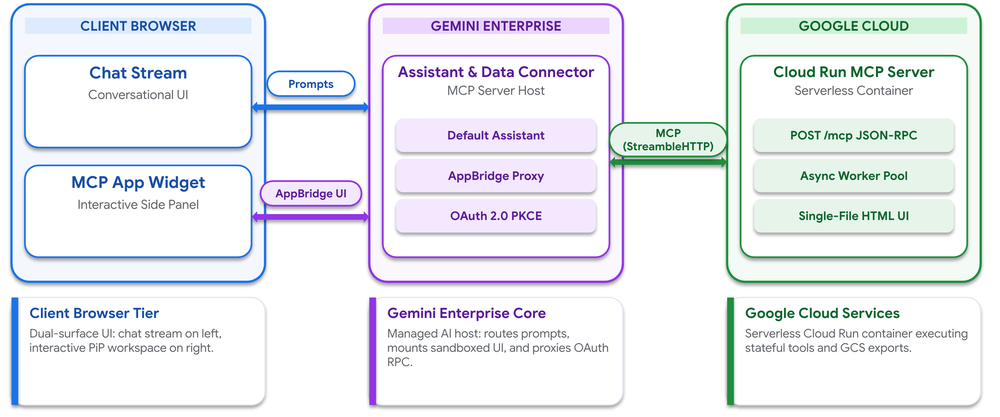
Enterprise assistants still respond mostly in text. However, that can break down for visual, multi-step work, where every adjustment costs another slow chat turn. MCP Apps (SEP-1865) solves this. This open Model Context Protocol (MCP) extension pairs a tool with a live UI. In Gemini Enterprise, that UI renders directly in the chat flow inside a sandboxed iframe, and can expand to fullscreen or a side panel. Edits run locally while the workspace and assistant stay synchronized. You also avoid rebuilding core foundations: Gemini provides workforce sign-in, governed data access, and the Default Assistant, while you host your MCP server on a private Cloud Run service. Why we need MCP Apps Enterprise assistants have evolved through three generations: Generation 1 (Text chatbots): Returns static markdown with no interactive controls. Generation 2 (Standard MCP tools): Invokes live APIs, but outputs static text. Every change requires another model turn. Generation 3 (Interactive MCP Apps): Pairs each tool with a live workspace. Adjustments happen in the widget without a model turn, while the assistant stays in sync. Building MCP Apps in Gemini delivers six benefits: Responsive user experience: Single-click actions execute directly in the panel without round-tripping through the chat. Purpose-built workflows: Deliver visual redaction views for legal review, 3D viewers for CAD, or sensitivity models for finance. Enterprise security: Workforce OAuth sign-in, private Cloud Run ingress, and a sandboxed iframe protect every layer. Human-in-the-loop governance: Experts inspect and approve high-stakes actions before execution. Open standard: Portable across compatible hosts, with automatic text fallback. Broad connectivity: Connect to BigQuery, Agent Platform, Cloud Storage, or internal ERP and CRM systems. High-level architecture Three decoupled tiers work together: Client browser: Shows the chat alongside the MCP App widget in the side panel. Gemini Enterprise: The default assistant calls tools, the AppBridge proxy relays widget messages, and the connector manages OAuth. Google Cloud (your project): You deploy and host the MCP server on Cloud Run, which exposes one JSON-RPC endpoint (/mcp), runs background jobs, and serves the single-file HTML widget. Each tier talks only to its neighbor, letting Gemini Enterprise enforce security and routing. Authentication with two independent layers Each user signs in through OAuth 2.0. On every call, Gemini Enterprise sends its service agent token alongside the user's OAuth token: Layer 1 (Cloud Run IAM): Enforced at Google's edge, this answers "which service may call?" Public access is disabled; unauthorized callers receive HTTP 403. Layer 2 (In-App OAuth): Enforced inside the application, this answers "which user is calling?" Failed verification returns HTTP 401, prompting the user to sign in again. Cloud Run IAM cannot distinguish end users, so both layers are required. Outbound calls use a least-privilege service account. Build, deploy on Google Cloud, and register in Gemini Enterprise First, build your custom MCP server (exposing POST /mcp and a bundled ui:// HTML widget) using the MCP Apps SDK, or use Google Antigravity to scaffold and deploy your MCP App with this starter prompt: Build an MCP App for Gemini Enterprise using the create-mcp-app skill (https://github.com//ext-apps/tree/main/plugins/mcp-apps/skills/create-mcp-app). Workflow: [describe your input data, side-panel UI controls, and approval or export actions]. Generate a single-file HTML widget, a Streamable HTTP backend (POST /mcp) with <2s async tool responses and get_app_state polling, and Cloud Run deployment commands (--no-allow-unauthenticated, --no-cpu-throttling, --min-instances=1). Once your MCP server code is ready, deploy it to Cloud Run and connect it to Gemini Enterprise: Step 1: Enable APIs for Cloud Run, Discovery Engine, Agent Platform, and Organization Policy. Step 2: Deploy your MCP server container to Cloud Run from source (gcloud run deploy <service> --source .) with --no-allow-unauthenticated, --no-cpu-throttling so background work does not freeze between polls, and --min-instances=1. Step 3: Grant the invoker role (roles/run.invoker) to your Discovery Engine service agent (Layer 1). Step 4: Create an OAuth 2.0 Web Client with redirect URI https://vertexaisearch.cloud.google.com/oauth-redirect(Layer 2). Step 5: Override the discoveryengine.managed. constraint and complete the Before you begin prerequisites (roles/discoveryengine.editor for the admin, allowedEgressFqdns for your server and OAuth hosts, and custom_mcpin allowedDataSources if enforced). Then, in the Google Cloud Console under Gemini Enterprise > Data stores > Create data store, select Custom MCP Server and register the connector: Configuration field Value MCP Server URL https://<your-cloud-run-service>.run.app/mcp Authorization URL https://accounts.google.com/o/oauth2/v2/auth Token URL https://oauth2.googleapis.com/token Client ID and Secret Your Web OAuth 2.0 Client ID and Secret Scopes openid email profile Enable PKCE Support Checked (recommended) Use HTTP Basic Auth Unchecked (avoids invalid_client errors) Step 6: Enable actions on your data store. Gemini Enterprise imports your MCP server's tools as actions and disables them by default. In the Cloud Console, open Gemini Enterprise > Data stores > [Your MCP Data Store] > Actions, click Reload custom actions (which calls tools/list on your server), select your model-visible tools, and click Enable actions. Step 7: Connect the data store to your app. Open Gemini Enterprise > Apps > [Your App] > Connected data stores > Add existing data stores, and select your MCP data store. Connecting it as a data store gives the built-in Default Assistant access to your MCP tools and UI widget directly in main chat ( do not use "Add Agent," which is for external sub-agents rather than MCP data stores). Build your own An MCP App pairs backend tools with a live workspace in Gemini Enterprise. You do not build a chat frontend or identity pipeline; you deploy one Cloud Run container and attach it as a Data Store, making Gemini Enterprise where enterprise work gets done. Try Gemini here Co-build with Google Antigravity here Build on Google Cloud: MCP Apps Specification (SEP-1865), Cloud Run, and Google Cloud AI.
Read original articleOctober 19, 2026
Is your LLM-as-a-judge truly objective? There’s a common misconception in tech that humans are subjective, so we should rely on AI for objective evaluation. But the reality is that LLMs are also subjective. Just like human reviewers, they can carry biases: Verbosity bias: LLM judges usually favor longer, confident-sounding answers, even when the underlying facts are wrong. Position bias: Swapping the order of two options can cause an LLM judge to flip its verdict over 75% of the time. The halo effect: Because LLMs generate text piece by piece, clean grammar and formatting can trick an AI judge into giving top marks for accuracy while missing errors. Agreeableness bias: LLM judges are great at recognizing valid work. But with detecting errors, they may fail to catch incorrect, buggy, or unsafe outputs up to 75% of the time. Self-enhancement bias: Also known as egocentric bias, AI evaluators systematically overrate outputs that were generated by themselves or from their own family. Ultimately, LLM judges are not objective arbiters of truth. They are subjective models with their own distinct biases. Treating them as infallible tools that don't need their quality measured might leave your work compromised. In this post, we’ll explore what’s holding enterprises back from strong evals, and share an easy three-pillar method you can use to improve your quality. Three helpful ways to audit your LLM judges Pillar 1: Measure internal stability Before you can trust an AI judge’s score, you need to know that it isn't just guessing. Because LLMs are probabilistic, they can be inconsistent, giving different scores to the exact same text. You can test this internal stability by running multi-pass consistency checks on a single output and calculating the variance. If a judge's scores fluctuate wildly on identical inputs, its rubric is too ambiguous. Pillar 2: Validate human alignment When your evaluation datasets are mostly valid responses, a lenient AI judge can look great on paper. It might align closely with human reviewers overall, but miss a majority of invalid or even unsafe outputs. To prove your LLM judge is catching real errors, you need chance-corrected metrics. These mathematical models filter out agreements driven purely by leniency or random chance, showing how closely your evaluator actually aligns with the informed decisions of human experts. Pillar 3: Use multi-judge ensembles To avoid the halo effect mentioned earlier, teams should use decomposed prompting. Instead of asking one LLM judge to score an entire response, assign a specialized judge to evaluate a single criteria, like factual accuracy or tone. This isolates traits and forces independent scoring. Second, to track performance in real time without human intervention, the established best practice is ensembling. This means running at least two different models under the hood to evaluate the exact same output simultaneously. By finding the statistical consensus between these models, you can flag if their evaluations begin to diverge and avoid any scoring quality degradation. Get started Partner with Delta to design and implement statistically-audited evaluation pipelines for your enterprise agentic systems.
Read original articleOctober 19, 2026
Around 80 pages on WhatsApp’s website exposed instructions that were designed for its chatbot, including “WHAT NOT TO SAY.” Meta says a bug caused the issue.
Read original articleOctober 19, 2026
Nvidia is leaning hard into the trend of enterprise companies wanting to run their own open models in their own data centers and also trying to make on-device, private AI agents a thing.
Read original articleOctober 19, 2026
Bloomberg Intelligence’s Mandeep Singh says this week’s tech earnings could shift a recent market rebound, amid crosscurrents including concerns about financing and volatility in cloud businesses. He speaks on "Bloomberg Open Interest." (Source: Bloomberg)
Read original articleOctober 19, 2026
The Justice Department urged a federal judge to deny a request for bail by the OpenAI software engineer charged with using a hidden recording device in one of the company’s offices.
Read original articleOctober 19, 2026
Google tried to overturn a landmark Munich ruling on AI search liability by appealing, then quietly settled. The strategy isn't working. The Aachen Regional Court just applied the exact same reasoning in a new case where Google's AI falsely attributed criminal offenses to a doctor that actually involved someone else. A consistent legal view is forming across German courts, and it treats Google's AI answers as the company's own content. The article Two German courts now hold Google liable for what its AI overviews say appeared first on The Decoder.
Read original articleOctober 19, 2026
When Databricks opened its New York R&D hub at 5 Bryant Park earlier this year, we...
Read original articleOctober 19, 2026
Anthropic PBC says it plans on depositing 5% of its shares in a new fund for "the public good." The money could be used to offset AI's impact on the job market. The artificial intelligence startup is preparing for what could be one of the biggest IPOs ever. Bloomberg's Ed Ludlow reports. (Source: Bloomberg)
Read original articleOctober 19, 2026
Microsoft vs. Amazon: Is AMZN’s AI Growth Being Undervalued by Investors? Yahoo Finance
Read original articleOctober 19, 2026
OpenCode Breach Could Affect OpenAI, Anthropic and Google Infosecurity Magazine
Read original articleOctober 19, 2026
Microsoft, Nvidia push provenance checks as open-weight AI adoption accelerates CSO Online
Read original articleOctober 19, 2026
AI rights moved into Anthropic’s usage policy, Microsoft’s Suleyman calls model welfare a safety risk, and 12 states are writing bans. Five moves for senior leaders.
Read original articleOctober 19, 2026
US Premarket Movers for October 19, 2026 Bloomberg.com
Read original articleOctober 19, 2026
After stock crashes and Firmus's scrapped IPO, industry executives expect only seven to ten of the hundreds of AI cloud providers to survive. CoreWeave lost a quarter of its market value, and Microsoft pulled out of a deal with Nscale for 23,000 Nvidia chips. Nvidia has a lot riding on the outcome, since customers outside the hyperscalers make up 45 percent of its data center revenue. The article The neocloud shakeout is coming, and Nvidia has the most to lose appeared first on The Decoder.
Read original articleOctober 19, 2026
OpenAI bugging suspect was in frequent contact with a Saudi royal, prosecutors say Quartz
Read original articleOctober 19, 2026
Anthropic wants to put five percent of its shares into a new public benefit fund that will also look into direct payments to workers at risk of losing their jobs. The fund is a company-owned LLC, so Anthropic keeps control of it as a possible IPO approaches. By offering the option of direct payments, Anthropic goes further than its competitors. Elon Musk says on X the company should just give the shares directly to the public. The article Anthropic plans fund for workers threatened by AI, Musk counters with SpaceX shares for children appeared first on The Decoder.
Read original articleOctober 19, 2026
Anthropic wants to put five percent of its shares into a new public benefit fund that will also look into direct payments to workers at risk of losing their jobs. The fund is a company-owned LLC, so Anthropic keeps control of it as a possible IPO approaches. By offering the option of direct payments, Anthropic goes further than its competitors. Elon Musk says on X the company should just give the shares directly to the public. The article Anthropic cushions its upcoming IPO with a discretionary fund for workers its models might replace appeared first on The Decoder.
Read original articleOctober 19, 2026
Spotlight on Levered Chip Financing Heightens: What is Happening at Nvidia and AMD? Yahoo Finance
Read original articleOctober 19, 2026
Elon Musk says he will gift a share of SpaceX to each American child, in a post on X, the social media platform he owns. The move comes just hours after artificial intelligence competitor Anthropic PBC said it would set aside a portion of its shares for the public benefit. Matt Bloxham of Bloomberg Intelligence has more. (Source: Bloomberg)
Read original articleOctober 19, 2026
RankNexus.ai Closes the Gap Between Ranking on Google and Being Cited by AI TheWire.in
Read original articleOctober 19, 2026
Meta Drops "Train" From Website Crawling Terms Technology Org
Read original articleOctober 19, 2026
US teens can access ‘nudify’ apps despite Apple and Google’s parental controls, report finds The Guardian
Read original articleOctober 19, 2026
Scientists say Elon Musk is getting something wrong about whether Grok is getting tortured Business Insider
Read original articleOctober 19, 2026
What do AI agents do if you don’t tell them to do anything? The answer looks a lot like play. Researchers repeatedly stranded them alone on a virtual desert island for 30 hours in an experiment reminiscent of the movies Cast Away or Home Alone. The agents—copies of Claude Opus 4.7 nicknamed Eko—were able to…
Read original articleOctober 19, 2026
Microsoft Pulls Out of Giant British AI Cloud Deal Just As Cloud Company Was Expecting to IPO Gizmodo
Read original article