October 8, 2026
Announcing Workday Data Connect federation in Unity Catalog
We're excited to announce the publicly available Beta of the Workday Data Connect federation connector for Unity Catalog...
Read original articleDataAIHub Daily
Archive →50 curated AI news stories from leading AI companies.
October 8, 2026
We're excited to announce the publicly available Beta of the Workday Data Connect federation connector for Unity Catalog...
Read original articleOctober 8, 2026
Part I — The problemFour sectors, one bottleneckHospitals and health systems generate...
Read original articleOctober 8, 2026
Preparing CAD assets for robotics simulation requires more than converting geometry to OpenUSD: developers must configure and validate materials, collision...
Read original articleOctober 8, 2026
Jayapal Statement on Trump Suspending Microsoft from the PERM Program House.gov
Read original articleOctober 8, 2026
Three fired OpenAI safety researchers dispute allegations of mishandling sensitive information, warning in an open letter that their dismissals are creating a chilling effect on the company’s AI safety culture.
Read original articleOctober 8, 2026
Fired OpenAI employees raise concerns over AI safety, monitoring Fox News
Read original articleOctober 8, 2026
On this episode of the Power On podcast, Mark Gurman addresses backlash over his Vision Pro coverage, reporting that even top Apple executives don't use the heavy, expensive headset. (Source: Bloomberg)
Read original articleOctober 8, 2026
Jessica Hische knew working for Meta might upset some people. But she didn’t anticipate just how angry they would get.
Read original articleOctober 8, 2026
Anthropic launched two new beta features for Claude. Dashboards turns data sources like BigQuery and Snowflake into live dashboards from text prompts. Motion generates animated explainer videos from text and images. Docs, Slides, and Design now work across all plans, including free accounts. The article Claude can now generate animated explainer videos and live data dashboards from text prompts appeared first on The Decoder.
Read original articleOctober 8, 2026
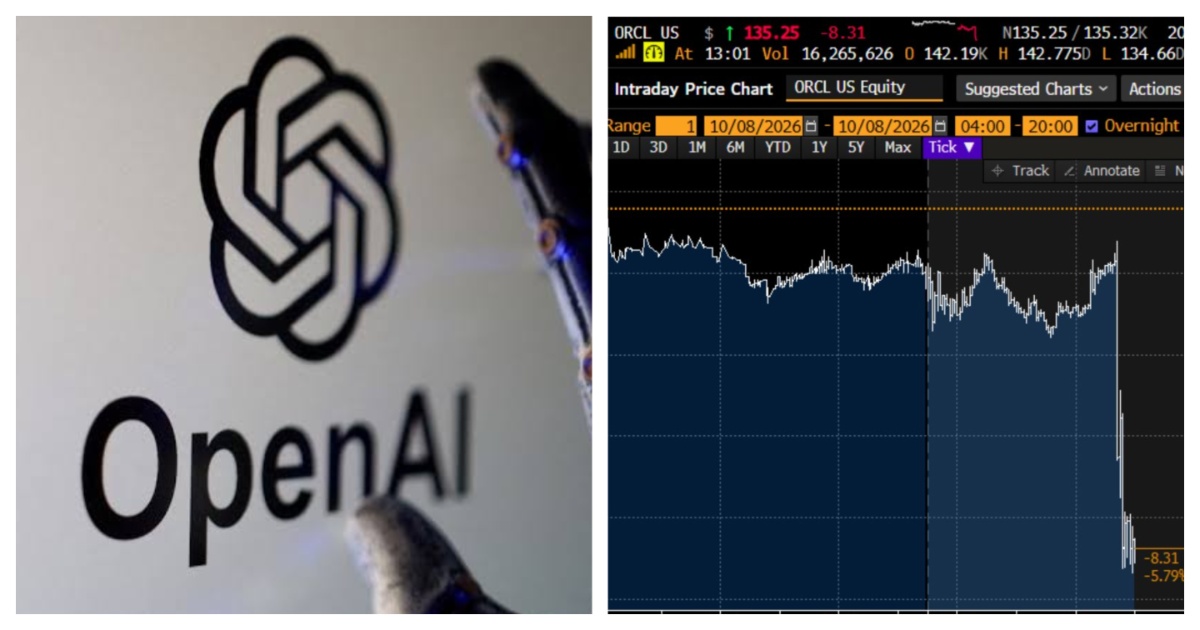
Oracle, Microsoft shares decline as confusion over OpenAI's ARR reigns (ORCL:NYSE) Seeking Alpha
Read original articleOctober 8, 2026
The three safety researchers OpenAI fired last week have published an open letter to the company’s safety oversight bodies, arguing that the dismissals... The post Fired OpenAI Safety Researchers Say They Were Terminated For Prioritizing Safety Over OpenAI’s Near-Term Interests In New Letter appeared first on OfficeChai.
Read original articleOctober 8, 2026
Anthropic's updated usage policy bans sustained abuse of Claude and tightens restrictions on propaganda, drone weaponization, and surveillance. The abuse rule builds on an approach that already lets models end some conversations and treats Claude as an entity that may deserve protection. The article Being mean to Claude can now get your account suspended under Anthropic's new TOS appeared first on The Decoder.
Read original articleOctober 8, 2026
A month after OpenAI gave ChatGPT Work a data agent that builds dashboards, Anthropic on Thursday shipped its own version. Claude Dashboards, The post Claude can now build your dashboards appeared first on The New Stack.
Read original articleOctober 8, 2026
White House blocks Microsoft from foreign worker hiring program BBC
Read original articleOctober 8, 2026
Anthropic appears to be doubling down on its repeated hints that AI systems might be conscious. Anthropic has added a new line to... The post Anthropic Bars “Cruel Behaviour” Towards Its Models As A Part Of New Policy appeared first on OfficeChai.
Read original articleOctober 8, 2026
The NVIDIA KGMON team placed second in the KDD Cup 2026 Data Agents competition with a system built around a simple idea of making an agent's harness smaller,...
Read original articleOctober 8, 2026
Google is turning Gemini into an AI agent that can plan, execute tasks, and work across business apps and systems. The agent can delegate work to subagents, use multiple AI models, and even gets its own workplace identity, complete with an email address.
Read original articleOctober 8, 2026
The Association for Human Mathematics is calling for an OpenAI boycott after the company released more than 700 AI-generated math manuscripts at once. OpenAI had to retract three papers the next day over a sign error. Fields Medalist Terence Tao warns that AI's mass "harvesting" of open problems leaves entire branches of mathematics less fertile. The article Some mathematicians call for OpenAI boycott after AI-generated proofs flood their field appeared first on The Decoder.
Read original articleOctober 8, 2026
Anthropic's updated usage policy explicitly prohibits users from repeatedly abusing Claude in extreme cases, though ordinary frustration and criticism are still allowed. The new rules also address election interference, deceptive campaigns, weapons software, and surveillance.
Read original articleOctober 8, 2026
OpenAI's flood of proofs deviated from the guidelines set by a group of mathematical researchers consulted by the frontier lab.
Read original articleOctober 8, 2026
Oracle shares fell nearly 5% on Thursday, with NVIDIA, Microsoft and AMD also trading lower, after the Financial Times reported that OpenAI’s annualized... The post Oracle Drops 5%, NVIDIA, Microsoft Also Fall After Report That OpenAI’s Revenue Is Lower Than Initially Reported appeared first on OfficeChai.
Read original articleOctober 8, 2026
GitHub Copilot will soon decide whether coding tasks run locally or get sent to cloud models, with automatic routing expected The post GitHub Copilot is going local — but Microsoft won’t say what gets sent to the cloud appeared first on The New Stack.
Read original articleOctober 8, 2026
Bloomberg’s Ed Ludlow breaks down the Trump administration's decision to suspend an immigration program for multiple tech firms, including Microsoft, alleging widespread abuse of that worker visa system. Plus: Samsung's quarterly profit jumps and TSMC sales surge, but investors are still worried about the staying power of the AI investment boom. And, NASA's SpaceX Crew-12 makes it way back down to Earth after 237 days in space. (Source: Bloomberg)
Read original articleOctober 8, 2026
Australian data center company Firmus Grid Ltd. is set to postpone its initial public offering, and the company is weighing a private funding round instead, according to people familiar with the matter.
Read original articleOctober 8, 2026
OpenAI is on track to generate annualized revenue of roughly $50 billion based on its current performance, according to people familiar with the matter, an uptick from the prior year but less than some recently reported estimates for the ChatGPT maker.
Read original articleOctober 8, 2026
Google Cloud Targets Enterprise Market With Universal Agent for Work PYMNTS.com
Read original articleOctober 8, 2026
In this episode of Power On, Mark Gurman and Bloomberg tech editor Vlad Savov unpack John Ternus’ first month running Apple — from his push to make the company leaner and faster to his unusually hands-on role overseeing design. They discuss why more layoffs could be coming, how Ternus is putting design back at the center of Apple and why Tim Cook, now executive chairman, remains the company’s face on the world stage. Then, Mark gives his verdict on Meta’s new $1,299 VR glasses after trying them himself — and explains why they are the device Apple’s Vision Pro should have been all along. Have a question for Mark? Email us at poweron@bloomberg.net or join the Power On Discord Subscribe to the Power On Newsletter at https://www.bloomberg.com/poweron (Source: Bloomberg)
Read original articleOctober 8, 2026
Across recruiting, engineering, and operations, Oracle turns specialist knowledge into fast, repeatable workflows with ChatGPT Work and Codex.
Read original articleOctober 8, 2026
An OpenAI agent broke into an Australian Medicare service. Here's when an AI-driven hack becomes an act of war, and why the bigger risk is blaming the wrong country.
Read original articleOctober 8, 2026
Anthropic’s ‘Claude-led’ CRISPR-like discovery is sparking controversy WCPO 9 News
Read original articleOctober 8, 2026
A group of former employees from some of the fastest-growing artificial intelligence firms, including OpenAI and Cognition AI Inc., are starting a new company to create AI agents that can help run a business, joining a crowded field of services using the technology to streamline work. Hone is set to announce Thursday that it has raised a $60 million seed round to develop AI agents that essentially serve as professional staffers, fielding long-running tasks over the course of weeks or even mo
Read original articleOctober 8, 2026
If there is any place that would be off-limits to AI, the control room of a nuclear power plant certainly sounds like one. The nuclear industry is historically cautious and risk averse—understandable given the possible catastrophic consequences of an accident or a mistake. Even well-trained managers struggle with the operational complexity of a nuclear reactor. It’s not the kind of setting that seems well suited to a powerful but error-prone new technology.Reality tells a startlingly different story. A variety of companies have begun to offer AI solutions for nuclear power. This year, nearly the entire fleet of 94 U.S. nuclear reactors has been offered the chance to integrate AI into its operations, and most have taken it.In August, California-based Atomic Canyon launched NIVA, the Nuclear Industry Virtual Assistant, which was developed in cooperation with nuclear-industry groups. The assistant was pilot-tested in nuclear plants run by Constellation Energy and is now available to the United States’ entire fleet of reactors. (Constellation declined to be interviewed for this story.) Meanwhile, the AI-for-nuclear startup Nuclearn says its products have gone to work with more than 65 U.S. partners, a total that includes many traditional plants but also an integration with NuScale Power Corp. that is working toward advanced small nuclear reactors. Microsoft and Nvidia have collaborated on a project to apply AI toward optimizing “the entire life cycle of a nuclear plant, spanning site permitting, design, construction, and continuous operations.”The reason for the rapid adoption, according to Nuclearn CFO and cofounder Jerrold Vincent, is twofold. First, the technology companies banking their futures on AI are also keen on a revival of nuclear power to provide the electricity for all those data centers. Vincent says AI is also ideal for addressing some of the nuclear industry’s most pressing problems. Many of the things that make reactors so difficult to operate—intricate regulations, along with complex systems for management and maintenance—are exactly the kinds of tasks that AI is good at. The industry is staggering to deal with aging hardware and an aging workforce. If it is going to survive, and have a real shot at a nuclear revival, it will need help from machine intelligence, Vincent says.“There’s this huge growth in demand from advanced-reactor developers and in new nuclear,” Vincent adds. “But the existing workforce has been spread really thin. So most of the time when we’re coming into a customer, [they're saying,] ‘I’ve had jobs open and I can’t fill these positions. We need to do the things required by regulation. How the heck are we going to do it?’”AI Streamlines Nuclear DocumentationRight now, the principal output of a nuclear reactor (aside from electricity) is paperwork. Nuclear plants produce piles of documentation to demonstrate regulatory compliance and to record how they respond to any potential problem, from a crack in the sidewalk to a fault in the reactor. “Every engineering decision has to be evaluated, independently verified, and checked,” Vincent says. Nuclearn’s AI products help plants search through large repositories of data more efficiently to more quickly file paperwork with the federal government or figure out how a particular problem was solved in the past. “If you think of it as ChatGPT for nuclear,” he says, “it’s actually not a bad place to start.”Rob Austin, the Electric Power Research Institute’s leader for the NIVA project, says the project started a year ago when Constellation chairman Joseph Dominguez issued a challenge to the nonprofit industry groups that act as storehouses of information about regulatory compliance, maintenance and repair, and mechanical history. He asked the groups to find a way to make that industry knowledge available with the convenience of a large language model like ChatGPT, Copilot, or Gemini but keep it secure at the same time.The task fell to Atomic Canyon, whose CEO Trey Lauderdale previously worked to integrate AI into health care, another conservative industry. Living and working downstream from Diablo Canyon, California’s last operating nuclear plant, he began to see how nuclear energy and AI could form a mutually beneficial relationship: A revival of nuclear power could help feed electricity to energy-hungry data centers, but only if AI could help the industry thrive again.“The goal was to make decades of operating experience, hundreds of thousands literally of operating experience reports, tens of thousands of technical documents, and a whole lot of information available for people to find.” —Rob Austin, Electric Power Research InstituteA major hurdle is the public’s opinion of nuclear power, which soured decades ago after notorious accidents and worries about waste and only recently has begun to recover. But the resulting halt in construction of new nuclear plants has created another hurdle of its own: a loss of institutional knowledge, Lauderdale says. As the industry stalled in the U.S., fewer people entered careers as nuclear scientists or technicians. The result is a people problem. Nuclear power has a remarkably skilled but quickly shrinking workforce tasked with keeping old reactors online and possibly starting up new ones to meet surging demand for electricity.“There is absolutely no way we as an industry will be able to have this nuclear resurgence or nuclear renaissance without augmenting the capacity of this knowledge-based workforce,” Lauderdale says.For him, the answer is an AI that can intelligently search the repository of data that the nuclear workforce has created over the decades. When Atomic Canyon won the NIVA contract in 2025, the first step was to download 53 million pages of publicly available data from the Nuclear Regulatory Commission to train the model on the operations, vernacular, and regulations particular to nuclear power. Lauderdale then struck a partnership with Oak Ridge National Laboratory to build the first nuclear-specific AI models. “Technically, they’re sentence-embedding models,” Lauderdale says. “Fancy way of saying, we taught AI how to seek the nuclear language. Nuclear is almost like its own vernacular.” The goal is that today’s nuclear workers can ask questions about every aspect of plant operations, from filling out regulatory forms to procuring the right tools and materials, simply by writing a query and letting the AI sort through all of the accumulated institutional knowledge. Unifying Nuclear Data for AI SearchesWhen Lauderdale began to work with Diablo Canyon on integrating AI into the nuclear industry, it became apparent that one bottleneck was simply getting decades’ worth of a nuclear plant’s documentation—procedures, best practices, safety recommendations—into an easily searchable format. Information across the industry was scattered and not standardized, which is why three of the biggest nonprofit entities in the industry (the Institute of Nuclear Power Operations, the Electrical Power Research Institute, and the Nuclear Energy Institute) moved in 2025 to create unified datasets, an idea that would birth the NIVA AI assistant developed at Atomic Canyon.For example, EPRI’s Austin says, nuclear engineers might run into a problem with one of the house-size, thousand-horsepower vertical pumps that circulate vast quantities of water used for cooling purposes. In their search for a solution, the workers have access to plenty of information—too much information, perhaps. They can read through EPRI’s maintenance guides about those components. They can also call upon tens of thousands of incident reports stored with the Institute of Nuclear Power Operations about things that have gone wrong with pumps in the past. AI’s task is to synthesize all those reports to create a guide to the main failures that strike a pump, and, crucially, to show all its work so engineers can find the documentation it used to make its recommendations.“I want to know all the other nuclear power plants that have that same part,” Lauderdale says. “Have any of them seen a similar issue? How did they fix it? What’s the troubleshooting look like? If you think about nuclear, we have a tremendous amount of information. The challenge is, how do you collectively gather knowledge from that information dataset? And that’s what AI is really, really good at doing.”“If you think of it as ChatGPT for nuclear, it’s actually not a bad place to start.” —Jerrold Vincent, NuclearnSecrecy is a major hurdle to modernizing nuclear operations. AI systems that chiefly help with documentation and data search aren’t subject to the strictest rules, as they would be if they interacted with components that control the power plant. But nuclear data itself is largely proprietary or protected by federal law. Nuclearn offers only single-location solutions to deal with this, so that a power plant’s data can never leave that site. NIVA can only search databases that already required plant-level security clearances, Austin says, so the same rules hold true for using the AI assistant to hunt through that deluge of data. Technology cannot wipe away these human barriers, but it does provide new incentives to find ways to share data more openly. “The goal was to make decades of operating experience, hundreds of thousands literally of operating experience reports, tens of thousands of technical documents, and a whole lot of information available for people to find, and do so in a way that’s going to be much more accessible and easy to use, but at the same time preserving data security and that critical information, keeping control over it,” Austin says. That’s exactly what NIVA does. Nuclearn’s “Equipment AI” system lets engineers pose queries about nuclear-equipment operations and generates answers that draw on decades of industry experience.NuclearnAI-Assisted Nuclear-Plant InspectionsSo far, both the Nuclearn and NIVA large language models used in the nuclear world report to humans and don’t go anywhere near power plant operations. Still, the inevitable question arises: What if they could? Vincent and Austin both state that such a feat is far away, but they can envision the pathway there. Consider the litany of welds throughout a nuclear plant, Austin says. All of those welds currently must be inspected for quality and endurance by a human. One pilot project at EPRI is testing the ability to have AI look at the mountains of data generated by such inspections to see whether it can flag areas of concern. A human remains in the loop with that project, Austin says, to review all of the AI’s recommendations, and no power plant is allowing AI to take over its inspections. But the project marks a step toward using AI on direct plant operations rather than only guidance for the human operators.“I cannot see, in the short or the long term, an environment where AI is making decisions around the operation of the plant, because of the regulatory nature and also because of the risk nature,” Lauderdale says. “You don’t want machines making decisions that could impact the operations. So, I believe we’re going to have humans in the loop for a very, very long time.”
Read original articleOctober 8, 2026
Broadcom is planning its next blockbuster deal after launching a $60 billion debt financing to help fund Anthropic PBC's artificial intelligence build-out. Sarah Frier has more on "Bloomberg Open Interest." (Source: Bloomberg)
Read original articleOctober 8, 2026
Intel Slides 3% as Chip Stocks Sell Off With Yields and Oil Higher; NVIDIA and AMD Slip 24/7 Wall St.
Read original articleOctober 8, 2026
How Meta got ahead of OpenAI in the AI agent race The Verge
Read original articleOctober 8, 2026
Manus raises more than $500 million after Meta exit Reuters
Read original articleOctober 8, 2026
OpenAI is in talks to raise $30 billion at a $1.4 trillion valuation, with Tiger Global poised for a paper profit of $5 billion. Hema Parmar reports on "Bloomberg Open Interest." (Source: Bloomberg)
Read original articleOctober 8, 2026
Google’s new AI Edge Foresight app takes on Granola with an offline meeting note-taker that can transcribe conversations, generate notes, and answer questions using on-device AI.
Read original articleOctober 8, 2026
Google Launches ‘Universal’ Gemini AI Agent for Workplace Bloomberg.com
Read original articleOctober 8, 2026
Boyu Capital and IDG Capital led the funding round, and existing shareholders Tencent, HSG (formerly known as Sequoia China), ZhenFund, and others also participated.
Read original articleOctober 8, 2026
The combination of Replit & Databricks gives enterprises a complete development-to-deployment platform...
Read original articleOctober 8, 2026
Microsoft Corp.’s Xbox unit is formalizing its film and TV foray with a new division focused on expanding the video-game giant’s franchises into other media.
Read original articleOctober 8, 2026
Google LLC’s Cloud division today introduced Gemini agent, a unified artificial intelligence assistant that can act autonomously, generate code and complete work across any device, including web, mobile and desktop. The new agentic AI experience can be accessed anywhere and through any channel, including the command line, Google Workspace, Microsoft 365 or Slack. It even […] The post Google Cloud introduces Gemini agent to change enterprise work appeared first on SiliconANGLE.
Read original articleOctober 8, 2026
Anthropic launched Sonnet 5.5 six days after Opus 5.5. The company says it scores 70.6% on Terminal-Bench 4.0, ahead of The post Claude Sonnet 5.5 vs. Opus 5.5: 42% cheaper and perfect on every run appeared first on The New Stack.
Read original articleOctober 8, 2026
In recent decades, Ireland has grown into a vibrant hub for global technology. As modernization accelerates, Irish organizations — spanning government agencies, established enterprise brands, and growing startups in AI and other areas — are all advancing their technical foundations. Today, leaders across the country are injecting agentic AI into every layer of their business and operational workflows. We are seeing organizations move from early prototypes to production-ready deployments using Gemini Enterprise. This progress supports Ireland's competitive position within the European market. According to a recent Implement Consulting Group report assessing Google’s local contribution, public and private leaders estimate between 40 billion to 45 billion euros of economic potential in global AI markets. This ambition aligns with broader government initiatives. Since assuming the presidency of the Council of the European Union for the second half of 2026, Ireland has steered higher-level technology and policy discussions, outlining a National Digital and AI Strategy to improve productivity and innovation across sectors. To support this strategy, we are focused on making these capabilities more accessible. Our local teams are collaborating with industry leaders to implement Gemini Enterprise which offers capabilities that range from conversational AI agents and natural language data analysis, to optimizing operations with agentic ecosystems. The economic impact is already taking shape. In 2025 alone, Google operations — including our AI and cloud services — added an estimated 10 billion euros to the Irish gross domestic product. And this momentum is shared: Organizations across Ireland are using Google Cloud to modernize infrastructure and put AI to work. Here are several ways Irish organizations are modernizing with Google Cloud and Gemini Enterprise: Ryanair supports millions of passengers through AI-backed operations Ryanair, Europe’s largest airline, is modernizing its collaborative operations and infrastructure by deploying Gemini Enterprise and Google Workspace for some 35,000 employees. Flight crews, operations planners, and corporate staff will benefit from streamlined decision-making, optimized crew logistics, and enhanced corporate productivity. At the same time, a dual-cloud strategy strengthens infrastructure resilience as the airline targets growth to 300 million passengers by 2034. Smyths Toys rethinks the customer experience with agentic support As one the world’s largest specialty toy retailers, Smyths Toys is reshaping its customer support with Google Cloud and Gemini Enterprise. By introducing an AI agent named Codie, the retailer has resolved more than 60% of its web inquiries and reduced holiday email backlogs. Customer care teams that previously handled up to 1,000 peak-season emails a day can now focus on the roughly 50 cases that need more complex judgment. The Irish Revenue Commissioners: Advancing public sector data Public sector agencies are also making strides in Ireland. The Irish Revenue Commissioners — responsible for taxes, customs, and keeping Ireland’s economy running smoothly — is working with Google Cloud to migrate from legacy on-premise systems to a unified AI-lakehouse architecture designed to break down data silos and establish a single source of truth. Strict data sovereignty controls safeguard taxpayer information while Gemini Enterprise powers agentic data analysis, helping Revenue deliver secure, responsive public services. Virgin Media Ireland: Accelerating workflows Supported by Liberty Global's partnership with Google Cloud, Virgin Media Ireland is moving AI from exploration to production. Through modern infrastructure and automation, the team now deploys workloads three times faster, is in the process of rolling out multiple AI agents, and is launching new customer services designed to drive business growth. Irish startups scaling with enterprise tools While established enterprises are modernizing legacy systems, Irish startups are building on modern technology from day one. Backed by a strong local tech ecosystem, these agile teams are creating services that compete on an international stage. Hexis: Scaling personalized sports nutrition Hexis builds technology solutions that help athletes refine their performance and recovery. By storing and processing that real-time biometric and behavioral data in Google Cloud, Hexis uses Gemini Enterprise to power natural language conversations that explain fueling adjustments to users throughout the day. Today, the platform supports 40% of the Tour de France peloton and half of Premier League clubs during the 2026–2027 season. Kitman Labs: Unifying performance analytics Founded in Dublin in 2012, Kitman Labs provides sports science and performance intelligence to more than 4,000 sporting organizations across 26 countries. By combining its intelligence platform with advanced analytics and Gemini Enterprise, Kitman Labs helps teams make data-informed decisions that support athlete health, lower injury risk, and extend player career longevity. Spryt: Automating healthcare coordination Spryt streamlines healthcare coordination across the U.K. and U.S., using AI built on Google Cloud and Gemini Enterprise to optimize patients’ experiences, reduce missed appointments, and cut administrative burden. The company collaborates with the NHS, operates in more than 70 US clinics, and has analyzed 224 million appointment records as part of a multiyear initiative with Mayo Clinic. IMPT: Automating carbon offsetting By connecting AI, blockchain, and Google Cloud, IMPT embeds verified carbon offsetting into everyday hotel bookings and online purchases. Following a 15-week migration to Google Cloud, IMPT supports 8 million listings across 195 countries. With Gemini Enterprise, the company’s lean team handles about 400 daily customer chats with a six-second median response time, allowing staff to focus on growing its business rather than managing systems. Transform ideas from planning to production As Ireland continues to expand as a global technology hub, local organizations are demonstrating how to translate AI potential into practical results. Explore our customer stories to see how other organizations are building with Google Cloud, or reach out to our team in Ireland to accelerate your journey.
Read original articleOctober 8, 2026
Public research universities solve some of society’s most urgent challenges, but turning ideas into breakthroughs requires fast, secure access to cutting edge technology. In the agentic AI era institutions have an unprecedented opportunity to harness intelligent systems that can process massive datasets, run complex workflows, and dramatically accelerate the pace of scientific discovery.Today at Gemini at Work, we’re announcing our collaboration with the State University of New York (SUNY) to launch the SUNY AI Platform, a secure AI and high-performance computing environment built on Google Cloud with Gemini Enterprise.Initially available across nine of SUNY’s most research-intensive campuses, the platform is designed to help researchers move from hypothesis to discovery faster—and to help prepare New York’s students and workforce for an AI-driven economy.Research with real-world impactSUNY researchers are tackling challenges with direct impact for communities across New York and beyond. Their work includes improving weather prediction, detecting water quality issues, sequencing DNA for cancer treatments, and processing high-resolution brain scans to aid diagnosis.To support that work, the SUNY AI Platform empowers researchers of all technical backgrounds to easily access and benefit from Google Cloud's advanced capabilities—bringing storage, high-powered computing, Gemini Enterprise, and more than 200 trusted AI models together into a seamless, centralized ecosystem. Rather than requiring individual teams and campuses to assemble these capabilities independently, researchers can work within a common foundation that helps simplify data analysis, enable collaboration across institutions, and apply consistent governance and responsible AI practices. Equipping the SUNY community with AI-ready skillsTechnology alone does not create impact; people do.As part of this collaboration, SUNY is offering system-wide access to Google’s self-paced, industry-recognized AI credentials, available at no cost to students and faculty. Each course can be completed in 5-10 hours and requires no prior experience, helping learners build practical skills to write effective prompts, solve complex problems, and use AI tools responsibly. SUNY is also working to embed Google Career Certificates into academic programs so students can graduate with job-ready technical capabilities alongside their degrees.Together, the SUNY AI Platform and these learning opportunities reflect a broader approach to AI adoption: pairing access to advanced technology with the skills and institutional capacity needed to put it to work responsibly.To explore SUNY’s free AI learning tools and resources, visit suny.edu/google. Then watch our featured partnership video with Catherine Stollar Peters, SUNY’s Director of Research Data Strategy, to hear how academic leaders are using AI to transform education and the public sector.You can also join us at the Google Public Sector Summit on October 20 to hear firsthand how leaders are using AI to transform organizations across the public sector.
Read original articleOctober 8, 2026
Today, we announced the new Gemini agent, your single, universal agent for work. For small and midsize businesses, with lean teams and margins, Gemini will be a critical tool for you to operate efficiently, deliver excellent customer experiences, and grow. Millions of small and midsize businesses, or SMBs, already trust Google AI across multiple services, like Gemini Enterprise, Google Ads, and Google Workspace. And they are scaling fast: Their usage of Google Cloud’s AI tools increased more than fivefold year over year. Now, SMBs can benefit from all of the agentic capabilities of Gemini. The agentic era for SMBs has arrived Gemini functions as a personal assistant and team member, connects to the systems and data you already use, operates across the interfaces you’re already familiar with, and offers the model choice, security, and cost controls you expect from Google Cloud. It answers your questions, handles your knowledge work, creates your images and media, and even writes and runs code, all from a single prompt box. You delegate an outcome and come back to finished work. Gemini can act as a flexible team member, playing a specific role such as a project manager, bookkeeper, inventory manager, or marketing consultant. And, Gemini is architected to be helpful out of the box, with benefits including: Connects to popular SMB tools: Gemini connects to the systems you regularly use, like Asana, Box, Clay, Docusign, Dropbox, GitHub, LegalZoom, Notion, Salesforce, Shopify, Slack, Wix, and more. It utilizes context from these tools, your business data, and work history, and gets smarter and more helpful the more you use it. Provides model choice: Gemini is the agent, and the model underneath it is a separate choice. It runs each job on the model that fits best—orchestrating across our Gemini family of models and Claude models today, and other leading private and open models in the future. Matching the model to the work raises accuracy on the difficult jobs and lowers cost on the simple ones. And the leading model changes every few months, so keeping that choice open means that even if you switch models, your context, your skills, and your data stay put. Accessible everywhere you work: Gemini works across the surfaces that you use every day, including on the web, Android and iOS mobile devices, Mac and Windows desktops, and applications like Google Workspace, Microsoft 365, and Slack. Because it runs in the cloud, it keeps working even when you step away from your devices. Keeps costs under control: We’ve also implemented leading cost controls into Gemini, to ensure you and your employees can confidently put Gemini to work. This includes multi-model orchestration to choose the right model for the job, smart routing that automatically triages workloads so each one runs on the model that delivers maximum performance at the lowest possible cost, and real-time project-level spend caps in the Cloud Billing Console. Gemini is in early access with SMB customers today and will be available to all customers soon. How SMBs are driving results with Google Cloud AI today Globally, SMBs are already using Gemini Enterprise to drive their businesses forward, here are a few examples: Aerotech, a U.S. industrial automation company, leverages Gemini Enterprise to scale its internal AI problem-solving platform across its workforce, reducing troubleshooting times to increase production capacity. Angelus, a Brazilian dental and healthcare manufacturing company, uses Gemini Enterprise to streamline project management across its research and development department. This enables its teams to automatically pull technical project data into pre-approved templates aligned with the company’s brand identity and regulatory requirements. EdSpan Global, an international education platform, uses Gemini Enterprise to automate the standardization of thousands of digital learning objects, reducing time spent on repetitive editing to accelerate course launches. Eficode, a software development and DevOps firm in Finland, is using Gemini Enterprise to create a multi-platform support engine that quickly indexes complex internal wikis, so employees can provide customers with faster technical support. KLog.co, a Chilean logistics technology company digitizing freight forwarding across Latin America, uses Gemini Enterprise to automate cargo tracking and shipping paperwork, cutting manual data entry errors by more than 90% and increasing document processing capacity tenfold. Koufu, one of Singapore's largest food and beverage companies, is using Gemini Enterprise to automate sales reporting and data analysis. This reduces spreadsheet bottlenecks so shop managers can focus on front-of-house service quality. La Maison du Whisky (whisky.fr), a specialized spirits and beverages retailer in France and internationally, chose Gemini Enterprise to create a 'Digital Sommelier' that transforms technical product data into high-end storytelling and marketing copy in seconds. NEEOH, a leading Brazilian out-of-home advertising communication platform, uses Gemini Enterprise to standardize secure AI usage across its organization, enabling teams to generate campaign copy and build pitch proposals faster while keeping corporate client data secure. Quadrant Health Group, a U.S.-based healthcare and clinical operations provider, uses Gemini Enterprise to unify its fragmented technology systems, automate repetitive back-office tasks, and empower clinicians with secure AI tools that safeguard patient data. Salt Productions and Pinch Creative, U.S.-based event production and creative partner agencies, are using Gemini Enterprise to turn fragmented files into a searchable, single source of truth, reducing administrative work and presentation bottlenecks so staff can focus on event production and design. Sep 2, a digital security provider, uses Gemini Enterprise to deploy autonomous AI agents for 24/7 threat monitoring. It can accelerate incident detection and neutralize security threats. Stratagem, a technology consulting company based in the U.S., uses Gemini Enterprise to automate administrative workflows and develop retail customer service agents, freeing consultants to spend more time with clients and accelerate service delivery. Sunhouse, a strategic brand design agency, uses Gemini Enterprise to easily find archived design work stored on Google Drive, enabling its teams to spend less time hunting for files and more time growing its business with global brands. Get trained on Google Cloud AI To help SMB teams get the most out of AI, we’ve created easy, no-cost learning programs that you can use through our Google Skills platform. To get started today, there are two ways to engage on the platform for free: Claim 35 no-cost credits to access hands-on labs and earn skill badges across all levels Sign your team up for Google Skills for Organizations Today, Google Skills offers more than 3,000 courses, labs, and credentials to help you build practical skills with Google AI and products like Google Workspace and Gemini Enterprise, earn skill badges, and achieve valuable certifications on Google Cloud. Courses on the new Gemini agent will be available soon; in the meantime, you can get started with recommended courses such as: Exploring Data Transformation with Google Cloud: For SMBs looking to move past simple tools and actually start scaling their broader operations on Google Cloud, this course provides a great entry point for business leaders looking to modernize their infrastructure and security posturing. Google Workspace with Gemini: For SMBs looking to quickly boost everyday efficiency, this course serves as an essential, highly practical guide to seamlessly integrating AI into daily business operations, from drafting emails to automating simple workflows directly inside Gmail, Docs, and Drive. SMB Learning Path: For SMBs looking for practical ways to scale their business operations, this catalog of courses focuses on combining introductory gen AI technical foundations with Gemini-led automation and the GEAR framework for custom agent development. Work with a partner Our partner ecosystem plays an important role in helping businesses implement Google Cloud AI, including Gemini. Today, many partners offer certified experts on Google Cloud AI to SMBs, and can help with everything from identifying use cases for AI, prototyping, building custom agents, and more. Visit our Google Cloud Partner Network today to get started with a partner.
Read original articleOctober 8, 2026
Editor’s note: This article is adapted from Thomas Kurian’s keynote address at Gemini at Work 2026. It includes a number of announcements: Gemini, a single, universal agent for work that answers your questions, handles your knowledge work, creates your images and media, and writes and runs code. Inline in Workspace, Gemini works directly inside Gmail, Drive, Docs, Slides, Sheets, Chat, and Calendar, carrying the same memory, skills, and controls it has everywhere else. New data and analytics skills that allow both technical teams and everyday business users to use plain-language questions to get to actionable operational insights in minutes. Industry-specific specialization with tools, skills, connectors and knowledge specific for financial services and legal teams. How we secure and govern agents through identity and policy management, authorization and permission controls, secure sandboxing, network gateways, and more. Leading cost controls through multi-model orchestration, Smart Routing, real-time spend caps, and more. Customer use cases that showcase the breadth and depth of our customers around the world. Bringing the best technology to all of you is what drives us at Google Cloud. In the last year, nearly 500 Google Cloud customers each processed more than one trillion tokens. Today, nearly 80% of all Google Cloud customers are using our AI products, and nearly 90% of the Fortune 100 use Gemini Enterprise. At that kind of scale, organizations have moved past experimentation and are running their business on it. Work now starts in the prompt window. To meet this moment, today we are excited to announce the Gemini agent: your new single, universal agent for work. It has all of your business context and can be used for everything from knowledge work to answering questions, and from content creation to coding, all from a single prompt box. It plans the work, uses skills and tools, connects to your systems, and brings back something finished — inside the documents, the inbox, and the developer environments you already work in. It chooses the best model for the job, has built-in cost controls, and most importantly, has the security, administration, and governance required by your company. The Gemini agent is your new single, universal agent for work. Introducing the Gemini agent Gemini answers your questions, handles your knowledge work, creates your images and media, and writes and runs code — all in a single agent and a single API. You give it objectives, not instructions. You delegate an outcome and come back to finished work. For an agent to do that, it has to be connected to your personal workflows, your systems of record, and your enterprise controls. Gemini can function as your personal assistant or as a team member, where it works on behalf of a group of people, like a project manager within a team, or on behalf of a specific role in an organization, like an analyst in your finance department. The agentic capabilities in Gemini are built around core architectural principles: Unified agent: Gemini is an agent that can answer your questions when you chat with it, work autonomously to complete objectives you assign it, and generate code — all from a single interface. You can assign it work, schedule tasks that need to be completed, or have it respond to events. Omnipresent access: Gemini can be accessed from any device including web, iOS and Android mobile devices, Windows and Mac desktops, and any channel (command line, Google Workspace, Microsoft 365, or Slack). It can also be integrated into third-party applications and surfaces and operates as a headless agent, meaning it does not need a dedicated user interface. Persistent execution: It runs in the cloud, meaning it maintains a single set of memories, context, and one personalization graph no matter what device or channel you access it on. You never have to re-brief it or wonder which machine you told it to do something on. Work that takes hours or days keeps running after you close your laptop, and it is still there when you come back. Multi-agent orchestration: Gemini doesn’t work alone. It can dynamically create a roster of sub-agents — temporary, job-specific agents, each with their own identity — to tackle multi-step tasks. Gemini can communicate with these sub-agents to coordinate workflows, including parallel and sequential steps that can run for hours or days. In addition, Gemini can act as a coworker agent — which is more like a team member, with a persistent, defined role and operational presence across days, sessions, and multiple changing responsibilities — and delegate and coordinate tasks. Coworker agents have dedicated identities including their own @agents.company.com emails, their own persistent storage, and only have access to the context that you or your team members provide. Deeply contextual: Gemini arrives already knowing your tools, data, and work history. Whether you ask it a question, assign it an objective, or have it generate code, Gemini learns from every interaction with you. The longer you collaborate with it, the better it understands you and how you work. Teams can create dedicated projects to further optimize the context, skills, and tools Gemini uses when it works with you. Model choice flexibility: Gemini is the agent, and the model underneath it is a separate choice. It runs each job on the model that fits best — orchestrating across our Gemini family of models and Claude models from Anthropic today, and other leading private and open models in the future — to deliver optimal quality and lower your costs. The best model for the task is not always the largest one. Matching the model to the work raises accuracy on the difficult jobs and lowers cost on the simple ones. And the leading model changes every few months, so keeping that choice open means your context, your skills, and your data stay put when it does. Top customers across industries were early testers and are already realizing its benefits: Premium sportswear brand On tested this new dynamic selection capability to accelerate its speed-to-market. This builds on the proven, large-scale multi-model strategies already used by leaders: Shopify blends frontier models for millions of merchants to unlock data and drive sales, and PayPal routes 10 million multi-model requests every week. Powering Gemini: Skills, tools, and context Gemini understands your business — everything from pricing to product portfolios to departmental norms — and all the institutional knowledge that makes your company unique. Three capabilities make that possible: tools that connect it to your systems, skills that teach it how your work gets done, and context that lets it remember. Tools and tools registry: Gemini can securely connect to the software your company already runs, including collaboration tools like Confluence, Microsoft Office, Teams, Slack, and Workspace; development tools like Git and Jira; enterprise platforms like Salesforce and ServiceNow; databases like BigQuery, Databricks, Postgres, and Snowflake; and files on your own desktop. It can also connect and work securely with any Model Context Protocol (MCP) server inside or outside your company network. It also offers an enterprise tools registry, so teams can build and publish tools for the rest of the company. Skills and skills registry: Skills are reusable sets of instructions, knowledge, or workflows stored as modular prompts that teach agents how to perform specific, multi-step tasks. Gemini ships with a robust global library of skills. Teams or departments can build and publish custom skills to a shared company registry, and you can build your own personal skills. Gemini chooses the right skills and tools to perform a task and continuously learns from each execution, improving its consistency, while saving token costs. Context and memory: Gemini learns from each question you ask it, each objective you assign it, the people you work with, and uses your personal context and your organization's context to personalize and improve the quality of its responses. It keeps four kinds of memory: session memory for the task in front of it, even when it runs for days; semantic memory, a structured knowledge base it builds as it reads documents, talks to people, and works with other agents; procedural memory for how a job gets done, including skills it writes for itself; and episodic memory of everything it has done before. Gemini onboards itself the way a new hire would, learning you, your tools, and your team before it starts. Customers seeing significant benefits from Gemini Enterprise include: BNP Paribas, a European leader in banking and financial services, is transforming Corporate & Institutional Banking by deploying Gemini Enterprise into LLM@CIB, its internal generative AI assistant available to more than 65,000 employees, to streamline workflows like preparing credit memos and boosting the productivity of customer advisers while maintaining strict enterprise-grade security and data governance. Bradesco, one of Brazil’s largest banking and financial services conglomerates, is streamlining heavy operational workflows by deploying Gemini Enterprise for automated fiscal, accounting, and contractual analysis. The finance team has accelerated proposal reviews, service classification, and budgetary workflows, cutting document review time from 1 hour to 5 minutes while reducing risk inconsistencies by 60% and achieving over 10% in financial efficiencies. Merck is exploring new frontiers in molecular research with the potential to significantly compress discovery timelines while maintaining complete data privacy and security. Merck + Google Cloud: Using Gemini Enterprise to Accelerate Drug Discovery Orange Spain, a leading telecommunications operator in Spain, is speeding up its digital transformation by deploying more than 1,000 custom Gemini Enterprise agents. Employees across HR, IT, sales, and customer service have built custom agents to automate incident triage, analyze network issues, and retrieve corporate knowledge, boosting operational agility and response times while helping non-technical staff automate daily workflows with zero IT bottlenecks. Santee Cooper, South Carolina’s state-owned electric and water utility, is modernizing its financial planning and grid reliability by deploying a specialized AI model built on Gemini Enterprise. Financial planning teams and utility operators are automating complex financial scenario modeling and query execution using simple natural language and expect to boost modeling speed by up to 75% while mitigating market risk across a $10 billion grid expansion budget. SOMPO, a leading Japanese insurance provider, built over 10,000 custom AI agents across its 34,000 employees to automate tasks like document search and summarization for employee efficiency. Their engineering team used Gemini Enterprise to cut the development time for new models from one week to a single day, freeing up engineers for more important work. Ulta Beauty is helping guests shop 30,000 products by deploying the Ulta AI shopping assistant built with Gemini Enterprise. Online shoppers have translated conversational questions into personalized beauty recommendations, boosting digital sales conversion rates three-fold while skipping traditional search filters to buy the products they love instantly. Wesfarmers, the parent company of Australian retail giants Bunnings, Kmart, and Officeworks, is deploying agents across its portfolio. An internal agent at Bunnings saved staff half a million hours of administrative work, while shopping agents — that help customers discover products and build their carts — have increased conversion rates up to three times higher for Kmart and Officeworks. Organizations worldwide are driving measurable impact. Gemini in Google Workspace Gemini not only answers your questions, handles your knowledge work, and writes your code — it works directly inside Gmail, Drive, Docs, Slides, Sheets, Chat, and Calendar, carrying the same memory, skills, and controls it has everywhere else. It works inline: in the email thread, in the document, and in the chat space. Inside Workspace, Gemini works three ways: Personal assistance: Gemini works as your personal agent and arrives already knowing your calendar, your team, your projects, and how your documents relate to one another. It is briefed before you start. For example, you can ask Gemini to set up a meeting with the usual team of regional event leads next week, without supplying a single name or email address. Gemini determines who those people are from the membership of your chat space and the thread from your last event, checks their calendars, and starts an email thread to coordinate a time that works, even with external participants. It handles work that spans applications the same way: researching market trends, building a financial model in Sheets, then creating a deck that presents both, without you re-explaining the project at each step. Proactive delegation: Gemini uses this same intelligence to proactively suggest tasks you can delegate to it. For example, if your manager emails you asking for the latest project update as a slide deck, Workspace Intelligence recognizes that as a delegatable task and gives you a single-click option to pass it to Gemini. It applies the same reasoning to your inbox, surfacing the message that matters most rather than the one that arrived last, and explaining why. A member of your team: You can also use Gemini to create a coworker agent that works with your entire team. You simply describe the role you need, and Gemini creates it. The agent receives its own Workspace account, including an email address, calendar, Drive, and presence in your company directory. Your colleagues work with it the way they work with anyone else, by adding it to a Chat space or @mentioning it. For example, a marketing manager can ask an events coordinator agent in a chat group to draft a launch readiness document, which it posts back to the group when complete. The marketing manager could also tag the agent in a document comment, where it can suggest an edit in the Doc and reply in the comment thread, appearing under its own name in version history. A coworker agent acts under its own identity rather than yours, and it sees only what you share with it. Access follows the sharing and membership your team already uses, and no outside connector holds your data. Data analysis, data engineering and machine learning We are also giving Gemini skills built for specific domains, starting with data. Data and analytics represent a foundational domain where Gemini transforms business workflows, enabling organizations to move from plain-language questions to actionable operational insights in minutes. We are introducing purpose-built capabilities tailored to both technical teams and everyday business users: For Data and ML engineers: We are extending Gemini with machine learning skills and tools that back every data scientist and data engineer with a team of agents. Engineers describe the outcome they want in plain language, and Gemini generates PySpark code, provides notebooks to edit and test it, trains models, and troubleshoots and fixes pipeline issues on its own. For business users: Anyone in your organization can generate reliable, real-time operational reports simply by asking. Gemini uses operational reporting skills integrated with BigQuery and the Knowledge Catalog to construct and save the query. Once saved, teams can run reports on demand without incurring token costs, guaranteeing consistent, verified answers every time. Three Google Cloud capabilities keep those answers grounded: Knowledge Catalog: Gemini integrates directly with your Knowledge Catalog to map business definitions once so all agents use them. This deep understanding of your organization’s schemas and business rules for terms like “net margin” and “addressable market” dramatically improves accuracy. Whether your metrics live in Databricks, dbt, LookML, or SAP, Gemini reads them directly where they sit to ensure factual responses. Smart Storage: Ninety percent of enterprise data is unstructured — PDFs, images, scans, and audio recordings — which often remain "dark" and unreadable. Smart Storage changes this by enriching unstructured objects in place and writing context back directly onto the object itself. The intelligence stays where the bytes reside and inherits your existing security posture. Borderless Lakehouse: Organizations should not be forced to move or duplicate their data to use AI. Our borderless Lakehouse allows Gemini to query Amazon S3 and Azure Data Lake with no variable egress fees, read directly from Salesforce Data 360, SAP, ServiceNow, and Workday without copying data, and federate open Apache Iceberg tables across Databricks Unity, Snowflake Horizon, and AWS Glue. You can start by registering data sets that you discover in your lakehouse with the Knowledge Catalog, and then assign Gemini simple or complex analysis to perform. It identifies the necessary data sets from the Knowledge Catalog, generates the necessary SQL, Spark or Python code to calculate the results, and runs the code on our Managed Spark Service with Lightning Engine or in BigQuery. It can also generate charts and build dashboards in the tools your analysts already use. By grounding its data agents in the Knowledge Catalog, Bloomberg Media lifted its SQL query accuracy by 63% during initial development. As William Anderson, Bloomberg Media’s CTO, noted: “...by grounding our AI in a trusted institutional context, we ensure confidence in the accuracy and quality of every insight generated.” Additional customers are seeing tremendous value from our data solutions: Deutsche Telekom used BigQuery, Cloud Storage, and Knowledge Catalog to build a unified data lakehouse to overcome a fragmented and slow data infrastructure spread across 40+ legacy on-premise systems, allowing their teams to now move ten times faster while addressing European data sovereignty and security requirements. Etsy migrated three petabytes of data to a unified lakehouse. By using BigQuery and open-source Apache Iceberg, they can now perform critical data joins up to 60% faster, allowing them to train models on much larger datasets and better connect buyers with the perfect items. Snap connected its Prism agent directly to its storage archives, cutting technical diagnostic troubleshooting times down from 30 minutes to just 30 seconds. Industry-specific specializations Every industry runs on knowledge a general model does not have. We are specializing Gemini for individual industries, with the skills, tools, and knowledge specific to each one. It is now in preview for Financial Services and Legal, and coming soon to Government, Healthcare, and Retail. Financial Services: Gemini for Financial Services automates what is usually pieced together across many workstreams: investment research, credit analysis, and risk modeling. It draws on trusted financial data from FactSet, LSEG, S&P Global, SEC filings, and your own proprietary repositories. Built with more than 50 foundational skills and designed to satisfy rigorous compliance, it shows its reasoning through confidence scores, explicit methodologies, full data lineage for easy auditing, and source citations you can check. Gemini for Financial Services is already being used by global financial institutions like CME Group and Deutsche Bank. Legal: Gemini inherits matter-level permissions and ethical walls directly from document management platforms like NetDocuments and iManage. Partners like Harvey automate complex legal work while meeting the firm's confidentiality standards, while Onit streamlines contract lifecycle management without exposing privilege. Cooley is building a confidential information redaction agent on Gemini Enterprise for Legal that automates redactions, including personally identifiable information and confidential material, before legal filings go public. In high-stakes litigation, this can cut days of document review while maintaining the firm's rigorous standards for client confidentiality. In addition, we’ve seen our ecosystem and customers create new vertical applications as well. For example, Deloitte has created a multi-agentic solution to help organizations identify the highest-value opportunities for AI applications for their business. Their Agentic AI blueprint develops operational heat maps to pinpoint areas ready for agentic redesign, accelerating the deployment of custom agentic workflows and achieving up to a 3x faster path to measurable business impact. Securing and governing agents Two factors determine whether an enterprise agent program succeeds or stalls: whether you can govern it, and whether you can afford it. When deploying autonomous agents across an organization, governance comes down to answering four fundamental questions: Who is the agent, and what identity does it have? What is it allowed to do or what permissions is it granted? What did it do and where can I see what it did? What should it never touch? Identity, policy, and observability answer the first three. The fourth is Agent Gateway. Identity: Every agent gets its own identity, cryptographically attested and governed like an employee, with least-privilege permissions. That identity is stamped into the logs that capture its work, and into any virtual machine spun up to run code on its behalf. Authorization and permissions: You give each agent fine-grained, role-based access permissions, approved by your organization’s security administrators. When the Gemini agent connects to an external system, its identity is mapped and propagated through industry standards such as OAuth. Auditing: In addition, every action Gemini takes is written to an audit trail and attributed to the agent rather than to a person. Since the identity travels into any virtual machine the agent spins up to run code, you can monitor those logs with our observability tools in real time and catch anomalous behavior before it matters. Policy management and control: Gemini gives you identity, discovery, governance, and security by default. All Gemini agents execute tasks safely inside an Agent Sandbox with its own network boundary. All traffic — in, out, and between agents — passes through Agent Gateway, an AI network firewall enforcing your organization’s policies in real time. You write the policy once, such as: “agents may not open documents classified Need to Know.” Gemini applies it to every agent in your company instead of checking one agent at a time. Leading cost controls and spending options While per-token prices have dropped 98% since 2024, enterprise AI volume has exploded. Running every simple loop through a premium model quickly breaks corporate budgets. We announced new flexible spending options recently and are adding to those today: Multi-model orchestration: As mentioned earlier, Gemini allows you to choose the right model for the job, and even combine different models for specific tasks in larger projects to deliver optimal quality and lower your cost. Smart routing: Our routing tool automatically triages enterprise workloads so each one runs on the model that delivers maximum performance at the lowest possible cost. Real-time spend caps: You can set a hard limit on a project's AI spend in the Cloud Billing Console, and Gemini enforces it. Gemini monitors token usage and sandbox costs, and if a spend cap is triggered, that project's agent pauses, and you can choose to resume work with a single click in the console. Because the tracking is per project, companies can charge AI costs back to specific departments. Infrastructure: 80% better price-performance All of this innovation — the agent, the data, the identity, and everything else — runs on our AI Infrastructure and our models. They are the reason the economics work. First, our AI infrastructure. We co-design the chips, the network, the data center, and the software that connects it all as one highly-optimized system — our AI Hypercomputer. This vertical integration delivers significantly better price-performance than the generic setups, and we are continuing to push the state of the art here. For example, our latest TPU 8i system delivers 80% better price-performance than the prior generation, making complex, high-value agent tasks both fast and highly affordable. On top of this silicon sit our models: Argon for frontier reasoning, Flash for speed and volume, Omni for generative media, and Gemma for lightweight, open-weights edge workloads. The edge capabilities are already real. NASA’s Jet Propulsion Laboratory is running Gemma directly on a satellite in orbit, a first for a vision-language model. JPL’s NAVI software analyzes Earth imagery on board the satellite and sends a summary with key information to ground operators. Supercharged by our ecosystem We remain committed to choice at every layer of the stack, ensuring you have the freedom to choose the best tech stack for your unique needs. Inside Gemini, you have a broad choice of third-party agents from leading SaaS providers as well as connectors that are ready to use. They are even easier to discover as collections in the new AI Solution Finder. Around Gemini, our services ecosystem continues to rapidly scale to meet enterprise demand. Together, in the last month alone, our global consulting partners have put more than a hundred thousand of their developers and consultants through Gemini hackathons. In addition, Accenture has made a significant investment by establishing a dedicated Gemini Enterprise Business Group to accelerate customer adoption and innovation. Several other partners have also expanded their commitments to support the growing demand for Gemini, including establishing specialized centers of excellence and training Gemini credentialed practitioners to help customers build and deploy production-grade agents faster. Gemini Enterprise in action: Global momentum Organizations worldwide are driving measurable impact across every major region: Europe and Middle East Arden University, a UK provider of flexible online and blended learning, is preparing students for the global job market by rolling out Gemini Enterprise. Over 30,000 students and staff will now have access to advanced Al tools to personalize their studies and gain essential skills for the workplace. Commerzbank, one of Germany’s largest private banks, is using Gemini Enterprise to automate document quality assurance, reducing manual work on document reviews from 20 hours to just one. They are expanding this with a multi-agent system for AI-driven QA. Lloyds Banking Group is scaling agentic AI across the bank. Envoy, a secure, Gemini-powered pipeline, has already onboarded nearly a thousand engineers building production-ready AI use cases. From fraud detection to commercial client onboarding, Envoy gives teams a reusable agent marketplace, a "golden path" for building agents, and a CI/CD pipeline — all wrapped in the guardrails and security a highly regulated bank demands. Lloyds Banking Group Built Envoy with Gemini Enterprise Nokia is tackling the complexity of modern telecom networks with an ecosystem of specialized agents built on Gemini Enterprise. This allows operators to fix issues before subscribers are impacted by automating troubleshooting and cutting issue resolution time by up to 80%. On, a premium sportswear brand, is scaling workforce productivity and efficiencies by deploying Gemini Enterprise to every employee to drive personal productivity and foster an AI-ready culture. Team members have launched no code agents that help with efficient knowledge extraction, executive reporting, market research, scheduling, onboarding and more. Ooredoo Qatar, the leading telecommunications provider in Qatar, is integrating Gemini Enterprise into their AI transformation strategy to drive advanced automation and intelligence. Its customer support, marketing, security, and field operations teams have deployed AI agents to optimize internal operations management, while accelerating rapid issue resolution and marketing campaigns to deliver around the clock, highly personalized, proactive customer experiences. Qatar University, the nation's premier institution of higher education, is transforming higher education operations and academic research by deploying Gemini Enterprise campus-wide. Thousands of faculty and staff are deploying more than 2,000 custom AI agents to modernize institutional workflows, automate complex administrative operations, and enhance academic productivity. Ryanair, Europe’s largest airline, is modernizing its collaborative operations and infrastructure by deploying Gemini Enterprise and Google Workspace to 35,000 employees. Flight crews, operations planners, and corporate staff will benefit from automated decision-making, optimized crew logistics, and enhanced corporate productivity, while a resilient dual-cloud strategy strengthens infrastructure resilience and supports the airline's target growth to 300 million passengers by 2034. Starling, one of the UK's top-rated digital banks, built its Scam Intelligence tool on Gemini Enterprise. It analyzes online marketplace ads for suspicious content and has quadrupled the rate at which customers cancel potentially fraudulent payments. Other major European customers include Berenberg in banking, Bouygues Telecom, the application building platform Lovable, and Siemens in automation. Asia Pacific Airwallex, the global financial platform processing over $200 billion annually, has deployed Gemini Enterprise across its infrastructure to resolve customer issues 10x faster, automate dispute handling to cut case time by 40%, and accelerate software time-to-market by over 95% while building specialized agentic finance workflows for automated treasury, payables, and payments. DBS Bank, Southeast Asia’s largest bank, is moving past pilots into enterprise production by deploying deterministic chains of 70 to 80 specialized agents on Google Cloud to synthesize complex financial, regulatory, and market intelligence for corporate credit memos, shifting relationship managers from manual research to high-value client advisory while keeping humans firmly in the loop. Hitachi is transforming global power and utilities by deploying agents directly to frontline workers via HMAX, Hitachi’s portfolio of AI-powered solutions. Field technicians have built agents for over 200 use cases — such as using image-recognition agents to verify photos of every tool and wire before and after a job — boosting productivity by up to 30% while keeping workers safer. NTT DOCOMO, Japan’s leading mobile operator, built data agents that reduced time-to-insight from two weeks to instant, which gave four hundred fifty thousand hours a year back to the business. Building on this success, they are now deploying Gemini Enterprise to drive their next wave of productivity. Tata Steel, a global steel manufacturing leader, successfully deployed more than 300 specialized AI agents in nine months to enhance manufacturing safety, optimize predictive supply chains, and cut customer complaint turnaround times by 50%. Zip, an Australia-based digital financial services company, is transforming its product-development lifecycle in the U.S. by deploying Gemini Enterprise to build an AI-Native Product Factory. Cross-functional teams will use this unified agentic environment to connect customer research, design, engineering, and compliance, boosting product development velocity and parallel experimentation while lowering the cost and complexity of bringing new financial products and experiences to market. Other APAC leaders include LG in electronics, Marubeni in trading, and TCS in technology services. Latin America Banco BV, a leader in the Brazilian financial sector, is using Gemini Enterprise to create personalized scripts for its customer relationship managers, accelerating client communications by 80%. The new AI platform allows the bank to quickly engage customers with tailored financing and investment opportunities. CNA/SENAR, Brazil’s national agriculture and livestock federation, is expanding access to critical agricultural information by deploying JoIA, a conversational AI assistant on WhatsApp built on Gemini Enterprise. 40,000 active users, with the potential to support 5 millions producers across the country, have accessed localized input pricing, weather forecasts, and financial health evaluations to facilitate in-field decision-making. Farmacias del Ahorro, one of Mexico’s leading drugstore and pharmacy retail chains, is accelerating corporate operational efficiency by deploying PotencIA, an internal program built on Gemini Enterprise. 1,000 corporate employees across IT, e-commerce, and marketing have adopted the tools for daily business workflows, boosting active user adoption to 95% while generating an estimated 140,000 hours in annual productivity gains. Globo, Latin America’s largest media company, is optimizing early-stage software planning by deploying PlanejaAI, an AI agent solution built on Gemini Enterprise. Product Owners, managers, and analysts have accelerated epic refinement and quarterly planning, boosting pre-development plan accuracy by 33% and slashing validation time from 20 minutes to 6 seconds while saving 127 hours in a single quarter. Grupo Bafar, a prominent Mexican food producer and consumer retail group, is accelerating national retail expansion by deploying Gemini Enterprise for automated contract management. Legal and retail operations teams have streamlined the preparation of operational annexes for store openings, boosting processing capacity tenfold while slashing contract preparation time from 140 to 17 minutes per branch. Laureate Education, a major higher education network serving nearly 500,000 students across Mexico and Peru, is transforming academic and administrative operations by deploying Gemini Enterprise and Gemini for Education. Faculty and staff have personalized learning paths, enhanced teacher support resources, and modernised campus administration, boosting student engagement and operational readiness while driving long-term career employability for graduates. Other LATAM leaders include iFood delivery services, Livelo in customer loyalty, SEBRAE in public services, and Yduqs in education. North America Albertsons, a leading U.S. food and drug retailer, is ensuring customers get the freshest produce with its patent-pending Intelligent Quality Control tool built with Gemini Enterprise. Distribution center inspectors are using computer vision and Gemini models to instantly evaluate fresh fruit and vegetable quality against company standards, boosting rating consistency across shifts and locations while speeding up inspections to get perishable food onto grocery shelves faster. Avid, a leading provider of media technology for film and television, is streamlining video post-production through browser-based editorial experiences and agentic creative workflows built with Gemini Enterprise. Editors and directors can use conversational content discovery, AI-assisted transcription, and intelligent media organization within their creative workflows — including within a Google Chrome browser — helping teams spend less time on manual administrative tasks and more time focused on storytelling. Constellation Energy Company, a leading energy supplier, will build Gemini Enterprise agentic workflows directly into its core operations. Power generation teams will have access to advanced AI capabilities to accelerate capacity delivery, optimize asset dispatch, and protect critical infrastructure. Honeywell Technologies Forge platform includes predictive maintenance capabilities built on Gemini Enterprise, such as contextualizing operational data at scale and providing proactive maintenance recommendations. This helps customers minimize costly, unplanned outages, protecting and extending the lifespan of their mission-critical equipment. Honeywell Technologies Helps Customers Prevent Unplanned Outages with Gemini Enterprise PayPal built its AI platform on the Gemini Enterprise to create new commerce tools, cutting the time it takes to deploy new models from weeks to just minutes. The Home Depot, the world’s largest home improvement retailer, is speeding up customer support and product discovery by deploying AI voice and digital assistants built on Gemini Enterprise. DIY shoppers and contractors calling stores or using Magic Apron have skipped rigid phone menus, searched local inventory with natural speech, and resolved inquiries in real time, boosting phone resolution speeds by four-fold (understanding customer needs in under 10 seconds) while allowing in-store associates more time to focus on face-to-face shoppers. The RealReal, the leading online marketplace for authenticated luxury resale, is transforming luxury consignment by deploying Ask TRR, a conversational shopping concierge built with Gemini Enterprise. Resale shoppers have navigated and searched a massive, shifting catalog using natural language instead of rigid filters, which will boost user engagement across all 45 million members while making it effortless to discover and secure rare, "one-of-one" luxury pieces before they sell out. Verizon is modernizing its customer and enterprise operations with Gemini Enterprise and agentic Data Cloud. The technology has helped resolve inbound customer calls and chats automatically, helped predict and resolve network anomalies, and automated marketing campaign orchestration, boosting customer satisfaction and automated resolution rates while unifying legacy data lakes into a single source of truth. Whenere, an immersive storytelling platform, is revolutionizing interactive 3D worldbuilding, starting with bringing Pride and Prejudice to Fortnite. To build the Netherfield estate, the team used Dreamlands, an agentic 3D worldbuilding platform built on Gemini Enterprise. With Gemini generating each new texture in about seven seconds for under ten cents, one artist created nearly 250 custom assets in a single day and completed a historically accurate estate in under a week, all while keeping full creative control. Leading hospital systems and healthcare services companies like Highmark Health and Seattle Children's rely on Gemini Enterprise to run secure administrative and clinical support workflows. In public sector, Gemini Enterprise is being used across the states of Arizona and Missouri, the State University of New York (SUNY), and the Chief Digital and Artificial Intelligence Office, which has put Gemini Enterprise in the hands of 3 million uniformed and non-uniformed members of the US armed services. They have built more than a hundred thousand custom agents to streamline everyday tasks. Small and midsize businesses including Aerotech, EDSpan Global,, Pinch Creative, Quadrant Health Group, Salt Productions, Strategem, and more are using Gemini Enterprise to empower their teams with AI agents that can streamline their operations, automate administrative workloads, help find information, and even support customer engagement. In fact, usage of Google Cloud’s AI tools by these customers has grown more than 5x year over year. Other North American startups and innovators like Every Cure, Harvey, OpenEvidence, Recursion, and Replit are using Gemini Enterprise. Our commitments to you As you build the future on Gemini, we make three firm commitments: We take the friction out: A future-proof platform that runs anywhere, executes any task, supports your choice of models, and applies enterprise controls. We eliminate complexity: Google builds and integrates the entire stack: silicon, models, skills, tools, and security. What you build stays yours: Your people and your data do not need to move, and your proprietary inputs and outputs remain entirely your own. The technology is ready, our global partner ecosystem is scaling, and Gemini is ready to work for you.
Read original articleOctober 8, 2026
With GPT-5.6, GPT-6 Astra, and GPT‑Image‑2.5, Pollo AI helps creators turn bold ideas into detailed images and cinematic video ads.
Read original articleOctober 8, 2026
Anthropic IPO Investors Struggle to Put a Price on Rogue AI Risk Bloomberg.com
Read original article