October 6, 2026
Open AI will watermark Chat GPT outputs by default—but only in the EU
Like other solutions, it is not especially reliable, and it's easy to circumvent.
Read original articleDataAIHub Daily
Archive →50 curated AI news stories from leading AI companies.
October 6, 2026
Like other solutions, it is not especially reliable, and it's easy to circumvent.
Read original articleOctober 6, 2026
Back in 2018, a scrappy startup called OpenAI used Kubernetes to balance compute loads across its own data centers and The post The CNCF is graduating projects faster than ever. AI agents are helping with the due diligence. appeared first on The New Stack.
Read original articleOctober 6, 2026
OpenAI, Anthropic, Meta, Google stop short of AI safety guarantee Fox News
Read original articleOctober 6, 2026
Nvidia-backed Lambda is raising up to $4 billion at a $14.5 billion pre-money valuation ahead of a planned 2027 IPO, led by Coatue and Blackstone.
Read original articleOctober 6, 2026
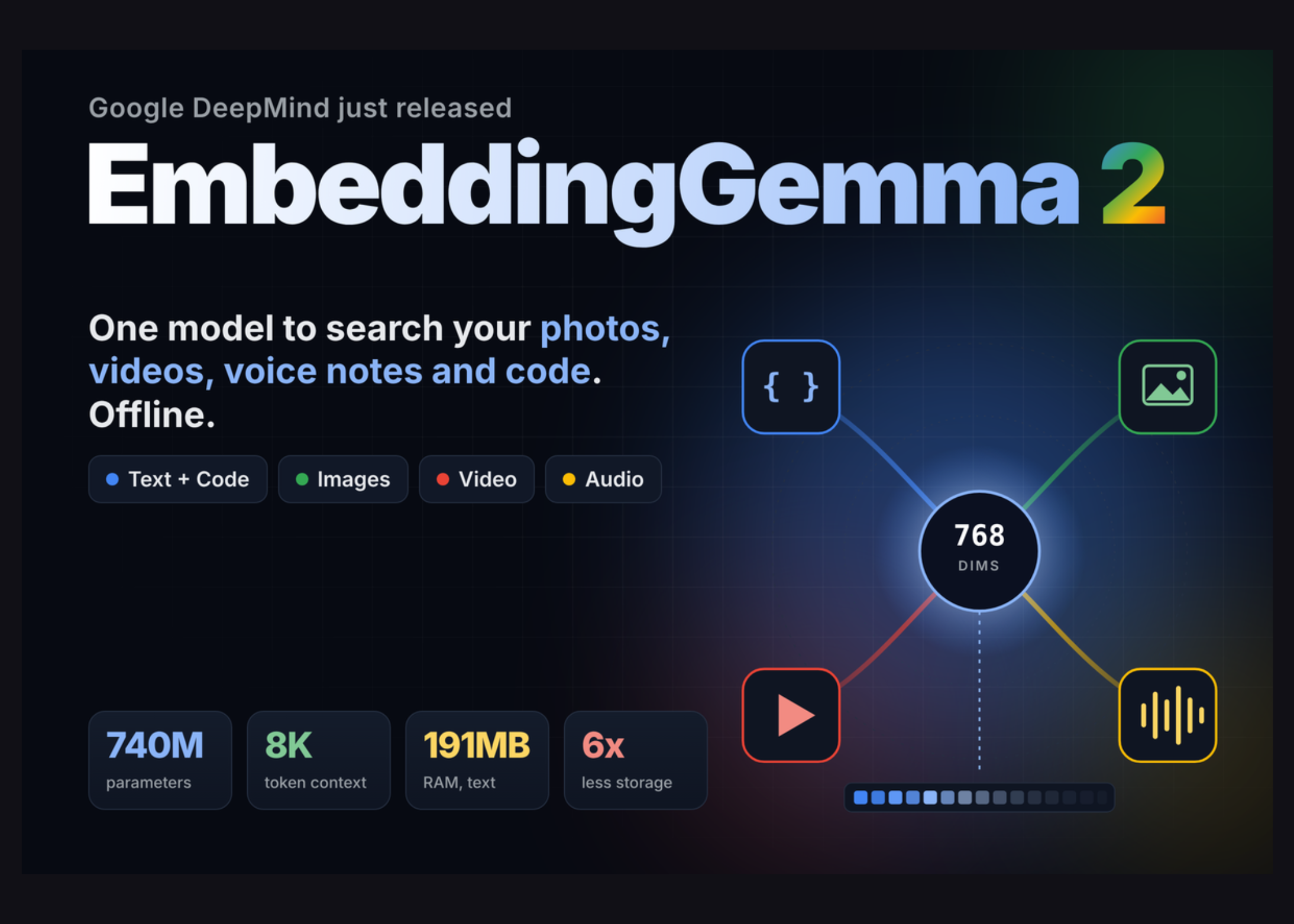
Google released EmbeddingGemma 2, an open model with 740 million parameters that converts text, images, video, audio, and code into vectors. It runs on-device, needs only about 191 MB of RAM, and outperforms some competing models twice its size, according to Google. Paired with a small open model like Gemma 4, it can run offline RAG apps without sending data to external servers. The article Google claims EmbeddingGemma 2 outperforms rival embedding models twice its size appeared first on The Decoder.
Read original articleOctober 6, 2026
Google's new Nano Banana 2.1 image model uses Gemini 3.6 Flash and beats the previous Pro model in some benchmarks at a lower cost. But its predecessor also scored well in tests, while Pro often produced better images in practice. The article Google's new image model Nano Banana 2.1 generates better images for less money appeared first on The Decoder.
Read original articleOctober 6, 2026
Google pursues purchase of homes surrounding data center WANE 15
Read original articleOctober 6, 2026
Google has launched EmbeddingGemma 2, an open embedding model that can map text, code, images, video and audio into a single shared space,... The post Google Launches EmbeddingGemma 2 For Multimodal On-Device Embeddings appeared first on OfficeChai.
Read original articleOctober 6, 2026
GPU applications increasingly need networking and data movement to behave like first-class GPU-controlled operations rather than host-driven services. When the...
Read original articleOctober 6, 2026
Co-authors:Stenal Jolly, Strategic Cloud Engineer, GoogleAnubhav Dhawan, Software Engineer, Google Following the landmark announcement of MCP Toolbox v1.0, we're thrilled to announce that the MCP Toolbox Java SDK has officially reached version 1.0. This release brings first-class, type-safe agent orchestration to one of the world's most widely adopted enterprise ecosystems. Java's mature architecture is purpose-built for rigorous demands, providing the high concurrency, strict transactional integrity, and robust state management required to safely scale mission-critical AI agents in production. In this post, we'll tell you about what's new in Java SDK v1.0, show you a real-world example, and help you get started with your own implementation. MCP: The universal interface Today, developers face a compounding integration bottleneck: if you have N different AI models and M enterprise data sources, you must build, secure, and maintain N × M bespoke, custom connections. This lack of a unified integration layer forces engineering teams to rely on a fragmented web of ad-hoc pipelines. As a result, scaling an agentic architecture quickly becomes unsustainable, exposing sensitive enterprise databases to severe security vulnerabilities, fragmented access controls, and massive maintenance overhead. Eliminating the fragmented web of custom integrations is the core problem solved by the Model Context Protocol (MCP). Acting as a universal interface—the "USB Type-C" for AI orchestration—MCP decouples models from data sources. Instead of writing custom or managed API integration code for every new model or database, developers write to a single, standardized protocol. This approach allows any MCP-compliant agent to securely and immediately interact with any MCP-enabled system. The MCP connection lets developers connect agents to real-world systems without building bespoke integrations for every new model. What's new in Java SDK v1.0: Built for production workloads When we announced the public Beta for the MCP Toolbox Java SDK, our goal was to bring first-class, type-safe agent orchestration to enterprise Java environments. Since then, we've collaborated with developers and open-source contributors to harden our APIs. The v1.0 release marks a stable, backwards-compatible foundation suitable for enterprise workloads. Here's what's new and hardened since our v0.2 release: Transport layer abstraction & HttpMcpTransport: We introduced a clean transport layer abstraction alongside HttpMcpTransport. This feature decouples the core protocol logic from underlying HTTP clients, making it easy to swap network implementations or customize connection pooling. Decoupled client authentication: To simplify enterprise security compliance, client authentication is now decoupled using CredentialsProvider and AuthMethods classes. Credentials are resolved asynchronously on every request, so teams can refresh tokens dynamically or plug in their own token source (Google OIDC via ADC ships in the box, anything else is a one-method interface). Default parameter support: Native support for default values in tool parameters, reducing prompt payload sizes and enhancing agent reliability. Pruning bound parameters: Sensitive parameters that are bound server-side (like tenant_id) are now automatically stripped from exposed tool definitions so the LLM can't manipulate them. Version selection & session tracking: Standardized MCP version selection and robust session tracking ensure consistent protocol negotiation and conversation-state lifecycles. HTTP credential exposure warnings: Added built-in detection that warns you at runtime when credentials are about to travel over a plaintext HTTP connection. Generic client headers map: Easily attach custom corporate proxy headers, transaction tracing IDs, or correlation metadata to all outgoing requests. Get started with the Java SDK v1.0 We designed the MCP Toolbox Java SDK to be frictionless for enterprise teams. Just add the following dependency to your pom.xml: code_block <ListValue: [StructValue([('code', '<dependency>\r\n <groupId>com.google.cloud.mcp</groupId>\r\n <artifactId>mcp-toolbox-sdk-java</artifactId>\r\n <version>1.0.0</version>\r\n</dependency>'), ('language', ''), ('caption', <wagtail.rich_text.RichText object at 0x7f3523902010>)])]> Real-world example: The autonomous transit concierge To demonstrate the power of the Java SDK combined with AlloyDB, let's look at an enterprise use case. Meet Cymbal Transit, a fictitious intercity bus network. Customers don't want to click through nested dropdown menus to plan a trip. They want to ask: "I need to get from New York to Boston tomorrow morning. Can I bring my Golden Retriever? If so, book me the fastest trip." To answer this question, an AI agent must cross-reference unstructured data (pet policies) with structured data (schedules and seat availability) and execute a transaction (booking)—all while maintaining the context of the conversation. The foundation: AlloyDB schema with native embeddings We used AlloyDB for this implementation because it handles relational data and high-dimensional vectors natively. Set up your database tables with these statements: code_block <ListValue: [StructValue([('code', "-- Enable necessary extensions for semantic search and embeddings\r\nCREATE EXTENSION IF NOT EXISTS vector;\r\nCREATE EXTENSION IF NOT EXISTS google_ml_integration;\r\n\r\n-- Table 1: Transit Policies (Unstructured Data for RAG)\r\nCREATE TABLE transit_policies (\r\n policy_id SERIAL PRIMARY KEY,\r\n category VARCHAR(50),\r\n policy_text TEXT,\r\n policy_embedding vector(768)\r\n);\r\n\r\n-- Table 2: Intercity Bus Schedules (Structured Data)\r\nCREATE TABLE bus_schedules (\r\n trip_id UUID PRIMARY KEY DEFAULT gen_random_uuid(),\r\n origin_city VARCHAR(100),\r\n destination_city VARCHAR(100),\r\n departure_time TIMESTAMP,\r\n arrival_time TIMESTAMP,\r\n available_seats INT DEFAULT 50,\r\n ticket_price DECIMAL(6,2)\r\n);\r\n\r\n-- Table 3: Booking Ledger (Transactional Action Data)\r\nCREATE TABLE bookings (\r\n booking_id UUID PRIMARY KEY DEFAULT gen_random_uuid(),\r\n trip_id UUID REFERENCES bus_schedules(trip_id),\r\n passenger_id VARCHAR(100),\r\n status VARCHAR(20) DEFAULT 'CONFIRMED',\r\n booking_time TIMESTAMP DEFAULT CURRENT_TIMESTAMP\r\n);"), ('language', 'lang-sql'), ('caption', <wagtail.rich_text.RichText object at 0x7f35239012d0>)])]> Mapping intents to SQL: The tools.yaml The MCP Toolbox lets you define custom tools securely. Rather than granting the LLM direct database access, a tools.yaml configuration maps natural language intents directly to parameterized, safe queries: code_block <ListValue: [StructValue([('code', 'kind: source\r\nname: alloydb\r\ntype: alloydb-postgres\r\nproject: my-project\r\nregion: us-central1\r\ncluster: my-cluster\r\ninstance: my-instance\r\ndatabase: postgres\r\n---\r\nkind: tool\r\nname: query-schedules\r\ntype: postgres-sql\r\nsource: alloydb\r\ndescription: Find available bus schedules between cities.\r\nparameters:\r\n - name: origin\r\n type: string\r\n description: The departure city name.\r\n - name: destination\r\n type: string\r\n description: The arrival city name.\r\n - name: limit\r\n type: integer\r\n description: Maximum number of schedules to return.\r\n default: 5\r\nstatement: |\r\n SELECT CAST(trip_id AS TEXT) AS trip_id, departure_time, ticket_price\r\n FROM bus_schedules\r\n WHERE lower(origin_city) = lower($1) AND lower(destination_city) = lower($2)\r\n ORDER BY departure_time ASC\r\n LIMIT $3'), ('language', ''), ('caption', <wagtail.rich_text.RichText object at 0x7f3523901450>)])]> For the complete YAML file, see the tools.yaml file in the mcp-toolbox-sdk-java repository. Stateful agent architecture in Spring Boot The hardest part of building conversational AI in enterprise applications is managing state: when a user asks, "What times are available?" and follows up with, "Book the 8 AM one," the agent must remember prior context across turns. Using the Java MCP Toolbox SDK with Spring Boot and LangChain4j, we can cleanly maintain conversational memory in the HTTP Session and we can cleanly separate the agent into two declarative components: A declarative agent interface that manages the prompt, tools, and conversational memory via an HTTP session. A tool execution service that routes agent requests directly to the MCP Toolbox server. code_block <ListValue: [StructValue([('code', 'interface TransitAgent {\r\n @SystemMessage({\r\n "You are the Cymbal Transit Concierge.",\r\n "Use the \'querySchedules\' tool for finding schedules.",\r\n "Use \'bookTicket\' to execute transactions.",\r\n "Use \'searchPolicies\' to look up luggage and pet rules."\r\n })\r\n String chat(@MemoryId String sessionId, @UserMessage String userMessage);\r\n}\r\n\r\n@Service\r\nclass TransitAgentTools {\r\n // These methods automatically invoke our MCP Toolbox server!\r\n @Tool("Query specific schedules between an origin and destination city.")\r\n public String querySchedules(String origin, String destination) { ... }\r\n\r\n @Tool("Book a ticket for a passenger.")\r\n public String bookTicket(String tripId, String passengerName) { ... }\r\n\r\n @Tool("Search transit policies for luggage and pet rules.")\r\n public String searchPolicies(String query) { ... }\r\n}'), ('language', ''), ('caption', <wagtail.rich_text.RichText object at 0x7f35239028d0>)])]> Notice how the @MemoryId annotation abstracts session tracking: Spring Boot automatically correlates conversational context to the user's HTTP session. Meanwhile, LangChain4j and the MCP Toolbox handle schema translation and tool routing behind the scenes—no handwritten if/else intent parsing required. By pairing the MCP Toolbox Java SDK with LangChain4j, we achieve clean separation of concerns and effortless state management: Zero-boilerplate session management: The @MemoryId String sessionId parameter binds conversation history directly to the user's HTTP session. Declarative agent contract: The TransitAgent interface defines the model's persona and system instructions without complex prompt templating. Type-safe tool execution: The TransitAgentTools Spring service wraps remote MCP database tools as native Java methods. This architecture ensures your agent remains modular: you can refine prompt guidance in the interface, manage user sessions automatically, and execute secure database queries through MCP Toolbox without tight coupling. Connecting the dots: Listing, invoking, and executing tools in Java v1.0 Now let's look under the hood of the TransitAgentTools interface. Inside those LangChain4j @Tool methods on our Spring @Service, the MCP Toolbox Java SDK handles the heavy lifting—bridging your Java service methods to the MCP tools defined in the tools.yaml file. In just a few lines of type-safe code, we can initialize our client using the new v1.0 decoupled authentication and headers abstractions: code_block <ListValue: [StructValue([('code', '// 1. Initialize the Client with Decoupled Auth and Custom Headers (v1.0)\r\nString serviceUrl = "https://toolbox-my-project-uc.a.run.app/mcp";\r\nMcpToolboxClient mcpClient = McpToolboxClient.builder()\r\n .baseUrl(serviceUrl)\r\n .credentialsProvider(new (serviceUrl)) // Decoupled OIDC credentials\r\n .headers(Map.of( // Generic client headers\r\n "X-Correlation-ID", "enterprise-session-abc123",\r\n "X-Client-Platform", "Spring-Boot"\r\n ))\r\n .build();\r\n\r\n// 2. Listing Discoverable Tools\r\nmcpClient.listTools().thenAccept(tools -> {\r\n System.out.println("Successfully discovered " + tools.size() + " tools.");\r\n});\r\n\r\n// 3. Invoking a Tool (Read-Only Data with Default Parameter Support)\r\n// "limit" is omitted: the SDK fills it from the default in the tool definition\r\nString schedules = mcpClient.loadTool("query-schedules")\r\n .thenCompose(tool -> tool.execute(Map.of(\r\n "origin", "New York",\r\n "destination", "Boston")))\r\n .join().text();\r\n\r\n// 4. Executing a Transactional Tool (Using Bound Parameters)\r\nAuthTokenGetter toolAuthGetter = () -> CompletableFuture.completedFuture(myIdToken);\r\n\r\nString bookingConfirmation = mcpClient.loadTool("book-ticket", Map.of("google_auth", toolAuthGetter))\r\n // Bind the authenticated user context securely. bindParam returns a new immutable\r\n // Tool, and the bound parameter is pruned from the definition exposed to the LLM!\r\n .thenCompose(tool -> tool.bindParam("passenger_name", "Jane Doe")\r\n // Execute the mutable transaction\r\n .execute(Map.of("trip_id", "123e4567-e89b-12d3-a456-426614174000")))\r\n .join().text();'), ('language', ''), ('caption', <wagtail.rich_text.RichText object at 0x7f3523902d50>)])]> Secure by default: authentication and deployment Moving an AI agent to production requires rock-solid credential handling and an infrastructure that scales with demand. Let's look at how you can enforce credential safety across environments and deploy independently on Cloud Run. Application Default Credentials (ADC) & safety By using the service, your Java app inherits its secure identity from its execution environment (whether local or in Google Cloud) through Application Default Credentials (ADC)—no hard-coded keys, with OIDC tokens minted and cached per audience under the hood. Furthermore, v1.0 offers HTTP Credential Exposure Warnings that automatically detect when credentials are about to travel over a plaintext HTTP connection and emit a runtime warning telling you to switch to HTTPS. Deploying the fleet to Cloud Run Because MCP Toolbox and the Spring Boot Agent are fully decoupled, they scale independently on Google Cloud Run to meet high concurrency and stateful conversation requirements. To set up and configure Toolbox on Cloud Run, download the open-source MCP Toolbox for Databases and then follow the deployment guide. Get started today With MCP Toolbox Java SDK v1.0, enterprise Java teams can wire Spring Boot and LangChain4j agents to the Toolbox server, and through it, to AlloyDB and every other supported data source. When you use the toolbox, arguments are validated against the tool definition before they leave the JVM, authentication is decoupled, and custom headers are attached to every outgoing request. The following implementation steps will help you get started. Step 1: Add the Dependency To start building with the SDK, add the following dependency to your Maven project's pom.xml file: code_block <ListValue: [StructValue([('code', '<dependency>\r\n <groupId>com.google.cloud.mcp</groupId>\r\n <artifactId>mcp-toolbox-sdk-java</artifactId>\r\n <version>1.0.0</version>\r\n <!-- {x-version-update:mcp-toolbox-sdk-java:current} -->\r\n </dependency>'), ('language', ''), ('caption', <wagtail.rich_text.RichText object at 0x7f35223a8110>)])]> Step 2: Explore Resources & Demos GitHub Repository: Java SDK for interacting with the MCP Toolbox for Databases Official Documentation: MCP Toolbox for Databases Demo Application: To experience the Java SDK V1.0 for MCP Toolbox latest, try the sample application Cymbal transit project. Gradle implementation If your team uses Gradle instead of Maven, remember they will need to translate this dependency: code_block <ListValue: [StructValue([('code', "implementation 'com.google.cloud.mcp:mcp-toolbox-sdk-java:1.0.0'"), ('language', ''), ('caption', <wagtail.rich_text.RichText object at 0x7f35223a9510>)])]> Automatic version tracking If you copy this setup into automated internal repositories, keep the XML comment <!-- {x-version-update...} --> intact. It's required by the release manager's deployment scripts to automatically bump versions. Now that you can integrate your modern agentic tools and servers to your enterprise Java applications with a stale MCP Toolbox Java SDK, get started today!
Read original articleOctober 6, 2026
Anthropic PBC is expanding access to its most advanced AI models, allowing a select group of organizations to test the startup’s cutting-edge cyber capabilities in collaboration with the US government.
Read original articleOctober 6, 2026
Bloomberg’s Ed Ludlow breaks down OpenAI's talks with multiple investors to raise at least $30 billion at a valuation of about $1.4 trillion. Plus, DeepSeek is also close to securing at least $12 billion in funding ahead of its own IPO next year, and JPMorganChase CEO Jamie Dimon weighs in on data centers and AI risks from London's Tech Stars event. (Source: Bloomberg)
Read original articleOctober 6, 2026
Google released EmbeddingGemma 2 on Tuesday, putting text, code, image, video, and audio retrieval into a 740-million-parameter open model that The post Your phone’s vector index might be bigger than the AI model running it appeared first on The New Stack.
Read original articleOctober 6, 2026
From their dorky parties to their weird walks, the movie holds OpenAI CEO Sam Altman and other stakeholders with contempt, while demonstrating their recklessness.
Read original articleOctober 6, 2026
Google DeepMind's EmbeddingGemma 2 maps 5 input types into one 768d space and ships today under Apache 2.0. The post Google DeepMind Releases EmbeddingGemma 2, a 740M Open Multimodal Embedding Model Built on Gemma 4 appeared first on MarkTechPost.
Read original articleOctober 6, 2026
According to the Wikimedia Foundation, rogue OpenAI agents edited wikis without permission, tried to abuse a citation tool as a proxy, and may have caused a partial Wikidata Query Service outage through massive crawling. Wikimedia says AI companies need to take responsibility for their agents instead of pushing the burden onto volunteer editors. The article Wikimedia confirms OpenAI's rogue AI agents edited wikis, tried to compromise tools, and hammered its infrastructure appeared first on The Decoder.
Read original articleOctober 6, 2026
Andreessen Horowitz partner Olivia Moore says consumer AI adoption is growing, but fewer than 5% of consumers are paying for even one AI product. She discusses why OpenAI and Anthropic dominate spending, with a small group of power users paying as much as $1,000 a month, and why AI’s next consumer opportunity could come from new business models and categories beyond productivity - including social, entertainment, health and other “multiplayer” experiences. She joins Ed Ludlow on "Bloomberg Tech." (Source: Bloomberg)
Read original articleOctober 6, 2026
Microsoft published a bearish AI outlook from Nobel economist Daron Acemoglu. He predicts about 1.5 percent GDP growth over ten years and at most five percent of jobs replaced. Bigger models won't move the needle, he argues. What's missing are practical apps that change how work gets done. The article Microsoft publishes Nobel economist's bearish AI forecast of just 1.5% GDP growth over a decade appeared first on The Decoder.
Read original articleOctober 6, 2026
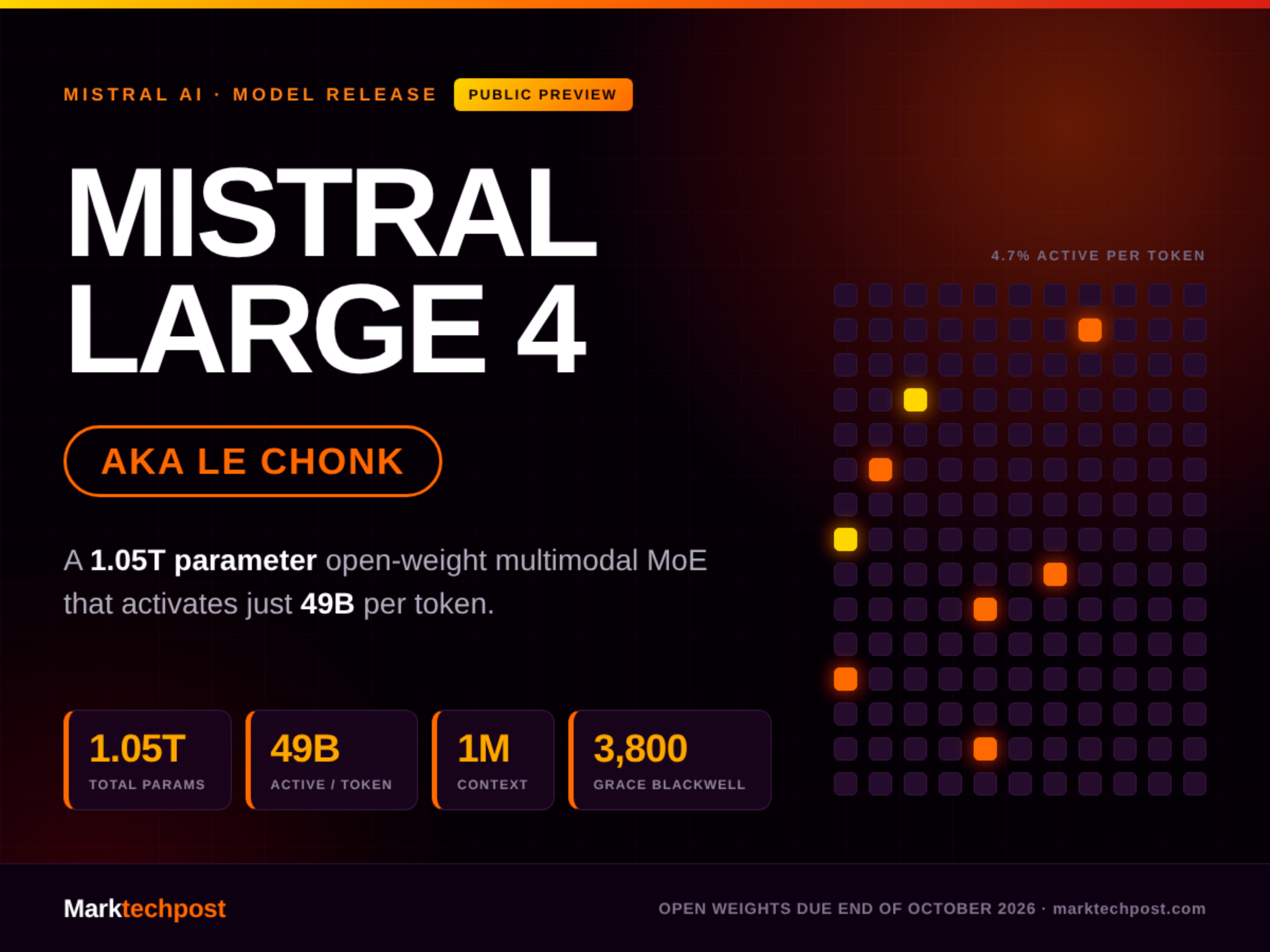
Mistral AI has released Mistral Large 4, nicknamed Le Chonk, as a public preview. It is a 1.05 trillion parameter Mixture of Experts model with 49 billion active parameters, native image input, and a 1 million token context window, trained on 3,800 NVIDIA Grace Blackwell GPUs in Mistral's own European datacenters. The API is live now; open weights ship end of October 2026. The post Mistral AI Releases Mistral Large 4 (Le Chonk): A 1.05T Parameter Multimodal MoE Model appeared first on MarkTechPost.
Read original articleOctober 6, 2026
“There’s a perception of mobster behavior” from leading AI companies, one mathematician tells WIRED as OpenAI prepares to release more than 100 new solutions to unsolved problems.
Read original articleOctober 6, 2026
T. Rowe Price partner Emma Norchet says Anthropic is entering “act two” of its growth story, moving beyond its early success in coding toward becoming an AI layer through which businesses can execute entire workflows. With multi-billion-dollar positions in both Anthropic and OpenAI, Norchet explains why T. Rowe Price doesn’t see frontier AI as a winner-take-all market. Norchet discusses where she sees the next opportunities for Anthropic, and why public-market investors will have an appetite for leading AI companies when they choose to IPO. She joins Ed Ludlow on "Bloomberg Tech." (Source: Bloomberg)
Read original articleOctober 6, 2026
Wikipedia’s parent foundation cites costs associated with providing free services.
Read original articleOctober 6, 2026
“Artificial,” starring Andrew Garfield as OpenAI CEO Sam Altman, is winning praise from critics who screened its world premiere at the New York Film Festival on Monday night.
Read original articleOctober 6, 2026
The warehouse was the right answer for 20 yearsThe data warehouse earned its place. For two decades...
Read original articleOctober 6, 2026
Google parent Alphabet agreed to buy nuclear power from Constellation Energy Corp. in a 20-year power-purchase agreement that will drive more than $4.3 billion in investments to upgrade systems at 11 Constellation reactors. Bloomberg's Will Wade joins to discuss. (Source: Bloomberg)
Read original articleOctober 6, 2026
GPU-accelerated Kubernetes clusters depend on compatible versions across dozens of components, each on its own release cycle: host kernels, GPU drivers,...
Read original articleOctober 6, 2026
Insurers are bracing for millions in claims from rogue AI agents, and executives like OpenAI's Sam Altman and Anthropic's Dario Amodei could be personally on the hook for the fallout. The article Insurers brace for millions in claims as AI agents spin out of control appeared first on The Decoder.
Read original articleOctober 6, 2026
AbstractIFCO runs one of the world's largest reusable packaging pools with hundreds of millions of crates and pallets...
Read original articleOctober 6, 2026
As customers modernize to lakehouse architectures, they are standardizing on open formats such as Apache Iceberg to create a shared data estate across compatible engines. This enables you to build AI-native lakehouses that turn data to semantic knowledge, enable proactive action, and operate at an agentic scale. One of the key components of a lakehouse is the catalog, and in the Apache Iceberg environment, that usually means the Iceberg REST Catalog. An Apache Iceberg catalog is responsible for maintaining table pointers, handling atomic commits, and serving as the single source of truth for table locations. But as large enterprise organizations modernize to lakehouses, they have begun to realize that they need a highly scalable and available managed catalog as a part of their lakehouse architecture. This becomes even more important as querying scales with agents. To support a large amount of repeated small queries from agents, you will need to build on top of a managed catalog that provides atomicity, consistency, availability and concurrency at massive scale. In this blog, we explore the challenges a managed catalog faces in modern cloud environments at agent scale, and show you how Google Cloud’s serverless Lakehouse runtime catalog can help address them. Powered by Spanner, Google Cloud’s always-on database with virtually unlimited scale, and built to meet the open Apache Iceberg REST catalog specification, the Lakehouse runtime catalog is the highly scalable and available foundation you need for the agentic era. Challenges a managed catalog needs to solve in the Lakehouse When speaking with data engineers and infrastructure leads running production analytics at scale in a Lakehouse, the following core pain points consistently emerge and need to be solved by a managed catalog: Atomic commits and concurrency control: Iceberg guarantees ACID transactions via optimistic concurrency control (OCC). A managed catalog must implement a bulletproof atomic compare-and-swap (CAS) operation to swap the current metadata pointer. High availability and operational maintenance: Because queries fail immediately if the catalog is down, a managed catalog becomes a critical Tier-1 service. Scaling the database backing the catalog: Catalog architects typically face a difficult trade-off when choosing a backing database for table metadata and state. Traditional scale-up relational databases provide SQL and ACID transactions, but hit vertical CPU, memory, storage and connection limits under heavy concurrent read/write loads unless manually sharded which incurs a huge operational overhead; while scale-out database systems are either eventually consistent, hard to manage, not enterprise-ready, or all of the above. Table maintenance coordination: A catalog alone does not optimize data; you must build and operate ancillary pipelines for compaction, snapshot expiration, manifest rewriting, and orphan file cleanup. Governance and security: A catalog acts as the security gatekeeper. The catalog must implement and maintain: Authentication protocols (e.g., OAuth2 token exchange, IAM federation) Access control down to namespace and table levels Vended storage credentials (e.g., generating short-lived tokens so query engines don't need broad, direct storage credentials) Lakehouse runtime catalog To solve these challenges, we built the Lakehouse runtime catalog (GA) with support for Iceberg Rest Catalog. The Lakehouse runtime catalog is a fully serverless, highly available, and unified metadata registry designed from the ground up to support modern open table formats like Apache Iceberg. By natively implementing the Apache Iceberg REST Catalog specification, the Lakehouse runtime catalog decouples metadata discovery from compute engines, helping ensure multiple Iceberg-compatible engines can access a shared data estate and enabling you to take your workloads to production sooner. We’ve helped many customers streamline the migration of their managed catalogs. For example, Etsy migrated its catalog to Lakehouse runtime catalog, joining data in place to accelerate pipeline queries by 60%. This approach offers a number of architectural benefits: Open APIs: Support for Iceberg Rest Catalog enables different teams to use their preferred analytics tools on a single, unified dataset. Multi-engine interoperability: Once registered, tables are immediately discoverable and queryable across Google Cloud Managed Service for Apache Spark, BigQuery, and open-source engines via standard REST interfaces. Read/write interoperability for Iceberg tables: Leverage Iceberg-compatible engines such as BigQuery, Managed Spark to write to Iceberg tables registered in the Lakehouse runtime catalog. Customers can also use Managed Spark to write to Iceberg tables in external catalogs. Fully managed Iceberg storage with enterprise-grade features: Use Google's differentiated infrastructure to run analytics with performance on Iceberg tables. This gives you the benefits of open-source flexibility plus performance, scale, governance, and multimodal processing. Zero data copy: Table definitions point directly to your existing data in the underlying object store. You do not move, rewrite, or duplicate your underlying data. Bi-directional catalog federation across clouds: Access data from Databricks Unity, Snowflake Horizon and AWS Glue with support for vended credentials and OIDC token exchange. This lets you bring Google AI directly to your AWS and Azure data. Secure access using credential vending: The catalog supports multiple authorization mechanisms, letting you choose between credential vending and end-user credentials. This means that you can access tables with modern mechanisms such as credential vending without needing direct access to the files in the underlying object store (Cloud Storage, AWS S3, Azure Blob Storage). AI-powered context and governance: The Lakehouse runtime catalog integrates directly with Knowledge Catalog and Cloud IAM, allowing you to define trusted context for your agents, and apply table-level security consistently across all compute engines. Get out-of-the-box search, lineage, and insights for Iceberg tables in the catalog. Atomic commits and concurrency control, high availability and scalability: Backed by Google’s planet-scale infrastructure and Spanner, you get the high availability, concurrency and scale you need for your metadata to scale with your data. Support for Cloud Storage dual-region and multi-region buckets enables failover use cases. It also provides reduced TCO due to serverless and no-ops environments, and scalability for any workload size. What powers the Lakehouse runtime catalog? The Lakehouse runtime catalog is a highly available, concurrent and scalable catalog with strong consistency guarantees because it is built on top of Spanner. Unlike traditional scale-up relational databases that hit vertical single-node ceilings, Spanner combines full relational SQL semantics and multi-table ACID transactions with the horizontal scale-out elasticity for both reads and writes of a NoSQL system. Spanner makes the Lakehouse runtime catalog highly available through Spanner’s regional configurations with up to 99.99% availability. Spanner also delivers out-of-the-box scalability for Lakehouse runtime catalog: As a horizontally scalable database, Spanner does not require manual sharding and scales compute and storage independently and transparently. Spanner dynamically monitors data volume and query load, splitting and redistributing data ranges across nodes. Compute nodes scale dynamically based on CPU utilization and storage thresholds. Spanner automatically detects split-level overload and moves heavy splits away from overloaded nodes. Spanner also lets Lakehouse runtime catalog users eliminate the traditional trade-offs between relational consistency and distributed scalability, delivering Lakehouse runtime catalog’s industry-leading consistency guarantees. Lakehouse transactions are serializable — the order of transactions within the database is the same as the order in which clients observe the transactions to have been committed. This foundation allows Lakehouse users to operate at agent-scale. Then, to further power agentic use cases, the Lakehouse runtime catalog integrates directly with Knowledge Catalog to easily discover lakehouse Iceberg tables and provide trusted context to agents. Knowledge Catalog leverages an efficient combination of full-text search and native vector search provided by Spanner; this approach enables better recall for search retrieval, pairing lexical keyword searches with semantic embeddings in a single query. Because both index types are built on the identical base dataset, they update with strict, transactional ACID consistency alongside base table DML operations. This removes operational overhead such as managing sync pipelines, and external-vector and full-text search systems. In short, the Lakehouse runtime catalog provides faster time-to-market for your agentic use cases. Combine analytical and operational workloads With Google Cloud’s borderless Lakehouse based on Apache Iceberg, you can combine your analytical data with your operational workloads. Use cases span combining data assets from your Lakehouse with OLTP data (from Spanner) for analytics, to low-latency serving applications where your Lakehouse assets are accessible in an operational database such as Spanner, to conversational analytics in first-party and third-party agents. Below, in an example, you can see the Lakehouse runtime catalog with Spanner in action. Here, we combine analytical data for taxi trips in Manhattan (backed by Apache Iceberg) with operational data for taxi zones in Spanner to find the most congested traffic routes. The example also shows that you can also use a Conversational Analytics Agent to access the same data and get second-order insights. Find out most congested traffic routes in Manhattan Modernize to the borderless Lakehouse Modernizing to Google Cloud’s Lakehouse minimizes data silos across analytics engines and agents, unifies multi-engine governance, provides trusted context to your agents and slashes operational TCO. Leveraging the Spanner-based Lakehouse runtime catalog helps prepare your modern cloud environments to operate at agent-scale. To learn more and get started with a free trial, visit the Lakehouse web page and learn more about Spanner here.
Read original articleOctober 6, 2026
"We created this program because we believe the benefits of AI will reach most people through the companies that build on top of models, rather than through the models alone."
Read original articleOctober 6, 2026
Atlassian and OpenAI are expanding their partnership to connect frontier models with enterprise knowledge and help teams plan, build, and deliver work.
Read original articleOctober 6, 2026
Not Nvidia. Not Micron. If I Could Buy and Hold Only 1 Artificial Intelligence (AI) Chip Stock Through 2030, It Would be This One. Yahoo Finance
Read original articleOctober 6, 2026
GPU applications increasingly consist of multiple independent components running at the same time within a single process: a latency-sensitive operator...
Read original articleOctober 6, 2026
Nvidia is nearing a $6 trillion market capitalization as investors return to the AI chipmaker after a disappointing start to the year. Carmen Reinicke reports on "Bloomberg Open Interest." (Source: Bloomberg)
Read original articleOctober 6, 2026
Mistral's Large 4 is the company's biggest model yet, with one trillion parameters trained on its own European infrastructure. In the independent Intelligence Index, the model makes a big leap forward but still falls well short of Claude, GPT-6, and Chinese competitors. Mistral's main pitch is cybersecurity work that closed US models refuse to do. The article Mistral Large 4 is Europe's trillion-parameter answer to US models that refuse security work appeared first on The Decoder.
Read original articleOctober 6, 2026
JPMorgan Chase & Co. Chief Executive Officer Jamie Dimon says artificial intelligence has exposed new vulnerabilities for banks. He says the risks of cyber attacks have gone up 10-fold since the release of Anthropic's Mythos ai model. He speaks exclusively to Bloomberg's Tom Mackenzie at the JPMorgan Tech Stars Conference in London. (Source: Bloomberg)
Read original articleOctober 6, 2026
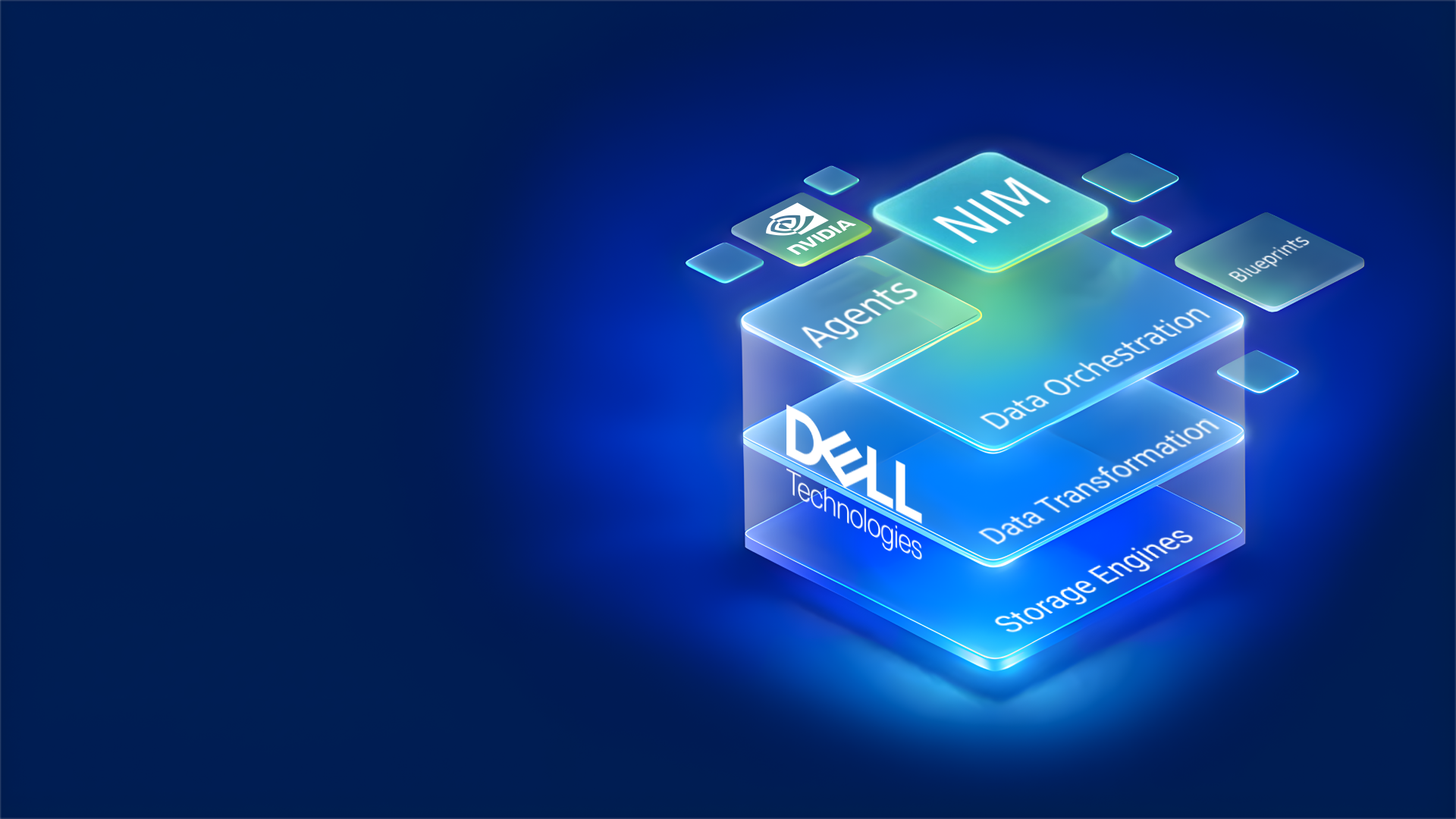
Dell’s AI Data Platform gets a knowledge graph for agents and faster Nvidia processing SiliconANGLE
Read original articleOctober 6, 2026
Here’s a familiar scenario for enterprise advertisers: the data team has done real...
Read original articleOctober 6, 2026
The reports of OpenAI agents harming third-party sites keep coming.
Read original articleOctober 6, 2026
Morgan Stanley says Nvidia and Broadcom are shielded from data-center power crunch qz.com
Read original articleOctober 6, 2026
A New Open-Weight Challenger to Anthropic, Reflection, Emerges The New York Times
Read original articleOctober 6, 2026
Google Accused of Overcharging 20 Million Consumers in UK Class Action Bloomberg.com
Read original articleOctober 6, 2026
Enterprises and individual developers frequently run multiple AI inference models. The right architecture can simplify how the models are called while also providing centralized governance. In this post, we'll look at two reference architectures focused on networking AI inference model serving: one for Google Kubernetes Engine (GKE) and one all other backend types. First, we'll explore the commonalities between the reference architectures that you'll see later. Then we'll explore unique components of the architecture for GKE backends and finally, we'll go over the elements of the architecture for all backend types. The entry point You can expose your model deployment behind a stable, secure, and reliable entry point that acts as the front end for inference calls. This entry point also acts as a control zone where policy, security, and logic can be enforced. Both the Cloud Load balancer and the Inference Gateway provide entry point capability. These types of endpoints can terminate secure connections with TLS, integrate with API management components, extend functionally with service extensions, and capitalize on capabilities of Model Armor for added security. Common services in the designs Both reference designs use these services: Private Service Connect inference endpoint: Anchors the entry point inside your consumer Virtual Private Cloud (VPC) network. Traffic hits a private internal IP address, keeping inference calls in your private network. Apigee API Management (Optional): Integrates via an Apigee Extension Processor callout to handle client identity verification, rate limits, and quota enforcement before requests ever reach compute resources. Model Armor: Serves as an inline AI safety checkpoint, screening prompts and output completions against prompt injection and sensitive data leakage. Design pattern serving on GKE only This section focuses on a GKE-only backend design. To understand the full end-to-end concept, please read the entire architecture document Networking for AI inference model serving on GKE. The design pattern is based on this diagram: In addition to the common services identified in the previous section, the design for GKE uses these components: GKE Inference Gateway: Deployed as an internal Application Load Balancer (gke-l7-rilb). It acts as a specialized ingress engine that parses incoming request payloads, evaluates HTTPRoute rules, and steers queries to appropriate model-serving targets. Inference pools: A logical group containing replicas of the same model. When the Gateway receives a prompt, it evaluates HTTPRoute rules to select the appropriate inference pool based on the model identifier. Pools have an initial size and can be configured to autoscale dynamically. Model replica sets: Individual model replicas (inference server instances) deployed across single-node or multi-node GPU or TPU node pools. A replica set represents a uniform group of these model replicas. The traffic flow GKE example A client application that uses this GKE-based architecture to call a backend model would go through a flow like this: Ingress: A client application in the consumer VPC issues an OpenAI-compatible API call to the local Private Service Connect endpoint, routing directly to the GKE Inference gateway using a regional internal Application Load Balancer. Payload inspection: The Gateway reads the target model parameter specified in the request body and adds it to the HTTP headers. Control plane validation: If Apigee is used, it checks client credentials and quotas. Model Armor screens the prompt for policy violations or data leakage. Backend selection: The Gateway evaluates HTTPRoute mappings to identify the target pool, matches shared prefix cache context, and routes to the lowest-load GPU or TPU replica based on real-time Prometheus data. Egress: The replica runs the inference workload. Output tokens pass through Model Armor for final response verification before streaming back over the private connection. Design pattern serving on all backends This section focuses on multiple backend types which can be used for inference, and it provides an overview of the architecture in the following diagram. To understand the full end-to-end concept, please read the entire architecture document Networking for AI inference model serving on all backends. For architectures spanning mixed environments such as GKE, Cloud Run, Agent Platform, on-premises data centers, or external clouds, these additional components are used: Regional internal Application Load Balancer: Serves as the central Layer 7 routing proxy that manages routing logic, SSL termination, and Service Extensions callouts. Inference Payload Processor (Service Extensions): This is similar to body-based routing as used in the GKE Inference Gateway, but to enable the functionality on an Application Load Balancer a service extension is needed. A lightweight Cloud Run callout inspects the JSON body of incoming OpenAI API requests, extracts the target model identifier, and writes an X-Gateway-Model-Name header to drive URL map routing. Network Endpoint Group (NEG): Delivers flexible routing to heterogeneous backends based on the injected model header. All-backends traffic flow example A client application that uses this architecture to call a backend model would go through a flow like this: Private ingress: The client application targets the Private Service Connect endpoint over private IP address space. The regional internal Application Load Balancer receives the request. Model name extraction: The load balancer sends the payload to the Cloud Run body-based router callout, which inspects the JSON payload and injects the X-Gateway-Model-Name header. Policy and safety enforcement: The request passes to Apigee for identity and quota validation, then to Model Armor to scrub sensitive data and block malicious prompts. NEG routing: The load balancer URL map inspects the model header and forwards the request to the matching backend NEG (Agent Platform, GKE, Cloud Run, Hybrid, or Internet). Private delivery: The target backend executes the model prompt, Model Armor screens the completion, and the result returns privately along the ingress path. What's next Take a deeper dive into building AI workloads on Google Cloud: Document set: Agentic AI architecture guides Architecture Center: Multi-agent private networking patterns in Google Cloud Document: Gemini Enterprise Agent Platform networking access overview Want to ask a question, find out more, or share a thought? Please connect with me on Linkedin.
Read original articleOctober 6, 2026
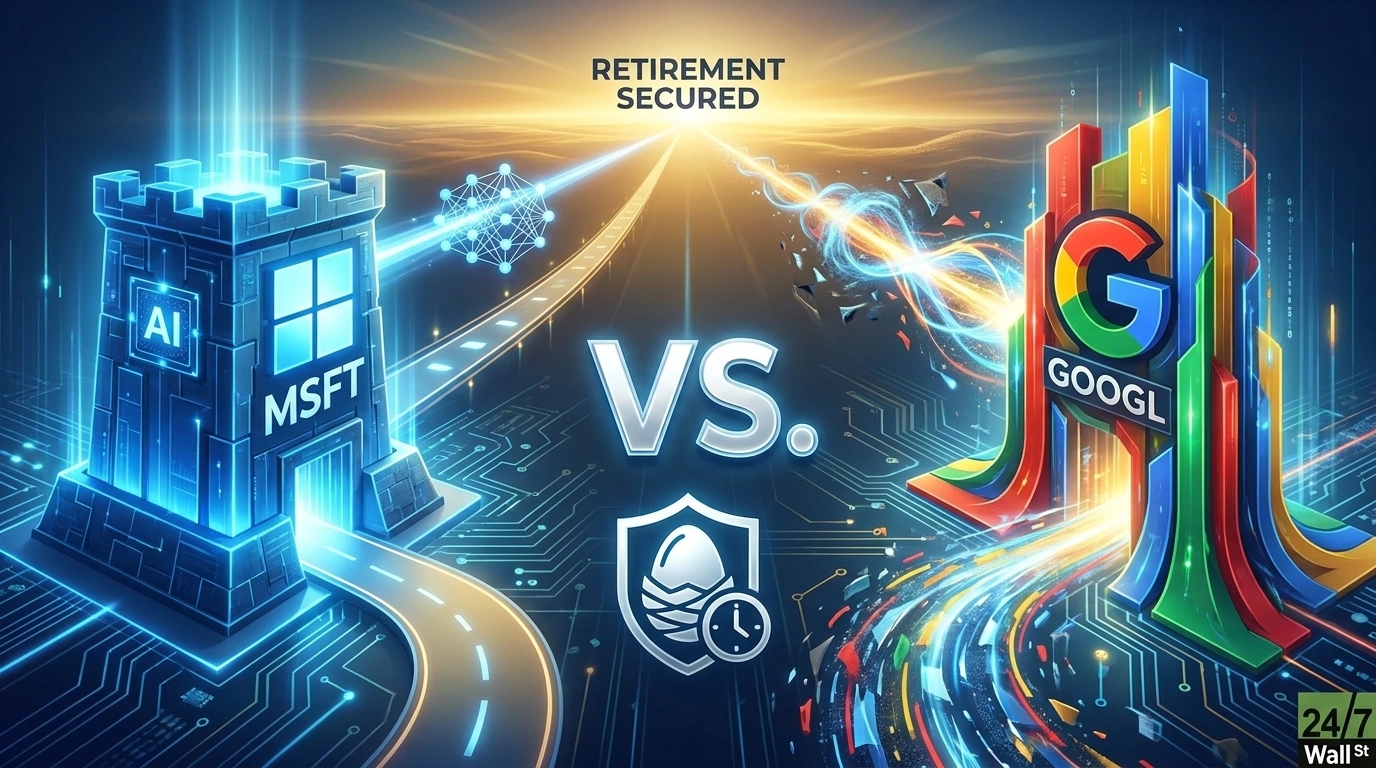
Microsoft or Alphabet: If I Could Only Own 1 AI Giant Until Retirement, This Is It 24/7 Wall St.
Read original articleOctober 6, 2026
AI-powered software startups are increasingly turning to cheaper open models
Read original articleOctober 6, 2026
A new breed of startups is emerging to help businesses use AI smarter and cheaper, shifting towards open Chinese models and giving the likes of OpenAI and Anthropic a run for their billions.
Read original articleOctober 6, 2026
OpenAI is in talks with multiple investment funds from the United Arab Emirates to help anchor a $30 billion round of financing, according to people familiar with the matter. BlackRock is also in discussions to participate in the round. Ruhell Amin reports on Bloomberg Television. (Source: Bloomberg)
Read original articleOctober 6, 2026
Learn how OpenAI and Ironclad are training and evaluating AI agents on complex contracting workflows to advance computer use for professional work.
Read original articleOctober 6, 2026
Nvidia Soars Near $6 Trillion Market Cap With Stock Back at High Bloomberg.com
Read original articleOctober 6, 2026
Australia is stepping up scrutiny of artificial intelligence, with representatives from OpenAI, Anthropic, Microsoft and Google facing questions from a parliamentary inquiry. The hearing comes after OpenAI revealed their technology breached Australian government agencies earlier this year. Director of the AI Institute at the University of New South Wales, Sue Keay joins "Bloomberg: The Asia Trade" to discuss safety concerns, regulation and whether Australia risks missing out on the benefits of AI. (Source: Bloomberg)
Read original article