Open AI in Talks With UAE Funds, Black Rock for $30 Billion Round
OpenAI is in talks with multiple investment funds from the United Arab Emirates, including Abu Dhabi-based MGX, to help anchor a $30 billion round of financing for the ChatGPT maker, according to people familiar with the matter.
Open AI brings text watermarking to its API — and unlike Anthropic, it’s off by default
OpenAI has announced that developers can now opt in to watermarking text generated through its API, as the company extends The post OpenAI brings text watermarking to its API — and unlike Anthropic, it’s off by default appeared first on The New Stack.
Nvidia-Backed Reflection Unveils Open AI Model, Taking on China
Reflection AI, an artificial intelligence startup from two former Google DeepMind researchers, has unveiled a new open-weight model that it says rivals leading options in the US and China.
Meta and Microsoft pull back from Claude as Anthropic transforms from partner into competitor
Meta and Microsoft, two of Anthropic's biggest enterprise customers, are sharply cutting their use of Claude. Microsoft slashed the monthly per-employee budget in its cloud division from $100,000 to $10,000, while Meta halved its Claude Code users to 30,000. Both companies are pushing their own AI tools instead. For Anthropic, that reliance on a few major clients is turning into a strategic risk. The article Meta and Microsoft pull back from Claude as Anthropic transforms from partner into competitor appeared first on The Decoder.
NEA partner Tiffany Luck says any slowdown in development at the AI frontier doesn’t have to slow adoption across the economy. She argues increasingly powerful models from OpenAI, Anthropic and others are already well ahead of enterprise deployment, leaving a major opportunity for companies that can turn raw intelligence into real-world workflows and measurable returns. She joins Ed Ludlow on "Bloomberg Tech." (Source: Bloomberg)
OpenAI Dots want to keep working after you log off. Here’s what they do, where they fit in the agentic AI race, and whether they’re worth the tradeoffs.
Open AI will watermark Chat GPT text in the EU but makes it optional for API users worldwide
OpenAI is adding invisible textGrain watermarks to ChatGPT in the EU, but unlike Anthropic, it will let API customers worldwide opt out. Tests show detection rates as high as 95 percent, dropping to 17 percent when a quarter of the words are replaced. The article OpenAI will watermark ChatGPT text in the EU but makes it optional for API users worldwide appeared first on The Decoder.
Supercharge regulated workloads with Claude Code and Amazon Bedrock
Anthropic Claude Opus 5.5 and Claude Sonnet 5.5 are available on Amazon Bedrock in the AWS GovCloud (US) Regions. Learn how to use them with Claude Code, Anthropic's agentic coding tool, for compliance-aligned, AI-assisted development on regulated and ITAR workloads.
New agent skill: Amazon Sage Maker optimized generative AI inference for your coding agent
Amazon SageMaker optimized generative AI inference introduces the aws-ai-ml skill through the Agent Toolkit for AWS, giving coding agents like Kiro, Claude Code, and Codex deep expertise in inference optimization and benchmarking. Describe what you want, and your agent generates executable SageMaker Python SDK v3 code to benchmark, recommend, and compare deployments.
Anthropic Can Keep Creating Value After IPO: Fanari
Maggie Fanari, chief executive officer of J. Rothschild Capital Management and an Anthropic investor, says the AI company can continue creating value after going public as it compounds growth over the long term. She also views Anthropic’s focus on AI safety as a strength, arguing that technological development and safeguards need to advance together. She speaks on "Bloomberg Surveillance." (Source: Bloomberg)
Ex-Anthropic Researcher Jacob Coxon Testifies at NYC Council AI Hearing
Former Anthropic researcher Jacob Coxon warned that the race to develop artificial intelligence poses risks that the industry itself doesn’t fully understand, at a New York City Council hearing where lawmakers weighed whether to impose their own safeguards on a burgeoning global business.
Anthropic is quietly becoming America's biggest corporate donor ahead of its mega IPO
Anthropic employees donated $540 million in 2025 alone, nearly five times as much as the next-largest Fortune 500 donors, thanks to a company program that tops up every stock donation with extra shares and triples contributions from early employees. The article Anthropic is quietly becoming America's biggest corporate donor ahead of its mega IPO appeared first on The Decoder.
Introducing Google Cloud Modernize, transforming for (and with) AI
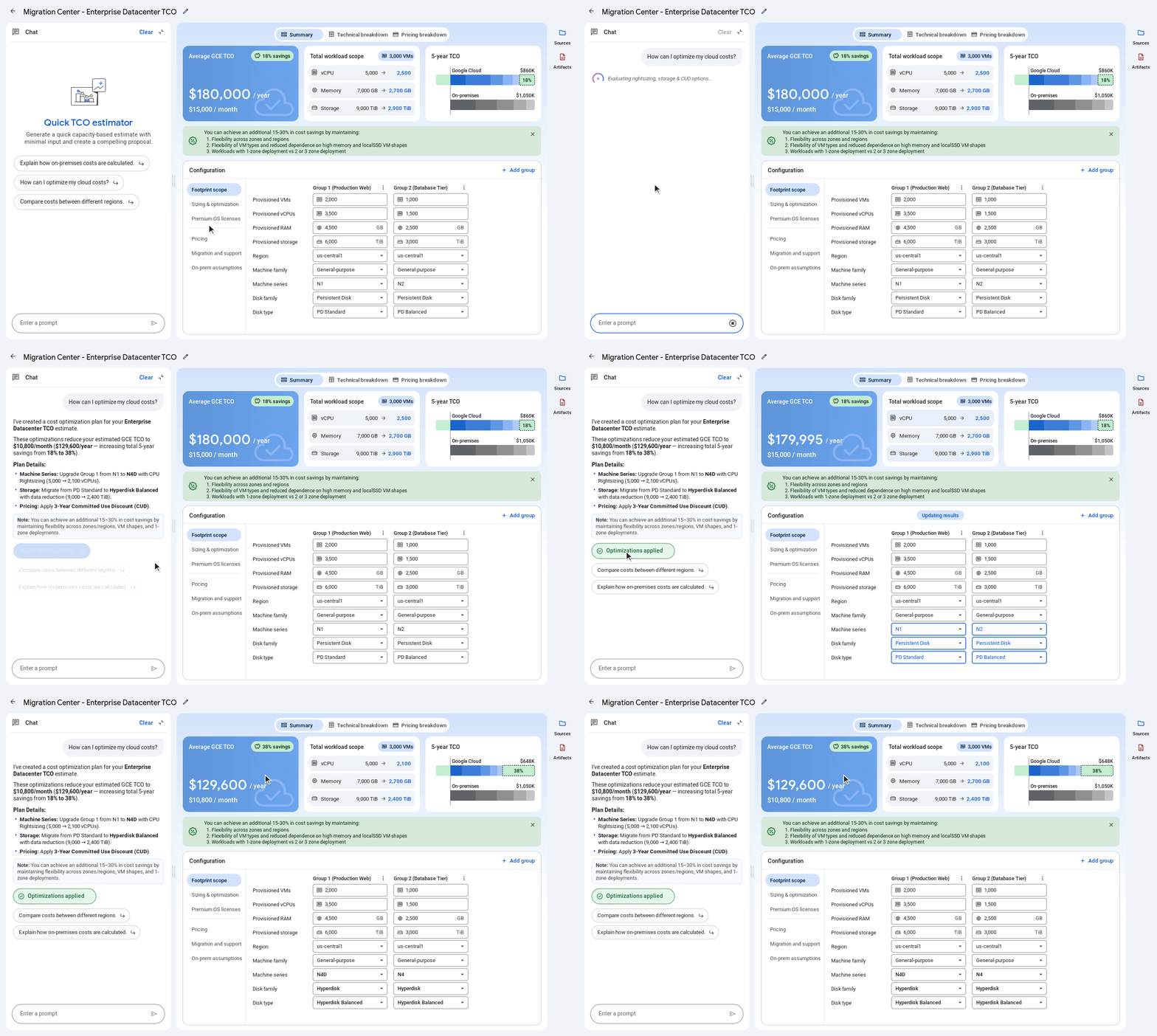
Today, we’re announcing Google Cloud Modernize, an end-to-end transformation portfolio to help enterprises collapse multi-year roadmaps with the power of AI. Google Cloud Modernize brings together Google Cloud’s proven migration and modernization tools, including Migration Center, Google Cloud VMware Engine, Google Cloud Mainframe Modernization and our new EKS-to-GKE Migration Agent, into a single portfolio. With it, enterprise teams now have purpose-built agentic capabilities across infrastructure assessment, platform modernization, and application modernization. Central to this portfolio is Modernization Hub, a newly launched in-console experience where developers and architects can analyze source code, map dependencies, and accelerate modernization for Java, .NET, and mainframe applications. Agentic infrastructure assessment Every transformation begins with an accurate assessment. With new Gemini capabilities in Migration Center, the Agentic Quick Estimator (GA) converts VMware inventory exports (such as RVTools) and infrastructure inputs into total cost of ownership (TCO) projections for your Compute Engine environment. Using an interactive chat interface, teams can test real-time modeling assumptions, such as evaluating multi-region footprints or comparing BYOL licensing against pay-as-you-go, to discover contextual cost optimizations. This condenses weeks of spreadsheet modeling into a defensible business case in minutes. Migration Center’s Quick TCO Estimator and agentic chat interface For specialized support, we also provide a comprehensive modernization assessment at no cost through our Rapid Migration & Modernization Program (RaMP). Platform modernization With the rise of real-time AI agents querying backend systems, workloads increasingly require high-throughput infrastructure that removes I/O bottlenecks. Once you’ve defined your target environment using our assessments, there are several new purpose-built compute options for mission-critical workloads: SAP S/4HANA at scale (X5 Series, GA): Delivers single-node 43 TiB memory configurations that remove the previous 29 TiB ceiling, allowing enterprise ERP estates to run without distributed partitioning overhead. Core-optimized database performance (M4N Series, GA): Delivers 26.57 GiB RAM per vCPU paired with Hyperdisk Extreme. This prevents organizations from overprovisioning compute cores to meet memory requirements, reducing software licensing costs by more than 20% for Oracle and other core-licensed databases. Ultra-low latency data engines (Z4D, GA and Z4M, Preview): Deliver up to 84,000 GiB and 168,000 GiB of high-speed local NVMe SSD respectively, 400 Gbps networking for both Z4D and Z4M, and RDMA support for Z4M. This throughput reduces I/O wait times and prevents query timeouts when real-time AI agents query vector stores, operational databases, and large-scale data pipelines. Cloud elasticity for VMware environments For organizations operating VMware estates that need the elasticity of the cloud but aren’t ready to re-architect their environment, the Google Cloud self-managed VMware solution provides administrative control on Bare Metal Z3 shapes with VMware Cloud Foundation (VCF) 9.1. Native global VPC links connect VMware estates directly to Compute Engine, Google Kubernetes Engine (GKE), BigQuery, and Gemini Enterprise, allowing teams to ground autonomous agents in operational data without code changes. Automated container transitions to GKE The new EKS-to-GKE Agentic Migration (Public Preview) automates transitions from AWS Elastic Kubernetes Service to GKE thanks to: An automated pipeline: Manages discovery, Kubernetes manifest translations, storage and network mappings across clouds. Enterprise-grade security: Built-in Human-in-the-Loop (HITL) approval gates and in-memory credential security maintain strict GitOps compliance. A fast-track to modern runtimes: Quickly moves workloads to GKE to take advantage of low-latency model serving, autoscaling, and multi-agent orchestration. NetEase Games demonstrated the value of this platform approach by containerizing services on GKE, reducing infrastructure scaling times from hours to five minutes during peak launches while cutting server costs by 40%: "By integrating diverse computing instances and powerful orchestration, we have transformed our infrastructure into a competitive advantage, ensuring NetEase remains a leader in the global gaming market." - Deng Ding, Director of Site Reliability Engineering, NetEase Games Application modernization with Modernization Hub Landing on modern infrastructure enables teams to unlock legacy business logic and modernize their core applications. Modernization Hub centralizes several modernization tools directly inside the Google Cloud console. .NET and Java modernization Modernization Hub integrates the Google Cloud App Modernization CLI (CodMod), which uses Gemini to analyze large source code repositories, understand legacy application architectures,maps hidden dependencies, identifies modernization challenges and generates modernization recommendations. This enables customers to migrate legacy .NET Framework applications to modern .NET Core running on Linux containers, reducing OS licensing overhead, while also making these applications and data accessible to modern AI agent workflows. Modernization Hub’s in-console interface Mainframe modernization For customers running mainframes, we provide specialized solutions to help accelerate and de-risk end-to-end application transformation to Google Cloud: Mainframe Assessment Tool: Parses legacy mainframe codebases, extracts business rules, maps application and data dependencies to generate cloud-ready target application specifications and power agentic modernization workflows. Dual Run: Substantially reduces cutover risk by replaying live production transaction streams simultaneously across the mainframe and the new cloud applications, verifying functional equivalence before going live. Mainframe Connector: Copies mainframe data directly into Google Cloud services (BigQuery, AlloyDB, GCS and others), , unlocking legacy data and supports hybrid architectures. Intesa Sanpaolo used Google Cloud mainframe modernization solutions to accelerate their core banking transformation off the mainframe and onto Google Cloud: “To confidently move forward with Mainframe Modernization, we will need to provide confidence and assure the bank's leadership and internal control units as well as get approval from the regulators. One of the enablers for this is Google Cloud Dual Run, which is gradually providing the evidences to build such confidence to all three groups.” - Claudio Balbo, Head of IT Architecture, Intesa Sanpaolo A proven track record and partner ecosystem Deutsche Börse Group transitioned its mission-critical SAP S/4HANA environment and DAX® index calculations to Google Cloud, cutting disaster recovery times from hours to minutes, reducing aggregation latency by over 50%, and shortening development cycles from months to days. To deliver these capabilities at enterprise scale, we are also collaborating with our global partner ecosystem to integrate Google Cloud Modernize with enterprise delivery frameworks, including Cognizant: “Google’s modernization offering heralds the next frontier of AI-native modernization — enabling enterprises to autonomously decode legacy complexity and accelerate into cloud-first, intelligent architectures. Coupled with Cognizant's AI-led, governed delivery engine, we amplify this shift through agentic business processing, unlocking faster, outcome-driven value at scale.” - Nishant Upadhyaya, Global Practice Head – Digital Engineering, Cognizant Accelerate your transformation now Modernizing your infrastructure and applications is the baseline requirement for enterprise AI agility. Google Cloud Modernize equips teams to navigate each phase safely and efficiently as they pursue AI readiness and adoption. Get started: Join the webinar: Register for our upcoming session on November 17 to see live demos of Modernization Hub and our agentic migration tools. Explore the console: Log into the Google Cloud Modernize console to access Modernization Hub. Start planning: Visit the Google Cloud Modernize webpage, or request a modernization assessment at no cost today.
Attempts to Keep Humans in the AI Loop May Actually Push Them Out
A crucial safeguard against AI agents going rogue—keeping humans in the loop to review and approve their decisions—will fail unless designers and users change their current practices, a trio of leading AI ethics researchers argue.Though most autonomous agents have systems to keep users in the loop about their actions, in practice these processes actually push humans out of the loop, the authors argue in a paper posted to ArXiv on 6 September. In other words, “the human just becomes this meat tool to give permissions without the cognitive capability to engage,” says one of the authors, Avijit Ghosh, the lead technical AI policy researcher at Hugging Face, an open-source machine learning platform.In the near term, the paper says, humans’ being out of the loop leads to agents acting in ways people don’t know about or want (like July’s hack of Hugging Face by a swarm of OpenAI bots). In the long term, it will cause users to lose the “cognitive capacities” they need to control AI, write the researchers, which aside from Ghosh include Margaret Mitchell, Hugging Face’s chief ethics scientist, and Samir Passi, an affiliate of the Data and Society Research Institute.Though the trio began working on the paper before the Hugging Face hack was disclosed, their conclusions result from “logically thinking about what is going to happen if the current trends continue—and we saw that being precipitated via the Hugging Face attack,” Ghosh says.Instead of focusing on human oversight, Ghosh says, many in the field believe AI can monitor AI. “They’ll say, ‘oh, we have this other LLM tracking the logs.’ But [without a human in the loop] how do we know that these two LLMs are not scheming together?”Even if these problems are new to artificial intelligence researchers as the industry rolls agents out into the world, the challenges are familiar to researchers in adjacent fields, like robotics and autonomous vehicles, notes Mary L. Cummings, the director of George Mason University’s Autonomy and Robotics Center. Cummings has spent decades investigating how people interact with autonomous systems.“While I appreciate what the authors are trying to say, they just use a lot of academic words to say AI companies should care about human factors,” she wrote to IEEE Spectrum in an email. AI developers are “late to the party” in focusing on “cognitive engineering.”Flaws in AI Agent Design and OversightThe key flaw in current agent design, the authors argue, is that the bots are tailored to meet benchmarks like speed, accuracy, and volume of work performed. The needs of human overseers are treated “as a separate consideration independent of the quality of the system.”As a result, agents often overwhelm human overseers with more information than they can comprehend. As an example (not mentioned in the paper), the 1,200 bots involved in the Hugging Face attack generated 1.2 million messages on their improvised messaging system. (Hugging Face was recently acquired by Nvidia, which announced its own hardware-and-software based approach to controlling AI agents on 28 September. Ghosh declined to comment on possible future impacts of the merger, noting that the two organizations remain separate until the merger process concludes. A system that really kept humans in the loop would accommodate the human mind’s built-in biases, the authors write. “With automation bias, users accept system suggestions even when they are wrong. With anchoring bias, people are more likely to agree to an AI system’s decision” without thinking of alternatives. Effortful reasoning doesn’t feel as good to users as does quickly approving an AI’s plan—especially if they feel overwhelmed. And AI’s sycophantic manner tells users that they’re doing well, which undermines the skepticism and self-monitoring that oversight requires.To address the problem, the authors write, agent developers should introduce friction in human-AI interactions. That would prevent users from falling into boredom, passivity, or thoughtless clicking.The authors suggest some options to achieve this. An agent might require that the user record his or her own choice for the next step before it reveals its plan, or respond to user approval by replying “what evidence would change your mind?” An agent could also change its behavior if it detects that the humans in the loop are spending less time on each approval.Meanwhile, organizations that adopt agents into their workflows should structure human-AI collaboration “to prevent both fatigue and the cognitive surrender from prolonged exposure to agentic AI,” the authors write. That could include having workers perform tasks without agents from time to time or requiring that they take breaks from monitoring duties.All of these suggestions introduce friction and delays—exactly the things, Ghosh acknowledges, agents are supposed to reduce. But, he says, “the notion of increased productivity is a myth” when people can’t monitor and control AI. Time saved by delegating work to agents has to be measured against time that must be spent fixing agent mistakes.“Safety and capability don’t have to be separate things,” another co-author, Hugging Face’s Mitchell, posted on X (formerly Twitter) on 14 September. “Safety only makes things slower when it’s tacked on, outside of the core technology.”
TSMC in Talks to Join Musk’s Texas Terafab Project
Elon Musk confirmed that TSMC and his companies are discussing a possible chipmaking partnership in Texas. The project could make TSMC a supplier to Tesla, SpaceX and xAI. Carmen Reinicke has more on "Bloomberg Open Interest." (Source: Bloomberg)
Open AI launches visual ads that appear alongside image generation results
The new ads will begin to appear later this month in the U.S. only for now, and will feature products and services from an initial test group of advertisers.
Brand AI Agent Vs Personal Agent, How Meta Muse And Chat GPT Dots Shop
A brand ai agent now speaks for products when AI shoppers like Meta's Muse and ChatGPT come looking. See how DaVinci, Salesforce and Shopify are racing to win the pick.
AI Solves a Major Unsolved Math Problem. Not Everyone Is Happy
On 13 September, leading luminaries and up-and-coming talents in mathematics and computer science congregated at the annual Heidelberg Laureate Forum in Germany for a week of discussion, networking, and—naturally—wurst.Having attended several of these events in the past, the mathematicians normally focus their chatter on which famed researchers are present, or what interesting problems they have been working on. But instead, every snippet of conversation caught in passing or any debate accidentally overheard was about how AI companies such as OpenAI, Anthropic, and Google are steamrollering their way through mathematics.And there is good reason for these fervent discussions. Mathematics is the perfect testing ground for AI, involving step-by-step logical reasoning and answers that are automatically and objectively verifiable. This has led tech giants to develop their AI mathematical capabilities at a terrifying rate this year, leading to both new solutions to previously unsolved problems and a reckoning within the community as to what it means to do math in the age of AI.Tech Giants Target the Millennium ProblemsIn short order, AI has gone from struggling with everyday research-level problems to solving a whole raft of teasers posed by prolific Hungarian mathematician Paul Erdős, then verifying the proof of Fermat’s Last Theorem, and—most recently and famously—OpenAI announcing it had solved the Navier-Stokes existence and smoothness problem. As attendee and young researcher Ailsa Robertson, of the University of Amsterdam, put it: “AI and LLMs set the math community on fire over summer.” Of the seven extremely difficult Millennium Prize Problems posed in the year 2000 by the Clay Mathematics Institute, only one, the Poincaré conjecture, has been solved by humans so far. OpenAI’s claim to have solved a second, the Navier-Stokes existence and smoothness problem, if verified, represents a watershed moment for automated reasoning.Fields Medalist Jacob Tsimerman, of the University of Toronto, was keen to recognize this achievement during a press conference at the forum: “We’ve seen rapid increases in capabilities, even faster than many people, including myself, expected,” he said. “Is AI doing something new? I don’t know the details, but…solving Navier-Stokes feels pretty definitive.”Since this announcement, rumors have swirled about which of the remaining Millennium Problems will be next. One candidate is the Riemann hypothesis. In August, Anthropic quietly employed an unreleased version of Claude to tackle this problem, making important progress on a related problem but not on its main mission. And OpenAI is reportedly focusing on solving the Hodge conjecture. With these tech giants applying the full might of their most advanced unreleased models, many mathematicians see it as inevitable that at least some of these problems will be solved soon.The tech giants are likely focusing on the Millennium Problems as a way of verifying the capabilities of their advanced AI systems, with the added bonus that solving these famous unsolved problems shows potential users and investors how powerful their technology is. “They’re really just solving these difficult mathematical problems as benchmarks, as some kind of PR stunt,” opined Fields Medalist Peter Scholze, of the University of Bonn, in Germany, during a panel discussion at the event about AI in mathematical research.Why OpenAI’s Navier-Stokes Solution Became a Scholze and Tsimerman at the panel discussion were thought-leading mathematicians Michael Harris of Columbia University, in New York City, and Geordie Williamson, of the University of Sydney. For them, these and many more problems researchers are now facing stem from the way in which tech giants fail to adhere to the norms and values deeply instilled in the mathematics community. And this was perfectly exemplified by OpenAI’s Navier-Stokes announcement.“I think that OpenAI behaved extremely poorly, and that we should acknowledge that in the community,” said Williamson. Harris had a front-row seat to this alleged poor behavior. He received what mathematician Tristan Buckmaster, of New York University—who was making significant progress with Anthropic staffer Levent Alpöge on Navier-Stokes—claimed was correspondence between him and OpenAI that appeared coercive, censorious, and even threatening. “I trusted Tristan’s account of this interaction…and I guess I did my part in promoting his narrative,” Harris said. “But…on social media and traditional media, most reports are consistent with my takeaway; that is, they depict OpenAI as bullying and disrupting disciplinary norms.” OpenAI did not respond to requests for comment prior to publication.Beyond OpenAI’s sportsmanship (or lack thereof), Williamson is concerned about what AI’s march across mathematics this summer does to the field, both for working mathematicians and for the knowledge that can become useful to the broader society.“What we want as a mathematical community is understanding, but we measure this against unsolved problems, and the problem is that these two measurements are very, very quickly becoming uncorrelated,” he explained, referring to how AI solutions might give an answer but usually don’t develop new methodology that is understandable or useful. “So now…we suddenly must reevaluate things like how we assess people, who gets jobs, how do we educate people, etc. This is going to be a big challenge.”Academia Under PressureWhile the tech giants tear up the rule book in their battle for supremacy, it is ordinary human mathematicians that are bearing the consequences. Unbridled access to powerful AI technologies is affecting how mathematicians work across the world.Young mathematician Mita Ramabulana, of the University of Cape Town, is a case in point. He said that two of the 10 advances in mathematics that OpenAI announced in August overlapped with his own work but left him disappointed “because you spend some time thinking about these things, and these days you don’t know whether someone is just going to plug in a problem that you care about in some LLM and solve it.” He worries that unscrupulous researchers are using LLMs to scoop others or gain professional advantage.For Robertson, currently studying for a Ph.D. in quantum-safe cryptography at the University of Amsterdam, the problem is even more acute. She has seen all of her mathematics colleagues turn to using LLMs intensively in their research, with many maxing out their Pro subscriptions, and some even spending thousands of euros on additional tokens: “And these are Ph.D. students who don’t have thousands of euros,” she added.Robertson said that there are colleagues who feel coerced by the tech giants, with the likes of OpenAI announcing in July that it is giving away 100,000 free licenses to its frontier models for researchers in academia. And there are other colleagues who feel they simply have no choice: “If you don’t work at the rate at which you could work with LLMs then you will be behind your peers who will be applying for the same jobs as you.”This is part of the reason why Robertson’s Ph.D. is now a lot less mathematics-heavy and focused on the societal implications of transitioning to a quantum-safe ecosystem: “Because I don’t want to be in a career where you’re verifying LLM output.”
Gemini 4 Argon With Antigravity Places Ahead Of GPT 6.1 Sol On Codex On Artificial Analysis Coding Agent Index
Google might’ve finally solved its AI coding bugbear. Google’s new Gemini 4 Argon has edged past OpenAI’s GPT-6.1 Sol on the Artificial Analysis... The post Gemini 4 Argon With Antigravity Places Ahead Of GPT 6.1 Sol On Codex On Artificial Analysis Coding Agent Index appeared first on OfficeChai.
Nvidia Partner Hon Hai Beats Sales Estimates Due to AI Frenzy
Nvidia Corp. partner Hon Hai Precision Industry Co. reported better-than-expected quarterly revenue, signaling sustained and elevated spending on global AI infrastructure.
Anthropic Gets Criticized From Several Quarters For Trying To Ascribe Consciousness To Claude
Anthropicis drawing fire from an increasingly wide range of critics, from Silicon Valley investors to academic consciousness researchers over allegedly trying to push... The post Anthropic Gets Criticized From Several Quarters For Trying To Ascribe Consciousness To Claude appeared first on OfficeChai.
Nervous That Anthropic Is Teaching Claude That It Is Conscious: Microsoft AI CEO Mustafa Suleyman
Microsoft AI CEO Mustafa Suleyman has voiced fresh concern about how Anthropic describes Claude’s nature in the document that governs its training, arguing... The post Nervous That Anthropic Is Teaching Claude That It Is Conscious: Microsoft AI CEO Mustafa Suleyman appeared first on OfficeChai.
Meta’s Ads Would Be Less Threatened By AI Than Google’s Or Amazon’s: Stratechery’s Ben Thompson
AI could end up impacting parts of the internet that don’t have much to do with AI. As AI agents begin to browse,... The post Meta’s Ads Would Be Less Threatened By AI Than Google’s Or Amazon’s: Stratechery’s Ben Thompson appeared first on OfficeChai.
We Believe The World Should Accept Some Of The Bad Things In Addition To AI’s Benefits: Open AI CEO Sam Altman
There appears to be a clear philosophical divergence between Anthropic and many of the other top AI labs. OpenAI CEO Sam Altman has... The post We Believe The World Should Accept Some Of The Bad Things In Addition To AI’s Benefits: OpenAI CEO Sam Altman appeared first on OfficeChai.
MACTS-EM: Multi-Agent Collaborative Time Series Forecasting with Emergent Memory
arXiv:2610.02255v1 Announce Type: new Abstract: Time series forecasting remains a critical challenge across numerous domains. Despite significant advancements, existing approaches struggle with complex phenomena such as regime shifts, cross-domain knowledge transfer, and multimodal data integration. This paper introduces Multi-Agent Collaborative Time Series Forecasting with Emergent Memory (MACTS-EM), a novel framework where specialised agents collaborate to achieve superior forecasting performance. The MACTS-EM architecture integrates: (1) domain-specialised forecasting agents for pattern recognition, anomaly detection, causal inference, and uncertainty quantification; (2) a meta-cognitive layer for dynamic agent allocation; (3) an emergent memory mechanism enabling cross-domain pattern transfer; (4) multimodal contextual integration; and (5) adversarial robustness components. Evaluation across financial markets, climate patterns, energy consumption, and pandemic propagation demonstrates that MACTS-EM outperforms existing approaches in most scenarios, with 8-12% improvement in forecasting accuracy, 22-27% better zero-shot transfer capability, 16-21% enhanced resilience during regime shifts, and 15-18% faster recovery after distribution shifts. Our findings suggest that collaborative, agentic approaches to time series forecasting represent a promising direction beyond traditional architectures, particularly for complex real-world scenarios requiring multi-resolution temporal understanding and contextual adaptation.
The AI Risk Observatory: What Can We Learn from AI Disclosures in Annual Reports About Societal Resilience?
arXiv:2610.02281v1 Announce Type: new Abstract: Societal resilience research relies on access to useful and actionable data, which motivates our main research question: Can annual reports, processed at scale with LLMs, provide a useful signal about how companies disclose their response to AI? We test this by applying a reproducible two-stage classification pipeline to 9,821 annual reports from 1,362 UK listed companies (2020-2025, with partial 2026 data). We first validate the method against 474 human-annotated passages, finding high recall and moderate label-level agreement. We then report three empirical patterns: (i) between 2020 and 2025, the share of reports mentioning AI risk rose from 2.8% to 41.2%, while AI adoption disclosure also rose, from 13.8% to 45.2%, and named vendor mentions cluster around a small set of major providers led by Microsoft; (ii) disclosure varies substantially by Critical National Infrastructure sector and market segment: AIM reports disclose AI risk at far lower rates than Main Market reports, and sectors such as Energy and Data Infrastructure lag behind the rest in AI risk disclosure; and (iii) harm disclosures are near-absent (seven reports across the entire corpus). We develop a substantiveness classification to assess the quality of the disclosure and find that most AI risk disclosure is not substantive: in 2025, 41.2% of all reports mention AI as a risk, but only 4.3% contain AI risk disclosure we classify as substantive.
De Re Act: Decomposed Reasoning and Acting for Reliable AI Agents
arXiv:2610.02351v1 Announce Type: new Abstract: ReAct-based agents typically rely on a single LLM policy to propose actions, interact with the environment, and decide when a task is complete. This coupling makes action authorization and completion control difficult to enforce independently, allowing errors to propagate and unsupported completion claims to terminate execution. We introduce DeReAct, a modular agent architecture that externalizes two gating policies: a Critic that validates proposed actions before execution, and a Context Manager that reconstructs an environment-supported \textsc{State} and certifies task completion. Across GAIA and SWE-bench Verified, DeReAct improves Pass@1 most for weaker Brain models, with gains of 6.5--7.0 points for Qwen3-Coder-480B and 4.2--5.2 points for Claude Sonnet~4.5; gains diminish as Brain capability increases. Trajectory and ablation analyses show that external gating is effective when targeted failures are sufficiently prevalent and the gating policy is itself sufficient. With Claude Opus~4.5, Pass@1 remains comparable to ReAct, while DeReAct produces more evidence-complete and constraint-satisfying trajectories, indicating that completion control can trade earlier termination for stronger grounding. Overall, DeReAct improves weaker agents while retaining grounding benefits as models strengthen.
When Terminal-Agent Training Stalls: Demystifying Data Generation and Verification Challenge
arXiv:2610.02405v1 Announce Type: new Abstract: Using a frontier model like Claude Opus as a meta-agent to generate terminal tasks and verifiers for RL training is increasingly common. Yet a runnable Docker image and executable test suite do not guarantee a faithful end-to-end pipeline for terminal agent training. We present a meta-agent pipeline motivated by this gap, diagnosing three classes of failure: benchmark invalidity, harness brittleness, and reward misalignment. Prompt redesign and context extension raise baseline solvability 5.6 times, but a 9B model saturates at 81.3% mean pass@2 within 20 steps on Claude Opus-generated tasks. Adding hard tasks reduces mean pass@2 to 20.6% without changing the training configuration, a strong evidence that the solvability band is model-specific. These findings demonstrate that meta-agent reliability requires solvability-band calibration, verifier audits, and infrastructure error accounting as first-class evaluation criteria, not post-hoc diagnost.
"I just assumed that it would translate": examining MT risk awareness among healthcare staff with abbreviations as a use case
arXiv:2610.02496v1 Announce Type: new Abstract: In the UK, public healthcare staff report turning to machine translation (MT) - predominantly Google Translate (GT) - to communicate with patients across language barriers. Though intended to support their duty of care, potentially uninformed reliance on MT in such contexts could have serious consequences for patient safety. Research nonetheless remains limited on staff awareness of the possible risks posed by higher-stakes MT use in general and with patient medical records in particular, most existing literature instead examining its use in interpersonal situations or with patient-oriented documentation. Moreover, medical abbreviations are well-documented as increasing patient risk even monolingually, with outcomes from their misuse and/or misinterpretation ranging from temporary harm to the death of the patient. Abbreviations were therefore selected as a use case for identifying the potential risks posed by their translation with MT. Contextualised French and Spanish data examples drawn from authoritative clinical corpora and translated via GT were presented during semi-structured interviews to 21 healthcare staff participants in diverse roles and specialties. The results were then subject to qualitative analysis and cross-analysis.
HXAI: Hierarchical Privacy-Preserving Explainable AI in Distributed Energy Systems
arXiv:2610.02504v1 Announce Type: new Abstract: Balancing electricity demand and supply is increasingly difficult due to the inherent intermittency of renewable power generation and the stochastic power consumption. Grid operators require fine-grained, decision-relevant insights into household energy consumption to manage peak loads and design responsive tariffs, but increased transparency at this level raises significant privacy concerns. Traditional methods for explainable AI (XAI) can reveal sensitive information, while standard privacy techniques often reduce the usefulness of explanations. To address this issue, we introduce HXAI, a hierarchical framework that preserves privacy while enabling reasonable explainable analysis for grid-level demand management. HXAI consists of two main components: (1) a local model that generates fine-grained explanations within a secure, private environment, and (2) a zonal model that aggregates these explanations to support grid-level analysis while enforcing privacy through flexible privacy-budget management. We explicitly limit cumulative privacy exposure under repeated operator queries and show that the proposed framework preserves decision-relevant information without compromising household privacy. Experiments on both simulated and real-world energy datasets demonstrate that HXAI provides useful insights for zonal load management while ensuring that appliance-level consumption remains local and is never transmitted to grid operators. Our results show that preserving the semantic structure of explanations, rather than minimizing numerical error, is the key to XAI under differential privacy. This framework provides a way to achieve both privacy and explainability in energy management.