September 22, 2026
Better prompt caching for GPT-6
Learn how GPT-6 improves prompt caching with higher cache hit rates, new diagnostics, explicit breakpoints, and controls that reduce latency and costs.
Read original articleDataAIHub Daily
Archive →50 curated AI news stories from leading AI companies.
September 22, 2026
Learn how GPT-6 improves prompt caching with higher cache hit rates, new diagnostics, explicit breakpoints, and controls that reduce latency and costs.
Read original articleSeptember 22, 2026
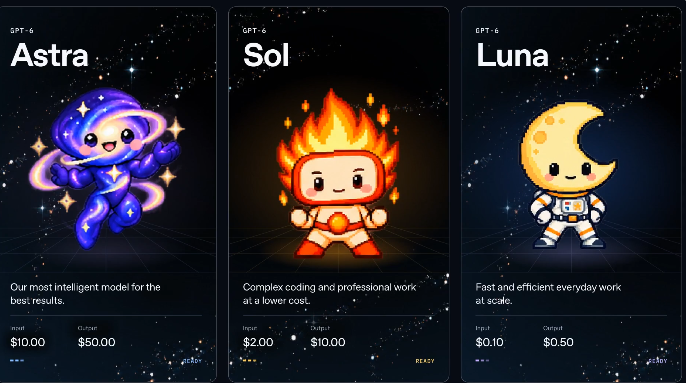
With GPT-6 Sol and Luna, OpenAI adds two cheaper models that deliver their predecessors' performance at half the token price and take aim at Anthropic's pricier offerings. Independent analyses find little gain in actual intelligence, though, and OpenAI likely didn't see Anthropic's simultaneous launch of Opus 5.5 coming. The article OpenAI's GPT-6 Sol and Luna cut prices in half but barely move the needle on performance appeared first on The Decoder.
Read original articleSeptember 22, 2026
Trump tells world leaders AI should be called something else & he won't rein it in National News Desk
Read original articleSeptember 22, 2026
Anthropic wants developers to use Claude and its family of tools to handle complete coding tasks. The company introduced Claude The post Claude Opus 5.5 wants to finish your coding tasks, not just start them appeared first on The New Stack.
Read original articleSeptember 22, 2026
EvilTokens provided an end-to-end platform that makes mass compromises faster and easier.
Read original articleSeptember 22, 2026
On Tuesday, OpenAI released GPT-6 Sol and Luna, an expansion of the GPT-6 line-up that aims to make GPT-6 Astra’s The post GPT-6 Sol closes most of the alignment gap with Astra. It’s one-fifth the price. appeared first on The New Stack.
Read original articleSeptember 22, 2026
British Columbia sues OpenAI, demands Tumbler Ridge shooter’s ChatGPT logs.
Read original articleSeptember 22, 2026
I Gave My Life Over to Meta’s A.I. Agent and Was Blown Away The New York Times
Read original articleSeptember 22, 2026
Meta says Muse was built from scratch, but acknowledges the AI assistant was "heavily inspired" by OpenClaw — down to some of its workspace filenames and content.
Read original articleSeptember 22, 2026
AMD: I Still Prefer Nvidia Or SOXX To This $1 Trillion Challenger (NASDAQ:AMD) Seeking Alpha
Read original articleSeptember 22, 2026
Independent benchmarking firm Artificial Analysis has published its first full evaluation of GPT-6 Sol and GPT-6 Luna, OpenAI’s newly released mid-tier and budget... The post GPT 6 Sol Shows Modest Gain Over GPT 5.6 Sol On Artificial Analysis Intelligence Index, But At A Much Cheaper Price appeared first on OfficeChai.
Read original articleSeptember 22, 2026
Anthropic and OpenAI roll out cheaper models in first release since call for slowdown CNBC
Read original articleSeptember 22, 2026
With new Macs, Apple aims to take on Microsoft, Nvidia in a rush to lower AI costs Reuters
Read original articleSeptember 22, 2026
The Horowitz Andreessen Academy is launching a new alternative to traditional college aimed at preparing young people for the AI economy. Backed by $42 million and supporters including Andreessen Horowitz, OpenAI, Anthropic, and Nvidia, the San Francisco-based program will focus on building with AI, interpersonal skills and hands-on projects rather than traditional majors. Founder and CEO Gagan Biyani joins Ed Ludlow on "Bloomberg Tech." (Source: Bloomberg)
Read original articleSeptember 22, 2026
OpenAI has widened its GPT-6 lineup with two new additions, GPT-6 Sol and GPT-6 Luna, slotting in below the flagship GPT-6 Astra model... The post OpenAI Releases GPT 6 Sol And GPT 6 Luna With 50% Lower Prices Than GPT 5.6 appeared first on OfficeChai.
Read original articleSeptember 22, 2026
Meta’s Muse Drags Down Stocks That Depend on ‘Consumer Inertia’ Bloomberg.com
Read original articleSeptember 22, 2026
Bloomberg’s Ed Ludlow breaks down Alibaba's new AI chip, an accelerator to compete with Nvidia and underpinning a massive expansion of data center capacity in coming years. Plus, he speaks with Gagan Biyani, founder and CEO of the Horowitz Andreessen Academy, Silicon Valley's alternative college for the AI era. And, he sits down with AI pioneer Fei-Fei Li to talk about the AI safety debate, the race against China, and growing competition to build world models. (Source: Bloomberg)
Read original articleSeptember 22, 2026
Tech Firms Mark Down AI Products to Compete With OpenAI and Anthropic PYMNTS.com
Read original articleSeptember 22, 2026
OpenAI on Tuesday released GPT-6 Sol and Luna, which will complement the flagship GPT-6 Astra model in OpenAI’s lineup. As The post OpenAI releases GPT-6 Sol and Luna — and cuts token prices in half appeared first on The New Stack.
Read original articleSeptember 22, 2026
OpenAI is launching two new models, which it says are cut from the same cloth as Astra.
Read original articleSeptember 22, 2026
Meet GPT-6 Sol and Luna, two models that bring frontier intelligence to everyday work with different balances of capability and cost.
Read original articleSeptember 22, 2026
When Anthropic merged Claude chat and Cowork into a single interface last week, it removed an increasingly irrelevant decision users The post Claude’s merged chat and Cowork vs. ChatGPT’s Work mode: ChatGPT is faster, Claude is more thorough appeared first on The New Stack.
Read original articleSeptember 22, 2026
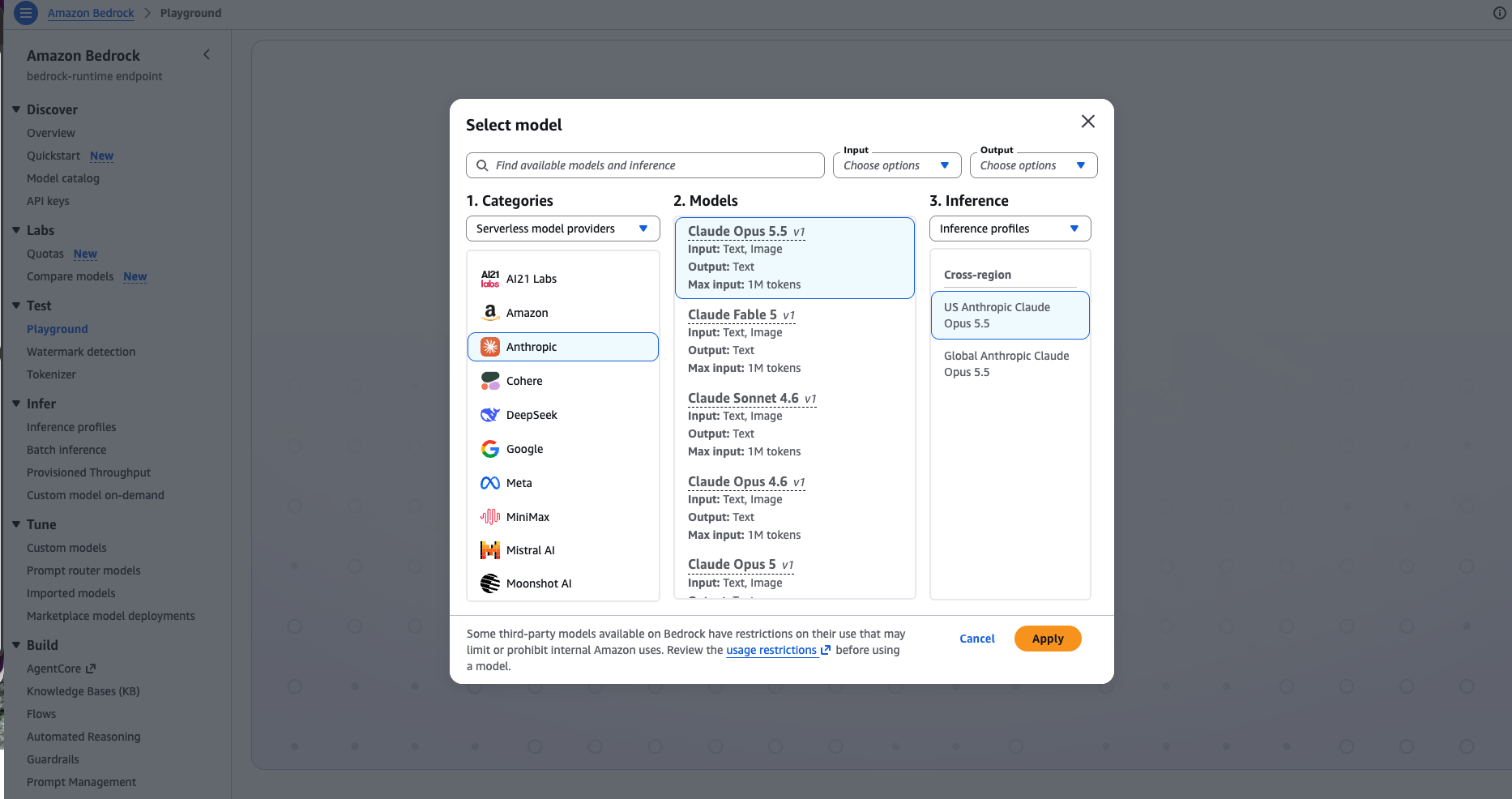
Claude Opus 5.5, Anthropic's most capable Opus model for agentic coding, knowledge work, and long-running tasks, is now available on Amazon Bedrock and Claude Platform on AWS. This post covers what's new in Opus 5.5, practical guidance, and how to start building with the model on Amazon Bedrock.
Read original articleSeptember 22, 2026
As large language model (LLM) inference increasingly processes sensitive information and proprietary model context across personal, enterprise, and regulated...
Read original articleSeptember 22, 2026
Anthropic Releases a New A.I. Model, Opus 5.5, Amid Safety Debate The New York Times
Read original articleSeptember 22, 2026
AI factories are power-limited systems that deliver maximum value when fully optimized. GPU workload placement is a key optimization. Poor workload placement...
Read original articleSeptember 22, 2026
Anthropic is launching Claude Opus 5.5, the first model in a new generation. The company says it matches Claude Fable 5.1 on most tasks while costing about 40 percent less to run than Opus 5. Anthropic's benchmarks also put it ahead of OpenAI's GPT-6 Astra on most tasks, despite being significantly cheaper. Sonnet 5.5 and Haiku 5.5 are expected in the coming weeks. The article Claude Opus 5.5 matches Fable 5.1 performance at lower cost and promises less "Claudish" writing appeared first on The Decoder.
Read original articleSeptember 22, 2026
OpenAI plans to let third-party groups vet its artificial intelligence models for safety risks in earlier phases of the development cycle, part of an ongoing effort to address heightened concerns about the technology’s potential harms.
Read original articleSeptember 22, 2026
Claude Opus 5.5 has just created the biggest gap in many months between the top model and the rest of the pack on... The post Claude Opus 5.5 Jumps To Top Spot On Artificial Analysis Intelligence Index, Creates 5 Point Lead Over GPT-6 Astra appeared first on OfficeChai.
Read original articleSeptember 22, 2026
Anthropic has released Claude Opus 5.5, the first model in what the company is calling its Claude 5.5 family. Anthropic says Opus 5.5... The post Anthropic Releases Claude Opus 5.5, Beats GPT-6 Astra On Most Benchmarks appeared first on OfficeChai.
Read original articleSeptember 22, 2026
Claude Opus 5.5 is here, and Anthropic has lowered the price. The new model, released on Tuesday, costs $4 per The post Anthropic releases Opus 5.5 and cuts pricing by 20%. Your agent calls might secretly get routed to an older model. appeared first on The New Stack.
Read original articleSeptember 22, 2026
Anthropic called it "the strongest-performing model we've tested to date."
Read original articleSeptember 22, 2026
Anthropic Unveils More Cost-Efficient Opus 5.5 Model Before IPO Bloomberg.com
Read original articleSeptember 22, 2026
Sheila Gulati, Founder and Managing Director of Total Capital and a former leader of Microsoft’s Azure business, discusses rising warnings from Sam Altman, Dario Amodei, and others about the AI sector. The segment frames the conversation around whether those warnings should be taken seriously and how they relate to broader concerns about AI oversight. She speaks with Romaine Bostick & Bailey Lipschultz on "The Close." (Source: Bloomberg)
Read original articleSeptember 22, 2026
Mandeep Singh, Bloomberg Intelligence’s global head of tech research, has been trying out Meta's new artificial intelligence agent called Muse. He says it's very helpful in finding discount codes and can make shopping easier, but there are some shortfalls. He speaks on Bloomberg Radio. (Source: Bloomberg)
Read original articleSeptember 22, 2026
Meta Platforms Inc.'s new artificial intelligence agent, Muse, is ranked the No. 1 free app on the US Apple Inc. iOS App and Google Play stores.Muse was downloaded more than 902,000 times in the six days after Meta introduced it on Sept. 8, and is available for people 18 years and older. Bloomberg's Mandeep Singh joins to discuss. (Source: Bloomberg)
Read original articleSeptember 22, 2026
Ex-Anthropic Staffers’ Self-Improving AI Startup in Talks to Raise at $5 Billion Value Bloomberg.com
Read original articleSeptember 22, 2026
AI coworkers and coding agents are spreading fast across organizations, and each...
Read original articleSeptember 22, 2026
Business leaders often have access to plenty of data, but still can’t get a reliable...
Read original articleSeptember 22, 2026
Nvidia Gains as Apple Pulls AI Off the Meter Yahoo Finance
Read original articleSeptember 22, 2026
OpenAI wants international standards for recursive self-improvement, where AI systems independently build the next generation of AI. Without safeguards, humans could lose control over this process. OpenAI says the US should take the lead on global measurement standards and oversight rules. The article OpenAI calls for international standards on AI that could improve itself appeared first on The Decoder.
Read original articleSeptember 22, 2026
SpaceXAI’s Grok Bot artificial intelligence agent has topped 400,000 weekly users roughly a month after it launched, a sign of modest early demand for a product that’s key to the AI ambitions of Elon Musk’s firm.
Read original articleSeptember 22, 2026
Have you ever read a paper in Science or Nature and thought, “Man, that research was so cool. I wish I could try that method on my own data,” only to spend a week wrestling with someone else’s undocumented repo, broken dependencies, and half-finished readme.txt?Well, now you can, more or less.Say hello to Paper2Agent, a new open-source framework that transforms academic reports into interactive AI agents you can talk to. Give it a paper, along with the accompanying codebase, data, or other supplementary material, and the system automatically extracts the core workflows, then spins up a tested, runnable toolkit that you can use on your own datasets.The concept may sound a little like Google’s NotebookLM (now called Gemini Notebook), which lets you upload documents and chat with an AI about what’s in them. But Paper2Agent aims to go a step further: Rather than simply answering questions about a paper, its agents can actually run the methods described in it—and potentially combine those methods with tools from other papers.The goal, explains Stanford computer scientist James Zou, is to change what a scientific paper fundamentally is. “Knowledge should not be static records,” Zou says. “It really should be dynamic and interactive—and this has many benefits, including making knowledge more reproducible but also enabling all sorts of new kinds of discovery.”Zou and his colleagues described the tool 16 September in Nature. They tested Paper2Agent across diverse disciplines including statistics, econometrics, and astrophysics. However, the researchers focused their proof-of-concept demonstrations on computational biology, where turning published methods into usable tools can be particularly cumbersome.From Paper to PromptThe team started with AlphaGenome, a deep-learning model that predicts how mutations in DNA affect gene regulation. (A companion resource unveiled earlier this month, the AlphaGenome Atlas, cataloged the model’s predictions for all 9 billion possible single-letter changes in the human genome.)The researchers fed Paper2Agent the corresponding documentation and code. About 45 minutes later, with no human intervention, the AI had produced 22 tools covering different aspects of AlphaGenome’s functionality, all on a personal laptop and for less than US $15 in computing costs. One tool, for example, could predict how a DNA change might affect gene activity, while others could compare those effects across tissues or analyze multiple variants at once.“The idea of making papers more dynamic and executable through an agentic interface is quite compelling.” —Dongping Chen, University of MarylandAll 22 tools passed automated validation, thanks to a testing agent working behind the scenes to run the various AlphaGenome sub-tools against reference results. If a test failed, the agent would diagnose the problem and try to fix the tool, with up to six attempts per function. If that didn’t work, it could drop the tool altogether.The validated tools were then packaged into a Model Context Protocol server and connected to Claude Code (though any compatible chat-based AI assistant could do). The result was a user-facing AlphaGenome agent that could take questions in plain English, run the appropriate analyses, and spit back results and visualizations.The team then put the agent through its paces, hitting it with a battery of questions, ranging from simple requests to open-ended research problems. According to the researchers’ analysis, it outperformed both standard Claude given the AlphaGenome codebase and a specialist AI co-scientist tool called Biomni.Multi-Agent Research Paper CollaborationGoing one step further, the researchers turned a couple of more papers into interactive agents and linked them with the AlphaGenome agent. (One of the additional papers was on how inherited DNA variants linked to autoimmune disease disrupt cell function, while the other was a more systematic exploration of how silencing every expressed gene alters immune cells.)Prompted to investigate the genetic basis of psoriasis, an itchy skin disease, the three agents collectively zeroed in on a little-understood gene called GPR137 as a likely causal factor. What’s more, the AI proposed 10 ways to validate this inference. A human researcher selected one, and the resulting analysis found that silencing GPR137 produced changes in gene activity strikingly similar to those caused by the psoriasis-linked variant in immune cells.“These agents, because they’re able to directly collaborate and communicate, can facilitate all these kinds of collaborations,” says Zou.Other researchers see plenty of potential as well. “The idea of making papers more dynamic and executable through an agentic interface is quite compelling,” says Dongping Chen, a computer scientist at the University of Maryland in College Park.“Agentification itself is a useful certificate that says, ‘This work is relatively complete and well documented.’” —James Zou, Stanford UniversityOlivier Elemento, a computational biologist who directs the Englander Institute for Precision Medicine at Weill Cornell Medicine in New York City, sees the approach as having broader implications for how researchers share their work.“It’s a real advance in terms of how we think about the publication process,” he says, “with AI at the center and in a way that makes publications more interactive.” (Elemento peer-reviewed the study for Nature.)The potential applications extend beyond the research side of academia, too. Artur Skowroński, head of application development at the Polish software company VirtusLab, noted in a blog post that Paper2Agent could help bring scientific papers to life in classrooms. For example, students could use the agent to play with methods described in the literature instead of merely reading about them.The Future of Agentified Research PapersWith Paper2Agent now up and running, Zou and his colleagues have begun turning more of their own research papers into agents. Just one day after publishing their Nature paper on Paper2Agent, they unveiled the Virtual Biotech, a multi-agent platform modeled on a drug development company.They described the system in Science and, at the same time, posted a Paper2Agent-generated incarnation of the paper.However, not every study they threw at the tool could be converted into an agent. Of the 100 computational biology papers they tried, 26 failed to make the leap to agent form, often because of incomplete code, missing documentation, or other software packages that couldn’t be made to work.But Zou sees that as a feature, not necessarily a bug. When the system gets stuck, it can expose missing information, errors in the code, or discrepancies between the paper and its implementation—problems that might otherwise go unnoticed. As Zou puts it: “Agentification itself is a useful certificate that says, ‘This work is relatively complete and well documented.’” Human scientists, Zou says, will still have the final say. But he envisions agents becoming part of what it means to publish a paper. Today, papers come with data and code availability statements. Tomorrow, he suggests, they could come with an “agent availability” statement: a virtual corresponding author available around the clock, in any language, to answer the questions that real authors never have time to field.Naturally, Zou and his colleagues decided to try the idea on their own study. They fed the Paper2Agent manuscript into Paper2Agent, creating an agent that now lives at paper2agent.ai. In other words, a paper about turning papers into agents has turned itself into an agent. The recursion, it seems, has already begun.
Read original articleSeptember 22, 2026
At TechCrunch Disrupt 2026, five sessions across the AI Stage and Real World AI Stage cover AI safety, featuring leaders from Anthropic, Nvidia, AWS, Waabi, and more. Register before September 25 to save up to $200.
Read original articleSeptember 22, 2026
Microsoft and Coinbase probe leads to arrest of crooks behind 'EvilTokens', a DIY phishing network powered by AI fortune.com
Read original articleSeptember 22, 2026
These 2 Companies Are Quietly Powering the AI Boom. No, It's Not Nvidia or Palantir. The Globe and Mail
Read original articleSeptember 22, 2026
Microsoft Corp.’s Xbox video-game unit is laying off 268 employees and consolidating several studios under Call of Duty maker Activision.
Read original articleSeptember 22, 2026
Alibaba Group Holding is rolling out what it calls China’s most powerful AI chip, an accelerator to compete with Nvidia. Ed Ludlow reports on "Bloomberg Open Interest." (Source: Bloomberg)
Read original articleSeptember 22, 2026
With new Macs, Apple aims to take on Microsoft, Nvidia in a rush to lower AI costs wkzo.com
Read original articleSeptember 22, 2026
With new Macs, Apple aims to take on Microsoft, Nvidia in a rush to lower AI costs Fort Worth Star-Telegram
Read original article