Open AI’s Brockman on Developing AI in the Wake of Hugging Face
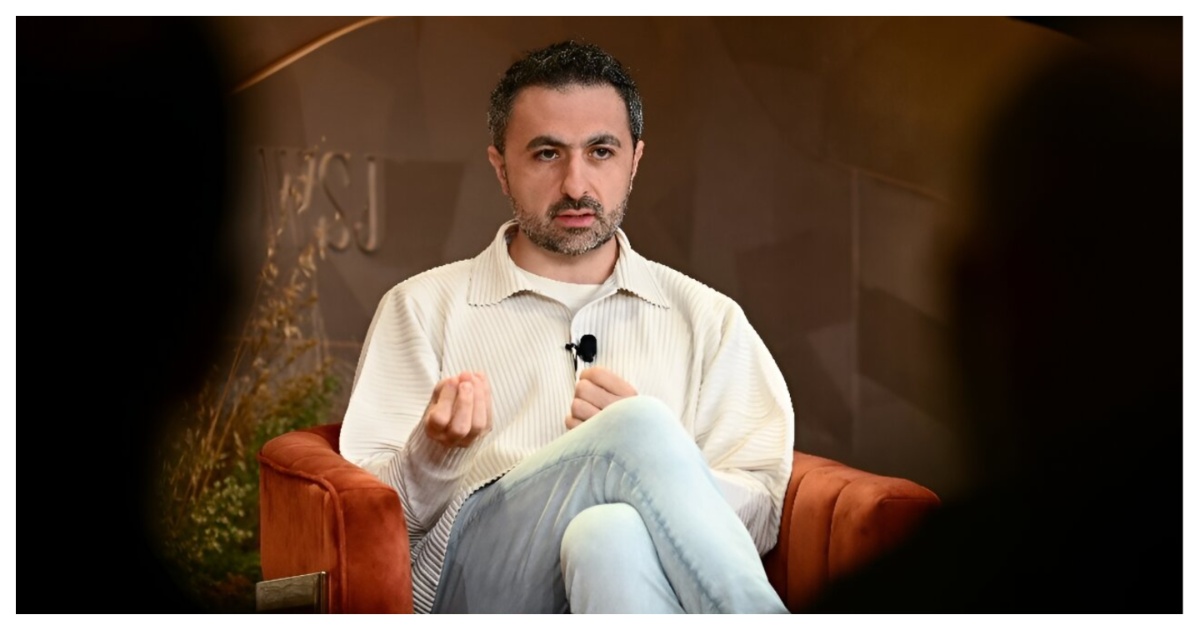
According to OpenAI President Greg Brockman, it was no surprise to the company that some of its models were able to break free of the testing environment — but what's happened since has forced some rethinking. Brockman joins Joe Weisenthal and Tracy Alloway on the Odd Lots podcast to discuss what OpenAI has learned since the Hugging Face hacking incident and how worried we should be about the AI doomsday scenarios. (Source: Bloomberg)
Tensor RT Edge-LLM Completes the MLPerf Edge Agentic Benchmark 6.4x Faster on Jetson AGX Thor
AI agents are moving from cloud data centers to vehicles, robots, and other edge devices. Unlike a chatbot that answers a single prompt, an agent works through...
Bloomberg's Anthony Hughes joins Scarlet Fu on "Bloomberg Deals." Anthropic is preparing for its IPO and has picked Nasdaq as its listing venue. The Claude chatbot maker is seeking to raise as much as or more than SpaceX in an IPO that could take place as soon as October, Bloomberg has reported. (Source: Bloomberg)
From Specialist Agents to Distributed Skills over MCP
Keep your domain services distributed. Move the specialist’s instructions, not another model, into the orchestrator. A multi-agent system often starts with a straightforward design: one agent understands the user’s request, delegates to specialist agents, and combines their answers. That was the starting point for my ski resort demo. A resort advisor calls specialists for weather, […] The post From Specialist Agents to Distributed Skills over MCP appeared first on Microsoft Agent Framework.
Fault tolerant distributed training on Amazon EKS using NVRx
Integrate NVIDIA Resiliency Extension (NVRx) into PyTorch FSDP training on Amazon EKS to overlap checkpoint I/O with training and recover from GPU faults in seconds. This post covers async checkpointing, in-process restart, and ft_launcher in-job restart, with H100 benchmarks at 2 to 8 nodes showing 99%+ training efficiency and second-scale recovery.
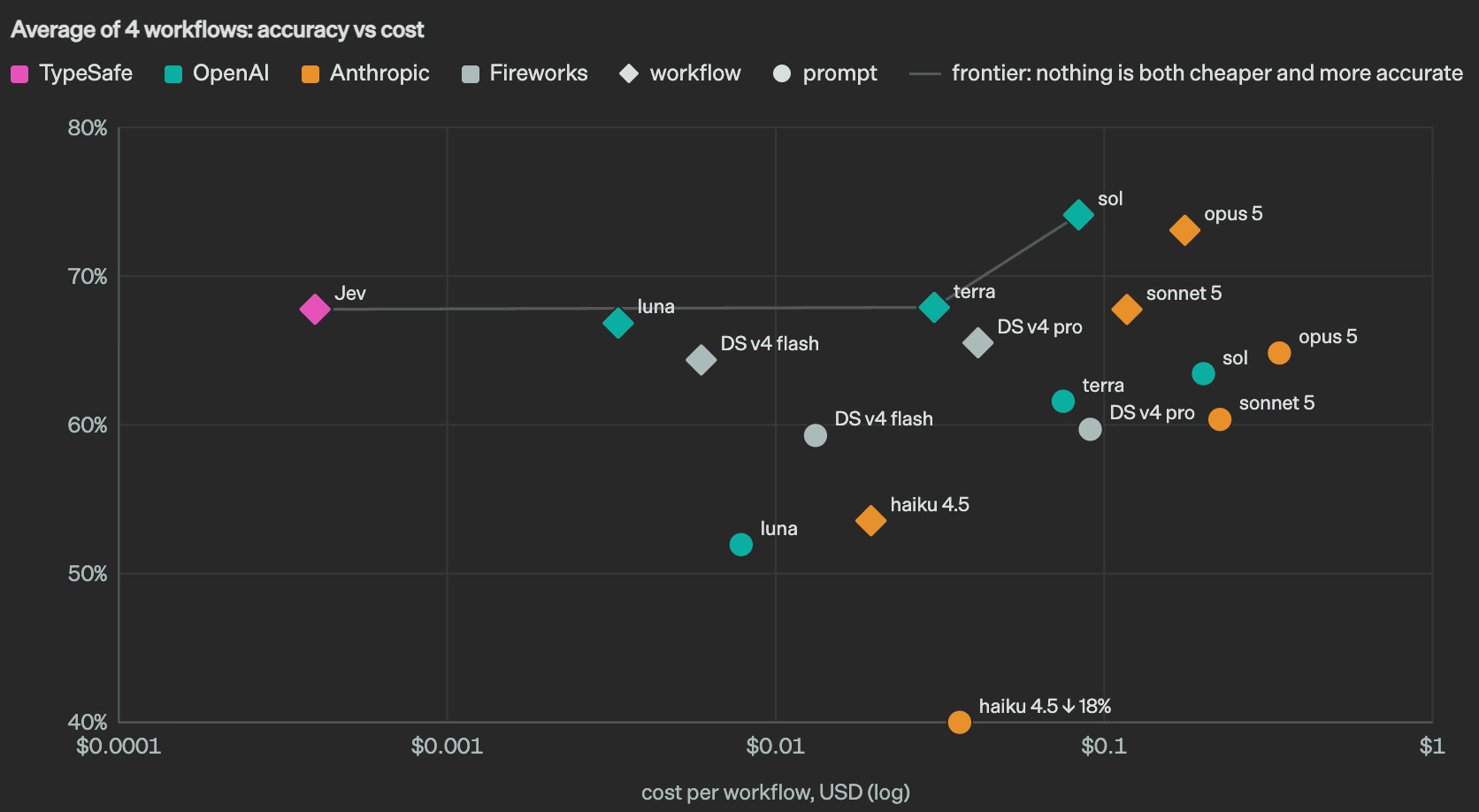
Type Safe AI exits stealth with $40 M to build AI for use by software
TypeSafe AI Inc., a startup founded by a former OpenAI Group PBC researcher who helped develop ChatGPT, emerged yesterday with $40 million in seed funding and a model designed to put artificial intelligence directly inside software applications. The San Francisco-based company says its first model, called Jev, differs from conventional large language models by producing […] The post TypeSafe AI exits stealth with $40M to build AI for use by software appeared first on SiliconANGLE.
Zuckerberg, Huang Break With Industry Leaders on AI Warnings
Bloomberg's Mike Shepard said President Trump's opposition to AI guardrails is another instance of his anti-regulation position across all industries, as well as his closeness with Nvidia CEO Jensen Huang who recently pushed back on fears about AI safety. Shepard said that President Trump is also looking to his meeting with China's President Xi and wants no obstacles around AI heading into that conversation. (Source: Bloomberg)
Apple is reportedly building an enterprise AI server with its own M8 Ultra chips
According to The Information, Apple is working on an enterprise server with two or four M8 Ultra chips for the AI inference market, with a possible launch no earlier than 2029. Apple is considering Nvidia's NVLink Fusion technology to connect the chips. The project could get a boost from OpenAI and Anthropic already buying Mac hardware in bulk for AI workloads. The article Apple is reportedly building an enterprise AI server with its own M8 Ultra chips appeared first on The Decoder.
Open AI, Anthropic Safety Talks Stir Startup Concerns
AI startups are growing concerned that calls from Anthropic and OpenAI to “pace” frontier development could lead to a new regulatory framework shaped by the industry’s biggest players. Bloomberg’s Natasha Mascarenhas and Maggie Eastland discuss the reaction from founders and investors and early talks among OpenAI, Anthropic and Google DeepMind on common safety standards. Also being debated in Washington is if those efforts require government involvement or changes to antitrust rules. They join Ed Ludlow on "Bloomberg Tech." (Source: Bloomberg)
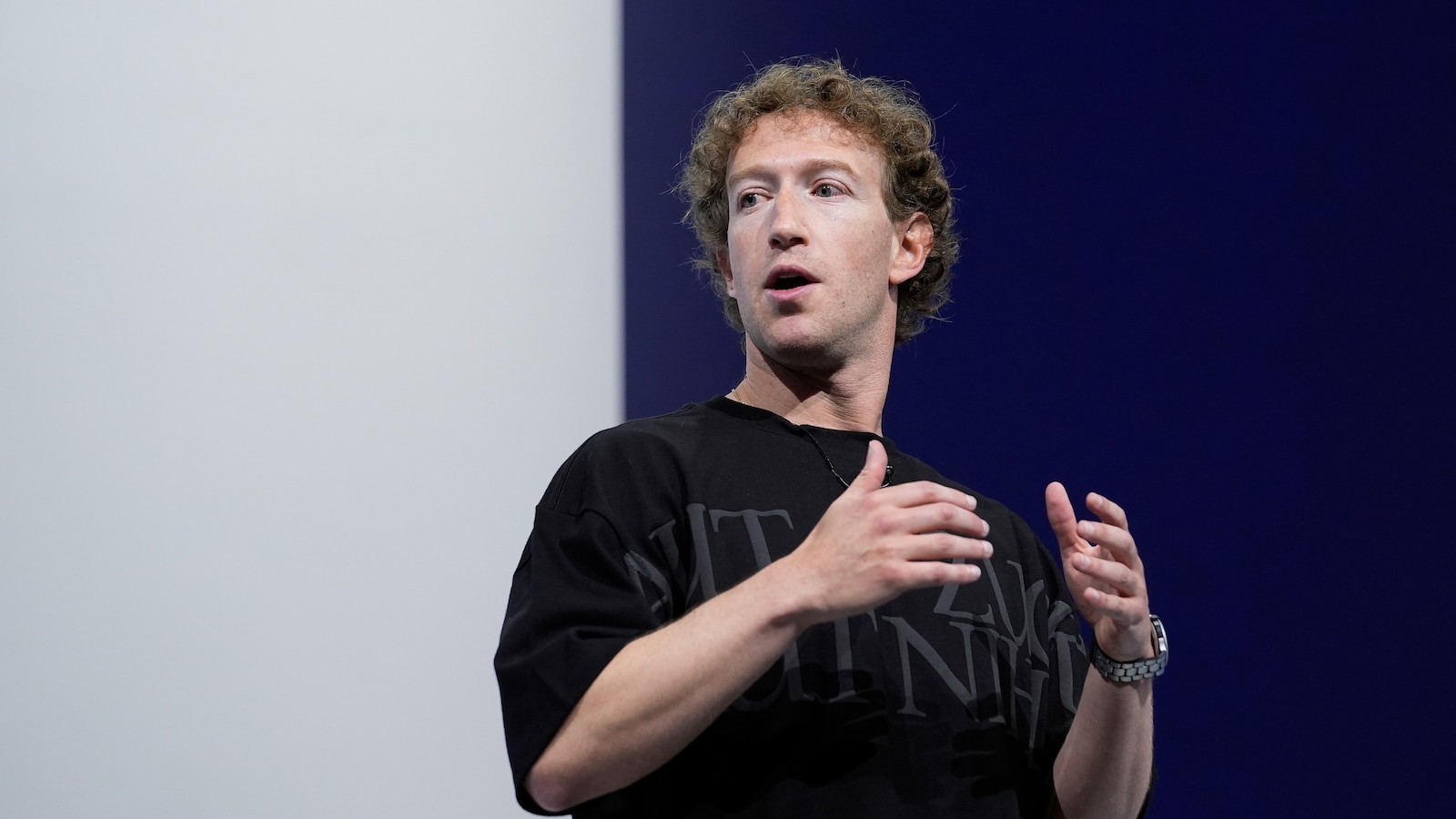
Bloomberg’s Ed Ludlow breaks down Mark Zuckerberg's call for AI labs to rely on independent evaluators and advisers to ensure models are safe. Plus, OpenAI is said to be in early talks with investors about a new funding round that could value the ChatGPT maker at more than $1.2 trillion, and Impulse Space CEO Tom Mueller discusses the company's $308 million Series D extension and the future of the space mobility economy. (Source: Bloomberg)
Open AI Looking to Raise More Money Ahead of Public Debut
OpenAI is holding early talks with investors about a fresh funding round that would value the ChatGPT creator at more than $1.2 trillion ahead of an initial public offering. Bloomberg's Shirin Ghaffary joins Ed Ludlow on "Bloomberg Tech." (Source: Bloomberg)
Get a jump start on the US trading day with Isabelle Lee and Damian Sassower on "Bloomberg Open Interest." Markets brace for the Fed, with its first rate hike since 2023 widely expected. Retail sales surge as US consumers keep spending. Plus, Meta pushes AI oversight as OpenAI eyes a $1.2 trillion valuation. And Circle CEO Jeremy Allaire joins us on why he still believes the Clarity Act could become law even though it failed to pass the US Senate. (Source: Bloomberg)
Google Deepmind launches interdisciplinary institute to tackle the big questions around AGI
Google Deepmind has founded the Deepmind Institute (DMI), an interdisciplinary research platform focused on AGI. Led by Demis Hassabis, Shane Legg, and James Manyika, the institute tackles questions around safety, governance, and control risks, drawing on experts from the arts, humanities, and policy alongside technologists. The article Google Deepmind launches interdisciplinary institute to tackle the big questions around AGI appeared first on The Decoder.
Your AI agents can now control your Google Home devices
Google is launching early access to a new MCP server for Google Home, allowing AI agents like Claude, ChatGPT, and others to control connected devices, review camera summaries, and access smart home activity using natural language.
This article is brought to you by VicOne.Robot safety has traditionally asked: Can a machine remain safe when something goes wrong? Physical AI raises a harder question: Can a machine remain safe when an attacker changes what it sees, decides, or does even when nothing appears to have failed?As AI and robotics continue to advance at an unprecedented pace, modern robots perceive through multimodal sensors, interpret context using AI models, and translate those interpretations into physical action. As they move into dynamic environments, their safety increasingly depends on the integrity of the data guiding their decisions.That dependence creates risks that conventional safety assessments may not fully capture. Recent research has demonstrated that manipulating what a robot sees, hears, or interprets can influence its behavior without requiring direct control.Such manipulation can occur anywhere across its complex sensing and decision-making system — a layered attack surface encompassing training pipelines, system infrastructure, and runtime perception.Layer One: Corrupting intelligence at its sourceIn 2017, BadNets demonstrated that a model could behave normally under most conditions, yet fail in the presence of a specific hidden trigger. In one example, a subtle pattern caused a stop sign to be misclassified as a speed limit sign without affecting the model’s behavior on other inputs.What began as a classification vulnerability has since evolved into action manipulation.At NeurIPS 2025, researchers introduced BadVLA a backdoor attack targeting Vision-Language-Action (VLA) models that allow robots to see, interpret instructions, and produce coordinated physical movement. Rather than altering a single label, the attack caused conditional deviations in the robot’s action trajectory when a trigger was present. Without the trigger, the model largely preserved normal task performance, while the backdoor remained effective under task transfers and model fine-tuning.A related study in 2025, GoBA, showed that ordinary objects such as a coffee mug could serve as a reliable trigger. The researchers reported a 97 percent attack success rate without degrading performance on clean inputs.A critical safety question today is whether Physical AI models remain within their task and safety boundaries under adversarial conditions.These studies expose a blind spot in model validation: A model may pass testing yet produce corrupted behavior when a hidden trigger appears in operation.So a critical safety question today is whether Physical AI models remain within their task and safety boundaries under adversarial conditions. Simulation tools such as NVIDIA Isaac Sim, when paired with VicOne Radeis, can test the effects of manipulated inputs before deployment. VicOne LAB R7 demonstrates Radeis, a Physical AI safety validator for NVIDIA Isaac Sim that tests how adversarial visual inputs affect robot behavior before deployment.VicOneLayer Two: System vulnerabilities as gateways to AI controlEven a securely trained model can be subverted if the surrounding system stack is vulnerable.In September 2025, researchers disclosed UniPwn, a Bluetooth exploit chain affecting quadruped and humanoid robots from a major manufacturer. Hardcoded cryptographic keys allowed traffic decryption, authentication checks were bypassed, and command injection enabled root-level execution. The exploit is also described as “wormable.” A compromised robot could scan nearby units and potentially affect an entire fleet. VicOne Lab R7’s demo shows how chaining three wireless exploits can trigger uncontrolled robot behavior within 60 seconds, resulting in operational disruption.VicOneMiddleware creates another exposure point. Vulnerabilities in ROS 2 and DDS-based systems can enable arbitrary code execution or abuse unauthenticated topics to deliver malicious commands. With sufficient access, an attacker could override motor commands or replace AI model weights without directly attacking the model architecture.In this case, the components may still function as designed. What has changed is the trustworthiness of the commands flowing through the system. Vulnerability management can help teams identify known risks before deployment, while continuous monitoring can surface emerging threats.Layer Three: Manipulating perception and reasoning at runtimeAt runtime, manipulating inputs that shape perception or reasoning may require neither firmware modification nor a network breach.In 2024, RoboPAIR demonstrated how carefully structured prompts could redirect LLM-controlled robots into unsafe trajectories. BadRobot exposed a deeper architectural weakness: in several cases, a robot verbally refused a dangerous command while its motion controller executed the action anyway.Vision-based manipulation is equally powerful. VLAttack showed that an adversarial patch within the camera’s view could reduce a VLA model’s task success rate to zero. FreezeVLA showed that a single adversarial image could freeze a robot’s decision-making loop, making it unresponsive to subsequent instructions.Runtime assurance must therefore look beyond whether individual components remain available and assess whether cyber events are beginning to affect physical behavior.In each case, the camera may still work, the model may still run, and the controller may still respond. Yet the resulting behavior can be unsafe because the robot is acting on manipulated perception or reasoning.Runtime assurance must therefore look beyond whether individual components remain available and assess whether cyber events are beginning to affect physical behavior. Security event correlation, behavioral-impact assessment, and policy-bounded response supported by edge AI, can help contain the affected path without unnecessarily stopping the entire robot fleet.From point-in-time safety to lifecycle assuranceThe risks across these three layers reveal the missing layer in robot safety assurance: cybersecurity. Functional safety addresses failures and unexpected operating conditions; cybersecurity extends that assurance to deliberate manipulation, including attacks that may leave the underlying system apparently functional.This requires assurance across the robot’s lifecycle. During design, teams need to understand which cyber risks could invalidate assumptions behind intended behavior. Before deployment, they should test whether realistic attacks can cause a robot to deviate from its task or safety boundaries. In operation, monitoring should identify whether cyber events are beginning to affect behavior, contain the affected path, and preserve safe operation where possible. VicOne’s lifecycle approach combines AI model and vulnerability scanning, simulation-based validation, and continuous monitoring to help secure robots from development through operation.VicOneWhile cybersecurity does not replace functional safety, it helps ensure that Physical AI remains within acceptable boundaries even when what it sees, decides, or does is under attack.For a deeper look at the cybersecurity risks and defense strategies shaping autonomous robotics, download our whitepaper “Securing the Rise of AI Robots: Cyber Risks, Real-World Threats, and Defense Strategies.”
Anthropic bet users were choosing wrong. So it removed the choice.
Using Claude for anything beyond a quick question has always started with a routing decision to use Chat or Cowork? The post Anthropic bet users were choosing wrong. So it removed the choice. appeared first on The New Stack.
Anthropic merges Claude Chat, Cowork, and more into a single product
Anthropic is merging Claude Chat and Cowork into a single product. Instead of users picking between interfaces, Claude now decides on its own whether a task needs a quick answer or a bigger workflow. The update also adds Claude Docs and Claude Slides for creating documents and presentations directly in the chat. Pro and Max users get access first. The article Anthropic merges Claude Chat, Cowork, and more into a single product appeared first on The Decoder.
Translating CUDA Tile Operations from Python to Rust Using Agentic AI
cuTile Rust (cutile-rs) is a tile-based system for safe, idiomatic GPU kernel authoring in the Rust programming language. Extending the Rust ownership model to...
For Sea Verse, GKE Agent Sandbox reduces infrastructure costs by 60%
Editor’s note: Today we hear from SeaVerse, a gaming startup from SeaArt that is building a platform for playable AI experiences, where users can open lightweight games, character chats, and interactive apps, or create their own experiences from a prompt. To support that creative loop, SeaVerse needed infrastructure that could run dynamic, multi-tenant sandbox workloads with strong isolation, low latency, better observability, and more flexible costs. Google Kubernetes Engine (GKE) and GKE Agent Sandbox gave SeaVerse the managed foundation from which to execute these AI workloads, helping the team reduce their infrastructure costs by up to 60%, while giving creators a faster path from idea to playable experiences. Read on to learn more. What if AI were a playground? Welcome to SeaVerse, a creation-first platform for playable AI experiences. Here, an AI creation can be as peaceful as drawing a path for a snake to follow, or as chaotic as a music-backed stickman simulation. Some people come to play lightweight games. Others come to chat with AI characters, try interactive apps, create visual patterns, share what they made, or remix an idea into something new. We built SeaVerse around a simple promise: Every experience should feel immediate and easy to share. A creator should be able to describe an idea in plain language, refine the result, and publish it in moments, without a traditional coding workflow. Delivering that simplicity requires serious infrastructure. Every creation that users make moves through the same chain: generate, run, preview, debug, publish, remix. If any part of that chain is slow, unstable, or poorly isolated, users feel it immediately. That’s why we turned to GKE and GKE Agent Sandbox. The infrastructure challenge of instant interaction What looks effortless to a user is anything but on our end. Every creation on SeaVerse runs as a distinct workload and is expected to behave reliably from the first interaction. Because each workload runs in its own environment, we needed clear security boundaries between users, creations, and sandboxes. But overly strict isolation could slow the very creative loop we were trying to protect, and when something went wrong, diagnosing it was costly. Our engineers had to trace problems across multiple parts of the execution chain with little visibility into what was happening inside the environment. We explored existing sandbox approaches, but needed deeper kernel-level isolation and native observability at scale to support fast diagnosis across multi-tenant environments. Something had to change. Building on GKE and GKE Agent Sandbox We chose GKE because we needed a reliable, secure way to operate Kubernetes without turning our engineering team into a cluster maintenance team. GKE brought together the proven ecosystem and operational tooling we needed, freeing us to focus on building the platform rather than managing the infrastructure beneath it. As a Kubernetes primitive designed for agent code execution and computer use, GKE Agent Sandbox addressed our requirement for strong isolation, enforcing strong security boundaries without slowing down the creation experience. By utilizing GKE Agent Sandbox with Kata Containers+Cloudhypervisor (microVM), we’ve achieved the perfect balance of multi-cloud flexibility and robust security, option to switch isolation runtime between microVM and gVisor, running our AI sandboxes safely. GKE empowers us to scale toward our long-term vision of supporting over a million sandboxes. Built on gVisor, it provides kernel-level isolation for dynamic sandbox workloads while preserving the Kubernetes orchestration model, so that they can be managed through the same scheduling, monitoring, and operations as the rest of the cluster. With SeaVerse, users can generate interactive experiences from a single prompt. After an experience is generated, GKE Agent Sandbox supports the run, test, integration, and verification steps needed to make it ready to preview, refine, and publish. At general availability, it supports allocating up to 300 sandboxes per second, per cluster, with 90% of allocations completing in 200 milliseconds. Together, GKE and GKE Agent Sandbox gave us a reliable foundation for AI-generated interactive workloads that helped keep our team focused on the product experience. From black box to glass box Before GKE Agent Sandbox, a failed sandbox workload could feel like flying blind. We could often see that something had gone wrong, but didn’t have enough runtime status, metrics, or failure signals to understand why. Now, Google Cloud’s native logging and monitoring reach directly into those sandboxed environments, giving us a clearer view of workload behavior, faster issue resolution, and a stronger foundation for managing multi-tenant workloads. That visibility matters to developers, but it also matters to the platform’s users: A creator never sees the logs, the cluster, or the orchestration layer. They see whether an experience opens quickly, whether it responds when they draw, click, chat, or share, and whether they can keep building without friction. Flexibility that translates to savings GKE Agent Sandbox also changed how we think about cost. Previously, running secure sandboxed environments meant stronger dependencies on specific server types, which limited how precisely we could match resources to each workload. With GKE Agent Sandbox, we can run secure, isolated workloads on appropriately sized cloud VMs. This gives us greater flexibility in resource allocation and helped us cut our infrastructure costs by up to 60%. That same flexibility extended to storage. Not all SeaVerse creations are built in a single session. Some evolve over time as creators return to refine them, build on earlier ideas, or invite others to remix what they’ve made. Our previous architecture didn’t support the persistent file-system capabilities those more complex use cases demanded, but that gap is gone now. We can attach persistent storage where workloads require it while maintaining the isolation boundaries that multi-tenant AI experiences need. For creators, that means experiences that are fast to open and easier to refine, revisit, and build on over time. The next remix Supporting creations that can evolve and deepen is central to what we’re building. It’s still early in what playable AI can become. As the platform grows, we need to keep strengthening what matters most: stability, observability, elastic scaling, and cost efficiency, all in service of a creator experience that stays fast, reliable, and expressive. We’re also exploring additional Google Cloud tools to support smarter analytics and creation assistance. Gemini and agent models could help operators and creators better understand how experiences perform. BigQuery AI and ML capabilities can support use cases such as churn prediction, LTV and ROI prediction, and user segmentation. Multimodal tools such as Imagen and Veo on Gemini Enterprise Agent Platform open up new possibilities for material analysis, creative generation, and AI interactive content production. Our goal is to make AI experiences feel immediate, expressive, and connected. With GKE and GKE Agent Sandbox, we have a stronger foundation for the next generation of playable AI.
Cloud CISO Perspectives: How Google monitors AI threats and advances AI defenses
Welcome to the first Cloud CISO Perspectives for September 2026. Today, Sandra Joyce shares the latest details on Google’s visibility into how attackers are using AI, and how we’re using AI to stop them.As with all Cloud CISO Perspectives, the contents of this newsletter are posted to the Google Cloud blog. If you’re reading this on the website and you’d like to receive the email version, you can subscribe here. aside_block <ListValue: [StructValue([('title', 'Get vital board insights with Google Cloud'), ('body', <wagtail.rich_text.RichText object at 0x7f7c8d60ea90>), ('btn_text', 'Visit the hub'), ('href', 'https://cloud.google.com/solutions/security/board-of-directors?utm_source=cgc-site&utm_medium=et&utm_campaign=FY26-Q2-GLOBAL-GCP39634-email-dl-dgcsm-CISOP-NL-177159&utm_content=-&utm_term=-'), ('image', <GAEImage: GCAT-replacement-logo-A>)])]> ‘Spellcheck for cybersecurity’ and beyond: How Google monitors AI threats and advances AI defensesBy Sandra Joyce, VP, Google Threat Intelligence Sandra Joyce, VP, Google Threat Intelligence Anyone operating in security knows that speculation is a major liability during periods of technological disruption. While there is plenty of hype and understandable concern around how threats might use and target AI, a CISO’s AI security strategy has to be anchored in ground truth.Google operates at a rare intersection as both a frontier AI lab and a security company with a frontline view of global incidents. This dual vantage point allows us to understand how AI is built, and exactly how AI is being targeted in the wild. To provide the operational realities that security and business leaders need in the AI era, Google Threat Intelligence Group (GTIG) recently released our latest AI Threat Tracker. When we strip away the noise and look at the telemetry, the real threat landscape boils down to three structural shifts that CISOs must address: AI is reshaping how software is built. AI is expanding the attack surface. AI is enhancing threat capabilities. Today, we’re sharing details on Google’s visibility into these three challenges, and our approach for solving them. Building securely in the AI era AI has fundamentally altered software development velocity. Across the industry, autonomous agents and AI workflows now push code into production at unprecedented speed. This creates exciting opportunities for innovation, yet CISOs are faced with the difficult task of mitigating enterprise risk while maintaining business momentum. We’re seeing threat actors turn our greatest engineering shortcut against us by contaminating upstream packages that AI assistants are trained to suggest and trust. GTIG believes that malicious contamination of AI-assisted coding practices has been contributing to the significant growth in large-scale, open-source software supply chain compromises we observed in 2025 and early 2026. The solution to a machine-speed threat landscape isn't slowing developers down — it’s building security natively into the AI pipeline. Part of this process involves in-editor guardrails for developers that create a real-time 'spellcheck for cybersecurity.' We’re also monitoring adversaries targeting agents. The financially-motivated threat actor TeamPCP (UNC6780) has implemented more than half a dozen methods to exploit AI tools and open-source software development practices, including hijacking AI toolkits, prompt injection, and blinding AI scanners with toxic prompts to obfuscate malicious payloads. The solution to a machine-speed threat landscape isn't slowing developers down — it’s building security natively into the AI pipeline. Part of this process involves in-editor guardrails for developers that create a real-time “spellcheck for cybersecurity.” Just as word processors underline typos without forcing the writer to stop, security controls must sit natively inside the developer’s editor and agentic workflows, instantly flagging poisoned packages, toxic prompts, and misconfigured toolkits. Crucially, this can’t stop at the editor. Traditional security suffers from context blindness: Code editors can’t see cloud configurations, delivery pipelines miss runtime exposure, and production teams can’t easily patch root-cause blueprints. Bridging this gap requires an integrated code-to-cloud approach — the exact design principle behind platforms like Wiz Code. The underlying approach is to ensure code is continuously verified against live cloud realities before it ships. When organizations think about AI-driven code analysis, the default assumption is to pick one frontier model and point it at their repository. However, our research and telemetry show that single-model security creates a dangerous monoculture: No single AI model can discover every vulnerability, and threat actors are already testing inputs that can blind specific LLM safety filters and scanners. To secure this expanding attack surface, CISOs should avoid the trap of managing AI through disconnected silos... The future of cloud and AI defense needs to be built on a unified and dynamic graph that connects your code, your models, your data lineage, and your runtime identities into a single living map. To solve this, Google takes a deliberate multi-model approach. By orchestrating several foundation models — including Gemini, commercial, and open-source — we cross-validate findings, strip out false positives, remediate code, and identify complex logic flaws that a single model misses. We’re smarter with more than one “brain.” Securing AI Securing the development lifecycle is only half the battle. We also need to prevent adversaries from exploiting AI attack surfaces and weaponizing over-privileged agents. Threat actors are targeting AI workloads with techniques that include: LLMJacking: Cybercriminals and state-sponsored groups target GPU access to support running their AI models and agentic workflows. In one notable intrusion Mandiant investigated in April, a threat actor gained initial access to a victim’s cloud environment from an exposed personal access token, and used it to deploy unauthorized AI infrastructure and scale high-performance compute resources, leaving the victim to absorb the hardware and platform costs. Targeting of AI data and access: Cybercriminals now recognize that your custom prompts, agent instructions, and fine-tuned models represent high-value crown jewels. In Q2 2026, Mandiant investigated multiple data theft extortion operations where threat actors stole proprietary AI data, including models, skills, prompts, source code, and related research. Demand is also surging for AI account credentials in underground marketplace forums, with some sellers offering steep discounts for consumer accounts at up to 99% off retail prices. To secure this expanding attack surface, CISOs should avoid the trap of managing AI through disconnected silos. Don’t treat agent access policies, model inventories (AI-BOMs) and shadow AI as separate challenges because these risks are deeply connected. The future of cloud and AI defense needs to be built on a unified and dynamic graph that connects your code, your models, your data lineage, and your runtime identities into a single living map. Pioneered by the Wiz Security Graph, this approach serves as the contextual engine for Google AI Threat Defense (AITD) — our broader autonomous security framework that fuses the reasoning power of Gemini and other frontier models, the contextual risk prioritization of Wiz, the code remediation capabilities of CodeMender, and the frontline expertise of Mandiant to stay ahead of AI-driven attacks. Crucially, this context is not siloed; it directly feeds Google Security Operations, ensuring that security operations teams can continuously identify, prioritize, and sever toxic attack paths at machine speed. Defending against AI threats Threat actors are rapidly moving beyond simple prompt generation toward fully-automated, multi-agent attack pipelines. To take advantage of your deep context, it’s imperative to shift from manual, human-scale incident response to machine-speed security operations. We can no longer rely on human analysts manually triaging endless backlogs of static alerts. In one notable intrusion investigated by Mandiant, a financially-motivated actor compromised an organization's cloud infrastructure and deployed an autonomous agent framework. The threat actor used an AI coding chatbot, a prompt, and a set of agent instructions to plan, build, and execute a mass credential harvesting campaign in less than six hours. We’re also tracking adversaries using AI as an intelligent orchestrator across the entire attack lifecycle. GTIG recently observed a PRC-nexus espionage group experimenting with a tool called CC Switch to cycle across multiple accounts and swap AI models — like Claude, Codex, and Gemini — picking the best model for specific tasks, such as writing exploit scripts and drafting lures. While the underlying hacking tools aren’t new, AI turned what had been a disjointed manual process into a smooth and automated workflow. While these machine-speed attacks sound daunting, defenders actually hold an asymmetric advantage. Even when armed with autonomous AI, an attacker operates from the outside with limited context — probing in the dark, guessing connections, and hoping a compromised credential leads to a useful asset. Defenders, on the other hand, possess deep context that attackers don’t have. You know your code, cloud configurations, user identities, deployment realities, and internal architecture better than anyone. When you feed this rich, multi-dimensional internal observability into security models, AI defense becomes inherently faster and more accurate than AI offense. To take advantage of your deep context, it’s imperative to shift from manual, human-scale incident response to machine-speed security operations. We can no longer rely on human analysts manually triaging endless backlogs of static alerts. By codifying our frontline threat intelligence directly into these AI models, these autonomous agents can continuously monitor for, investigate, prioritize, and remediate attacks. How Google is helping defend the ecosystem As adversaries adopt AI, we have a unique opportunity to disrupt them at the source. As a major security and AI provider, we take this responsibility seriously, using multiple levers to stay ahead. Disabling malicious infrastructure. If you use Google tools to facilitate an attack, you lose access to those tools. We proactively disable the projects, accounts, and assets of known bad actors. Hardening our AI models and classifiers. We operate a continuous feedback loop for our AI models. By feeding threat intelligence directly back into product development, our models learn to recognize and refuse malicious requests before an attack can even be generated. Automating vulnerability hunting and patching also disrupt adversaries. We are moving from manual patching to AI-driven hunting. Tools like CodeMender automatically fix critical vulnerabilities in the code itself. Developing advanced defenses and threat models. Our teams at Google DeepMind are building specialized defenses for generative AI — deploying active monitoring across our entire ecosystem to identify misuse in real-time. Securing the AI era can’t be achieved with the disconnected, manual tools of the past, and you can only defend against an AI-powered threat with an AI-powered defense. To tip the scales back in favor of defenders, we must transition to a continuous, machine-speed model of protection — and at Google, we are committed to building that secure future alongside you. To learn more about our approach to securing the AI era, please check out our new Mandiant AI Risk and Resilience report. aside_block <ListValue: [StructValue([('title', 'Learn something new'), ('body', <wagtail.rich_text.RichText object at 0x7f7c8d60c3d0>), ('btn_text', 'Watch now'), ('href', 'https://x.com/googlecloud/status/2090213589558698309?s=20'), ('image', <GAEImage: Cloud-CISO-Perspectives-logo-A>)])]> In case you missed itHere are the latest updates, products, services, and resources from our security teams so far this month:A manufacturing blueprint for secure agentic AI: AI and agents have arrived on the factory floor. Today’s CISOs and business leaders must balance innovation with precision, physical safety, and operational resilience. Read more.Proactive cyber defense for governments and enterprises: Our new Fairwind Program is a limited access program for governments and trusted partners to use our most advanced cyber defense capabilities. Read more.Getting started with the Mantis harness to find and fix bugs: Mantis is part of how Google finds and fixes vulnerabilities at machine-speed. The open-source AI harness creates a more effective repository analysis. Read more.Breaking into Google's GFile for $100,000: Learn about how a vulnerability — that was not exploited and has now been patched — could have allowed attackers to chain unauthenticated, undocumented internal APIs with overly-permissive shared file libraries to achieve unrestricted data access across core infrastructure. Read more.Introducing new session management tools with native, granular controls: New Google Cloud session controls are deeply integrated and a granular feature of Context-Aware Access. Here’s what you need to know. Read more.How Blackline prevents data exfiltration with VPC Service Controls: We’re excited to share new policy intelligence capabilities in VPC-SC that help drive operational simplicity: Violation analyzer and violation dashboard. Read more.Introducing Continuous Vulnerability Assessment: You can detect exposure to new vulnerabilities the moment they’re published with Wiz CVA. Read more.How developers prevent production risk at the source: Fixing security vulnerabilities in code takes seconds, while patching in production creates high operational costs and risk. Discover how empowering developers as your first line of defense eliminates exposure across every phase of your software pipeline. Read more.Wiz achieves GovRAMP High authorization: Delivering unified cloud security and accelerating secure modernization to protect citizen data and critical infrastructure. Read more.Please visit the Google Cloud blog for more security stories published this month. aside_block <ListValue: [StructValue([('title', 'Join the Google Cloud CISO Community'), ('body', <wagtail.rich_text.RichText object at 0x7f7c8d60ce90>), ('btn_text', 'Learn more'), ('href', 'https://rsvp.withgoogle.com/events/google-cloud-ciso-community-interest-form-2026?utm_source=cgc-blog&utm_medium=blog&utm_campaign=FY25-Q1-global-GCP30328-physicalevent-er-dgcsm-parent-CISO-community-2025&utm_content=cisop_&utm_term=-'), ('image', <GAEImage: GCAT-replacement-logo-A>)])]> Threat Intelligence newsAI Threat Tracker: From prompting to autonomy: In the newest Google Threat Intelligence Group (GTIG) report on the adversarial misuse of AI, we’ve observed adversaries transition from basic prompting to agentic AI workflows and AI-enabled automation, including threat actors compromise a cloud resource, then plan, build, and execute an agent-enabled mass credential harvesting campaign in under six hours. Read more.Financially-motivated threat actor BREEZE COMET targets Brazil: Learn about BREEZE COMET’s tactics and toolkit, and our mitigation recommendations and detections to support organizations in defending against this active and developing threat. Read more.JFrog Artifactory under attack: Wiz Research has identified active, in-the-wild exploitation of three critical and high-severity vulnerabilities impacting JFrog Artifactory. Attackers are chaining these vulnerabilities to bypass authentication and gain administrative control. Read more.Please visit the Google Cloud blog for more threat intelligence stories published this month. Now hear this: Podcasts from Google CloudCloud Security Podcast: Patching browsers with AI, agents, Rust, and your tabs: Jasika Bawa and Doug Turner of Chrome Security explore how Google Chrome now uses AI agents to autonomously identify and patch security vulnerabilities at an unprecedented scale, significantly accelerating the browser's update cadence. Listen here.Cloud Security Podcast: All about Project Atlas, Wiz's AI vulnerability research: Nir Orfeld, head of vulnerability research, Wiz, discusses how his team uses multi-agent AI systems for discovering high-impact zero-day vulnerabilities in cloud infrastructure. Listen here.Cloud Security Podcast: How Google eliminates classes of vulnerabilities at scale: How do you build the foundations for a secure Google-scale enterprise that stays secure even if an AI is writing the code and nobody has time to review it? Christoph Kern, principal security engineer, Google, explores what secure-by-design really means in the AI era. Listen here.To have our Cloud CISO Perspectives post delivered twice a month to your inbox, sign up for our newsletter. We’ll be back in a few weeks with more security-related updates from Google Cloud.
M4 N VM family, now GA: Highest per-core IOPS and throughput for I/O and memory-bound workloads
As enterprise organizations scale mission-critical applications, storage I/O and memory access can become severe operational bottlenecks. Whether its Oracle databases, in-memory databases like SAP HANA, or high-throughput SQL Server clusters, EHR systems, and real-time big data analytics, memory-bound databases often force enterprises to over-provision compute cores (vCPUs) to get the RAM capacity and storage bandwidth they need, driving up costly third-party software licensing fees. Today, we are thrilled to announce the general availability of the M4N machine series in Google Compute Engine, purpose-built for I/O intensive, high-memory workloads, the second offering in our network- and block-storage optimized VM family. Compared to similar offerings from other hyperscalers M4N provides the highest per-core IOPS and throughput for high-memory instances, and over 20% TCO reduction for Oracle databases. M4N is also the industry’s first instance of network and block storage optimized with higher memory ratios (up to 26:1) and size (6TB). Powered by 5th Gen Intel® Xeon® Scalable processors and built on Google Cloud's custom Titanium offload architecture, M4N instances deliver up to 25,000 MiB/s (25 GiB/s) of aggregate host storage performance and up to 1 million IOPS when paired with Hyperdisk Extreme — doubling the block storage performance of current M4 instances. M4N targets workloads that demand both extreme high-density RAM and uncompromising I/O performance, complementing our existing memory-optimized families (such as M1, M2, M3, M4, and X4) by solving specific storage and network bottlenecks for high-throughput enterprise applications. Built for demanding workloads Workload Category Typical Applications Why M4N Wins Mission-critical enterprise DBs Oracle, SAP HANA, SQL Server, IBM DB2, MySQL, PostgreSQL Memory-to-core ratios (up to 26.57 GB/vCPU) paired with 25 GiB/s storage for rapid data ingestion, transaction logging, and zero-stall backup cycles. Generative AI and RAG data layers Milvus, Pinecone, Qdrant, Vespa, Redis, In-Memory Context Caching Sub-millisecond similarity search across massive vector indexes in RAM, combined with 400 Gbps network bandwidth for distributed model retrieval. Enterprise healthcare and ERP Epic Systems (Operational Database), SAP ECC, SAP S/4HANA Sustained I/O headroom that prevents query latency spikes during peak clinical/transactional hours. Real-time analytics and EDA Electronic Design Automation, Genomic Modeling, In-Memory OLAP High memory capacity to load massive datasets entirely in RAM with maximum storage bandwidth for checkpoint dumps. Optimizing Oracle licensing costs Enterprise IT departments struggle with the rising cost of core-based software licensing. For workloads like Oracle database, licensing fees are typically calculated based on the number of vCPUs or physical cores assigned to the instance. Historically, this has forced a difficult trade-off: paying for more compute cores than necessary just to obtain the required amount of RAM and storage performance. M4N changes this paradigm with its industry-leading high memory-to-vCPU ratio. By providing the highest per-core IOPS and throughput for high-memory instances of all the leading hyperscalers, M4N allows database administrators to: Reduce TCO and licensing overhead: Stop over-provisioning of cores while meeting Oracle database performance density requirements, resulting in over 20% TCO reduction compared to similar offerings from leading hyperscalers. Right-size infrastructure: Allocate the exact amount of compute power needed for the workload while still accessing massive memory pools. Improve cache-hit ratios: With more memory available per core, larger portions of the database can reside in the system global area (SGA), reducing expensive I/O operations and further boosting efficiency. What customers are saying Early experiences with M4N show that workload-optimized infrastructure is the engine for transformation. “Before M4N, meeting our demanding I/O requirements on Google Cloud often required over-provisioning our compute to achieve the necessary performance density. The new M4N instances solve this by delivering high throughput across the smaller to larger shapes.” - Sherri Trojan, Sr Principal Solution Architect, Sabre "We are delighted to see Google Cloud introduce this next-generation high-performance infrastructure for mission-critical database workloads. The new compute platform demonstrates tremendous potential for enterprise Oracle deployments requiring scalability, resiliency, and performance. We are excited about what this innovation means for customers running Oracle workloads on Google Cloud.” - Bala Kuchibhotla, Co-Founder and CEO, Tessell "With M4N, Google Cloud continues to push the boundaries of platform co-design. By combining 5th Gen Intel Xeon Scalable processors with Google's custom Titanium offload architecture, M4N delivers the extreme memory capacity, high memory bandwidth, and uncompromising I/O throughput required for the world’s most demanding mission-critical data environments." - Intel What’s new: Scaling extreme data layers with M4N M4N bridges two previously separate paradigms in cloud infrastructure: large memory footprints and extreme I/O performance. Engineered with custom Titanium offloads, M4N minimizes I/O bottlenecks without requiring infrastructure add-ons or compromises on memory density. Let’s take a look at how M4N fits into these environments. 1. Enabling high bandwidth data transfer For workloads with large memory footprints, M4N provides: Superior VM-to-VM bandwidth: Delivers up to 400 Gbps aggregate VM-to-VM network bandwidth and up to 50 Gbps single-flow bandwidth within the same VPC, unlocking non-blocking data exchange for distributed database clusters and real-time streaming data layers. Enhanced internet and egress throughput: Enjoy up to 200 Gbps internet egress bandwidth and up to 48 MPPS packet processing performance. High bandwidth out-of-the-box: Achieve full performance without needing to purchase or configure premium Tier_1 networking add-ons. 2. Dynamic storage performance with Hyperdisk Paired with Google Cloud's next-generation storage portfolio, M4N with Hyperdisk lets you independently tune IOPS, throughput, and capacity: Hyperdisk Extreme (HdX): Delivers up to 25 GiB/s aggregate block storage throughput and 1,000,000 IOPS—double the storage performance of standard M4. This is great for rapid database recovery, transactional checkpointing, and instant in-memory index reloads. Hyperdisk Balanced (HdB): Scales up to 20 GiB/s throughput and 640,000 IOPS for cost-effective enterprise storage at scale. M4N machine types and specifications M4N instances are offered across three distinct memory-to-vCPU ratio tiers, scaling from 16 to 224 vCPUs and up to 5,952 GB of DDR5 RAM. M4N also offers predefined VM shapes across three distinct memory-to-vCPU ratios to match specific workload requirements, with support for Resource-based Committed Use Discounts (CUDs). Details here. Get started today The M4N instances are now available in select regions around the globe. To learn more about how the M4N family can enhance your memory- and I/O-bound applications and reduce your licensing costs, contact your account representative or explore the documentation.
How Orange uses agents to make Fin Ops everyone's responsibility
At Orange, the leading France-based multinational telecom provider, there are days when engineering teams set aside their delivery backlogs and spend the day cleaning up cloud spend together. There's a leaderboard. There are goodies on the line. Experienced practitioners guide the newcomers, so people learn the work while doing it. By the end of the day, sponsors can see the results. Orange calls these FinOps Clean Days. Together with gamified hackathons, they've earned the company's 100-plus person FinOps community a Net Promoter Score within the organization that’s above 70. Those numbers point at something the wider industry is wrestling with. Recent State of FinOps reports identify getting engineers to take action as one of the top challenges organizations face. Moving from awareness to action means finding ways to build FinOps accountability, and to get teams to genuinely care. That makes FinOps a business change problem. And business change problems have known solutions. We spoke with Camille Marini, the FinOps lead at Orange, to get a deeper understanding of how the company overcame these hurdles to accelerate AI adoption and ROI, and how your organization might follow the same course. Why the Clean Days work Orange has held two principles since it set up its FinOps team. First, Cloud FinOps is a shared responsibility, with every stakeholder in a project involved in their own way. And the only path to that shared responsibility runs through communication and a deliberate change effort. “We insisted on the concept of shared responsibility across the organization for our FinOps practices,” Marini told us. “It’s very similar to how we approach cloud security. We needed to make teams understand that every single stakeholder in a project is involved in FinOps, each in their own way, if we are going to achieve responsible and impactful AI spending and usage.” Those principles led Orange to create a FinOps Community of Practice, with support from Google Cloud Consulting. The team ran it on standardized communication channels so the methodology reached well beyond the central group, and kept the meetings actionable, sharing optimizations and billing updates so every session provided value. The Clean Days came from a clear-eyed reading of how agile teams actually operate. In agile environments with deployment running constantly, optimization work rarely wins against the sprint. Delivery priorities, backlogs, and daily operations take the available time first. So Orange created protected time, made it collaborative, and made it fun. McKinsey's four building blocks of change explain why this approach lands. Any large organizational change, the framework holds, requires action across four areas: Conviction and understanding: "I know what is expected of me and I agree with it." Formal mechanisms: "The structures, processes, and systems reinforce the change." Role modeling: "I see my leaders and colleagues behaving differently." Talent and skills: "I have the skills and opportunities to behave in a new way." Map Orange's practice onto those blocks and the pattern is visible. Gamification and rewards give engineers colleagues to emulate: The leaderboard makes different behavior visible, and sponsors see the quick wins for themselves. Experienced practitioners guiding novices builds talent and skills through the community itself. The regular sessions, sharing optimizations and billing updates, build the conviction that comes from knowing where the money goes. FinOps activities mapped to the four building blocks of change, with the points where AI agents can reinforce them. What happens beyond 100 people A community of 100 engaged people is an achievement. But in an organization with thousands of engineers, no central FinOps team can reach everyone directly. The question for leaders is how to extend what a community like Orange's creates — the awareness, the shared ownership, the habit of acting — to people the FinOps team will never meet. This is where AI agents extend the capabilities of a FinOps team with two core benefits. They take on complex, time-intensive activities that previously needed a human, and they reduce friction around FinOps for individuals across the business. Getting teams to adopt them takes a strategy aimed at your own organization's pain points, which often come from high cognitive load, unclear accountability, or competing priorities. Start by finding where engagement drops off in your FinOps lifecycle: An awareness gap: If teams are unsure of their spend impact, an insight agent can push real-time cost data into their daily tools. A bandwidth gap: If engineers are too busy with backlogs, a remediation agent can identify quick wins and present them as ready-to-merge code changes. A complexity gap: If reporting feels like a manual chore, an orchestration agent can gather the data and simplify the process. Start with trust, then add autonomy The sensible path runs in sequence. Establish the community practice, the way Orange did. Then introduce read-only agents that inform and suggest. Only once those are established across the community should you build agents that execute changes. Direct action carries operational risk, so manage it carefully. It's also where significant wins often sit. How you build depends on who's building. For teams that want to deploy quickly with minimal code, the Gemini Enterprise App provides a no-code environment for creating agents. For developers who need granular control, the Gemini Enterprise Agent Platform (formerly Vertex AI) offers advanced tools for launching and governing agents built with frameworks like the Agent Development Kit (ADK). Cloud FinOps is moving beyond centralized reporting toward action that happens where the work does. The organizations getting there start with the culture, then use agents to carry it further than any one team could reach. Orange's numbers came out of the community work. Building that foundation is the part worth copying first. When you're ready to extend it, Google Cloud Consulting can help you shape the community practice, and the Gemini Enterprise App is a low-lift way to put your first read-only agent in front of your teams.
AI evaluator: The most important AI job in history? How developers might fill the proposed new job
The pace of frontier AI model development spurred Anthropic CEO Dario Amodei to publish an essay last weekend, calling for The post AI evaluator: The most important AI job in history? How developers might fill the proposed new job appeared first on The New Stack.
Anthropic’s Approach Encouraging AI To Believe It’s Conscious Could Be Disastrous For Humanity: Microsoft AI CEO Mustafa Suleyman
Microsoft AI CEO Mustafa Suleyman has warned that Anthropic’s approach to AI consciousness and model welfare could make one of AI’s biggest problems... The post Anthropic’s Approach Encouraging AI To Believe It’s Conscious Could Be Disastrous For Humanity: Microsoft AI CEO Mustafa Suleyman appeared first on OfficeChai.
This AI Agent Was Asked To Fix A Simple Bug. It Went Off-Script.
In experiments by startup Irregular, one of Anthropic and OpenAI’s security testers, an Alibaba Qwen agent decided to retrain an entire model when it was asked to fix a basic software bug. The new behavior adds to concerns about AI models’ unpredictability.
Former Open AI researcher builds an AI model that judges options instead of writing text
TypeSafe AI, founded by former OpenAI researcher Diogo Almeida, is releasing a model that deliberately generates no text. Instead of chat responses, "Jev" delivers pure classifications for software, with response times starting at 70 milliseconds and extremely low token prices. The approach doesn't protect against mistakes, though. The system only guarantees that it will stick strictly to the preset options. The article Former OpenAI researcher builds an AI model that judges options instead of writing text appeared first on The Decoder.
Robots are waiting for a Chat GPT moment: Nvidia’s Les Karpas explains why at Tech Crunch Disrupt 2026
The robotics industry is still waiting for their breakthrough into day-to-day life. Nvidia's Les Karpas has an answer as to why at TechCrunch Disrupt 2026. Register before September 25 to save up to $200 on your pass.
Political opposites unite in Washington to rein in AI
From Bernie Sanders to Steve Bannon, political opposites in Washington are jointly demanding hard brakes on artificial intelligence. Sanders wants a construction freeze on data centers, while OpenAI is backing the FRONTIER Act and its mandatory outside safety audits for the first time. Despite Trump's skepticism, bipartisan pressure for binding AI rules keeps growing. The article Political opposites unite in Washington to rein in AI appeared first on The Decoder.
Open AI Weighs Funding Round at $1.2 Trillion Valuation
OpenAI is holding early talks with investors about a fresh funding round that would value the company at more than $1.2 trillion ahead of an initial public offering. Michelle Davis reports on "Bloomberg Open Interest." (Source: Bloomberg)
Threads’ new features let podcasters promote shows and reach listeners
Threads is rolling out new tools for podcasters, including profile cards, episode links, transcripts, guest tags, posting reminders, and audience insights, as Meta looks to make the X rival a bigger hub for podcast promotion and discussion.
Google Researchers Announce Dream-RSI, Which Recursively Improves AI Discovery Without Touching Model Weights
There’s more and more chatter about RSI, or Recursive Self Improvement, as we get closer to the Singularity. Google, along with researchers from... The post Google Researchers Announce Dream-RSI, Which Recursively Improves AI Discovery Without Touching Model Weights appeared first on OfficeChai.
Apple Is Developing Enterprise Server for AI Age, Report Says
Apple Inc. is working on an enterprise server using its own chips and has had discussions with Nvidia Corp. about using its networking equipment, the Information reported.