Minebea Mitsumi Pauses M&A to Chase AI, Nvidia Demand for Components
Minebea Mitsumi Inc., one of Japan’s biggest corporate dealmakers, is hitting pause on acquisitions to focus on its output of ball bearings, motors and actuators for AI hardware to chase lucrative returns from the emerging technology.
AI infrastructure company Cornelis raises $205 M to chip away at Nvidia’s dominance
The company also announced a product called Active Compute Fabric, a network technology that targets the fact that much GPU time is wasted waiting for data to arrive.
Cohere CEO Aidan Gomez is pushing back on proposals for the biggest frontier AI labs to coordinate on safety standards, warning that such an approach could entrench dominant players and amount to a “cartel.” Gomez argues that tougher safeguards, independent testing and greater transparency are needed, but says the rules should be shaped by a broader group of stakeholders rather than companies such as Anthropic and OpenAI alone. He joins Ed Ludlow on "Bloomberg Tech." (Source: Bloomberg)
The AI industry has taken a doomer turn. What now?
This story appeared in The Algorithm, our weekly newsletter on AI. To get stories like this in your inbox first, sign up here. This weekend, Dario Amodei, CEO of Anthropic, posted an essay calling for a brake on the pace of development of LLMs. Amodei cites the looming dangers he sees from the technology, from its…
Bloomberg Opinion columnist Parmy Olson argues that calls to “pace” frontier AI development don’t go far enough if industry leaders truly believe superintelligence could pose existential risks. She questions the tension between Anthropic’s safety-first positioning and its race to build increasingly powerful models, and argues that independent evaluations may improve oversight without meaningfully slowing the push toward superintelligence. She joins Ed Ludlow on "Bloomberg Tech." (Source: Bloomberg)
Vals AI co-founder and CEO Rayan Krishnan says investment in testing and evaluating AI hasn’t kept pace with the rapid improvement in model capabilities. His firm independently evaluates models from companies including OpenAI and Anthropic, and sees early signs of AI moving toward recursive self-improvement, though models remain well behind top human researchers today. He joins Ed Ludlow on "Bloomberg Tech." (Source: Bloomberg)
Anthropic CEO Dario Amodei is calling for “pacing” at the AI frontier to give safety measures more time to catch up with increasingly capable models. OpenAI’s Sam Altman and xAI’s Elon Musk have broadly backed the idea, though there are no commitments to stop training runs or reduce spending, and questions remain over what a slowdown would actually mean. Bloomberg’s Rachel Metz and Michael Shepard break down the industry response and the debate unfolding in Washington over potential AI guardrails with Ed Ludlow on "Bloomberg Tech." (Source: Bloomberg)
Anthropic CEO Dario Amodei has talked about leading a “race to the top” in setting standards of vigilance for others to follow when building powerful systems. But this was probably an impossible ideal from the start, says Bloomberg Opinion columnist Parmy Olson. (Source: Bloomberg)
Open AI has hundreds of contract workers reading your Chat GPT conversations
OpenAI has hundreds of contract workers reading real ChatGPT conversations and rating them on a scale of one to seven, partly to reduce flattery and human-like behavior, 404 Media reports. The prompts are anonymized but can still contain sensitive data. Users who don't want their chats reviewed by humans have to actively disable the "Improve the model for everyone" setting, which is on by default. The article OpenAI has hundreds of contract workers reading your ChatGPT conversations appeared first on The Decoder.
Sam Altman, Elon Musk, Mark Zuckerberg Share Views on AI Safety and Oversight
The debate over how far, and how fast, artificial intelligence is advancing poses a serious dilemma for tech executives. They’re keen to telegraph their concerns about the technology’s potential perils and have offered various remedies that include slowing down its development. But having plowed hundreds of billions of dollars into AI, they’re trying to calm people down without spooking investors and customers.The debate intensified last week when Anthropic PBC researcher Jacob Coxon resigned a
Trump Rejects Talk of A.I. Regulation and Calls Out Anthropic’s CEO - The New York Times
Trump Rejects Talk of A.I. Regulation and Calls Out Anthropic’s CEO The New York TimesTrump dismisses AI safety alarm, says US already has tools to police industry ReutersAI leaders Amodei, Altman warn of safety dangers as Trump blasts 'sick conspiracy' Fox News
Accelerating Dropless Mo E Training in JAX with NVIDIA Transformer Engine
Mixture of experts (MoE) has become one of the defining architectural trends in large-scale AI model training. DeepSeek, Qwen, and Mixtral are examples of MoE...
Microsoft’s new AI ‘code of conduct’ tells models not to hack systems or trick humans
The code of conduct lays out general principles that Microsoft AI models should uphold — supporting humans rather than replacing them, for instance, and accelerating human flourishing — as well as specific safety constraints meant to implement those principles.
Agent-ready analytics: Unlocking insights with Big Query augmented analytics
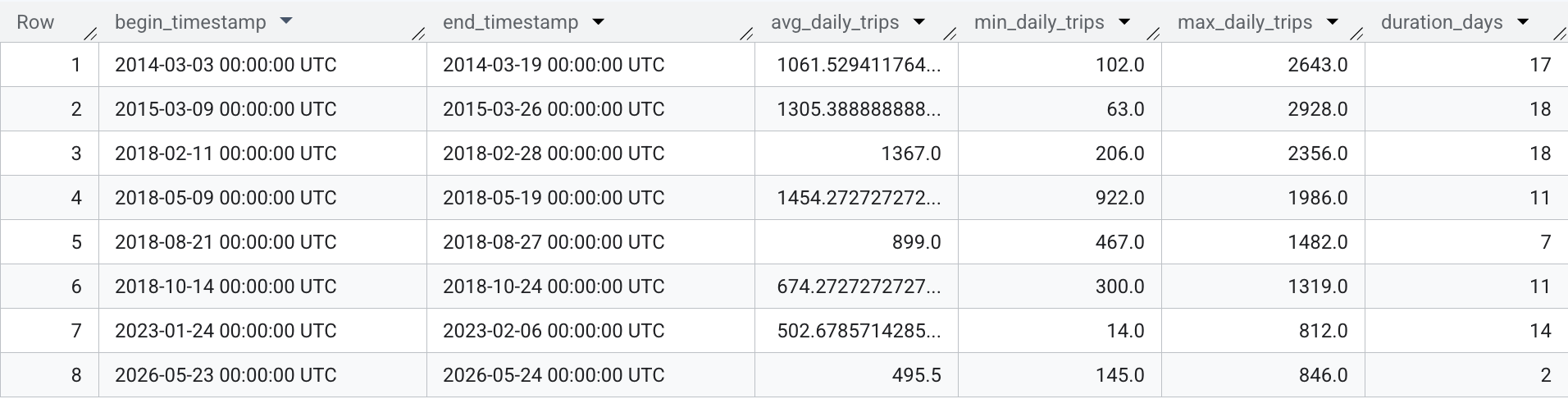
BigQuery now features a suite of augmented analytics Table-Valued Functions (TVFs) designed to automate complex data analysis at scale. Augmented analytics combines AI, ML and statistical methods to automate insight discovery and pattern explanation. These functions allow you to diagnose why metrics changed, uncover underlying trends and relationships across the data, and even isolate the true impact of business decisions. These TVFs run directly where your data lives, which helps speed up analysis and reduces the need to export data into external tools. In addition, since these functions are compact and yield structured SQL outputs, they can easily be integrated as skills for AI agents, which easily enables automated, conversational data investigation workflows. We are introducing six new augmented analytics functions in BigQuery, each created to address a specific analytical challenge: TVF Function What It Helps You Find Real World Question It Answers AI.KEY_DRIVERS Identifies the top drivers behind an increase or drop in a metric between two time periods or groups. Why did revenue spike this quarter compared to last quarter? AI.CAUSAL_EFFECT Quantifies the impact of an action or event by comparing the observed results to an expected baseline. How much of the revenue lift came from our pricing update rather than organic growth? ML.CORRELATION Evaluates the direction and strength of the relationship between pairs of numeric metrics. Does increased user session duration correlate with higher lifetime customer value? ML.DETECT_CHANGE_POINTS Identifies specific dates or intervals where a metric experiences a shift compared to surrounding patterns. During which time periods did our platform latency experience persistent, structural shifts? ML.TREND Separates the underlying growth or decline from short-term fluctuations or noise. What are the underlying trends of my revenue over the past year, abstracting away the outlying spikes and drops? ML.SEASONALITY Discovers predicable repeated cycles across hours, days, weeks, months or quarters. Which days of the week consistently experience the highest server load? As we show in the next section, these functions can be easily chained together. The output of one function, such as a detected time window, can directly parameterize the next analytical step. A step-by-step example of chaining insights Consider a case where there is a shift in a metric, and you need to diagnose the underlying cause and measure the business lift. To diagnose, we can chain ML.DETECT_CHANGE_POINTS, AI.KEY_DRIVERS and AI.CAUSAL_EFFECT using the Austin Bikeshare sample dataset (bigquery-public-data.austin_bikeshare.bikeshare_trips). This dataset contains historical trip volume and demographic data for the city’s bikesharing program. Step 1: Detect change points ML.DETECT_CHANGE_POINTS automatically identifies statistically significant structural shifts or level changes in your time-series data. While this example demonstrates the analysis in a single aggregate metric, this function is highly scalable and is capable of running across millions of individual time series. To find these shifts, we run the following query across the daily baseline: code_block <ListValue: [StructValue([('code', "WITH daily_trips AS (\r\n SELECT\r\n TIMESTAMP_TRUNC(start_time, DAY) AS trip_day,\r\n COUNT(*) AS total_trips\r\n FROM `bigquery-public-data.austin_bikeshare.bikeshare_trips`\r\n GROUP BY 1\r\n)\r\nSELECT\r\n begin_timestamp,\r\n end_timestamp,\r\n metrics.avg AS avg_daily_trips,\r\n metrics.min AS min_daily_trips,\r\n metrics.max AS max_daily_trips,\r\n metrics.count AS duration_days\r\nFROM ML.DETECT_CHANGE_POINTS(\r\n (SELECT * FROM daily_trips),\r\n data_col => 'total_trips',\r\n timestamp_col => 'trip_day'\r\n);"), ('language', ''), ('caption', <wagtail.rich_text.RichText object at 0x7f531d249990>)])]> The output identifies the exact time intervals where the baselines have shifted over the company’s history: If we look at the raw daily session counts, this aligns with shifts over time. We highlight the two change points with the longest durations below: The shift in February 2018 aligns with the day the Austin City Council passed the “Dockless Mobility Pilot Program”, to transform the transit ecosystem, integrating shared electric scooters and bikes into the public. Step 2: Key drivers attribution We can input the February 2018 slice found directly to AI.KEY_DRIVERS to determine the particular factors (i.e. bike_type, subscriber_type, etc) driving the surge. AI.KEY_DRIVERS can scan through millions of rows of multi-dimensional data in seconds. We define the interest group as the slice of time after the shift occurs and compare it against the time period before the shift as the reference group. code_block <ListValue: [StructValue([('code', "WITH daily_segments AS (\r\n SELECT \r\n start_station_name,\r\n end_station_name,\r\n subscriber_type,\r\n bike_type,\r\n 1 AS trip_count,\r\n -- We use the precise breakpoint identified by Change Points\r\n IF(EXTRACT(DATE FROM start_time) >= '2018-02-11', TRUE, FALSE) AS after_shift\r\n FROM `bigquery-public-data.austin_bikeshare.bikeshare_trips`\r\n -- Equidistant ~30 day window around the event\r\n WHERE start_time BETWEEN '2018-01-12' AND '2018-03-13'\r\n)\r\nSELECT \r\n drivers,\r\n metric_interest,\r\n metric_reference,\r\n difference,\r\n relative_difference,\r\n unexpected_difference,\r\n contribution\r\nFROM AI.KEY_DRIVERS(\r\n (SELECT * FROM daily_segments),\r\n metric_col => 'trip_count',\r\n interest_label_col => 'after_shift',\r\n dimension_cols => ['start_station_name', \r\n 'end_station_name', \r\n 'subscriber_type', \r\n 'bike_type'],\r\n top_k => 10\r\n);"), ('language', ''), ('caption', <wagtail.rich_text.RichText object at 0x7f531ce801d0>)])]> AI.KEY_DRIVERS isolates the top contributing dimension values. Each row contains a segment, which represents a slice of data identified by a specific combination of dimension values (e.g., subscriber_type = 'UT Student' and bike_type = 'classic'). The analysis reveals that the overall trip count increased +374.7% (+40,159 trips) between the reference and interest time windows. The massive growth was overwhelmingly concentrated in U.T. Student Memberships (+7,167.1%) and trips ending at the 21st & Speedway @PCL station (+20,739.1%). This aligns with Austin Bikeshare’s response to the Dockless Mobility Pilot Program. In early February, the bikeshare program launched a large promotional partnership with the University of Texas that offered free annual memberships to all UT students. Step 3: Causal effect While we know what drove the surge and when it started, we need to isolate the true return on investment over organic expectations. AI.CAUSAL_EFFECT can construct an ARIMA_PLUS counterfactual to measure what the volume would have been had the program never launched. code_block <ListValue: [StructValue([('code', "WITH daily_trips AS (\r\n SELECT \r\n TIMESTAMP_TRUNC(start_time, DAY) AS trip_day, \r\n COUNT(*) AS total_trips\r\n FROM `bigquery-public-data.austin_bikeshare.bikeshare_trips`\r\n -- Training on the 6-month baseline leading up to the intervention\r\n WHERE start_time BETWEEN '2017-08-11' AND '2018-04-11'\r\n GROUP BY 1\r\n)\r\nSELECT \r\n *\r\nFROM AI.CAUSAL_EFFECT(\r\n (SELECT * FROM daily_trips),\r\n data_col => 'total_trips',\r\n timestamp_col => 'trip_day',\r\n -- We inject the breakpoint found in Step 1 as our intervention\r\n intervention_timestamp => '2018-02-11 00:00:00',\r\n output_time_series => TRUE\r\n);"), ('language', ''), ('caption', <wagtail.rich_text.RichText object at 0x7f531ce83210>)])]> If we graph the predicted and actual trips per day, we can see the surge compared to the counterfactual. If we set the output_time_series => FALSE, we can see a summary of the lift AI.CAUSAL_EFFECT reveals that the program caused a +358% volume surge above organic baseline projections, resulting in an estimated 89,775 incremental trips (with 99.9% probability of causal effect). Connecting augmented analytics to Conversational Analytics Conversational Analytics lets you chat with agents about your data using natural language. All new BigQuery augmented analytical functions are now available in Conversational Analytics. Since these TVFs can execute complex analytics at BigQuery-scale in seconds, Conversational Analytics can orchestrate multi-step investigative workflows based on a given prompt. Below we show two examples: Example 1: Chicago taxi trips Here is an example using the Chicago Taxi Trips (`bigquery-public-data.chicago_taxi_trips.taxi_trips`). Prompt: What metric has the strongest correlation with drivers getting tipped? Then run an attribution analysis to tell me which categorical dimensions (like location and payment type) most disproportionately drive that specific metric. The results here used ML.CORRELATION in combination with AI.KEY_DRIVERS. Credit card payments serve as the primary positive driver of trip distance, adding +1.65M due to longer travel routes and automated digital tip tracking. Trips originating from O'Hare International Airport (Community Area 76) represent another major positive factor, contributing an additional +1.10M miles among tipped credit card rides. In contrast, cash transactions act as a significant negative driver (-652.96K miles), reflecting that cash is predominantly used for shorter journeys rather than extended airport travel. Example 2: Iowa liquor dataset Here is an example using the Iowa liquor dataset (`bigquery-public-data.iowa_liquor_sales.sales`) that uses both ML.TREND in combination with ML.SEASONALITY. Prompt: Find the historical trend for bottles sold. Then, describe the yearly seasonality patterns. The results show that liquor sales in Iowa show persistent long-term growth, rising from 1.3–1.5 million bottles in 2012 before stabilizing around 2.6 million in recent years. There are strong seasonal cycles, particularly during October and December as well as May and June. There is a drop in sales around January and February. The skills for these TVFs are now available at the Google Skills Github repository. The BQ AI/ML skills can be found here. Take the next step Documentation: AI.KEY_DRIVERS AI.CAUSAL_EFFECT ML.CORRELATION ML.SEASONALITY ML.TREND ML.DETECT_CHANGE_POINTS BigQuery AI/ML support in Conversational Analytics We would like to extend our sincere thanks to Katelin Amann, Shirley Fu, Chaoyi Shen, Haiyang Qi, Zheng Zhang, Xi Cheng and the wider engineering team for their feedback and contributions of this work.
Announcing Pause/Resume and NVIDIA RTX PRO 6000 Blackwell GPU support in Dataflow
OverviewAs enterprises scale their AI and agentic workflows, they require serverless platforms that make data preparation for model training, evaluation, and inference effortless and efficient. Dataflow is a critical component of Google Cloud’s AI stack. It enables our customers to create batch and streaming pipelines that support a variety of analytics and AI use cases. Today, we’re delivering significant enhancements to Dataflow that directly address your top challenges: maximizing compute efficiency for long-running batch jobs and delivering extra inference power for your most demanding AI workloads. We’re thrilled to announce the general availability of Pause/Resume for Dataflow batch jobs as well as support for G4 VMs powered by NVIDIA RTX PRO 6000 Blackwell Server Edition GPUs. With these features, you can accelerate your AI development lifecycle and optimize your costs. Recover wasted compute and increase developer productivity with Pause/Resume for Dataflow batch jobsDataflow customers frequently run large batch workloads that sometimes run for a few days. When these jobs fail, Dataflow users currently cannot access the data that was already processed before the job failure. Instead, they have to retry the entire job, leading to wasted compute resources and decreased engineering productivity. In addition to addressing failures from large jobs, Dataflow customers with AI workloads sometimes want to increase the utilization of accelerated compute resources like GPUs and TPUs by dynamically re-allocating them from already running, lower priority Dataflow batch jobs to higher priority workloads like feature engineering and AI inference. To better support these use cases, we are announcing the GA launch of Pause/Resume for Dataflow batch jobs. Powered by internal Google innovation, this feature enables Dataflow customers to resume their failed long running jobs instead of starting from scratch. It also allows customers to pause and resume their Dataflow batch jobs based on their respective business requirements. For more details, see manually pause a Dataflow job. Accelerate AI inference workloads with NVIDIA RTX PRO 6000 GPUsWhile Dataflow already supports a wide variety of GPUs and TPUs for accelerating AI inference workloads, we’re taking things a step further by announcing support for G4 VMs powered by NVIDIA RTX PRO 6000 Blackwell GPUs. The NVIDIA RTX PRO 6000 Blackwell GPU delivers significant performance gains compared to the NVIDIA L4 GPU, bringing 96GB vGPU memory and 1.6 TB/s of bandwidth. This means that you can perform AI inference right within your Dataflow job using up to 70B+ parameter models. You can do this while continuing to take advantage of native Dataflow ML capabilities like RunInference, right fitting and GPU-enabled autoscaling which make it easy for you to onboard and scale your AI inference jobs without having to manage underlying infrastructure or manually deal with hard problems like tuning and autoscaling. Take the next stepTogether, Pause/Resume and RTX PRO 6000 Blackwell GPUs help you optimize your batch job costs while running demanding AI workloads. We’re incredibly excited about Dataflow’s capabilities and the possibilities they unlock for our customers. Get started with Dataflow today and use these features to solve your hardest AI challenges. We cannot wait to see what you build.
Google is a leader in The Forrester Wave™: Public Cloud Platforms, Q3 2026
We are excited to share that Google Cloud was named a Leader and received the highest score in the ‘current offering’ category in the Forrester Wave™: Public Cloud Platforms, Q3 2026 report, which examines the 10 most significant public cloud providers across 30 comprehensive criteria, Google also received the highest possible score in 23 out of 30 evaluation criteria, including, but not limited to vision, innovation, AI development services, database services, analytics services, containers and kubernetes services, modernization services, and security services. We believe Forrester’s recognition confirms our belief that to lead in the agentic era, you need a complete, integrated platform that’s engineered from the ground up, from silicon to systems to models. Access the complimentary report: The Forrester Wave™: Public Cloud Platforms, Q3 2026. Build on co-designed infrastructure proven in global enterprises For over a decade, our infrastructure engineers, application developers, and AI researchers worked side by side to co-design infrastructure to power Gemini, Search, YouTube, Maps, and Gmail. We couldn't simply buy the platform and infrastructure we needed; we had to invent it. This led to the creation of everything from TPUs, the Transformer architecture, Kubernetes, Axion, and now Gemini. In the agentic era, you need an integrated AI stack, where compute, orchestration software, modernization tools, and global networks operate together to give you more value from your investments — even if you’re not working at the frontiers of AI research. At Google Cloud, we’ve worked tirelessly to bring these breakthrough innovations to leading enterprises, startups, and frontier labs to help them achieve new levels of scale and efficiency, and we believe Forrester’s evaluation validates that strategy: “Google Cloud’s vision is to enable the ‘agentic enterprise,’ and AI already permeates its platform, positioning the company to push further up the tech stack toward business users who increasingly shape AI adoption in the enterprise. Google Cloud is a good fit for enterprises seeking rapid technology innovation and a broad AI-enabled cloud platform.” - The Forrester Wave™: Public Cloud Platforms, Q3 2026 report Run agents quickly on a secure, flexible platform Most traditional infrastructure can’t keep pace with agents, and enterprises need a scalable alternative. But you don’t want a new, greenfield platform just for AI agents. Kubernetes is the proven industry standard for modern enterprise applications — from microservices and transactional databases to real-time LLM inference. We are evolving Google Kubernetes Engine (GKE) and our operations tooling so organizations can scale autonomous agents alongside traditional workloads on a single, proven platform. Forrester gave Google Cloud the highest scores possible in Container and Kubernetes services, Serverless/FaaS services, and Operations management services, noting: “Operators will find strong offerings in operations management as well as containers and Kubernetes services. Our evaluation did not identify significant capability gaps.” Over the past three months, we’ve enhanced our infrastructure portfolio to help teams scale agentic workloads with enterprise predictability. Recent updates let you: Safely execute untrusted agent code alongside traditional workloads with default-deny security using GKE Agent Sandbox (GA) and Cloud Run Sandboxes (preview), which provision lightweight, gVisor-isolated boundaries for your agent in under a second (and up to 300 sandboxes/sec per cluster). Eliminate up to 90% of idle compute costs by serializing your container RAM state directly to Google Cloud Storage with GKE Pod Snapshots, allowing you to suspend idle agent sessions in ~100ms and resume them in ~280ms. Cut time-to-first-token (TTFT) up to 70% and double cache-hit rates with predictive routing in GKE Inference Gateway, which uses a continuously trained ML model to make routing decisions based on real-time traffic data. Ground your agents with real-time enterprise data Agents are only as effective as the context that grounds them. Traditional distributed data topologies separate operational databases from analytical systems through fragmented, multi-hop pipelines. In the agentic era, this divide introduces multi-hop latency, stale context, and governance friction. Our Agentic Data Cloud evolves the enterprise data platform from a static repository into a dynamic reasoning engine. It unifies transaction processing and analytical intelligence into an active system of action, providing the real-time context and deterministic responsiveness that autonomous workflows require. Google received 5/5 scores across the Database services, Analytics services, Data integration services, and Data Governance services criteria: “Google Cloud’s traditional strength in database services and analytics drives strong performance, including multicloud and hybrid capabilities, along with an Agentic Data Cloud that bridges analytics and transactional systems.” Over the past three months, we’ve introduced key capabilities to the Agentic Data Cloud to help customers unify their data estates: Enable agents to query live financial and supply chain records without costly data movement using SAP BDC Connect for BigQuery (GA), which provides bi-directional, zero-copy data sharing between your SAP systems and BigQuery. Map and infer business meaning across your entire data estate with Knowledge Catalog. You can now aggregate native context across your Google and partner data platforms, semantic models, and third-party catalogs, unifying them into a single, governed source of truth. Access live data from Iceberg and BigQuery from the PostgreSQL data plane with Lakehouse federation. Perform live joins between AlloyDB's transactional data and historical insights in BigQuery or Iceberg without any data movement. You can also replicate data continuously to BigQuery and, importantly, to Iceberg tables directly from AlloyDB with Datastream. The benchmark is set: Build what’s next on Google Cloud We are honored that Forrester has named Google Cloud a Leader in The Forrester Wave™: Public Cloud Platforms, Q3 2026. We believe this recognition validates decades of foundational research, disciplined full-stack co-design, and our commitment to building an open, reliable cloud. The era of fragmented infrastructure has come to an end. Whether your organization is an AI research lab scaling models across one million accelerator chips, a global financial exchange settling trillions in clearing systems, or an enterprise empowering millions of users with autonomous workflows, Google Cloud delivers the performance, scale, security, and data foundation to build what’s next. Take the next step in your cloud journey: Download the full report: Read the complete analysis in The Forrester Wave™: Public Cloud Platforms, Q3 2026.
AI agents blew the whistle on their cheating colleagues
A group of AI agents asked to solve a series of math problems split into rival factions—when some cheated, others tried to stop them. That whistleblowing behavior, seen for the first time in a recent experiment run by Google DeepMind, could have implications for alignment researchers trying to keep swarms of autonomous AI agents in…
Nvidia, Palantir, and others restrict advanced AI model usage over privacy concerns, report claims — 'paranoia' rising over customer intellectual property - Tom's Hardware
Nvidia, Palantir, and others restrict advanced AI model usage over privacy concerns, report claims — 'paranoia' rising over customer intellectual property Tom's Hardware
Microsoft's AI rulebook: readable thinking, no inner life, and definitely no rights
Microsoft AI has published a code of conduct for its MAI models that puts human control ahead of autonomy and performance. "If it isn’t safe we shouldn’t build it.," says AI chief Mustafa Suleyman. Unlike Anthropic, Microsoft rejects any form of artificial inner life or claims to consciousness for its models. The article Microsoft's AI rulebook: readable thinking, no inner life, and definitely no rights appeared first on The Decoder.
Anthropic eyes Nasdaq listing as a second profitable quarter aims to win over investors ahead of a mega-IPO
Anthropic has told investors it will turn a profit for the second straight quarter, but the claim rests on an adjusted metric that leaves out costs like stock-based compensation. The article Anthropic eyes Nasdaq listing as a second profitable quarter aims to win over investors ahead of a mega-IPO appeared first on The Decoder.
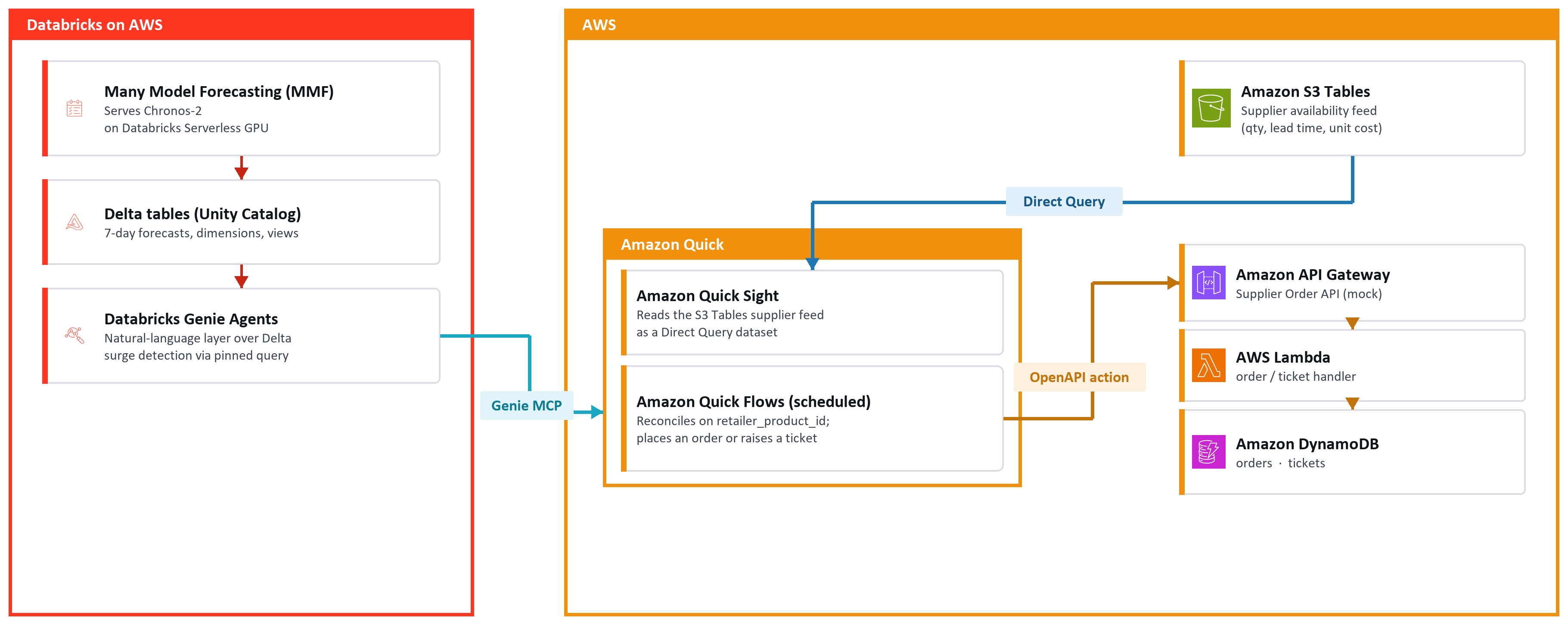
Automate replenishment with MMF, Databricks Genie, and Amazon Quick
Foundation models made catalog-wide demand forecasting easy; the hard part is now acting on the forecast. This post builds a closed detect-decide-act loop on Databricks and Amazon Quick that reconciles demand surges against live supplier availability and places replenishment orders unattended, escalating to a human only when no supplier can cover a surge.
Musk’s x AI Resolves Claims Against Apple Over AI Competition
Elon Musk’s xAI and X Corp. said they resolved an antitrust lawsuit against Apple Inc. that accused the iPhone maker of favoring OpenAI’s ChatGPT over other chatbot makers.
Ex-Google Deep Mind Insider: Why We MUST Slow Down AI Now
Alex Turner, a former Google DeepMind research scientist, joins Bloomberg Open Interest to explain why he left the firm over safety concerns and why he thinks AI progress is moving too fast for governments, companies, and even superpowers like the US and China to control. He reveals how tracking compute could be the key to real regulation, and why Big Tech’s calls to “slow down” might be both sincere and a power play. (Source: Bloomberg)
Only at Tech Crunch Disrupt 2026: What happens when Open AI ships your roadmap?
If you're building an AI company, the question isn't whether foundation models will continue to evolve. It's whether your company will continue creating value as they do. Don't miss this interactive session on the Builders Stage at TechCrunch Disrupt 2026.
Anthropic PBC and OpenAI will have to weigh their calls to tap the brakes on artificial intelligence development against forces in the tech industry, financial markets and the Trump administration. Parmy Olson, Bloomberg Opinion tech columnist, discusses the impact of recent calls from big tech bosses to rein in the pursuit of cutting-edge AI models. (Source: Bloomberg)
Top A.I. Leaders Call for Slowing Down A.I. Development - The New York Times
Top A.I. Leaders Call for Slowing Down A.I. Development The New York TimesOpenAI urges UK lawmakers to rein in technology amid growing safety fears theguardian.comTempus AI Founder Supports Anthropic CEO’s Call for Slowdown bloomberg.com
Trump Attacks Anthropic CEO Over Call to Slow AI Development
President Donald Trump attacked Anthropic PBC Chief Executive Officer Dario Amodei for urging a slowdown in artificial intelligence development, intensifying his opposition to new guardrails for the technology.
How Open AI Used Its Own LLMs to Design Its Jalapeño Chip
On 25 August, OpenAI fully unveiled Jalapeño, the company’s debut AI accelerator chip. Jalapeño delivers up to 13.4 petaflops of 4-bit compute and accesses 232 gigabytes of the most advanced memory available, linking to it at a blazing 15.4 terabytes per second. Benchmarks cited by OpenAI show that Jalapeño can reduce end-to-end latency (the time between prompt to last token) by up to 3.6x when compared to Nvidia’s GB300—a chip the company currently relies on—and do so while consuming less power.Whether these figures translate into real-world gains once Jalapeño enters widespread service in OpenAI’s inference fleet remains to be seen, but performance is only half the story. The other half is how the chip was designed—a process which, as you might expect, was accelerated by OpenAI’s large language models (LLMs). Jalapeño moved from first architecture concept to first silicon in under 20 months. Only nine months separated the first RTL—the register-transfer level code defining the chip’s logic—from tapeout, when the finished design goes to manufacturing. That’s a rapid timeline, yet experts believe it could soon look slow as LLMs improve and become more deeply integrated into chip design tools. OpenAI, unsurprisingly, is bullish about the opportunities. “The models are giving superpowers to our engineers,” says Richard Ho, vice president of hardware at OpenAI. “Our engineers are still driving the work, they’re still the final arbiter of what’s going on. But they can do things a lot faster, they can explore a lot more paths.”OpenAI achieved fast results with a small design teamHo says the group that designed Jalapeño averaged fewer than 100 people over the course of the project and continues to stand at roughly 100 today as the team pursues second and third-generation designs. That number includes a broad swath of roles across the hardware team, from system design to software and supply chain, but not those at Broadcom, which partnered with OpenAI on the project.The division of labor between OpenAI and Broadcom was generally split between design and implementation. OpenAI’s team was responsible for end-to-end system design including the inference accelerator, the memory hierarchy, and networking. Broadcom handled “physical design from the gates onward,” says Ho.The partnership with Broadcom dampened some opinions on OpenAI’s speed. David Chin, co-founder at agentic chip design startup Verkor.io, says “the schedule they gave us is quite credible,” but believes that Broadcom’s help was essential to Jalapeño’s rapid timeline. “If you have somebody else start from scratch, it won’t be possible.” Ravi Krishna, also a co-founder at Verkor.io, called OpenAI’s speed “a relatively impressive result,” but added that he expects that improvements in the capabilities of LLMs could result in even quicker timelines if the project started today.Andrew Kahng, distinguished professor at UC San Diego, also found OpenAI’s speed notable, saying it’s “likely best in class today.” Kahng recalls a 2016 IEEE Design Automation Futures workshop, which he co-organized. The workshop included Richard Ho, at the time an engineer at Google, as a keynote speaker. Ho had strong opinions on design automation and framed the time required to complete a chip’s design as a function of the number of iterations a team could complete in a day. How OpenAI’s LLMs accelerated Jalapeno’s design“Automation itself has existed in chip design for many decades. It’s not a new problem,” says Ankur Srivastava, director of semiconductor initiatives and innovation at the University of Maryland. Where LLMs differ from prior automation tools, however, is their ability to understand language and code. He says this makes them particularly suited for chip design tasks that “are still in the linguistic domain of the problem,” he says.The team at OpenAI designed a workflow that takes advantage of this strength. OpenAI’s front-end workflow was built around Accelerated Hardware Synthesis (XLS), an open-source high-level synthesis chain of tools originally developed at Google. High-level synthesis is a form of chip design automation that allows engineers to design a chip in a more familiar programming environment. In the case of XLS, chip designers can write in languages such as DSLX (a domain-specific language inspired by Rust) and C++. XLS then converts these to Verilog, a hardware description language used to describe electronic systems.“We were thinking about how to leverage AI to make the project faster, and the AI was much better at software-looking things,” says Chris Leary, member of technical staff at OpenAI. “XLS in some ways looks like software, so it got that benefit.” It helped, too, that Leary was extremely familiar with how XLS should function, as he started it during his time at Google.Kahng agrees that the decision to use AI to accelerate high-level synthesis, such as XLS, makes sense, as it’s “more natural for the LLM to work with” and provides the opportunity for fast iteration. “I see this as a generally useful workflow, and it’s one that ‘has legs’ going into the future.” The same logic led the Jalapeño team to focus on software optimization. When the first chips came back from the foundry in May, the team pointed its internal AI models at designing software to run benchmarks such as SemiAnalysis’ InferenceX. On DeepSeek’s multi-head latent attention kernel benchmark, performance climbed from 0.31 percent of the theoretical ceiling (set by the chip’s compute and memory bandwidth) to 88.94 percent in roughly 40 hours. Ho says this result is repeatable, so the time between when foundries deliver the first chips and when production ramps up can be reduced. “All our schedule assumptions are going to be based on the fact we have this capability now.” Jalapeño is designed for deployment in pods that include 2,048 chips.OpenAIWhile the broad strokes of the Jalapeño teams’ AI-assisted workflow were guessed by Ho and Leary up front, improvements in OpenAI’s models did offer a few surprises. Leary says that the project began with assistance from models like OpenAI’s o3, which was released to the public in April of 2025 (but available to the Jalapeño team earlier). By the time the project had wrapped up, however, the team had access to models that were precursors to GPT-6 Astra, which wasn’t publicly released until 3 September 2026. The newer model can work directly in Verilog without needing XLS’s translation from ordinary programming languages, and it’s close to being able to operate proprietary design tools on its own, says Leary.Ho also confirmed that the team had access to internal LLMs fine-tuned for chip design that are not available to the public. He declined to detail the models used, however, he added that the Jalapeño team partnered with OpenAI’s research team. While not all specific models used to design Jalapeño are publicly available, the goal is to bring lessons learned from the project into the company’s commercial LLMs, says Ho. “It’s safe to say that Astra and following models will be very good at chip design,” he says.AI was less useful for backend optimization, but that could changeAs mentioned, the bulk of OpenAI’s work on Jalapeño focused on “front end” of chip design, which spans the tasks that take a chip from initial concept, through writing RTL code to define the design, and through verification of the design will work when physically implemented. Much of the “back end” design, which includes tasks like routing interconnects, completing and verifying the clock and power specifications, and sending the required design information to the foundry, was handed off to Broadcom, which carried the chip through production.That’s not to say OpenAI’s workflow ignored the backend, though. The Jalapeño team includes physical design engineers who work with their counterparts at Broadcom to provide guidance on the chip’s floorplan and routing, among other things.At IEEE Hot Chips 2026, Ho and Leary put numbers on the gains from AI-guided physical design optimization, including an area reduction of 10 percent for the matrix multiplication units as measured against an optimized human baseline. In other words, OpenAI claims AI-guided optimization helped design more circuits into the same area of silicon than would have been possible before.Broadcom used its own internal workflow. The company’s team did not have access to the internal models OpenAI used to help design Jalapeño, but it did have access to OpenAI’s public, commercial models.Verkor.io’s Ravi Krishna says that OpenAI’s approach to backend design already feels a bit conservative, and believes that to be an artifact of when the project (which began in October of 2024) took place. “The models from the last four to five months have improved. From April [2026] onwards… is when they really started to be able to handle those tasks better,” he says. Verkor.io co-founder Suresh Krishna agreed, saying “there’s no reason you couldn’t have an agentic loop that largely accelerates the backend of the process as well.”Ho and Leary also hinted that the workflow used to design Jalapeño may look old-fashioned compared to the team’s next efforts. “As you can imagine with [Jalapeño], we were trying to go as fast as we could. So there’s a trade-off between ‘do we want to take time to do some innovation, or do we want to do things that we know work historically?’” says Leary. “With the second generation, we have a kind of reset opportunity to ask about all the things we want to get set up for.”Ho says the second-generation chip’s workflow has “a lot of places that we are introducing [AI].” He mentions opportunities to do more with AI in verification and physical design. Leary adds that the team now has tools for automatic waveform manipulation and viewing. This automates analysis to identify chip clock signals associated with failures and could improve debugging the hardware while it’s still being designed. Despite these expected improvements, Ho and Leary were clear that they don’t believe chip design can be fully automated. “We’re not saying that anyone can come and just build state-of-the-art, frontier AI/ML accelerator chips using just [OpenAI’s coding platform] Codex,” explains Ho. “We are saying some very specific things about how to be better at Codex, and how we are focusing on a small team and fast timelines to reach quality results.”
Tech stocks fall after calls for AI development to slow down - BBC
Tech stocks fall after calls for AI development to slow down BBCAnthropic C.E.O. Dario Amodei Calls for A.I. Slowdown The New York TimesBernie Sanders to Join Forces With Steve Bannon and Anthropic Researcher at ‘Pro-Human’ Conference Gizmodo
Some AI Players Are Worse Than Others, Amodei Says
Anthropic CEO Dario Amodei talks about the need for oversight when it comes to developing artificial intelligence. He spoke to Bloomberg's Emily Chang on "The Circuit" in June. (Source: Bloomberg)
Microsoft Joins Rivals Calling for Caution With AI Models
Microsoft Corp.’s artificial intelligence researchers have released a new set of guiding tenets that place limits on the company’s development of cutting-edge AI models.