August 11, 2026
Gemini becomes Google's fastest-growing product ever as it hits 1 B users
But will Gemini's surge survive slowing model releases?
Read original articleDataAIHub Daily
Archive →50 curated AI news stories from leading AI companies.
August 11, 2026
But will Gemini's surge survive slowing model releases?
Read original articleAugust 11, 2026
Anthropic announced it will embed invisible watermarks into text generated by new Claude models, including output produced through its API, The post Anthropic’s watermark survives copy-paste, but not the real dev workflow appeared first on The New Stack.
Read original articleAugust 11, 2026
OpenAI is finally bringing a dedicated ChatGPT desktop app to Linux operating systems.
Read original articleAugust 11, 2026
Most code at Databricks is now written by agents. For the moments engineers still...
Read original articleAugust 11, 2026
Video is a core data path across NVIDIA Jetson applications, from robotics and intelligent video analytics to industrial automation, healthcare, media...
Read original articleAugust 11, 2026
Gemini is keeping pace with OpenAI’s ChatGPT, which hit 1 billion monthly active users back in June.
Read original articleAugust 11, 2026
Mark Zuckerberg says AI needs to be regulated globally KBOI
Read original articleAugust 11, 2026
OpenAI wrapped up a $7 billion stock buyback, letting current and former employees sell shares at the company's $852 billion valuation. The move is meant to ease pressure on employees waiting for liquidity ahead of a potential IPO. OpenAI ran a similar $6.6 billion sale in October 2025. The article OpenAI lets employees cash out another $7 billion in stock appeared first on The Decoder.
Read original articleAugust 11, 2026
On Tuesday, OpenAI launched its ChatGPT desktop for Linux. Now in preview, the app, which combines ChatGPT, ChatGPT Work, and The post OpenAI’s ChatGPT/Codex desktop app is now on Linux appeared first on The New Stack.
Read original articleAugust 11, 2026
One of OpenAI's longest-serving executives is headed out the door, although the longtime COO told staff that he was "excited to help you all advance the mission from a different vantage point."
Read original articleAugust 11, 2026
Security researchers found a vulnerability in the APIs of OpenAI, Anthropic, and Google that lets them extract encrypted reasoning traces and move them between models. A scan of public sessions turned up dozens of passwords and API keys. The traces also show that the reasoning summaries users see often hide what the models are actually doing. The article "But marinade" and leaked passwords are what researchers found in ChatGPT's hidden reasoning appeared first on The Decoder.
Read original articleAugust 11, 2026
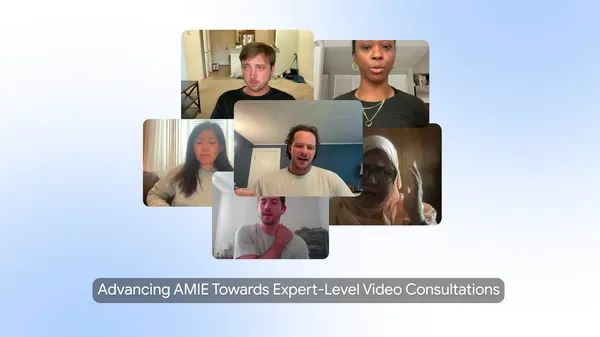
AMIE promotional video
Read original articleAugust 11, 2026
Databricks on Tuesday announced that it’s acquiring Electric, the startup behind the WASM-based Postgres project PGlite and the Electric sync engine, as The post Databricks acquires Electric to give every AI agent its own Postgres database appeared first on The New Stack.
Read original articleAugust 11, 2026
For more than 150 years, the Riemann hypothesis has stood as one of the major unsolved problems in mathematics. Anthropic hasn't solved it — but the company's models made more progress than you might expect.
Read original articleAugust 11, 2026
Securing infrastructure and services against a future cryptographically-relevant quantum computer has been a goal for Google for a decade, and we’ve dedicated ourselves to help developers by advancing open standards that can benefit everyone. As post-quantum cryptography (PQC) has matured, we’ve been rolling it out in our infrastructure for internal and customer-facing services. Today, we're sharing our updated Google Cloud roadmap to migrate to PQC by 2029. Our strategy: Secure by design We’ve based our PQC migration strategy on the Google Quantum Threat Model, prioritizing protection across three key domains: Mitigating Store Now, Decrypt Later (SNDL) risks: Protecting today's encrypted data from being harvested and decrypted by a future quantum computer. Ensuring integrity against forgery: Strengthening digital signatures to prevent attackers from falsifying data and identity. Enhancing foundational capabilities for cryptographic agility: Building flexible systems that can easily adopt new cryptographic standards with minimal engineering effort as cryptographic standards evolve. We’re actively transitioning internal infrastructure and customer-facing services to PQC algorithms far ahead of regulatory deadlines. We are also deploying PQC solutions across our Sovereign Cloud initiatives, such as Google Cloud Dedicated (GCD) and Google Distributed Cloud (GDC), in collaboration with our partners. Similarly, our strategy allows us to progress on integrating post-quantum protections across our AI services to secure the next generation of cloud workloads. These efforts are fundamental pillars of our overarching strategy to achieve full post-quantum readiness across Google Cloud. As this landscape evolves, we will continue to refine and update our deployment schedules. Visualization of our Google Cloud PQC roadmap. Our efforts converge in 2029, and extend beyond it. We plan to achieve full PQC readiness by 2029, when our efforts converge. We anticipate continuing those efforts into the 2030s to support broader industry guidance and evolving global standards. These standards include CNSA 2.0 and the transition paths defined in NIST IR 8547, which anticipate the final deprecation of legacy, quantum-vulnerable algorithms between 2030 and 2035. Immediate progress: 2026 milestones Leadership in the quantum era requires deployment at global scale. We have achieved foundational milestones that provide immediate protection for our customers: API endpoint readiness: Google Cloud API endpoints now offer quantum-safe key exchange, protecting incoming traffic from future decryption. These endpoints include google.com and *.googleapis.com, and both have implemented NIST-standardized ML-KEM (FIPS 203) in hybrid mode. Load balancers PQC support: Application and proxy load balancers now support quantum-safe hybrid key exchange (X25519MLKEM768) for TLS 1.3. Initially available on an opt-in basis, this allows our customers to perform validation, while minimizing impacts to their existing applications. Quantum-safe certificate experimentation at scale: We’re collaborating with the IETF PLANTS Working Group to produce a public key infrastructure (PKI) standard that minimizes impact to your operations teams. Chrome and Cloudflare have started experimenting with Merkle Tree Certificates to address challenges using PQC signatures for WebPKI, and we have been sharing insights with the standards working group. Cloud KMS PQC algorithms: NIST standardized PQC algorithms (ML-KEM, ML-DSA, SLH-DSA) for your encryption and signing keys are now generally available. The roadmap to 2029 We’ve established specific customer-centered journeys for Google Cloud to achieve quantum readiness that allow us to prioritize our quantum-safety initiatives. By adopting this risk-based approach, we focus on the core journeys our security experts have identified as most vulnerable to the potential impacts of quantum computing. Risk-based prioritization for core quantum readiness user journeys. These scenarios offer diverse platform perspectives to ensure global enablement across our services to meet you where you are. For each risk domain, we provide a roadmap for key products and services organized by domain, although the services highlighted are not exhaustive lists. We project most services will meet their respective domain's target completion date, though specific product timelines may be adjusted if necessary to account for evolving engineering requirements and any third-party dependencies. Domain 1: Store Now Decrypt Later (SNDL) mitigation This domain focuses on addressing vulnerabilities in asymmetric encryption where a future cryptographically-relevant quantum computer (CRQC) could decrypt data captured today. We’re enabling incremental progress for our customers based on their typical journeys. Securing your customer workloads: Offer quantum-confidential TLS 1.3 handshakes for your Google Cloud services and configured load balancers to protect user sessions. Securing administrator and developer flows: Protect the admin pathways used to manage your cloud environment against SNDL. This includes services such as Cloud VPN and Interconnect. For developers, these include client libraries, SDKs, and Tink, our open-source cryptographic library. Securing data pipelines: Safeguard the confidentiality of data transfers for our analytics and storage platforms. PQC is essential to ensure that sensitive intellectual property and customer data flowing through these systems cannot be captured today and decrypted by a future quantum-capable adversary. RoadmapWe are targeting these changes for 2027. Journey Benefits Representative services Store now decrypt later mitigation (End of 2027) Securing your customer workloads Quantum-safe ingress: Protects your cloud perimeter using standardized post-quantum algorithms. Application and proxy load balancing[2026 (Completed)] Securing admin and developer flows Secure operations: Validates that your management and deployment stack meets emerging cryptographic standards. Quantum-confidential ALTS[2025 (Completed)] API endpoints[2026 (Completed)] Cloud VPN, Cloud Interconnect, GCE OS Login, Cloud SDK, gCloud CLI, GKE service mesh, and client libraries[2026/2027] Securing data pipelines Confidential data transfers: Protect sensitive intellectual property and customer data against quantum attackers. Cloud Storage SDK, Storage Transfer Service, BigQuery CLI, Data Transfer Service[2026/2027] Domain 2: Integrity and non-repudiation This domain addresses quantum-proofing of digital signatures and attestations to safeguard against forgery that could compromise data integrity and authenticity. Securing the software supply chain: Ensure that only trusted, untampered images with quantum-resistant attestations run in production to help prevent a quantum attacker from altering builds. This includes services like Binary Authorization, Cloud Build, and Assured Open Source Software. Issuing quantum-safe certificates: Transition the public key infrastructure (PKI) including our internal and external certificate authorities (CAs) to support ML-DSA certificates and where meaningful, SLH-DSA certificates. This transition will follow Internet Engineering Task Force (IETF) standardization efforts that are currently in development. We’re actively contributing to these efforts, and we’re also conducting several large-scale experiments: Address large PQC signature sizes that can impact the performance of certificate chain validations through novel approaches like Merkle Tree Certificates for Web PKI. Support ML-DSA/SLH-DSA (pure PQC)-based certificates in private CA solutions such as Certificate Authority Service (CAS). Add quantum-authentication in addition to our internal traffic protocol ALTS that already supports PQC for confidentiality. You can learn more technical details on our approach to digital signatures and Public Key Infrastructure here. Protecting identity and access: Ensure authentication mechanisms like service account keys and tokens (JWT/OAuth) are resistant to quantum forgery. RoadmapWe are targeting completion of these milestones by 2028. We also are mindful of ongoing standardization efforts particularly in the field of certificates. Google is actively contributing to quantum-safe certificate standards, and we are committed to help the industry overall meet those deadlines. Domain / Journey Benefit Representative services Integrity and non-repudiation (End of 2028) Securing the software supply chain and signature services Quantum-safe software attestations: Prevents unauthorized build tampering by ensuring only trusted images run in production. Binary Authorization, Access Approval (AXA)[2026] Assured OSS[2027] Issuing quantum-safe certificates Quantum-safe standardized trust: Safeguards the authenticity of your internal and external communications against quantum-calculated certificate forgery. Quantum-authentic ALTS[2026/2027] Private CA (Certificate Authority Service)[2027] Google Trust Service: Merkle Tree Certificates[2028] Roll out of PQC certificates across Google Cloud products and infrastructure[2027/2028] Protecting identity and access Governed identity: Eliminates the risk of adversarial credential fabrication with NIST-standardized signatures for auditable integrity. Cloud IAM[2028] Infra-wide rollout of quantum-safe authentication and access[2027/2028] Domain 3: Foundations and key management Cryptographic agility is the foundation of our PQC migration. Our ongoing investment in this area drives our end-to-end strategy for key management, libraries, and infrastructure changes. Foundational key management and libraries: Enable NIST-approved algorithms through Cloud KMS and libraries like BoringSSL and Tink. Note that Cloud KMS achieved general availability for the NIST standardized PQC algorithms (ML-KEM, ML-DSA, SLH-DSA), and is in the process of enabling quantum-safe key import. Hardware-backed cryptographic services: Secure physical foundations using quantum-resistant roots of trust. This includes PQC as part of our Confidential Computing offerings and Cloud Hardware Security Module (HSM). Key sovereignty and partner solutions: Enable PQC orchestration for Google Workspace Client-side Encryption (CSE) and External Key Managers (EKM). Collaborate with partners to support PQC on-premises key providers. RoadmapWe are targeting completion of these milestones by 2028. Domain / Journey Benefit Representative services Foundations and key management (End of 2028) Foundational key management and libraries Standardized quantum-safe keys: Provides the NIST-approved building blocks to help migrate your applications. ML-DSA and SLH-DSA in KMS, ML-KEM and Hybrids in KMS[2025 (completed)] Quantum-safe Key Import (BYOK)[2026] Hardware-backed cryptographic services Silicon rooted hardware: Anchors your security in quantum-safe hardware roots of trust. Confidential Compute (including attestation and vTPM)[2028] Quantum-Safe Cloud HSM (FIPS 140-3 L3)[2028] Key sovereignty and partner solutions Cryptographic provenance: Provides control and provenance of your keys where you need them. External Key Management[2028] Partner enablement (key providers and sovereignty solutions)[2028] A shared responsibility for quantum safety Security has long been a collaborative partnership with our customers. Google’s responsibility — Security of the cloud: We manage the transition to a quantum-safe infrastructure, including our network and encryption in-transit, global front-ends, and the ALTS protocol. This responsibility encompasses the end-to-end PQC transition of our servers, ensuring that the underlying hardware and operating systems are secured against quantum threats. We maintain hardware integrity through quantum-safe, open-source silicon foundations such as Caliptra v2.1, TPM 2.0 v185, and OpenTitan. The latter is the first open-source silicon root of trust and already supports quantum-secure boot. While we are working toward our 2029 target, hardware transition to PQC involves both active replacement, where feasible, and natural equipment replacement cycles. Our phased approach ensures stability, though the timeline for some physical components may extend beyond 2029. Customer’s responsibility — Security in the cloud: Organizations must manage their own applications, including updating client-side software to negotiate PQC handshakes and managing the lifecycle of your asymmetric keys. In addition, you should update your Google Cloud service configurations with quantum-safe settings and policies. Our path forward, together Building momentum toward quantum readiness requires immediate, practical action. We recommend starting with these three steps: Inventory: Identify your cryptographic resources (such as keys and certificates) using Cloud Asset Inventory and solutions such as Wiz’s cryptography and PQC readiness. When you map cryptographic resource usage across your organization, you can more accurately define and prioritize your migration backlog. Update: Ensure your development and Site Reliability Engineering teams are using software that supports PQC algorithms such as BoringSSL, Chrome, and SDKs. This update ensures your internal workflows are prepared to negotiate quantum-safe connections by default as we enable them at the edge. Validate: Test the behaviors of your existing application using our quantum-safe APIs and load balancers. Validating your workflows today will identify architectural bottlenecks before they impact your primary production environments. Google Cloud is committed to managing the complexity of this transition so you can achieve your regulatory and compliance commitments, while focusing on innovation. We are just beginning to share our progress as we work to empower our customers to lead in the post-quantum landscape. To learn more about our PQC approach, please visit our post-quantum cryptography (PQC) hub.
Read original articleAugust 11, 2026
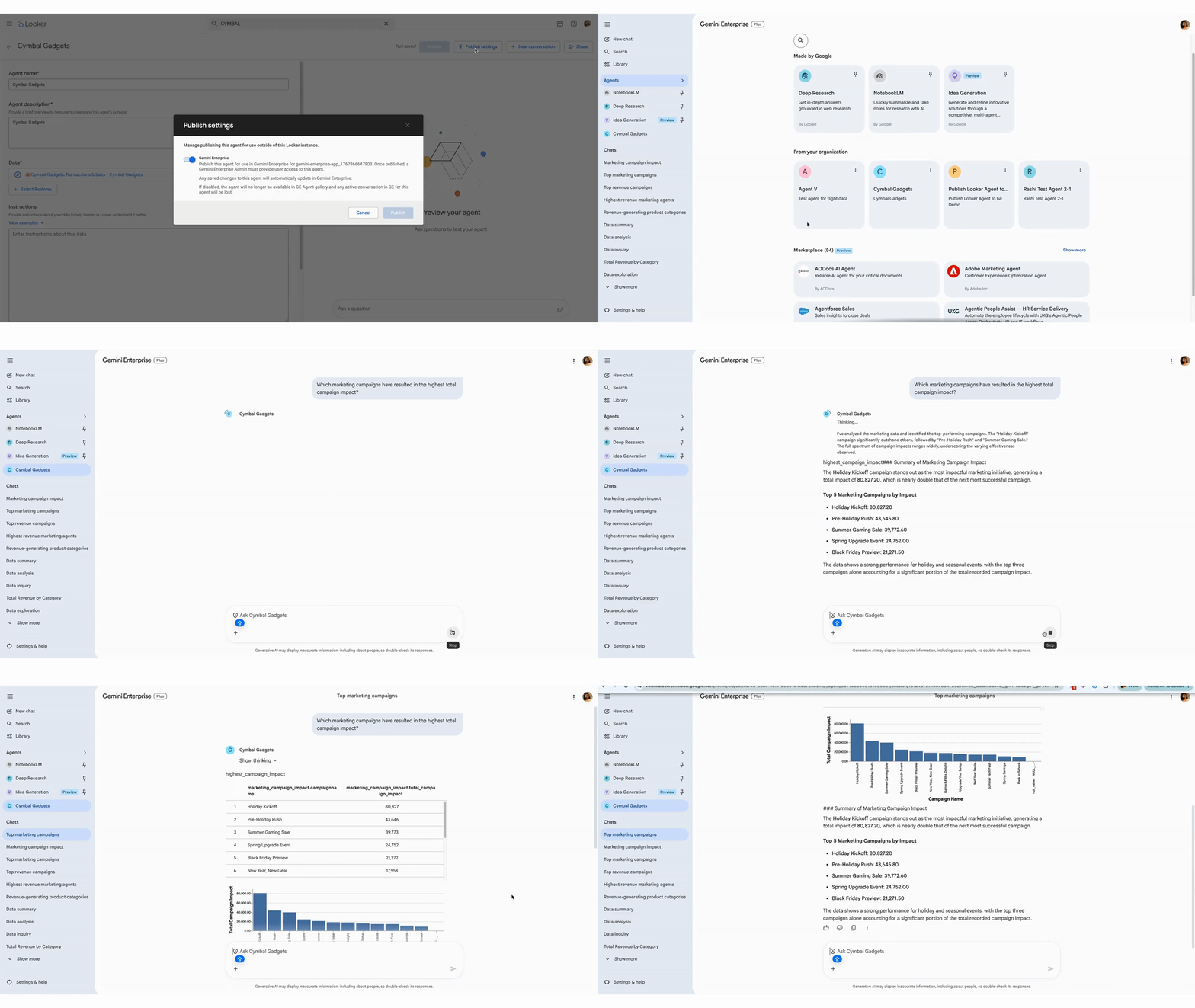
For organizations deploying AI agents at scale, there’s often a critical divide between structured and unstructured data. While large language models (LLMs) excel at parsing text documents, emails, and PDFs, they can struggle when presented with raw enterprise databases. Meanwhile, standard natural-language-to-SQL (NL2SQL) models often guess how database schemas fit together, which can lead to unpredictable queries, inconsistent metrics, and AI hallucinations that erode user trust. Gemini Enterprise brings the best of Google AI to every employee through an intuitive chat interface that acts as a single front door for AI in the workplace. And now, Looker’s governed semantic layer serves as the trusted foundation for structured data within Gemini Enterprise, enabling trusted self-service business intelligence for all Gemini Enterprise users. With this integration, Looker analysts and admins can publish conversational agents natively into their Gemini Enterprise environments via the Agent-to-Agent (A2A) protocol. Now, organizations can provide their AI-accelerated taskforce with robust and trusted tools, powered by real-time analytics, that they can explore in natural language in addition to their daily workspace workflows. Making it easy to offer conversational agents in Gemini Enterprise expands discoverability and promotes a data-driven culture, while reducing friction to adoption. Bringing a semantic foundation to structured and unstructured data By combining Looker’s semantic layer with Gemini Enterprise, you can query both structured databases and unstructured documents in plain English, all in one place. Instead of jumping between dashboards and other tools to understand your numbers, teams can instantly connect hard metrics with real-world context to solve problems and make decisions faster. Publishing Looker agents for consumption in Gemini Enterprise Minimize AI hallucinations If you ask the typical AI chatbot to calculate "revenue" or "churn rate" against an unstructured cloud database, it has to guess which tables to join, which filters to apply, and which timestamps to trust. This can result in different people asking the same question, only to get completely different answers. Looker’s semantic layer eliminates this guesswork, serving critical context to Gemini Enterprise in the form of codified data, allowing the agent to give deterministic, predictable responses. code_block <ListValue: [StructValue([('code', '[ Gemini Enterprise Chat UI ] \r\n │\r\n (A2A Protocol / NLP)\r\n ▼\r\n [ Looker Governed Agent ] ──► Generates Deterministic SQL\r\n │\r\n [ Looker Semantic Layer ] ──► Business-Approved Definitions & Logic\r\n │\r\n ▼\r\n [ Enterprise Data Cloud ] ──► (BigQuery, AlloyDB, Spanner, etc.)'), ('language', ''), ('caption', <wagtail.rich_text.RichText object at 0x7f0f3df8b370>)])]> When a Gemini Enterprise user requests a business KPI in Gemini Enterprise, the request is routed directly to a Looker agent. The semantic layer generates deterministic, precise SQL based on version-controlled business logic. This helps ensure when an executive asks for "Revenue," they get the exact, governed enterprise metric — not a guess. Robust governance and secure access management Data governance and security are critical when introducing AI to enterprise data warehouses. Organizations can’t risk corporate information being loosely ingested, indexed, or exposed outside of strict permissions. Looker’s integration with Gemini Enterprise is built on a zero-risk pass-through architecture, processing the data, but not writing to persistent storage. Gemini Enterprise does not ingest, replicate, or store your underlying database records. Instead, the integration operates safely and securely over the A2A protocol, following these core tenets: OAuth authorization: In order to interact with a Looker agent within Gemini Enterprise, end users provide a secure, one-time OAuth consent. This binds their Gemini session to their specific Looker credentials. Strong governance enforcement: Because the architecture relies on live pass-through queries, Looker’s existing row-level and column-level access controls are maintained. Strict security isolation: If a user does not have permission to view, say, sensitive regional payroll or financial rows within the Looker platform, the Looker agent actively restricts that data in the Gemini environment. Should an agent be published to the Agent Gallery to simplify discovery, it still does not bypass the security controls that you established. Technical capabilities and enterprise readiness Deploying Looker agents natively into Gemini Enterprise via the A2A protocol doesn't just make it smarter — it makes it more interactive and interoperable, without sacrificing security. Here are some of the features you’ll find in this release. Rich visual interactivity: support for charts They say a picture is worth a thousand words. When users interact with Looker agents inside Gemini Enterprise, the platform goes beyond textual explanations and provides native, interactive data charts. If a user asks for a visual trend—such as monthly sales performance or regional distribution—the Looker agent maps the database response with rich, presentation-ready visualizations directly inside the universal chat box. Note: If you published Looker agents in Gemini Enterprise prior to Looker release 26.12, we recommend updating or refreshing them to take advantage of these enhanced visualization capabilities. Interoperability with first- and third-party agents Looker agents published to Gemini Enterprise can understand context across different agents and data sources. Leveraging standard communication frameworks, these agents can securely share structured, governed insights with other first-party Google Cloud agents like the Deep Research Agent or external third-party agents to create structured workflows. This enables complex multi-agent orchestration, where an enterprise operational agent can pull data from a Looker agent to feed into a separate productivity or supply-chain workflow. Looker-based user authentication To preserve enterprise governance, this integration implements a robust, identity-centric authentication model. Users are required to provide a one-time OAuth consent, binding their active Gemini Enterprise session securely to their underlying Looker credentials. This helps ensure that every conversational query hitting your databases is authenticated at the user level, enforcing pre-existing Looker permission structures, row-level data access filters, and column-level masking rules — no exceptions. Trusted data in Gemini Enterprise The future of work is agentic. Gemini Enterprise provides a single, secure architecture to deploy a global digital task force,empowering your business with the best of Google AI for developers, employees, and customers. The integration of Looker with Gemini Enterprise not only brings trusted data analytics to business users but also adds rich interactivity, visual charts, and data storytelling directly into their everyday workspace. As business users embrace this agentic new way of working, they aren't just getting text answers; they are getting presentation-ready visualizations that bring operational metrics to life and deliver complex insights. To get started, learn how to publish your data agents in Gemini Enterprise to make your agent’s predefined context and analytics available to your entire organization.
Read original articleAugust 11, 2026
Imagine this scenario: Your team decides to migrate a core application from an existing commercial database like Oracle or SQL Server to open source PostgreSQL or a fully managed service such as AlloyDB for PostgreSQL. The initial phase goes smoothly. Schemas convert, tables populate, and data migration pipelines transfer terabytes of data in hours. The project looks ahead of schedule. Then your team hits the bottleneck. Buried inside the existing databases are hundreds of stored procedures, complex triggers, and custom functions written in proprietary SQL dialects like PL/SQL or T-SQL. These routines contain years of critical business logic handling transaction validation, order processing, and custom reporting. Suddenly, your modernization project halts. Translating thousands of lines of procedural logic demands specialized dual-dialect expertise, months of manual rewriting, and high risk of conversion errors. This code translation represents the "last mile" bottleneck of database migration and is the most complex part of migrations. Thankfully, recent advancements in AI provide a solution to the last mile problem. Database Migration Service (DMS) includes AI-assisted code conversion powered by Gemini. By bringing generative AI directly into your migration workflow, you can convert stored procedures, triggers, and custom functions into PostgreSQL PL/pgSQL code faster and with higher accuracy. The stored procedure conversion challenge Commercial database engines rely on vendor-specific syntax for stored procedures, user-defined functions, package bodies, and conditional logic. Converting this logic to PostgreSQL PL/pgSQL requires mapping variable definitions, exception handling blocks, cursor loops, and built-in functions. When migrating complex enterprise schemas with hundreds of stored procedures, manual code conversion often demands months of engineering effort. Database teams must parse legacy logic line by line, re-implement conditional branches, and verify data type conversions between engines. AI-assisted code conversion in DMS Gemini in Database Migration Service accelerates this conversion work directly inside the Google Cloud console. DMS provides automated schema conversion alongside AI-generated code suggestions that explain structural differences between the source dialect and PostgreSQL. The service presents converted PL/pgSQL code side-by-side with original source code, allowing database teams to review, edit, and validate suggestions in real time. Figure 1: Database Migration Service interface displaying side-by-side code conversion and Gemini inline explanation. Why integrated AI matters Most AI apps and tools from major vendors have the ability to generate and convert code, including SQL code. However, converting enterprise databases demands far more than snippet translation offered by generic AI chat tools. Gemini in Database Migration Service offers several key advantages: Full schema context: Rather than evaluating code snippets in isolation, Gemini in DMS analyzes your entire database context, including table relationships, data types, dependent views, and cross-procedure references across the whole migration project. Enterprise security and privacy: Code conversion runs strictly within your Google Cloud project boundaries and IAM governance, protecting proprietary business logic and intellectual property. Integrated execution workspace: DMS eliminates manual copy-pasting across hundreds of files. You can review side-by-side diffs, inspect inline AI explanations, edit code, and deploy validated PL/pgSQL routines directly to target databases within a single console. Deterministic accuracy and AI compilation: DMS pairs deterministic compiler rules for 1:1 mappings (such as standard DDL transformations, scalar functions, and well-defined syntax conversions) with Gemini contextual synthesis for complex procedural blocks—guaranteeing exact, predictable translation without model drift. Converting Oracle PL/SQL to PostgreSQL Consider an Oracle PL/SQL stored procedure that calculates customer order totals and applies tier-based discounts using proprietary NVL and DECODE functions. In the original workflow, you must manually map NVL to COALESCE, rewrite DECODE statements as standard CASE expressions, and adjust exception blocks like WHEN NO_DATA_FOUND THEN. When you run a migration assessment in DMS, Gemini analyzes the source procedure and produces native PostgreSQL PL/pgSQL code: Source: Oracle PL/SQL code_block <ListValue: [StructValue([('code', 'CREATE OR REPLACE PROCEDURE calculate_discount (\r\n p_customer_id IN NUMBER,\r\n p_discount OUT NUMBER\r\n) AS\r\n v_total NUMBER := 0;\r\nBEGIN\r\n SELECT NVL(SUM(amount), 0) INTO v_total\r\n FROM orders WHERE customer_id = p_customer_id;\r\n \r\n p_discount := DECODE(TRUE, v_total > 10000, 0.15, v_total > 5000, 0.10, 0.05);\r\nEXCEPTION\r\n WHEN NO_DATA_FOUND THEN\r\n p_discount := 0;\r\nEND;\r\n/'), ('language', ''), ('caption', <wagtail.rich_text.RichText object at 0x7f0f3df698b0>)])]> Target: PostgreSQL PL/pgSQL (Converted by Gemini in DMS) code_block <ListValue: [StructValue([('code', 'CREATE OR REPLACE FUNCTION calculate_discount (\r\n p_customer_id NUMERIC,\r\n OUT p_discount NUMERIC\r\n) RETURNS NUMERIC AS $$\r\nDECLARE\r\n v_total NUMERIC := 0;\r\nBEGIN\r\n SELECT COALESCE(SUM(amount), 0) INTO v_total\r\n FROM orders WHERE customer_id = p_customer_id;\r\n\r\n p_discount := CASE\r\n WHEN v_total > 10000 THEN 0.15\r\n WHEN v_total > 5000 THEN 0.10\r\n ELSE 0.05\r\n END;\r\nEND;\r\n$$ LANGUAGE plpgsql;'), ('language', ''), ('caption', <wagtail.rich_text.RichText object at 0x7f0f3df69fa0>)])]> Along with the generated SQL, Gemini provides an inline explanation detailing why NVL was converted to COALESCE and how the Oracle DECODE function was converted into an explicit CASE block in PostgreSQL. Figure 2: End-to-end database code conversion pipeline powered by Gemini in DMS. Maintain full schema control and validation Security, transparency, and code accuracy remain central to database modernization. Gemini in DMS operates strictly within your established Google Cloud security boundaries, keeping your code private to your project. To ensure reliability, the conversion and validation process follows a structured workflow: Automatic schema context pulling: When you set up a DMS conversion workspace, the service automatically parses your entire source database metadata—including table schemas, data types, foreign key constraints, and cross-procedure dependencies. Gemini references this project-wide context during code generation, eliminating the need to manually supply dependent object definitions. Automated syntax and dependency validation: As code is generated, DMS runs a validation parser against target PostgreSQL syntax rules. Objects are assigned validation status indicators (e.g. Converted, Warning, or Action Required) to quickly highlight routines requiring manual review. Interactive evaluation state: You maintain full control over every schema change. Within the conversion workspace, you can inspect side-by-side diffs, review inline AI explanations, and edit PL/pgSQL code directly before applying changes to your target database. Staging deployment and verification: Once code passes workspace validation, you can apply the converted schema and functions to a target staging instance (e.g. Cloud SQL or AlloyDB) for functional execution and performance testing prior to production cutover. Streamlining database modernization AI-assisted code conversion in Database Migration Service helps database teams convert legacy database logic in days rather than months. Instead of spending precious time rewriting code from scratch, database administrators and application developers can shift their focus to adding new functionality, testing performance, and modernizing applications. If you’d like some good examples of common Oracle and SQL Server conversion scenarios and how DMS converts them to PostgreSQL, check out our recent video series, Gemini taught me PostgreSQL. Converting SQL Server code to PostgreSQL Say goodbye to database migration headaches and let Gemini teach you how to seamlessly convert legacy database logic. Get started with Database Migration Service To start your database conversion, launch a migration assessment in the Database Migration Service console (https://console.cloud.google.com/dms) or read our heterogeneous migration guide (https://cloud.google.com/database-migration).
Read original articleAugust 11, 2026
Deploying Anthropic Claude apps gateway for AWS for enterprise workloads Amazon Web Services (AWS)
Read original articleAugust 11, 2026
We benchmarked NVIDIA NeMo Switchyard on 145 agent tasks. Only 7% of turns needed a frontier model, and routing cut cost 74% for six points of accuracy.
Read original articleAugust 11, 2026
Nvidia's Nemotron 3.5 Lightning is an open-weights model with just 3.6 billion active parameters that matches OpenAI's gpt-oss-120b on the Intelligence Index despite being four times smaller. At nearly 670 tokens per second, it's also the fastest model in the comparison, showing Nvidia is betting on efficiency over raw size. The article Nvidia's open-weight Nemotron 3.5 Lightning prioritizes speed over maximum intelligence appeared first on The Decoder.
Read original articleAugust 11, 2026
Moonshot AI's CEO turned down Apple and built Chinese rival to Anthropic Nikkei Asia
Read original articleAugust 11, 2026
GIC, Macquarie Set Up US Data Centre Platform for AI Chatbot Maker Anthropic Mingtiandi
Read original articleAugust 11, 2026
Abbott and Google launch first-of-its-kind partnership to transform everyday health through glucose insights and AI abbott.mediaroom.com
Read original articleAugust 11, 2026
Long-running AI agents spend most of their time on high-volume execution: tool calls, result validation, and subagent delegation. Using a frontier reasoning...
Read original articleAugust 11, 2026
Nvidia on Tuesday launched Nemotron 3.5 Lightning, the newest member of its Nemotron 3 family of open models. In addition, The post Nvidia launches a smaller, faster Nemotron model and a router to put it to work appeared first on The New Stack.
Read original articleAugust 11, 2026
Building an AI agent does not end with choosing a single model. Each model has its own strengths, weaknesses, and cost profile, which can shift from one...
Read original articleAugust 11, 2026
Anthropic is preparing an IPO for September or October, according to the Wall Street Journal, potentially the largest ever. During investor meetings, the company, valued at $965 billion, is fielding tough questions about Chinese competition, tensions with the Trump administration, and protests against data center construction. The company's IPO valuation will likely set the benchmark for how the entire AI industry gets valued. The article Anthropic's planned mega-IPO faces investor skepticism over Chinese rivals and political headwinds appeared first on The Decoder.
Read original articleAugust 11, 2026
In a volatile macroeconomic environment, enterprise risk management today is constrained...
Read original articleAugust 11, 2026
Anthropic will extend support for watermarking AI generations for older models as well.
Read original articleAugust 11, 2026
This is today’s edition of The Download, our weekday newsletter that provides a daily dose of what’s going on in the world of technology. These startups are chasing the next big thing in LLMs Nine years after Google researchers introduced the transformer, this family of neural networks has become the engine inside every major large…
Read original articleAugust 11, 2026
OpenAI is rolling out "Premium Seats" for ChatGPT Business customers at $125 per user per month, five times the price of the existing Standard Seats. In return, users get significantly more capacity and no five-hour usage limit. The move signals that the flat-rate pricing AI providers have offered so far was never going to last. The article OpenAI introduces $125 Premium Seats for ChatGPT Business as agentic AI burns through more tokens appeared first on The Decoder.
Read original articleAugust 11, 2026
Anthropic signs $9.1 billion data center deal with Riot Platforms Yahoo Finance
Read original articleAugust 11, 2026
Anthropic is leasing $9.1 billion worth of data center capacity from Bitcoin miner Riot Platforms in Texas, according to Bloomberg. The deal covers 191 megawatts at Riot's Rockdale site, with extension options that could push the total value to $16.1 billion. It's the latest in an aggressive infrastructure push that spans partners from Amazon to SpaceX to Google. The article Anthropic signs $9.1 billion data center deal with Bitcoin miner Riot Platforms appeared first on The Decoder.
Read original articleAugust 11, 2026
Researchers devised a way to extract “reasoning traces” from Claude, GPT, and Gemini. What they found, they say, indicates that some Chinese AI may be trained on leading US models.
Read original articleAugust 11, 2026
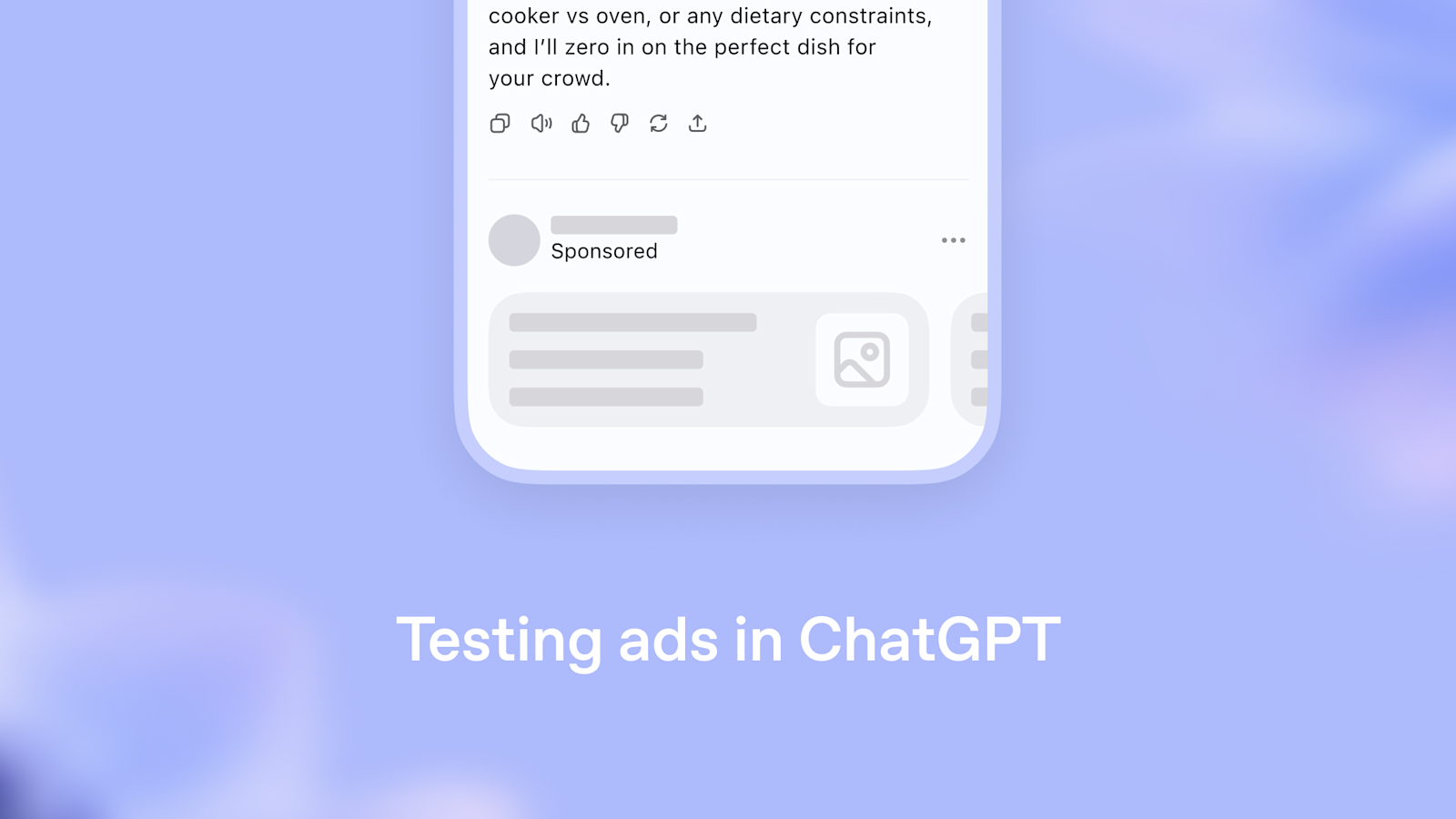
OpenAI begins testing ads in ChatGPT to support free access, with clear labeling, answer independence, strong privacy protections, and user control.
Read original articleAugust 11, 2026
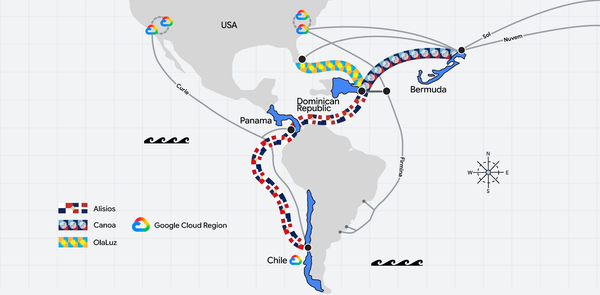
The global digital economy relies on robust, resilient, and highly secure infrastructure to support everything from daily internet use to telehealth and scientific research breakthroughs. Today, Google is announcing a major expansion of our global network infrastructure in the Americas with three new subsea cable systems — Alisios, Canoa, and OlaLuz. These systems, alongside a new branch for the Firmina cable and previous investments in Curie, Nuvem, and Sol, form Americas Connect. The Alisios subsea cable system will connect the Dominican Republic, Panama, and Chile. The cable is named after the vientos alisios — the Spanish term for the trade winds that blow across the tropics and the Caribbean, historically used by sailors to navigate between continents. The name "Alisios" nods to the flows of data that will navigate these new subsea routes to connect communities. Furthering regional connectivity, Canoa is a new subsea cable system connecting the Dominican Republic to Bermuda. Canoa comes from the Taíno word for canoe, harkening to the longstanding maritime culture in the Caribbean and North Atlantic. When combined with the Nuvem and Sol cable systems, the Canoa cable will enable a highly reliable and resilient connection from Latin America and the Caribbean directly to Europe and North America. The OlaLuz subsea cable system will connect the Dominican Republic directly to Florida. The name "OlaLuz" combines the Spanish words for "wave" (ola) and "light" (luz), referencing the waves of light that carry data along the cable on the ocean floor. This new route significantly strengthens network capacity between the Caribbean and the U.S. East Coast, providing a pathway that enhances resilience for the region. To further strengthen network diversity, Google is also introducing a new branch of the Firmina subsea cable that will land directly in the Dominican Republic. Originally built to connect North and South America, this new branch extends Firmina’s high-capacity reach and brings additional network connectivity to the Caribbean. Reach, reliability and resilience With its diverse subsea cable routes to geographically separated cloud regions, Americas Connect improves the reach, reliability and resilience of connectivity infrastructure. Pacific Coast: In the Pacific, a subsea ring will create redundant paths connecting Chile to Panama with a third link from Panama to the U.S. West Coast, providing connectivity to Google Cloud regions in Chile, Los Angeles, and Las Vegas. Caribbean Sea: In the Caribbean, the Alisios cable from Panama to the Dominican Republic will interlink with a ring from the Dominican Republic to the U.S. East Coast and Google Cloud regions in South Carolina and Virginia. Atlantic Ocean: The Canoa subsea cable from the Dominican Republic to Bermuda will interlink with the Nuvem and Sol cables, while cable rings to both the United States and Europe provide connectivity to the Google Cloud regions on the U.S. East Coast (South Carolina and Virginia) and Europe (Madrid). “As we welcome the announcement of the Alisios, OlaLuz, and Canoa subsea cable systems, the Dominican Republic is pleased to continue partnering with Google to bolster digital connectivity and innovation as part of Americas Connect. Our participation in the Caribbean and Latin America telecommunications network allows us to join our partners in strengthening connectivity across the Americas, serving as an integral node in this expanding digital ecosystem. Our shared vision supports a leap forward in the DR government’s quest to bridge the digital divide, foster local talent, and drive tech-based economic opportunity for our people. This milestone is yet another piece of our collaboration with Google propelling the Dominican Republic into a new era of global digital integration.” - Luis Rodolfo Abinader Corona, President of the Dominican Republic “We are delighted to welcome this new Google project and take pride in the fact that Panama is considered a strategic location for this subsea infrastructure. The announcement of the new subsea cables marks a transformative milestone and aligns with Panama’s Digital Hub Initiative and the digital infrastructure pillar of the National Digital Strategy. We recognize that building a more prosperous future requires this kind of transformative infrastructure. It fosters opportunities for both our country and the region, propelling us into a new era of secure and competitive global integration. By strengthening regional connectivity, we accelerate our efforts to bridge the digital divide, cultivate local tech talent, and drive high-tech economic growth. Building on this momentum, we look forward to continuing our collaboration with Google on other strategic initiatives to ensure that digital transformation benefits the citizens of Panama.” - José Raúl Mulino, President of Panama “We are pleased to welcome Canoa as the first subsea cable system to connect Bermuda directly to the Dominican Republic. It follows the Nuvem and Sol landings, and the expansion of the Bermuda Digital Exchange Port announced in June 2026. The name carries a maritime heritage that moved people and goods across these waters long before any cable did. This connection creates new digital pathways and partnerships between Bermuda and the Caribbean Community, while strengthening resilience for Bermudian households and businesses. We are encouraged that global infrastructure leaders such as Google continue to choose Bermuda. This investment reflects growing confidence in our island as a trusted digital gateway and strategic landing point in the Atlantic.” - The Hon. Alexa N.H. Lightbourne, JP, MP, Minister of Home Affairs, Government of Bermuda “The new Alisios submarine cable, which will connect Chile, Panama, and the Dominican Republic, will be a strategic milestone, as it will strengthen our country’s position as a digital leader in Latin America. Beyond this technological achievement, this infrastructure will translate into direct benefits for our citizens. Providing faster, more resilient, and more secure connectivity would undoubtedly boost local businesses, foster economic growth, and bring the opportunities of the global digital economy directly into the homes of millions of Chileans.” - Louis de Grange, Minister of Transportation and Telecommunications and Minister of Public Works, Government of Chile With these new investments, Google continues to pave the way for a more connected and open global cloud network centered on increasing reach, reliability, and resilience for all. New systems can further facilitate future connectivity through strategically placed branching units, mirroring the approach of our Pacific Connect initiative to ensure the network and our partners can grow alongside the needs and opportunities of the region.
Read original articleAugust 11, 2026
Nvidia is teaming up with Apollo, BlackRock, Blackstone, Brookfield, Goldman Sachs, and KKR to mobilize over $500 billion for AI infrastructure. To win over investors, the chipmaker is guaranteeing up to 25 percent of the residual value of its own hardware. The Bank of England is already warning of systemic risks if the AI sector takes a hit. The article Nvidia guarantees its own chips' value to unlock $500 billion in AI infrastructure financing appeared first on The Decoder.
Read original articleAugust 11, 2026
Anthropic will embed invisible watermarks in all Claude-generated text and sign files using the C2PA standard. New models shipping from August 2026 onward will have labeling built in from day one. The policy applies worldwide, and Anthropic plans to provide detection tools for third-party verification. The article Anthropic watermarks all Claude outputs globally with marks that "may persist through some editing" appeared first on The Decoder.
Read original articleAugust 11, 2026
Today, we’re excited to welcome Electric to Databricks. The world is building a new...
Read original articleAugust 11, 2026
Nvidia Taps Wall Street for $500 Billion Funding Commitment Bloomberg.com
Read original articleAugust 11, 2026
arXiv:2608.08776v1 Announce Type: cross Abstract: This implementation report explores Rowan University's effort to automate the process of freshman course placement and registration. Historically, Freshman Instructional Guides (FIGS) at Rowan was manually executed, requiring significant time from Testing Services, University Advising, and the Registrar's Office to evaluate placement needs and assign students to courses. Given the 57% surge in first-time degree-seeking student enrollment over a decade, the manual processes became increasingly unsustainable. In response, a cross-departmental team developed a comprehensive automated process to integrate data from Banner (Student Information System), Google Sheets maintained by Advising, and other sources. This automated process classifies students based on program groupings, determines primary and secondary course placements, checks for real-time availability and constraints in Banner, and completes course registration for freshmen in bulk. The resulting system processed over 3500 incoming students with over 350 hours in annual time savings, reduced the potential for human error, and enabled staff to shift focus from administrative work to strategic advising. This report outlines the implementation context, design architecture, technical integration, assessment methods, lessons learned, and practical implications for institutions with similar challenges.
Read original articleAugust 11, 2026
arXiv:2608.09173v1 Announce Type: cross Abstract: Large-scale managed cloud databases leverage sophisticated load Packing and Migration (PAM) algorithms, which provide the efficiencies necessary for running these services at scale on cloud resources. Research into optimizing the resources and reliability of cloud databases at massive scales is limited by a lack of public NoSQL workloads. We address this in the context of Cosmos DB, Microsoft's flagship cloud-hosted NoSQL database. We first propose open-source NoSQL workloads from real Cosmos DB clusters, and analyze these traces to derive a novel reliability metric, Distressed Resource Volume (DRV), which captures the quality of service experienced by the end user. We then develop an open-source policy simulation framework, LoadStar, powered by a non-parametric statistical model of estimating the QoS of real traffic patterns. These form a reusable benchmark pipeline for validating policies for resource-centric NoSQL workloads. We then define a resource optimization problem for placing Cosmos DB replicas onto VM nodes, develop the Luna model for forecasting future load distributions, and the Orbit PAM algorithm that uses these forecasts to trigger and rebalance stressed replicas, to reduce tail-errors. Our experiments, validated using LoadStar for these workloads, demonstrate Orbit's benefits over the existing Cosmos DB policy and a worst-fit optimized baseline, with higher load delivered at lower error rates and up to $35\%$ reduction in resources. These have been deployed in production, with potential savings of $\$100M$s/yr while improving service reliability for millions of customers.
Read original articleAugust 11, 2026
arXiv:2608.09408v1 Announce Type: new Abstract: Industrial recommender systems commonly use cascaded retrieval, ranking, and re-ranking pipelines. Although efficient, these pipelines fragment information and objectives across modules, rely on rigid rules, and have limited awareness of real-time intent, leaving session-level shifts among browsing, comparison, and purchase insufficiently addressed. We present DREAM (Developing Recommender Engine with Agentic Methods), an autonomous optimization control architecture that adds a perception-aware, orchestrable, and auditable policy layer atop existing pipelines without replacing them. DREAM has two core components. First, a three-tier Intent Engine fuses on-device signals into structured L0/L1/L2 intent representations; its edge-cloud trigger chain reduces reporting volume to approximately 8.7%. Second, a Meta Engine uses a MetaModel for layered M1-to-M2-to-M3 reasoning: intent summarization, strategy planning informed by Strategy Memory, and parameter translation. It dispatches the resulting parameters through a unified outlet with safety guardrails. A Reward Dual Loop continuously optimizes both components by combining offline simulation for strategy-space exploration with online feedback for outcome calibration, forming a cycle of generation, execution, evaluation, and experience accumulation. Large-scale A/B tests on Taobao's homepage feed show that re-ranking control alone improves IPV by 2.06%, Core IPV by 2.39%, and GMV by 0.88%. Extending control to fine ranking raises these gains to 2.71%, 3.06%, and 1.31%, respectively, while consistently improving PV by more than 1%. These gains require neither replacement of pipeline models nor compromise of serving stability, supporting agentic meta-control as a viable paradigm for industrial recommendation.
Read original articleAugust 11, 2026
arXiv:2608.09440v1 Announce Type: new Abstract: Industrial recommender systems rank heterogeneous content under coupled user, business, commercial, and experience objectives. Existing generative ranking methods typically construct item sequences directly, making them difficult to integrate with mature predictive models, operational rules, and field-level guardrails. We present MetaStrategy, a framework that instead generates a structured, executable ranking strategy. Conditioned on request context, a large language model (LLM) policy emits a typed JSON bundle controlling objective weights, content and category preferences, experience constraints, and position policies. A deterministic validator and compiler instantiate an isolated Generator that competes atomically with incumbents under the list-level Evaluator of the Generator-Evaluator (GE) architecture. We train the policy in a production-path replay environment that re-executes logged requests through the current re-ranking stack without user exposure. The method combines selection, relative-rank, and baseline-lift rewards, a self-competitive curriculum that feeds frequent strategies back as competitors, and Evaluator-routed reward-augmented on-policy distillation that transfers complementary 4B-parameter Teachers into a compact 0.8B-parameter Student. We deploy MetaStrategy in Taobao Homepage Guess You Like through diff-triggered nearline generation; LLM inference remains outside synchronous ranking, with no observable increase in response time (RT). In a seven-day user-randomized online A/B test, MetaStrategy wins 27.93% of treatment-side GE calls and significantly improves click page views (click PV) by 2.11%, item-detail page views (IPV) by 3.12%, and transaction amount by 2.83%.
Read original articleAugust 11, 2026
arXiv:2608.07593v1 Announce Type: cross Abstract: Context-aware recommender systems have long recognized that factors such as location, time, and weather shape where and what people choose to eat. Existing weather-aware food and point-of-interest recommenders, however, typically treat weather generically -- mapping conditions to preferences through hand-crafted rules or specially trained context models -- and do not capture that the culturally appropriate response to weather is itself region-specific: a rainy evening calls for hot tea and fried snacks in one culinary culture and for very different comfort food in another. Encoding such weather-by-region-by-cuisine interactions as explicit rules or training data is brittle and does not scale. We present a weather- and location-aware agentic dining-recommendation system that takes a different approach: a large language model (LLM) orchestrates tools for location and weather retrieval and then reasons in natural language over the combined context, drawing on the cultural and culinary world knowledge already latent in the model to produce region-sensitive, weather-appropriate recommendations without per-region rule tables or specialized training. We describe the agent architecture, the tool-orchestration flow (Google location services and a weather service feeding an OpenAI LLM), and the reasoning mechanism, and we report on a working prototype that was implemented and briefly deployed end-to-end. We discuss design trade-offs -- cost, latency, ambiguity handling, and fallbacks -- and we are explicit about limitations, including the absence of a formal user study and the risk of cultural stereotyping in locality-based inference. The contribution is architectural: a simple, extensible pattern for incorporating environmental and cultural context into agentic recommendation through LLM reasoning rather than engineered rules.
Read original articleAugust 11, 2026
arXiv:2608.07870v1 Announce Type: new Abstract: Improving sample efficiency remains a core challenge in reinforcement learning (RL), especially in real-world settings like robotics, where data collection is costly. This challenge is pronounced in visual RL, where high-dimensional inputs often obscure learning signals. While prior work in visual RL has focused on algorithmic solutions, such as better dynamics models or exploration strategies, recent advances in state-based RL show that architectural design alone can lead to significant gains in sample efficiency. This raises an important question: Can these architectural principles transfer to visual RL? In response, we introduce V-Simba, a simple yet effective visual RL architecture inspired by the Simba architecture from state-based RL. Built on top of Soft Actor-Critic (SAC) with data augmentation, V-Simba modifies the architecture by adding normalization layers to stabilize training and using pointwise convolutions to reduce computation. Despite its simplicity, V-Simba matches or outperforms the state-of-the-art methods across the DMC, Adroit, and Meta-World benchmarks, while being more computationally efficient than DrQ-v2. We make our code publicly available at https://github.com/DAVIAN-Robotics/V-Simba.
Read original articleAugust 11, 2026
arXiv:2608.07533v1 Announce Type: new Abstract: An embodied agent is an intelligent entity that interacts with its environment through a physical body. Currently, the evaluation of embodied agents primarily relies on two paradigms: (1) manually annotated Visual Question Answering (VQA) pairs and (2) high-level task completion metrics, such as success in navigation or manipulation. The former is labor-intensive and subject to variability in annotation quality. The latter may obscure critical vulnerabilities, allowing agents to complete tasks through suboptimal means or safety violations, thereby concealing safety risks and inefficiencies. Given that spatial cognition is the cornerstone for executing embodied tasks, there is a pressing need to assess whether embodied agents possess robust spatial cognition during task execution. Inspired by metamorphic testing principles in software engineering, we propose MetaSpace, a novel framework designed to evaluate the spatial cognition of agents. By leveraging spatiotemporal multimodal states derived from real execution trajectories, MetaSpace automatically generates test cases based on predefined metamorphic relations (MRs) grounded in logical rules and physical laws. Crucially, we encode these MRs as executable rules in a logic programming language (Prolog). Violations of these relations indicate failures in spatial cognition. Our empirical evaluation across three embodied scenarios demonstrates that MetaSpace successfully detects 90,422 spatial cognition errors in state-of-the-art (SOTA) MLLM-driven agents. We introduce the Spatial Cognition (SC) score to quantify performance. Results indicate that all SOTA agents achieve average scores between 0.44 and 0.52, significantly lower than the human benchmark of 0.96.
Read original articleAugust 11, 2026
arXiv:2608.07538v1 Announce Type: new Abstract: As LLM agents move from decision support to autonomous procurement, firms need to know whether delegated negotiators create value, divide it predictably, and avoid money-losing contracts. We study this in a canonical supply chain bargaining problem: a buyer with private demand information negotiates a quantity-payment contract with an uninformed seller. We benchmark nine LLMs from OpenAI, Google, and Alibaba against a validated Perfect Bayesian Equilibrium across 9,840 LLM-to-LLM negotiations. First, capability governs value creation. Agents agree in 98.9% of negotiations and capture 95.4% of first-best surplus undiscounted, but average 2.98 rounds against the benchmark's 1.25, and this delay erodes 21-34% of surplus. Capability also governs reliability: baseline models accept individually irrational contracts in 19.2% of cases, versus 0.0-0.6% at mid-tier and flagship, making automated profit verification the binding guardrail below that threshold. Second, surplus capture is relational. Provider identity predicts who captures surplus better than capability rank: self-play buyer shares average 40% for OpenAI, 50% for Google, and 70% for Alibaba's Qwen, an ordering that survives restricted communication and no discounting. Reversing which provider sells moves the division by 7-18 percentage points, and the capable Qwen flagship is the weakest cross-family seller: vendor choice is a first-order distributional decision. Third, the prompt is a strategic lever. Delegation separates the principal's economic patience from the agent's prompted strategic patience, a free deployment choice that is the single strongest driver of surplus division (90% of explained variance). Together these establish an equilibrium-referenced audit of AI agents along three dimensions: discounted efficiency, distributional profile, and operational reliability.
Read original articleAugust 11, 2026
Mark Zuckerberg’s latest manifesto promises to save America with AI The Washington Post
Read original articleAugust 11, 2026
Anthropic Tries to Shore Up Investor Confidence Ahead of Blockbuster IPO WSJ
Read original article