Mark Zuckerberg’s AI manifesto is exactly why people don’t like AI
On Monday, Mark Zuckerberg published a 6,500 word manifesto about personal AI, largely about the possibilities for the "personal superintelligence" systems Meta AI is building.
Old OCR text cripples language model training, and Fine Books wants to fix that at scale
The FineBooks project from Hugging Face and EleutherAI tested 14 open-source OCR models on more than 2,000 historical book pages. The top model, dots.mocr, hits 97.6 percent character accuracy at under two dollars per thousand pages. That's good enough for AI training data, but not yet for scholarly transcriptions, the team says. The article Old OCR text cripples language model training, and FineBooks wants to fix that at scale appeared first on The Decoder.
Open AI launches GPT-5.6-Cyber to help defenders find vulnerabilities before attackers do
OpenAI aims to give cybersecurity defenders a head start: The new GPT-5.6-Cyber model answers up to 98.5 percent of security queries that would otherwise be blocked and has already uncovered two previously unknown Chrome vulnerabilities. According to OpenAI, the window of opportunity for defenders is shrinking. Access requires identity verification. The article OpenAI launches GPT-5.6-Cyber to help defenders find vulnerabilities before attackers do appeared first on The Decoder.
Meta released Muse Glimmer on Monday, a 30-billion-parameter open-weight model designed to run agentic workflows on local hardware. It’s available The post Meta’s Muse Glimmer fits on a laptop appeared first on The New Stack.
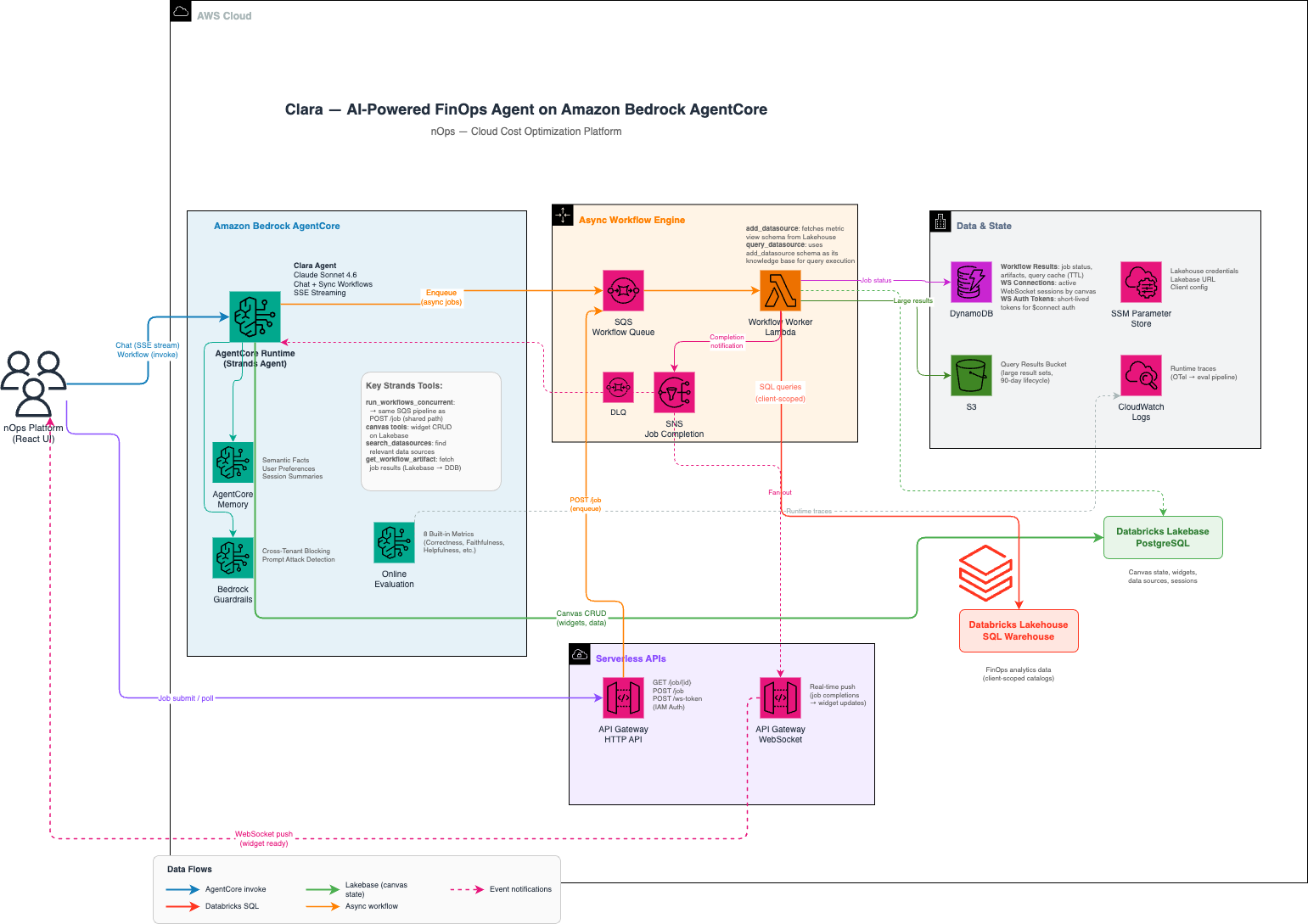
How n Ops shipped Fin Ops agents 75% faster with Amazon Bedrock Agent Core
nOps rebuilt its Clara FinOps AI agent on Amazon Bedrock AgentCore, replacing a self-managed Amazon EKS stack running LangChain and LangGraph. The move cut time-to-production by 75% (from 10-12 months to 4 months), improved response quality, and reduced operational overhead while keeping analytics governed through Databricks Lakehouse Metric Views.
Meta’s new Glimmer AI model offers a hint at Zuckerberg’s personal intelligence vision
Meta’s new open-weight Muse Glimmer model offers a glimpse of Mark Zuckerberg’s personal superintelligence vision, as well as the emerging divide between AI users can own and access.
How WPP operationalizes platform and data engineering for AI marketing
Between chaotic levels of market fragmentation and economic volatility, marketing and communications agencies can no longer rely on the human intuition they’ve traditionally used to win clients and optimize their ad spend. WPP is replacing that guesswork with an AI-powered view of shifting market dynamics, giving brands predictive certainty that lets them invest with confidence while moving at the speed of the market. That’s the value of WPP Open, its agentic marketing system. But before it could begin applying sophisticated AI models to power those insights, WPP had to overcome a critical engineering challenge: the marketing data that made up the models was fragmented across hundreds of global agencies. While this dynamic made it nearly impossible to deploy AI tools efficiently and securely, access to models was only part of the equation. And until it built a reliable way to ingest, clean, and serve data to those models, WPP couldn’t unlock the true potential of generative AI. To solve this, WPP partnered with Google Cloud to construct a unified data backbone and custom platform engineering path. Now, by standardizing its serverless compute patterns and data processing workflows, WPP is able to securely deploy targeted marketing campaigns in days instead of months. Architecting a centralized, service-based data foundation An important part of this effort was accelerating data availability and centralizing management. To do this, WPP adopted a service-based project structure for its current production environment. Rather than isolating every workload into separate silos, its engineering team centralized Google Cloud Storage (GCS) and BigQuery into dedicated, shared data projects, while also segregating the compute and processing workloads into distinct processing projects. This structure simplified the core team’s user experience and ensured that all data consumers interacted with a unified source of truth. Because data from WPP’s various product lines lives in shared infrastructure, it was essential that security be strictly enforced at a granular level. By directly applying identity and access management (IAM) controls at the individual GCS bucket and BigQuery dataset levels, the company’s teams only see the data they’re authorized to access. At the same time, raw data from various partners lands in dedicated GCS buckets in order to keep the raw inputs organized and isolated. From there, Managed Service for Apache Spark executes custom Apache Scala and Spark jobs to cleanse, normalize, and canonicalize information into standardized cohort definitions (SCDs). By utilizing a serverless architecture combined with Kubeflow for pipeline orchestration, WPP’s data engineering team avoided the overhead that often results from managing cluster infrastructure. This allowed them to focus entirely on the data transformation logic fueling the downstream GCS and BigQuery layers that ultimately feed the company’s audience & performance AI models. What made our collaboration with Google Cloud successful was the balance they struck between uncompromising professionalism when it comes to best practices and timely delivery of incredibly pragmatic, real-world solutions.- Jonas DahlbaekSenior Data Engineering Lead, WPP Standardizing data into unified cohorts When raw data enters WPP’s processing zone, its platform converts it into SCDs that become core concepts used throughout the framework for keying purposes. These are based on five keys: age, gender, geo, product, and interest. But these underlying data definitions are fluid and continuously canonicalized to reflect evolving marketing concepts. As a result, this uniform structure allows WPP to join and aggregate data on a global scale without exposing sensitive underlying particulars or relying on shared identifiers. The platform's core processing engine was built in type-safe Scala to ensure comprehensive visibility and compliance This custom framework tightly controls how data is transformed, and it inherently supports full source traceability while guaranteeing that every data point within the curated datasets can be traced back to its origin. This is a crucial level of traceability when building enterprise AI applications, as data scientists and auditors must understand exactly what information feeds into the models, even as WPP concurrently prepares to transition to Google Cloud Knowledge Catalog for automated, enterprise-wide data governance in the future. Working with Google Cloud has been instrumental in accelerating and standardizing our engineering efforts. In a world where massive volumes of fragmented data present a daily challenge, having the right infrastructure is paramount to thriving in the AI age and helps our developers and AI marketers alike.-Suleman KhanProduct Manager for OI & Google Partnerships, WPP Standardizing the enterprise software lifecycle For WPP, even with all these steps in place, processing data is only half the battle. To serve applications and manage the underlying infrastructure, the company’s platform engineering team developed a suite of reusable and centralized GitLab continuous integration and continuous deployment (CI/CD) templates. With this, WPP reduced the cognitive load on individual development teams and ensured that all deployments met strict corporate security standards. These templates manage various enterprise workloads autonomously. The suite includes universal Cloud Run templates for full-stack web applications and batch data processing and scheduled pipelines. It also includes a deploy-only template for multi-stage workflows and a Cloud Run functions deployment template for event-driven microservices. Implementing zero-rebuild promotion Rebuilding container images in a production environment can introduce unnecessary risk and the potential for configuration drift. In order to maintain environmental consistency, WPP embraced a "build once, deploy many" methodology that applied cross-project IAM logic and Google Cloud Artifact Registry configurations. As part of this process, developers build and test container images in the development environment. Once those exact, immutable container images are validated, they’re promote directly to production. This zero-rebuild promotion ensures total parity across deployment stages and eliminates unexpected production behaviors. The CI/CD templates also facilitate progressive traffic migration, which allowed teams to route a small percentage of traffic to new revisions before initiating a full rollout. Immutable deployments. Traceable data. Unshakable trust. When you know exactly what goes into your AI, you can ship at the speed of light.- Ranjith K PoldasAssociate Director , Devops (I&P), WPP Media Automating security and intelligent networking With this modern architecture, enterprise security acts as a foundational enabler for WPP, so it integrated Wiz security scanning directly into the pre-push phase of the CI/CD pipeline to catch vulnerabilities before code merges. The company also utilized Google Cloud Identity-Aware Proxy to enforce zero-trust access across its internal applications. To further simplify operations, WPP adopted templates with intelligent virtual private cloud (VPC) logic. This configuration automatically identifies and resolves networking conflicts between legacy VPC connectors and modern Direct VPC access. This automated networking prevents deployment failures and accelerates the release cycle. Monitoring operational health and driving ROI Because a resilient platform foundation requires deep observability, WPP’s engineering team now monitors strict operational metrics instead of relying solely on deployment frequency. The team tracks request latency across p50, p95, and p99 percentiles, alongside 4xx and 5xx error rates. It also monitors container startup times to mitigate cold starts, while tracking overall CPU and memory utilization. This granularity ensures that both data pipelines and serverless infrastructure always remain highly available. "Navigating a transformation of this scale across multiple complex workstreams—spanning data engineering, platform infrastructure, and AI integration—required more than just alignment; it demanded deep, mutual trust. Working as true partners, Google Cloud and WPP moved in lockstep to deliver production-ready platform capabilities on time."Yang Yue , Program Manager , Google Cloud For WPP, operationalizing its data and AI stacks at this velocity provided the necessary infrastructure for its advanced workloads, and the business impact was clear and quantifiable. By building this dual foundation, the company reduced creative and strategy time from four weeks to just three hours. It also saw a 70% gain in production efficiency, a 33x increase in content volume, and a 2.8x increase in campaign return on investment. In short, by partnering with Google Cloud and implementing a broad suite of products and tools, WPP was able to quickly realize a significant ROI and boost productivity, efficiency, reliability, and security across the company.
How Malachyte solves retail’s cold-start problem with managed real-time AI
What’s the best way to recommend products to little-known users? We’ve spent our careers trying to solve this problem for major companies like Spotify and Priceline, and it’s why Sidd founded Malachyte, an AI-powered ecommerce recommendation platform. These days, consumers have come to expect content that feels personalized and relevant, and online services competing for their attention have no choice but to do this exceptionally well. Malachyte was inspired by some unique insights into how advanced AI models, and large language models in particular, could be applied in new ways to old challenges like personalization and recommendations. As Malachyte set out to win potential customers’ business, we needed secure, scalable, reliable and, above all, leading-edge AI infrastructure to continue building the personalization algorithm we had always envisioned. By utilizing Google Cloud tools like Bigtable and Managed Service for Apache Kafka, Malachyte has been able to help some of its retailers double and sometimes even triple their sales. This is the story of how we built it, and the ways any founder can use services like these to start deploying AI foundation models in new ways. How Malachyte lifted sales for their users For Malachyte, the aha moment was discovering that it could use neural networks with attention mechanisms — the same concept powering large language models — to personalize retail search and product pages. This approach is what enables LLMs to derive meaning from the relative order of items in a sequence, in their case the order of words and syllables in a sentence. When it comes to a retail website or app, what Malachyte wanted to capture was the sequence of customer interactions with the site. What if we predicted the next thing a user wants on an ecommerce website just like LLMs predict the next word in a sentence? A pre-GPT language model might have tried to look at a specific sequence of words or even fragments of words (what we now know of as tokens), but those earlier models wouldn’t examine what happens if the words were in the comparable order but weren’t contiguous or were re-arranged. The breakthrough came — in part through Google’s work on transformers — when LLMs gained the ability to understand complex and long-range dependencies within a sequence of items. This more sophisticated method has delivered dramatic results — both for the proliferation of gen AI in general, and for Malachyte’s application of the technology. To make this work in practice, Malachyte creates a vector of everything known about a visitor when they arrive on a site. Most users are visiting for the first time, so little is known about them. This is what’s known as the “cold start” problem. The trick is to use every interaction with a user to refine this vector. Each new addition to the vector, like a click or a query, does two things: it drives a prediction about the next thing the user wants, and it provides more information about the user. Malachyte’s platform then updates the user vector and the prediction at the same time. This not only enhances the understanding of the individual user and their preferences, it also improves the overall model with the anonymized user data. With every inference, the context of both the average and the specific shopper grows. The company further innovates by not just using attention-based neural networks but combining that with updating user profiles 100 milliseconds at time. Malachyte’s recommendation and search agents populate the next page’s search results or recommendation carousels based on what users clicked on previous pages. To be sure, this idea isn’t in itself new. Retailers have long used collaborative filtering recommendations systems to identify similar users and items that required massive sets of interaction history. These models typically required a lot of data, including third-party cookie-based profiles and demographics. By focusing on the sequence of interactions in a session, retailers can achieve far more personalization — with less required data or spend — than by focusing only on a user’s profile. As a bonus, retailers can now offer their users more privacy by not relying on long-term cookie data. This works because of the model structure and multimodal vectors that encode everything they know about a user, including browser data, click history and searches. The output, too, is multimodal: The same model can be applied to on-site search product pages, category pages, and add-to-cart carousels. To make this work, each product in the catalog is embedded into the same space as the user vector, which gets updated and subsequently moves the vector closer to relevant products and further from those that aren’t. The neural network computing the embedding is being continuously trained across retailers who work with Malachyte, improving the quality for everyone. The system effectively becomes a data cooperative with each retailer's user helping make the model smarter for everyone. A user session represented as a vector in a space of products. To make this delivery for every user at every inference in 100 milliseconds, Malachite found real benefits in building onGoogle Cloud’s real-time AI stack. With this system, every behavioral event streams into a Managed Service for Apache Kafka cluster. Rather than queuing for a future training job, each event immediately becomes an update to the user’s profile in Bigtable. The Kafka cluster allows the customer’s front-end to persist, so the user session signals quickly with little worry about how they fit into the user vector. Bigtable allows Malachyte’s services to look up and update the right user vectors, and it and Kafka operate at the order of 10 milliseconds per step, which allows the entire recommendation loop to complete with no disruption to the user experience. The three layer real-time AI architecture: a retailer’s website, Malachyte’s AI models and serving front ends, and context management infrastructure. In addition to a fast core, a second layer of product catalog updates, inventory signals, and retailer-specific dimensional data keeps product data up to date. This flows through Cloud Pub/Sub, which offers globally accessible REST APIs that enable connections retailers can use without deep integration work. Malachyte agents run on Google Kubernetes Engine (GKE), with model inference on Google Compute Engine (GCE). Continuous ingestion of external data, such as product catalog updates, operates through Pub/Sub’s global messaging system. With its migration to Google Cloud’s AI architecture, Malachyte demonstrated that production AI inference and training are about more than GPUs and storage. They require real-time continuous learning infrastructure that includes a fast key-value store, a streaming layer, and a managed messaging system, all integrated with the foundation model architecture. This approach also shows that even a small team like Malachyte’s can have a big impact in an industry. It just needs access to powerful infrastructure and core AI managed services. Try it for yourself Looking to shake up your industry or stay ahead of the competition like Malachyte? Try Managed Service for Apache Kafka, Cloud Pub/Sub, and Bigtable. New customers can receive $300 in Google Cloud credits.
Cluster Network Policy in GKE: Balancing control and autonomy for your microservices
Managing network security in a multi-tenant Kubernetes environment typically requires balancing two distinct needs: developers need their microservices to communicate effectively, while platform and security teams must maintain compliance, prevent lateral movement, and establish cluster-wide guardrails. Historically, the standard Kubernetes NetworkPolicy has been the primary tool for this. While effective for single-namespace isolation, standard NetworkPolicy is scoped strictly to individual namespaces and designed around developer self-service. When cluster administrators attempt to use it for global security enforcement, it can lead to policy conflicts and operational challenges. To address this, we introduced (CNP), an open-source standard developed by the Kubernetes SIG-Policy Working Group (WG), to Google Kubernetes Engine (GKE). Designed for scale, CNP is a cluster-wide resource that allows administrators to manage network security centrally, providing a mechanism for those responsible for global security to implement consistent, non-bypassable policies. Read on for technical details about CNP, some common use cases, an example policy, and how to get started. Structuring policies with tiers A core capability of is its hierarchical tier system. Rather than attempting to reconcile flat, conflicting peer rules simultaneously, CNP establishes a deterministic, top-to-bottom evaluation hierarchy: The admin tier: The highest precedence level. Rules here are enforced before any other policies. The network policy tier: The standard namespace level, where developers manage their specific application policies. The baseline tier: The lowest precedence, establishing the cluster’s default behavior when no other policies apply. This can be overridden using namespace scoped policies. This tiered structure helps align network security with organizational roles. Using standard role-based access control (RBAC), you can manage the admin tier to enforce compliance mandates, while platform teams can use the baseline tier to set a default "deny-all" zero-trust posture across the cluster. At the same time, developers can write standard network policies for their applications without overriding core security mandates. This deterministic, top-to-bottom evaluation method resolves conflicts between different teams' policies. The admin tier introduces an explicit Pass action. This allows security teams to inspect traffic against global rules and then delegate the final Accept or Deny decision down to the developer's namespace policy, facilitating both central oversight and distributed management. Common network security scenarios This tiered architecture translates complex security requirements into centralized rules. Here are common scenarios where provides a practical solution: Isolating sensitive workloads: You can apply an admin-tier global deny rule to isolate specific namespaces — such as those used for payment processing or compliance data — from the rest of the cluster. This action overrides any permissive developer policies that might otherwise expose these environments. Protecting core services: To prevent configurations that might disrupt internal operations, administrators can create an admin-tier global allow rule for critical services like kube-dns. This allows these services to remain accessible regardless of any misconfigured namespace policies. Managing external egress: By utilizing IP address range matching, egress traffic can be controlled at the cluster level. This functionality allows you to explicitly restrict or permit access to corporate intranets or external IP ranges, serving as a safeguard against unauthorized data exfiltration. Example scenario Consider a common enterprise requirement: Application workloads across all namespaces must be permitted to reach central platform infrastructure (such as shared authentication and telemetry services), while access to sensitive environments — like a restricted vault namespace — is strictly prohibited. Meanwhile, routine microservice traffic is delegated to developer-managed, namespace-scoped policies. makes this straightforward. A platform administrator simply defines an admin-tier guardrail centrally: code_block <ListValue: [StructValue([('code', 'apiVersion: policy.networking.k8s.io/v1alpha2\r\nkind: \r\nmetadata:\r\n name: platform-isolation-guardrail\r\nspec:\r\n tier: Admin\r\n priority: 10\r\n subject:\r\n # Target all application tenant namespaces, excluding system and core infrastructure\r\n namespaces:\r\n matchExpressions:\r\n - key: kubernetes.io/metadata.name\r\n operator: NotIn\r\n values: ["kube-system", "shared-services", "restricted-vault"]\r\n egress:\r\n # 1. Mandate access to central shared platform services\r\n - name: allow-shared-services\r\n action: Accept\r\n to:\r\n - namespaces:\r\n matchLabels:\r\n kubernetes.io/metadata.name: shared-services\r\n\r\n # 2. Enforce strict block on accessing the restricted vault namespace\r\n - name: block-restricted-vault\r\n action: Deny\r\n to:\r\n - namespaces:\r\n matchLabels:\r\n kubernetes.io/metadata.name: restricted-vault\r\n\r\n # 3. Explicitly delegate all remaining traffic to developer namespace policies\r\n - name: delegate-remaining-egress\r\n action: Pass\r\n to:\r\n - namespaces: {}\r\n - networks:\r\n - 0.0.0.0/0\r\n - ::/0'), ('language', ''), ('caption', <wagtail.rich_text.RichText object at 0x7efcfe3c93d0>)])]> Extending open-source foundations Instead of building this functionality as proprietary extensions, we worked with the Kubernetes community to design the API (policy.networking.k8s.io), distinguishing it from the namespace-scoped NetworkPolicy API (networking.k8s.io). Furthermore, we collaborated closely with the Cilium community to build its implementation of the API. Because it is built on open-source standards, GKE helps ensure that security configurations remain portable across different environments. The API natively supports tier selection, enabling clear and deterministic policy evaluation. This approach lets administrators enforce robust security guardrails while maintaining the operational flexibility that development teams depend on. on GKE elevates workload network security — shifting operations from namespace-scoped rules to unified, cluster-wide governance. It is currently in preview in version 1.36 and later. To learn more and get started, check out: Configuring GKE Kubernetes SIG-Network API Specification
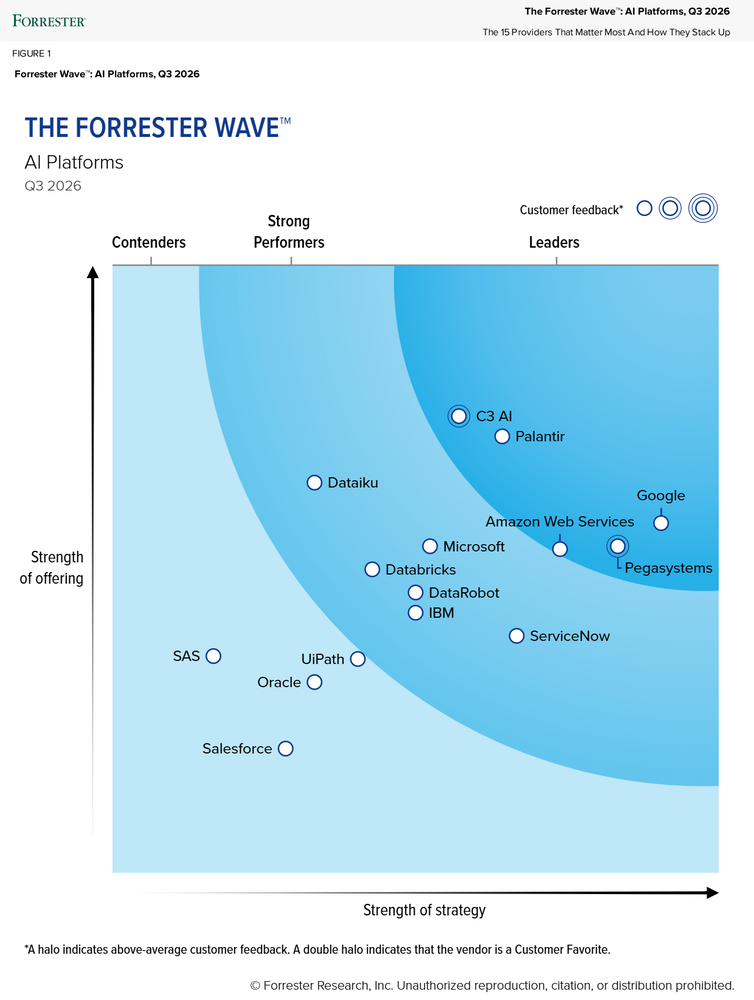
Google named a Leader in The Forrester Wave™: AI Platforms, Q3 2026
At Google Cloud, we help organizations of all sizes build and operationalize complex agentic workflows with total confidence. By combining world-class AI research with an open, fully integrated AI platform, we give customers the flexibility to innovate and the foundation to deliver measurable business value. At the center of it all is Gemini Enterprise, a unified platform designed to power the agentic enterprise, meet builders where they are, and deliver enterprise trust by default. We believe this integrated approach is why Google has been named a Leader in The Forrester Wave™: AI Platforms, Q3 2026 report, and received the highest score in the Strategy category. Powering the Agentic Era As agents become embedded across every part of the business, organizations need a unified platform. Gemini Enterprise serves as the front door to AI for your entire organization, removing the silos between business users, developers, and IT leaders by connecting them all with shared, universal context. Gemini Enterprise Agent Platform is the foundation that enables technical teams and IT leaders to safely, securely, and cost-effectively build and deploy production-grade agents. Any agent built in Agent Platform can be deployed across your entire workforce through the Gemini Enterprise app, putting custom agentic capabilities directly into the hands of every employee. By unifying enterprise data, frontier model capabilities, developer tooling, and IT operations under one roof, Gemini Enterprise empowers teams to transform products, services, and complex agentic tasks while maintaining centralized control every step of the way. New Way Now: Mars accelerates marketing campaigns from months to weeks with Gemini Enterprise See how Mars accelerates their marketing campaigns from months to weeks with Gemini Enterprise Meeting builders where they are No two development teams build agents in the same way. Some work in coding environments, others rely on low-code tools, and many organizations use a mix of models. Gemini Enterprise is built for that reality. We offer a platform tailored to every team's skill set, enabling high-code developers to build complex agentic systems while giving business and operational teams low-cod and no-code tools to rapidly design and test agent behaviors. And with access to over 200 native and third-party models, alongside pre-built agent templates, engineering teams can move from prototype to deployment with speed. True enterprise AI should extend far beyond text. Gemini Enterprise is multi-modal by design, meaning it natively understands, reasons across, and generates text, code, audio, image, and video inputs in a single workflow. By securely connecting this multi-modal intelligence to your enterprise data wherever it lives, your engineering teams can turn this information into contextual business experiences. New Way Now: Kohl’s turns data analysis into active conversation with Gemini Enterprise See how Kohl’s uses Gemini Enterprise to turn data analysis into active conversations and deliver personalized customer experiences Enterprise trust, built in Trust is foundational to AI adoption, which is why Agent Platform is built with enterprise-grade governance, security, and observability by default. To help you scale with confidence, Agent Platform features built-in guardrails, continuous evaluation, and real-time tracking for costs, latency, and token usage. This operational transparency gives organizations the control they need to safely expand agentic workflows across the business. Builders can also leverage capabilities like Knowledge Catalog to establish a universal context engine across the enterprise, aggregating metadata with zero-copy federation to improve agent accuracy. New Way Now: TELUS builds an Agentic Data Cloud to turn connectivity into customer intelligence See how TELUS uses Gemini Enterprise to turn data silos into an Agentic Data Cloud, driving real-time, proactive customer experiences. Looking ahead We believe this recognition reflects our commitment to delivering an open, scalable, and powerful AI platform. As agentic systems reshape how enterprise software is built, Gemini Enterprise will continue to provide the foundation developers need to build with confidence. Want to dive deeper into the report? Access the full Forrester Wave™: AI Platforms, Q3 2026 report here. Forrester does not endorse any company, product, brand, or service included in its research publications and does not advise any person to select the products or services of any company or brand based on the ratings included in such publications. Information is based on the best available resources. Opinions reflect judgment at the time and are subject to change. This report is part of a broader collection of Forrester resources, including interactive models, frameworks, tools, data, and access to analyst guidance. For more information, read about Forrester’s objectivity here.
Meta AI Releases Muse Glimmer: A 30 B Open-Weights Agentic Model That Runs on One Consumer GPU
Meta's Muse Glimmer is a 30B open-weights agentic model under Apache 2.0. It fits 24 GB VRAM and decodes 3.1x faster with DFlash speculation. The post Meta AI Releases Muse Glimmer: A 30B Open-Weights Agentic Model That Runs on One Consumer GPU appeared first on MarkTechPost.
Meta Muse Code vs. Fable 5: Meta Muse is cheaper, but at what cost?
Meta released Muse Code on August 5, its first AI coding agent, built on the new Muse Spark 1.2 model. The post Meta Muse Code vs. Fable 5: Meta Muse is cheaper, but at what cost? appeared first on The New Stack.
“It blows my mind”-“It has a tendency to overengineer things a little”: Developers react to road-testing Open AI GPT‑5.6 Sol
OpenAI made its family of GPT-5.6 models available to its app and API users globally at the start of July. The post “It blows my mind”-“It has a tendency to overengineer things a little”: Developers react to road-testing OpenAI GPT‑5.6 Sol appeared first on The New Stack.
Open AI’s letter to Governor Abbott on responsible AI infrastructure in Texas
OpenAI sent Governor Greg Abbott a letter outlining its commitment to responsible AI infrastructure in Texas. The letter supports reliable, transparent growth that benefits Texans.
Meta returns to open models with Zuckerberg's plan to out-copy China and sell compute by auction
Meta has released Muse Glimmer, the first open model from its new Superintelligence Labs. It's a 30B agent model that runs on consumer hardware once the weights are compressed, needing less than 20 GB of memory. In an accompanying essay, Mark Zuckerberg mounts an aggressive defense of distilling other labs' models and calls for fewer restrictions on US labs, a direct counterpunch at OpenAI and Anthropic. An open-weight version of Muse Spark 1.2 should follow soon, according to the Wall Street Journal. The article Meta returns to open models with Zuckerberg's plan to out-copy China and sell compute by auction appeared first on The Decoder.
Zuckerberg lays out vision to put superintelligent AI in everyone's hands - Fox Business
Zuckerberg lays out vision to put superintelligent AI in everyone's hands Fox BusinessMeta Unveils an Open Version of Its Most Powerful A.I. Model The New York TimesMeta releases open-source AI model as Zuckerberg warns on concentrated control 10TV
Run Local Agentic AI Workflows with Meta’s Muse Glimmer on NVIDIA
Meta returns to the open source ecosystem with the release of Muse Glimmer, a 30B open-weight dense model with a 120K+ context window built for local AI...
V4-Flash vs. V4-Pro: Deep Seek promised better and cheaper. It’s true, but not how I expected.
DeepSeek, the Chinese AI lab that’s been undercutting OpenAI and Anthropic on price since it arrived, recently refreshed V4-Flash, moving The post V4-Flash vs. V4-Pro: DeepSeek promised better and cheaper. It’s true, but not how I expected. appeared first on The New Stack.
Open AI acquires Next Slide to bring AI-generated presentations into Chat GPT
OpenAI acquired NextSlide, the startup that turned prompts, notes, documents, and research into editable presentations. The article OpenAI acquires NextSlide to bring AI-generated presentations into ChatGPT appeared first on The Decoder.
Expanding Daybreak as the Cyber Defense Window Narrows
Meet GPT-5.6-Cyber, OpenAI’s cybersecurity-specific model available through Daybreak Red for authorized vulnerability research, exploit validation, and security testing.
Invisible to the Machine: Auditing AI Restaurant, Cafe, and Bar Recommendation Against a Complete Market Census
arXiv:2608.07069v1 Announce Type: new Abstract: AI assistants are becoming a primary interface for local discovery, yet almost nothing is known about which venues they surface -- especially in food and drink, where recommendations carry direct revenue consequences. We present the first census-denominated audit of AI venue recommendation: a complete enumeration of 4,776 cafes, restaurants, and bars across two bounded markets (Canggu and Ubud, Bali), against which we evaluate 2,208 search-grounded responses from four production AI systems (ChatGPT, Claude, Gemini, Perplexity) to 96 persona-conditioned queries, collected over seven days under a pre-registered protocol. Because we observe the full market, we can measure what sampled audits cannot: 85.6% of venues were never recommended by any system -- 72.6% even among established venues with fifty or more ratings. Visibility follows a two-margin structure. Entry into answers is associated with documentation: review volume (OR 1.64), an own website (OR 1.92), listed price information (OR 1.54), and third-party web mentions (OR 1.44) -- while star rating is null at this margin (OR 0.89). Rank within answers reverses the pattern: among recommended venues, rating significantly predicts first position (OR 1.17). Presence in an open POI dataset (Foursquare), a folk-theorized visibility factor, shows no positive effect at either margin. Outright fabrication is rare (0.08% of mentions), but systems recommended permanently closed venues 93 times -- staleness, not hallucination, is the practical failure mode. Cross-system agreement is low (top-20 Jaccard 0.33-0.54). A two-week test-retest shows cross-period answer similarity comparable to same-day rerun similarity: the churn is sampling stochasticity, not temporal drift. We release our protocol, registry construction method, and derived data.
Divergent Response Modes in Frontier Language Models Under Steering Pressure
arXiv:2608.06578v1 Announce Type: new Abstract: Frontier language models are trained using distinct data, objectives, and safety pipelines. Whether these differences produce measurably different behaviors under explicit steering pressure remains underexplored. This study evaluates behavioral steerability across six frontier models from six developers using 300 paired base and steered items over three categories: values-conflict, reasoning-elicitation, and reasoning-suppression (plus 40 validation items). All six models act as blind peer judges and classify every response based on fixed behavioral rubrics. The resulting 24,480 judgments are scored by leave-one-out consensus. We find that models differ not just in how much steering shifts their behavior but in what kind (mode) of response they give, and some response modes appear in only one or two of them. GPT-5 deflects requests to disclose its reasoning while leaving its answer intact (99% vs. 0% for all other models). Claude Opus 4.7 and GPT-5 resist explicit suppression instructions and in different ways. Using Llama as the open-weight model, we trace the largest behavioral split to its internals. A linear probe decodes the behavior from the residual stream at 0.87 held-out accuracy while injecting that direction during generation drives the behavior from 0% to 86% across an intervention sweep. Every finding holds under both a token-budget remediation and a control experiment with a hypothesis-blind judgment prompt.
SNI-GNN: Smart NIC-Assisted Full-Graph GNN Training with In-Network Embedding Prediction
arXiv:2608.06441v1 Announce Type: new Abstract: Full-graph GNN training delivers high accuracy but scales poorly on multi-server clusters due to heavy, irregular inter-node embedding exchanges. We present SNI-GNN, a SmartNIC-assisted full-graph training system that reduces communication while preserving accuracy by predicting remote embeddings in-network. SNI-GNN deploys a lightweight linear-trend predictor on SmartNICs to refine cached historical embeddings, coupled with an importance-based boundary-node sampling policy and an asynchronous DPU--GPU data pipeline with intermediate-result reuse. We provide error and convergence bounds showing that predictor bias remains controlled under bounded second-order dynamics and yields standard non-convex convergence with inexact gradients. Implemented on NVIDIA BlueField-3, SNI-GNN integrates with state-of-the-art full-graph systems, cuts communication by 21--45\%, achieves 1.3--3.6$\times$ end-to-end speedups over BNS-GCN and up to 1.29$\times$ over baseline SANCUS, with accuracy loss $\leq 0.01$, and scales efficiently to 16 GPUs on graphs with up to tens of millions of edges. These results indicate SmartNIC-based in-network prediction is a practical complement to partitioning and compression techniques for communication-efficient full-graph GNN training at scale.
Premium seats are coming to ChatGPT Business. Sign up by August 20 to get $100 in workspace credits and unlock higher usage for your team's most demanding work.
NVIDIA Releases Nemotron Labs Voice Chat 11 B: An Open Full-Duplex Speech-to-Speech Model with ~450 ms Turn-Taking and Live Tool Calling
NVIDIA releases NemotronLabs VoiceChat 11B, an open full-duplex speech-to-speech model with 448 ms latency and live tool calling. The post NVIDIA Releases NemotronLabs VoiceChat 11B: An Open Full-Duplex Speech-to-Speech Model with ~450 ms Turn-Taking and Live Tool Calling appeared first on MarkTechPost.