
In one of the previous chapters, we discussed RAG (Retrieval-Augmented Generation), where AI looks up information before answering.
A natural follow-up question is: how does it actually find the right information from thousands of pages?
It is not scanning documents the way a person reads a book. The system uses two ideas together: embeddings and vector databases.
This post explains both in plain, practical language.
In one sentence: embeddings help AI understand similarity, and vector databases help AI retrieve it fast.
The core problem: finding the right information fast
Imagine you have:
- 1,000 pages of notes
- 100 PDFs
- 10 textbooks
Now someone asks: "How do plants make food?"
You would not read everything from page one. You would jump to the most relevant section.
AI faces the same challenge, just at a much larger scale.
What are embeddings?
Embeddings are a way to convert text into numbers that represent meaning.
Key idea: these numbers represent _semantic meaning_, not just word spelling.
Computers cannot work with "meaning" directly the way humans do. So a sentence is transformed into a numerical representation. If two sentences mean similar things, their embeddings are close to each other.
For example:
- "I love cricket"
- "I enjoy playing cricket"
Different words, similar intent. Their embeddings are usually close.
Simple analogy
Think of a city map where similar places are often close to each other, like schools near other schools or hospitals near medical stores:
- Similar ideas are close together
- Unrelated ideas are far apart
So "cricket" and "football" may sit near each other, while "cricket" and "cooking" are usually far apart.
Embeddings create this kind of meaning map.
_This is why AI can connect related sentences even when wording is different._
Why embeddings matter
They allow search by meaning, not just exact words.
Suppose a user asks: "How to treat fever?"
A document says: "Ways to reduce body temperature."
A strict keyword search might miss this match because the wording is different.
Embedding-based search can still connect the two because the meaning overlaps.
That is the big shift: semantic match over word match.
Why this matters: better retrieval means better final answers in RAG pipelines.
What is a vector database?
Once text is converted into embeddings, those vectors need to be stored somewhere and searched efficiently.
A vector database is built for exactly this purpose:
- Store embeddings
- Find the closest matches quickly
So instead of searching for exact words, it searches for nearest meaning.
Simple analogy
Think of a library:
- Old system: books arranged alphabetically
- Vector database: books grouped by topic similarity
Books about plants are close to other plant-related books. Sports content is grouped near sports.
This makes retrieval faster and more relevant.
Think of it this way: keyword search asks "Do these words match?" while vector search asks "Do these meanings match?"
How it works together (step by step)
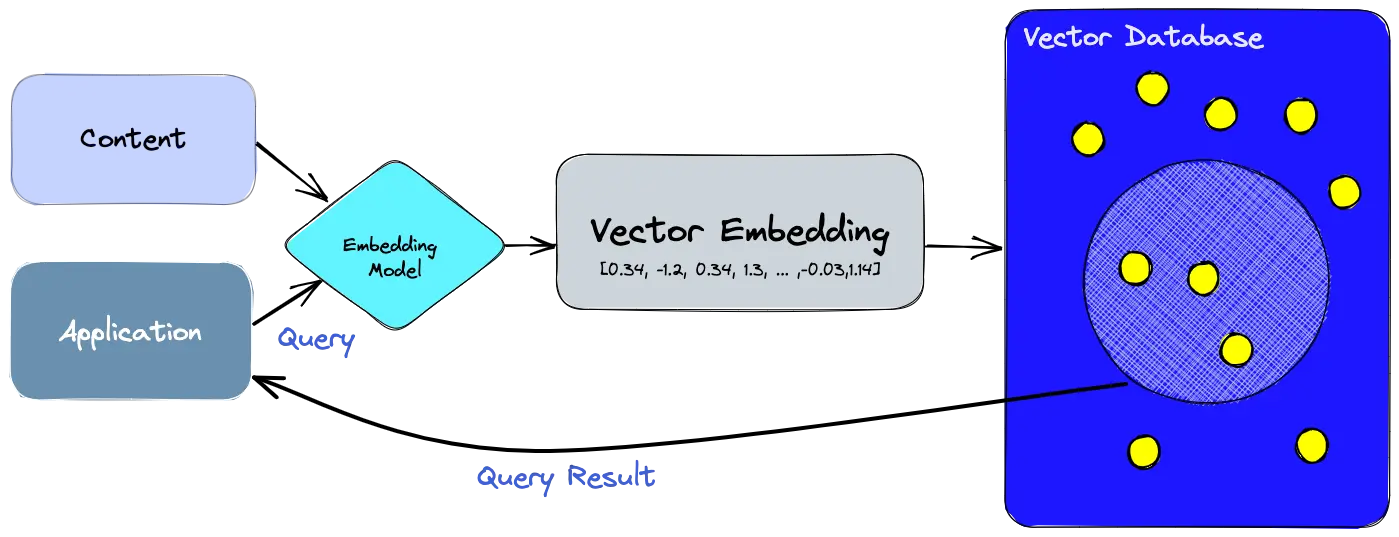
This is the full flow in simple terms:
- Store knowledge
Documents are split into smaller sections (chunks).
Each chunk is converted into an embedding and stored in the vector database.
- User asks a question
Example: "Explain photosynthesis."
- Convert question into embedding
The question is also transformed into numbers.
- Find similar chunks
The vector database finds the closest chunk embeddings by meaning.
- Send context to the model
Those relevant chunks are passed to the LLM.
- Generate final answer
The model writes a clear response using the retrieved context.
In one line:
Question -> meaning vector -> similar chunks -> LLM -> answer.
You can also read it as:
Question -> Embedding -> Retrieval -> Generation
How this connects to RAG
RAG is basically this pipeline in action.
- Retrieval = vector database search
- Generation = LLM response
So embeddings plus vector databases act like the "library system" inside RAG.
Shortcut memory line: _RAG retrieval works because embeddings make meaning searchable._
Real-life example
Imagine a school chatbot where all textbooks are indexed in a vector database.
A student asks: "Why do plants need sunlight?"
The system retrieves the relevant textbook section, then the model explains it in simple language.
The student gets a focused answer without manually searching through chapters.
Keyword search vs meaning search
- Keyword search looks for exact terms.
- Meaning search looks for intent and semantic similarity.
Example:
- Query: "heart attack causes"
- Document text: "reasons for cardiac arrest"
Keyword match may fail. Meaning-based retrieval can still find the right section.
What is chunking, and why it matters
Large documents are usually split into smaller pieces called chunks.
This helps because:
- Search becomes more accurate
- Relevant context is easier to isolate
- Retrieval is faster and cleaner
Instead of handing the model an entire book, the system gives only the most relevant sections.
Practical benefit: smaller, relevant context usually improves both speed and answer quality.
Can this still go wrong?
Yes. Retrieval systems are powerful, but not perfect.
Common failure cases:
- Wrong chunks are retrieved
- Important source data is missing
- Chunking is poor, so context gets split badly
When retrieval quality drops, answer quality drops too. It is like opening the wrong page of a textbook and confidently summarizing it.
_Good generation cannot fully compensate for poor retrieval._
One-line takeaway
Embeddings turn meaning into numbers, and vector databases make that meaning searchable at speed.
Big-picture connection
At this point, the full stack should feel clear:
- LLMs generate answers
- Prompting shapes answers
- RAG brings in external knowledge
- Embeddings and vector databases help retrieve that knowledge
Together, they make modern AI assistants far more useful than plain text generation alone.
Final mental model:
LLM = writerVector DB = librarianEmbeddings = meaning index