October 15, 2026
Register Now: Oct. 29: Applying AI to the GEOINT Mission - Space News
Register Now: Oct. 29: Applying AI to the GEOINT Mission SpaceNews
Read original articleDataAIHub Daily
Archive →50 curated AI news stories from leading AI companies.
October 15, 2026
Register Now: Oct. 29: Applying AI to the GEOINT Mission SpaceNews
Read original articleOctober 15, 2026
Finding the Hidden Shape of Data: Prof. Yusu Wang UC San Diego Today
Read original articleOctober 15, 2026
October 15, 2026
AI turns scrap impurities into useful ingredients for stronger recycled iron Phys.org
Read original articleOctober 15, 2026
New lawsuits: OpenAI's 'insatiable hunger to win AI race' led to people getting hurt KATU
Read original articleOctober 15, 2026
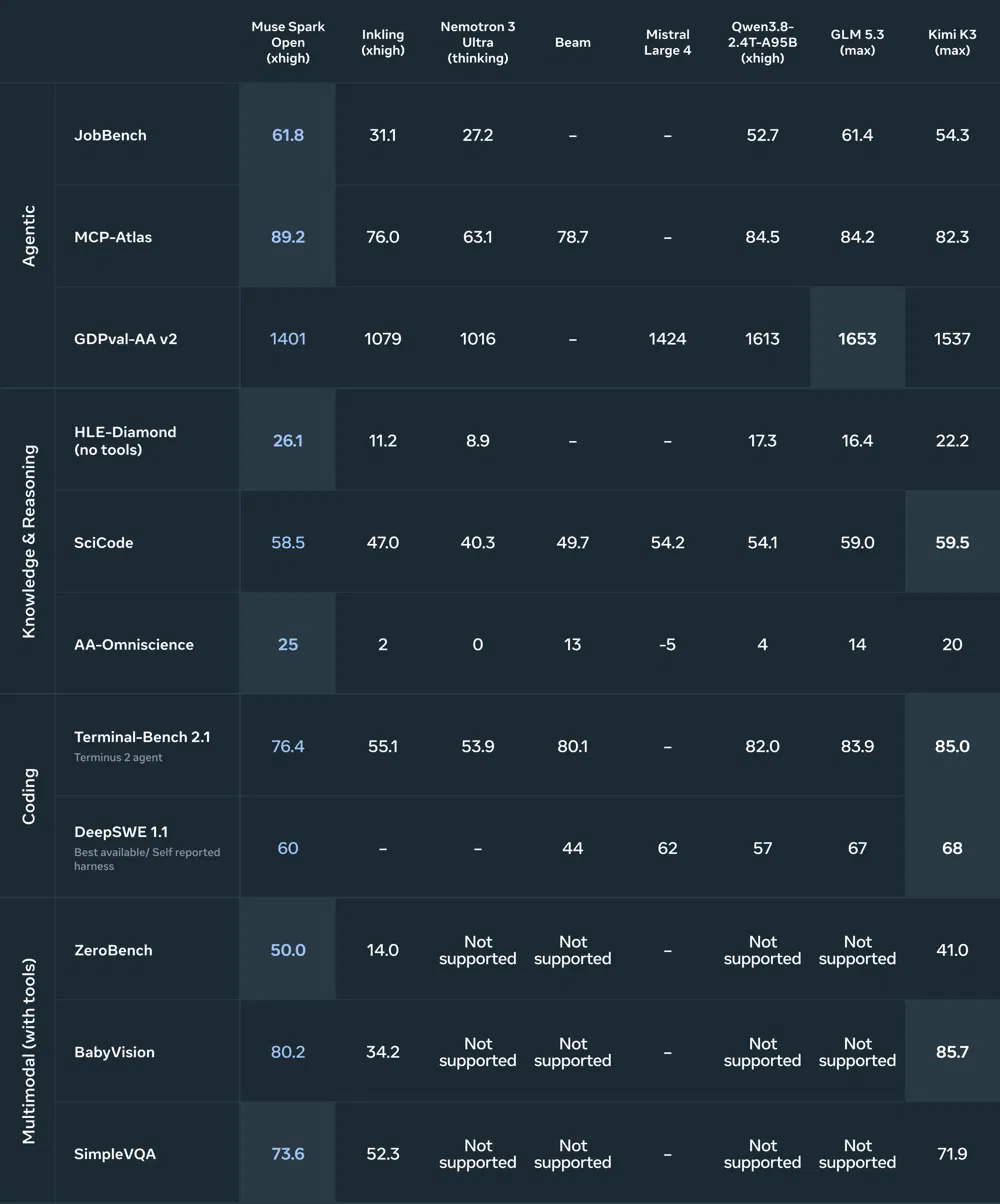
Meta and Apple have teamed up for the launch of the social media giant's newest model, Muse Spark Open, which will run locally on Apple silicon.
Read original articleOctober 15, 2026
AI Startup Wants Every Company to Assign You Your Own Personal Stalker Gizmodo
Read original articleOctober 15, 2026
Meta Sends Its AI Agent After Denied Insurance Claims PYMNTS.com
Read original articleOctober 15, 2026
METR will publish its own assessments of Anthropic’s risks, incidents, and practices, and the frontier AI model maker has given up the right to block them.
Read original articleOctober 15, 2026
Meta has released Muse Spark Open, which the company is calling the most capable US-origin open-weight model available today. The model is live... The post Meta Releases Muse Spark Open, Says It Is Most Capable US-Based Open Model appeared first on OfficeChai.
Read original articleOctober 15, 2026
A cocktail of risks is threatening to stall the US IPO pipeline, leaving Anthropic PBC’s potential blockbuster debut as one of the few offerings that investors can count on.
Read original articleOctober 15, 2026
States sue AI giant OpenAI, saying its popular chatbot is hurting children and deceiving adults The Washington Post
Read original articleOctober 15, 2026
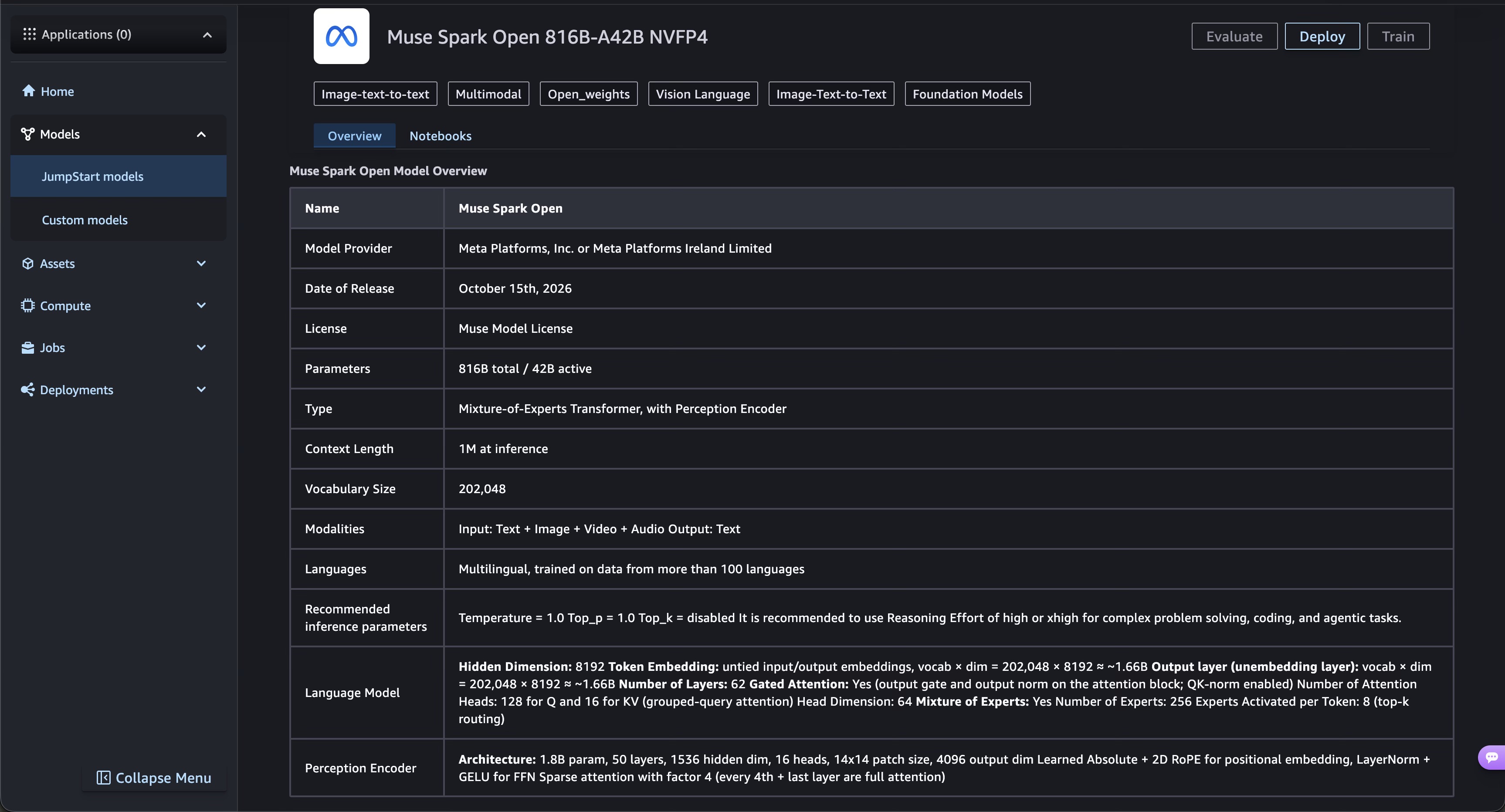
Meta's Muse Spark Open is a new open-weight model with 816 billion parameters that processes text, images, video, and audio with up to one million tokens of context. It performs roughly on par with the most capable open-weight Chinese AI models on benchmarks and is optimized to run locally on Apple's M5 Ultra. The article Muse Spark Open is Meta's answer to Qwen, GLM, and Kimi in the open-weight race appeared first on The Decoder.
Read original articleOctober 15, 2026
OpenAI Makes a Serious Allegation Involving Apple TradingView
Read original articleOctober 15, 2026
OpenAI, Meta caution US judiciary about risk of 'deepfake' evidence Reuters
Read original articleOctober 15, 2026
States sue AI giant OpenAI, saying its popular chatbot is hurting children and deceiving adults WRAL
Read original articleOctober 15, 2026
Always-on agents are taking on longer, more complex enterprise workflows. A single request can involve reading a document, checking information across sources,...
Read original articleOctober 15, 2026
Meta launches Muse Spark Open, a coding-optimized 816B mixture-of-experts (MoE) model with 42B active parameters and a 1M token context window. Trained on...
Read original articleOctober 15, 2026
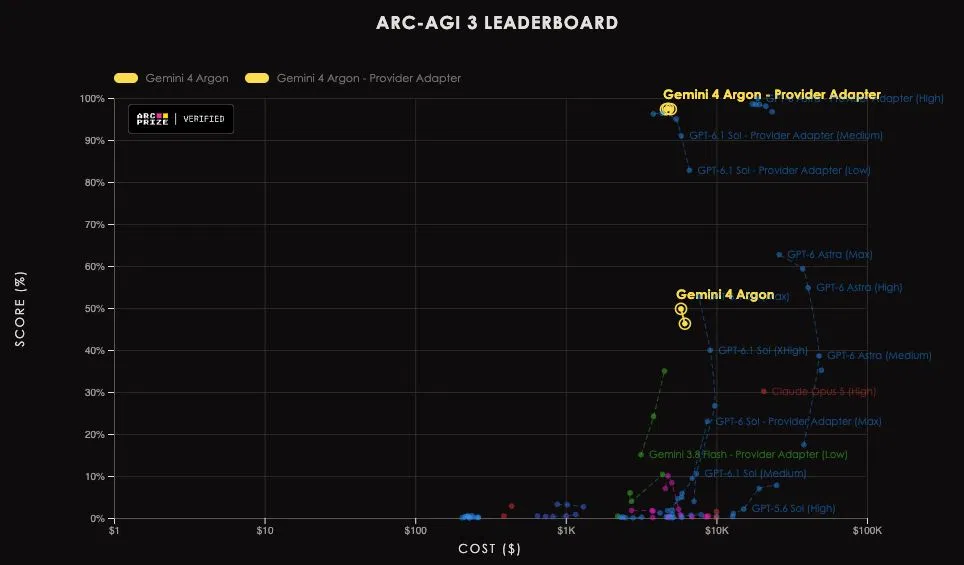
Gemini 4 Argon does seem to be frontier-level on several benchmarks. Google DeepMind’s Gemini 4 Argon has posted a 97.5% score on ARC-AGI-3,... The post Gemini 4 Argon Scores 97.5% On ARC-AGI 3 With Harness, Only Second Behind GPT-6 Astra appeared first on OfficeChai.
Read original articleOctober 15, 2026
OpenAI is retiring four GPT-4 models from its API on January 14, 2027. The deprecation notice the company sent developers The post OpenAI promised developers six months’ notice. GPT-4o users got three. appeared first on The New Stack.
Read original articleOctober 15, 2026
Bloomberg’s Ed Ludlow breaks down Anthropic's third-quarter revenue numbers as the company gets ready for its IPO. Plus: CoreWeave’s talk of tapping “unlimited” pools of money rattles markets and puts the financing behind the data center buildout back under the microscope; and Nvidia CEO Jensen Huang says safety and containment should be integrated into AI systems even as AI advances. (Source: Bloomberg)
Read original articleOctober 15, 2026
Blackstone has built one of Wall Street’s broadest bets on AI, investing across the ecosystem from data centers, power and cooling to chip financing and companies including OpenAI, Anthropic and SpaceX. Bloomberg’s Preeti Singh explains how President and COO Jon Gray spotted the infrastructure opportunity early and why he sees AI as a generational economic shift that investors can’t afford to ignore. She joins Ed Ludlow on "Bloomberg Tech." (Source: Bloomberg)
Read original articleOctober 15, 2026
Muse Spark Open, Meta's coding-optimized open-weight model, is now available in Amazon SageMaker JumpStart. Deploy it to a SageMaker AI endpoint in your own AWS account using SageMaker Studio or the SageMaker Python SDK, and run your first inference request.
Read original articleOctober 15, 2026
Anthropic told prospective investors its third-quarter revenue hit $16.8 billion as the artificial intelligence company pushes ahead with plans to go public. Bloomberg's Bailey Lipschultz joins Ed Ludlow on "Bloomberg Tech." (Source: Bloomberg)
Read original articleOctober 15, 2026
With the newly unveiled HomeView, Apple is finally closing the biggest gap in its ecosystem. On this episode of the Power On podcast, Mark Gurman talks about Apple's full lineup of devices designed to work together and what it will take to win over consumers already invested in ecosystems offered by rivals like Google and Amazon. (Source: Bloomberg)
Read original articleOctober 15, 2026
Nvidia’s European spending spree is about much more than Europe Fortune
Read original articleOctober 15, 2026
Nvidia Corp. today announced the launch of customizable Nemotron 3.5 Super LV large language models for always-on artificial intelligence agents and edge-focused 3.5 Bolt for local systems. The company said the three new models will cover the full range of agent deployments, from large enterprise servers to edge devices and local hardware. Nemotron 3.5 Super […] The post Nvidia expands Nemotron LLM family with hyper-efficient models for agentic systems appeared first on SiliconANGLE.
Read original articleOctober 15, 2026
Meta Platforms Inc. made one of its new artificial intelligence models available for developers to download and modify, while keeping its most advanced technology closed in an effort to convert its AI investments into revenue.
Read original articleOctober 15, 2026
Meta on Thursday launched Muse Spark Open, a new 816B open model (with 42B active parameters) that the company argues The post Meta ships Muse Spark Open, its answer to China’s best open-weight models appeared first on The New Stack.
Read original articleOctober 15, 2026
OpenAI Hit With Stack of Lawsuits Over ChatGPT Allegedly Coaching Children to Harm Themselves Futurism
Read original articleOctober 15, 2026
Nvidia and Broadcom Narratives Define the AI Chip Landscape 24/7 Wall St.
Read original articleOctober 15, 2026
Google's Gemini 4 Argon controls robots, generates simulations from photos or sketches, and evaluates training videos. On Google's own ERQA benchmark, it scores 87 percent. But the published example prompts show that the demos still need a lot of human guidance. The article Google wants Gemini 4 Argon to be the only AI model robots need appeared first on The Decoder.
Read original articleOctober 15, 2026
Anthropic PBC told prospective investors its third-quarter revenue hit $16.8 billion, and the company achieved profitability in the quarter on an adjusted basis. Bloomberg's Bailey Lipschultz joins to discuss. (Source: Bloomberg)
Read original articleOctober 15, 2026
With Nemotron 3.5 Super VL, Nvidia is releasing an open multimodal model with 120 billion parameters for enterprise agents. Two compact Bolt models bring agents to local machines. Dozens of organizations are already fine-tuning Super VL, but getting the most out of it means buying Nvidia hardware. The article Nvidia's Nemotron 3.5 Super VL is an open model built to run enterprise AI agents nonstop appeared first on The Decoder.
Read original articleOctober 15, 2026
Nvidia on Thursday announced a few new additions to its Nemotron family: Nemotron 3.5 Super VL, a 120B vision-language model for The post Nvidia squeezed a 74B agent model into 24GB so it can run on your laptop appeared first on The New Stack.
Read original articleOctober 15, 2026
Editor's note: Generative AI startups are moving rapidly beyond static clip generation to build interactive, real-time worlds. In this technical deep dive, we explore how AI startup Visko collaborated with Google Cloud TPU engineers to deploy Orbis — its continuously streaming Live World Model—on Cloud TPUs, going from initial kickoff to production handover in just 30 days. What makes a live video world model so challenging to serve in production? The bottleneck isn't average throughput — it's beating a relentless real-time clock. Unlike offline video generators where a user submits a prompt and waits in a queue, a live world model streams continuously. Every new chunk of video and synchronized audio must finish rendering before the viewer finishes watching the previous one, or the world freezes. Today, we're excited to share how Visko, an AI startup pioneering interactive world models, teamed up with Google Cloud to solve this exact challenge. Working side by side, Visko and Google Cloud engineers deployed Visko's end-to-end live inference pipeline — combining video generation, super-resolution upscaling, and synchronized audio—onto a single Cloud TPU slice. Together, the teams brought end-to-end generation down, rendering at 1.07x playback speed. Here is an inside look at how we engineered the pipeline to hit that milestone in a single month, the architectural optimizations that moved the needle, and practical lessons for other startups building ultra-low-latency generative AI on Google Cloud. Redefining interactive media with Live World Models While most generative video platforms focus on rendering fixed, pre-baked clips, Visko is building what it calls Live Models: video world models that generate continuously and respond on the fly. Visko's flagship model, Orbis, streams live video starting from a single text or image prompt. As the stream plays, viewers can enter new steering prompts in real time, dynamically evolving the scene without restarting or breaking continuity. For instance, in one test session, the livestream opens on a cat napping beside a crackling fireplace; when the viewer steers the scene to introduce a bowl of food, the bowl materializes seamlessly, and the cat stretches, stands up, and meows. Since launching its public demo on September 1, 2026, Orbis has unlocked new possibilities across interactive entertainment, live commerce, AI companions, immersive education, and robotics simulation. To scale these interactive sessions reliably, Visko partnered with Google Cloud TPU engineers in August 2026 to port the Orbis live pipeline to Google's Tensor Processing Unit (TPU). Within 30 days, the full multimodal pipeline was running in real time on TPUs. Visko’s ambition is to power a new generation of interactive worlds that people can step into and shape in real time. Streaming continuous video and audio under a strict clock is a fundamentally different system challenge than offline clip generation. Working side by side with Google Cloud's TPU engineers, we brought the full Orbis pipeline to TPUs in just 30 days — giving us the low-latency compute and memory bandwidth required to bring Live Models to creators and developers at scale. "Visko is bringing an exciting new class of real-time, steerable workloads to the Cloud TPU ecosystem. By co-engineering their live multimodal pipeline on a singleTPU slice using JAX, torchax, and custom Pallas kernels, we proved how quickly a lean startup team can go from PyTorch prototype to render at 1.07x playback speed on Google Cloud's AI Hypercomputer."– Dave Elliott, Head of Developer Advocacy for AI, Google Cloud Live video is a hard-deadline problem When you serve an offline clip generator, latency is forgiving — the user waits once while the backend processes frames. A live world model has no waiting room. Every single chunk must be denoised, decoded from latents, upscaled to 1664x936 (at 18 fps), and paired with generated audio faster than realtime playback speed, for as long as the session runs. Two structural constraints make live world models far more demanding than standard batch inference: Batch size of one: Each live stream represents an individual viewer's interactive session. You cannot mask latency by grouping dozens of concurrent requests into a massive batch — the standard playbook for keeping AI accelerators saturated. Strict sequential dependency: Every chunk depends directly on the one before it. Because the video model maintains a rolling memory of recent video latents so that chunk N+1 smoothly continues the action from chunk N, you cannot pre-render chunks out of order or parallelize across future timestamps. For startup infrastructure engineers coming from LLM serving, it helps to think of live world modeling not as a tokens-per-second throughput benchmark, but as an unforgiving per-step latency SLO. Architecting the multimodal pipeline on a single TPU slice To keep infrastructure lean and cost-effective as Visko scales, the team designed the live pipeline to chain three distinct generative models on a single Cloud TPU slice running in BF16 precision. When a viewer submits an initial prompt or a live steering update, all three generative models — the core video diffusion model, the super-resolution upscaler, and the audio generator — share the same chips, taking turns on the hardware for each chunk. Figure 1: Visko's end-to-end Orbis live pipeline chains video diffusion, latent decoding, super-resolution upscaling, and pure-JAX audio generation sequentially on a single Cloud TPU slice, completing each chunk faster than the playback speed. To combine rapid startup iteration with bare-metal accelerator speed, the software stack is built on three open-source pillars: JAX: Google's high-performance Python array library for accelerators, compiled into optimized machine code by the XLA compiler. torchax: An interoperability layer that runs PyTorch models directly on Cloud TPUs via JAX, enabling startup teams to bring existing PyTorch components over without an upfront, ground-up rewrite. Pallas: The custom kernel programming language for TPUs in JAX — the TPU counterpart to writing custom Triton or CUDA kernels on GPUs. Real-time performance breakdown: Hitting the clock By profiling and optimizing each stage on a single slice in BF16, the engineering team achieved a total per-chunk latency of under the target while — maintaining roughly 7% headroom to absorb variance during live streaming: Figure 2: Chart of per-chunk latency budget on one TPU slice. Because video denoising accounts for nearly two-thirds of the total compute budget, that stage became the primary focus of our kernel and parallelism optimizations. Inside the stack: Three optimizations that unlocked real-time streaming 1. Ulysses context parallelism across all TPU chips A video chunk expands into a massive sequence of spatiotemporal tokens inside the video transformer. To distribute that workload across the TPU chips at batch size 1, the team implemented Ulysses context parallelism. Instead of splitting model weights, Ulysses splits the token sequence across chips. Immediately before the attention layer, a high-speed all-to-all interconnect exchange regroups the tensors so that each chip holds the entire video sequence, but only for one-quarter of the attention heads. After each chip computes attention over the full sequence for its assigned heads, a second all-to-all exchange restores the sequence-split layout for the feed-forward layers. Figure 3: Ulysses context parallelism across TPU chips at batch size 1. High-speed all-to-all Inter-Chip Interconnect (ICI) exchanges transition tensors between a sequence-split layout for feed-forward layers and a head-split layout for Pallas splash attention. 2. Custom Pallas splash attention from MaxDiffusion To accelerate the attention computation itself, the team integrated a custom Pallas splash attention kernel from MaxDiffusion, Google Cloud's open-source reference library for diffusion models on Cloud TPU. Splash attention brings FlashAttention-style tiling to TPU architecture: rather than materializing the full quadratic attention matrix in High Bandwidth Memory (HBM), it computes attention in compact tiles that remain inside ultra-fast on-chip VMEM. Startup teams can drop the exact kernel used in this port straight into their own pipelines via custom_splash_attention.py. 3. A 5.8x audio speedup by moving from torchax to pure JAX We first brought all three Orbis models onto Cloud TPU with *torchax*, which runs PyTorch code on TPU through JAX and XLA without a rewrite. For the video and upscaling models, `torchax` paired with Pallas attention kernels met our latency target directly, and both stay in `torchax` in the final pipeline. Only the audio model needed a rewrite. Moving the audio stage from `torchax` to *native JAX* made it *5.8x faster* and brought the full pipeline under the playback deadline. Startup Builder Tip: Port strategically.The takeaway isn't "skip torchax" — it's to use it as a fast bring-up bridge. torchax got our PyTorch models running on TPU in days rather than weeks, giving us the end-to-end telemetry needed to pinpoint true bottlenecks. Measure the full pipeline first, and invest engineering cycles rewriting only the components that dominate your latency budget. Field notes for AI builders: Cloud TPU lessons Takeaways from tuning live multimodal inference on Cloud TPU: - *Ulysses context parallelism for single stream video:* At batch size 1, splitting the token sequence across chips with `all-to-all` interconnect exchanges was faster than both tensor parallelism and ring attention. - *Native BF16 for continuous streams:* FP8 quantization cuts memory bandwidth pressure, but small quantization errors build up across chunks in a continuous stream. Native BF16 kept visual quality intact within the latency budget. - *Selective JAX ports:* `torchax` kept the video and upscaling models in PyTorch, so the team only rewrote the audio bottleneck in native JAX. - *XLA compilation caching:* The first boot spends a few minutes compiling XLA graphs. Caching compiled artifacts brings worker restarts under a minute. Building real-time generative models on Cloud TPU? Start here If your startup is pushing the boundaries of live video, world models, or ultra-low-latency multimodal inference, you can build with the same toolkit that powered Visko's port: Accelerate diffusion attention out of the box: Grab the open-source splash attention kernel used in this collaboration from MaxDiffusion, and explore the Pallas documentation to write custom TPU kernels. Migrate PyTorch fast, then optimize selectively: Bring your existing PyTorch models onto TPU quickly with torchax, pinpoint bottlenecks with the Cloud TPU Profiler, and port latency-critical stages to native JAX. Spin up TPUs on demand: Use TPU Flex-start VMs to provision TPU capacity for short development and benchmarking runs without a long-term reservation. Scale with Google for Startups: Early-stage AI startups looking for cloud credits, technical mentorship, and access to Google Cloud's AI Hypercomputer stack can apply to the Google for Startups Cloud Program. Special thanks to the Visko.ai team for the close technical partnership, and to the Google Cloud TPU engineers who lead the project including: Yixin Shi, James Huang, and Elisa Tsai.
Read original articleOctober 15, 2026
The open-source Temporal execution platform is rapidly becoming a foundational layer of modern software infrastructure — especially for orchestration in distributed systems and AI agent workloads. However, deploying and scaling workers in Temporal comes with unique challenges. Workers poll for tasks instead of serving requests, so request-driven serverless platforms can be an awkward fit. This often results in running worker fleets on Kubernetes or VMs, which you have to manage and pay for continuously. You build a metrics pipeline and tune autoscaling triggers, and scaling still trails bursts because of metrics lag. Every deployment means juggling upgrades and versions, and you pay for that compute whether or not there's work in the queue. We built Cloud Run worker pools for exactly this kind of pull-based work: Your instances connect to a queue or stream, take the next item, and process it. Starting today, Temporal Cloud, which is the fully managed version of Temporal’s open-source platform, can scale them for you. Currently in preview, Temporal Serverless Workers on Cloud Run let you deploy your workers as a worker pool, and Temporal sizes the pool to match the work on your task queues. When there's no work, it can scale the pool to zero. There's no cluster or autoscaler to run, and your worker code stays the same. How Cloud Run worker pools fit with Temporal A worker pool is Cloud Run's resource for continuous background work. It has no public endpoint, and each instance is allocated CPU for its whole lifetime, which matches how a Temporal worker runs. Temporal manages your Cloud Run worker pools as follows: Your Temporal workers run as Cloud Run worker pool instances in your project and poll Temporal Cloud for tasks. Temporal Cloud tracks your task queues and sets the worker pool's instance count through the Cloud Run Admin API, using the IAM permissions you grant. Temporal never opens a connection to your instances, so you don't need to open ports or add firewall rules for it. You run each build version as its own Cloud Run worker pool. An older build's worker pool can sit at zero instances until a workflow that started on it needs it again. Your Temporal workers run in your project, under your service account, and on your network. Temporal decides how many of them run. What you can build with Temporal Serverless Workers The combination of Cloud Run worker pools with Temporal Serverless Workers opens up a variety of interesting use cases: Autoscaled agentic workers: AI agents run multi-step chains of LLM reasoning and tool calls. Temporal's durable execution and Cloud Run worker pools work together here. Temporal workers spin up instantly to handle bursts of LLM steps, embeddings or API calls, then scale to zero when the queue empties. Workers get keyless access to Google Cloud AI APIs. You can also attach a GPU for inference, and the workers attached to the GPUs will still scale to zero. Temporal runs each model and tool call as a durable activity; if a worker disappears mid-step, the activity retries on another worker and the workflow continues. Long-running Workflows: Temporal Workflows can run indefinitely, allowing for building applications that track the state of real-world resources over long periods of time. This pattern is typically known as the “Entity Pattern,” because the Workflow represents the state of some entity. However, these long-running Workflows don’t usually have consistent compute requirements: Some individual steps are short, some are long, and other times, the Workflow is sleeping, waiting for external input, such as from a human or another system. Cloud Run worker pools provide flexible compute to support this pattern: Individual steps can run for as long as is required, and Temporal will automatically scale down the worker pool when there is no work to be done. Bursty batch work: Worker pools bill only while instances run, so a worker pool that sits idle between batch runs costs nothing while it's at zero instances. For jobs like billing runs or media transcoding, Temporal scales the pool out as batches arrive and back in once the queue drains. Your maximum instance count caps how many instances you pay for. Tasks beyond that capacity wait in the queue rather than being dropped. Why Cloud Run worker pools for Temporal workers Before, running Temporal workers on Cloud Run services took some workarounds: an HTTP listener, because services expect containers to listen on a port instance-based billing, so workers kept their CPU between requests minimum instances, so the service didn't scale to zero By running Temporal workers on Cloud Run worker pools, you don’t need those workarounds anymore, and you have: No endpoint to manage. There's no public URL or load balancer to lock down, and no health-check port to implement. Steady CPU at a lower price. Instances don't idle or throttle. Cloud Run doesn't remove instances because they look idle, so Temporal alone decides when the pool shrinks. Worker pools list at almost 40% less per vCPU-hour and GB-hour than instance-billed Cloud Run services. Scaling without revision churn. Changing the instance count doesn't create a new revision, so Temporal can resize the pool as often as the load changes. How Temporal manages scaling and versioning of worker pools Temporal decides when to add capacity using one main signal: the delay between a task landing in the task queue backlog and a worker picking it up. If that delay grows, the available workers are saturated. Scaling occurs as follows: Server-side detection: The Temporal server tracks this backlog-to-worker latency for each task queue. Push notification: When the latency crosses its trigger conditions, the server sends a push notification to the worker controller instance. Provisioning: The worker controller then adds capacity to the worker pool. New instances take time to start and connect before they can poll for tasks, so capacity lags behind the signal. Because Temporal keeps spare capacity, the pool grows ahead of demand instead of after tasks pile up. Scale-in is more conservative. Temporal waits for a stabilization period after the last time a task found no available worker (90 seconds by default), and it pauses between successive reductions. Cloud Run’s configurable graceful shutdown extends shutdown from 10 seconds to 10 minutes. That gives SIGTERM-aware workers time to finish or checkpoint. The instance count stays between a minimum and a maximum that you set. If the first task after an idle period can't wait for an instance to start, set the minimum above zero. Deploying new workflow code without breaking running executions is hard. Temporal workflows are stateful and deterministic, so if you swap their code mid-run, you get non-determinism errors. Serverless Workers on Cloud Run solve this by requiring Temporal Worker Versioning. You don't patch code with conditional branches. Instead, you deploy each Worker Deployment Version as its own worker pool deployment, identified by a deploymentName and a buildId. Using distinct worker pools solves two problems: Workflows that started on a particular Worker Deployment Version continue to run and complete on that version. Each Worker Deployment Version is scaled and drained individually, matching compute spend and utilization to the requirements of your application. As existing workflows complete and drain on a previous Worker Deployment Version, the underlying Worker Pool is eventually scaled down to zero automatically. You set a versioning behavior for each Workflow type, or set a Worker-level default: PINNED: A workflow stays on the Worker version (Build ID) it started on and finishes there. Best for short-running workflows, order processing and multi-step APIs. AUTO_UPGRADE: A workflow moves to the new "Current" or "Target" Worker Deployment Version as you roll it out. Best for long-running workflows, such as subscription billing or tasks that run for weeks. Learn more about configuring worker versioning here. Get started Setup takes three steps: Containerize your Temporal Worker and deploy the container as a Cloud Run worker pool, with the Build ID in the pool name. Keep credentials such as your Temporal API key in Secret Manager. Connect Temporal to your worker pool by granting Temporal Cloud permission to manage the worker pool so it can scale it. Create a Worker Deployment Version in Temporal that points at the pool's project, region, and name. Temporal Serverless Workers on Cloud Run is in preview, so APIs and configuration may change before the stable release. To get started, Learn how Serverless Workers on Cloud Run scale and handle versions. Deploy your first worker with the setup guide. See Cloud Run worker pools for CPU, memory, GPU and networking options. Sign up for the configurable graceful shutdown preview.
Read original articleOctober 15, 2026
Small teams, short runway, and constant pressure to ship faster — it’s the reality we see every day among the founders we work with at Google for Startups. When you are building a company from the ground up, every hour spent on operational overhead or infrastructure plumbing is an hour taken away from your core product. Last week at Gemini at Work 2026, we introduced the Gemini agent: a single, universal agent designed to work both as your personal assistant and as a dedicated member of your team. And this week, we made our new frontier model, Gemini 4 Argon, widely available — trained to maintain context across long, multi-step tasks. Here is a look at how the Gemini agent works, five practical takeaways for founders, and how startups are already using it to punch above their weight. What is the Gemini agent? Instead of prompting separate chatbots for writing, coding, and data analysis, the Gemini agent is a single agent that takes high-level objectives and returns finished work. Three principles define it: Unified: A single agent can now handle knowledge work, data analysis, creative asset generation, and writing and running code. For complex jobs, it dynamically spins up temporary, job-specific sub-agents and coordinates their work in parallel or in sequence. Omnipresent access: It works across the surfaces you use every day — on the web, command line, desktop, and mobile, as well as natively inside Gmail, Docs, Sheets, Slides, Drive, Chat, and Calendar. Persistent: It runs in the cloud with continuous memory across four dimensions (session, semantic, procedural, and episodic). It onboards itself like a new hire — learning your team, tools, and business context so you don't have to re-explain your startup with every prompt, and keeping multi-day tasks moving even after you close your laptop. For founders wearing five hats at once, Gemini works like a digital chief of staff that's already briefed on your calendar, projects and documents. Ask it to research market trends, build a financial model in Sheets and turn both into a pitch deck, without repeating what the project or goals are at each step. It also works ahead of you. When an investor emails asking for your latest product update as a deck, Gemini spots the request and offers to handle it; one click and it comes back with completed work, ready for sharing or review. Five takeaways for startups 1. Coworker agents and skills help you scale your output Beyond personal assistance, you can create persistent coworker agents that work with your entire team. Each agent comes with its own Workspace account, email address, Drive storage, and directory presence. You can define a specific role — such as a launch coordinator, QA triager, or financial analyst — and your teammates can add agents to a Chat space or @mention it in a Google Doc comment to delegate work. You can also equip agents with reusable skills — or let Gemini write skills for itself as it learns your processes. For example, with operational reporting skills connected to BigQuery and the Knowledge Catalog, anyone on your team can ask a plain-language question to build and save a live report. Once saved, those reports run on demand without incurring additional token costs. Gemini also offers pre-built specializations, starting with legal and financial services. What it means for startups: Coworker agents can immediately increase the capacity of your teams, and skills can standardize repeatable processes like investor and operational reporting without burning tokens on every run. 2. Open and third-party model choice Gemini is the agent, and the model underneath is your choice. As startup architectures mature, sending every task to a single frontier model quickly eats into gross margins. With the Gemini agent, you can dynamically route workloads across Gemini models, third-party models like Anthropic’s Claude, and lightweight open models like Gemma. What it means for startups: You get flexibility without lock-in. You can optimize your cost per task — using compact models for high-volume, deterministic jobs and frontier models for complex reasoning — and swap models as your product evolves without rebuilding your workflows. 3. Connected to your services and tools An agent is only as useful as the systems it can reach. In addition to Google Workspace, the Gemini agent connects directly to your engineering, data, and business stack, including partner solutions: Development and collaboration: Git, Slack, Jira and more Data and local files: BigQuery, Postgres, Snowflake, Databricks, and more alongside files on your desktop Custom tools via MCP: Any Model Context Protocol (MCP) server inside or outside your network so your engineers can build and share internal tools. What it means for startups: Instead of spending engineering cycles maintaining custom connectors, your team can plug the agent straight into your existing codebase, databases, and MCP tools so it can act on live data wherever it lives. 4. Built-in security and governance For B2B startups, the enterprise security audit is often where deals stall. Under the hood, every agent is assigned a cryptographic Agent Identity for clear audit trails, runs inside an isolated sandbox, and protected with built-in prompt injection defenses. External traffic is routed through Agent Gateway, allowing you to enforce governance policies. And managing coworker agents is as straightforward as managing users today, since they all have a Workspace account. What it means for startups: When an enterprise buyer’s CISO asks how your AI workflows handle data privacy, prompt injection, and access control, you have an enterprise-grade architecture ready — helping you clear procurement hurdles. 5. Protect your runway with real-time cost controls Autonomous agents that run sub-agents for hours or days can quickly run up a bill if a loop goes unchecked. You can now set hard, real-time spend caps directly in the Cloud Billing Console; if a cap is reached, the project's agent automatically pauses so a bug never turns into a billing surprise. Underneath, Gemini runs on Google’s specialized AI infrastructure, including our inference-optimized TPU 8i, which delivers 80% better performance-per-dollar than the prior generation. What it means for startups: You and your developers can experiment with long-running, parallel agentic loops with a built-in financial safety net that protects your cash reserves and builds confidence with your backers. Founders already building Startups and AI-native innovators are already putting Gemini to work. Immersive storytelling platform Whenere used Dreamlands, an agentic 3D worldbuilding platform built on Gemini platform, to bring Pride and Prejudice to Fortnite — with Gemini generating textures for each new object in about 7 seconds for under 10 cents; one artist created nearly 250 custom assets in a single day and completed a historically accurate estate in under a week. They join application-building platform Lovable and fellow startups and innovators including OpenEvidence, Recursion, and Replit and more. Build with Google for Startups The agentic era gives lean teams the leverage to punch far above their weight — whether you’re deploying coworker agents to cover internal operations or building agentic workflows directly into your product. While these new Gemini agent capabilities are not publicly available yet, startups can contact our sales team to learn more and discuss how to get ready. In the meantime, you can explore the Google for Startups program to access credits, hands-on technical guidance, mentorship, global founder community programs and more.
Read original articleOctober 15, 2026
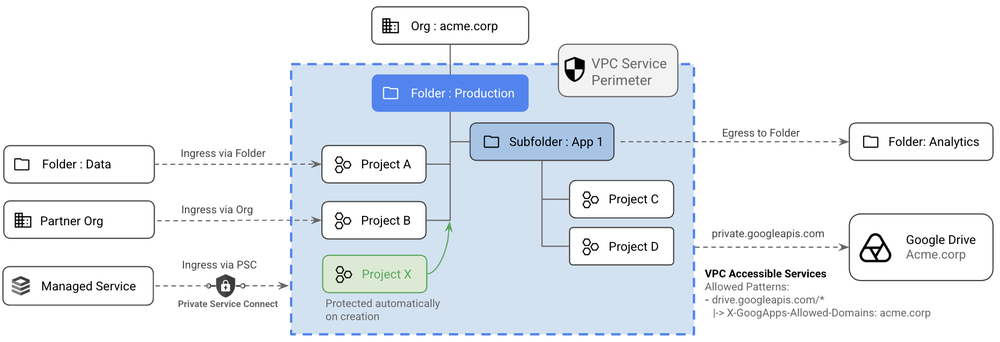
Agents represent a fundamental shift in cloud operations. They can act on behalf of users or autonomously, make non-deterministic decisions, and request data across projects at unprecedented speed and scale. Because agents are a distinct category of non-human identity (NHI), they require unique secure-by-default guardrails. Traditional, manually-operated network perimeters are vulnerable to today’s machine-speed attacks. Overly permissive perimeters, built to avoid blocked connections, increase the risk of unauthorized data theft, but overly strict perimeters stall development under a flood of access denials. Today, we're excited to announce key enhancements to VPC Service Controls (VPC-SC) that make perimeters easier to create, maintain, and scale. You can now add folders to perimeter membership, so that projects contained in them inherit policy. You can also manage granular exceptions and resolve denials with guided, scoped remediation. The result is data protected by default, so you can scale autonomous agents across your enterprise without letting data leave your perimeter. This update is generally available, and at no additional cost. Perimeters aligned to your architecture VPC-SC provides a context-aware network security perimeter around your Google Cloud deployment, designed to secure your organization against data theft, even in the event of compromised credentials, identity and access management (IAM) misconfigurations, and insider threats. By extending network-layer protection across service-to-service interactions in Google Cloud's infrastructure, VPC-SC goes beyond traditional firewalls and creates an additional layer of defense that prevents access outside your corporate network — and is now easier for your organization to manage. Cloud administrators configuring VPC-SC can now include folders in perimeter membership, automatically extending the folder’s access policy to every project and nested subfolder it contains. New workloads can inherit protection by default, with no further modification. Figure 1: Simplified perimeter authoring in VPC-SC. Perimeter membership updates when a project is moved, simplifying lifecycle maintenance. Security coverage follows the resource hierarchy that your organization already governs, and compliance verification requires only confirming that the resource is located in the correct part of the hierarchy. Dry-run mode also supports folder membership, helping administrators evaluate the effect of a hierarchy-wide perimeter against live traffic before enforcement. Folder and organization support in ingress and egress rules Well-defined ingress and egress rules establish granular, context-aware perimeters without sacrificing operational flexibility across complex multi-project environments. Security administrators can now specify Google Cloud folders and organizations directly within those rules. A single hierarchy reference stands in for the set of projects beneath it, which keeps rules concise, keeps attribute counts well within quota limits, and extends access automatically to projects created later in the hierarchy. Figure 2 : Simplified authoring of ingress/egress rules. Using Private Service Connect endpoints in ingress and egress rules Enterprises increasingly use private paths to reach desired endpoints in their deployment instead of exposing the traffic to the internet. Private Service Connect endpoints for Google APIs are now supported as an attribute in ingress and egress rules. Administrators can author a rule that authorizes access specifically over a designated private endpoint, producing a policy that corresponds directly to the connectivity architecture it is intended to govern. Figure 3: Supporting Private Service Connect endpoints with ingress and egress rules. For organizations that have standardized on Private Service Connect, including endpoints propagated across the estate through Network Connectivity Center, this provides both a more precise and a more concise means of expressing source for the request. Service patterns in VPC accessible services Service patterns in VPC accessible services provide granular control over Google APIs accessed with private Virtual IP addresses (VIP), permitting interoperability beyond just VPC-SC integrated services. If the workload requires controlled access to validated API endpoints over a private path, administrators can now allow only the specific API URL patterns required. Additionally, the capability supports appending org-restriction-headers with egress requests to facilitate access to only authorized domains and resources. Because you don’t need to manage egress-proxy, you can accommodate legitimate operational requirements while maintaining a tightly-bounded private path, instead of choosing between a broad allowance and no access at all. Figure 4: Granular control over Google APIs with service patterns in VPC accessible services. Guided violation remediation VPC-SC perimeter policies evolve continuously alongside the workloads they protect, and administrators periodically need to authorize a legitimate access request not yet covered. New Guided Violation Remediation in VPC-SC Violation Analyzer cuts resolution time for blocked requests from days to minutes by generating a policy fix with remediation recommendations, which you can validate in Dry-Run mode first. Rather than just diagnosing why the violation occurred for a given denial, Violation Analyzer evaluates the blocked request against the applicable perimeter configuration, and proposes a specific configuration change, narrowly scoped by least-privilege design principles, to authorize the traffic: an ingress rule, an egress rule, an access level, or an update to VPC accessible services. This relieves pressure on administrators to broadly open up a perimeter just to resolve a violation and get an application working quickly. Read more about how BlackLine uses Violation Analyzer to streamline investigations. Figure 5 : VPC-SC Violation Remediation for faster turn-around. Get started today VPC-SC makes it simple and automated to deploy and refine granular network perimeter protection, even for autonomous agents. To get started: Establish your folder baseline: Identify the folders in your resource hierarchy that correspond to the boundaries you intend to enforce, and define perimeters around them so that new workloads inherit policy on creation. Run risk-free in Dry-Run mode: Observe production traffic safely without blocking active developers. Unblock traffic with Violation Analyzer and Violation Dashboard: Use automated least-privilege remediation recommendations to resolve any denials that surface. Enforce with confidence: Secure your full data estate by transitioning to enforcement once your dry-run logs show your intended access with clean, authorized traffic. To learn more about how VPC-SC can help simplify your data security posture and confidently secure your autonomous agent fleets, check out the VPC-SC documentation.
Read original articleOctober 15, 2026
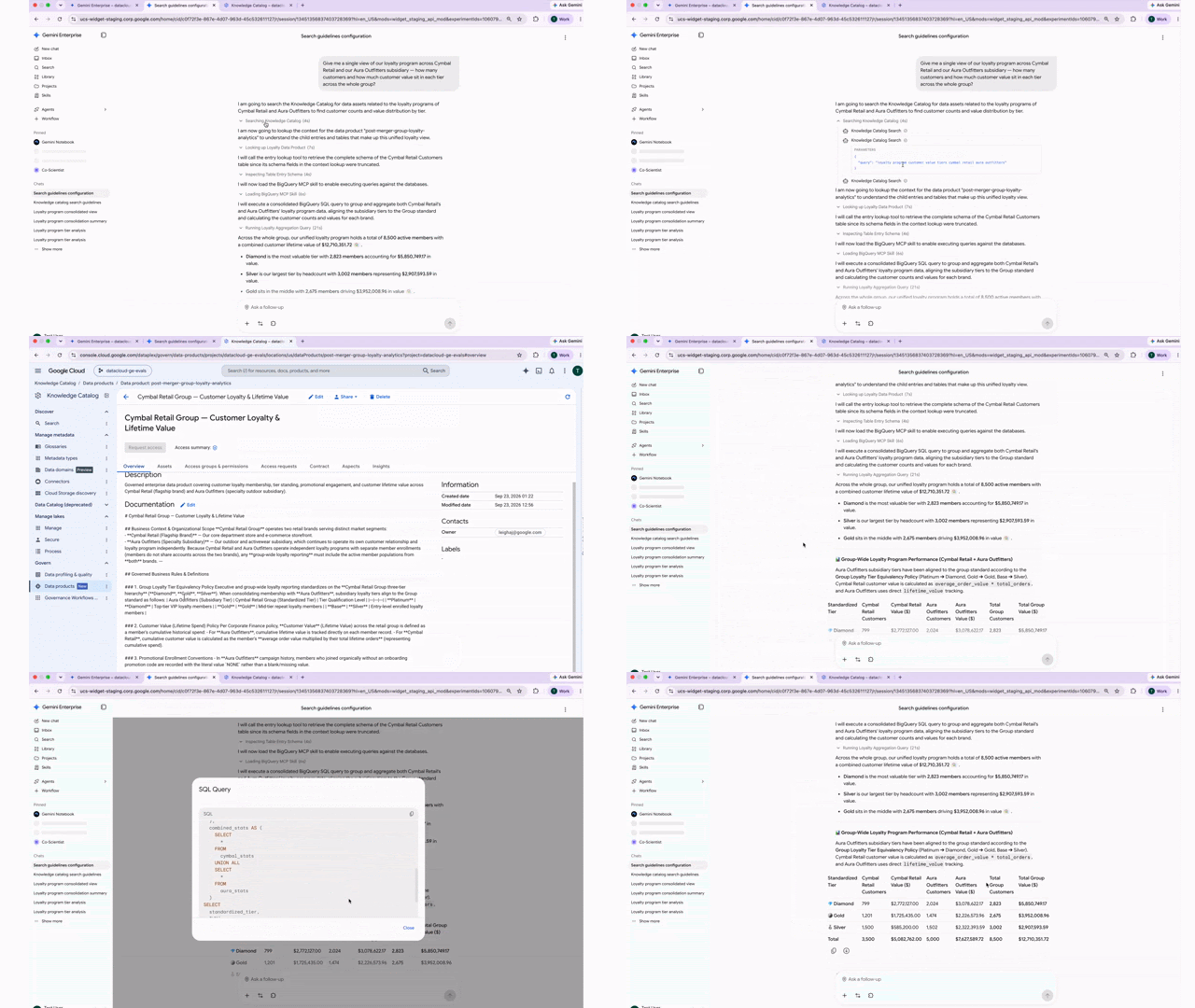
As enterprises shift their AI usage from experimental chatbots to autonomous agents, teams are hitting a critical bottleneck: accessing and reasoning over data scattered across multiple clouds, SaaS platforms, and on-premises systems. To turn AI agents into true systems of action, organizations need a foundation that can handle petabyte-scale reasoning without the security risks of data movement. Last week at our Gemini at Work event, we announced how Gemini can help you transform business workflows. To help power your agents with your enterprise data, we will dive deeper into the new Gemini integration with borderless Lakehouse to help you build, secure, and scale agents that work across your data estate. Access data that lives outside of Google Cloud through Gemini The ultimate value of the borderless Lakehouse is realized through the agents you build to transform your organization, with Gemini as the front door. With the new Gemini integration, data that’s either preconfigured or stored in your borderless Lakehouse is now directly integrated into Gemini. Currently in preview, this means you can set up access to new data sources, such as Databricks Unity Catalog or Snowflake Horizon, through Lakehouse catalog federation directly from Gemini. Now your business users can use natural language to query records that live across clouds while your AI agents can ground their reasoning and generate code from the same data — all without moving it. By directly contextualizing AI agents across your borderless Lakehouse, you can help accelerate your organization’s AI adoption while simplifying access to critical information. Gemini agents invoked by business users can access data that lives in BigQuery and Databricks Unity Catalog to provide comprehensive reporting and get insights using natural language. Borderless Lakehouse advancements In addition to this new, native integration with Gemini, we’re sharing that several features we introduced earlier this year to power your data foundation with the borderless Lakehouse are now generally available, including: Support for Cross-Cloud Interconnect and cross-cloud caching for AWS and Azure BigQuery support for Apache Iceberg V3 specifications Read-write interoperability on Apache Iceberg tables for both BigQuery and Managed Service for Apache Spark Bi-directional caching with AWS Glue, Databricks Unity Catalog, and Snowflake Horizon Catalog using Lakehouse runtime federation Integration with Knowledge Catalog Zero-copy data integration with Salesforce, SAP and Workday, and now, Confluent Tableflow Synchronization of Databricks Delta Lake assets through the Lakehouse console using Dataflow Let’s explore. Performance and reasoning at petabyte scale While agent context windows are typically limited to ingesting hundreds of kilobytes at a time, enterprise workflows sometimes join petabytes of data across clouds. An agent-native data platform that needs to combine data across sources, like product and customer data, to your CRM cloud and warehouse telemetry needs to be able to process data at scale. When you do this over MCP, you are limited to megabyte scale because of context windows and payload size. By integrating at every layer of the data and AI stack, the borderless Lakehouse provides enterprise-grade scalability, enabling agents to reason over petabytes of data with similar performance to it being stored locally. At the networking layer, Cross-Cloud Interconnect and cross-cloud caching provide high-throughput, low-latency paths to AWS and Azure, eliminating variable egress fees. When an agent joins Iceberg tables in Amazon Azure Data Lake Storage with data in BigQuery, every uncached byte it scans crosses a cloud boundary, so the network sets the pace. Cross-Cloud Interconnect gives the Lakehouse a dedicated, private connection between Google Cloud and AWS or Azure, at 10 Gbps or 100 Gbps per connection. Lakehouse queries travel over that connection rather than the public internet, so latency stays low and predictable. Cross-cloud caching serves repeat reads from inside Google Cloud, so agents can query data in other clouds without migrating it. The borderless Lakehouse includes several key optimizations to integrate Iceberg metadata within the query engine. BigQuery now supports Apache Iceberg V3 specifications, including binary deletion vectors and sort orders. These features allow the engine to handle row-level updates and deletes more efficiently by eliminating the need to rewrite entire data files. We also upgraded BigQuery’s execution engine with a new FlatBuffers-based Parquet reader and parallelized I/O to help reduce CPU overhead and serialization bottlenecks and narrow the performance gap between open formats and native storage. This builds upon recent performance innovations to the query engine designed to support agent workloads, which often come in herds and need to process small queries quickly and cost effectively. With BigQuery fluid scaling and history based optimizations, you can run scalable and efficient agent workloads while maintaining openness with Apache Iceberg. Meanwhile, read-write interoperability on Apache Iceberg tables for both BigQuery and Managed Service for Apache Spark makes it easy for all of your data teams to work off the same Iceberg tables in Google Cloud Storage. This vertically optimized stack helps make your agents faster and more cost-effective, leveraging the power of BigQuery and Lightning Engine to activate data without moving it. To expand the analytical depth of the lakehouse, graph support for Iceberg in BigQuery lets you analyze relationship networks, such as supply chains, directly on open table datasets. Comprehensive context and data access for your agents An AI agent is only as smart as the context it can access. To help prevent hallucinations and improve accuracy at the metadata layer, the borderless Lakehouse unifies your enterprise data using the Lakehouse runtime catalog. Based on the Apache Iceberg REST Catalog, it provides bi-directional catalog federation with AWS Glue, Databricks Unity Catalog, and Snowflake Horizon Catalog. The Lakehouse runtime catalog also includes a new standard Hive Metastore-compatible endpoint, allowing engines like Apache Spark, Trino, and Presto to discover metadata without architectural changes. The borderless Lakehouse also integrates directly with Knowledge Catalog, which automatically indexes your distributed data assets, to provide the precise business metadata and semantic definitions agents need to reason over your entire enterprise corpus — including unstructured data in Cloud Storage. This gives agents just enough context to be accurate while controlling token costs, helping you develop an intelligent and sustainable agentic strategy. The borderless Lakehouse provides zero-copy data integration with your SaaS applications like Salesforce, SAP and Workday and integrates with a larger partner ecosystem, capturing enterprise data in Knowledge Catalog and acting as a single context engine for your agents. Today, we’re expanding the partner ecosystem with new integrations for Confluent Tableflow, now generally available, which syncs to Lakehouse runtime catalog so the Iceberg tables it produces show up directly in BigQuery, with no copying and no extra ETL. Finally, organizations with Databricks-centric repositories can now easily import, transform and synchronize their Delta Lake assets into Lakehouse through the Lakehouse console using Dataflow. Modernize with ease Customer use of Apache Iceberg has more than tripled since the beginning of 2025, and enterprises building with Google Cloud’s borderless Lakehouse are seeing significant impact from it: Etsy unified three petabytes with borderless Lakehouse, joining data in place to accelerate pipeline queries by 60%. Commerzbank transforms raw distributed data into governed, agent-ready access. Hightouch integrates directly with borderless Lakehouse so teams can power their marketing directly on an open Iceberg lakehouse and activate that data across the Google Cloud ecosystem. Roundel modernized its Target Product Ads technology stack from the ground up with borderless Lakehouse, completely rebuilding its data ingestion, processing, and measurement pipelines. If you are ready to get started with the transition to borderless Lakehouse for your organization, it doesn’t need to be difficult. For organizations currently using legacy Dataproc Metastore, we now offer an automated, zero-downtime migration path to the serverless Lakehouse runtime catalog. This preserves your existing schemas and lineage while unlocking the AI-ready features of the borderless Lakehouse, so you can stop managing infrastructure and start activating agents. Get started today with the Build a borderless Lakehouse codelab or visit our website to learn more.
Read original articleOctober 15, 2026
October 12 - October 16 Looker Data Apps are now in Preview to build and host interactive, agent-generated applications natively inside LookerGenerated using natural language prompts, the Antigravity CLI, or Claude Code, these interactive web applications, natively hosted inside Looker, transform business reporting into operational systems of action. Users can test scenarios, adjust parameters, and trigger workflows in downstream platforms while inheriting LookML semantic modeling, row-level security, and access controls with no runtime LLM token costs. Read the announcement blog. Build end-to-end data science pipelines with the Data Agent KitFollowing the general availability of the Data Agent Kit, a new end-to-end walkthrough demonstrates how data teams can build, test, and schedule machine learning pipelines directly from their preferred code editors. Explore the walkthrough and codelab. Manage dashboard agents as code to bring CI/CD and version control to LookML dashboardsData teams can now declare agent parameters, configurations, and prompt instructions alongside dashboard files in code. This integration enables standard developer workflows for conversational BI, including Git version control, peer review, branching, and automated CI/CD validation before agent modifications reach production end users. Read the technical guide on the Google Developer Community. Simplify AI search with native AlloyDB hybrid search and Reciprocal Rank FusionAlloyDB for PostgreSQL simplifies hybrid search architectures by combining vector similarity search and keyword BM25 retrieval within a unified database engine. Using Reciprocal Rank Fusion (RRF), developers can merge lexical scoring and semantic embeddings into a single ranked result without writing a complex SQL query. This unified approach removes the operational overhead of running and synchronizing external search engines alongside operational databases for retrieval-augmented generation (RAG) and search applications. Explore hybrid search in AlloyDB. October 5 - October 9 Data Agent Kit is now generally available to bring Google Data Cloud to any coding agentData Agent Kit provides a free collection of Model Context Protocol (MCP) tools and Google-authored agent skills that connect more than 15 Google Data Cloud services directly to coding agents across VS Code, Antigravity, Cursor, Claude Code, and Codex. This release expands support for developers and data practitioners to inspect schemas, author queries, and build end-to-end data pipelines in natural language directly from their IDE or CLI. Read the announcement blog. Spanner Omni is now generally available for deploy-anywhere, multi-model workloadsSpanner Omni brings Spanner's distributed SQL, graph, vector, and key-value capabilities to any environment, including on-premises data centers, other public clouds via Kubernetes or VMs, and local developer laptops. Organizations can build and run multi-model applications with consistent APIs and query engines across hybrid and multi-cloud footprints while seamlessly scaling to managed Spanner on Google Cloud. Read the launch blog and explore how Spanner also removed cumulative mutation limits for DML transactions. AlloyDB delivers PostgreSQL for agents and native BM25 hybrid searchWe announced PostgreSQL for agents in AlloyDB, introducing an agentic database architecture engineered for real-time data access at agent scale with workload isolation. In addition, native BM25 ranking is now in Preview for AlloyDB and Cloud SQL, allowing developers to combine keyword search and vector embeddings directly in PostgreSQL without maintaining an external search engine. For hybrid deployments, the AlloyDB Omni RPM Orchestrator is now generally available, and you can dive deeper in our new Build AI apps and agents with AlloyDB eBook. Lakehouse runtime catalog adds regional endpoints across 22 regions and GA support for flexible column namesLakehouse runtime catalog regional endpoints are now live across 22 Google Cloud regions across the Americas, Europe, Asia-Pacific, and the Middle East, supporting both the Apache Iceberg REST catalog endpoint and the Apache Hive catalog endpoint to help customers meet strict data residency and sovereignty requirements. In addition, flexible column names for Apache Iceberg tables are now generally available by default across Iceberg external tables and managed tables, enabling seamless querying of columns containing spaces, hyphens, and Unicode characters. We also announced the Preview of cross-cloud caching and connections for the borderless Lakehouse. Unlock predictive and agent-ready insights with BigQuery augmented analytics TVFs, TabFM, and identity columnsBigQuery introduced augmented analytics table-valued functions (TVFs): six built-in functions that automate metric diagnostics, trend analysis, and pattern discovery directly where your data lives and integrate as skills for AI agents. We also introduced TabFM in BigQuery to bring tabular foundation model capabilities to predictive analytics, alongside BigQuery identity columns to automatically generate sequential surrogate keys and simplify data warehouse pipelines. Dataflow adds Pause/Resume and NVIDIA RTX PRO 6000 Blackwell GPU support for large-scale AI workloadsNew Dataflow capabilities make it easier to run high-throughput streaming and batch AI pipelines at scale, including Pause/Resume job controls and support for NVIDIA RTX PRO 6000 Blackwell GPUs. And for teams running Apache Spark workloads, learn how to mitigate compute stockouts and maximize availability using flexible VMs. Unlock up to 3x higher QPS and microsecond latency with Memorystore for Valkey 9.1Memorystore for Valkey 9.1 is now available, delivering up to 3x higher queries per second (QPS) and microsecond-level caching latencies to accelerate high-throughput applications and real-time AI agent state management. Read the blog. Customer momentum across Google Data Cloud — Yahoo, PayPal, Surescripts, Airwallex, and Lucius AIOrganizations across industries are scaling their data and AI foundations on Google Data Cloud. Yahoo uses flexible VMs in Managed Service for Apache Spark to reduce provisioning failures by 85%, while PayPal migrated mission-critical analytics workloads to Managed Service for Apache Spark to scale and reduce operational overhead. On the database front, Surescripts migrated 30.5 billion annual healthcare transactions to AlloyDB with 99.998% uptime, Airwallex manages more than 5,000 databases with 99.99% availability on Cloud SQL with a team of four DBAs, and Lucius AI runs a 210,000-tender global platform on AlloyDB and MCP with 47x faster ScaNN vector search. September 7 - September 10 Pub/Sub SMTs can now AI Inference your Gemini Enterprise Agent Platform models!Pub/Sub AI Inference SMTs allow you to apply inference on an incoming stream of events using models hosted in Gemini Enterprise Agent Platform. The model’s prediction is appended to your event, making it available for downstream processing in your data warehouse (like BigQuery) or operational database (like BigTable). This feature, now generally available, can dramatically simplify or enhance anomaly detection systems you are operating. PostgreSQL Source Connector is now generally available in Managed Service for Apache Kafka!Managed Service for Apache Kafka’s PostgreSQL connector allows customers to capture changes from their PostgreSQL database and ingest them into their Kafka infrastructure with low latency. This source connector is compatible with Cloud SQL for Postgres, AlloyDB, and self-managed PostgreSQL databases. Try this along with our entire portfolio of managed connectors, including MirrorMaker 2.0, BigQuery, Cloud Storage, and Pub/Sub! E-mail kafka-hotline@google.com if you have questions or feedback! Pause-on-failure for Dataflow batch jobs is GADataflow pause-on-failure enables you to preserve the state of a batch Dataflow job before it fails. By pausing your Dataflow job, you can address issues that are external to the pipeline and resume processing without losing completed work. This helps you better manage resource costs and improve job reliability when you face temporary outages or capacity constraints. The insertAll API is now the BigQuery Storage Write API (REST)The legacy insertAll streaming API is now rebranded as the BigQuery Storage Write API (REST). By dropping the "legacy" label, developers can confidently build long-term HTTP-based streaming workflows. This stateless JSON-over-HTTPS endpoint offers a lightweight alternative to heavy gRPC libraries—ideal for serverless web apps, IoT telemetry, and AI logging. The transition is seamless for existing users, requiring zero code changes and offering 100% backward compatibility. However, the Storage Write API (gRPC) version remains the recommended standard for high-throughput, continuous pipelines. August 31 - September 4 Stateful processing is available in BigQuery continuous queries in PreviewStateful operations significantly expand what’s possible with BigQuery continuous queries. This feature allows users to leverage functions like JOINs, aggregations, and windowing functions directly in their streaming queries. Now you can calculate metrics over time (for example, a 30-minute average) to power your downstream applications and AI agents with much richer, real-time signals.Try out our feature here and share your feedback with bq-continuous-queries-feedback@google.com! Synthetic data generator tool is available for Managed Service for KafkaYou’ve launched your first Kafka cluster. Now what? The next thing to do is to produce some data to the cluster, but that involves modifying a client application somewhere or spinning up a virtual machine. The synthetic data generator tool, now generally available, can start sending mock data to your cluster in 3 clicks, and will get data streaming into your cluster in less than two minutes. The perfect utility for those moments you just want to test your cluster and new features. Try our quickstart today! Dataflow pipeline updates are faster & more flexibleDataflow pipeline updates can now stop-and-replace pipelines, a major addition to the existing in-place-update feature. The new parallel pipeline option accelerates the migration between the old & new pipeline, resulting in reduced disruption to your business. You can also set a timeout on drains that prevents runaway costs for your pipeliness in the event of stuck processing. This feature is generally available. Try it here! July 6 - July 10 New Lakehouse managed tables now in preview Lakehouse tables for Apache Iceberg are now in preview and available in the console. By using Google-managed Apache Iceberg tables in Lakehouse, you can eliminate the overhead of maintaining duplicate data pipelines and complex synchronization logic between BigQuery and open-source engines. This unified table format delivers native, multi-engine read and write interoperability, allowing you to run concurrent DML/DDL operations across diverse analytics tools on a single, shared storage layer. Built-in automated table management handles painful background optimization tasks like compaction and partition tuning, freeing up your team to focus on building rather than managing storage maintenance. June 1 - June 5 Beyond the Query: Powering AI Agents with Bigtable, Firestore & Memorystore Discover the latest advancements in Google Cloud's NoSQL Database portfolio, including Bigtable, Firestore, and Memorystore. This series is designed for a broad audience: whether you are exploring these databases for the first time or are an existing user looking to leverage the new capabilities announced at Next '26. Register here to secure your spot! Cloud Engineer's AI Toolkit Workshops: Solve data-driven challenges with BigQuery, AlloyDB, Gemini and more. Hosted by Google Cloud Labs, this highly technical event is built specifically for Platform Engineers, SREs, and cloud infrastructure teams ready to bridge the gap between AI prototypes and production-grade deployments. Look out for more locations coming soonToronto - June 25 (Data Cloud) | RSVP HereChicago - June 30 (Data Cloud) | RSVP Here Start a 10-day Bigtable free trial with a 1 node SSD cluster and up to 500GB of storage capacity. With no credit card required to start, you can easily ingest workloads and manage workloads that require low-latency, high-throughput, and predictable access. Plus, new Google Cloud customers get $300 in free credits on signup. May 11 - May 15 Managed Service for Apache Airflow has launched a wave of new features, including the general availability of Airflow 3.1, AI-powered agentic troubleshooting, a new managed Airflow MCP Server for custom agent integration, and declarative YAML-based orchestration pipelines—discover all the details in the full blog post. April 20 - April 24 Google-built ODBC Driver for BigQuery is now available in PreviewWe are excited to announce the launch of the new, Google-built ODBC driver for BigQuery. This new open-source driver provides a direct, high-performance connection for applications to BigQuery and is developed entirely in-house by Google. Download a new driver and connect your application to BigQuery. April 13 - April 17 We announced we are reintroducing Data Studio to play a significant role in the AI era, expanding from data visualizations and reports to host BigQuery conversational agents and data apps built in Colab notebooks. We announced BigQuery Graph is now available in preview, offering an easy-to-use, highly scalable graph analytics solution, empowering data professionals to model, analyze and visualize massive-scale relationships in an entirely new way. April 6 - April 10 We introduced Conversational Analytics for Looker Embedded environments, enabling users to add natural language experiences to their own custom data-driven applications, powered by Gemini. We expanded Looker’s capabilities for faster ad-hoc analysis, with the introduction of self-service Explores, enabling you to bring your own data to Looker’s semantic layer and gain instant access to insights in a governed data environment. March 23 - March 27 We showed you how you can scale your reads with Cloud SQL autoscaling read pools. This feature allows you to provision multiple read replicas that are accessible via a single read endpoint and to dynamically adjust your read capability based on real-time application needs. Our customers are leveraging the full power of Conversational Analytics and Looker to drive major business and technical breakthroughs in the AI era. Companies like Telenor, Pet Circle, Fluent Commerce, Lighthouse Intelligence, Wego, and ROLLER are turning data into insights and actions, grounded by Looker’s semantic layer. March 16 - March 20 We introduced an enhanced Gemini assistant in BigQuery Studio, transforming the agent from a code assistant into a fully context-aware analytics partner. February 23 - February 27 We introduced managed and remote MCP support for Google Cloud databases, including AlloyDB, Spanner, Cloud SQL, Bigtable and Firestore, to power the next generation of agents. This announcement extends the ability for AI models to plan, build, and solve complex problems, connecting to the database tools our customers leverage daily as the backbone of their work environment. We outlined how you can build a conversational agent in BigQuery using the Conversational Analytics API to help you build context-aware agents that can understand natural language, query your BigQuery data, and deliver answers in text, tables, and visual charts. February 16 - February 20 Our customers are leveraging the full power of Looker to drive major business and technical breakthroughs. Companies like Arrive, Audika, Carousell, Framebridge, GumGum, Intel, Overdose Digital, Ocean Network Express, Subskribe and Promevo are leveraging Looker’s newest AI-driven capabilities, including Conversational Analytics, to transform data to insights and actions, and empower their entire organization with a single source of truth, powered by Looker’s semantic layer. February 2 - February 6 Join us on March 4 for our webinar, Win Your AI Strategy with Cloud SQL Enterprise Plus, to learn how to power your generative AI workloads with 3x higher performance and 99.99% availability. Register today to discover how to build a scalable, enterprise-grade foundation for your most demanding AI applications. January 26 - January 30 We introduced Conversational Analytics in BigQuery, which allows users to analyze data using natural language. Conversational Analytics in BigQuery is an intelligent agent that generates, executes and visualizes answers grounded in your business context directly in BigQuery Studio, making data insights for data professionals more conversational. We outlined how data products have become the foundation for AI agents, providing the context needed to make autonomous agents reliable and trusted for real business use, backed by organized business logic and semantic understanding. We highlighted how you can supercharge data analytics workflows, and outlined Google Cloud’s AI agent offerings for data engineering, data science, and development tools, so you can integrate agentic workflows in your applications, empower your teams and speed discovery. January 19 - January 23 We have fundamentally reimagined Firestore with pipeline operations for Enterprise edition. Experience a powerful new engine featuring over a hundred new query features, index-less queries, new index types, and observability tooling to improve query performance. Seamlessly migrate using built-in tools and leverage Firestore’s existing differentiated serverless foundation, virtually unlimited scale, and industry-leading SLA. Join a community of 600K developers to craft expressive applications that maximize the benefits of rich queryability, real-time listen queries, robust offline caching, and cutting-edge AI-assistive coding integrations. Introducing Google Cloud SQL on MSSQLTips: We are highlighting a new technical guide published on MSSQLTips titled "Introducing Google Cloud SQL." This article serves as an essential resource for SQL Server administrators and developers exploring Google Cloud's fully managed database service. It provides a detailed overview of Cloud SQL capabilities, including high availability, security integration, and the seamless transition of on-premises SQL Server workloads to the cloud, making it an ideal resource for those planning their migration strategy. We are excited to announce the Public Preview of Microsoft Entra ID (formerly Azure Active Directory) integration with Cloud SQL for SQL Server. Designed to tackle the challenge of identity sprawl in multi-cloud environments, this integration allows organizations to govern database access using their existing Microsoft identity infrastructure. Key benefits include centralized identity management, enhanced security features like Multi-Factor Authentication (MFA), and simplified user administration through direct group mapping. This feature is available for SQL Server 2022 and supports both public and private IP configurations. January 12 - January 16 Google-built JDBC Driver for BigQuery is now available in PreviewWe are excited to announce the launch of the new, Google-built JDBC driver for BigQuery. This new open-source driver provides a direct, high-performance connection for Java applications to BigQuery and is developed entirely in-house by Google. Download a new driver and connect your Java application to BigQuery. Troubleshoot Airflow tasks instantly with Gemini Cloud Assist investigations: Cloud Composer just got smarter. We are excited to announce that Gemini Cloud Assist investigations are now available directly within Cloud Composer 3. Instead of manually sifting through raw logs, you can now simply click "Investigate" on a failed Airflow task. Gemini analyzes logs and task metadata to identify failure patterns—such as resource exhaustion or timeouts—and provides actionable recommendations driven by Gemini Cloud Assist to resolve the issue. This integration shifts the debugging experience from manual toil to automated root cause analysis, significantly reducing the time required to restore your pipelines. Learn more about AI-assisted troubleshooting. Related Article What’s new with Google Data Cloud - 2025 Recent product news and updates from our data analytics, database and business intelligence teams. Read Article
Read original articleOctober 15, 2026
Better Artificial Intelligence Stock for 2026: Astera Labs vs. Marvell Technology Yahoo Finance
Read original articleOctober 15, 2026
Eight States Bring Parallel Lawsuits Against OpenAI Over Safety Issues PYMNTS.com
Read original articleOctober 15, 2026
FTC may fine AI firms on par with companies that delay data breach reports.
Read original articleOctober 15, 2026
Nvidia Corp. Chief Executive Officer Jensen Huang defended the financial health of AI computing supplier CoreWeave Inc., a major customer in which the chipmaker is also an investor, after concerns over its debt sparked a massive selloff of its shares and bonds.
Read original articleOctober 15, 2026
Bank of America has hired 1,000 outside contractors to fix software vulnerabilities uncovered by AI models like Anthropic's Mythos, CNBC reports. The article Bank of America puts 4,000 people on fixing vulnerabilities uncovered by Anthropic's Mythos and other AI models appeared first on The Decoder.
Read original articleOctober 15, 2026
Better Artificial Intelligence Stock for 2026: Broadcom vs. NVIDIA Yahoo Finance
Read original articleOctober 15, 2026
Blackstone’s Jon Gray Plots Once-in-a-Century Bet on the AI Boom Bloomberg.com
Read original articleOctober 15, 2026
FTC subpoenas Anthropic and OpenAI over artificial intelligence safety concerns The Independent
Read original articleOctober 15, 2026
Anthropic’s done it again. On Tuesday, Opaque Systems announced a new agreement with Anthropic that “carries Opaque’s work forward.” Vague The post Anthropic’s been eyeing confidential AI. It just made its move with another acquihire. appeared first on The New Stack.
Read original article