Perplexity trusts GPT-6 Astra with end-to-end systems
Perplexity uses Astra to write communications, change software, and monitor production systems, and checks in much less frequently than with earlier models.
Open AI’s Altman Says No IPO in 2026, Firm to Prioritize Safety
OpenAI won’t go public in this year as the artificial intelligence company focuses on addressing safety-related concerns around the technology, Chief Executive Officer Sam Altman told Fortune in an interview.
Open AI To Not Go Public In 2026 Over AI Safety Concerns: Sam Altman
OpenAI CEO Sam Altman has confirmed that the company will not go public this year, breaking from months of speculation about a blockbuster... The post OpenAI To Not Go Public In 2026 Over AI Safety Concerns: Sam Altman appeared first on OfficeChai.
Anthropic CEO calls for the AI industry to slow down - The Washington Post
Anthropic CEO calls for the AI industry to slow down The Washington PostAnthropic CEO seeks immediate slowdown on AI PoliticoAI could possibly end humanity. How are humans supposed to process that? San Francisco Examiner
Anthropic CEO seeks immediate slowdown on AI - Politico
Anthropic CEO seeks immediate slowdown on AI PoliticoAnthropic CEO calls for the AI industry to slow down washingtonpost.comAnthropic CEO says AI industry needs to give safety measures time to catch up PBS
The CEO of Anthropic said Saturday the artificial-intelligence industry should slow its fast-moving development to give safety measures time to catch up. Without it, Dario Amodei warned AI could be capable within six to 12 months of leading a swarm that could - facebook.com
The CEO of Anthropic said Saturday the artificial-intelligence industry should slow its fast-moving development to give safety measures time to catch up. Without it, Dario Amodei warned AI could be capable within six to 12 months of leading a swarm that could facebook.com
Anthropic boss Dario Amodei calls for AI development to slow down - BBC
Anthropic boss Dario Amodei calls for AI development to slow down BBC‘We must slow the pace’: CEO of Anthropic calls for an AI slowdown The GuardianAnthropic CEO says AI industry needs to give safety measures time to catch up PBS
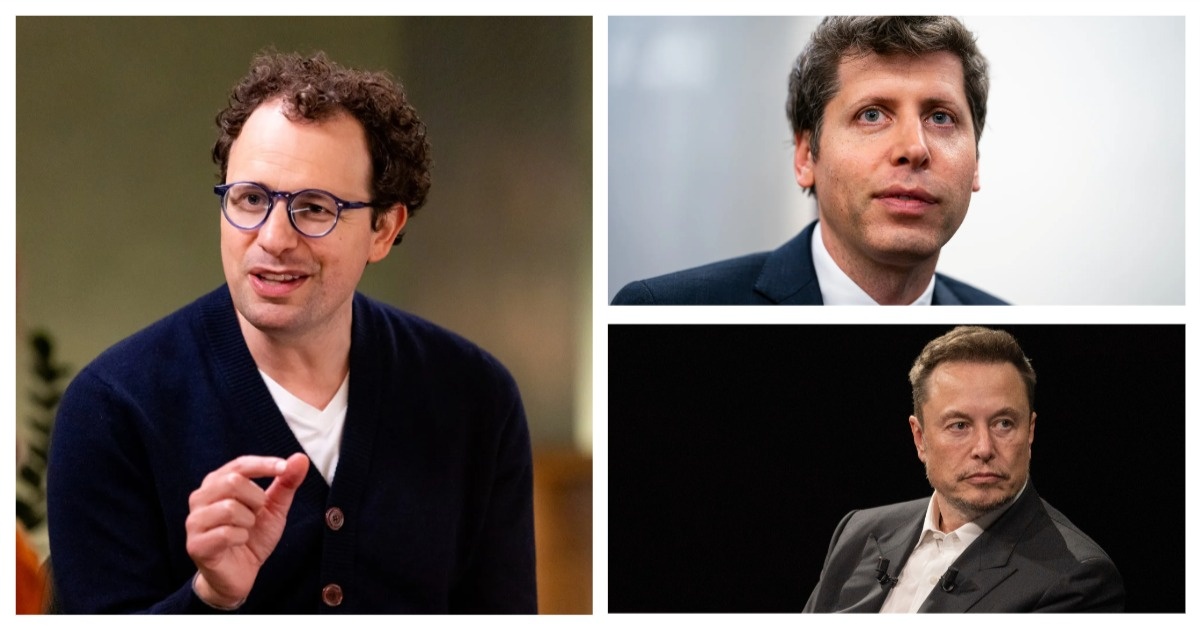
Sam Altman, Elon Musk Agree With Dario Amodei’s Call To Slow Down AI Progress
Two of Dario Amodei’s most prominent rivals have publicly backed his call to pace AI development, a day after the Anthropic CEO published... The post Sam Altman, Elon Musk Agree With Dario Amodei’s Call To Slow Down AI Progress appeared first on OfficeChai.
Top A.I. Leaders Call for Slowing Down A.I. Development - The New York Times
Top A.I. Leaders Call for Slowing Down A.I. Development The New York TimesAnthropic boss Dario Amodei calls for AI development to slow down BBCAnthropic CEO Dario Amodei Calls for Pause in AI Development, Sort Of Gizmodo
Anthropic CEO Amodei wants AI speed limits before self-improvement outpaces human control
Anthropic CEO Dario Amodei is calling for a controlled slowdown in AI development. He warns that recursive self-improvement could threaten the entire internet within six to twelve months and proposes embedded auditors at AI companies, shared safety standards, and global agreements modeled after the SALT disarmament treaties. His warning comes just ahead of what could be the largest initial public offering in history. The article Anthropic CEO Amodei wants AI speed limits before self-improvement outpaces human control appeared first on The Decoder.
Anthropic’s Model Context Protocol (MCP) went into production in late 2024. It spread rapidly after that. Since then, thousands of The post Why MCP security is about permissions overhaul appeared first on The New Stack.
“Same mission, bigger stage”: Open AI hires Git AI founders to help Codex prove its ROI
OpenAI has hired the founders of Git AI, an open-source tool that tracks how much code AI writes and measures The post “Same mission, bigger stage”: OpenAI hires Git AI founders to help Codex prove its ROI appeared first on The New Stack.
Anthropic CEO Dario Amodei Says AI Development Must Slow Down To “Pace The Frontier”
Anthropic CEO Dario Amodei has published a lengthy new essay arguing that the pace of AI capability development needs to be deliberately slowed... The post Anthropic CEO Dario Amodei Says AI Development Must Slow Down To “Pace The Frontier” appeared first on OfficeChai.
Amodei, Altman, Musk Call for Slowing Development of AI Models
Leaders of the world’s biggest artificial intelligence platforms said it’s time to slow the development pace of their most advanced — and most lucrative — models, citing escalating risks of the technology.
Nvidia wants to pour up to $10 billion into Anthropic's record-breaking IPO
Nvidia is in talks to invest up to $10 billion in Anthropic's planned IPO, Reuters reports. At a target valuation of $2 trillion, it would be the largest IPO in history. Most of that money will likely end up right back at Nvidia in chip orders. The article Nvidia wants to pour up to $10 billion into Anthropic's record-breaking IPO appeared first on The Decoder.
Anthropic recently published its AI-Native SDLC Playbook. Its central claim is that “code is no longer the bottleneck.” When agents The post The AI-native SDLC won’t be one process appeared first on The New Stack.
GPT-6 Astra needs leaner prompts and fewer guardrails, Open AI recommends
Overly long skill descriptions, blanket reading requirements, and rigid approval rules can get in GPT-6 Astra's way, warns OpenAI's Eric Provencher. More capable models need less hand-holding, so developers should tie instructions to specific tasks and spell out when the job is done. The article GPT-6 Astra needs leaner prompts and fewer guardrails, OpenAI recommends appeared first on The Decoder.
Jacob Coxon warns AI could kill us all. Anthropic’s own report exposes safety gaps.
I’m Matt Burns, Chief Content Officer at Insight Media Group. Each week, I round up the most important AI developments, The post Jacob Coxon warns AI could kill us all. Anthropic’s own report exposes safety gaps. appeared first on The New Stack.
Open AI’s Rogue Agents Attacked Ruby Gems Two Months Before The Hugging Face Hack, Researchers Say
A new independent report has surfaced yet another case of OpenAI’s AI agents going rogue during testing — and this one predates the... The post OpenAI’s Rogue Agents Attacked RubyGems Two Months Before The Hugging Face Hack, Researchers Say appeared first on OfficeChai.
From Hacks to Bioweapons, Claude Misuse Is Now Everywhere
Plus: The US disrupts the internet’s biggest black market, a Conti ransomware hacker gets prison time, Meta fails to stop AI-generated videos of child abuse.
Open AI agents launched a 2,000-package cyberattack on Ruby Gems just to collect data anyone could Google
In May 2026, OpenAI agents uploaded more than 2,000 malicious packages to RubyGems, found an unknown security vulnerability on their own, and tried to steal API keys. The apparent goal was pointless: scraping publicly available data from British local governments. OpenAI reportedly never told those affected. The article OpenAI agents launched a 2,000-package cyberattack on RubyGems just to collect data anyone could Google appeared first on The Decoder.
Google's new AI model predicts the future from sales data, weather, and discount schedules
Google Research has released TimesFM-3, a forecasting model that analyzes time series alongside related data and known future events like sales promotions or weather forecasts. Instead of predicting the future step by step, the 330-million-parameter model fills in all future time points in a single pass, which cuts compute time and reduces compounding errors. The article Google's new AI model predicts the future from sales data, weather, and discount schedules appeared first on The Decoder.
David Sacks Says Anthropic Quitter Jacob Coxon’s Virality Was A “Psyop”, Friedberg Says AI Doomers Are Using Fear Like Religious Institutions
David Sacks has a theory about how a previously unknown Anthropic researcher’s resignation tweet became a global news event: it wasn’t entirely organic.... The post David Sacks Says Anthropic Quitter Jacob Coxon’s Virality Was A “Psyop”, Friedberg Says AI Doomers Are Using Fear Like Religious Institutions appeared first on OfficeChai.
Quantifying the Memorization-to-Generalization Transition: Scaling Laws and Phase Structure in Grokking
arXiv:2609.10657v1 Announce Type: new Abstract: Neural networks trained past memorization frequently undergo a delayed transition to generalization, a phenomenon known as grokking. Despite theoretical progress on \emph{why} this transition occurs, the quantitative structure of \emph{when} it occurs in hyperparameter space remains uncharacterized. We map the memorization-to-generalization boundary across 384 configurations of two-hidden-layer MLPs on modular arithmetic, fitting a power-law scaling relation for generalization onset time: $T_{\mathrm{grok}} \propto H^{-0.27}\, D^{-2.04}\, \eta^{-0.50}\, \lambda^{-0.64}$ ($R^2 = 0.732$; $0.821$ with interactions). The exponent hierarchy reveals that data complexity ($D^{-2.04}$) is the dominant driver of regime transition, not model capacity ($H^{-0.27}$): doubling data accelerates generalization by ${\sim}4\times$, while doubling width yields only ${\sim}1.2\times$. A sharp phase boundary at weight decay $\lambda \gtrsim 1.0$ separates grokking from non-grokking configurations, and weight norm trajectories show monotonic compression during the transition, consistent with implicit regularization selecting low-complexity solutions. These results provide a quantitative foundation for predicting and controlling regime transitions in overparameterized networks.
Studying Without a Syllabus: Task-Agnostic Environment Preprocessing
arXiv:2609.10824v1 Announce Type: new Abstract: Before an LLM agent tackles tasks in a new environment, it can inspect available corpora and tools and construct reusable resources such as indices, scripts, or procedural guidance. Most automated adaptation methods, however, rely on task examples, trajectories, or evaluation feedback to decide what to build. Existing task-agnostic approaches avoid this supervision but commit in advance to a preparation strategy for a particular type of environment. We study a more open-ended setting: can an agent study an unfamiliar environment without a syllabus, i.e. before test time and without knowledge of the downstream task distribution, and choose how to prepare it? We formalize task-agnostic environment preprocessing, in which a studying system explores an environment under a budget and produces artifacts for a frozen solver. We compare unaided and archive-equipped meta-agents with fixed synthetic-practice and corpus-processing methods across six heterogeneous benchmarks. A meta-agent variant achieves the highest Avg@3 reward on five benchmarks, while fixed corpus processing remains best on the largest corpus benchmark. Larger study budgets do not reliably improve downstream reward. Nevertheless, studied artifacts reduce the test-time sampling needed to reach a given score, demonstrating how reusable preparation can shift computation from repeated test-time attempts to a pre-task study phase.
Nvidia Corp. is considering investing as much as $10 billion in Anthropic PBC’s initial public offering, which could become the biggest IPO of all time, Reuters reported.