August 4, 2026
Icon inks Anthropic partnership to deploy Claude into clinical trials - Fierce Biotech
Icon inks Anthropic partnership to deploy Claude into clinical trials Fierce Biotech
Read original articleDataAIHub Daily
Archive →32 curated AI news stories from leading AI companies.
August 4, 2026
Icon inks Anthropic partnership to deploy Claude into clinical trials Fierce Biotech
Read original articleAugust 4, 2026
Anthropic has been on a cloud partnership spree in recent months, and its latest move is reportedly a $10 billion deal with AI cloud startup Volta.
Read original articleAugust 4, 2026
The week-old Open Secure AI Alliance, spearheaded by Nvidia and grown to over 120 companies, already has proposals out for defending against AI agents.
Read original articleAugust 4, 2026
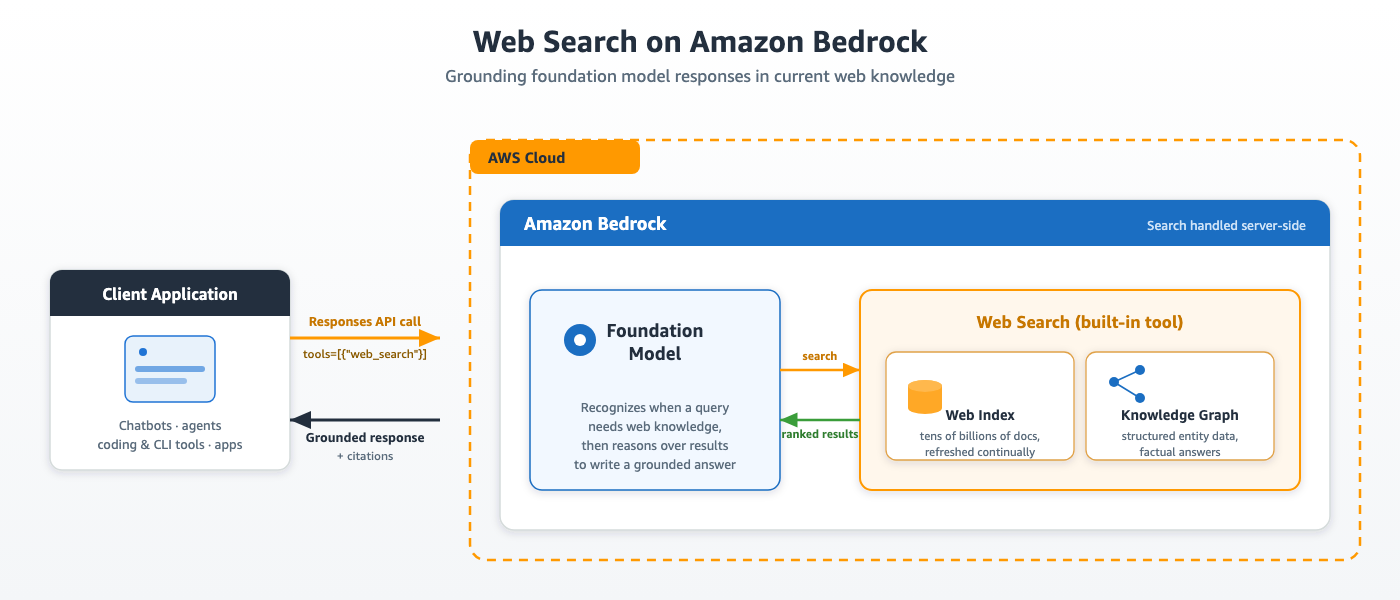
Today, we are introducing the general availability of Web Search on Amazon Bedrock. It is a server-side built-in tool that grounds model responses in current web knowledge. With Web Search, grounding becomes a native capability of Amazon Bedrock, with no third-party vendors to onboard, no external APIs to orchestrate, and no additional third party vendor security reviews to conduct. In this post, we walk through what Web Search on Amazon Bedrock is, why it matters, how to enable it using the OpenAI Responses API, and how to get started with the tool.
Read original articleAugust 4, 2026
Thibault Sottiaux, who leads core products at OpenAI, believes that today’s version of Codex will seem outdated before the year The post Today’s Codex will feel “primitive” by fall — and its own team’s roadmap backs it up appeared first on The New Stack.
Read original articleAugust 4, 2026
Developers increasingly want to build agents that can reason about code, modify files, execute commands, interact with developer tools, and work across entire repositories. While GitHub Copilot already provides a powerful coding harness for these scenarios, developers often need additional capabilities such as observability, middleware, approval workflows, enterprise governance, and integration with broader agent ecosystems. […] The post Build Production-Ready Agents with the GitHub Copilot Harness and Agent Framework appeared first on Microsoft Agent Framework.
Read original articleAugust 4, 2026
OpenAI shared a big research update this week, announcing that an internal version of Astra, its next frontier model, created The post OpenAI’s Astra just proved 10 long-standing math and science theorems. The tokens cost $2,000. appeared first on The New Stack.
Read original articleAugust 4, 2026
Google is working with Broadcom, Apollo, Blackstone, and Morgan Stanley on a multibillion-dollar financing structure that supplies Anthropic with AI chips and data centers while keeping most of the risk off Google's balance sheet. The setup leaves roughly $200 billion in contracts dependent on Anthropic's continued growth and ability to make its lease payments. The article Google moves billions in Anthropic chip risk off its balance sheet appeared first on The Decoder.
Read original articleAugust 4, 2026
The last six months have seen a rapid rise in AI-powered productivity and a proliferation...
Read original articleAugust 4, 2026
A central challenge in robotics is building policies that generalize beyond the demonstrations they’re trained on. A policy that succeeds in a training scene...
Read original articleAugust 4, 2026
For the past two years, most of the conversations about AI and software development have centered on security: How do The post Claude, Gemini, and GPT-5 can handle every SDLC task. Almost none of them should. appeared first on The New Stack.
Read original articleAugust 4, 2026
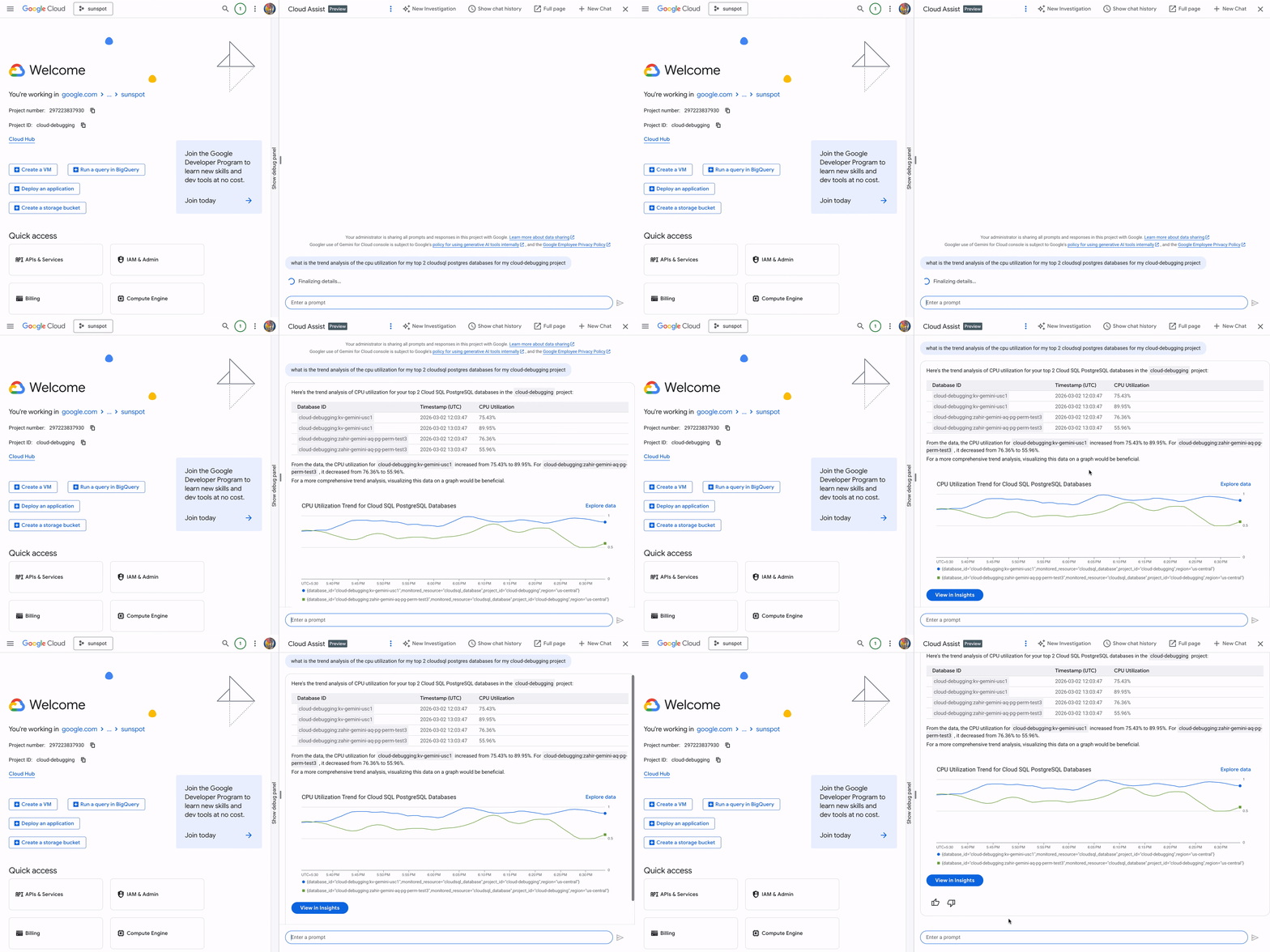
As part of the Agentic Data Cloud launch at Google Cloud Next ‘26, we announced two AI-powered database agents to simplify database management. These include the Database Onboarding Agent for Day 0 operations — setup, configuration, and initial deployment — as well as the Database Observability Agent for Day 1 and 2 operations, including monitoring, troubleshooting, and ongoing maintenance. These agents are always on, informed by Google’s years of experience, and integrated across Google surfaces such as Chat, CLI, the Google Cloud console, Managed Context Protocol (MCP) servers, and third-party tools — including your preferred integrated development environment (IDE), so you get help where and when you need it. Traditionally, managing and creating databases has involved a combination of manual architecture planning, custom scripts, and distinct tools. Teams handle database provisioning, schema design, index configuration, and query tuning, alongside performance monitoring—often cycling through repeated testing and optimization cycles as application demands change. Although this method is functional, it demands substantial technical skill and continuous attention throughout the entire database lifecycle. For example, developers often fear making an update that may limit their ability to scale the system later. Similarly, when an application slows down, finding the exact query or resource constraint causing the issue can take hours of manual investigation and troubleshooting. Intelligent AI-powered agents can simplify database lifecycle management by automating many of these tasks such as recommending the right database type for the workload, detecting anomalies, recommending the right configurations, optimizing queries, and providing actionable insights to improve operational efficiency. By embedding these capabilities directly into workflows where you need them, agents help organizations build, operate, and optimize databases more efficiently while reducing operational overhead. Let’s take a closer look at these new database agents. Database Observability Agent: From diagnosis to remediation The Observability Agent empowers Site Reliability Engineers (SREs), DevOps pros, DBAs and developers to diagnose complex issues and remediate them using simple natural language prompts. As your operations scale, identifying subtle issues like query hotspots or lock contention becomes an expensive burden. The database observability agent uses Google’s operational expertise and the reasoning capabilities of Gemini to solve these challenges. By automatically connecting telemetry across multiple sources including Database Insights, Cloud Monitoring, Cloud Logging, and Cloud Trace the agent provides a clear root cause analysis in minutes. Beyond just identifying the "why," the agent suggests recommended actions to fix the issues found, and can execute validated actions with your approval. For example, if it detects a bottleneck, it might suggest you "Enable connection pooling for Cloud SQL instance," providing the rationale and expected impact before you commit to the change. Some capabilities include: Fleet-level troubleshooting: The Observability Agent is integrated with Database Center so you can use Gemini Chat to ask complex fleet-wide questions like, "Which databases in my fleet consumed the most CPU in the last 7 days?" to receive a summarized analysis across your entire fleet. In-product investigations: The agent correlates complex telemetry across Database telemetry, Cloud Monitoring, Cloud Logging, Cloud Trace, and multiple other data sources to pinpoint issues like latency spikes or lock contention. (In preview with select customers) Validated remediations: Instead of just identifying problems, the agent provides crisp recommendations and can execute validated actions with your approval, such as adding indexes for a Cloud SQL instance. (In preview with select customers) MCP tools: The Observability Agent derives insights with the help of tools such as system metrics, query metrics, fleet inventory, and issues, which are also available as MCP tools via the Database Insights MCP Server and Database Center MCP Server. Integration that fits your workflow You can access these Database Observability Agent capabilities directly within your existing database management processes. The agent powers several experiences, including: Cloud Assist chat: Ask questions in natural language, for example, "What is the CPU utilization trend for my top Cloud SQL instances?" to get a summarized analysis complete with charts. Then, within the Chat window, you can start an investigation for any issues found,and get a root-cause analysis and remediations. In-product investigations: Use Gemini Cloud Assist to investigate and remediate issues in-context on relevant database pages from the console. Developer tools: Consume the agent’s capabilities through Antigravity or an IDE of your choice. This is augmented by the rich set of observability MCP tools that Google provides. All of these tools are available on Google Remote MCP servers. Combining them together is like giving developers a virtual DBA to optimize their databases, but all within their IDEs. Supports multiple managed databases You can use Observability Agent to get answers to your database queries, to access any database metric instantaneously, or to leverage AI-powered diagnosis to resolve complex problems. The agent covers a broad set of issues across a variety of Google Cloud databases, including: Cloud SQL: Troubleshoot and optimize your database instance load, query performance or connectivity issues for all Cloud SQL database engines. For Cloud SQL for PostgreSQL, leverage the agent to troubleshoot common database issues. Similarly, the agent helps you identify issues, find their root cause, and take remediation actions for other supported databases and issue types. Spanner: Here, the most common troubleshooting scenario involves optimizing read and write latencies. The agent helps you do that in minutes, covering a broad set of scenarios ranging from hotspots to lock contentions. AlloyDB: Troubleshoot and optimize your database instance load, query performance or replica lag issues. Bigtable: Diagnose and optimize your read and write latencies, complete with crisp, actionable recommendations. Database Onboarding Agent The new Database Onboarding Agent is your active partner during the database selection process. Instead of spending hours reading documentation, you can describe your application requirements to the agent in natural language. The agent understands technical metrics like IOPS, latency limits, and replication lag, so it can provide a sound recommendation. You can access the Database Onboarding Agent’s capabilities directly within the Gemini chat interface. With the Database Onboarding Agent, you get: Recommends database solutions: Analyzes user requirements regarding workload performance, scale, data type, and reliability to suggest optimal Google Cloud Managed Database services (e.g., Cloud SQL, Spanner, AlloyDB). Smart recommendations: The agent reflects your requirements back to you, such as recommending AlloyDB for a high availability configuration, helping you have confidence in its selections. Streamlined configuration: Once you choose a service, the agent generates the required commands. You can then use these commands to provision your database instance, configure the correct features, and deploy it. Get started The Database Observability and Onboarding Agent’s capabilities are available for a wide range of services, including AlloyDB, Bigtable, Cloud SQL (PostgreSQL, MySQL, SQL Server), Firestore, Memorystore, and Spanner. These agents are currently available via Gemini Cloud Assist. Explore AI assisted troubleshooting and Gemini Chat for AlloyDB, Cloud SQL, Spanner, and Visit Gemini Cloud Assist page to learn more.
Read original articleAugust 4, 2026
In today’s retail environment, shoppers expect highly personalized product discovery experiences and conversational assistance that feels genuine, natural, and genuinely helpful. Today, successful product discovery is about understanding semantic meaning and the rich, connected relationships between products, categories, and guest intent. It is no longer just about keywords and basic browsing. At Target, this work is handled by our Guest Product Confidence platform team. They are responsible for building the features that establish trust and guide purchasing decisions, such as ratings, reviews, and AI-driven digital shopping assistants. An exciting example of this is our Gift Finder chat agent, which we launched during the 2025 holiday season online and in the Target app to help shoppers discover the perfect items through friendly, conversational dialogue. To deliver real-time personalization and context-rich semantic responses like these at global scale, we identified a critical architectural need to move away from a fragmented data ecosystem toward a unified data platform. We needed a solution capable of supporting high-throughput transactional workloads, highly connected graph relationships, vector similarity search, and full-text keyword search all at once. In this post, we’ll explore how we achieved all four with Spanner. Overcoming fragmented architecture Previously, Target’s discovery data ecosystem relied on a combination of Elasticsearch clusters for search and inverted indexes, alongside separate NoSQL datastores for our transactional data. While functional, this fragmented architecture presented significant operational and technical challenges. Disconnected context: Keeping separate search, vector, and transactional databases in perfect sync was a constant challenge. Siloed information led to missing context, disconnected attribute relationships, and inconsistent query results. High operational overhead: Managing independent clusters, tuning search indexes, and handling complex, custom synchronization and aggregation logic required intensive manual intervention from our engineering teams. Expansion bottlenecks: Expanding our retail data domains required adding new database collections, maintaining complex joins, and navigating weak transactional guarantees across our discovery and core transactional systems. Siloed intelligence: We lacked the ability to query graph relationships, vector similarity, and keyword search indexes in a single transaction. To build the next generation of AI-driven guest experiences, we needed to consolidate on one platform. Building the enterprise ontology on Spanner Graph We evaluated multiple specialized technologies, including standalone vector databases and niche graph databases. However, adding more single-purpose databases would have only worsened our operational complexity and data synchronization pipelines. We ultimately chose Spanner Graph to build our enterprise ontology, which is a "graph-of-graphs" paradigm that allows us to construct a massive, generative AI-powered shopping graph. By unifying our data, we bring semantic data, graph relationships, vector embeddings, and operational transactions under one roof. This establishes Spanner as our single authoritative source of truth for both transactional state and semantic intelligence. Our high-level architecture now consists of three core pillars: 1. Enterprise augmentationThis layer captures our enterprise retail catalog, aggregates relevant metadata from multiple backend sources, and utilizes generative AI for agentic data enrichment to dramatically improve the quality and depth of the product data we ingest. 2. Unified graph, vector, and search store Instead of shifting data across multiple databases, Spanner Graph stores our entity nodes, relationship edges, and vector embeddings in the same database engine. Spanner Graph natively supports multi-hop graph traversals, semantic vector similarity, and full-text keyword queries over our relational tables. Because this multi-model synergy is native, we get strict ACID transactions for absolute correctness across distributed workloads without the need for fragile external sync pipelines. 3. Orchestration and AI layerThis layer powers our conversational guest interfaces, utilizing rich, structured context fed directly from Spanner Graph to ground our LLMs. It extracts highly specific product relationships to power tools like the Gift Finder while governing responsible AI processes and evaluating generated outputs. A smooth, zero-downtime incremental migration Transitioning critical search and discovery infrastructure that millions of guests rely on required a cautious, zero-downtime approach. We executed this migration in four structured phases. Schema and ontology mapping: We defined the specific retail entities, such as products, categories, brands, and guest preferences, and their corresponding relationships within the Spanner Graph schema. Data integration and parallel replay: We built mutation-based data integrations in a parallel pipeline. This allowed us to continuously replay live transactional updates, apply schema transformations, generate embeddings, and write them directly into Spanner Graph in real-time. Canary deployment: We gradually shifted live read traffic to the new Spanner Graph-backed platform, validating query performance, semantic accuracy, and database stability under real retail workloads. Cutover and cleanup: Once performance was thoroughly verified, we fully transitioned all search and discovery traffic to Spanner and deprecated our legacy Elasticsearch stack, entirely removing the maintenance burden of those clusters. Business impact By building directly on Spanner Graph, we unlocked measurable technical and business outcomes: The ultimate GraphRAG foundation: Traditional RAG relies on flat vector similarity, which often misses the structured associations between products, such as matching a toy with its compatible accessories or age-appropriateness. By combining deep graph traversals with semantic vector search in a unified GraphRAG architecture, we grounded our LLMs with highly precise context. This directly improved our recommendation relevancy, enhanced guest satisfaction, and boosted our Net Promoter Score. Consolidated SQL + GQL interoperability: With Spanner Graph, our developers query structured relational catalog data and connected graph relationships in a single query using standard SQL and GQL (Graph Query Language). This eliminates the need for data duplication, latency, or complex ETL pipelines to bridge these paradigms. Serverless scalability with zero growth ceiling: Spanner automatically handled massive, unpredictable traffic spikes during peak retail events like Black Friday and Cyber Monday. Spanner's built-in autoscaler dynamically adjusted computing capacity to handle burst traffic during high-intensity, limited-time promotional offers without sacrificing performance. 50% reduction in infrastructure maintenance: By consolidating our transactional NoSQL and search index databases into a single managed Google Cloud service, we eliminated the operational burden of maintaining separate database clusters. Our developers now spend 50% less time on database administration and infrastructure upkeep, allowing us to build and deploy new, customer-facing AI features much faster. Migrating to Spanner Graph has accelerated our generative AI roadmap, serving as the ultimate proof of what is possible when you build on the right data foundation. Want to supercharge your AI apps? It starts with databases with the right graph capabilities at virtually unlimited scale. Discover how Spanner Graph can turn data into action for your organization.
Read original articleAugust 4, 2026
In the Medium blog post, "From MARS to SETOF REFCURSOR: Migrating Multi-Result Stored Procedures to PostgreSQL," we explored the fundamental architectural differences between SQL Server and PostgreSQL regarding multiple result sets. We looked at how SQL Server natively streams multiple tabular streams from a single execution, whereas PostgreSQL requires a more deliberate strategy using explicit cursor manipulation. If you’re facing a massive database migration with hundreds of these procedures, manually rewriting them is a non-starter. This is where automated tools come in. In this post, we’ll explore in detail how Google Cloud’s Database Migration Service (DMS) approaches this exact challenge, the conversion logic it applies under the hood, and how to actually run and test the generated code. The Core Conversion Strategy of DMS There are many reasons to migrate your databases to PostgreSQL, including enterprise performance and availability, a thriving developer and user community, and strong AI capabilities. But tricky queries, like those with multiple result sets, can slow down your migration project. DMS looks at two specific things: How many result sets does the procedure return? and Does it use a scalar RETURN value? The decision matrix for the translation looks like this: Scenario SQL Server Characteristic PostgreSQL Target Object Mechanism Scenario A 1 Result Set OR a Scalar Return Value only STORED PROCEDURE Handled natively via an INOUT refcursor parameter or standard variable tracking. Scenario B Multiple Result Sets OR a combination of Result Sets + Scalar Return FUNCTION Converted to a RETURNS SETOF refcursor block. The scalar return value is appended as its own separate cursor dataset. Automating Multi-Result Set Conversions: Inside DMS SQL Server utilizes a tabular data stream protocol that allows multiple results to be transmitted over a single connection execution path without explicit declarations. PostgreSQL, by contrast, relies on a distinct execution protocol where multiple datasets are managed deterministically via cursors. To bridge this structural difference, DMS automates the translation logic. Consider a baseline healthcare reporting scenario. We have a master procedure (sp_GetPatientSummary) that orchestrates data retrieval for a patient by conditionally calling two child procedures: one for lab results (sp_) and one for clinical visits (sp_). Depending on conditional logic and procedural execution paths, a single execution can return up to four distinct result sets plus a status integer indicating whether the patient was found. SQL code_block <ListValue: [StructValue([('code', 'CREATE OR ALTER PROCEDURE sp_GetPatientSummary\r\n @PatientID INT\r\nAS\r\nBEGIN\r\n SET NOCOUNT ON;\r\n DECLARE @LabReturnValue INT;\r\n\r\n IF NOT EXISTS (SELECT 1 FROM Patient WHERE PatientID = @PatientID) \r\n RETURN 0; \r\n\r\n SELECT PatientID, FirstName, LastName, DateOfBirth FROM Patient WHERE PatientID = @PatientID;\r\n\r\n EXEC @LabReturnValue = sp_ @PatientID = @PatientID, @QueryType = 1;\r\n\r\n-- Conditional: If child returned 1, call it again for Result Set #3\r\n IF @LabReturnValue = 1\r\n EXEC sp_ @PatientID = @PatientID, @QueryType = 2;\r\n\r\n EXEC sp_ @PatientID = @PatientID;\r\n \r\n RETURN 1; -- Success scalar status\r\nEND;'), ('language', ''), ('caption', <wagtail.rich_text.RichText object at 0x7fab5c083040>)])]> The Target: PostgreSQL’s Deterministic Cursors To align with PostgreSQL's execution model, DMS maps the original T-SQL behavior into a structural PL/pgSQL architecture using SETOF refcursor and explicit cursor management. 1. Simple Tracking: Stored Procedure Translation For the child procedure sp_, which yields exactly one result set, DMS creates a standard PostgreSQL PROCEDURE utilizing an explicit INOUT refcursor parameter to safely pass the pointer back to the caller. SQL code_block <ListValue: [StructValue([('code', "CREATE PROCEDURE dbo.sp_(\r\n _patientid INTEGER, \r\n INOUT result_set_refcursor refcursor\r\n)\r\nLANGUAGE plpgsql\r\nAS $$\r\nBEGIN\r\n sp_.result_set_refcursor := NULL;\r\n OPEN result_set_refcursor FOR \r\n SELECT visitid, patientid, doctorname, visitdate, visitnotes\r\n FROM dbo.doctorvisits\r\n WHERE doctorvisits.patientid = sp_._patientid\r\n AND doctorvisits.visitdate >= localtimestamp + interval '-6 MON';\r\nEND;\r\n$$;"), ('language', ''), ('caption', <wagtail.rich_text.RichText object at 0x7fab5c083280>)])]> 2. Multi-Set Tracking: Function Translation For the master routine and the complex lab child routine, an INOUT parameter isn't enough to capture the varying arrays of output. DMS transforms these into PL/pgSQL Functions returning a SETOF refcursor. Take note of how the translated sp_ builds its cursors sequentially and, at the very end, dynamically opens a distinct cursor explicitly named "return_value" to pass the scalar integer back to the execution stack: SQL code_block <ListValue: [StructValue([('code', "CREATE OR REPLACE FUNCTION dbo.sp_(_patientid INTEGER, _querytype INTEGER)\r\nRETURNS SETOF refcursor\r\nLANGUAGE plpgsql\r\nAS $$\r\nDECLARE rc refcursor; _recordsfound INTEGER := 0;\r\nBEGIN\r\n IF _querytype IN (1, 3) THEN\r\n OPEN rc FOR \r\n SELECT resultid, patientid, testname, testdate, isexception\r\n FROM dbo.labresults\r\n WHERE patientid = _patientid \r\n AND testdate >= localtimestamp - interval '6 months';\r\n RETURN NEXT rc;\r\n\r\n IF EXISTS (\r\n SELECT 1 FROM dbo.labresults \r\n WHERE patientid = _patientid \r\n AND testdate >= localtimestamp - interval '6 months'\r\n ) THEN recordsfound := 1; \r\n END IF;\r\n END IF;\r\n\r\n IF _querytype IN (2, 3) THEN \r\n rc := NULL; -- Reset to generate a new unique cursor name\r\n OPEN rc FOR \r\n SELECT resultid, patientid, testname, testdate, isexception\r\n FROM dbo.labresults\r\n WHERE patientid = _patientid \r\n AND isexception = TRUE \r\n AND testdate >= localtimestamp - interval '2 years';\r\n RETURN NEXT rc;\r\n\r\n IF EXISTS (\r\n SELECT 1 FROM dbo.labresults \r\n WHERE patientid = _patientid \r\n AND isexception = TRUE \r\n AND testdate >= localtimestamp - interval '2 years'\r\n ) THEN \r\n _recordsfound := 1; \r\n END IF;\r\n END IF;\r\n\r\n rc := 'return_value';\r\n OPEN rc FOR SELECT _recordsfound AS return_value;\r\n RETURN NEXT rc;\r\nEND;\r\n$$;"), ('language', ''), ('caption', <wagtail.rich_text.RichText object at 0x7fab5c05be20>)])]> Parsing the Output Programmatically When integrating these migrated routines back into your application data access layer, QA and application engineers need to adapt how they process execution results. Instead of reading standard tabular rows sequentially, the calling application or test harness receives an array of cursor references. To handle this programmatically, your application must fetch the data from each returned portal sequentially. DMS isolates the scalar return value by placing it inside its own dedicated, explicitly named "return_value" cursor dataset at the very end of the execution stack. Preparing your development teams for this structural mapping ensures that your application logic and validation scripts can accurately parse the multi-layered response arrays without disruption. Executing and Testing the Migrated Code Testing these migrated objects in PostgreSQL requires working within explicit transaction blocks. Because PostgreSQL cursors are bound to the transaction lifecycle, accessing the data from the memory portals requires encapsulating the execution and the data retrieval commands within a single BEGIN ... COMMIT block. Here is how you execute and fetch the entire complex dataset for Patient 3 inside PostgreSQL: SQL code_block <ListValue: [StructValue([('code', 'BEGIN;\r\n\r\n-- 1. Exec the function to initialize and stream back the cursors\r\nSELECT * FROM dbo.sp_getpatientsummary(3) AS summary_cursors; \r\n\r\n-- 2. Fetch data from the sequentially generated anonymous portals\r\nFETCH ALL FROM "<unnamed portal 1>"; -- Patient Demographics\r\nFETCH ALL FROM "<unnamed portal 2>"; -- Lab Results (Query Type 1)\r\nFETCH ALL FROM "<unnamed portal 3>"; -- Lab Results (Query Type 2)\r\nFETCH ALL FROM "<unnamed portal 4>"; -- Doctor Visits\r\n\r\n-- 3. Fetch the named scalar return value tracking cursor\r\nFETCH ALL FROM "return_value";\r\n\r\nCOMMIT;'), ('language', ''), ('caption', <wagtail.rich_text.RichText object at 0x7fab5c05b580>)])]> DMS Insight: The Mechanics of Result Set Counting The DMS product employs a sophisticated pre-processing mechanism to understand the expected result set count and the possible existence of a return value. The ultimate goal is to map every SQL Server procedure into one of three distinct categories: no result sets, a single result set, or multiple/dynamic result set counts. To achieve this accurately, DMS performs a deep structural analysis: Direct Result Sets: First, the engine scans the procedure's body to count the direct result sets, which are the explicit SELECT statements executed directly within it. Dynamic Considerations: Special consideration must be given when dealing with looped or conditional SELECT/EXEC statements. Because these constructs inherently mean the number of returned result sets can differ between executions, the count for that procedure is immediately marked as "dynamic". Building the Call Network: When the engine encounters references to other stored procedures, it does not yet know how many result sets those child procedures expose. To solve this, DMS builds a comprehensive directed graph to model the entire call hierarchy between procedures. DFS Propagation: Only once this directed network is fully built can the engine run a Depth First Search (DFS) algorithm. This DFS traversal systematically propagates the result set counts—whether fixed integers or dynamic flags—back up the call chain to the top-level procedures. Consequently, the generated code is accurately modified to support both returning the outer datasets and allowing child routines to be invoked correctly within nested execution stacks. This graph-based approach guarantees accuracy and seamlessly supports highly complex inter-procedural interactions, including both direct and indirect recursions. Summary Google Cloud’s Database Migration Service takes the guesswork out of structural transformations by programmatically applying the FUNCTION vs. PROCEDURE decision tree based on result set counts. While it completely preserves your core business and conditional execution logic, it does change how application connection pools and QA engineers interact with execution results. Understanding this automated architecture ensures you can effectively map out your validation scripts and configure your data access layers for seamless day-two operations in PostgreSQL. Now that you learned how to convert multiple result sets, it's time to start a PostgreSQL database on Google Cloud. Please let us know how your journey was. Get started with a Database Migration Service with the Google Cloud $300 free credits. Start building for free.
Read original articleAugust 4, 2026
When people think about digital transformation in banking, they often focus on the visible results: mobile apps and new digital services. But there's an invisible infrastructure making all these services possible: APIs. At Deutsche Bank, we recognized that APIs aren't just technical plumbing; they're the nervous system of modern banking. A few years ago, our application landscape was dominated by monolithic systems. As we evaluated how to break them into modular, reusable APIs, one thing became clear: we couldn't just decompose our work into APIs — we needed a central API management platform (APIM) to manage what would emerge. We needed something where documentation, security policies, and governance all had to be built in from the start, not bolted on later. The question wasn't just how to modernize, but how to best serve our customers and position ourselves for tomorrow's opportunities, especially with emerging technological paradigm shifts. Needing a system that was adaptable, scalable, reliable, secure, and AI-ready for the demands of modern banking, we chose Google Cloud's Apigee as our APIM platform. Building the backbone: four key capabilities Today, Apigee manages our API ecosystem — from open banking APIs connecting us with fintech partners, to the internal microservices powering our various banking platforms, and even the client-facing applications that enable seamless digital experiences such as online banking. Here are four important capabilities the platform offers us: 1. Unified governance without sacrificing speed Apigee is the foundation of our API catalog. Every endpoint, version, and dependency is documented and discoverable. Development teams find and reuse existing APIs rather than rebuild functionality. We've moved from "Where's that customer data API?" — which took days — to a searchable, real-time catalog accessible to any developer. But governance isn't about bottlenecks, it's about guardrails, and with Apigee's policy framework, we automatically enforce standards. OpenAPI specifications, schema validation, and error handling are now baked into the platform. Teams move faster because they work within consistent frameworks. 2. Security: the employee onboarding analogy When thinking about API security, imagine onboarding a new employee. You don't give them access to every system on day one. You follow the least privilege principle, so they get exactly the permissions needed for their role. If they switch departments, their access rights will be updated. If they leave the company, access is revoked immediately. Apigee works the same way for our services and applications. When connecting a new service — say, one that accesses customer accounts — we don't open the floodgates. Through OAuth2 scopes and API key management, we define precisely what that agent can access: Read account balances? Yes. Initiate wire transfers? No. Access 90-day transaction history? Yes. Full historical data? Only with elevated permissions. Like employee access, these permissions are centrally managed, regularly audited, and instantly revocable. Just as we track employee activity for compliance, Apigee logs every API call to see who accessed what data, when, and why. This becomes critical with high-volume automated systems. An automated service doesn't take breaks and can make thousands of calls per minute if misconfigured. Rate limiting and quota enforcement ensure that even when something goes wrong, the blast radius is contained. 3. Resilience and performance at scale Banking doesn't have downtime. When customers check balances at 3 a.m. or markets surge with trading activity, our APIs must respond instantly and reliably. Apigee's load balancing and auto-scaling evenly distribute that traffic. Health checks and circuit breakers automatically route around struggling services, and for frequently accessed data, Apigee's caching delivers sub-millisecond responses without hitting backends. 4. Observability: measuring everything Before Apigee, understanding API performance was like assembling a jigsaw puzzle with pieces from different boxes. Now we have unified dashboards showing real-time traffic, error rates by service, usage analytics by consumer, and compliance metrics. This visibility serves operations, product managers who track partner value, and security teams who identify anomalies. Apigee provides a central suite of capabilities for managing the full API lifecycle The path forward We built this infrastructure for the API economy, and in doing so, we have also built a strong foundation for the future of digital banking. As the industry evolves, this API-first approach will be critical for integrating next-generation services. As digital banking continues to advance, a shift toward intelligent services that can react, predict, and assist in real time is underway. Capabilities such as real-time pattern recognition, predictive insights, and AI-powered assistants are becoming part of everyday digital experiences, with their visibility and impact increasing as adoption accelerates. Each of these capabilities will consume APIs — and they will introduce new requirements: ultra-low latency, high-throughput data flows, and secure orchestration across multiple APIs. Because we invested in a flexible API platform with Apigee, we are well-positioned to adapt and optimize our infrastructure for these future needs, rather than having to rebuild it. Emerging standards: MCP, A2A, and the future The industry is exploring new integration standards. Protocols like Model Context Protocol (MCP) and Google's Agent2Agent (A2A) are interesting because they build on existing API infrastructure. Our Apigee-managed APIs are well-positioned to leverage these advancements. For instance, MCP could benefit from our OpenAPI specifications, and A2A could leverage our OAuth2 framework, with both relying on the governance we've built. We're also exploring patterns like placing new types of servers behind Apigee proxies to maintain security controls while enabling modern workflows. Our "always-API" pattern ensures that services benefit from centralized management, no matter how they are accessed. MCP and A2A are complementary, MCP has a tools and resources focus, while A2A is focused on peer collaboration The vision: APIs as universal interface Every banking capability will eventually be exposed as an API. That’s not because APIs are trendy, but because they're the most flexible, composable, and governable way to share functionality, whether consumed by mobile apps, partner fintechs, analytics platforms, or other automated agents. At Deutsche Bank, this shift is already taking shape. The same API foundation that powers our core platforms is now enabling our evolution toward more intelligent, AI-supported services across the bank. That foundation provides the consistency, governance, and scalability needed to bring these capabilities to life, ensuring that as new intelligent services emerge, they can be integrated seamlessly, securely, and at enterprise scale. Apigee makes this possible by providing governance that scales across all use cases. It's not about controlling innovation; it's about enabling it safely. Lessons learned Invest in excellent documentation. Semantic summaries and clear schemas aren't extras; they're foundational for both developers and AI. Treat security like employee onboarding. Least privilege and role-based access apply equally to APIs. Observability is a competitive advantage. Unified analytics enable data-driven decisions. Plan for the future now. Your API management infrastructure becomes your advanced integration layer. Stay curious. Experiment with emerging standards. Flexibility wins. Conclusion We're at an inflection point. The API economy enabled fintech and open banking. Now, the same infrastructure can serve as the backbone for the next wave of innovation. Our investment in the API platform wasn't just about managing APIs better; it was about building a foundation for whatever comes next. As the industry transforms, we’re ready. The future belongs to organizations that move fast without breaking things. For us, that future is powered by Apigee.
Read original articleAugust 4, 2026
Anthropic is locking in $10 billion worth of computing capacity from Volta Infra Holdings, a cloud startup that's only a few months old. The article Anthropic locks in $10 billion of compute from Volta, a cloud startup that didn't exist six months ago appeared first on The Decoder.
Read original articleAugust 4, 2026
Autonomous vehicle (AV) development often relies on separate models for trajectory generation, high-level intent prediction, scene understanding, and data...
Read original articleAugust 4, 2026
Apple says its trade secrets investigation into OpenAI has widened. In a new court filing, Apple claims additional former staff may have retained or accessed confidential information.
Read original articleAugust 4, 2026
When Nvidia announced NOOA (Object-Oriented Agents) last week, it signaled a broader shift in agent development: The harness around a The post Nvidia’s NOOA makes an agent one Python class appeared first on The New Stack.
Read original articleAugust 4, 2026
Databricks is a sponsor at Black Hat USA 2026 this week. Find us at Booths #5106...
Read original articleAugust 4, 2026
America’s Cosmic Bet on AI foreignpolicy.com
Read original articleAugust 4, 2026
The Trump administration discussed sanctions and cloud bans targeting Chinese open-weight AI models, according to the New York Times. OpenAI and Anthropic pushed for restrictions, while Nvidia, Google, and Meta fought back. After pushback from Silicon Valley, Washington backed off for now, but a decision is expected before Xi Jinping's visit in September. The article Silicon Valley’s rift over open source pushes back contemplated White House bans on Chinese AI appeared first on The Decoder.
Read original articleAugust 4, 2026
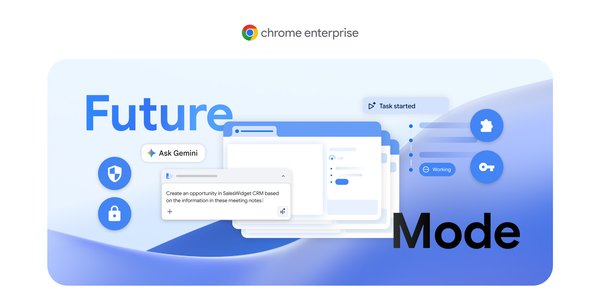
Editor's Note: Our Future Mode series will give businesses insight into how Chrome Enterprise is approaching AI in the browser. Stay tuned for more blogs in this series.Future Mode Part 2: The foundation for securing agentic browsingToday, autonomous AI agents aren't just drafting emails. They’re navigating SaaS applications, synthesizing data across multiple tabs, and completing multi-step tasks on our behalf. Because the majority of enterprise work continues to happen on the web, the browser has naturally become a primary operating ground for these autonomous workflows.But this raises a critical mandate for IT leaders: as the line between human action and automated execution blurs, organizations need robust data protections in place for both users and agents. When an AI agent acts dynamically on an employee's behalf, both the user's identity and enterprise data must be secured. At Google, when we think about efficient workflows, we see the browser as one of the easiest and safest places for employees and agents to collaborate. In this blog we’ll take a look at how Chrome Enterprise is evolving its security for the agentic era.The browser advantageThe browser is uniquely positioned to underpin this next wave of productivity workflows because it holds the context of an employee’s workday. Employees signed into Chrome are already getting the access and policy requirements set by their organization. As employees use task automation capabilities like auto browse, Chrome understands the shared tabs, open documents, and the SaaS applications the employee is currently using. By anchoring employees’ agentic workflows inside the browser, they benefit from real-time situational awareness and their corporate identity.Let’s look at some examples. An agent can source top talent for recruiters by scanning public profiles on professional networking sites and automatically creating candidate files in their web-based Applicant Tracking System. Finance and operations teams can offload the tedious "portal hopping" required for monthly vendor management by having a browser-based agent securely log into multiple billing platforms, retrieve and reconcile PDF invoices.Enterprise-grade controls with Chrome employees with AI agents means balancing security and automation. As an agent navigates between corporate CRMs, internal cloud docs, and public web apps to synthesize information, it creates new, complex vectors for potential data exposure.Chrome Enterprise Premium brings advanced Data Loss Prevention (DLP) directly into the browser workspace so IT and security teams can enforce strict data governance on agentic behaviors in the same way they are enforced on risky user actions.Chrome Enterprise Premium inspects agentic data flows in real time across multiple defense layers. While built-in DLP policies block unauthorized attempts to transfer sensitive IP, PII, or financial data to public LLMs, comprehensive extension controls also let organizations manage permissions and highlight risk signals to prevent unauthorized DOM scraping.The browser extends context aware access controls from a user to their agentic activity. If an employee doesn't have authorization to access or export specific data, their AI agents won't either.Continuous momentum in browser securityChrome is doing a variety of things to make secure agentic collaboration possible, building on a long history of advancing web safety. We are actively launching capabilities to give IT leaders the visibility they need for this new era. For example, we launched analogous extension visibility earlier this year—giving organizations deep visibility into how software agents access and handle sensitive data—and we have many more enterprise guardrails in the works.As we extend these protections to agentic browsing, we’ve designed a robust, layered architecture built on three core pillars to protect users and agents alike from emerging threats like indirect prompt injection:Partially inspired by Google DeepMind’s CaMeL research, the User Alignment Critic with Chrome auto browse is an isolated, high-trust system model that acts as a secure gatekeeper. It analyzes only the metadata of a proposed action to ensure it aligns with the user’s original goal. If an injection attack tries to hijack the agent, the Critic vetoes the action instantly.Site Isolation is the bedrock of Chrome’s security. We are extending this by architecturally limiting an agent's playground to origins strictly relevant to the immediate task. The browser prevents a compromised agent from acting arbitrarily on unrelated, logged-in sites.As the agent operates, it logs its exact logic in a work log in the browser tab, allowing the employee to intercede at any moment and keeping the employee in the loop. For example, Chrome’s auto browse intentionally stops at critical junctures, like finalizing a contract, submitting a financial transaction, or executing a mass email. Chrome acts as the enforcement mechanism, requiring explicit human approval before any high-stakes action is committed. Employees also get visibility into agent’s actions via Chrome History, where background pages navigated by the agent are explicitly tagged as agent actions.This philosophy of transparent, human-centric AI assistance is also what drives our broader ecosystem innovation, including Gemini Spark. To make the Gemini Spark experience even more powerful, we've just launched a new direct Chrome integration.Our commitment to agentic security and looking forwardTo ensure our defenses are ironclad, we have deployed automated machine-learning red-teaming systems to continuously test Chrome against synthetic threats. We have also expanded our Vulnerability Rewards Program (VRP) to include Chrome's agentic capabilities, offering up to $20,000 for researchers who identify verified breaches in our agent security boundaries.The future of productivity is about secure, seamless collaboration. By extending core browser isolation principles, launching foundational visibility controls, and bringing DLP to agentic workflows, Chrome Enterprise ensures that enterprises can embrace the next generation of AI productivity without compromising on security, visibility, or control—allowing enterprises to innovate safely.
Read original articleAugust 4, 2026
OpenAI is pushing back against Apple's trade secret lawsuit and has released iMessage threads from former Apple engineer Chang Liu. The messages appear to show Apple employees themselves reaching out to their former colleague for technical help and internal files after he left the company. The article OpenAI fires back at Apple's trade secret lawsuit with chat logs showing Apple employees kept texting their former colleague appeared first on The Decoder.
Read original articleAugust 4, 2026
arXiv:2608.00106v1 Announce Type: new Abstract: Agentic systems must decide not only what answer to produce, but which reasoning and execution operations should precede it. A controller may answer directly, decompose a request, retrieve evidence, execute code, delegate to a specialist, or verify an intermediate result. Existing routing work largely selects model endpoints, retrieval depth, or tools in isolation. We introduce an executable benchmark and a budget-aware meta-router that composes heterogeneous operations from raw task text. The benchmark contains 216 training, 72 development, 108 held-out test, and 108 locked lexical-shift challenge tasks across data analysis, frozen-corpus research, and document processing. Outcomes are machine checked after operations execute. Independent regularized logistic heads predict operation probabilities from word and character features, are temperature-scaled on development data, and are greedily composed under route-cost and action-count budgets. On the held-out test, the learned policy achieves 100% success versus 93.5% for strong static and fixed workflows, with 43% lower cost than the static policy; a matched learned one-shot router reaches 56.5%. On the untouched challenge split, learned success falls to 75.9% and trails static routing at 93.5%, while remaining 49% cheaper and exceeding one-shot routing by 34.3 points. The gap identifies lexical generalization, rather than route execution, as the principal limitation. These results establish a reproducible testbed and a bounded proof of concept, not evidence of live-LLM performance.
Read original articleAugust 4, 2026
arXiv:2608.00107v1 Announce Type: new Abstract: Agentic systems must repeatedly decide whether to answer directly, decompose a task, invoke a tool, execute code, delegate to a specialist, verify an intermediate result, or recover from failure. These meta-decisions affect not only task success but also operating cost and latency, yet they are often embedded inside an orchestration framework and evaluated only through aggregate task accuracy. We present MetaRoute-Bench, an open, inspectable framework for comparing meta-decision policies under a shared execution model. The initial benchmark contains 180 synthetic task profiles spanning data analysis, research, and document processing, eight routing policies, and 30 paired random seeds. Across 43,200 traces, a task-aware compositional policy achieves 79.4% success compared with 76.7% for a strong workload-specific static policy, 67.4% for one-shot task routing, and 52.9% for direct answering. Relative to the static policy, this is a 2.7 percentage-point improvement with paired 95% CI of plus or minus 2.0 points, at 4.7% higher mean cost and 6.4% higher latency. Ablations show the largest losses when route composition is restricted to one operation and when verification is removed. These results are generated by a seeded offline execution model rather than a live deployment; accordingly, the primary contribution is a reproducible evaluation method and an analysis of routing-policy tradeoffs, not evidence of production effectiveness. We release task generation, policies, traces, tests, and analysis artifacts to support live-system validation.
Read original articleAugust 4, 2026
arXiv:2607.28631v1 Announce Type: new Abstract: AI Scientist systems capable of autonomous research have the potential to significantly accelerate scientific discovery. However, evaluating and comparing the quality of AI-generated papers remains an open challenge. We propose and implement a rigorous benchmarking protocol using an automated peer-review system that harnesses frontier large language models to assess scientific papers across four core dimensions: originality, scientific rigor, clarity, and significance. We evaluate four leading AI Scientist frameworks: \textit{Sakana AI (v1 & v2)}, \textit{CycleResearcher}, and \textit{Data-to-Paper}. Each framework was run on a consistent set of 15 research proposals published by a commercial autonomous AI scientist company (FARS), generating 60 papers that we evaluate alongside 15 FARS benchmark papers. Using three independent LLM reviewers (GPT-5.4, Gemini, and Claude), we find that FARS benchmark papers significantly outperform all competing frameworks, achieving mean scores of 2.14--2.47 on a 1--5 scale compared to 1.00--1.87 for other systems. Notably, FARS scores are more than 2$\times$ higher than the next-best systems on Gemini and Claude evaluations. We find strong agreement among Gemini and Claude ($\rho$ = 0.907, $p < 0.001$), and both correlate extremely strongly with the synthesis score ($\rho$ = 0.961, $p < 0.001$), validating the reliability of automated evaluation. However, GPT-5.4 exhibits weaker agreement ($\rho \approx 0.32$), suggesting it evaluates papers using different criteria. These results establish the first quantitative benchmark for AI Scientist systems and demonstrate that multi-model LLM evaluation provides a scalable, consistent framework for assessing autonomous research quality.
Read original articleAugust 4, 2026
arXiv:2608.00916v1 Announce Type: new Abstract: Modern reranking recipes---billion-scale cross-encoders, mixture-of-experts (MoE) backbones, and distillation against strong teachers---have outpaced the training infrastructure available to most academic groups. Existing Tevatron reranker training relies on the Hugging Face Trainer with DeepSpeed or PyTorch FSDP1, but these backends lack efficient support for large-scale MoE training. We present Tevatron 3.0, which integrates a Megatron-Core training backend into Tevatron while preserving its data pipeline, evaluation workflow, and Hugging Face-compatible checkpoints. We benchmark existing distributed training configurations against the new backend, showing that Megatron matches FSDP reranker quality and training efficiency under comparable data-parallel settings, is up to 22% faster in the recommended single-node configuration, and supports both LoRA and full-parameter fine-tuning. Crucially, expert parallelism enables training a 30B-parameter Qwen3-30B-A3B MoE reranker, which is infeasible with PyTorch FSDP1. Using this framework, we conduct a controlled comparison of MoE versus dense models, LoRA versus full-parameter tuning, and distillation versus contrastive training on BEIR-15 with three first-stage retrievers, and report serving throughput for Hugging Face and vLLM. We find that the MoE reranker matches dense 8B quality while activating less than half as many parameters and achieving substantially higher inference throughput. We will release the framework and trained checkpoints.
Read original articleAugust 4, 2026
arXiv:2608.00938v1 Announce Type: new Abstract: Productionizing generative recommenders for high-volume, real-time ads retrieval creates two serving challenges: eligibility, ensuring that each generated ad is eligible for the request under the advertiser's audience targeting rules, and compute, which requires meeting strict latency and GPU cost requirements while remaining capable of generating thousands of ads per request with wide-beam decoding. This paper presents GRACE, a serving system for ads generative retrieval that addresses both challenges. For eligibility, GRACE introduces Generative Target Matching (GTM), which extends catalog-valid constrained decoding with personalized filtering over Semantic ID (SID) prefixes using bitmask and Bloom filter matchers derived from targeting rules. SID-level GTM improves final ad-level target matching pass rate from 23.55% to 40.42% over constrained decoding alone. For compute-cost and latency, GRACE targets encoder-decoder Transformers, which are more lightweight than LLMs. It redesigns the decoder around the wide-beam, short-sequence regime, covering attention kernels, KV cache, and beam search optimizations. On NVIDIA GH200, compared with the faster of FlashAttention-2 and FlashAttention-3 baselines, GRACE improves cross-attention latency by 68.0 times and self-attention latency by 23.4-25.8 times across decode steps. Together, these changes reduce decoder latency by 11.1 times, keeping ads generative retrieval within latency and compute requirements.
Read original articleAugust 4, 2026
Explore new education plugins for ChatGPT Work and Codex that help K–12 teachers, college educators, and students learn, teach, research, and build.
Read original articleAugust 3, 2026
OpenAI addresses Apple’s baseless lawsuit, corrects claims about its employees, and shares messages documenting what happened.
Read original article