
Generative AI is becoming part of our daily lives - from chatbots to homework help to office tools. But to truly understand how it works, we need to know three important ideas: Bias, Prompting, and Tokens. Let's break them down in simple terms.
1. Bias in AI - Why AI can be unfair sometimes
Imagine you ask an AI to recommend a new movie. If it mostly knows about action movies because people trained it mostly using action movie data, it might keep suggesting action movies - even if you like comedies.
Bias in AI happens because AI learns patterns from data. If the data is incomplete, unbalanced, or reflects human prejudices, the AI can make unfair decisions. For example:
- A Hiring AI model trained mostly on male resumes might prefer male candidates.
- A Language AI model might misunderstand cultural expressions - like common sayings, jokes, or school traditions.
More Examples:
- Example I: If an AI mostly reads books from one country, it might not know what "eating ladoos" means, and could give a strange answer when asked.
- Example II: If it mostly sees school projects of any particular continent (say Africa), it might suggest ideas that don't make sense for schools in other continent (say Asia).
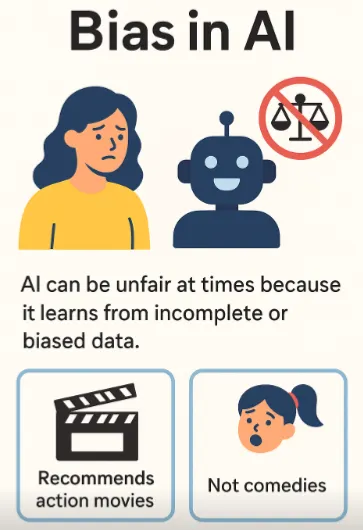
Takeaway: AI doesn't "choose" to be unfair - it just reflects the patterns it sees. That's why it's important for developers to carefully check and improve the data.
2. Prompting - Talking to AI the right way
A prompt is what you tell the AI - it's like giving instructions to a friend.
- Bad prompt: "Tell me something." → AI might give a random answer.
- Good prompt: "Explain why the sky is blue in a way a 9th grade student can understand." → AI gives a clear, useful answer.
Tips for better prompts:
- Be specific: The more details you give, the better the AI can respond.
- Add context: Let AI know the audience (kids, students, adults).
- Ask step by step: If the task is complex, break it down.
Examples:
- Instead of saying: "Write a story," say: "Write a short story about a talking dog who learns to ride a bicycle in a small town."
- Instead of saying: "Explain math," say: "Explain fractions using chocolate bars for a 4th grader."
This skill of writing effective prompts is called prompt engineering, and it's like learning the "language of AI."
Takeaway: Treat AI like a teammate - the clearer your instructions, the better the results.
3. Tokens - The building blocks of AI language
_This is important topic. Please read carefully and slowly._
Think of AI like a reader that sees words not all at once, but in small chunks called tokens. Tokens are tiny pieces of text - words, or even parts of words. For example:
- "Hello" → 1 token
- "AI is amazing" → 3 tokens (each word is a token)
- "unbelievable" → might be 2 tokens: "un" + "believable"
AI reads and writes text token by token.
Why this matters:
- Some AI systems have a token limit - they can only read and write so much at once.
- Longer prompts or responses use more tokens.
Examples:
- If you write a very long story, AI may not "remember" all of it because it runs out of token space - like a notebook with only have a certain number of pages.
- If you give short, clear instructions, AI can use its token space more effectively to focus on what matters.
Takeaway: Tokens are the "atoms" of AI language. AI builds every answer one tiny piece at a time.